Global Read Aloud 2015

If you’ve been here for any length of time, you’ve probably figured out my love of all things online–collaborating with other classes through things like Mystery Skype, Edmodo, Twitter, World Read Aloud Day, Dot Day, blogs, etc.  I hope that you’ve also seen how I am willing to try new things, not necessarily knowing how they will work out in the end.  I consider myself to be a risk-taker with technology and with new learning ideas.  I guess I trust that worst that will happen is that whatever it is won’t work and then we’ll try somethign else. 🙂

So, when my friend Tam Scharf, from Yr5sK in Queensland, Australia, invited me to join the Global Read Aloud this year, I knew I had to do it!  I have read about it for a couple years (during my time on Twitter!), but wasn’t really sure what to do to get involved.  Well it’s really pretty simple and has already proven to be a great opportunity for Rm. 202 kiddos!

The basic idea is that our class is reading a chapter book along with many other classes and there have been activities planned by a small group of teachers on our team that each class is trying out and then posting to our blog, or to Padlet, or other online venues.  Some classes are tweeting, and there will be Skype sessions planned, as well.

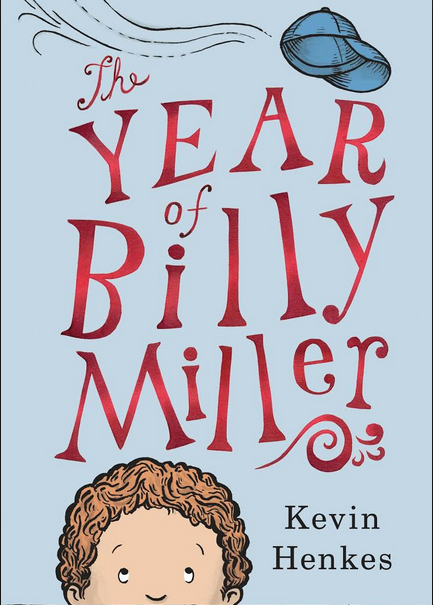
Our class chose to read a great book by a familiar author, Kevin Henkes, called The Year of Billy Miller.  The best part is that I had heard about it and was interested in reading it anyway.  So then when I found out it was a text choice for this project, it seemed like a perfect match.  And it’s about a 2nd grader.  Win/win/win. 🙂
Screenshot 2015-10-15 20.48.04Each week we are reading a different part of the book (it’s broken up into 4 parts that focus on a different relationship), and we do the coordinating activity.

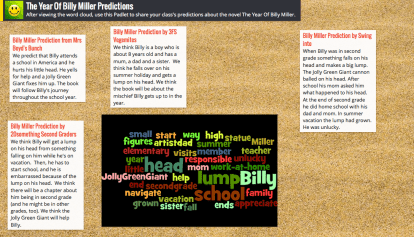
The first week we studied a word cloud about Billy Miller and brainstormed what we thought the book would be about.  We posted our predictions (along with other GRA friends) on a Padlet set up for that activity.

Screenshot 2015-10-15 20.51.41Here’s what we thought about the book:

Screenshot 2015-10-15 20.52.37

It was great to read what other kids thought about the story, and we even revised some of our thinking based on what they shared.  Already a great start and we hadn’t even started reading!

Last week we read the first section (called Teacher) and met Billy and the other main characters in the book.  We are using this book as our study in Readers’ Workshop and it’s matching up perfectly with our work with story elements.  We learned how to use a story map, and recorded the characters, setting adn problem/setting so far in the story.  We’ll keep modifying this organizer as we go on, as well as completing the other planned activities.

We’re excited to join in for this week’s work: a Popplet about what we think about Billy as a character.  We’re not done yet but are excited to share our thinking once we get there.

This story is so fun and kids can easily relate to it; the project is a great motivator for us as readers and citizens of the world!  We found out the other day that there are over 500,000 kiddos signed up doing the same thing as us–WOW!!

I’ll update you with more as we get further into this great collaboration!

3 Writing Celebrations in 1 Day!!

We have been working through the writing process, using seeds we’ve put in our Writers’ Notebooks.

Screenshot 2015-10-13 20.20.44

Once we got to the end (which took WAY longer than I remembered it would!), we were ready to CELEBRATE with our friends!  The best part about what we did was that we did it with more than one class!  Mrs. Appelbaum’s class was finished with their pieces, too, so we got together.

As with many things, the way Mrs. Appelbaum did her writing celebration was a little different from me, so she taught me something new and it was super!!  First, she shared with Rm. 202 kiddos the directions her class had come up with to share their work with a partner:

IMG_5456-minThere was also a comment sheet she had come up with, where readers would give the writer feedback based on these starters: “Something I liked about your writing was…”; “Something I learned was…” and “Something I wonder now is….”  I’ve done compliment sheets before, but they’ve always been completely open-ended.  The structure of her sheet was helpful for those that needed ideas, but was also still open-ended enough for kids to make choices on how they’d respond.

From within minutes of when we started, the room was “a-buzz” with that fabulous sound of excitement, learning, and laughing as kiddos proudly shared the work they had done to create meaningful writing pieces.

This is a short video, but here’s what it sounded like:

While you can’t really get the same experience from seeing pictures of it as if you were there, I do think you can imagine the experience.  Sometimes just seeing the pride and happiness on their faces is story enough!

This slideshow requires JavaScript.

Ok, these next few will look really similar, but they’re from the 2nd go-round, where Mrs. Appelbaum’s friends came to hear our writing.  We were excited to try out her “rules” and the compliment sheet on our work!

I don’t have pictures of the last share we did, but after we had practiced with the Appelbaum team, we invited our friends from Ms. Turken’s class (they’re first graders) to listen to our writing, too.  This was the first time they had been to a writing celebration and we were hoping to teach them well about how it was supposed to work.  You’d never have known they were newbies–they were writing rockstars and worked really hard to give us meaningful comments on our work!  Hopefully we can share with them again when they’re finished their own writing pieces.

Whew! What an exciting day of celebrating our hard work, our meaningful writing ideas and our using grit and perseverance to share great stories!  Way to go, Rm. 202 kids!

The World According to Betty Birney

One thing our school does really well is support readers and writers.  One way that happens is by inviting “real” authors to come and share their journeys with us.  They share their love of words and we are inspired to do the same. 🙂 (Remember when Lisa Campbell Ernst came a couple of years ago,  or Mary Casanova last year?? Amazing, I tell you. 🙂 ).

Well, last Friday we were treated with a last-minute visit from Betty Birney, courtesy of a fabulous indie bookstore near us called The Novel Neighbor.  Once we found out that she was coming, I had to find out if I could make a connection.  So of course I checked her out on Twitter.  And yes, I found her!

Screenshot 2015-10-12 21.27.58I love that there is a way to “meet” people before you meet them, connect in meaningful ways and help kids see what “real” authors do.  And yes, I only say “real” like that because kids do.  All of my students are authors, but to them you’re not a “real” one unless you’ve actually published a book.  You know, it’s how you think when you’re a kid.  Well, ok, I’ll be honest….some adults think that way, too.  But nope, I’ll teach you–if you write, you’re a writer.  If you write things, you’re an author.  There.  Now you know. 🙂

Anyhow, Betty showed up and gave us a FABULOUS presentation of her journey as a writer, showed us some great pictures (like of her writing house where she works–I mean, what??  A little blue house in the backyard for your office?  I’m a little jealous.  That sounds like a dream. 🙂 ), and told us some incredible stories.  Like how her first writing job was for hot dog advertisements (or hot dog buns or something like that, but food….), and how she worked for Disney.  Um, yeah, you heard me–Disney (you’ve heard how I am kind of obsessed with it, right??) .  Like she wrote promotional posters for the opening of Big Thunder Mountain Railroad and got to spend a whole day just riding the roller coaster over and over and over.  She wrote for a little TV show you may have heard of called Winnie the Pooh (wrote lots of books of Pooh, too!), and got has written loads of other things, too.

I don’t have a picture of it, but one of my favorite things of this author visit was that all of my writers brought their Writers’ Notebooks with them so they could capture anything inspiring and brilliant that Betty said.  And because “real” writers take their notebooks with them everywhere!

Oh, and did you see in those tweets that we planned for pictures?  Of course, because that’s what bloggers do!

CAM02320-min

First me. And yeah, I know–I look crazy excited. Guess because I was. Kind of like I was with a celebrity. I wouldn’t mind having her job. 🙂

And then it was everyone’s turn:

1443797829486-min

I know you can’t hear them, but when we were taking the picture, we were saying, “We love Betty Birney!”  What a great morning. 🙂

Dot Day 2015

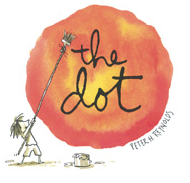
A  little while ago we celebrated a special day along with many thousands of other kids and teachers around the world: Dot Day. The idea is simple: read and enjoy the book The Dot with your class and then explore the story creatively–in any way you want.  Easy peasey, right?  Sign us up!!

Screenshot 2015-10-11 20.25.47So we read the story, and talked about what it meant to “make your mark.”  And since we’re Roadrunners, kiddos brought up the ideas of grit, growth mindset and making mistakes.  Who knew there was so much to learn in a story about a girl and a painting?  Ok, so I knew it was all in there. Hee hee.  I’m just super impressed that my students came up with it before I even told them.  Way to go, Rm. 202 friends!

After we were done reading and talking, I set them loose to work their magic.  With paint.  Or markers.  Or colored pencils, or crayons–whatever they wanted to use to show their creativity was fine by me.  And show us they did!

Check it out:

We weren’t done there, though.  Nope.  Had to do some writing about it, of course!  So kiddos were given a sheet to help them think through how they would explain their work.  Basically I wanted to give kiddos the support with sentence starters (if they needed it), as well as the structure of understanding what they could actually explain about the process (sometimes 2nd graders just want to tell you one sentence and be done).

Kiddos were instructed to complete a rough draft (which was made of four parts: When I read The Dot, it made me think of….; So I decided to make…; I used…; and I want to make my mark by…).  On the second day of work we had to have a conversation about what it meant to be “done,” because like I mentioned before, some kiddos thought just saying “I used paint” would be a thorough explanation of what they did.  I showed them my sheet–all filled out–and we discussed the thinking I did in order to decide what to say, as well as how to use the organizer correctly.  The lesson here was simple: if you are given 4 lines to write your ideas upon, then you should write 4 lines of words.  Well, it seemed simple at least, but was not so obvious as you might think.  Once they finally had a rough draft, they were then to work by themselves or with their elbow partner to revise and edit their work before creating their final draft on special “Dot” paper.  This was perfectly tied into the writing cycle we were working through and was a nice picture of how writing doesn’t just happen during one set time of day.

It took us a week to all finish our writing, and then we were ready to share.  I was happy to see how well it all fit in our hallway, using the windows and the one vertical part of the wall.  Perfect space-wise, and perfect because we (and everyone who walks through our hallway) get to be inspired by our dots every day!

This slideshow requires JavaScript.

The Writing Process–in Math??

Yep, you read correctly.  We’ve been learning the writing process–mainly in regards to our work in Writers’ Workshop–but also in math!

A few years ago, when our school started working with Cathy Fosnot and Mathematics in the City, I learned about how many parallels there are between communicating in mathematics and communicating in most any other setting.  At the time it was kind of mind-blowing to think about how mathematicians revise and edit their work just like authors.  After hearing more, and thinking it through, and then trying it with kids, it made sense.

So…as with many other things I learned about with older kids, and protocols that I know work well with any age, we’re talking about the writing process in mathematics again.  In 2nd grade. 🙂

The first unit we worked through this year was about place value, and was related in many ways to money; this made sense to kiddos and helped them think through how to “trade” 1s for 10s, 10s for 100s and just how to make groups in different ways to “make” a number.

One day they were challenged to consider this story:

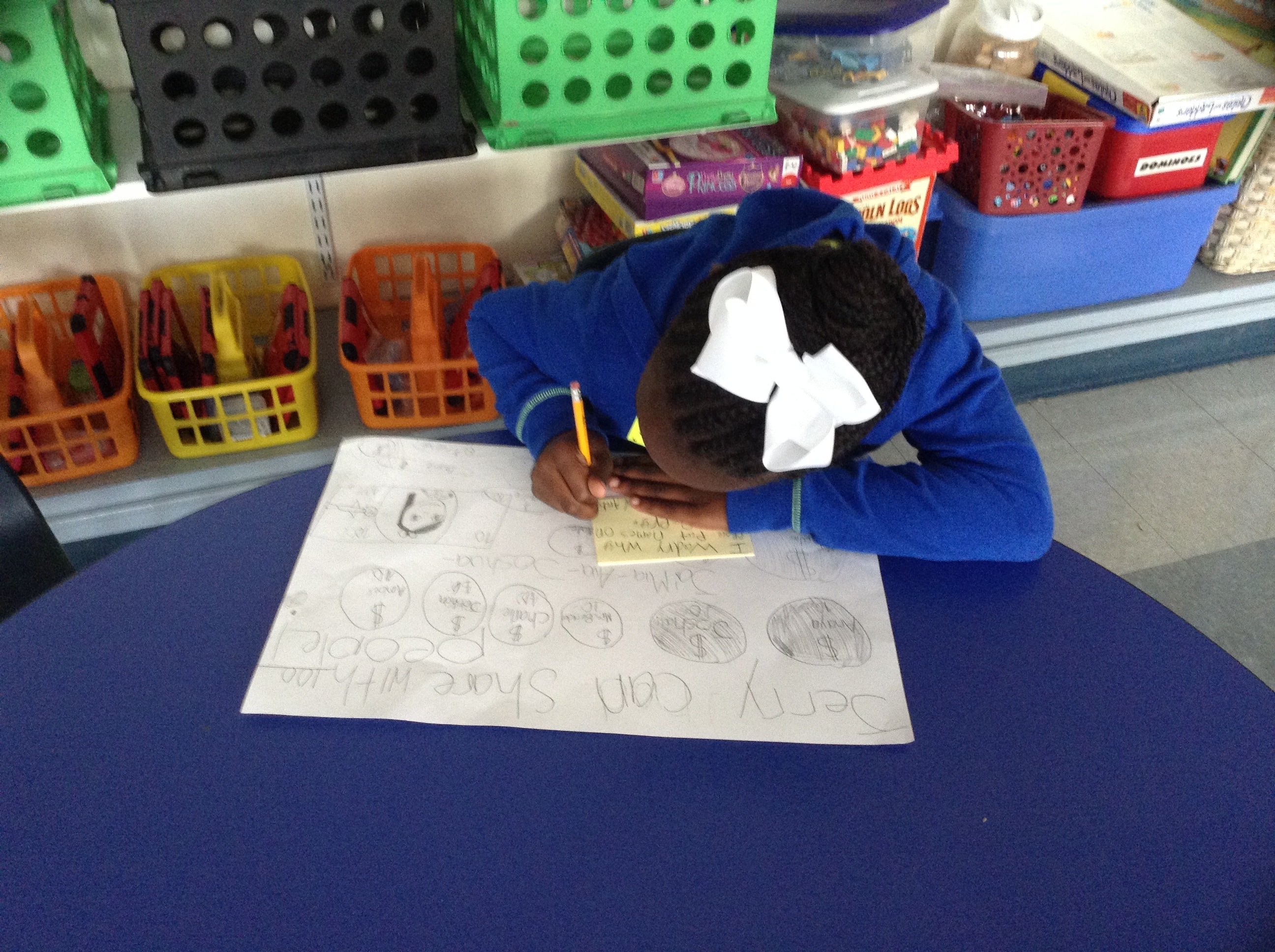
Screenshot 2015-10-08 20.37.03-minWith their elbow partner they were supposed to figure our the answer to that question: If Jerry has $1000 to share, with how many people could he share a $10 bill?

Kiddos worked for almost 2 math periods to figure out their answer (which was really the answer to the question of how many 10s are in 1000) and clearly share their thinking on a poster.  For many, the answer of how many people was easy, the way to share their ideas not so much.

As a means of helping them know when they were “finished,” we discussed these parameters for their work:

Screenshot 2015-10-08 18.51.45-minAfter we had our posters finished, we were ready for our gallery walk.  During a Gallery Walk, students put their posters out for other mathematicians to read and comment upon–with the goal of helping deepen mathematical thinking and help create more meaningful representations.  It works much like a writing celebration, which is a great connection because all of our kiddos know how to do that. 🙂

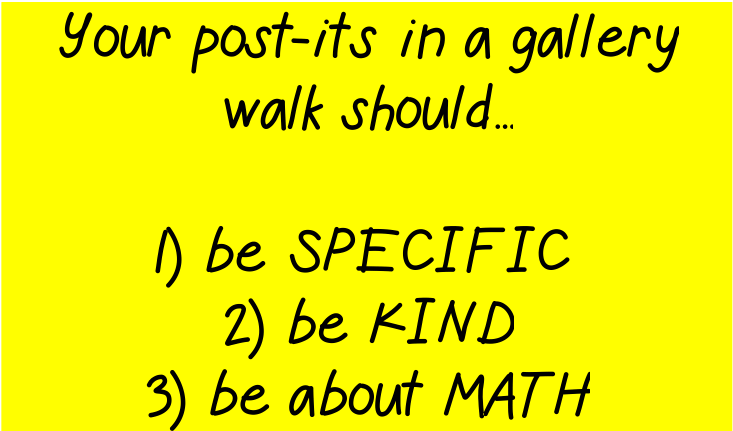
Before we were ready to start commenting on others’ work, we needed a review of how to make effective, meaningful notes on our friends’ work.  We sat for a quick refresher using this flipchart:

Screenshot 2015-10-08 18.51.56-minThen we practiced recognizing helpful comments that followed the guidelines.  I gave examples and non-examples, and then we modified the ones we have given a thumbs-down (which mean they were not specific, kind or math-related).

After that, we were off to work in our gallery walk.

IMG_5395-min IMG_5396-min IMG_5397-min IMG_5398-min

We did pretty great with our first walk of the year, and I’m sure kiddos brought their kindergarten and first grade knowledge with them to help as they shared their thoughts with other groups.  I was impressed with how questions were used and kids were specific with what parts didn’t make sense or that they thought others could improve upon.

After adding comments, partners were given a few minutes to review what others had shared.  In order to debrief and think about how to use this to help us next time, partners had to share out with the larger group one thing they would do to revise their poster to make it better (and ideally we’d have taken time to actually revise them, but we ran out of time!).  Next time we are ready for a math congress and gallery walk, we’ll definitely come back to this moment and remember what we learned. 🙂

Tiny Notebooks: Notebook Day is HERE!

If you haven’t read the first part of this story, check it out here.

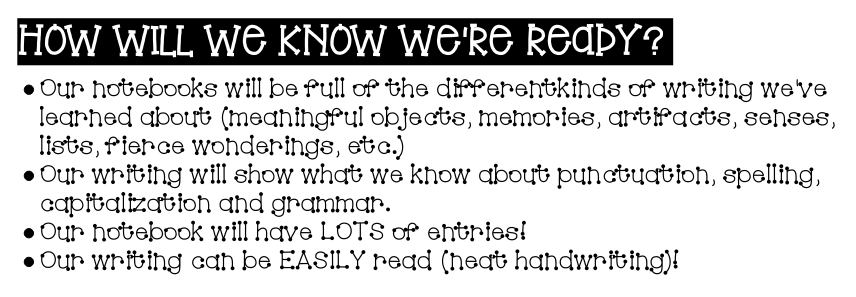
In order to know when the next step after Tiny Notebooks was coming, kids had to do some thinking.  After chewing on the question of “What’s the right way to do “real” notebooks with my kids?” I asked them a question.  It was one I knew they had an answer to, and one that I should have asked them sooner.  It was easy: How will we know when we’re ready?  And as I expected, they knew the answers:
Screenshot 2015-09-27 16.55.16And so after this conversation, I explained the way my friends had made my head hurt (in that good way!), and how I wasn’t sure what to do.  We agreed that it made TOTAL sense that kids would get their notebooks at all different times and they were TOTALLY good with it.  They knew that they were in charge of when they were ready and that they simply had to PROVE to me that they were ready.  Challenge accepted.

And so later that week, I came into Writer’s Workshop with this pile of goodies:

IMG_5335And these smiling faces were the first round of Rm. 202 friends who were ready for their REAL notebooks!  Yippee!

IMG_5336The excitement that then filled the room was contagious!

And so what I was worried about was that kiddos would walk away from this first Notebook Day discouraged, that they would be sad that they weren’t included and just give up.  Instead, most everyone else sat down and got right to work continuing to prove that they were ready for the next round:

IMG_5342Since that day, I’ve had many small group and 1:1 conferences specifically answering the question “Mrs. Bearden, when will I be ready?”  It’s been so great to be able to use the list we made as well as notebooks of kids that were ready as examples of what they had to do to get to that next step.  It’s just the way our standards-based rubrics work: this is what you have to demonstrate to me in order to show me you’re ready.  I LOVE THAT!  And again, rather than being discouraged, kids are ON FIRE with their writing, working towards the day when they will get that red, polka-dotted gift. 🙂

A few days later…

IMG_5344And just Friday…

Screenshot 2015-09-27 17.28.53So, thank you 2nd grade team for igniting a passion I didn’t even know needed to be ignited and for nudging me to rethink the way I’ve always done things.  Most times “the way you’ve always done it” isn’t a good reason to do it that way again. 🙂

Nudge, Nudge

I love it when thinking is nudged.  I love it when someone asks as question that makes you think in a COMPLETELY different way than you were headed, and you are COMPLETELY surprised when it happened.  Well, since my team is all working from the same writing plan this year (which is not really something I’ve ever done before!), there have naturally been some questions that have come up related to what we’re doing.  Of course they have been, “Hey, tell me more about this…” kind of questions, not “What in the world were you thinking?” questions, which is nice. 🙂

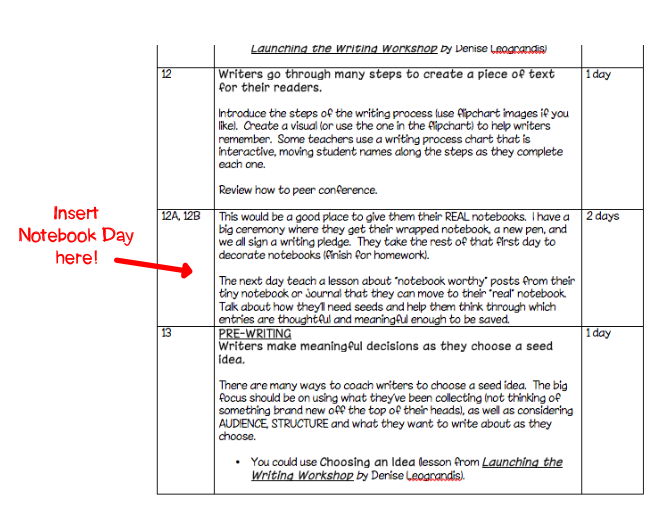
So…you know we’ve been doing work with tiny notebooks as a way to introduce Writer’s Workshop this year.  Well, eventually there comes a time when our 2nd grade writers will prove to to us that they are ready to graduate into their “real” Writer’s Notebooks.  As a matter of habit, I guess, I put that step into the plan right around Day 12, when I figured that everyone would be ready; I’ve always done it that way with everyone on the same day (like here, and here).

Screenshot 2015-09-27 16.22.35I proceeded normally, working a few days ahead of my team, which was nice so I could work out the kinks of the plan (I’d used this idea with older kids, but never with 2nd graders, so I wasn’t quite sure how it would work! LOL).  Then one day, at a working lunch, the subject of notebooks came up again.  Everyone wanted to know how I had decided to actually handle it, and what procedure I was going through to get them to my kiddos.  I mentioned that I was going to plan Notebook Day for the following week, with everyone celebrating on the same day (which is again, the way I’ve always done it).  The next thing that happened was really interesting.  Most of my friends around the table just said, “Hmm….” and I could tell they were trying to work it out.  They asked me about the purpose of teh tiny notebooks and how it didn’t make sense to do everyone’s Notebook Day on the same day if everyone was ready at different times.  They were, after all, supposed to PROVE to me that they “got it.”  I explained that the real thing behind the tiny notebooks was, in addition to teaching them how to use their “real” notebook, the expectation and anticipation of getting their new notebooks.  I rationalized that I’d always gotten everyone on board in a really positive way and that maybe it didn’t really matter if they were ready; Notebook Day was more about the ceremony and excitement around being a writer.  We agreed that probably everyone else was going to give individual kids their notebooks when they were ready, rather than all at once, and that I was probably going to go ahead with an all-class celebration.  Most importantly, though, we agreed that there was no RIGHT way to do it.  Personal choice and professional judgment was paramount here.

Well, the meeting ended and I went on with the rest of my day, but I COULD NOT get that conversation out of my head.  I had a headache in a really good way.  You know those kind?  The ones when you know that you’re chewing on something really important and you’re actually ok that it hurts? (You don’t have those?  I hope so, because it means that you’re surrounding yourself with really great people who challenge you to improve your practice and evaluate how you do things. 🙂 ).  I finished out the day, still unsure how I would proceed, and went home to have the same conversation with Mr. Bearden.  I was pretty sure that (while it wasn’t a right/wrong issue) he would side with me, agreeing that a whole-class Notebook Day was a great idea.  Well…he didn’t.  He was actually really great about asking many other questions about it, and making suggestions about how I could have better explained my thinking to my team.  He sided agreed that my team’s thinking that “when you’re ready” is the best time for new notebooks.

I chewed and chewed, trying to figure out why I’d always done it that way, and whether or not it would (or should!) work for this particular group of kiddos.  Why hadn’t I ever done it “when they were ready,” as I had always explained to my students it would be?  Why had I always done notebooks as a one-size-fits-all type situation?  Well, ok, honestly probably because it’s easier.  Especially with bigger kids, I probably didn’t want to manage keeping track of who had their notebook and who didn’t, as well as not wanting students to feel like they weren’t good enough or good writers.  The whole thing, after all, was based on helping kids see themselves as writers, learn to live like writers and WANT TO BE WRITERS.  In my mind, any negative (or something they could perceive as negative) was a no-go.

But maybe a one-size-fits-all what this group needed.  Maybe, since they’re younger writers and this is the very beginning of their lifelong journey as writers, this was the year that I changed my whole process and really did what I said I was about all along (novel idea, right?)? And really, now that I admit it, when does one-size-fits-all ever work for kids?

So I decided I’d jump in and change up the whole “real” notebook deal this time around.  There are pieces of it that I knew I wanted to keep the same, but the “when” of the process would be different for this new group of kiddos.  And you know what?  It’s been totally great and then some.  Better than I could have imagined, and the anticipation and excitement are actually increased since kiddos aren’t sure when their Notebook Day will come.

(But really they can be sure…read more here. 🙂 )

Tiny Notebooks: Where Do Writers Get Their Ideas? (Part 2)

Ok, so as I got to #3 on the list of places where writers get their ideas, I figured I should write the story in 2 parts.

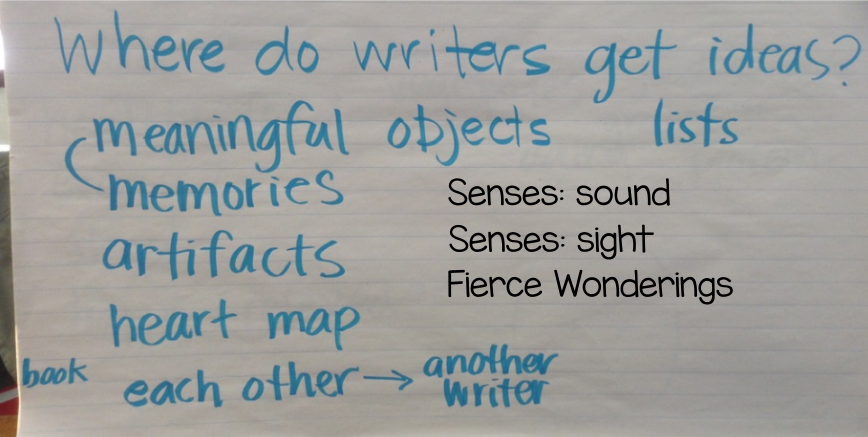
Here’s the EQ and the list, for a reminder:

Let’s get back into it:

4.) Heart Maps: This strategy has to do with how writers can sketch pictures to give them ideas, as well as how thinking about what’s in your heart (things that are important to you!) can help give you ideas.  These hearts are added to kiddos’ “real” notebooks as they get them.  They can be added to and changed as kiddos change, but here they are for now.  Look at all of those ideas waiting to be written about!

This slideshow requires JavaScript.

5. Books and Each Other: While this was not officially one I put on the list this time, it came up in our conversations and we couldn’t let it go.  Often you get ideas just from hearing what your friend is writing about!  We are learning how to have meaningful conversations with other writers.

6. Lists: This one is so easy!  I shared lists in my notebook that I have written of characters, ideas for settings (really it’s places I saw on signs while I drove to Nashville), smells I like, smells I hate, lists of lists, lists of ideas for things I can write about in the future.  The possibilities are ENDLESS here!

7. Senses: Sound: For the example of this one, I shared an entry I had written in my notebook one day while I was at the pool.  Back in 2005 before I had kids and could actually RELAX when I went there (LOL, love you Riley and Allie!), I used to read and write in my notebook.  One day I heard the sounds of two birds in a bush next to me and imagined their chirps and coos as a conversation.  When we tried this one, we were able to go outside and enjoy the beauty of the new and improved Robinson Naturescape as we listened for interesting sounds and described them with our words.

8. Senses: Sight: I had another one in my notebook that I entitled “Santa in St. Croix,” where I described a guy with who looked like I imagined Santa would look like if he was on vacation.  I wrote about his “bowl of jelly belly” and how he was wearing tiny red shorts and black flip-flops instead of a red suit and boots.  I also read an entry describing clouds on a sunny morning and shoes I was wearing.  We ventured outside again, hoping to find something beautiful and inspiring in our backyard woods.

This slideshow requires JavaScript.

9. Fierce Wonderings:  This is perhaps the one that is most transferable to other areas of learning.  Once we get kids wondering (which is really pretty easy), and then recording their wonderings (which for us was a little trickier), we can start to DO something with those wonderings.  it could be starting a research project, helping a kiddo find just the right book based on their interests, getting kids to imagine and create possibilities based on the unknown, or even a genius hour project.  We have them in our notebooks and on our Wonder Wall.  We’re hoping to do great things with them, and continue to wonder about the world around us!

The best part of all of this thinking and writing is that it’s just the beginning!  I hope you’ll stay along for the continuing journey! 🙂

Tiny Notebooks: Where Do Writers Get Their Ideas? (Part 1)

I think that probably the most hated heard phrase from writers (kids and adults alike) is “I don’t have anything to write about!”

Yep, I have heard it countless times, and maybe I’ve even said it before.  But that was a long time ago.  It was at the very beginning of my writing journey when I thought that everything I wrote about had to be a big deal.  A monumental story that would blow everyone’s minds. Or that it had to be made up–a fabulous fiction story that would be a bestseller if I just finished it.

Then I actually learned about how a Writer’s Notebook works and how what real writers do is not try to collect the most amazing things ever, but that they learn to look at the world differently so that EVERYTHING is interesting.  They see the normal, ordinary things of life in a new way and begin to find things to write about in their everyday lives.

And so that is my goal as I interact and teach writers in Rm. 202–regardless of what grade they are in.  Writers are people who collect their ideas and thoughts for later, and often times mine those ideas for a diamond in the rough that the can polish into a shiny piece of writing to share with someone else.

Ok…in 2nd grade we talked about another essential question on which we will chew and return to over and over:

Screen Shot 2015-09-20 at 8.37.09 PM

I mean really, in many ways, this is the key to unlocking the writing mystery.  It’s the way that we get past the “I can’t” and see towards the “Maybe I can…”  So we’ve been working hard to learning about and then trying out many ways that writers get ideas for their writing.  And I’m super happy that many of my own entries have been the mentor texts we’ve been using for examples.

While there are TONS of answers to this question, I’ve narrowed it down (along with the help of some very smart teacher mentors like Ralph Fletcher who know way more than me) to a list of things that a) 2nd graders can do and b) can be used over and over.  Remember: these are strategies, not prompts.  I’m telling kiddos WHAT to say, but instead helping them think about HOW to say it or the STRUCTURE it could take.  The topic is whatever they wish.  Nice!

We’ve been working with this list (and again, please excuse the “ugliness” of the draft!):

Screen Shot 2015-09-20 at 8.51.09 PMI am not sure that I have pictures of everyone of these things, but I will try my best to show each of the ideas we’ve tried.  Here we go!

  1. Meaningful Objects: Writers get ideas from OBJECTS that are important to them, often which are also linked to a strong memory of a person, a place, an event, etc.

I shared this image with the class and then my thoughts about it:

Screen Shot 2015-09-20 at 8.57.23 PMEach kiddo then used their own meaningful objects (many of which we took pictures of so they could add them to their notebooks) to share a story!

Check out some of our writing:

2. Memories: The best part of memories is that anything that is from the past that you want to remember technically counts here!  A memory can be something from today, or something from years ago!  Recent or ancient, they are worth saving for the future.  This was one where I linked kiddos into the “What do you want to remember when you go off to college?” question.  It seemed to help them understand the importance of how they’d be using their notebooks to save things. 

3. Artifacts: Ok, so technically, meaningful objects, memories and artifacts are all related to each otehr, but I taught them as 3 separate ways to write because they can also be used individually of each other.  Often you’ll find that an artifact IS a meaningful object that reminds you of a memory.  Triple win!  And again, like with most of these ideas, there are multiple ways to interpret an “artifact:” a photo, a ticket stub, a card, a candy wrapper, a flower petal (yep, I have those in my notebook!), a hair bow (a 2nd grade friend put one of those in her tiny notebook!), ANYTHING that makes you think of something else. 🙂

Here are some examples of artifacts we’ve been saving:

To go right to part 2 of this story, click here. 🙂

Tiny Notebooks: Why Do We Write?

I shared the very beginning of our 2nd grade writing journey here.  Since that first day, we’ve done many amazing things as 2nd grade writers.  Let me share them with you. 🙂

For this first unit of writing in 2nd grade, we’ve been working to establish our writing community, helping every writer to see their part in it.  YES, you are a writer!  YES, you have important ideas to share with us (and the world)!  YES, I want you to like it (but it’s ok if you don’t yet)!

The first big, essential question that we’ve been chewing on and answering (over and over again!) is:

Screen Shot 2015-09-20 at 6.14.00 PMSimple question, right?  I’d say not really.  It’s kind of easy to make a list of the kinds of writing we do, or to tie our reasons to things we want to do with our writing (i.e. make a shopping list), but to really dig down to the REASON for writing is a little harder to do initially.  So when Rm. 202 writers came up with these ideas on our first try, I was super impressed:

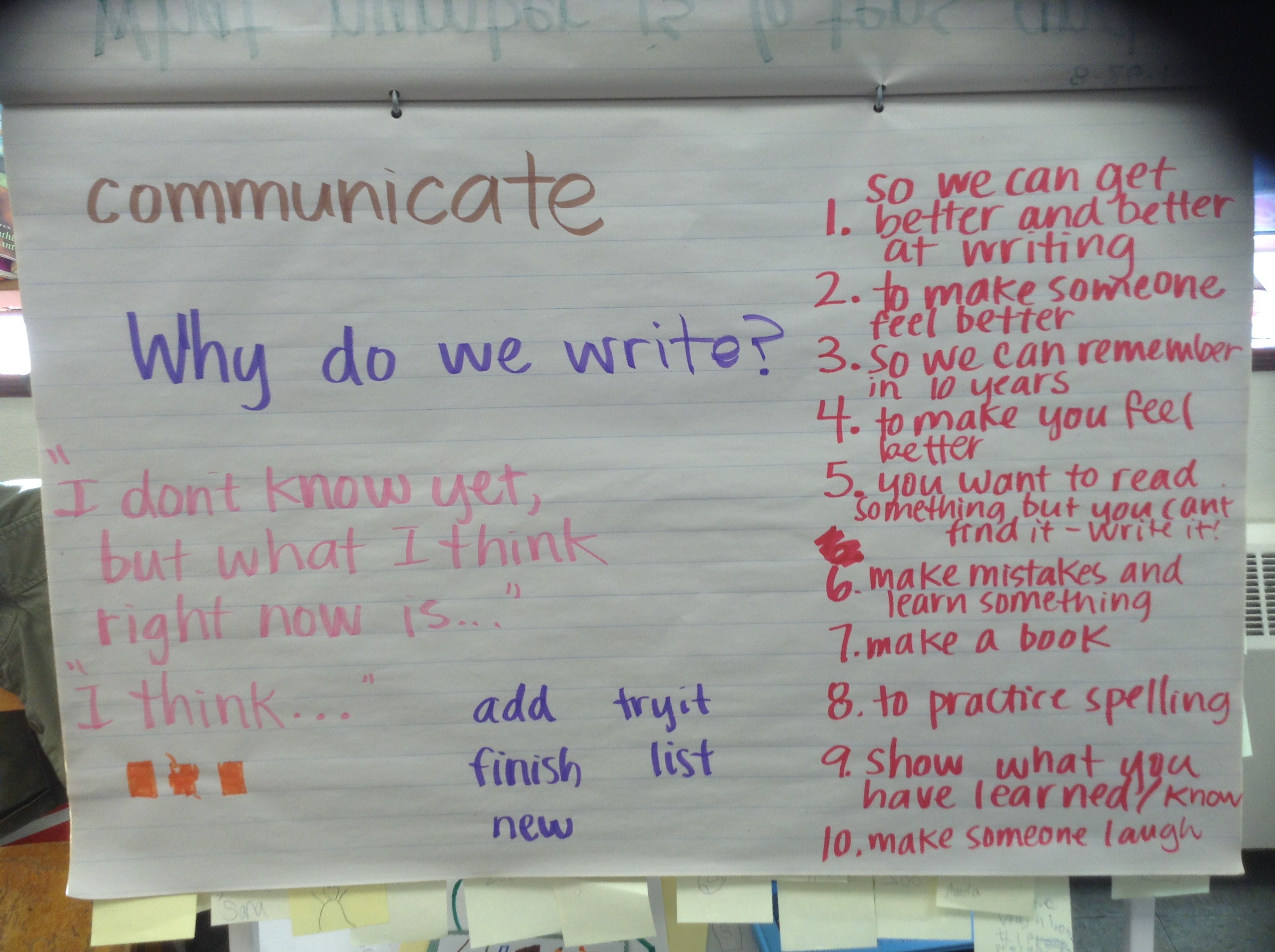
IMG_5296

Please apologize for the “ugliness” of this chart. It has not been beautified as an anchor chart for our wall yet, and so it a work in progress. We can up with so many great answers, and then tied them all to the idea that we write to communicate. The pink parts are sentence starters they could use with their partners when they discussed the question for the first time.

We had a great conversation about the communication idea, too, when I suggested that it is how I would answer the question.  Someone said, “So that’s the RIGHT answer?”  Someone else said, “No, there is no RIGHT answer!”  We talked a lot about how there is not ONE right answer, that there are MANY right answers, and that I DO NOT have all of those answers.  Love those kinds of chats. 🙂

So as a means of tackling this question, we began to look at how writers use their Writer’s Notebooks to collect stories.  As I mentioned in the first post, I connected their Tiny Notebooks to the idea of a scrapbook; they would begin filling it up with things they wanted to remember in 10 years (which just happens to be when they go to college!).  It was lucky that my first notebook is 10 years old, and so the time span only made sense. 🙂

For the next part of the Tiny Notebook story, check this out.