Writing About Reading

I figured out today why I have such a hard time deciding what to write on this blog: I like for things to fit nicely into categories/tags/subjects/projects, and so often, the things we do around Rm. 202 are not that way.  I find that maybe I’ve gotten to that place where many of our subjects overlap–just like I’ve always hoped they would!  I know, that sounds like I’m not doing it on purpose (which of course I am, as I carefully plan how and when and why), but I think sometimes when you’re in the middle of something you can’t really see the big picture (isn’t there some quote about forests and trees that would fit here? LOL).

So as I think about how to describe what we’ve been doing in Writing lately, it’s hard to explain just the writing part, because it includes reading (which is perfect, as those two subjects go hand-in-hand anyway, right?).  We have been working on writing opinion letters, with most of our topics being about the series books we’re reading in our book clubs.  Luckily, though, there are lots of other things to have opinions about, so we’ve been trying out that structure with other topics, too.

We’ve gone through many versions, with me teaching mini-lessons and kiddos then trying out the big ideas.  We’ve talking about format of a letter; stating opinions; adding reasons as well as details and support for those reasons; using transition words like one reason is, another reason is, last but not least (which many kiddos were doing already just based on learning them last year!); as well as just using interesting words and making our letter match our audience.  The procedure became that they would write a letter, but then rather than actually delivering it to that person, they’d give it to me, and I’d note what they did right and what they could work on for next time.

We wrote about books, 100th Day of school suggestions, ideas about why their weekends were good, as well as many other things about which you could have an opinion.  I was noticing, though, that over the last few weeks our letters had been getting shorter and less detailed (which was obviously not the goal!).  We had a class meeting and Millie suggested that the reason this was happening was because they had written so many letters that actually they were getting really sick of it and weren’t trying their best anymore.  While this was sad, I totally saw how that could be, and as impressed by her insight.  Others agreed and so I made a plan that we would work our hardest to create our best final letters (to Mrs. Meihaus, our librarian, about our vote for the Show-Me Reader Award) over the next 3 days and then be done.

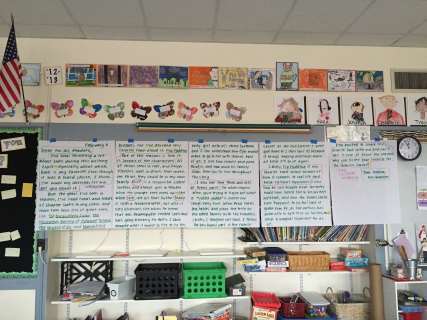
So as I thought about what we would do for those next 3 days, I knew I needed to give another model to my writers about what that letter should look and sound like.  And since I wanted them to write about books, I did, too.  My letter was about my favorite read-aloud choice, Fig Pudding by Ralph Fletcher.  It looked like this:
IMG_0368-min

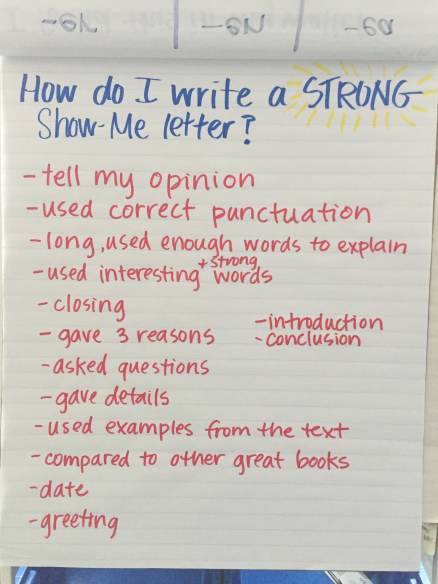
I had hung the letter up there before the day started, and it was one of the first things (thankfully) that kiddos noticed when they came in.  Yeah, the first response was “Wow, that’s long!”  Later on, I had them look at it, studying it to answer this question: How do I write a STRONG Show-Me letter?  Not surprisingly, they were able to notice a whole page full of things that I had in my letter that they needed to put in theirs.
IMG_0367-min

As they made their list, I marked their ideas on the actual letter (notice the different colors and the things we boxed in) so we could reference it later.  I was impressed to see that they had been paying attention, and that they could come up with that all on their own!

After this, I gave kiddos a graphic organizer to use to plan their letter and we got busy.  We’re almost done, so I’ll share our progress in the next few days.  It’s pretty good stuff!

Jumbled Thoughts

One of the things that happens to over-thinkers thinkers like me is that there are often loads and loads of jumbled thoughts all up there in my head at the same time.  I find it a very rare occurrence that I am only thinking about or planning thing at a time (is this called multi-tasking or just crazy?!).  Today is one of those days when there are many things filling the space between my ears, and so as a means to think some of it through, I’m writing about it.

This weekend means that yes, I’m “off” because it’s not a school day, but when you’re a teacher you’re never really not not thinking about school or how to make your classroom a better place for the learners you spend every day with. Today this thinking was magnified as I was attending #edcampStl (Ed Camp St. Louis), learning and growing with other fabulous educators.

As with every EdCamp experience, I left with my head spinning because of all of the inspiring conversations.  Along with the general planning I’m thinking about for next week and the coming month, I’ve got some other things on my mind after today:

  1. Teaching Artistic Behaviors–100% Choice Learning:  Today I went to a really great EdCamp session with Kelly Lee (@yogagirly).  I wasn’t really sure what I was in for (but thought maybe it was how to add more art/design into regular subjects), and then I found out it was by an art teacher and I was really more unsure (I have a good record of picking badly by the title of the session…).  It ended up being something really inspirational, and now I’m trying ot figure out how to use her ideas in my own classroom with 2nd grade.  The basic premise is that in her art class, Ms. Lee has her room broken into “studios” based on mediums (collage, drawing, fiber, digital and painting).  Each day, artists listen to SHORT lesson or inspiration (based on a concept, artist, etc.) and then choose which studio in which to work for the day.  In their plan book, students make a goal and plan for the class time, and then spend time in that studio working to achieve their personal goal.  At the end of the class time, 5 minutes is provided for reflection on the day’s work.  As I sat and listened, I tried to imagine how I could tweak this idea to include all the subjects I teach, perhaps with just 5 studios (or decks since we’re working on being pirates!) that would work for everything we do.  Right now I’m trying to decide if something based around the multiple intelligences would work….
  2. Biography as Narrative Non-Fiction:  I am not sure if I’ve mentioned here before that my team does a really cool thing with planning, and each person (there are 5 of us) is responsible for creating the plan for everyone for one subject.  I’m in charge of writing, and so I’ve had the opportunity to share some exciting things with my teammates (and therefore their students!) this year, like blogging, a new way to think about Writer’s Notebooks, and a punctuation study.  Right now we’re about to start a new unit–biography per the curriculum calendar–and I’m having a hard time getting started.  I remember teaching that unit with 4th and 5th graders and it was BRUTAL!  I’m really not so excited about 1) trying to write that genre with little kids, and 2) planning a non-fiction unit right after we did one (we’re all working on creating picture books about the cultures we’re researching in Social Studies).  So…I’ve been on the search for some fresh ideas of how to teach biography to young writers and help them be able to successfully write about inspirational characters–most of whom are probably from long ago and hard to understand.  I know that I want to include lessons on important vs. interesting information, as well as investigations into the elements of a biography as well as the definition of a paragraph, but beyond that I am dreading the whole thing! I ran across a unit online the other day, though, that explains how to write biography as a form of narrative non-fiction, rather than expository or descriptive non-fiction (which is what we’ve been doing anyway).  I like the idea of trying something new, as well as thinking about how this could be a good transition between NF writing and the narrative fiction that we’re doing next.  This could be the bridge.  Most of the texts we share with students are written in this genre anyway, so it might not be as hard as maybe I first thought…..
  3. Valentine’s Day Questions (yep, I question a lot of things….): ‘Tis the season to celebrate.  Two weeks ago it was the 100th Day of School–which I think we ended up with a great plan for–and now this week has Valentines’ Day (ok, well, V Day is not until Sunday, but we will celebrate it on Thursday).  Again, I feel pulled to do a litany of “cute” things that kids will enjoy, full of glitter and glue and hearts and fun (here’s how we decided to spend the day last year).  I’m not at all opposed to having fun (we’ve talked before about how we have fun every day in Rm. 202!), but to put aside our learning to….wow–even as I just typed that I had an epiphany….(weird, right?)…

Let me show you a picture to explain the thought I just had:

IMG_0294

This wrapper was funny to me because it came from a friend the day after my coach and friend, Amy, had reminded me of this question when we were talking about 100th Day Questions.  Just now as I was in the middle of saying how I didn’t think it was the right thing to do to just abandon our work and PLAY, I was reminded of what I say I’m about; play and fun and laughter are important parts of the learning we do together.  So….see why the thoughts are all jumbled?  Who knew teaching 2nd grade would be so hard!?  It’s the parties and fun parts that make me crazy, not the curriculum!  (Maybe it’s me who’s the crazy one…).

Have any suggestions?  I’d love to hear your thoughts on any of my jumbled thinking. 🙂  Remember, it takes a village!


The Greatest Star on Earth: Kate Klise

I love introducing kiddos to authors.  Whether it’s via Twitter, a new book or an actual author visit, helping students connect with the “real” people who write the stories or information they love is a great treat.  Perhaps the best part is how special and important they feel when we send a question or comment to a writer and they answer.  Ralph Fletcher is particularly special to my class as we have read both Marshfield Dreams and Fig Pudding by him this year (and he responds to all of our tweets!), but my students have also personally connected with Lisa Campbell Ernst, Maribeth Boelts, Marla Frazee (who I just realized illustrated Clementine!), Mary Casanova, Betty Birney, and also Kate Klise (who was just at our school this week!).  The way they feel so special and important when an adult responds to their words is pretty priceless and immeasurably motivating. The way these writers have both encouraged and inspired my students to some of their best work is pretty amazing. 🙂

So when I heard that we were having an author visit shortly after Winter Break I was really excited….but then I heard the name of the author and thought how completely strange it was that I had never heard of her; I pride myself on being up on books, writers, reading and things of that nature (by the way, Twitter has been HUGE in helping me with this–you should totally check it out!).  Luckily this was not a problem, because our amazing librarian, Mrs. Meihaus, works hard to introduce us to the writer and their books so that when they do come, we’ll be ready. 🙂

Our class read just a couple of her picture books (and since then I’ve found out she has written over 25 others!), and found that we really enjoyed her writing voice, as well as Sarah Klise’s (her sister is her illustrator) pictures.  We tried out Shall I Knit You a Hat? and Little Rabbit and the Meanest Mother of Earth, and when she was here she read us Grammy Lamby and the Secret Handshake.

Once she got here, we were all abuzz, excited to hear what she would tell us about herself and teach us about writing.  A couple of friends took their Writers’ Notebooks to be sure to catch Ms. Klise’s smart words.

Basically, her presentation was a workshop where she taught us (2nd and 3rd grades) the necessary elements for writing a good story.  She told funny stories, made us laugh, and most importantly got us involved in the show.  We hung on her every word!

This slideshow requires JavaScript.

And, because authors are rockstars in our world, we had to take a minute for a photo opp!  Thanks SO MUCH, Kate Klise, for taking time out to spend the morning with 2nd graders who are working to grow as writers and share their stories with the world!

IMG_0206-min


Writing Lately

Elementary school is an interesting thing.  Because of the way that school has been structured for years and years, we teach and learn all the subjects together in one day, yet each one is compartmentalized into it’s only little spot in the schedule.  Well that’s how it’s traditionally done, but I try my hardest to help my kiddos see that “writing” is not just something we do from 10:30 to 11:15 every day, just like “reading” doesn’t only happen from 9:00-10:30.  These are just things that we do as learners and they are ways we learn and show our learning.

That being said…we do have specific things that we do as writers on most school days.  One of those is write.  During Writers’ Workshop.  (I know, I told you it was interesting).  I wanted to share two things that we’ve done lately that help show our growth as writers over time.

First of all was a writing challenge.  I love how when I told my kiddos that we were going to have a writing challenge they pretty much all cheered.  I don’t know if it was the “writing” part or the “challenge” part, but either way I was pleased.  The challenge was to take a piece of writing they had done at the being of our last writing cycle (Small Moments) and work to improve it to show the things they had learned over the last few weeks that they didn’t know before.  They would revise and edit their piece and then publish a final draft.  They worked with a writing partner (which is also something we typically do as writers in our room) to help make sure they didn’t miss anything.  They sure worked hard and their final pieces turned out pretty great!

Secondly, remember how I shared that everybody has their “big” notebook now?  It means I finally got to share the lesson about how to take all those super smart entries they wrote while they were learning about Writers’ Notebooks and save some of them. Basically they had to ask reread the entries in their tiny notebooks, and then ask themselves if they were: 1) important, 2) something that showed what they can do as a writer, 3) something they could use in the future, or 4) something they wanted to remember.  If the answer was YES to any or all of those, then they taped it into their big notebook to save for later.  It was great to see their reflecting and thinking as they evaluated their writing over the last few months.  Great stuff happening there, too!

Over the River and Through the Woods

Little Red, Pretty Salma, Petite Rouge, Little Roja, Lon Po Po. The list goes on and on.  And it’s a pretty good list, eh?  Rm. 202 thinks so!  (Do you know what it’s a list of?) We have just begun a study much like one (only better!) that we did last year.  And you know how I told you about this thing I have the other day?  Yeah…well I am afraid that because of that thing I didn’t tell you about that awesome study last year.  UGH!  Luckily things have changed, though, and I’m starting this story much earlier. 🙂

This quarter we’re studying culture, and because of the unit I found last year (I used a variation of this Cinderella unit from First Grade Wow.  It went SMASHINGLY and was a great combination of literature, non-fiction text, culture AND geography.  It was also tons of fun to boot, which increased the engagement with a topic that is already generally interesting for first graders.  Win, win, win all around!

So this year when we came to this culture/geography time of year again (which in our curriculum usually happens in January), I knew I wanted to try something similar to what we had done last year.  The big idea of the unit is that folktales and fairytale can tell you something about culture.  When talking about culture, it is also important to understand the geography related to that culture; where the people live and why they might do the things they do there is essential to the puzzle.  Makes sense then, that all of those things would be connected–integrating subjects gives students multiple ways to make new information fit in with old knowledge and therefore make for stronger pathways to memory and understanding.  And honestly, making the unit include multiple subjects and topics helps time-wise.  Fitting it all in is always a concern for teachers, and this helps me get it all in.

Starting with framework from last year, I collected books.  The Cinderella theme worked so well and I knew I had to find another fairy tale or folktale that both had multiple versions, as well as a story that would interest my students.  There were obviously many choices, but I went with Little Red Riding Hood.  This story was familiar enough (like Cinderella), but also had many variations, and had interesting characters we could study, as well.

Our focus is to be using the fairy tales and folktales to analyze story structure, characters and main idea, as well as compare and contrast different versions.  Eventually we’ll probably write about our favorite version, trying to convince our readers why it’s the best with strong evidence from the text.  We will also study geographical concepts like continents, countries (and how they’re different from states and cities, as well as what our country is), bodies of water and regions–this one is new this year.  Besides just studying cultures of other places (which was our main focus last year), we’re incorporating the idea of regions of our own country this time; there are stories from both different countries and US regions in this unit.  We’ll analyze maps, talk about how they work and what information they give us, put stars on the places from where our stories come, color and label maps and talk about the places we know about (as well as places we wonder about).  Eventually then, students will choose one culture to learn more about, and research it.  This will incorporate with our next writing unit, and then will still touch reading and social studies skills and concepts, too.

And here’s the part where the “messy” of writing about this starts.  Previously, I would have waited until the very end of the study, hoping to include all the details and pictures, including fabulous videos of us presenting our final products.  Like I mentioned earlier, that often meant that I then didn’t even get around to writing about ANY of it–usually because I either forgot the details, ran out of steam or just didn’t have time.  And yeah, it makes me sad that it’s missing on the blog.  So here we go.  You might want to wear gloves.  Or a poncho.  Maybe goggles or a raincoat?

First let me share our booklist. I compiled it from a variety of places online, as well as just by standing forever in front of the fairytale section of my library with a crooked neck reading books spines.  I know–I’m a glutton for punishment.  It’s really not so easy, either, by the way, because they’re organized not just by story, but by author and by country.  Oh, and then they’re the ones that aren’t so obvious because they don’t have ‘Little Red Riding Hood’ in the title.  Anyhow…

We are using stories from Germany (the original), China (we have two from this culture, actually), Ghana, Spain, as well as from at least 4 regions in the US (and maybe another one that I’ve forgotten.  Told you this was messy!!!).

  1. Little Red Cap by the Brothers Grimm and Little Red Riding Hood by Sam McBratney
  2. Lon PoPo by Ed Young and Auntie Tiger by Laurence Yep
  3. Pretty Salma by Niki Daly
  4. Little Roja Riding Hood by Susan Middleton Elya
  5. Petite Rouge: A Cajun Red Riding Hood by Mike Artell
  6. Little Red Riding Hood: A Newfangled Prairie Tale by Lisa Campbell Ernst
  7. Little Red Cowboy Hat by Susan Lowell

 While those are the “official” titles, we are also going to enjoy some others that will be specifically for the reading part of the study, where we can study version, point-of-view and character.  Those include (at least for now!):

  1. Ninja Red Riding Hood by Corey Rosen Schwartz
  2. The Wolf’s Story: What Really Happened to Little Red Riding Hood by Toby Forward
  3. Very Little Red Riding Hood by Teresa Heapy

  4. Red Riding and the Sweet Little Wolf by Rachael Mortimer
  5. Honestly, Red Riding Hood Was Rotten!: The Story of Little Red Riding Hood as Told by the Wolf (The Other Side of the Story) by Trisha Speed Shaskan

  6. Super Red Riding Hood by Claudia Da′vila

I’m excited to share more pages to our story as we go along! 🙂


Everybody Now

It’s been happening in little bursts this year:

And EVERYBODY has a notebook!  It’s been a long time coming, and every writer in our class has done an amazing job of working hard to prove they are ready.  I am super excited at how excited they are about learning to be better writers by WRITING EVERY DAY!!  If you know a friend from Rm. 202, please tell them how proud you are of their hard work and grit!!

So I Have This Thing…

So I have this thing where I can’t write about something on the blog until after it’s finished.  Like the whole thing.  Even if it’s a Writing unit, a Social Studies project that takes 6 weeks or a Math investigation that is 10 days long.  I guess part of the reason is I want to make sure I have all of the parts to tell the full story–the beginning, middle and end–as well as to make sure that I’ve figured out the angle, the focus or the Big Idea I want to make sure to highlight.  I want to have identified the problem and then share the solution.  I want to have taken all the right pictures (which I have now learned the hard way have to be compressed before I upload them!) and figured out just the right words to write so that the most people want to read–and then comment on!–the post.  You get it the idea.  I want it to be perfect.

But unfortunately what happens when I work like that is that often time gets away from me.  I wait too long and a whole list of things occur: a teachable moment goes uncelebrated and the story goes untold, I forget the best parts of the story because too much time passes, I lose momentum, or even worse I end up with SO MUCH to write that then I can’t do it.  And then my blog sits untouched since mid-December, with many amazing learning experiences not shared.  And the funny thing is it’s taken me what seems like FOREVER to figure out that maybe that’s not working.  Yeah, I guess I’m kind of a slow learner.

So I’m not sure where that leaves me then.  I could go back and (with the help of the pictures I’ve taken) catch up on the 1,000 things that have happened since a month ago (ouch!); I could just shared the “finished” things that have occurred this week and celebrate the amazing things my students are learning–as well as what they are teaching; or I could just start writing about things in a new way and not worry so much about making sure that every post, every “story” is complete before I tell it.  Often, it’s the middle, the messy parts, the while-it’s-happening stuff that is the most interesting anyway.  It’s the things I learn when I’m not expecting them that are the most enlightening.  It’s the lessons that don’t go the way their supposed to that often have the most impact, and it’s when I stretch myself out of my comfort zone and try things a new way that often I find I wonder why I didn’t do that a long time before.

I guess I just made the decision then.  I am resolving to try something new this year (but I still say I don’t make New Years’ Resolutions), and tell stories at whatever stage of completion that they are in.  I pledge to share the ugly parts of learning as well as the well-planned, perfectly-executed, went-just-the-way-I-wanted-them-to parts (yeah…there’s much more of the previous than the latter anyway, so it’ll give me lots more to write about!).  I guess I already try to share the whole story anyway, but I’ll try to make sure I am ok with just little bits at a time instead of just the final product.  It’s the process not the product anyway, right?

Thanks for listening to my rambling, especially if this is the first time you’ve been back to our blog in a while and were expecting something different (which makes me wonder–what do you expect when you come here?  I’d love to know! Leave me a comment. 🙂 ).  I hope to make this a time to turn over a little bit of a new leaf and start the year with a fresh commitment to share the amazingness that happens in Rm. 202 every day.  I hope you stay around to join us for the ride.  It will definitely be fun, and probably pretty messy.  Great combination, I’d say! 🙂

3 Writing Celebrations in 1 Day!!

We have been working through the writing process, using seeds we’ve put in our Writers’ Notebooks.

Screenshot 2015-10-13 20.20.44

Once we got to the end (which took WAY longer than I remembered it would!), we were ready to CELEBRATE with our friends!  The best part about what we did was that we did it with more than one class!  Mrs. Appelbaum’s class was finished with their pieces, too, so we got together.

As with many things, the way Mrs. Appelbaum did her writing celebration was a little different from me, so she taught me something new and it was super!!  First, she shared with Rm. 202 kiddos the directions her class had come up with to share their work with a partner:

IMG_5456-minThere was also a comment sheet she had come up with, where readers would give the writer feedback based on these starters: “Something I liked about your writing was…”; “Something I learned was…” and “Something I wonder now is….”  I’ve done compliment sheets before, but they’ve always been completely open-ended.  The structure of her sheet was helpful for those that needed ideas, but was also still open-ended enough for kids to make choices on how they’d respond.

From within minutes of when we started, the room was “a-buzz” with that fabulous sound of excitement, learning, and laughing as kiddos proudly shared the work they had done to create meaningful writing pieces.

This is a short video, but here’s what it sounded like:

While you can’t really get the same experience from seeing pictures of it as if you were there, I do think you can imagine the experience.  Sometimes just seeing the pride and happiness on their faces is story enough!

This slideshow requires JavaScript.

Ok, these next few will look really similar, but they’re from the 2nd go-round, where Mrs. Appelbaum’s friends came to hear our writing.  We were excited to try out her “rules” and the compliment sheet on our work!

I don’t have pictures of the last share we did, but after we had practiced with the Appelbaum team, we invited our friends from Ms. Turken’s class (they’re first graders) to listen to our writing, too.  This was the first time they had been to a writing celebration and we were hoping to teach them well about how it was supposed to work.  You’d never have known they were newbies–they were writing rockstars and worked really hard to give us meaningful comments on our work!  Hopefully we can share with them again when they’re finished their own writing pieces.

Whew! What an exciting day of celebrating our hard work, our meaningful writing ideas and our using grit and perseverance to share great stories!  Way to go, Rm. 202 kids!

The World According to Betty Birney

One thing our school does really well is support readers and writers.  One way that happens is by inviting “real” authors to come and share their journeys with us.  They share their love of words and we are inspired to do the same. 🙂 (Remember when Lisa Campbell Ernst came a couple of years ago,  or Mary Casanova last year?? Amazing, I tell you. 🙂 ).

Well, last Friday we were treated with a last-minute visit from Betty Birney, courtesy of a fabulous indie bookstore near us called The Novel Neighbor.  Once we found out that she was coming, I had to find out if I could make a connection.  So of course I checked her out on Twitter.  And yes, I found her!

Screenshot 2015-10-12 21.27.58I love that there is a way to “meet” people before you meet them, connect in meaningful ways and help kids see what “real” authors do.  And yes, I only say “real” like that because kids do.  All of my students are authors, but to them you’re not a “real” one unless you’ve actually published a book.  You know, it’s how you think when you’re a kid.  Well, ok, I’ll be honest….some adults think that way, too.  But nope, I’ll teach you–if you write, you’re a writer.  If you write things, you’re an author.  There.  Now you know. 🙂

Anyhow, Betty showed up and gave us a FABULOUS presentation of her journey as a writer, showed us some great pictures (like of her writing house where she works–I mean, what??  A little blue house in the backyard for your office?  I’m a little jealous.  That sounds like a dream. 🙂 ), and told us some incredible stories.  Like how her first writing job was for hot dog advertisements (or hot dog buns or something like that, but food….), and how she worked for Disney.  Um, yeah, you heard me–Disney (you’ve heard how I am kind of obsessed with it, right??) .  Like she wrote promotional posters for the opening of Big Thunder Mountain Railroad and got to spend a whole day just riding the roller coaster over and over and over.  She wrote for a little TV show you may have heard of called Winnie the Pooh (wrote lots of books of Pooh, too!), and got has written loads of other things, too.

I don’t have a picture of it, but one of my favorite things of this author visit was that all of my writers brought their Writers’ Notebooks with them so they could capture anything inspiring and brilliant that Betty said.  And because “real” writers take their notebooks with them everywhere!

Oh, and did you see in those tweets that we planned for pictures?  Of course, because that’s what bloggers do!

CAM02320-min

First me. And yeah, I know–I look crazy excited. Guess because I was. Kind of like I was with a celebrity. I wouldn’t mind having her job. 🙂

And then it was everyone’s turn:

1443797829486-min

I know you can’t hear them, but when we were taking the picture, we were saying, “We love Betty Birney!”  What a great morning. 🙂

Dot Day 2015

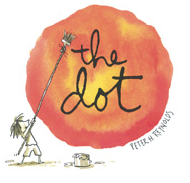
A  little while ago we celebrated a special day along with many thousands of other kids and teachers around the world: Dot Day. The idea is simple: read and enjoy the book The Dot with your class and then explore the story creatively–in any way you want.  Easy peasey, right?  Sign us up!!

Screenshot 2015-10-11 20.25.47So we read the story, and talked about what it meant to “make your mark.”  And since we’re Roadrunners, kiddos brought up the ideas of grit, growth mindset and making mistakes.  Who knew there was so much to learn in a story about a girl and a painting?  Ok, so I knew it was all in there. Hee hee.  I’m just super impressed that my students came up with it before I even told them.  Way to go, Rm. 202 friends!

After we were done reading and talking, I set them loose to work their magic.  With paint.  Or markers.  Or colored pencils, or crayons–whatever they wanted to use to show their creativity was fine by me.  And show us they did!

Check it out:

We weren’t done there, though.  Nope.  Had to do some writing about it, of course!  So kiddos were given a sheet to help them think through how they would explain their work.  Basically I wanted to give kiddos the support with sentence starters (if they needed it), as well as the structure of understanding what they could actually explain about the process (sometimes 2nd graders just want to tell you one sentence and be done).

Kiddos were instructed to complete a rough draft (which was made of four parts: When I read The Dot, it made me think of….; So I decided to make…; I used…; and I want to make my mark by…).  On the second day of work we had to have a conversation about what it meant to be “done,” because like I mentioned before, some kiddos thought just saying “I used paint” would be a thorough explanation of what they did.  I showed them my sheet–all filled out–and we discussed the thinking I did in order to decide what to say, as well as how to use the organizer correctly.  The lesson here was simple: if you are given 4 lines to write your ideas upon, then you should write 4 lines of words.  Well, it seemed simple at least, but was not so obvious as you might think.  Once they finally had a rough draft, they were then to work by themselves or with their elbow partner to revise and edit their work before creating their final draft on special “Dot” paper.  This was perfectly tied into the writing cycle we were working through and was a nice picture of how writing doesn’t just happen during one set time of day.

It took us a week to all finish our writing, and then we were ready to share.  I was happy to see how well it all fit in our hallway, using the windows and the one vertical part of the wall.  Perfect space-wise, and perfect because we (and everyone who walks through our hallway) get to be inspired by our dots every day!

This slideshow requires JavaScript.