Privacy

Recently I read a post by Pernille Ripp that was a topic I had never really thought of before.  She writes about all things education, and I always learn something when I read her words (i.e. I first learned about kid blogging from her work, and read about many other topics like homework, classroom management, genius hour, etc. from her as well).  This time I was drawn to her blog by a tweet she posted related to privacy–a topic I had not yet thought much about related to myself and my students.  Ok, yes, I had thought about privacy related to not sharing student personal information and keeping them safe in their online spaces, but not related to privacy in other terms.

Her blog post was about student work and stories and how important it is to ask their permission before you post their words to social media.  She proposed that not every kid wants you to share their news.  Not every kid wants you to tell the world about their ideas, their projects, their problem solving–even if it’s good.  And she proposes that students have the right to tell you if they want you to share on their behalf.

Wow….that was never a thought I had ever had before.  OF COURSE my friends want me to share their projects, their pictures, their super-smart ideas.  OF COURSE my friends want me to toot their horns on Twitter and our blog so that loads of other people can celebrate with them.  That’s what I would want so that’s everyone else would want, too.  Right?  Of course.  Well that’s what I used to think.  And now I’m not so sure…

After reading that post I immediately started looking at things that happen in our classroom a little differently.  While I’ve always said that it’s “ours” and not “mine,” I’m not so sure that I’ve worked that way in regards to what I have shared on Twitter and our blog.  I think I always thought: “Well no one has ever told me NOT to share their work;” “No students has ever told me that didn’t want me to put their stuff on our blog;” “Everyone is proud when they have a great idea, and so they’d want me to tell everyone about it!” I guess what I really mean is that I didn’t really think about it.  And then I had a moment (again, after reading Pernille’s post) where I thought I should ask.  Something awesome had happened, and I was taking pictures of the moment, but thought to ask permission form a friend to post his picture and he told me no.  I was a little taken aback, but then it started to make me wonder how many other times if I’d had asked that question of him if he’d have said no.  I went back to those statements I’d had previously and thought this: “Well, of course, no one told you not to post.  They didn’t know they could.  You didn’t ask them.  Maybe they just thought  ‘She’s the teacher and so she’ll do what she wants to do.”  Sure, it may also have been because they really didn’t care.  But the point is, I don’t really know.  I had never given them the opportunity to tell me.  (And for the record, if I think more about that friend and his hesitance to post his picture online, he has probably felt that way about many other things and just not told me.  Oops.)  I wonder how many others in the last five years would have said “no,” too, if they’d have had the chance.

So…going forward, I will be the one who stands for the student who never says yes.

I will be the one who asks before I tweet about something my kiddo does (and yes that counts for the ones who live in my house, too.).  They may not want me to tell everyone.  Even if it’s something really great.

I will be the one to ask before I put their picture or artwork or Keynote or writing piece–whatever–on my blog, and I will not expect them to automatically post it to their own blog, either.  They are allowed to be in charge of what is public and what is kept between us.

I will be the one to ask before I assume that everyone loves praise and digital high-fives like I do.  I can’t assume that everyone is just like me.  Ha!  Guess I already knew that was true, but just hadn’t thought about it in this sense before.

So what do you think?  How will you think differently about what you post or share about the kiddos in your care?  What will you continue to do in the same way?  I’d love to hear your thinking! 🙂


Math Place Value Challenge

I mentioned on the math warm-ups post that we had been working on place value, and that mathematicians had a challenge to figure out how many sticks were in a big ‘ole pile.  They were given a small group (their partner plus another partnership) and two questions: How many sticks do you have? How can you count them in a way that will be easy to show someone else what you’re doing?

Each group was given a pile of popsicle sticks and they got busy!

As I went around to each group, I asked how they had decided what to do, and how they were determining how many sticks they had.  Most were bundling in 10s (yay!) and I nudged them to make an even easier way to see how much is in a big pile.  Could they continue to bundle and make a bigger group?

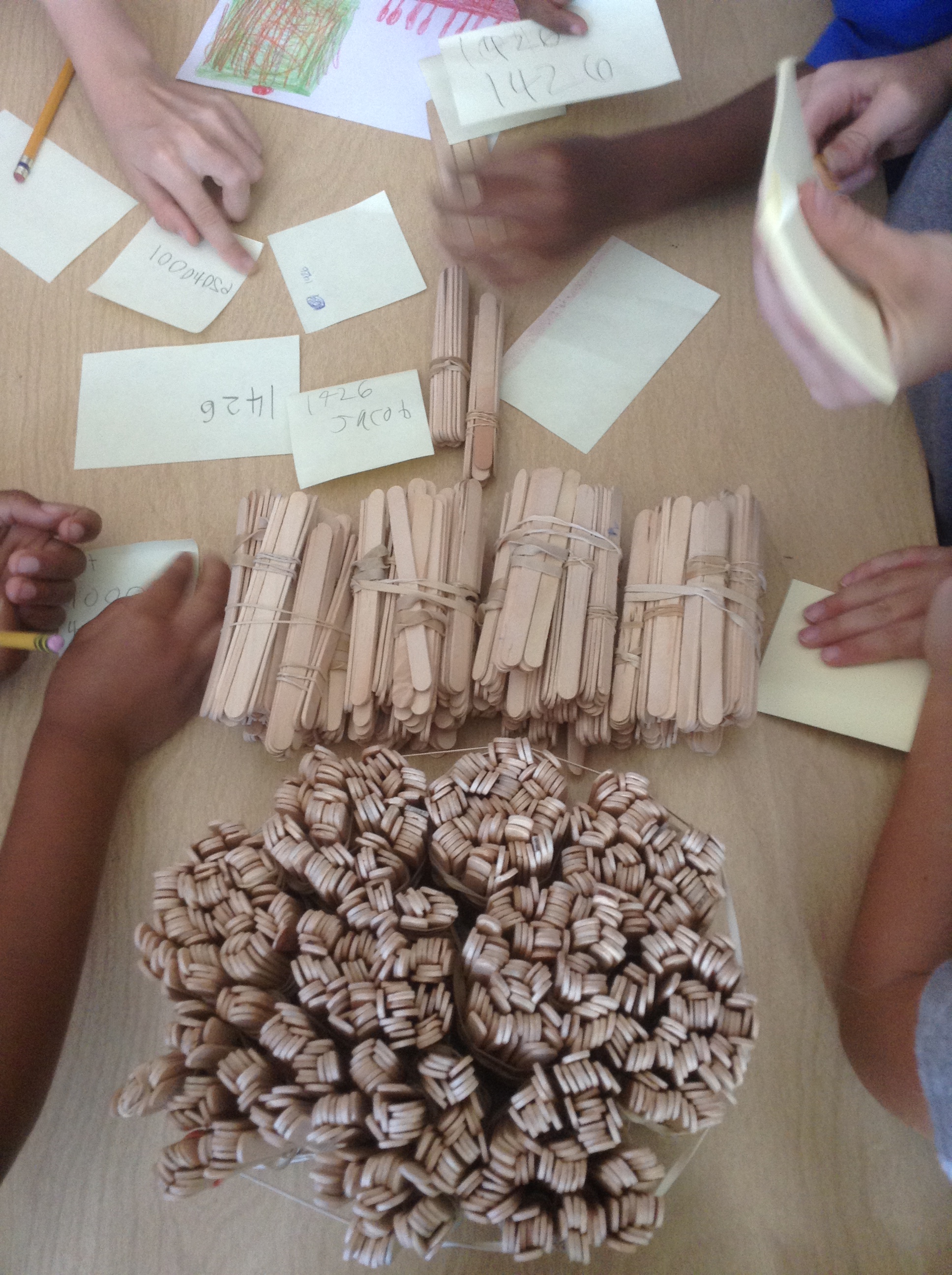
In the end, most groups ended up with bundles of 100, some 10s and–if their pile had any–some leftover 1s.  They put their collections back in the tubs, and marked how many they had with a post-it note.

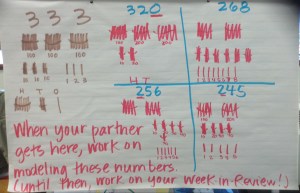
Then we worked for a bit on how to model the numbers we had made.

IMG_5304The next step was to figure out how many we had altogether.  Many suggested that we could put our bundles together, but weren’t (at first) sure how to do that.  We talked about how they had made their 100s bundles–with 10 10s–and then guessed that we might be able to make some more 100s from the loose 10s in everyone’s tubs.

Left with a massive pile of 100s, that eventually led us to thinking there must be a better way to show how much that pile had in it.  I asked if they thought we could bundle any bigger numbers and honestly most of them thought I was crazy!  I just began collecting 100s in my arms and counting: 100, 200, 300, 400….and they got the idea.  They going until they got to…10 100s!  That was a great conversation next about what number we had just made.  10 100?  We figured out that it was a 1000, and that when we said “10 100” that helped us know about how many bundles were inside, but that it wasn’t the right way to say the number.  We stretched a big ‘ole rubber band and made a 1000 bundle!!  We counted the whole thing and agreed that we had one-thousand, four-hundred twenty-six sticks!

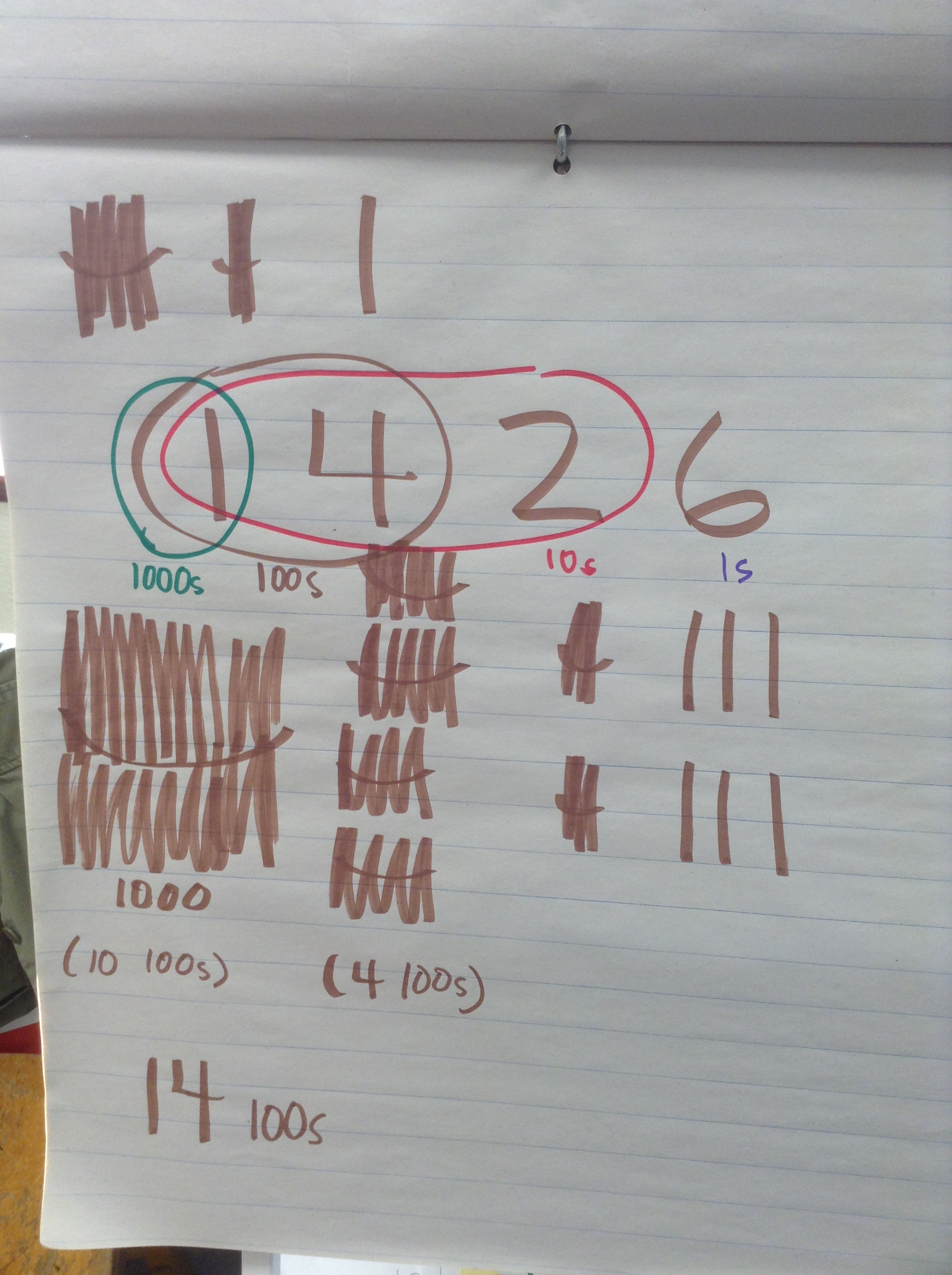
IMG_5288But how in the world do you WRITE the number one-thousand, four-hundred, twenty-six?  We gave it a go.  Many of us remembered that when we went from 2-digits to 3-digits it was a 100s number, and since we had 4 groups of sticks, maybe that meant our number had 4-digits…

IMG_5287 Our model of this number–1,426–looked like this:

IMG_5306Many minds were blown as we figured out how many 100s and 10s were inside that big number.  We figured out that it was actually than just what the digit said, because of all of the groups inside of groups.  I loved how many kiddos kept saying, “Wow, this is fun!” and “Man, we’re learning so much today!”  Definitely lots of great mathematical thinking happening here!

UPDATE:  I got this email after the first posting of this story.  Love this stuff!  Thanks for sharing, Shannon. 🙂

Hi Jennifer!  
You had so many math posts on the blog this weekend, that I wanted to share a story with you.  We have a Curious George story CD in the car that we listen to a LOT and in one of the stories George gets 10 dozen doughnuts.  The other day when this story was on, Millie asked me if 10 dozen was 120!  I was so surprised!  I said that it was and asked her how she knew that.  She told me “5 2’s are 10, and then another 5 2’s makes 20 and 10 10’s is 100 so, 120”.  It took me more than a minute to follow the math just because it wasn’t how I was used to thinking of problems, but she was totally right and I saw this “new” math stuff in action :).  It was kinda cool!  She was doing multiplication and didn’t even know it.  Thanks for teaching her such great foundational skills that allow her to do these kinds of problems in her head!

Getting Started with Writing: Tiny Notebooks

Ok…do I need to start by explaining my love for the teaching of writing?  Or just my love of writing itself?  Probably not.  You’ve read those stories before, right? 🙂

We got started with writing in 2nd grade on our second day.  I started by reading two books:

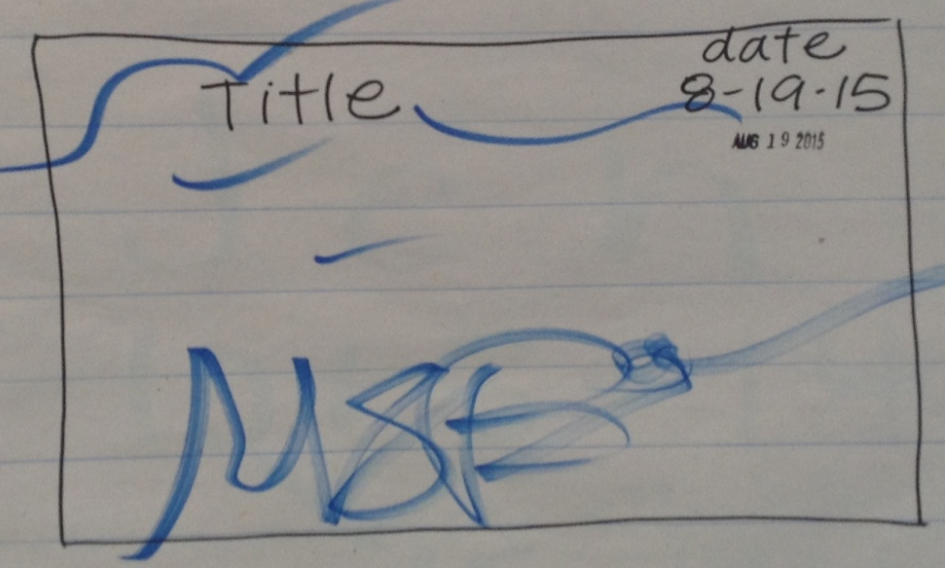
I chose them partly to be funny (The Incredible teacher one was because their notebooks used to be full-sized and are now only half-sized notebooks like I used here.  By the way, they didn’t think this was funny. LOL), and also to give us an idea for somewhere to get started (an entry about something they had done over the summer).  Before they left we had a quick reminder of how to label each entry, as well as a reteach of how to use the date stamp (yes, there is a lesson for this!).

Ignore that big blue scribble...it was from another conversation we were having about how authors sometimes sign their books....

Ignore that big blue scribble…it was from another conversation we were having about how authors sometimes sign their books….

After our lesson, most kiddos got to their spots and got started quickly.  Some took a little extra long with the date stamp, and some did a lot of thinking.  I’d say most of us got something on the paper, but I did hear some of those dreaded words: “I don’t have anything to write about!” Ugh.  But then I remembered they were second graders AND it was the second day of school, so they may have been a little rusty.  I worked with one friend to put an ideas list in the back of his notebook (like we had done last year but he had probably forgotten), and had multiple conversations with friends about how to find an idea (like talking to another friend about their writing, thinking about their day, showing them an example in my Writer’s Notebooks or using a book for inspiration).  We had a quick share at the end of our writing time and got ready to move on.   I LOVED it when the next question was, “Can I take this journal home and finish my writing for homework?”  Well, of course, dear friend, you can do that! 🙂  I LOVE this not because I wanted my little friends to have homework, but because it shows me that they are already getting the idea that writing can happen anywhere, and that their stories are important enough to them that they want to finish sharing them.  And yes, those notebooks came back the next day. 🙂
This whole “I don’t know what to write about” thing had me thinking about what to do the next day.  I needed to get them thinking again about how ANYTHING could be an idea for writing, not just great big events or monumental occurrences.  Ideas come from watching the world in a new way and expecting to see stories.  Those can happen on the way to school, while you’re eating breakfast or at recess.  And probably when you’re least expecting them.

This made me think about how to connect this idea to something they could understand.  I thought about we could explore the idea of a scrapbook and how your Writer’s Notebook is a place to collect things you don’t want to forget.  I pulled out my very first notebook (which I started in the summer of 2005, 10 years ago), and read a couple of entries (I wish now I’d brought that notebook home so I could show you those entries–boo. :().  I talked about how the moments I wrote about were not “BIG” deals, and I wouldn’t remember them now if I hadn’t written them down.  We connected this to how in Inside Out the memories turn gray in long-term memory and are sucked away forever (good thing I’m up on pop culture, huh? Never know where a connection will come from!).  We don’t want this to happen to our memories, and it doesn’t have to if we collect them!  For them, 10 years from now is when they go to college–how cool for them to be able to think about things they want to remember at that point in their lives.  Totally didn’t mean for that connection to happen, but was SUPER glad it did!

Then we read a book (as another way to help them visualize the possibilities) and made a chart of the small stories in there that we could write about:

This got many kids thinking and they shared new sparks they had: one friend said he could put in the necklace he wore this summer on the airplane when he flew by himself, and another friend wanted to bring pictures of his dogs–because they will probably be dead in 10 years and he doesn’t want to forget them.  Cute, right?  That same friend wanted a picture of me so he could remember me in college, too.  He wrote this entry with that picture:

Screen Shot 2015-08-23 at 9.36.11 AMWhile of course I love this entry because it’s about me (ha!), but also because it is the definition of how I want them to be thinking about their notebooks as a way to collect and curate their thoughts.  Plus I think it’s just cool how deep and wide 2nd graders can think when we give them an invitation and opportunity to do so. 🙂

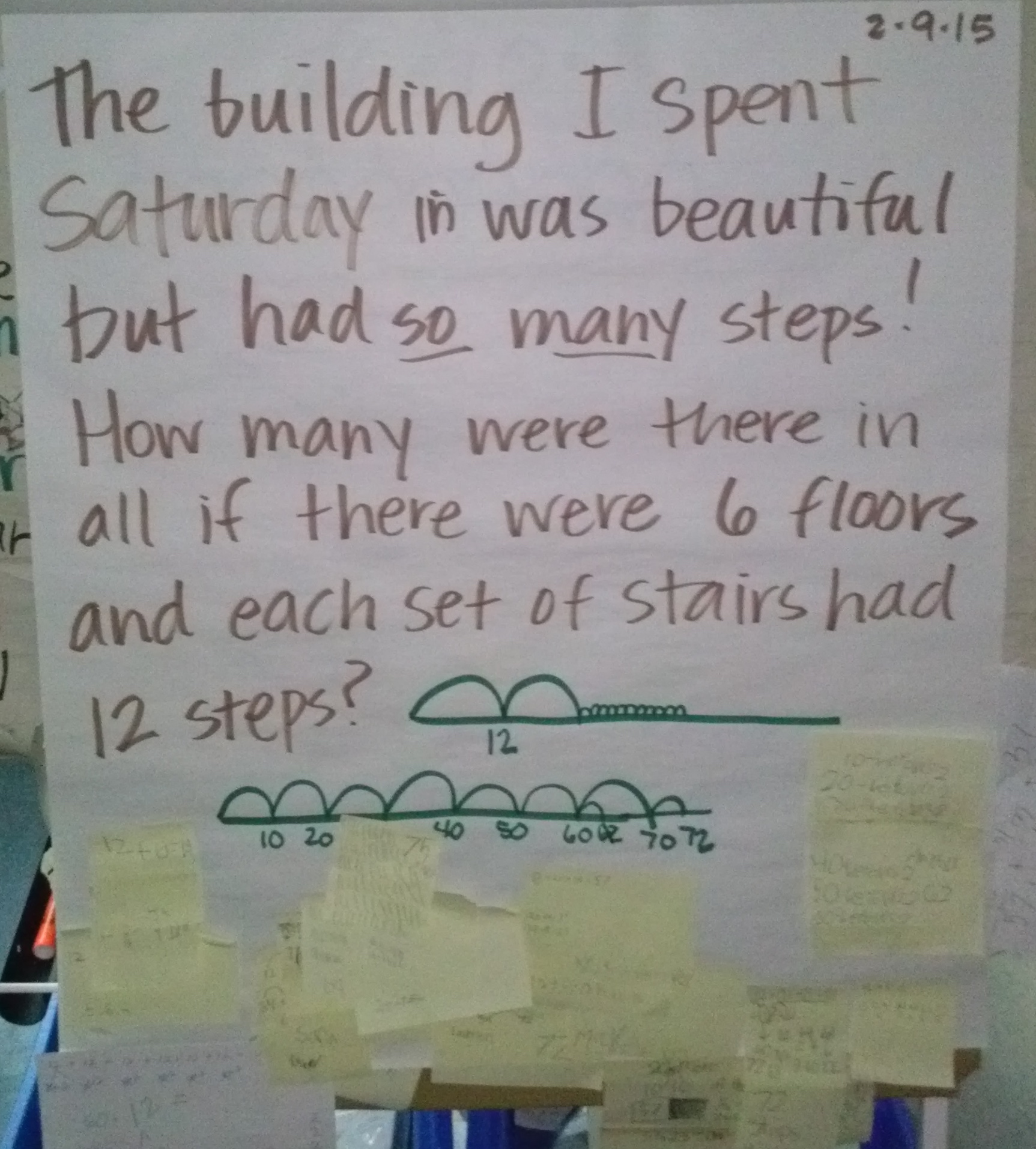
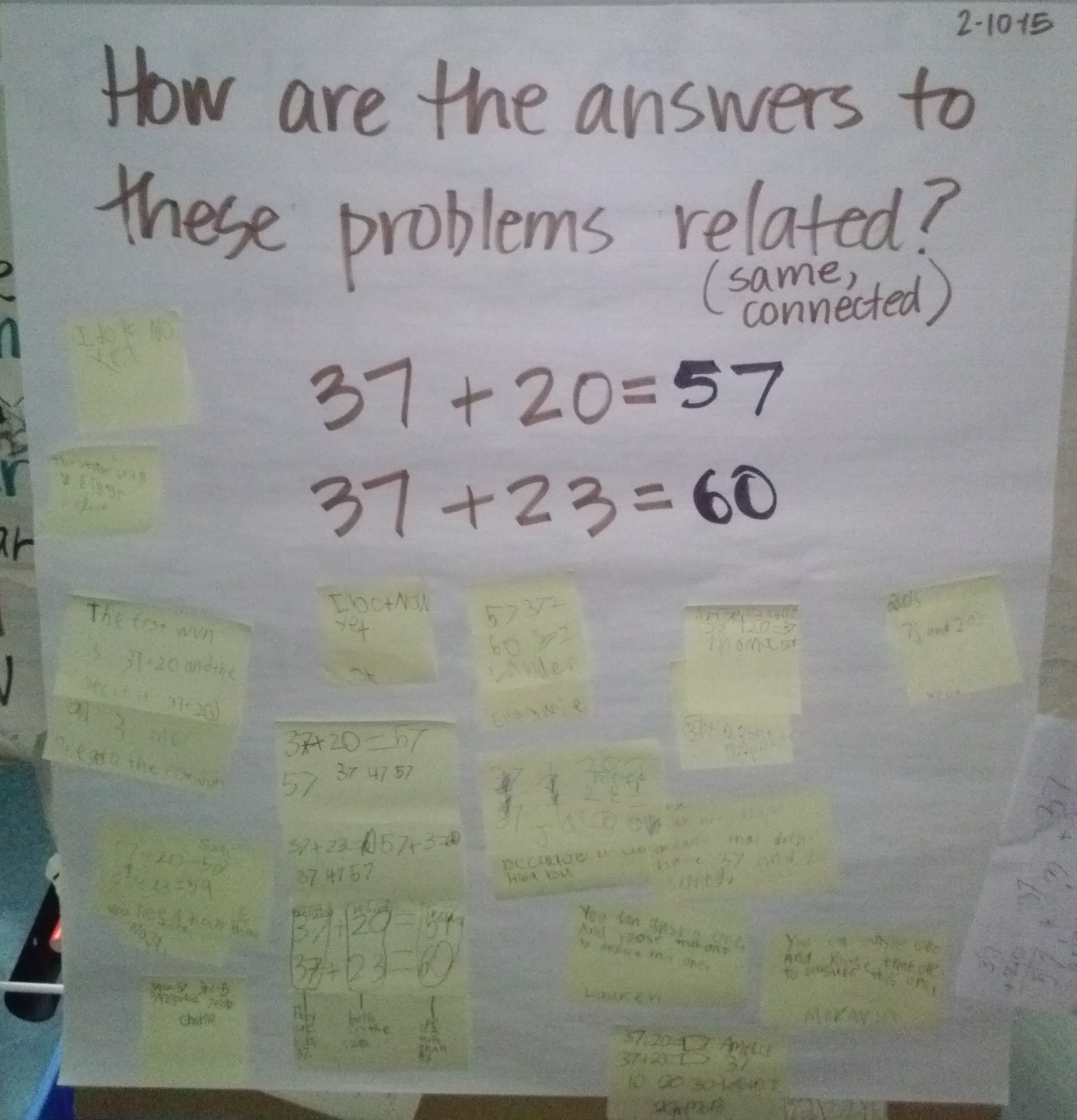
First Grade Math Warm-Ups: Week of February 9-12, 2015

Is there ever a week in January or February when we have all 5 days?  This was another short one (and one filled with a party), so there are only 3 warm-ups this week.  As I’ve mentioned previously, we’re continuing to work on addition within 100, grouping around place value and making sense with our explanations.  Enjoy!

Monday

CAM01615

Tuesday

CAM01614

Wednesday

CAM01601

First Grade Math Warm-Ups: Week of 12-8 to 12-12

So excited how these are working out, and how they lead to such great conversations during our math time.  So easy to get math brains thinking early in the day and then letting it simmer all day.  By the time we come back to it at 2:00 it somehow makes even more sense.  LOVE!

Monday

CAM01132

We’ve been working on doubles a lot lately, during conversations, in groups and by playing games.  The hope is that my mathematicians can then transfer that knowledge to solving problems.  This one let them give it a try.  And since you’re here, let me show you the doubles games we’ve been playing–I think we might have to make a new version of these for every season:

Continue reading

Interactive Writing Explained

**Disclaimer–I am SO excited to share this post and have been thinking about the right way to write it for a LONG time!  My kiddos worked SO hard on the writing in this story and are rockstars in my book.  THANKS FOR READING!!**

If you have been here for a while then you know that this year is my first year in first grade in a LONG, LONG time!  I got my start there more than a decade ago, then moved on to work with “big” kids for a while and am back to my roots.  Much has changed, but I’m finding that many things have stayed the same–some things are just good teaching.  Best practice.  Good stuff for kids.  Interactive writing is one of those things.  I learned how to do it back then and am being reminded of it’s importance and power with kids today.  Let me explain. 🙂

First of all a definition: interactive writing is a writing experience (often whole group) where teacher and students “share the pen” to create meaningful text together.  The teacher, using what she knows about students and their current understandings about letters, sounds, words, etc., purposefully chooses kids to add certain parts to the composition, building on their knowledge and helping them make connections to new skills and concepts.  This is not done haphazardly, and is best done with planning ahead of time–although I have had some amazing experiences with IW that happens “on the fly.”  Ideally, the texts you compose together because touchstones for future learning; revising and revisiting are part of the process. Continue reading

Math Warm-Ups: First Grade Version–Week of 12-1 to 12-5

For years in 5th grade I posted about Math Warm-Ups and how we used them to get our brains ready for flexible math thinking every morning.  Last year I didn’t use them much–for one reason or another–and this year they didn’t make sense until just recently.  So here we go–join us to see how Math Warm-Ups work with young mathematicians and how we use them to stretch our brains!

Week of December 12-1 to 12-5

Monday

Wait–Monday we didn’t have a Math Warm-Up.  Partly because it was the first day after a really long weekend and also because we had some unexpected freezing rain during the morning rush and it took me 2 1/2 hours to get to school that day!  I did anything but rush to school.  Here’s a picture of how fast we were going at one point.  And believe me, I was being really safe while I took this pic:


See that?  I think it says 2 miles an hour.  On the highway.  Seriously.

See that? I think it says 2 miles an hour. On the highway. Seriously.

Tuesday

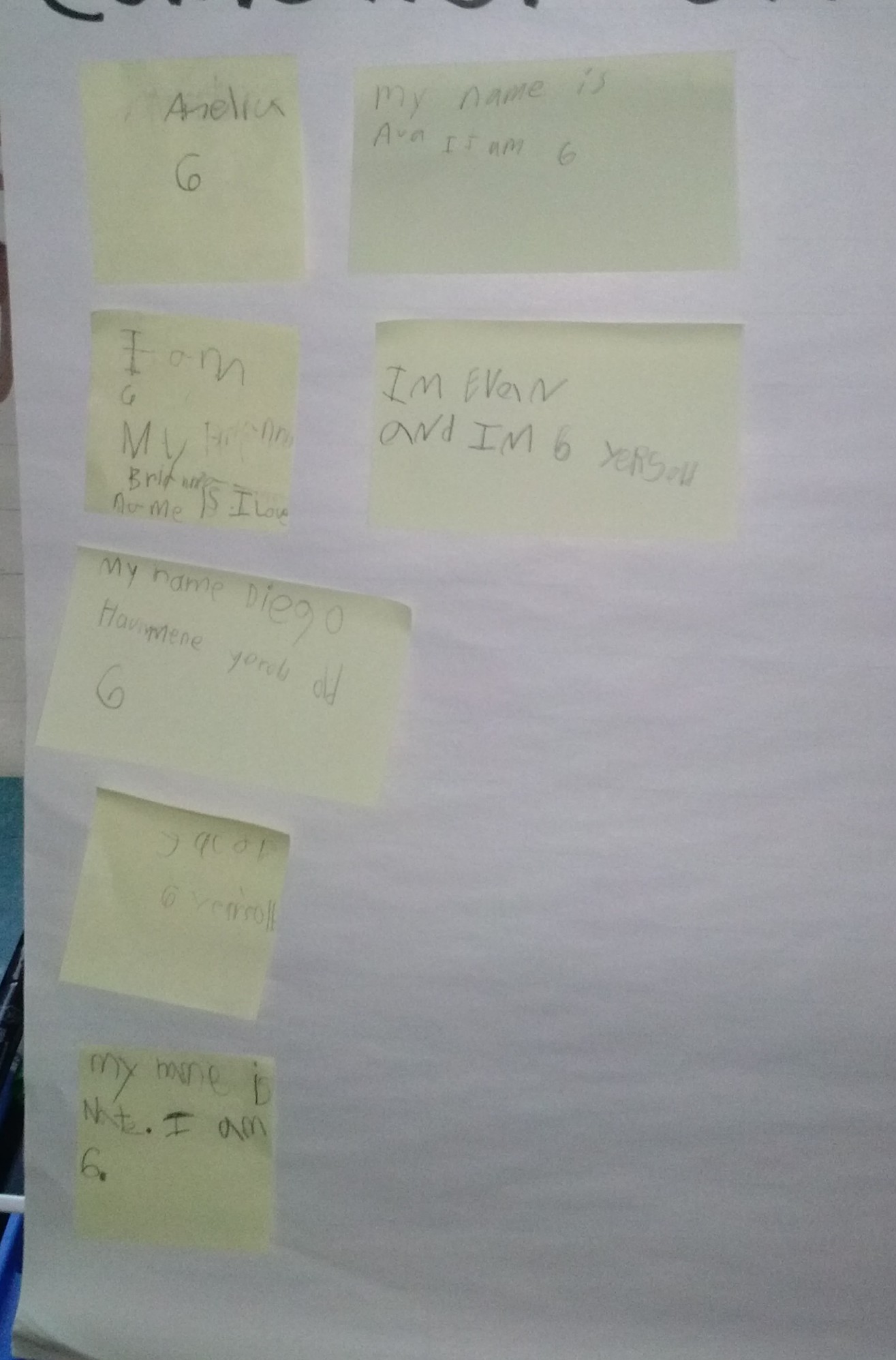
This was the first day of Math Warm-Ups so I asked a question that I knew everyone could answer easily, as the point was to teach the purpose and procedure more than focus on a math concept.  Still, we were able to pull in many things we’d been working on in math during our conversation about this warm-up.

CAM01121

Now that I look at that picture, I wish I would have taken one right after we put all the post-its on it, because it was much messier, and that’s actually part of the conversation we had about what we could do with the data we had collected: someone suggested that it needed to be more organized.  I also asked them what question we could answer with the information we had up on the easel.  There were several good ideas, one of which was “Do we have more 6YOs or 7YOs in our class?,” hence why we ended up with two columns of notes.

           CAM01086    CAM01085

It was great to watch and listen when we started to analyze the notes and figure out how many of each age there were: they used what we’ve been learning about grouping objects to count, and recognized that I put them into the same shape as the 10 frames we’ve been looking at lately.  They were similar to what our math racks look like, too, and they quickly and easily saw that there were 7 6YOs on this day and 10 7YOs.  We talked about other questions we could answer, and also talked briefly about how this data could change based on the day (we had 3 friends absent).

Wednesday

CAM01120

Another one I knew most could answer easily, but a little harder than yesterday.  The focus today was on making sure we followed all the directions of the warm-up: answering the WHOLE question and putting our name on our post-it.  There were still some who did not, so we made sure to talk about that when we reviewed this question during math.  The words LESS and GREATER were also a focus, as was writing the number the way it should actually look–with digits in the right places AND going the right direction (which is still tricky for some friends at this point in 1st grade!).

Thursday

CAM01119

We’ve been working on flexibility with combinations up to 20, as well as most recently practicing doubles and doubles +1.  This was interesting, then when most kids put 10+9 as their answer (which is probably the easiest combination to figure out).  I noticed many who wrote combos that DIDN’T equal 19, so the conversation was around accuracy as well as how they figured out their answer.  It also told me that as a whole, we need some more practice on this skill!

Friday

CAM01118

This question was just one to see where we were with fractions, as we’re about to finish up that unit.  The benchmark is just that kids understand 1/2s and 1/4s, but the “extending” on our rubric is 1/3s and I was pretty sure most kids could tackle that as well.  And boy was I right!  Now…I am not entirely sure if kiddos answered these on their own (like they’re supposed to) or if they worked together, so there’s more work to be done, but for the most part you can see that most of those rectangles (which is also part of this unit) are divided into 3 equal pieces!  Even the way I worded the question gave me some information–info that I didn’t expect–when someone said, “I can’t just draw 1 line and make thirds.  Can I draw more than 1?”  Obviously that friend knew what was going on!  I hadn’t done that on purpose, and so made the change on the chart for the rest of the friends who completed it.

This is our first try with warm-ups this year and I am excited to see where they go!  Great job, Rm. 202 friends!  You did an AWESOME job!

Teachers–What kinds of math warm-ups have you done with your class?  Have you tried them with 1st graders?  How did it go? We’d love to hear about what’s going on in your class!  Parents–did you hear about Math Warm-Ups from your kiddo?  What were they saying? 🙂

Ten Black Dots

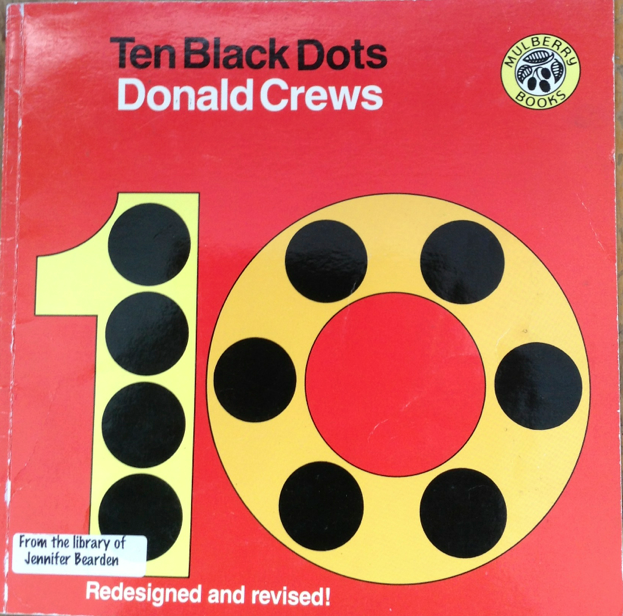
One of the great things that happens at the beginning of first grade is a series of Kingore lessons that Mrs. Berger comes to do with all of our classes.  We gather together 6 times, doing a variety of different types of thinking over the course of the lessons.  The first one was related to the book Ten Black Dots by Donald Crews.

Screen Shot 2014-10-06 at 9.01.00 PM

In short, the lesson asks kids to think outside the box, and create a picture using 10 black dots (or in our case they were red or green circles!).

IMG_3138

First Mrs. Berger read the book to us.

IMG_3146

I had to try it out first. And man…it’s hard work thinking like that on your feet in front of a rug full of kiddos! She didn’t tell me she was going to ask me to do this, so the “thinking face” I have on is a real one!

IMG_3147

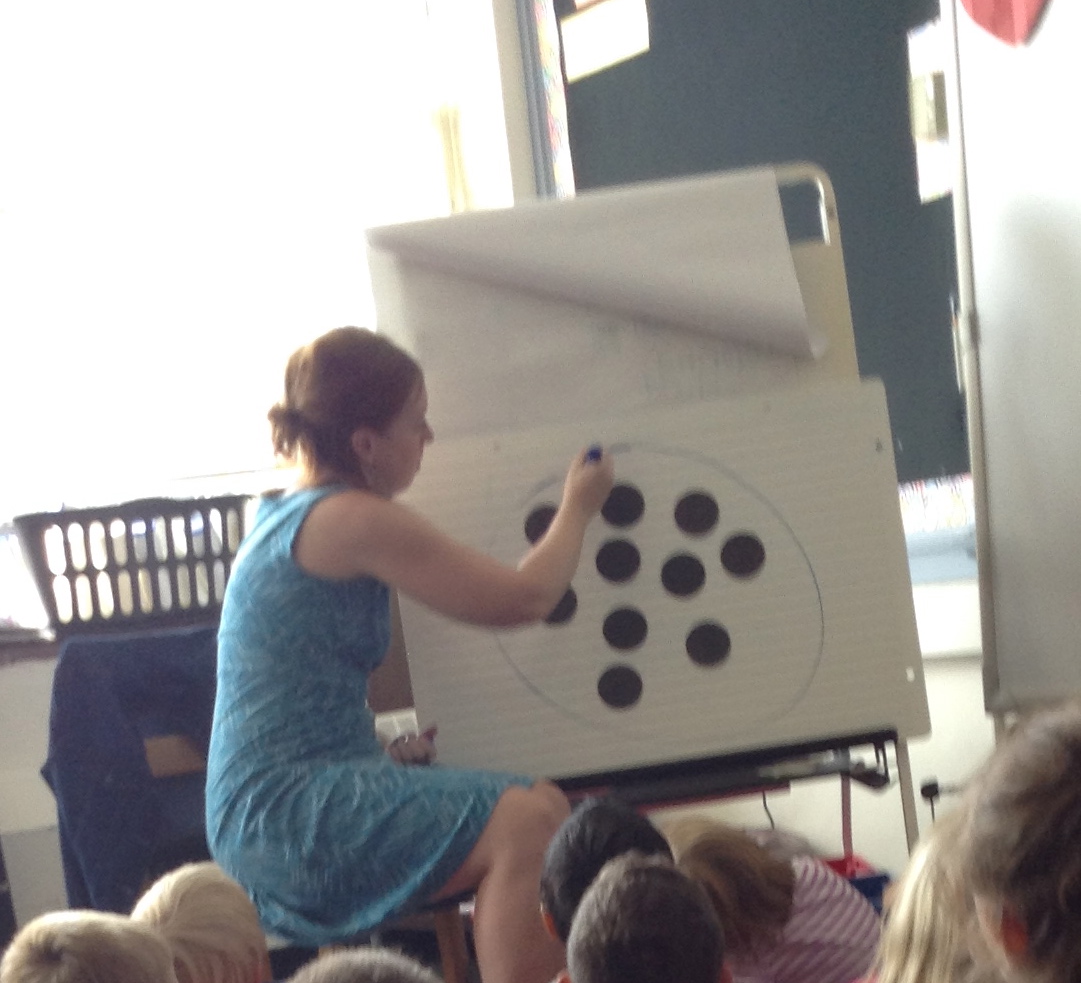
I started by putting my dots all in a group, and suddenly an idea came into my head.

IMG_3148

Mrs. Berger challenged me to add some details so that my audience could tell for sure what my picture was. I added some lines on my circle. Can you tell what it is yet?

IMG_3150

A few more details…

IMG_3153

My finished Ten Dot picture: a pizza! I know–kind of an obvious choice. This was a HARD job! Wait til you see what our kiddos came up with….:)

Kiddos were then asked to count out 10 dots from a bag, and get to work on their own Ten Dot creation.  I’m excited to share their CREATIVE thinking:

This slideshow requires JavaScript.

How is that for a showcase of some AMAZING thinking?!  I’m trying not to be embarrassed that I made a pizza….:)  GREAT job, Rm. 202 kids!

Mathematics in the City (in Kirkwood)

Mathematics in the City is an organization I learned about this summer when the fabulous Kara Imm came to Robinson to teach us about how to better teach addition/subtraction and multiplication/division of fractions using new units from Cathy Fosnot (another amazing math mind!).

Fast-forward to now: yesterday we (several 5th and 6th grade teachers and math specialists) were lucky to have Kara back again to continue to learn from her (and each other!) as we taught one of those units in our own classrooms!  We spent the morning planning our lesson, digging into the mathematics, talking about how we’d introduce the scenario, anticipating what kiddos would do and say, and brainstorming questions we’d ask our mathematicians to help “lift their thinking.”  Then our group (oh, did I mention there were like 15 teachers??) watched as Mrs. Hong taught the lesson in her room with her friends.  We got to “kid-watch” and take notes on what thinking they used, how they explained their work and also practice what we’d planned during our earlier session.

At lunch we debriefed on how the morning had gone, planning for how we’d change things based on the information we gathered.  Then it was time to plan for what would happen in my classroom later that day.

We decided that Kara would lead a number string with my students, focusing on fractions, but using the context of money.  Her string looked like this:

photo-27

See the red parts?  Those are the problems she gave students to solve (remember when we did number strings together at our Curriculum Night?  Same idea, only with a different concept).  The black is documenting kiddos’ thinking, and the blue is how she was modelling their thinking.  The story she told here (that gave kiddos an entry point and helped them make connections to what they know) was about how she’d found some money as she walked along this morning.  What a great way to talk about fractions huh?  TOTALLY made it less scary, and who doesn’t know at least SOMETHING about money?  The thinking they were able to share was fabulous, and the kiddos who felt confident to share their thinking was great, too; some kids who don’t normally share during number strings were more than willing to do so with this one!


I know that pictures of this totally don’t do the fabulous thinking justice, but here are some shots I captured during our work yesterday.  Check them out!

This slideshow requires JavaScript.

What a fabulous (man, I say that alot, but it’s true!) opportunity to learn with such great minds!  Can’t wait to see how this helps our math thinking progress as we begin a new investigation and more number strings!

If you’re a parent, be sure to share what your kiddos said about this experience.  If you’re a teacher, have you used number strings in your room?  Do you know Kara or Mathematics in the City?  Do you use Cathy Fosnot units with your learners?  What do you think of them??  I’D LOVE TO HEAR ABOUT IT!!


Our First Class Meeting!

If you don’t know about how we do Class Meetings around here, be sure to check out the previous posts Lessons in Democracy and Class Pet Petitions for a little background first….go ahead.  I’ll wait for you. 🙂

We had our first real class meeting this past Friday and it went really well!  I say “real” because the week before (our first Friday) I walked them through the process of 5th grade class meetings, to either remind or inform them of how we’d be doing them this year.

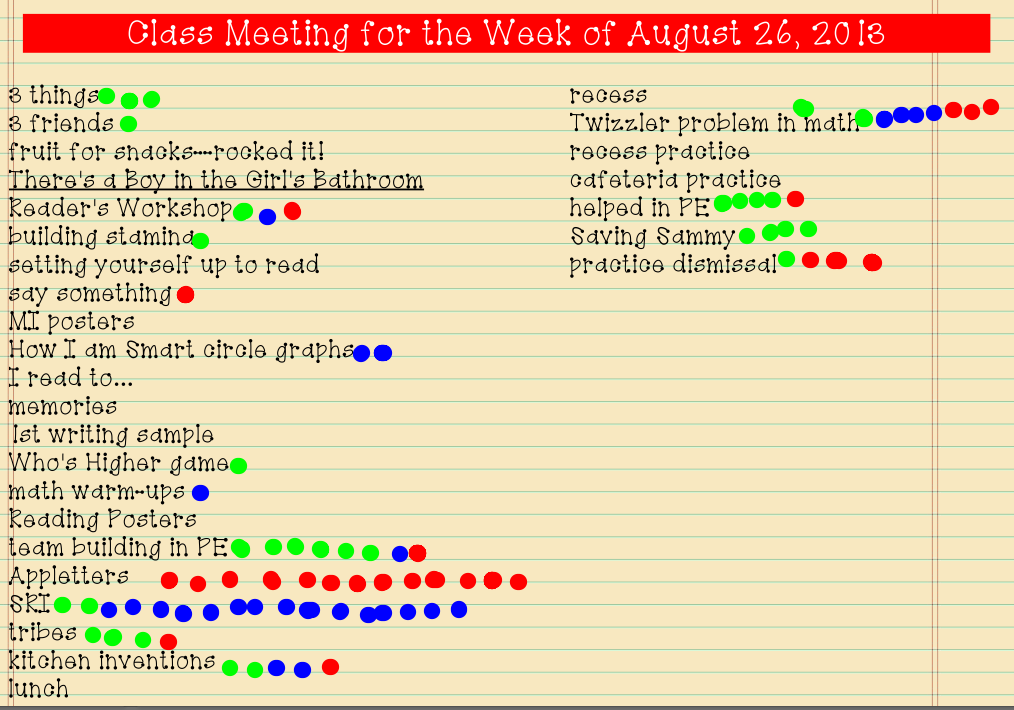
Here’s our chart after dots were added: Screen Shot 2013-09-03 at 7.28.13 PM

We had a busy week, huh?  The lists at the beginning of the year always seem to be a lot longer because we do many more short activities as we’re getting to know the classroom and each other, as opposed to longer projects as we move further into the year.  And for some reference, SRI is the Scholastic Reading Inventory and helps assess readers.  Students get their Lexile level from this assessment, which helps them as they choose books (which I guess is why so many kiddos gave this a blue dot–signifying that they learned alot from that activity).

I found it really interesting (and surprising, honestly) that so many kiddos chose Appletters as the topic to discuss and problem solve around.  And with that many red dots I was dying to find out their thinking about how we could fix it for next time.

After they shared their concerns, these were the things they mentioned that we could work on:

  • kiddos using really loud voices during the game
  • some just sitting (not participating or waiting for others to come to them)
  • not allowing others to join their words
  • leaving others out on purpose, or replacing their letters with other letters
  • only trying to make words with friends, instead of trying lots of options
  • people stepping on each other, running into each other or shoving as we move around the room

Then we were on to problem solving (we actually had a lunch break in between to do some thinking), and came up with some ideas on how we could improve our game the next time we played it:

  • aim at using a Level 1 or 2 voice (which at our school means whispers or soft voices), so even if we get a little louder we’ll still be at a reasonable volume
  • give kiddos time to think independently before we move together to build words
  • make a rule that you could add letters or rearrange them to make new words, but NOT remove letters once they are there
  • play in another part of our room, or try to use more space instead of clumping together
  • have a place for “odd” letters (like Z, X, Q, etc.) to go if you can’t build a word, then those letters try to build something.
  • I also suggested that I would add some other guidelines for what kinds of words they could build.

These were pretty good, and we were excited for the next time we played!

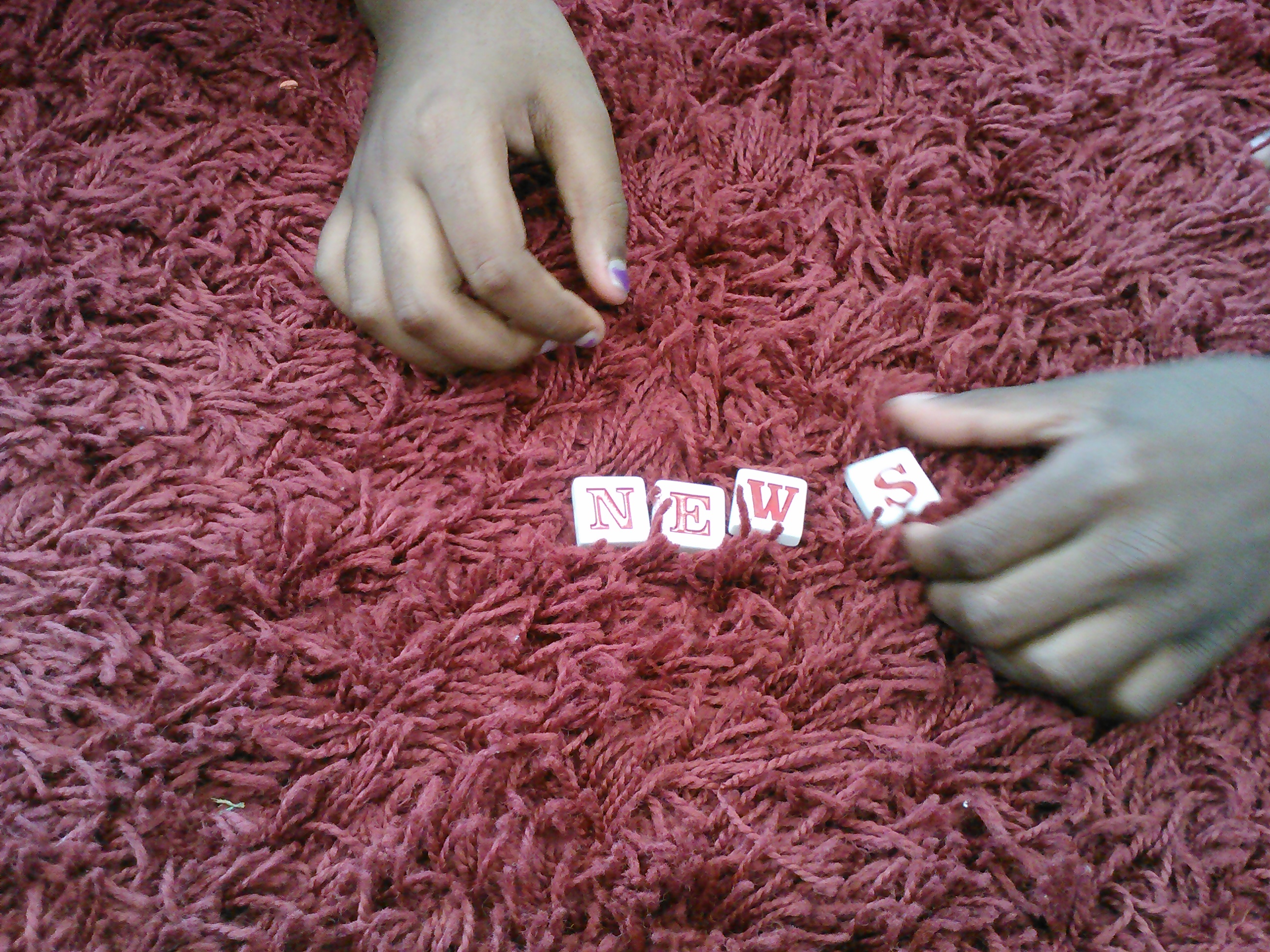
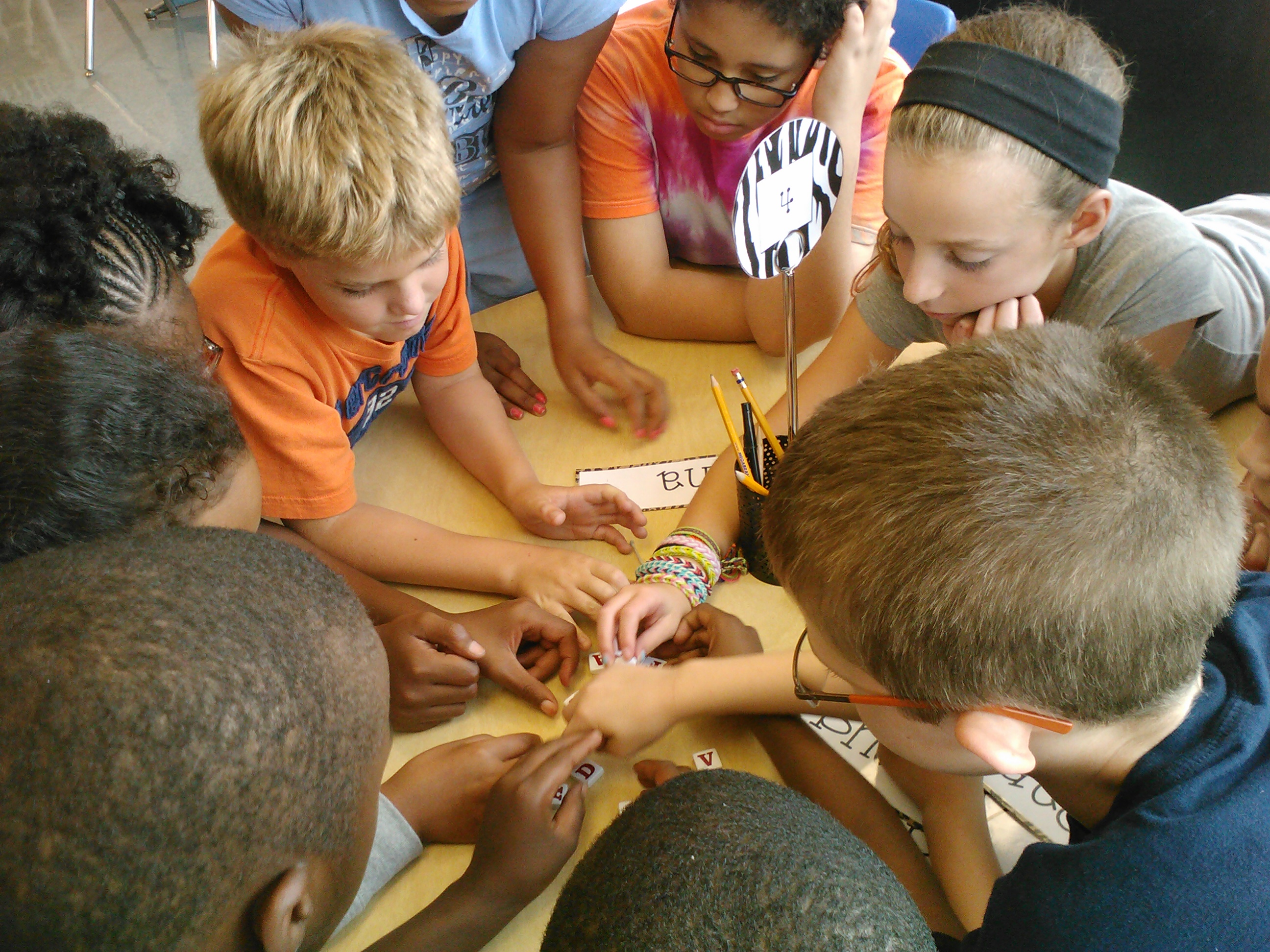
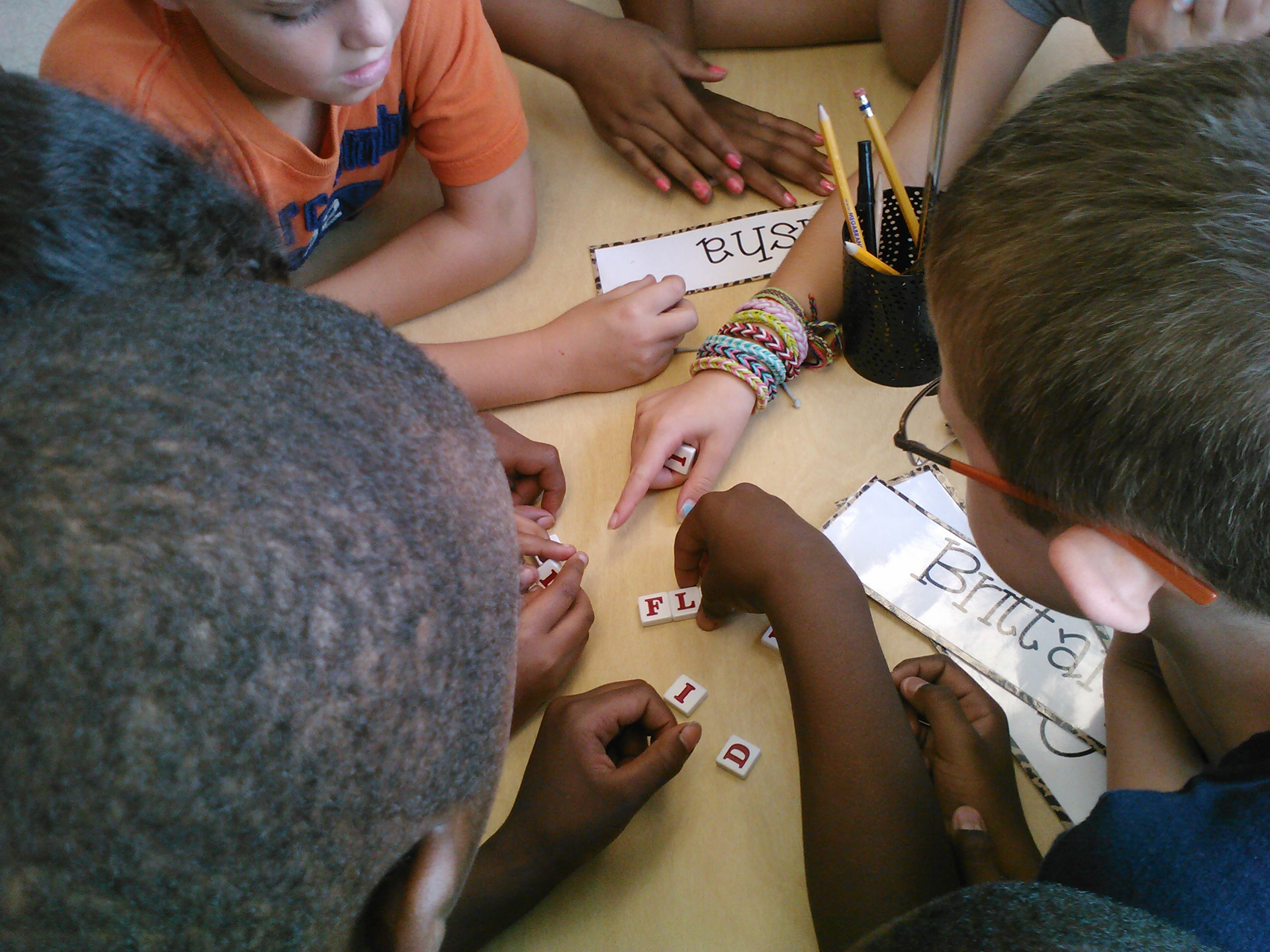
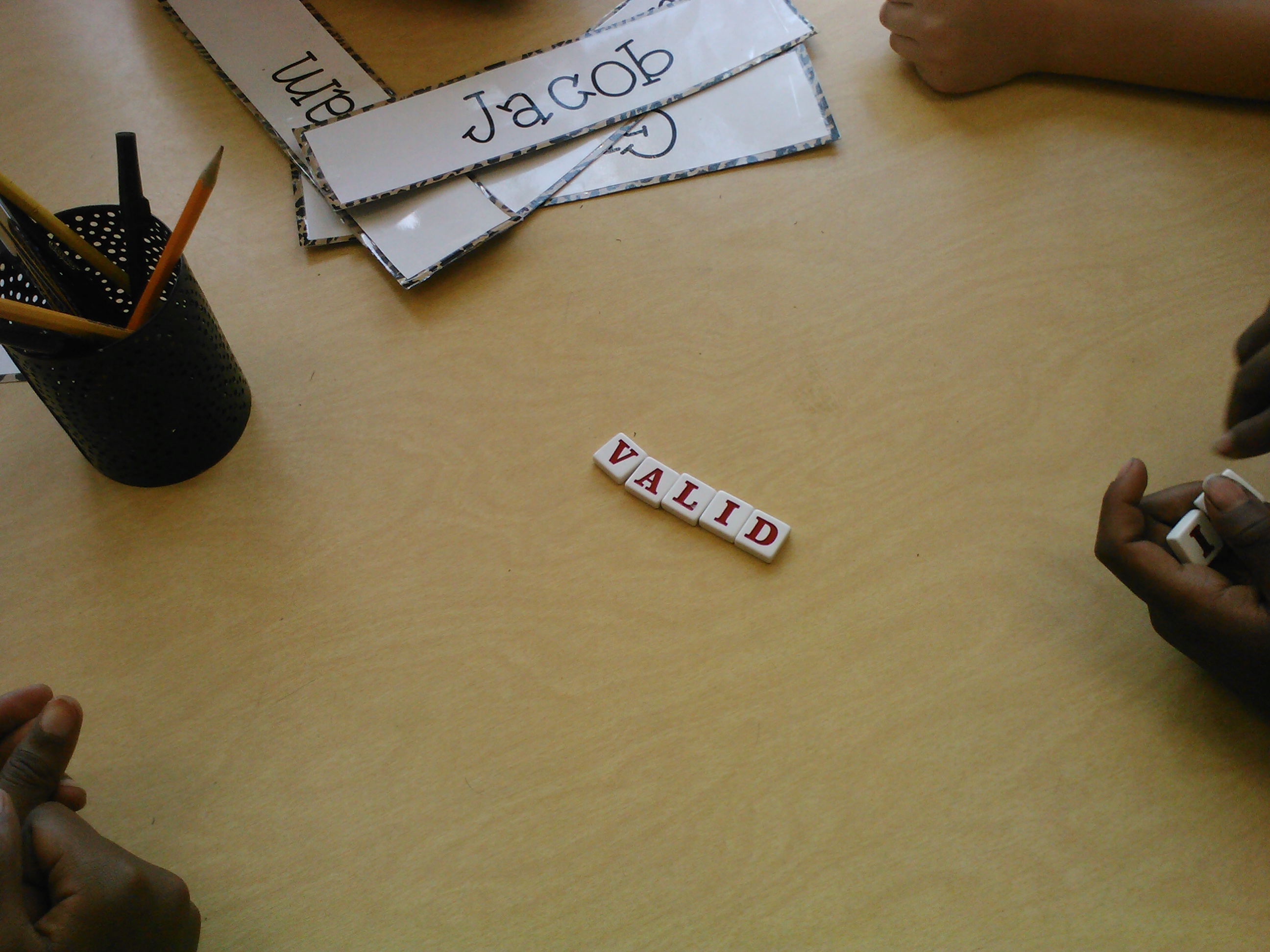
Little did they know that their next opportunity would come that afternoon!  The “rules” this time was that their words had to be at least 4 letters long, and could not be names (remember GIBY from last time?). We all agreed that the next time we were much improved.  Check out our words the second time around!

IMG699

Someone said this word was inspired by a book cover they were looking at just before we played our game–funny that they were actually able to find the letters to build it!

IMG700

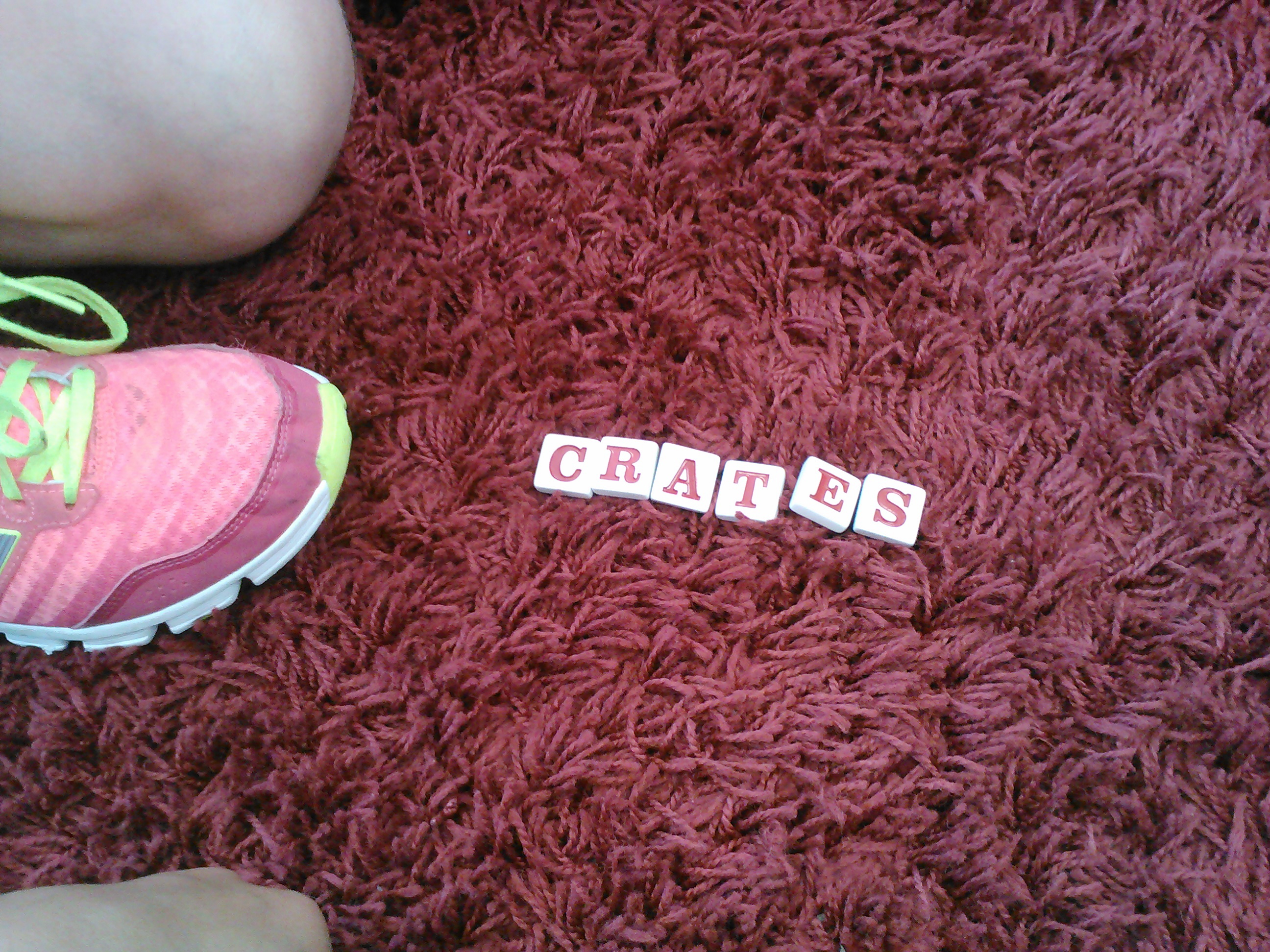
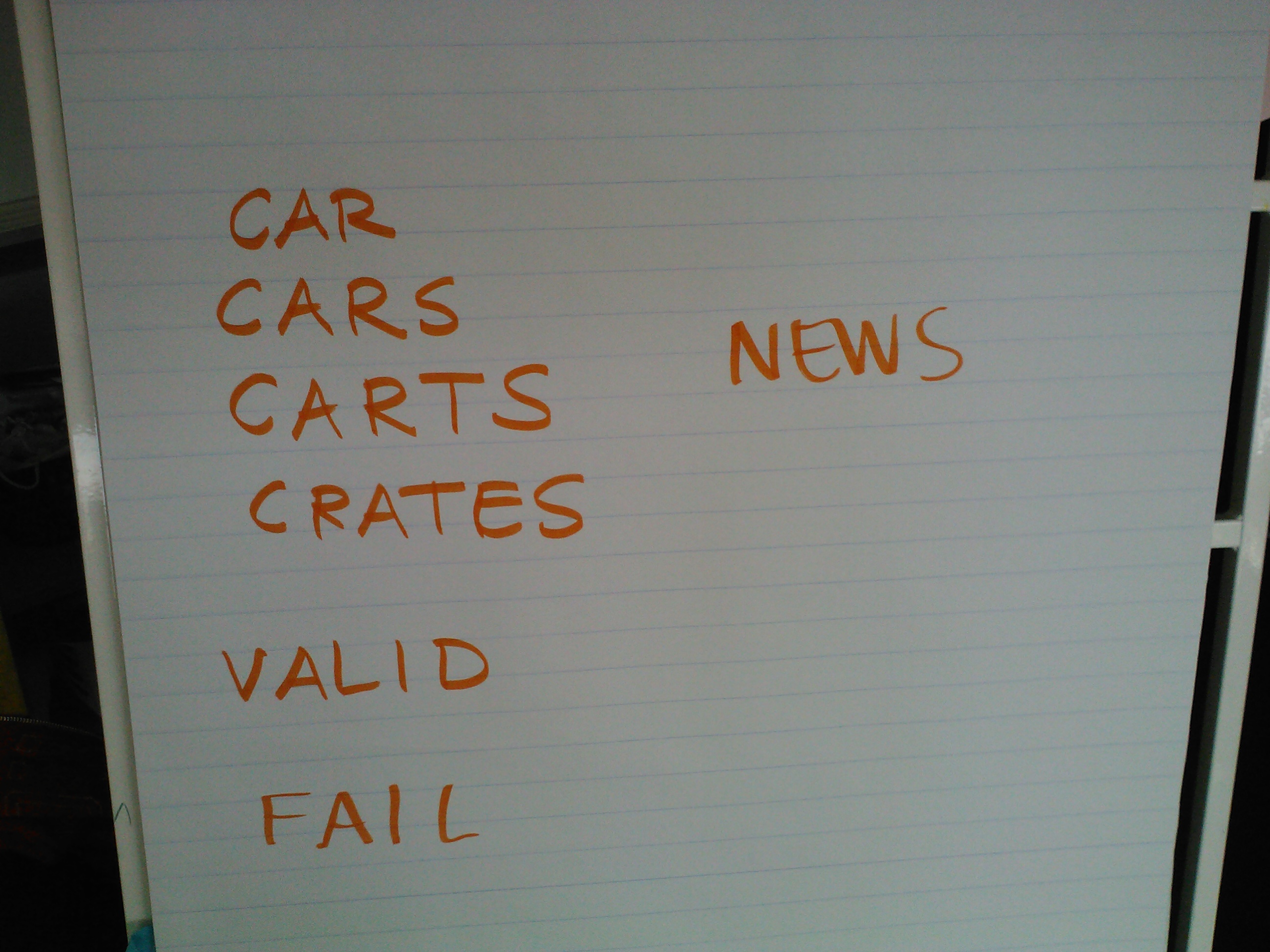
Check out the way CAR turned into CRATES--a longer word with more friends involved!  Success!

Check out the way CAR turned into CRATES–a longer word with more friends involved! Success!


All of the "odd" letters met at Table 4 to see what they could come up with...

All of the “odd” letters met at Table 4 to see what they could come up with…


...and many hands made for light work.

…and many hands made for light work.


IMG704

Definitely not an Appletters “fail” here–that’s a good word!

IMG703

Check this one out! Another one where someone (Owen!) was just looking at the letters and this came to him! Genius!

What a FABULOUS example about how a group of people with great ideas can change things for the better!  What a great start to the year, and an exciting precedent for class meetings to come. WAY TO GO, RM. 202!! YOU ROCK!