Mystery Skype–April 14 (#3)

We’re on #3 Skypes in about 2 weeks!  YEHAA!!  Today was the 2nd in two days!

Like last time, we had jobs, but at the end of the last session we decided to trade.  Unlike last time, our camera worked, though (did I mention that?  They were Skyping with a blank screen the whole time! 😦 ).

By the way, this post has made me think it might be a good idea to start a new page just devoted to Mystery Skypes.  Would make it easier for us (and everyone else!) to find the archives when we need them.

This was another great session, and at the end I’ll share what we know now that we didn’t know just three short sessions ago. 🙂

Screenshot 2016-04-18 21.14.57

Screenshot 2016-04-18 21.15.23

This slideshow requires JavaScript.

The debrief this time was a question about how much more they know now than they did just a couple of short days ago.  Here where their responses when I asked “What do you know now?”

  • “I am a better greeter because I’ve practiced three times. I don’t need my dos/don’ts sheet anymore!” JH
  • “Now I can visualize a map in my head when they ask a question.” KB
  • “My job was easier today [than yesterday] because I wrote shorter words.” EM
  • “I think doing a job more than once makes it easier.” AM
  • “I know more about maps.” PM
  • “I know more about what to do as task manager.  I can just sit and watch what’s going on [and give reminders when they need them] instead of walking around.” AK
  • “I know where to stand and use better angles to take better pictures.” CB
  • “I am better at Twitter.  I did it almost alone!” JM

What great thinking, Rm. 202 friends!  As always, you amaze me with your reflection and insight. 🙂  Keep it up–excited to see what happens as you keep going with Mystery Skypes!

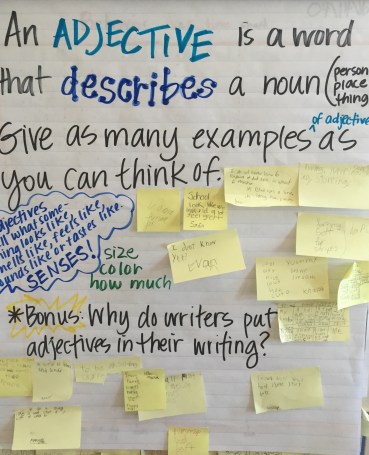
Writing Warm-Ups: Second Grade Debut

A couple of years ago, I tried writing warm-ups in 5th grade.  The idea was the same as our math warm-ups, and would give kiddos a way of getting their thinking ready for whatever my writing lesson was going to be for the day.  For some crazy reason I stopped doing these, and totally forgot about them.  Until this week.  And then I forgot again between Monday and Wednesday and finally remembered to try one on Thursday.  So this 2nd grade debut of Writing Warm-Ups only has two examples.  But hopefully they’re really great and that will make up for it. 🙂

Thursday

We are in the middle of a fiction cycle, and were to going to begin revising.  Our lesson on this day was about adding details into your draft and making the story more interesting for your reader.  This got them thinking about that before we started, and so when we read our mentor text and got into our conversation, they were ready.

FullSizeRender 74

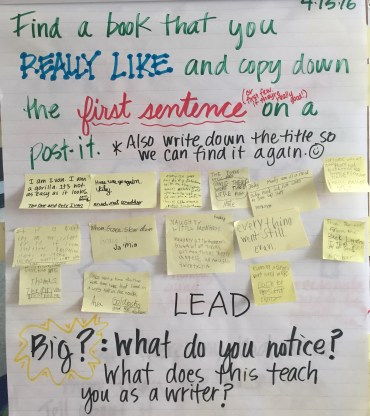
Friday

Can you tell what today’s revision lesson was about?  Yep–leads! And since I knew I’d want them to collect some good examples for us to use in our discussion, I had them do that as their warm-up.  Again, a win/win because it got them thinking, and saved time during our Writer’s Workshop since had already done that work.  They did a great job of paying attention to how the intros sounded and were able to make connections to how writers need to make their leads hook the reader so they’ll want more.  🙂

FullSizeRender 75

It’s only been two days, but I can already tell these are going to give us a really big bang for our buck.  Stay tuned–I’ll have more to share next week. 🙂


Second Grade Math Warm-Ups: Week of April 11-15, 2016

What? This week I did MWUs every day?  Partly that happened because we actually had every day this week at school, but also because I moved the MWU to a different time of day and it made the timing easier (sometimes mornings can get a little crazy and sometimes I have other things I need them to do instead).  Now (at least for the time being), we’ve moved Writing Warm-Ups to the morning and Math Warm-Ups to right after lunch, and that conversation is then the beginning of our math time together (that part is still the same).  Confused enough now? Don’t worry–the big deal is that I have FIVE MATH WARM-UPS TO SHARE!!  They’re pretty great, too, so I’m glad you stayed through that long intro to check them out. 🙂

Monday

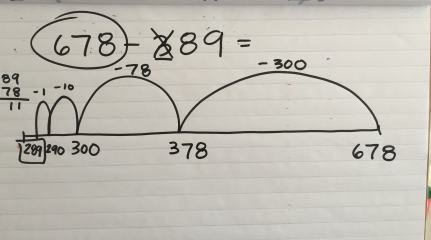
We have been working on subtraction lately, and my kiddos have started to do some amazing thinking with negative numbers as a means of figuring out differences.  It started with just a couple of friends a couple of weeks ago and now probably at least half the class has tried it!  The chart here is similar to the HTO model (which we called Sticks and Dots back then) we used in 1st grade, but connected to an investigation we did with the T-Shirt Factory and refers to the inventory of t-shirts.  The come in Boxes of 100, Rolls of 10 and then loose ones.  Same idea, but inside the context it makes much more sense.  Like most times, you’ll see we did it using two other strategies, as well.  The green numbers on top are from the strategy Making an Easier Problem, in this case by adding 11 to both numbers (which we know is possible because of the idea of constant difference).

FullSizeRender 50-min

We also tried it with Circle, Split, Subtract and modeled our thinking on a number line.
FullSizeRender 53-min

And check it out–we got 289 every time!

Tuesday

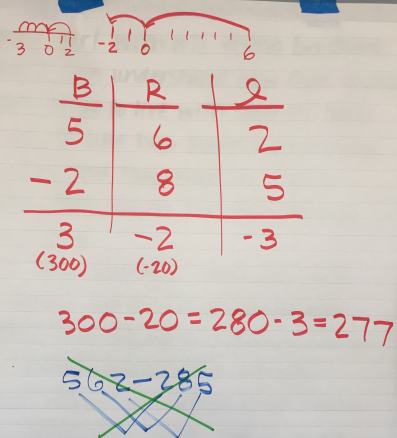
Another concept we’ve been playing around with is the inverse relationship between addition and subtraction.  This one also asked them to analyze someone else’s thinking.  We tried it by adding up…
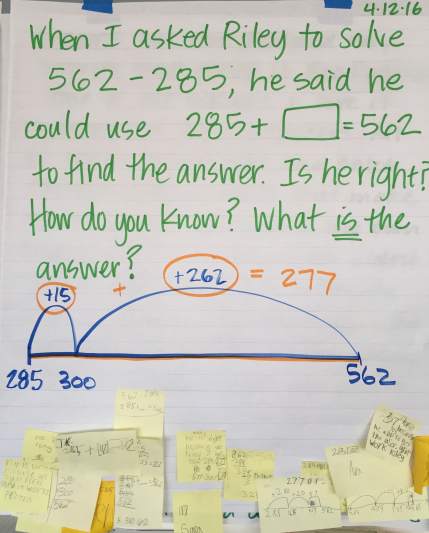
FullSizeRender 59-min

…as well as with our negative number strategy.  Again, we got the same answer both times!
FullSizeRender 57-min

Wednesday

On Tuesday during math, I gave kiddos a check-in sheet to see what they could do on their own with subtraction, now that we’ve been working on it for a while together, and the last problem was a challenge problem.  Ok, it really isn’t that much harder (just another place), but I wanted to see what kiddos would do when I added 1000s to our work.  Landen and Ava decided to that the BRL chart would probably work the same way if you just added another column, and suggested that we try it together as a math warm-up the next day.  Great idea, kiddos!

IMG_1443-min

Somehow I took my picture before we had done our work on the chart, so you can’t see it, but believe me–it worked just like they thought it would.  Oh, and when I was using this chart again with someone later that day, we decided that instead of just T for thousands (which doesn’t fit the context of the t-shirt story), we’d say T was Trucks, because you could put 10 boxes on trucks.

Thursday

We’ve been working on both geometry as well as subtraction in math for the last couple weeks (and some still also on money from our last unit), but I decided that we’d use the MWU as the start for our conversation by throwing up some geometry vocabulary I needed to emphasize.  So using examples and non-examples, I had them think about parallel:

FullSizeRender 73-min

They were able to figure out the meaning (for the most part), although many kept saying it meant “straight” and we had to clarify what they really meant, because ALL of those lines are straight….and while I don’t like math tricks, I did show them that in the word PARALLEL are clues to what it means: PARA for the PAIR of lines, and that the l’s make two parallel lines themselves (ok, well they do if they’re lowercase…see, told I don’t like tricks).

Friday

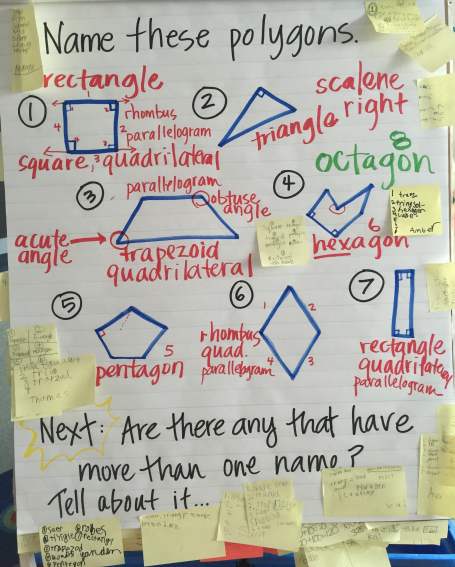
Today’s MWU was geometry again, related to work we’d done this week, as well as connecting to the work I knew I’d have them do during Math Workshop today.  Win/win! (Oh, and I realize now I mislabeled the trapezoid as a parallelogram.  Oops.  I’ll fix that on Monday. 🙂 ).
FullSizeRender 72-min

After this conversation we went on a great shape hunt challenge outside, but you’ll have to wait about it.  We’re not quite done yet.  🙂

Note: See that “next” on the bottom?  I’d tried many versions of that extra question this week on math and writing warm-ups.  It seems that when I put “bonus” there, kiddos thought that meant they didn’t have to do it. LOL  So I tried “next” and also “big ?” to help them see that they could do both of them. Or at least start thinking about the answer, since it would be what we’d be talking about anyway.


Mystery Skype–April 13 (#2)

Remember our Mystery Skype last week?  Well after that AMAZING experience, the first things that came out of my kiddos’ mouths were “When are we doing this again?”  That meant that I had to get busy because I needed to schedule another one for them! I tweeted out a request and quickly I got many requests.  One of them was today.  Here’s the story. 🙂

We are all about learning in Rm. 2o2 and so the first thing we did was reflect on the experience from last week and talk about what had happened.  I showed them the blog post I had written and asked them to think about what they saw.  We analyzed the photos and talked about what we would do the same and what we would change.  Some noticed that there were not pictures of everyone, and we agreed that the next photographers would make sure to get images of each job that we had on our list.

Next I showed them the video from our first try.  We did the same analysis and noticed somethings we could change.  Many of the “issues” just came from the fact that this was the first try at something like this for our videographer.  We talked about some technical things like shooting at people’s faces (and not their legs and feet), not moving the camera too fast (because it makes the watcher d-i-z-z-y!), not talking over the recording  and making sure–just like the photographer–to get the WHOLE room in the video.  We made sure everyone knew that we were only working on how to make our next try even better, not saying that anybody did anything wrong.

It was time to pick jobs and so we sat down to decide what each person would do.  After our debrief from last time, we had decided to add in Tweeters (check out the AMAZING job Mrs. Sisul, Ja’Mia and Makayla did today!) and Closers, so that made just two people doing each job.  Rather than the chart we made the first time around, I thought I’d try to start digitizing some things, so I made our job list in a Google Doc like Mr. Solarz’s example.   I just made a doc that we can add pages to for each MS (at least that’s my plan for now) so we can keep track of who’s done what during each session.

Screenshot 2016-04-13 19.58.54

I hope to start using a Google Doc for questions next time, too.  For today we hand wrote them and I entered it into the table:

Screenshot 2016-04-13 21.12.45

We had to go to PE right after this, but before we left, we agreed we should get everything set up, since we only had 10 minutes from when we got back until we got started.  I was SUPER pleased that this was what I saw them do:

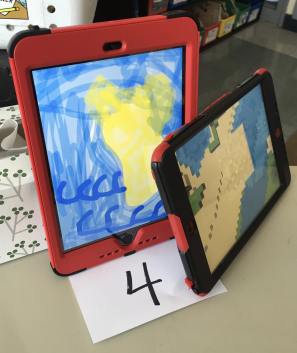
The Data Enterers had their area ready, the maps for the Researchers were laid out, the chairs for the Questioners, Greeters and Closers were in place and the Photographers and Videographers had their iPads raring to go!  Isn’t it amazing what 7-8YOs can do when they are motivated and have a purpose? LOVE!

Here are the photos we collected from our session today:

This slideshow requires JavaScript.

And the video.  Don’t worry–this one’s a bit shorter than the one from last time.  And you should get sick and dizzy either.  At least I hope not. 🙂

Then, when we were finished we sat down to debrief.  We said many of the same positive comments as last time, but I noticed many kiddos were a little unhappy about their jobs this time around.  Well, some of them were.  When we went through the assigning of jobs, obviously some kiddos got the one they wanted, and the others didn’t.  We talked about what to do about it, and we were divided about how to fix the problem.  We suggested that we could stay with our original jobs, since we felt that we had done a great job of finding the right person for each one (which we had agreed upon after we finished the first time around).  Not surprisingly, not everyone liked this idea.  We also considered just staying with the new ones we made today, since we didn’t really have time to reassign before our next scheduled Skype tomorrow morning.  Again, not everyone agreed this was the best.  Then, someone quietly suggested that we could trade.  He said, “What if I want a new job and so does someone else. Can we trade jobs?  That might work.”  BINGO!  Everyone loved this idea and so we quickly had the “traders” meet on the rug and most got a satisfying trade out of the deal and walked away happy.  Unfortunately, since there was an odd number, one person did have to stay with a job they don’t really like, but I’m sure it will all work out and next time she’ll be able to try something new.  Oh, and I had forgotten until now, but I would be remiss if I didn’t mention that one of the reasons someone gave for trying new jobs every time was “I like to make mistakes so I can learn something.  That happens when you try new things.”  HA!  Pretty amazing, right?

And you know, as fun as this is, and as much as it reinforces geography and inquiry and does loads for engagement and motivation, I just love watching what happens when you get out of the way, let kids do their thing and they run the show in ways that are far beyond what you’d think the realm of 2nd graders would be.  But then again, I continue to see it over and over, so I should stop being so surprised, right? 🙂

Design Challenge: Landforms

Last week we tried a challenge in Science where kiddos had to create a representation of a body of water.  Since then, I’ve heard multiple times “When are we doing this again?”  Then, when my friend, Mona, asked me if I was planning on doing the same thing with landforms I knew we just had to!

I didn’t want to make the situation exactly the same, however, so I thought of ways I could change the parameters to up the level of the challenge.  Last time, students chose their own group, as well as the materials they used to build.  It was great that somehow everyone chose something different and there was no arguing about who used what.  That doesn’t happen a lot in our room, but I was super glad it didn’t come up here.  So this time I again let them choose who they worked with (which because of numbers was groups or 2 or 3), but there as more chance in both their landform AND their building material.  I wrote the choices on index cards (very high tech, I know) and put them in two cans.  Each group chose one from each container.

I was impressed with how easily kiddos accepted both of the cards without complaining.  Again, not much of that happens with Rm. 202 friends, but I was pleased with how quickly they got to work planning their next moves.  After about 3-4 minutes, most were ready.  There was only one pair who did fuss a teeny bit about how they’d be done really fast and how their cards were not a challenge.  We talked about how that meant that they needed to figure a way to challenge themselves, ask themselves “What could we do differently than we had originally planned?”

Much like last time, they had 25 minutes to work on their representations and then we’d do a gallery walk to see if we could guess what everyone had created.  They were to work for the entire time and had to use their assigned medium, but other than that there weren’t too many rules.

Ok, here’s your chance to see if you can figure out our landform creations, and then I’ll give you the answers.

IMG_1219-min

IMG_1220-min

IMG_1221-min

IMG_1226-min

IMG_1223-min

IMG_1224-min

IMG_1225-min

What do you think? Did you guess them?  Here are the answers:

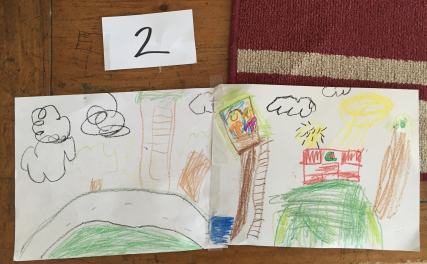
  1. plains
  2. hills
  3. valley
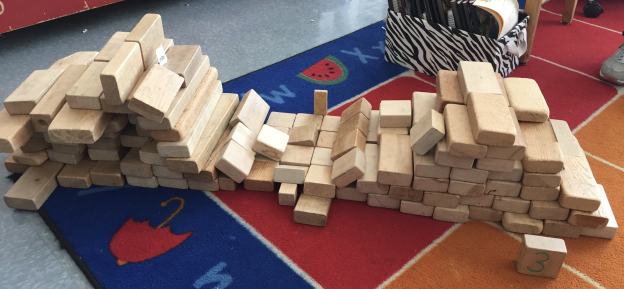
  4. barrier islands
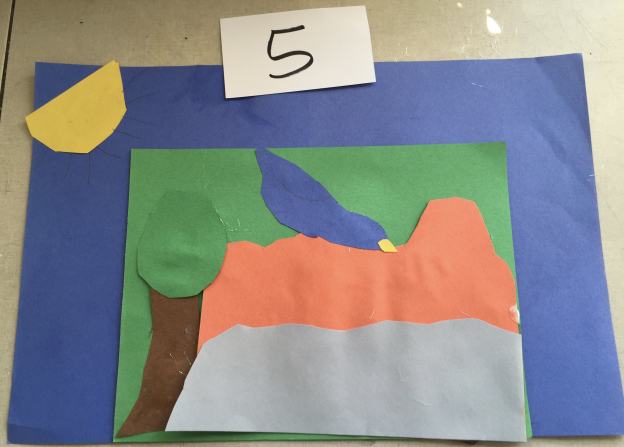
  5. canyon
  6. plateau
  7. mountains

We love how building challenges work for learners in Rm. 202, and we want to know how they work for you.  Any stories to tell us?  What suggestions do you have for future design challenges we could try?


What’s in Your TBR Pile?

Many, many years ago I was a presenter for Project Construct.  I had a super responsibility of teaching Missouri teachers about how to incorporate Readers’, Writers’ and Math Workshop into their classroom routine.  It was during this time that I learned about “nightstand books” and TBR piles.  Oh, you know, that 12-inch stack of books that sit next to your bed so you have them ready to go when you have a few minutes to read before bed?

Well, often my pile sits elsewhere than my nightstand, but for sure it’s always there.  And sometimes it’s taller than 12-inches.  Like in the summer when it’s about as tall as my 5-YO (she’s 40 inches right now, by the way. 🙂 ).  My current TBR pile looks like this:

IMG_1175 2-min

Anyhow, after we had learned about recipes and how they help guide us with book choices, we talked about something else readers do–make plans.  I started our conversation by asking a simple question: Why do people make plans?  I didn’t specifically say readers at this point because I wanted them to think broader and try not to guess my specific plan for the day just yet. Kids turned and talked to their partners and came up with SUPER ideas.  They connected this to how builders use blueprints and how important those are to making the building look “right” in the end.  They mentioned how writers make plans so they know what their stories are supposed to be (can you tell what we’ve been doing in Writers’ Workshop lately?).  They talked about how plans keep your organized and help you know what to do.

After that great start, it was easy to then expand the idea to how readers make plans for what they will read next.  This allows them to move smoothly from one book to another, without wasting reading time wandering around the library.  It helps readers think critically about what they want to read and why (I explained to my kiddos why each of those books is in my pile), and to be more purposeful in their choices.  This becomes especially easy if you choose books that are in a series, or if you “trust an author” and read all the books that they’ve written. I can TOTALLY do this with Ralph Fletcher, Sharon Creech, Jerry Spinelli, Joan Bauer and Liane Moriarty.

Kiddos had a great time trying out this strategy, and then send me their lists when they were finished.  We’re going to use them now and I plan to hold kids accountable to try out the books they put on their list.  While they can change, these piles (which are saved as pictures/notes on their iPads) help them think ahead and more purposefully use their time both in the classroom and at home.  I’m excited to see how they continue to help us grow as readers through this year and even beyond!


Recipe For a Good Book

I remember vividly the first time I ever taught about recipes in my classroom.  It was towards the end of the year, when I was teaching 4th grade (ok, I don’t remember the exact year–maybe 2006?–but I do remember the kiddo!), and during a reading conference a kiddo was struggling with finding a book that was a good fit for her.  For some reason I was thinking about how what she really needed was a plan–a recipe–for how to find a good book for her.  And since that first conference so many years ago, I’ve found that this lesson is one that almost every kiddo (and probably some adults, too!) could find helpful.  I went back to look at when I had written about it here, and I found this post from about 4 years ago.  Rather than try to explain the whole thing again, I ask you to take a few minutes and read about it from back then.  Really, I’ll wait. It won’t take long.  Just come back when you’re finished and I’ll tell you about how it worked in 2nd grade the other day (See? Told you all kinds of kids could benefit from it!  I think I’ve used it in every grade level I’ve taught over the years, and even for myself!) 🙂

Are you back?  Well, like I said before, this issue seems to come up every year and now that I think about it, maybe that speaks to the lessons I teach at the beginning of the year on how to choose books.  I wonder why they aren’t “sticking” and why kiddos eventually need this secondary explanation of “good book” recipes.  I wonder if it has to do with the fact that they change so much as readers over a given school year (especially if they are younger readers, or struggling readers making big gains) and so the books that were just-right or “good” for them in August are certainly not the same for them in March.  I guess like anything else, as well, just telling them once probably isn’t enough.  Perhaps I should find a way to incorporate book choice lessons into every unit that I teach.  In many ways choosing a just-right fiction book is very different from choosing a just-right non-fiction book anyway.  Oh, and I feel like I should mention that my definition of “just-right” book doesn’t have so much to do with a level as it does with student interest, motivation and desire.  All of that other stuff can be worked on once you help them find THE book for them.  Many times the kiddos who first need my recipe lesson are ones who don’t really see themselves as readers yet.  They don’t really know what to do when they’re standing in the aisles of the school library or looking at the buckets in our classroom library and need a hook to get them started.  That’s really what I’m thinking about when I help guide them here.
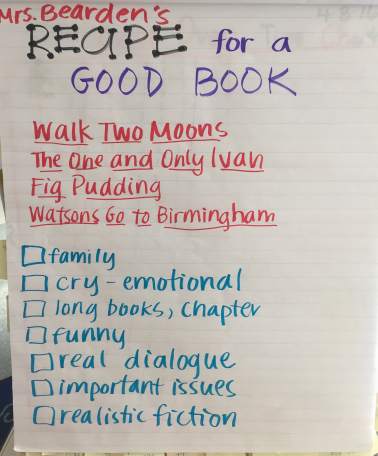
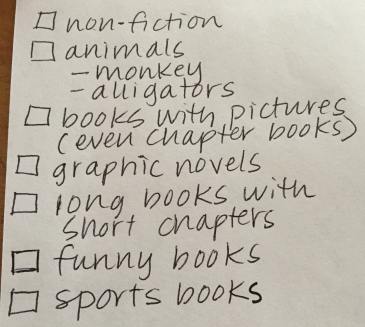
Ok, well, just like it happened in that example from 5th grade many years ago, I had a conference with a kiddo the other day who needed some guidance to find his version of a good book.  We talked about books he has read that he really liked and what it was about them specifically that he liked.  We used those things as our “recipe” and wrote them down:

FullSizeRender 30-min

This now becomes a shopping list when he’s in our classroom, the school library, the bookstore, the book fair, the county library, etc.  The big idea is that if he knows what he likes he knows when he’s found it.  This is a HUGE idea that kids often miss.  They so often just wander through the shelves not really knowing what they’re looking for, expecting that they will just know what it is when they find it.  It’s like traveling to a new place without a map AND without really knowing your destination.  You will NEVER get there.

Well, after this first conference, I ran into two other friends in the same day that needed the same lesson and so it quickly got moved to my “everybody-needs-this-as-a-mini-lesson” list.  I then showed everyone in Rm. 202 the plan the next day by sharing my own example:

FullSizeRender 49-min

Not everyone is necessarily ready for this right now, but everyone had a go at trying their own list and we will tweak over the coming days as they practice using it for book shopping.  The great part is that it is customizable, personal, and specific to each reader.  And it can be easily changed as they change as readers.  LOVE!

Second Grade Math Warm-Ups: Week of March 28- April 1, 2016

We were continuing with our study of subtraction this week, and so all our MWUs are related.  Happy calculating!

Monday

This one is just to keep our brains fresh about money and time, since we’ve “officially” moved on, but that we obviously should not forget. 😊

IMG_1092-min

Tuesday

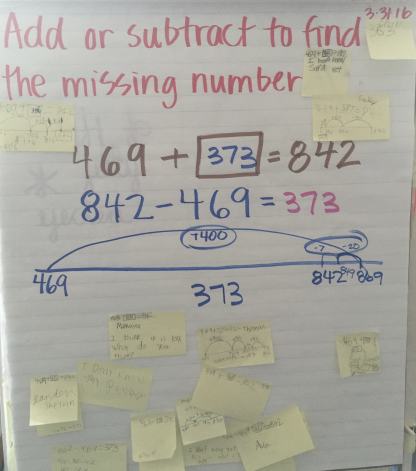
This problem pushed my kiddos to think about the reciprocal relationship of addition and subtraction.  I had to remind many of them how this could be solved with subtraction, but we had a great conversation once I convinced them it was possible.  The strategies are ones we had been working on in Math Workshop lately.

Wednesday

Just because, you know, I don’t want them to forget how to add…:)

IMG_1088-min

Thursday

Tried this format again because I wanted to see what they remembered.  The great question after we modeled our thinking with the number line was “Where is our answer?”  This one took a few minutes for those that still didn’t see the connection between the parts and whole, between how we could either add or subtract.  It was also surprising (still) to some that the answer to the second equation is the same.  Ja’Mia had to convince us of you she knew.  And yes, she was able to do that by telling us about how addition and subtraction are “opposites.”

IMG_1087-min

What would you add to this week of warm-ups? 🙂

Lego Challenges With Mrs. Sisul

We had an amazing 1st-day-back-from-Spring-Break today!  Our principal, Mrs. Sisul, has been learning about engineering and STEM with Legos, and volunteered to come set us up with some Lego challenges if we were interested.  Well, yes, of course, Rm. 202 friends were interested!  Luckily she was free this afternoon and came on up with her big ‘ole box of Legos!  Check out what happened! 🙂

She started with a quick reminder of what STEM means (Science, Technology, Engineering and Mathematics), and then introduced what we would be doing: every kid would get a card with a challenge and they would work to do that challenge with Legos.  Pretty straightforward, right?  Well, they she led us through a great line of thinking about how we work best, and how kiddos would have the choice of how they tackled the challenge: alone, with a partner, a group of 3, a group of 4–whatever worked for each kiddo.  She shared her example that she knows that as a learner she likes to be able to bounce ideas off of another learner, and so she’d focus on finding another person to work with.  She asked me to share my strategy, and I talked about how I knew that that plan would DEFINITELY not work for me.  I am the kind of learner who needs to process and plan by myself first, and then I might want to work with someone else to blend ideas, get a critique or ask a question.  I know that if I went with a partner right off the bat, I wouldn’t have anything to share with them–so if I was Mrs. Sisul’s partner, I wouldn’t be a very helpful partner!  Right off the top I could tell that Rm. 202 kiddos were thinking about what would work for them, and they knew what would be best.  We had all sorts of groups–singles, partners and groups of 3.  Some kiddos worked alone, but right next to another friend so they could get feedback that way.

Ok, once teams were developed, Mrs. Sisul gave the guidelines for how kiddos would get their Legos.  She walked them through a planning session where they were to really think through what kinds of Legos they’d need.  She would call names of kiddos 3-4 at a time, and they’d have 30 seconds to “block shop” and then get started.  Once everyone had an initial visit to the pile, they were free to come back for more.  And since it would be virtually impossible for me to explain the amazingness with which these kiddos followed this protocol, I had to record it.  Check out what it was like when Mrs. Sisul dumped the Legos:

Once we got started, I roamed around and got some footage of them working. I know, kiddos wanted me to do the challenges, too–but I couldn’t document it to share with you if I did that!  Maybe next time. 🙂

Here are some videos that share more of their thinking while they got started:

This one has some great thinking about what happens when things are hard (which this was for some of us!):

There’s one more, and it’s really the one I’m the most tickled about.  It’s an example of what happened in our room when we put 20 kids and 2000 Legos together.  I want you to think about what you see first, but then I’ll tell you why I liked it:

As I watched this video, I noticed these things:

  • quiet voices
  • pleases and thank yous
  • kiddos finding pieces for others
  • sharing
  • everyone just taking what they needed
  • no one grabbing, hogging or arguing
  • kiddos respectfully letting others into the circle
  • focus
  • engagement
  • motivation
  • laughter
  • encouragement
  • respect for self, learning, others and the environment

What did you see? (Please leave us a comment and let us know–Rm. 202 kiddos would LOVE to hear what you thought and would LOVE to know you watched their super hard working!)

Ok, I know you’re wondering what some of those challenges looked like, and how they tackled them.  Here are some examples.  And yes, they told me I could. 🙂

This was definitely one of those touchstone moments in our classroom that we will return to for many days and weeks to come (darn, I only wish we’d done it earlier in the year!).  I know that we walked away with many things (and I hope to share what those were in THEIR WORDS soon), but one of them definitely was that there is not one way to solve a problem.  We could each access each of these challenges in our own way, and use whatever skills, ideas–and Legos!–that we wanted to in order to achieve our goal.  One friend even decided to do the same challenge twice to make it even harder for himself!  We are builders and thinkers and problem-solvers in Rm. 202 and this was definitely right up our alley!  Come back any time, Mrs. Sisul!

Second Grade Math Warm-Ups: Week of March 7-11, 2016

This week was a FULL one!!  It was also another great example of how these warm-ups were meant to be used.  I know…wish it was always like that.  But anyhow, they were all directly connected to what we were doing in Math Workshop, and gave kiddos a great opportunity to think about the work we’d be doing later on in the day.   It was really cool to watch how their understanding would be deeper when we debriefed later on, or when they had a chance to discuss the problem with their partner or a small group.  Also, since they are connected to our regular math work, I have lots more to say about many of them than I will do here.  But that’ll be in a later post, so be sure to stay tuned!!  Here you go!
Monday

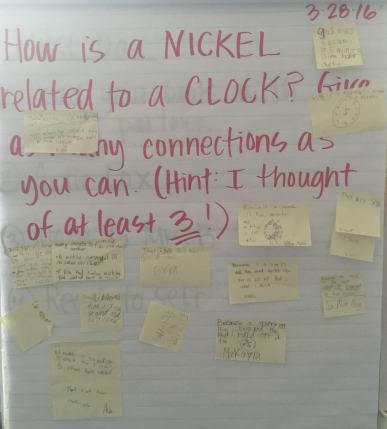
IMG_5782-min This one is related to the work we’ve been doing with The T-Shirt Factory, and would help them with the work they’d do later on with breaking up larger numbers into smaller groups.

Tuesday

IMG_5786-min

Wednesday

So we didn’t get a chance to discuss the problem all together on Tuesday, so I analyzed their answers on my own, and instead used their post-its to help me build the problem for Wednesday morning.  It was based on our work the day before in Math, as well as their answers here.

Thursday

This one was asked with the idea of stretching their thinking for later in the day about how a number can be broken apart.  Up til now, kiddos have typically just been thinking about a number in terms of hundreds/tens/ones.  I wanted to nudge them into thinking about a number in a variety of ways, using the parts to compensate and make problems easier.

IMG_5787-min

These were two close-ups I needed to share.  The first was just so you could see more of their answers to this one–they almost all connected this question to the work we did on Monday, even though I wasn’t sure they would.  Nice!  The second is just a great example of grit in our classroom.  Kiddos know that they are not to write “I don’t know” on a post-it; they always have to try something.  Often we use the stem “I don’t know yet, but here’s what I”m thinking right now…”  Do you see what Ella Marie wrote there?  Love it: “I have no idea what you mean by this, but I will do what I think you mean….76 is 70 and 6.”  This is a great example of trying something she isn’t sure is right, but that she feels safe enough to take a risk.  🙂

Friday

Again, this was connected to our work all week, and I wanted a way to take a little assessment, so they turned their work into me rather than putting it on the post-its like normal.  This will help me as I group and plan for our next days….after Spring Break!!

IMG_5793-min