#FDOFG–Got GRIT?

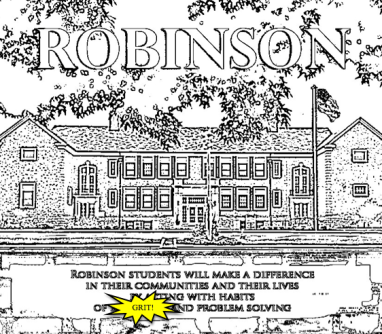
If you’ve read our Robinson Mission Statement (or if you’ve listened to a Robinson kiddo or teacher talking lately), then you know it mentions GRIT:
Screenshot 2016-08-22 21.58.05

and our kiddos know that you gotta have GRIT, make mistakes, try again and work hard in order to learn and be successful.  And so this being true, this is a topic that it is important to start talking about (and practice using!) early in the year.

We started the other day by talking about that the word GRIT meant to my new friends.  I was SUPER impressed with what they already knew; even as kindergarteners, these kiddos were learning about and applying this big deal concept.  Check out what they said during our first conversation:

IMG_3178

I was especially impressed by the way Mara explained GRIT as having “enough courage to do something even if it’s hard or you’re scared.”  It’s like being brave!

We used another fabulous classroom tool to practice this idea (and one that my friend and teammate, Mrs. Marks, reminded me about the other day): puzzles!  I had been collecting them all summer with the intention of bringing in new ones for this year’s class, so when I saw the AMAZING job Mrs. Mark’s first graders had done with working hard and being gritty with puzzles, I knew this was the way we’d be gritty, too!

Kiddos were able to choose a partner and a puzzle and they got busy.  We worked for a pretty big chunk of time, and while we worked pretty hard, not many of us finished–which is TOTALLY ok for our first try!

We did have one puzzle that was completed by Kaiden and Jack, though–check it out!

IMG_3165

Now, don’t get me wrong–this doesn’t mean the rest of us weren’t being very diligent puzzle-makers and working with our partners well, but I did hear many kiddos say “This is hard!” and “I can’t do this!” or “There are too many pieces in this puzzle!”  It seems like we need to keep working on our self-talk, our problem solving about what to do when things are hard, and even with what we can say instead of those negative explanations.  Later on this week we’ll going to start talking about YET, and I am sure that this will be helpful to my first grade friends.

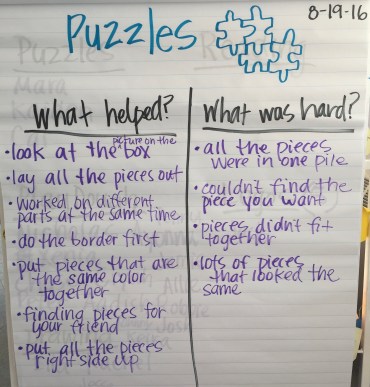
We also debriefed on the activity, marking what was helpful and what was hard.  This will also guide our thinking the next time we do puzzles (or encounter anything that’s hard!).
IMG_3179

I can’t wait to share with you what happens the next time!


#FDOFG–Guided Discovery: Play-Doh

On Open House night, I had up a wish list that families could grab from and donate items to our class if they liked.  One thing on the list was play-doh.  I hadn’t ever asked for it before, but got the idea from another teacher, and thought I’d give it a try. Play-Doh is one of those things (kind of like Legos and blocks) that can be used in so many ways.  Thanks to the Ella and her family, we got a huge box of Play-Doh a couple of days before school started!  THANK YOU, KOHRINGS!!

On Thursday is was time to whip it out and discover what we could do with it!  Part of a guided discovery is for kiddos to just play and have fun, to figure out what they can and want to do with a certain item/manipulative.  So after we went over some basic guidelines (only use the color from your can, keep it on the table, be sure to clean up all the bits and pieces when you’re finished, etc.) Rm. 202 kids got the first 5 or so minutes to do whatever they wanted.  Then we spent some time using the Play-Doh to share some of our thinking.

Kiddos were asked do create something that represented the following things: 1) their FAVORITE thing to do when they aren’t at school (by the way, lots of Rm. 202 kiddos made TVs), and 2) their FAVORITE thing to do at school.

Then I had kiddos make their names.  Not a hard thing, really, but some kiddos needed encouragement with figuring out how to use the amount of Play-Doh they had to make the letters they needed or to shape the “curvy” letters so we knew what they said.  Some kiddos had time to make both their first and last names, and we even had a couple of Rm. 202 friends share tips for how to make their dough super flat (Allie used her forearm, and Peter used his fist and pushed real hard!).

This slideshow requires JavaScript.

I was excited for how they were excited, as well as for the things we learned about each other during this seemingly “easy” activity.  It’s a first time I’ve done an intro survey this way, and am glad that I did.  After we had had a chance to investigate and play, then Play-Doh then became a choice during afternoon choice time. I’m excited to see the other ways we’ll use it to represent our learning as we go further into the year, too!

Students: What did you make with your Play-Doh to show what you like to do outside of school?   What did you find that was easy about this?  What was tricky for you?

Parents: What did your kiddos tell you about our Play-Doh investigation?  Were you surprised with what they made? 

Teachers:  What ways have you used Play-Doh in your classroom with your learners?

We’d love to hear from you!!

#FDOFG–First Grade Friends

It’s the first days of first grade, and like in any grade (or any place where there are new groups of people who don’t know each other well yet), there have to be lessons on how to be a good friend.  We did this with a book (or two…or three), and then we charted what we noticed.   We then spent the rest of the day purposefully doing things WITh our friends, then noticing which of those “good friend” things we were doing.

We started with the book Scaredy Squirrel Makes a Friend, because our friends in Rm. 203 came and shared it with us.  Yes–their WHOLE CLASS came over and shared the book with us because they thought we’d like reading it. (Which, by the way, is another message Ms. Turken and I had discussed wanting to sent to our classes: Readers share books they like with their friends!  So, ok, we had coordinated this beforehand, but then we did the same and shared our Box book with them when we were finished with it. 🙂 ).

Screenshot 2016-08-21 15.20.18

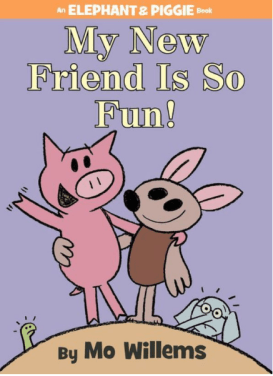
We also read an Elephant and Piggie book (don’t you love those??) called My New Friend is So Fun! and talked about what we know about how good friends treat each other.

Screenshot 2016-08-21 15.28.46

We made our chart…

IMG_3174

…and Jamie had a super idea that we keep going back to the list to check ourselves throughout the day.  Then Kaiden suggested that we make a note because I mentioned that I might forget.  See his post-it up there!?  What great 1st grade thinking already!!

Our next chance to practice our “good friend moves” came next when we went outside for recess.  We talked before we left about goals we had to do the things on the chart, and then we got busy having fun and being friendly!

We read a couple of more books…

Screenshot 2016-08-21 18.07.21

Our friend, Rachel, shared this one because she enjoyed reading it with her mom at home, and she thought we’d enjoy it, too.  We sure did!

FullSizeRender 2

Kaiden thought this would be a good one and he was right!!  

…and talked about examples of “good friend moves” we found in the books.  We learned a lot from Louise, Peanut Butter and Jelly (yep, she’s in that book at the end–sorry, spoiler alert!).

After Day 2 (when this work started), we continued to come back to our work over and over.  We did things with our Room Crews (which I’ll show you in another post), and focused on things we had in common.   Each group made a web of things that everyone in their group had that was the same.  We practiced using kind words, asking good questions and working together.  Taking turns was important, and so was using quiet learning voices so everyone could concentrate.  Wow–who knew that being a friend was such hard work?!

After we shared in our small groups, we connected with the whole class and we figured out that a lot of us had things that were in common.  The next step was to do the same procedure, but with things that the whole group DIDN’T like.  They thought that was a fun twist, and they did a great job.

Obviously this is the first but not the only time we’ll talk about being friends.  I have been so impressed, though, with how kids have stepped up and are demonstrating the behaviors on our chart.  I know we’ll only continue to add to the tally marks and the “moves” as we go forward.  I can’t wait to share our progress.  Here’s to being great first grade friends!

#ISWAYR–Take 2

Last week I finally decided to update my reading progress after I had had actual time to sit and digest some really good books.  I changed the typical meme It’s MONDAY What are You Reading to SUMMER and jumped in.  My favorite picture was the one where my TBR pile was up to my knees! Remember?  As of last night (when I finished a book in a half hour!), my pile is half as tall.  LOVE seeing the progress.


So, to update you, this week this is what we read…

This year I have more picture books in my piles than I usually do.  Partly because since I’m in primary again I need to try out some new titles for my class this fall, partly because picture books are awesome, partly because I have had many great ones recommended to me lately, and also partly because they are quick. 🙂

When I was at the Scholastic Reading Summit a couple of weeks ago, I was reminded (by Colby Sharp) of a book I had meant to read, but hadn’t yet.  And since I had first been introduced to it, it had become a Caldecott winner and so there was another reason why I needed to enjoy it.  It was kind of a long story, but Colby told a great story of how his class does its own Mock Caldecott unit, where they vote for their favorite, and they were SURE that this book should win.  And then it did!  He even shared a heartfelt video from the winning illustrator herself, Sophie Blackall.  I was already sold on the book, but this just added to my interest.

And in case you don’t know, that book was Finding Winnie: The True Story of the World’s Most Famous Bear.

IMG_2450-min

What a joy to be able to read a book with that shiny gold sticker!!

This one was instantly a hit with my kiddos, and somehow it was a story I had never heard!  I guess I had never been a huge Winnie the Pooh fan, so perhaps that’s why, but whatever the reason, this was a great story to learn.  And of course, the pictures were BEAUTIFUL.  I think that’s possibly what I liked the best: the story and the illustrations were equally magical, making for a beloved book that we will surely return to again and again.  This book was made to be reread over and over and over.

And so on today’s list of to-dos: another trip to the library to see what new treasures we can find!

What have you been reading? How tall is your TBR pile?? 🙂


Rm. 202 Kids Take Over–Read Aloud Take 2

I am so excited with what’s happening in our room with Read Aloud lately.  The level of excitement, confidence and pride that is present because of all of these super 2nd grade readers sharing their skills is definitely impressive.  Some kiddos have even signed up more than once on the calendar!!

The only thing I have to say that makes me really sad is that there are couple of kiddos who only have pictures (rather than videos) because my devices were not cooperating on those days.  I HATE that, because everyone of them has done a SUPER job, and you’ll miss them.  Just take my word–every read aloud has been A. Maz. Ing.

Gotta share that chart that she used, too. 🙂  It needs some edits (so please look past the typos 🙂 ), but it was such a great idea that she came up with on her own.  She was very prepared for her lesson. 🙂

IMG_1624

Please take a minute to leave a comment for our brave, super talented, 2nd grade readers! Way to go, Rm. 202 kiddos!

Design Challenge: Earthquake Proof Buildings

A week or so ago I saw this tweet:

Since we had been studying slow changes and fast changes in Science for a while anyway, it made perfect sense to try it out!  And unfortunately, there had also just been some major earthquakes in both Japan and Ecuador that same weekend, so the idea of creating earthquake proof buildings was a real life one to solve.  And yeah, it would be fun. 🙂

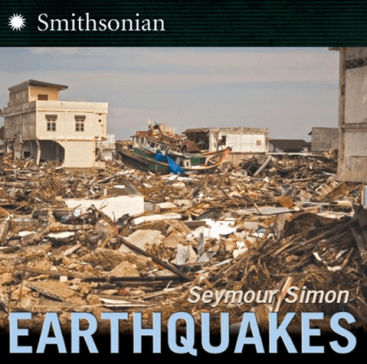
We began by reading a pretty great Seymour Simon book on earthquakes to gain more information, and answer any questions that might come up about how they work.  Knowing exactly what happens helps us build stronger buildings that would withstand the tremors.

Screenshot 2016-05-01 21.37.27

We talked and discussed and made predictions and inferences.  Then we got with our partners and planned–most on paper and some with some help from their iPad.

Then we got busy building.  The 1st building part was actually spread over two days (an afternoon and then the next morning) because we ran out of time.

This slideshow requires JavaScript.

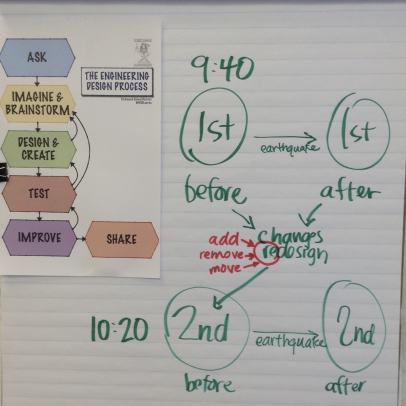
We used this design cycle protocol to help us know what to do, and wrote down the timing so we could keep on track.

IMG_5810-min

Some even tried out their prototype on the earthquake machine before the “real” deal.  They got some ideas about redesign or shoring up their foundations.

Caught some groups in their planning stages:

We took videos of our trials, and many kiddos voiced their ideas for redesign in their recordings.  We all did some writing/thinking about it, but I’ll share those in another post, since after I add our videos, this piece will already take you 7 hours to read it!  Thanks for hanging in there–it’s worth it, I promise!!

Charlie, Evan and Joshua


Ella Marie and Emily


Millie, Amelia, Ja’Mia and Tyrin


Makayla and Ava


Amber, Sara and Thomas


Peyton, Baron and Landen

Forces that Shape the Earth: Slow and Fast Changes

I shared some building challenges we had done a couple of weeks ago, where we solidified our understanding of both bodies of water and landforms.   We still had some thinking to do, as well as demonstrating that we understood the difference between slow changes and fast changes that happen on Earth.  Besides using things like Legos, big blocks, pattern blocks, and other things to build with, we often incorporate art into our science and social studies work and represent ideas with pictures.  This was one of those times.  It was a mural/collage project, much like these that have happened in 5th grade (with both regular units as well as with test preparation).

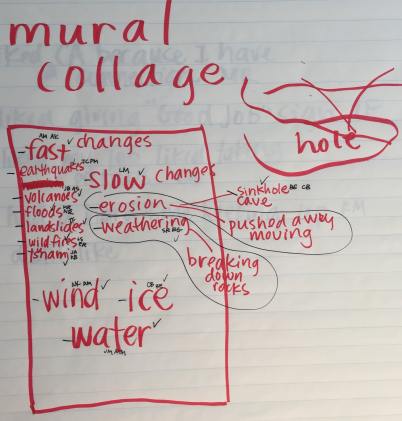
Our first step was to jot down what we remembered about slow and fast changes we’d already learned about.  We made this chart together:

FullSizeRender 147-min

We brainstormed what we knew about the difference between slow/fast, as well as examples of each, and the causes for these effects on the land: wind, water and ice.  Their directions were then to create a representation (2D with paper and other art supplies) that everyone could recognize and explain when they looked at the poster.  No words (except for the two parts of EROSION and WEATHERING since these were important vocabulary terms) were allowed.

While kiddos worked, they went through the design cycle as they planned, created, tested (by sharing their representation with another group or two to see if others could recognize the concept they were trying to display), redesigned and then shared by putting their creation on our poster.  This mural did a couple of things for Rm. 202 learners–helped them solidify understanding of concepts, demonstrate that understanding, as well as remind them of that learning as they connect the picture to the idea in their heads.  I plan on using the images on this poster as a part of our assessment at the end of the unit (I just haven’t fleshed out exactly what that will look like yet…still in the design phases!).

Here are the images on our mural.  Can you tell what each of them represent?

FullSizeRender 139-min

Each one up close.  Half are slow changes and half are fast changes.  Oh, and there is one image that we thought was an example of both:

I was really impressed with the diligence portrayed while they worked on this project.  There were a couple of pairs who had to go through 2 or 3 versions of their creation before they figured out one that made sense to someone but themselves.  There was lots of cooperation and suggestion that happened during our work session, too, as kiddos bounced ideas off each other, shared supplies and asked other pairs for help.  Another example of an engaging, motivating and focused way to practice science without pencil/paper or just reading about it.  Way to go, Rm. 202 scientists!

If you want, leave us a comment about what you think our pictures are images of.  We’d love to share our learning with you.  What questions do you have?  We’re becoming experts on these ideas of forces that shape the land! 🙂

Second Grade Writing Warm-Ups: Week of April 18-21, 2016

This was our second week of second grade writing warm ups, and they have been just as successful as they were when I first started them in 5th grade (remind me of this for next year when I forget that again, ok? LOL).

We’re in the drafting/revising/editing part of the writing cycle, so that is reflected in the warm-ups I had them try this week.  Check ’em out!  We’d love to know what you have to say about them, too, so leave a comment when you’re done! 🙂

Monday

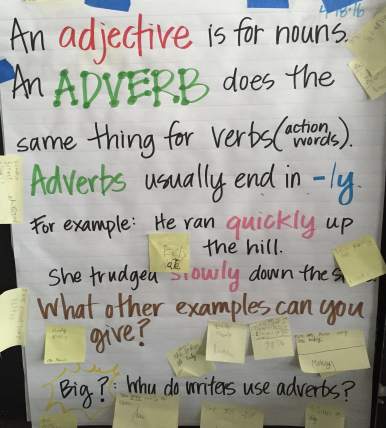
This warm-up goes with the one we did last Friday, as we added details to our fiction with adjectives.  And yes, I quickly realized there were WAY TOO MANY WORDS on this chart, when someone’s first response was “Wow–that’s a lot….”  Oops.  I think they got it, for the most part, though.  Since this day we’ve been recognizing them everywhere and talking about how they help the reader.  Many have added some to their drafts.   I’ll revise for next time.  🙂

IMG_1514-min

Tuesday

This question is obviously very general, mainly because I knew that our focus in Writers’ Workshop this day would be to finish up (hopefully!) what we’d been working on for the last few days (rather than something new).  We had a design challenge planned for pretty much the whole morning and so our time would be cut a little short for writing, as well.  It also helped me get a better gauge on where everyone was with their drafts.  There are a couple of post-its that say “I haven’t revised yet.”  These friends obviously needed more time!

IMG_1513-min

Wednesday

I tweeted this picture after we did on it, because I was so impressed by the work they had done on it!  The endings they chose to post were really thoughtful ones, and then our synthesis of what makes a “good” ending was also great thinking!

FullSizeRender 127-min

I had them finish this stem “A good ending…” and this is what we decided upon:

FullSizeRender 126-min

We had a great conversation about how a “good” ending is not any one thing, and that it depends on the story you’re writing, as well as your goals for how you want your reader to respond to your text.  Notice the adverb that someone pointed out from our conversation on Monday. 🙂

Thursday

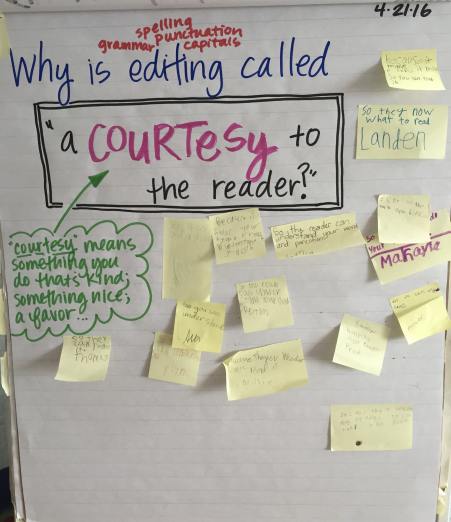
I’m not even sure where I learned that phrase, but long ago I was taught that about the idea of editing being a “courtesy to the reader.”  We touched on it at least a little last year in first grade, but I wanted to get their thoughts on it now, as we began editing our pieces for publishing next week.  And since I knew they might need help (or at least a reminder) with what courtesy means, I added it to the question.  They had great suggestions about how it helps the reader understand your message, as well as making it so they know what to read and how to read it, but we had to really focus our conversation in on HOW to do that.  Many 2nd grade writers still talk a good editing game, but don’t always show that knowledge in their actual final drafts.  We’ll continue to work on that next week as we finalize our published texts.

IMG_1509-min

What did you work on as a writer this week?  What do you think of our warm-ups?  How would you have answered them?

Rm. 202 Kids Take Over–Read Aloud!

Last week I was having a reading conference with a friend, and as we were talking about TBR piles and good book recipes, another idea came to me that would help one reader, and then in turn many others: kiddos doing read aloud.

As I continued to talk to this friend about books, I suggested that he choose a book from his new TBR pile to share with the class.  We talked about how he would have to prepare to do this, including practicing holding the book up so that everyone could see the pictures.  It was totally picture-worthy while he was working.

And maybe the best part was when he turned to me and said, “Wow, this is hard.  My arm hurts!  Is it hard for you, too?” We had a great little chat about how teachers have to have strong arms. 🙂

He continued to work and was ready to present to us.  Man was he excited!

Check out the stories he shared with us:

Well…as you can imagine, this sparked interest by many other people to be able to share with us at read aloud time.  And what a great idea, as I considered all of the many things kiddos learn on both sides of this opportunity.

We began to schedule read alouds in a couple of ways: I gave some friends the assignment based on books we were reading in our small group together, and some friends just began to request a spot.  And since then it’s become a “have-to” for everyone.  It’s just such a good idea that we (ok, probably I) decided all should participate!

Amber took the next turn, and did a super job of matching up to what my lesson would have been that day anyway–good readers use evidence from the text to support their thinking.

Then on Friday, Emily took her turn and taught us about fiction/non-fiction (as well as using some pretty great teacher moves for management!) with The Little Work Plane.

Now don’t worry if you don’t see your favorite Rm. 202 friend in this post–each will get their turn.  While I had originally never intended to take this path with readers in our room, it’s a SUPER example of how organically ideas come up for us, and how kids’ ideas are often the BEST ideas! Thanks, Rm. 202 kiddos for taking chances, learning new things and then sharing that learning with the rest of us!

Mystery Skype–April 14 (#3)

We’re on #3 Skypes in about 2 weeks!  YEHAA!!  Today was the 2nd in two days!

Like last time, we had jobs, but at the end of the last session we decided to trade.  Unlike last time, our camera worked, though (did I mention that?  They were Skyping with a blank screen the whole time! 😦 ).

By the way, this post has made me think it might be a good idea to start a new page just devoted to Mystery Skypes.  Would make it easier for us (and everyone else!) to find the archives when we need them.

This was another great session, and at the end I’ll share what we know now that we didn’t know just three short sessions ago. 🙂

Screenshot 2016-04-18 21.14.57

Screenshot 2016-04-18 21.15.23

This slideshow requires JavaScript.

The debrief this time was a question about how much more they know now than they did just a couple of short days ago.  Here where their responses when I asked “What do you know now?”

  • “I am a better greeter because I’ve practiced three times. I don’t need my dos/don’ts sheet anymore!” JH
  • “Now I can visualize a map in my head when they ask a question.” KB
  • “My job was easier today [than yesterday] because I wrote shorter words.” EM
  • “I think doing a job more than once makes it easier.” AM
  • “I know more about maps.” PM
  • “I know more about what to do as task manager.  I can just sit and watch what’s going on [and give reminders when they need them] instead of walking around.” AK
  • “I know where to stand and use better angles to take better pictures.” CB
  • “I am better at Twitter.  I did it almost alone!” JM

What great thinking, Rm. 202 friends!  As always, you amaze me with your reflection and insight. 🙂  Keep it up–excited to see what happens as you keep going with Mystery Skypes!