What If?

“What if I sat backward like this?” “What if I fell over this railing?” “What if I dropped my coat down there?” “What if I could jump really high and bounce off the floor, then touch the ceiling?” “What if I could fly but I didn’t know it, so I jumped down but right before I hit the bottom I swooped up?””What if I went to the moon?”

I could go on and on. This was just a tiny bit of what I overheard as I sat with my kiddos at the mall today. It’s a question I hear every day since I spend so much time with little ones, both at school and at home. The questions are different depending on the kid or the venue, but the beginning of the inquiry is the same: what if?

Usually I just roll my eyes or quickly answer or just ask why everyone is always asking that question; it seems like it’s the first thing someone says when I give a deadline or a requirement on an assignment. “What if it’s not that long?” “What if I don’t finish?”  The questions at home seem to be more “out there” and are usually related to outer space or super powers (remember I live with a 5- and 8- year-old. LOL).

But for  some reason I was less annoyed and more inspired by the question today. Instead, it got me thinking. In a new way. I had a question of my own: “What if teachers asked ‘what if’ more often? What if our go-to question was ‘why not?’ instead of always ‘why?'”

In my classroom, I try to build a culture of trying new things, of creating a place where possibilities are endless and of where kiddos see things in new and-dare I say-innovative ways. I try to make Rm. 202 a place where thinking happens, risks are taken and norms are challenged (in an appropriate way, of course–I don’t mean I want or let all of my students run wild and not follow directions!). I want to encourage my students to think for themselves and feel safe and free to tell me (and their peers) if they see things differently, or if they have an idea that they think might work better. I want my students to be willing to ask “what if we…” and then have the rest of us thoughtfully consider their suggestion. Whether that be a way to solve a problem (like during a class meeting), a way to show our thinking (like when I’m crafting an assignment or project), or when they think they have a passion or interest worthy of all of us investigating it together, I want to provide a venue where students can feel free to express their ideas and have ownership over their learning.

But even further than just providing a place for my students to ask that “what if?” I want to model it for them, as well. I want my 2nd graders (or 4th graders or 5th graders, my own kids, whomever), to see that I am a learner and a risk-taker, as well. I want them to know that I see what others are doing and ask myself “What if we do that, too?” I want them to hear my process as I work through the idea, deciding that it is worth it to try even if we don’t know what the outcome will be.  Sometimes I want them to see that my “what if” doesn’t always end the way I thought it would (or wanted it to), and that’s okay.  I want my kiddos to feel safe to say “What if I fail?  What if I don’t know the answer?  What if I have to try again? What if it’s hard?” and be okay with not knowing.  Not doing it right. Not “getting it” the first time.  Not knowing what will happen and trying anyway. We are always talking about making mistakes and how that’s the key to learning new things and I think “what if” goes hand-in-hand with that philosophy.  “What if?” without an answer can be really frightening; I want my students to know that I am often unsure when I try new things, too.

I haven’t always been willing to take risks and think outside the box.  Unfortunately, it was for all the wrong reasons.  I “had” to do it right, but more for myself, the parents in my room and my colleagues than for my students. I was far too worried about someone asking something about it or having me justify my thinking or even worse what would happen if somebody didn’t like my ideas.  Eventually–through much soul-searching, encouragement, many years of growth and LOTS of mistakes–I have gotten to the point where I’m more concerned with my students’ growth and development and what THEY think about what we’re doing than what others think or what the outcomes will be. At this point I am much more willing to do something new or ask–and then answer!–“what if?” than I ever have been.

The concern I have is that there are so many teachers (and therefore students) who are not willing to find out what happens when they ask “what if?”  They are too concerned with pretenses or perceptions, or even worse looking like they have it all together.  They are scared of failing, scared of falling, of not knowing the answer, of not knowing more than their students, of not living up to someone’s expectations, of not being enough.

What happens when that’s where teachers stay, however, is that they miss out on many great opportunities–great learning situations, watching their students (and themselves!) do things they never thought possible.  It’s amazing to see what occurs when we step off that ledge and leap even if we don’t know what will happen!  I know from experience that it’s almost never as bad as we thought, and usually is even better than we could have imagined. 🙂

“What if” can be a really scary question, but it can also be really exciting! 

So I ask you….”what if” you took a leap of faith?  “What if” you took a risk and tried something you weren’t sure about? “What if” you did it for yourself? “What if” you did it for your students?  “What if” you asked “what if?”  I’d love to hear what happens! Share your story, will you? 🙂

Happy (Chinese) New Year!!

We did something this past week that has never happened in Rm. 202–or in any classroom I’ve taught in: celebrated Chinese New Year!  Our friend Baron’s mom, Mrs. Eyrick, was born in Taiwan, and offered to come share some of their Chinese culture with us.  It was perfect because we both got to see a little more about our friend and his family, and also, it fit in with our Social Studies unit right now.  Match made in heaven!

She showed up a little early and got busy decorating with some traditional Chinese New Year symbols and colors.  We learned that red and gold are important, as they stand for life and fortune.  Mrs. Eyrick brought us a dragon, lanterns (realized I didn’t get any pictures of those! :(), some fish as well as decoration for our door and a big Happy New Year sign.  So festive!

We sat down together on the rainbow rug and she told us all about the history of Chinese New Year, and how the Western Hemisphere (where we live) bases their calendar on the sun, and how the Eastern Hemisphere (where China is) bases their calendar on the moon (lunar) phases.  She explained the Chinese Zodiac, and told us how friends in China celebrate this happy time.

She even brought us a treat!  She shared traditional Chinese New Year “lucky” food–clementines–and gave each kiddo a lucky red envelope.  It had real money inside!!  We also got to enjoy some other Chinese tasty treats together.

What a great afternoon and a fabulous celebration! Thanks, Mrs. Eyrick, for coming to teach us about your culture. 🙂


Yet….is now!

I have loved looking up at these butterflies all year:

They are pretty, but also help us remember that we are about possibilities in Rm. 202; we don’t know to do some things now–YET–but we will some day if we work hard and keep going.

I’ve been thinking about how/when we’d return to these goals (written during our first days of 2nd grade together), and Valentine’s Day seemed like as good a time as any.  Our focus was showing how we care about each other, and it’s definitely because of how we love and care for each other and work together that our yet has become now.  So we took some time to review them, and then make new goals to hang up and work on.

Kiddos took their butterflies and reviewed the goal they had written.  If they knew it was something they knew how to do now, they wrote “NOW I DO!”, along with the date, on their butterfly.  It was pretty exciting to see that almost all of us were able to celebrate achieving our goals, and we assured the others that their yet would come. 🙂  Check out how proud these kiddos are of their progress!

(There was one more, but he didn’t want me to post his picture. :))

After we took down our butterflies and declared our progress on them, we need something new to fill our wall.  It was looking a little lonely:

IMG_0491-min

So we got to work.  I don’t have the finished product to show you, because we’re still working, but here’s a sneak peek at what will go up here:

It will be beautiful for so many reasons!  I’ll share soon. Come back, will you? 🙂

Second Grade Math Warm-Ups: Week of February 8-11, 2016

This was another of those weird weeks in the Winter where we have less than a full week of school.  Oh, yeah, and we celebrated Valentine’s Day today which made for a funny schedule.  AND then you add in ridiculous Missouri weather and an accident (oh, no, not mine–just one that added an hour to my commute!) and this week has already been the longest in ages.  What? It’s only Thursday? Well here’s to a professional development day tomorrow, then. 🙂
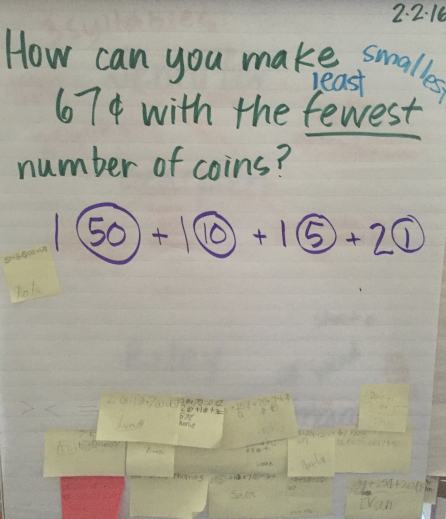
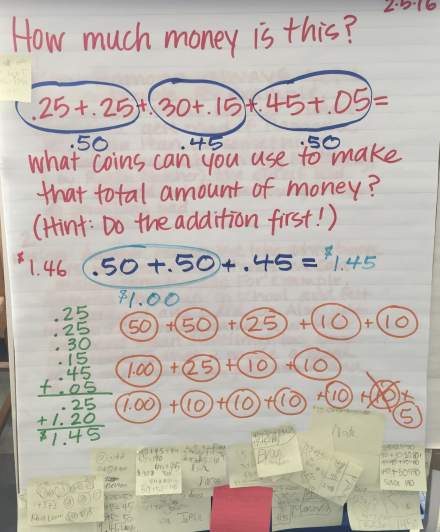
So…a short week and a crazy day today means I have only three warm-ups to share.  I think they’re pretty good ones, though.  Made for great conversations.  Enjoy!  Oh, yeah, they’re all about money again.

Monday

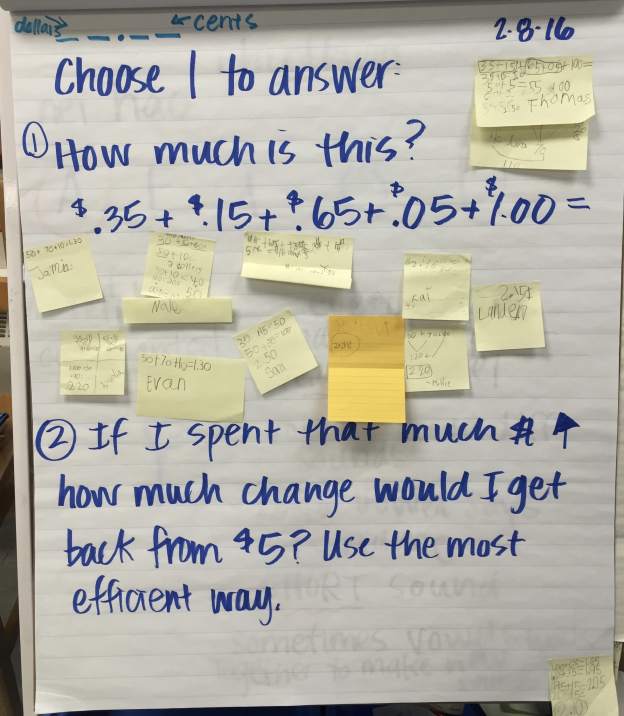
This was the first time I’d asked a money question written in equation form.  Many were confused by seeing cents written as dollars (they kept saying “Why did you put a dollar sign there?”), and so we had to clarify that during our debrief.

IMG_0548-min

Tuesday

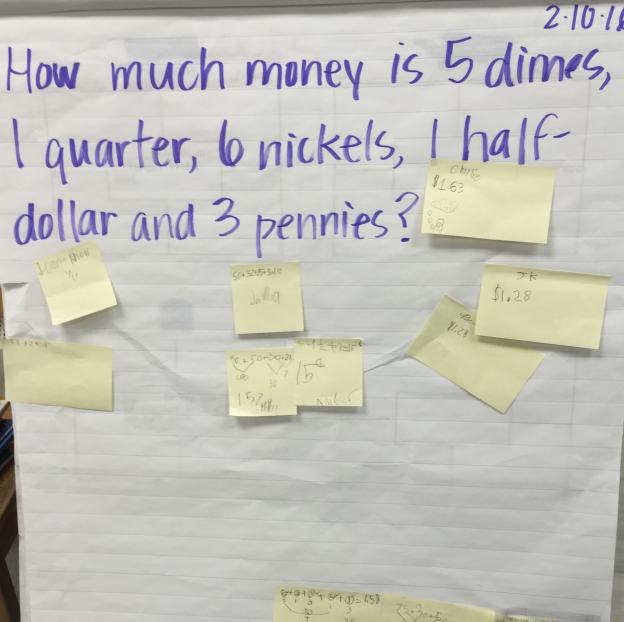
This was a challenge to think of amounts in more than one way.  They did pretty well with it, though.

IMG_0471-min


Wednesday

When we talked about this one, we had some great conversations about efficiency when counting coins, and how making piles of dollars (starting with the biggest coins) is a quick way to figure out the total.  We also practiced making $.25 in multiple ways (not just a quarter).  We called it “Mickey Mouse” when we found 2 dimes and a nickel, so 2 Mickeys and a 2 quarters makes a dollar, as does 2 Mickeys and a half dollar.  Just so you know. 🙂

IMG_0549-min

Writing About Reading

I figured out today why I have such a hard time deciding what to write on this blog: I like for things to fit nicely into categories/tags/subjects/projects, and so often, the things we do around Rm. 202 are not that way.  I find that maybe I’ve gotten to that place where many of our subjects overlap–just like I’ve always hoped they would!  I know, that sounds like I’m not doing it on purpose (which of course I am, as I carefully plan how and when and why), but I think sometimes when you’re in the middle of something you can’t really see the big picture (isn’t there some quote about forests and trees that would fit here? LOL).

So as I think about how to describe what we’ve been doing in Writing lately, it’s hard to explain just the writing part, because it includes reading (which is perfect, as those two subjects go hand-in-hand anyway, right?).  We have been working on writing opinion letters, with most of our topics being about the series books we’re reading in our book clubs.  Luckily, though, there are lots of other things to have opinions about, so we’ve been trying out that structure with other topics, too.

We’ve gone through many versions, with me teaching mini-lessons and kiddos then trying out the big ideas.  We’ve talking about format of a letter; stating opinions; adding reasons as well as details and support for those reasons; using transition words like one reason is, another reason is, last but not least (which many kiddos were doing already just based on learning them last year!); as well as just using interesting words and making our letter match our audience.  The procedure became that they would write a letter, but then rather than actually delivering it to that person, they’d give it to me, and I’d note what they did right and what they could work on for next time.

We wrote about books, 100th Day of school suggestions, ideas about why their weekends were good, as well as many other things about which you could have an opinion.  I was noticing, though, that over the last few weeks our letters had been getting shorter and less detailed (which was obviously not the goal!).  We had a class meeting and Millie suggested that the reason this was happening was because they had written so many letters that actually they were getting really sick of it and weren’t trying their best anymore.  While this was sad, I totally saw how that could be, and as impressed by her insight.  Others agreed and so I made a plan that we would work our hardest to create our best final letters (to Mrs. Meihaus, our librarian, about our vote for the Show-Me Reader Award) over the next 3 days and then be done.

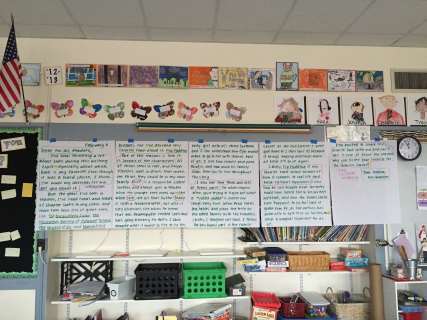
So as I thought about what we would do for those next 3 days, I knew I needed to give another model to my writers about what that letter should look and sound like.  And since I wanted them to write about books, I did, too.  My letter was about my favorite read-aloud choice, Fig Pudding by Ralph Fletcher.  It looked like this:

IMG_0368-min

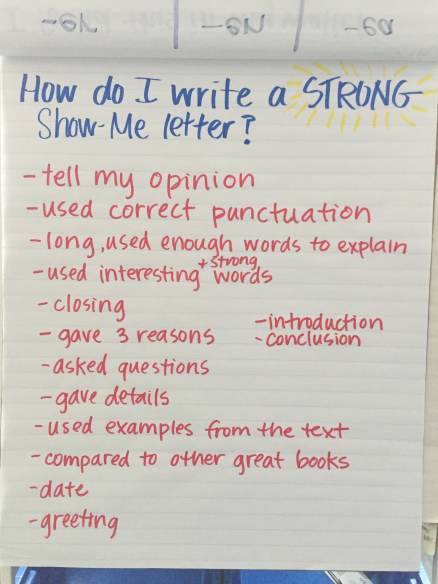
I had hung the letter up there before the day started, and it was one of the first things (thankfully) that kiddos noticed when they came in.  Yeah, the first response was “Wow, that’s long!”  Later on, I had them look at it, studying it to answer this question: How do I write a STRONG Show-Me letter?  Not surprisingly, they were able to notice a whole page full of things that I had in my letter that they needed to put in theirs.

IMG_0367-min

As they made their list, I marked their ideas on the actual letter (notice the different colors and the things we boxed in) so we could reference it later.  I was impressed to see that they had been paying attention, and that they could come up with that all on their own!

After this, I gave kiddos a graphic organizer to use to plan their letter and we got busy.  We’re almost done, so I’ll share our progress in the next few days.  It’s pretty good stuff!

Second Grade Math Warm-Ups: Week of February 1-5, 2016

This was finally a semi-normal week: we had 5 school days and no “extra” stuff to mess with the schedule.  It was also the first week in a long time that we had a math warm-up every morning, which means I have lots of problems to share! I even found a couple of odd ones from last week–which was NOT a normal week because of the 100th Day and a 1/2 day on Friday.

These last few weeks we’ve been working on money, so all of these relate to that topic.  They are progressive, from Monday to Friday, and speak to the new skill/concept I was planning to cover that day; some kiddos really had no idea how to do this when i asked them to think about it in the morning and so had to give-it-a-go, or work with a partner. These were definitely questions where I saw many post-its that said, “I’m not sure yet but what I think is…”  (The extra two I’m sharing this week are related to our muffin challenge from the 100th Day.  Be sure to check out that post for more info!).

Last Week Muffin Problems


This week’s money problems:

Monday

IMG_0317-min

 Tuesday

IMG_0348-min

Thursday

IMG_0380-min

Friday

IMG_0382-min

Spelling Investigations

I have been doing spelling differently than others for while.  Even when I used to do spelling tests every week, the way the words were chosen was a little different than what is typical (personalized to each kiddo, often from their writing or frequently misspelled words that mattered to them).  We even used an actual week–not a school week–and kiddos studied from Wednesday to Tuesday.  I never quite felt, though, that what we did was effective; either kids were great spellers and they stayed that way, or they had struggles and those remained as well.  Even when they did well on tests, they didn’t do such a great job of bringing that expertise into their work.  Eventually, the last year I taught 5th grade, I abandoned spelling tests altogether.  No one seemed to notice…

When I moved to 1st grade last year, it was an easy decision to tackle spelling inside of all of the other things we were doing with reading and writing, especially during interactive writing and word work during guided reading groups. My kiddos took to this kind of thinking quickly, and used their new skills interchangeably between subjects, which is a true sign of transfer of knowledge.

So, fast forward to thoughts about 2nd grade.  This one was a little bit tricky; all of the other classes in our grade do spelling in a traditional sense of the word–lists of words each week that follow a pattern, with a test on Friday.  I was pretty sure that I was going to opt out of that choice (but for a long time wasn’t sure how to explain why without sounding like I was right and others were wrong.   I’m actually working on how to do that in many areas; my objective is NEVER to judge or sound like a know-it-all–unfortunately my passion often super cedes and that happens–but instead my goal is to share info I have, offer concerns or questions that arise, or bring up other considerations on the topic that might not have been mentioned.  Believe me, I am FAR from knowing it all!).

I found my “out” when I thought more about interactive writing this summer with my previous 1st grade team and Mrs. Ford, our Director of Professional Learning (and my longtime friend!).  As the rest of the table planned how they’d begin the structure with their 1st graders in the fall, I considered how I might build on the foundation we’d set last year and continue the same kind of thinking, pushed to a new level.  When my friend, Katie, suggested the idea of spelling investigations, I knew they were a good fit with my learners.

Much like we are already in the habit of doing with math, investigations would be centered around conjectures that students brought up about words/letters/sounds/patterns that they notice.  Kiddos were already familiar with this idea as mathematicians, and so it seemed like a natural connection.  We had worked through our first one last year as 1st graders, anyway, and it is a permanent (and well-utilized–we even used it today during a reading group!) fixture on our word wall:

IMG_0352-min

So far in 2nd grade (before we started this study), we’ve added a could of other ideas to our investigations.  They are still in an informal form, as we add to them frequently:

Sometimes small groups investigate them specifically, sometimes we talk about them as a whole group when we’re reading together, and sometimes kiddos just notice things about them as they are reading in their own independent work.

So why am I writing about this now, you ask?  Well, last Friday I was at a staff in-service with the rest of my district 2nd grade cohort.  We broke into smaller groups to discuss a topic we’d been working on throughout the year, and my teammate and I realized we were the only ones there!  So much for a district cohort. LOL  It worked out really great, though, because despite the fact that we work together on a regular basis, we don’t often have time to sit for a long period of time discussing one specific topic.  This day, of course,  it was spelling. ❤

As we talked about what we were doing in spelling (which is completely different for her than it is for me), questions came up about how, why and what results we were looking for, how we knew if what we were doing was working.  We agreed transfer was the goal.

I shared details about the way we had tackled spelling through our word study and investigations, and she began to wonder about how she could try something like that with her learners.  She came up with the idea of doing an investigation with students’ names.  She had experience with a similar procedure from 1st grade, but had yet to get her kiddos thinking about words/names/sounds/ that way as 2nd graders.

She put together a plan for how to start–with kiddos looking for patterns/sounds that they’ve studied (during their traditional spelling work and tests) that occur in their names.  They’d move on to making more words with those patterns/chunks, try to figure out how/why those sounds work that way, and also try to brainstorm other ways their names could be spelled using what they know about sounds.  For me, the best part of the conversation wasn’t even the plan or the ideas we shared, it was how excited she was about trying it!  There was a new energy in her related to spelling, which would of course be spread to her students when they started their own investigations.

Well, as I was also inspired by both her energy and the noticings I had made about our own classroom names, I resolved to do the same studies in my classroom as she would be doing.  We agreed to check in along the way to see what each group of students was doing; my class had already had experienced with this kind of thinking, so we hypothesized that there would be differences in what we noticed and discovered.

More on the details of Rm. 202 spelling investigations soon! (Yep, this post has gotten way too long to keep going! hee hee).  Please check back and see what we’re doing with spelling and words and what we’re discovering about sounds that can help us be better readers and writers. 🙂


The Greatest Star on Earth: Kate Klise

I love introducing kiddos to authors.  Whether it’s via Twitter, a new book or an actual author visit, helping students connect with the “real” people who write the stories or information they love is a great treat.  Perhaps the best part is how special and important they feel when we send a question or comment to a writer and they answer.  Ralph Fletcher is particularly special to my class as we have read both Marshfield Dreams and Fig Pudding by him this year (and he responds to all of our tweets!), but my students have also personally connected with Lisa Campbell Ernst, Maribeth Boelts, Marla Frazee (who I just realized illustrated Clementine!), Mary Casanova, Betty Birney, and also Kate Klise (who was just at our school this week!).  The way they feel so special and important when an adult responds to their words is pretty priceless and immeasurably motivating. The way these writers have both encouraged and inspired my students to some of their best work is pretty amazing. 🙂

So when I heard that we were having an author visit shortly after Winter Break I was really excited….but then I heard the name of the author and thought how completely strange it was that I had never heard of her; I pride myself on being up on books, writers, reading and things of that nature (by the way, Twitter has been HUGE in helping me with this–you should totally check it out!).  Luckily this was not a problem, because our amazing librarian, Mrs. Meihaus, works hard to introduce us to the writer and their books so that when they do come, we’ll be ready. 🙂

Our class read just a couple of her picture books (and since then I’ve found out she has written over 25 others!), and found that we really enjoyed her writing voice, as well as Sarah Klise’s (her sister is her illustrator) pictures.  We tried out Shall I Knit You a Hat? and Little Rabbit and the Meanest Mother of Earth, and when she was here she read us Grammy Lamby and the Secret Handshake.

Once she got here, we were all abuzz, excited to hear what she would tell us about herself and teach us about writing.  A couple of friends took their Writers’ Notebooks to be sure to catch Ms. Klise’s smart words.

Basically, her presentation was a workshop where she taught us (2nd and 3rd grades) the necessary elements for writing a good story.  She told funny stories, made us laugh, and most importantly got us involved in the show.  We hung on her every word!

This slideshow requires JavaScript.

And, because authors are rockstars in our world, we had to take a minute for a photo opp!  Thanks SO MUCH, Kate Klise, for taking time out to spend the morning with 2nd graders who are working to grow as writers and share their stories with the world!

IMG_0206-min


LRRH–Inspiring Sharing and Caring

I started the story recently about our culture/geography/literature study of Little Red Riding Hood.  We’ve done many things along the way with stories and maps and learning about regions (which I promise to share later!), but today there’s another story to tell.

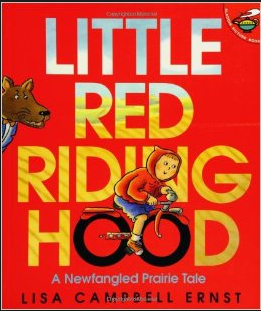
Today we read Little Red Riding Hood: A Newfangled Prairie Tale by Lisa Campbell Ernst.  The connection was to the Midwest region (at least as far as our SS unit was concerned), but my kiddos made many others kinds of important to connections in addition!

Screenshot 2016-01-20 13.44.55

The Little Red story here is very different than most others (and I won’t spoil the ending for you), and so gave us some new things to think about and respond to as readers and thinkers.  Before I was even finished, the suggestions came spilling over and kiddos could not contain themselves.  Many of them were related to this picture, which is on the last page:

FullSizeRender 21-min

Like I mentioned, the muffin-related ideas came quick and fast and I grabbed a marker and started recording so we wouldn’t forget the conversation:FullSizeRender 22-min

There are many layers to this list, and they’re not all related to the 100th Day, but that was a catchy title that Tyrin suggested.  We did decide, though, that we wanted to make these as part of our 100th Day festivities and share them with our 2nd grade friends–and there happen to be about 100 of them.  Seems like a match made in heaven. 🙂

We hope to address some of the others (and I’m sure add many more!) in the days to come.  Many of them could relate to a service-learning project and all will touch the hearts (and stomachs!) of our community.  As I keep saying, I can’t wait to continue to share this story!


Revised Pirate Code Ideas

Today we were finally able to revisit our initial list of ideas for our own Rm. 202 Pirate Code.

We used a protocol called Walk, Stop, Turn and Talk (which I saw on Twitter this weekend but sadly can’t remember who to credit for the idea) to talk about our thoughts on the first try.  Kiddos walked around until I called “stop,” in which case they turned to the closest friend and talked about which options on the list they thought should be kept.  They were supposed to give reasons based on how that addition would help us learn like pirates (based on our answers to that question which we had recorded the other day).  It looked and sounded like this:

Here’s our revisions, and then a “prettier” copy of the changes:

Pretty good, huh?  Oh, and that red part is that we decided that Learn or Walk the Plank! should be our Class Motto.  Verdict’s still out on that one. 🙂