A Little Further Into the Woods

Since we’ve begun our Little Red Riding Hood culture study, some exciting things have happened!  Let me tell you about what’s going on!

Alongside the LRRH books that we shared was another book, full of all sorts of organizers, charts, and a map.  This would be where we’d record our thinking and learning throughout the study.

Screenshot 2016-02-07 15.22.10LRRH_culture

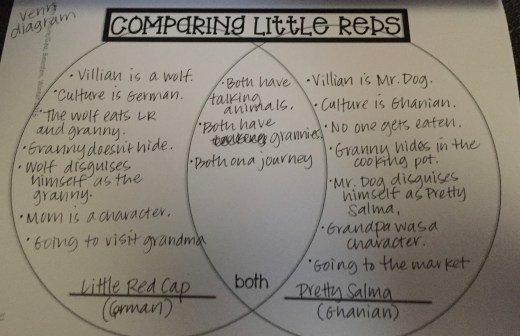
As we read a book, kiddos would fill in a chart that marked certain features of each story, which we would later use to compare stories and use the information to learn more about each culture represented.

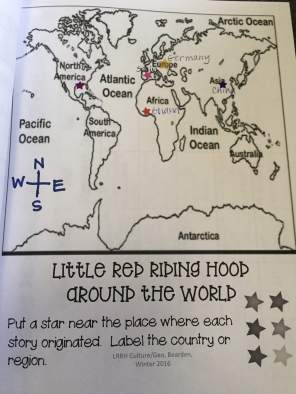
Additionally, we kept track of where our countries are in the world, by adding a star on the map for every one we read.  Later on, we added a US map to our book (which I don’t have a picture of yet) as we learned about regions.

IMG_0392-min

As we read different versions, we also compared how certain books were alike and different…

IMG_0395

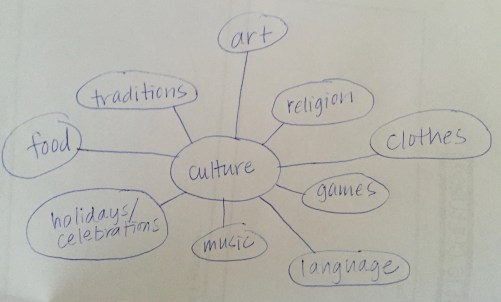
…as well as finding other things that we needed to add into our book (note to Mrs. Bearden to make sure to put this in there next year!):

IMG_0393

Once we got the background of the stories, talked about characters, compared and contrasted and decided on our favorites, we were ready for the really fun part–researching more about the cultures from our books.

Each kiddo chose their top 3, then randomly came and declared which culture group they wanted to be in.  I wanted it to be about the country/region/culture, not the people in the group, so this part was all done first, then I shared their groupings.  Each group has 3 people, which is kind of ideal.  I could hardly get the directions out before they were ready to get going (kind of like with our spelling investigations this week–they were eager!).  I had found books for each group to start their research, but groups had to go book shopping to find the right ones.  Once they had books, they were busy digging in, collecting information about land (not culture, but related to the geography focus), language, holidays, food, games, religion, school, music, art and then a topic of their choice.

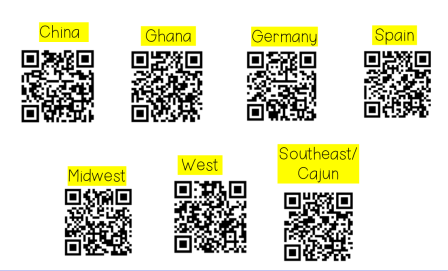
After our initial book search, kiddos were allowed to use website that I had found, as well as World Book Online and Kid Info Bits, which we have subscriptions to from our library.

Screenshot 2016-02-07 17.09.06

We even had an opportunity to learn about German culture from someone in Germany! I sent out a request on Twitter for friends from our countries/regions of choice, but was unable to work out any Skyping situations.  Then I remembered that Mrs. Appelbaum’s daughter is studying German in GERMANY and that she might be available to help us out!  She was more than willing and so we worked out a FaceTime call for last Thursday afternoon.  Those girls were so excited (and so was I!)!

We are just about done with research and are excited to start writing–we’re going to take all of our information and make books to share with other Robinson kiddos!  Stay tuned for updates on that part of our work!


Over the River and Through the Woods

Little Red, Pretty Salma, Petite Rouge, Little Roja, Lon Po Po. The list goes on and on.  And it’s a pretty good list, eh?  Rm. 202 thinks so!  (Do you know what it’s a list of?) We have just begun a study much like one (only better!) that we did last year.  And you know how I told you about this thing I have the other day?  Yeah…well I am afraid that because of that thing I didn’t tell you about that awesome study last year.  UGH!  Luckily things have changed, though, and I’m starting this story much earlier. 🙂

This quarter we’re studying culture, and because of the unit I found last year (I used a variation of this Cinderella unit from First Grade Wow.  It went SMASHINGLY and was a great combination of literature, non-fiction text, culture AND geography.  It was also tons of fun to boot, which increased the engagement with a topic that is already generally interesting for first graders.  Win, win, win all around!

So this year when we came to this culture/geography time of year again (which in our curriculum usually happens in January), I knew I wanted to try something similar to what we had done last year.  The big idea of the unit is that folktales and fairytale can tell you something about culture.  When talking about culture, it is also important to understand the geography related to that culture; where the people live and why they might do the things they do there is essential to the puzzle.  Makes sense then, that all of those things would be connected–integrating subjects gives students multiple ways to make new information fit in with old knowledge and therefore make for stronger pathways to memory and understanding.  And honestly, making the unit include multiple subjects and topics helps time-wise.  Fitting it all in is always a concern for teachers, and this helps me get it all in.

Starting with framework from last year, I collected books.  The Cinderella theme worked so well and I knew I had to find another fairy tale or folktale that both had multiple versions, as well as a story that would interest my students.  There were obviously many choices, but I went with Little Red Riding Hood.  This story was familiar enough (like Cinderella), but also had many variations, and had interesting characters we could study, as well.

Our focus is to be using the fairy tales and folktales to analyze story structure, characters and main idea, as well as compare and contrast different versions.  Eventually we’ll probably write about our favorite version, trying to convince our readers why it’s the best with strong evidence from the text.  We will also study geographical concepts like continents, countries (and how they’re different from states and cities, as well as what our country is), bodies of water and regions–this one is new this year.  Besides just studying cultures of other places (which was our main focus last year), we’re incorporating the idea of regions of our own country this time; there are stories from both different countries and US regions in this unit.  We’ll analyze maps, talk about how they work and what information they give us, put stars on the places from where our stories come, color and label maps and talk about the places we know about (as well as places we wonder about).  Eventually then, students will choose one culture to learn more about, and research it.  This will incorporate with our next writing unit, and then will still touch reading and social studies skills and concepts, too.

And here’s the part where the “messy” of writing about this starts.  Previously, I would have waited until the very end of the study, hoping to include all the details and pictures, including fabulous videos of us presenting our final products.  Like I mentioned earlier, that often meant that I then didn’t even get around to writing about ANY of it–usually because I either forgot the details, ran out of steam or just didn’t have time.  And yeah, it makes me sad that it’s missing on the blog.  So here we go.  You might want to wear gloves.  Or a poncho.  Maybe goggles or a raincoat?

First let me share our booklist. I compiled it from a variety of places online, as well as just by standing forever in front of the fairytale section of my library with a crooked neck reading books spines.  I know–I’m a glutton for punishment.  It’s really not so easy, either, by the way, because they’re organized not just by story, but by author and by country.  Oh, and then they’re the ones that aren’t so obvious because they don’t have ‘Little Red Riding Hood’ in the title.  Anyhow…

We are using stories from Germany (the original), China (we have two from this culture, actually), Ghana, Spain, as well as from at least 4 regions in the US (and maybe another one that I’ve forgotten.  Told you this was messy!!!).

  1. Little Red Cap by the Brothers Grimm and Little Red Riding Hood by Sam McBratney
  2. Lon PoPo by Ed Young and Auntie Tiger by Laurence Yep
  3. Pretty Salma by Niki Daly
  4. Little Roja Riding Hood by Susan Middleton Elya
  5. Petite Rouge: A Cajun Red Riding Hood by Mike Artell
  6. Little Red Riding Hood: A Newfangled Prairie Tale by Lisa Campbell Ernst
  7. Little Red Cowboy Hat by Susan Lowell

 While those are the “official” titles, we are also going to enjoy some others that will be specifically for the reading part of the study, where we can study version, point-of-view and character.  Those include (at least for now!):

  1. Ninja Red Riding Hood by Corey Rosen Schwartz
  2. The Wolf’s Story: What Really Happened to Little Red Riding Hood by Toby Forward
  3. Very Little Red Riding Hood by Teresa Heapy

  4. Red Riding and the Sweet Little Wolf by Rachael Mortimer
  5. Honestly, Red Riding Hood Was Rotten!: The Story of Little Red Riding Hood as Told by the Wolf (The Other Side of the Story) by Trisha Speed Shaskan

  6. Super Red Riding Hood by Claudia Da′vila

I’m excited to share more pages to our story as we go along! 🙂


Veterans’ Day 2015

Until just a few years ago, Veterans’ Day came and went at Robinson without much fanfare.  I mean, yeah, we’d mention it to our classes, perhaps watch a video or read a book about why the day was special, but that was pretty much it.  There was not a whole-school focus, an assembly or any other type of celebration.  Then ( I believe the year Mrs. Kesler became our FABULOUS music teacher), that all changed and Veterans’ Day became one of the most special days on the calendar. 🙂 Remember last year?

Even before the day came we were hard at work: writing letters of thank you to veterans, as well as creating the centerpiece place mats for the tables in the cafeteria for the reception.

This slideshow requires JavaScript.

And pretty much since school started, too, kiddos have been working on the music for the assembly we hold yearly now to celebrate those who give/gave their very best to keep us safe and sound.  While I would love to invite each and every one of you to experience what is now Veterans’ Day at our school, I only have a couple of short videos to share.  It’s a taste at least, right? 🙂  Oh, and I HATE to admit this, but it always seems that my phone runs out of memory right in the middle of someone’s video I’m trying to record–yep, at just the WRONG moment–and this time it was during the girls’ song. 😦  (Since we split boys and girls for specials, our grade level had two songs).  Hopefully you’ll get the idea.  Again–super sorry I didn’t catch it all. 😦

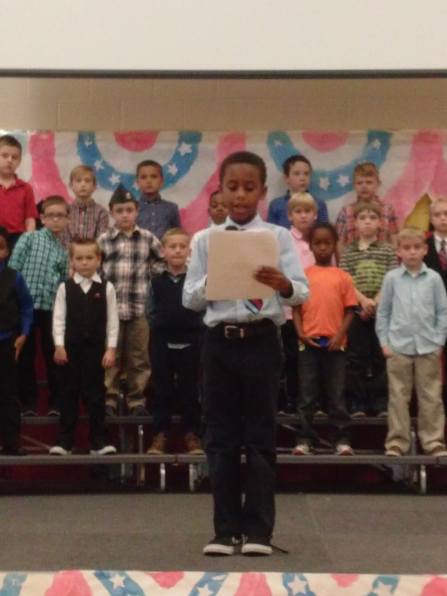
Before 2nd grade started, Khalani got to represent our grade and read a special thank you poem for the veterans.  Our theme was HEROES.

CAM02434-min

Then the boys sang their tribute:

Girls took their turn next:

I found two more pictures of how handsome and beautiful we look all dressed up:

CAM02442-minCAM02445-min

Happy Veterans’ Day!  How did you celebrate the special day? 🙂

Field Trip Fun in Downtown StL

We are lucky to be able to take field trips–pretty much to anywhere we want to go!  This year our team was trying to think outside-the-box a little more than usual, planning for field studies that not only connect to our 2nd grade curriculum, but that are important experiences for all kids to have in general.  We’ve thrown out some amazing ideas, and this fall we ended up with a trip that I’m pretty sure no one had ever gone on before. It was related to our study of economics, and was loads of fun, too. 🙂

Mrs. Driscoll worked it out for us to be able to visit the Federal Reserve Bank (and I hate to admit I didn’t even know we had one in our city!), as well as the Old Courthouse, which is a great historical building to visit.  But wait–the best part (or at least the fancy-schmanciest part) is that we got to eat lunch in a hotel ballroom!  Yep–she worked hard to secure a venue that would accommodate us no matter what St. Louis fall weather would throw at us–and we ended up being welcomed by the Crowne Plaza hotel, which was right across the street from both of the places we were visiting.  And yes, it was a lucky find–by the time it was time for lunch it was pouring down rain!  Way to go, Mrs. Driscoll, and thanks Crowne Plaza!

One more picture:

CAM02420-min

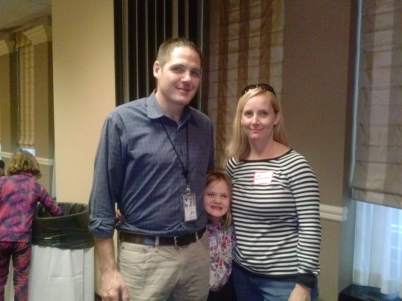
Look! Ava got to have both of her parents on our trip–Mom came along as a chaperone, and Dad works at the Federal Reserve Bank and got to join us for lunch! He was working that day and planned it so he could be on duty when we visited the museum at the bank.  What a special surprise!

We learned much, laughed a lot and had a great time!

I Hope You Make Mistakes

I start almost every day in Rm. 202 by saying something to my students that still had some of them very confused:

Screen Shot 2015-09-20 at 5.19.11 PMI remember the first time I said it.  No kidding, some of their eyes were as big as saucers and they thought I was kidding.  “You mean you want me to mess up?”  “You want me to fail?”  Well….yes, actually I do.  Not because I want you to feel badly, or because I want anything negative for you, but because I want you to learn something.  When we make mistakes, we learn what NOT to do, or we learn how to do things differently, which helps us next time.  If we’re always comfortable, and everything is easy, then we’re coasting and not learning.  And THAT is not ok with me.

We have been talking a lot about our brains and how they work, and a couple of these videos have helped some of my friends look at me a little less crazily when I mention mistakes:

All of this fits in perfectly with our YET talk, and helps us all get on the same page as we learn and grow together.  Not everyone is there yet, but I know that as we continue to understand how being perfect is not the goal, but learning new things is, more will get on board.  Their new successes will help spur them to WANT to make mistakes, for that is when they LEARN something new. 🙂

What’s On the Agenda?

The beginning of the year brings with it many things: new faces, new clothes, new experiences, new books to read, and assessments.  Lots of assessments.  Luckily for me, I know many of my students really well already, since we were together last year, but even still I need to learn the “2nd grade version” of them.

One particular assessment that I have a love-hate relationship with is the F&P (that’s just what we call it because it’s from Fountas and Pinnell; it’s a reading assessment).  I love it because of the deep, rich information it gives me about my kiddos as readers and how it helps me tailor my instruction to just what they need.  I kind of hate it, though, because it takes FOREVER to administer.  It involves a student reading a book to you aloud and then answering the comprehension questions to demonstrate their understanding of the text (there are both fiction and non-fiction titles included).

Sounds easy, right?  Well it is relatively easy to administer, but when you add in the fact that there are 21 students in my class and sometimes you have to read 2 or 3 stories until you find the student’s instructional level, you can quickly add up to a lot of time necessary to finish the job.

So, that’s where the idea of the agenda comes in.  It’s my attempt at having my students working on meaningful, important learning activities independently so that I can spend time 1-on-1 with students to finish my assessments.  Win-win, right?

We did this kind of thing on a smaller scale last year a couple of times, which gave me the courage to try it again now that we are 2nd graders.  The difference this go-round was that the time frame was longer (two school days instead of a morning) and that the assignments were on a little bit bigger scale (last time it was mostly finish-up work).

Now, before I gave it to my students I ran it by one of my most important helpers–my son, Riley, who was a 2nd grader last year.  Even at 8, he’s really good at looking at things I’m considering and thinking about them in terms of what other students would say.  And he did have some thoughts.  He suggested that there was TOO MUCH on the page and that many kiddos (him included) would be overwhelmed by the number of things they had to do.  I appreciated this insight, and actually had a plan, then, for how to modify the list for those that might need more support.

Wednesday morning came and it was time to share my crazy-cool plan with my students.  I was SUPER excited with how enthusiastic they were about the whole thing.  They were blown away with how they could make so many important choices, with how they got to decide when they would do each thing (meaning we’d have all different subjects and projects happening at the same time!), and with how fun the opportunities sounded!

So here’s what the agenda looked like:

Students could choose to do them in any order and spend as much time as they needed to on each one, with the goal of being done by the end of the second day.  We had a conversation before we got started about different ways to tackle such a big list, as well as how we would have to work responsibly and respectfully so that everyone could complete the challenge.  At several points throughout the days we stopped for check-ins, to have students share insights they were having, ask questions about things they may have been confused about, or make suggestions for how to make the work more manageable.

Overall, I was SUPER impressed with how things went!  I would have to say that the way they were able to manage their time and materials was even beyond what I expected.  Before we started, we made a big deal about how the important part was that they were able to work independently, freeing me up to finish my reading interviews with everyone.  It was great to hear how they problem-solved together, sometimes asking multiple classmates until they found their answer.  I do have to mention on conversation I overhead that I thought was particularly funny (and helpful!).  Someone was asking what they were supposed to do on a certain assignment, and a friend’s matter-of-fact response was “Well did you read the directions yet?  That’s why she wrote all that on there for you–so you’d know what to do!”  Hee hee.  Yes, I giggled a little at her answer.  But she was right. 🙂  And yes, she did offer help when the kiddo came back because he had a question about those directions. 🙂  Many times I heard friends reminding each other not to bother me or even asking “How can I help you?” when they knew their friend needed something.  Nice!

Having done this once, and getting really positive reviews on it from my students, I will definitely be doing it more regularly this year.  Ideally, I’d have some version of this happening all the time, with me having time to pull small groups and do 1-on-1 teaching as often as I could to help meet individual needs.  I feel like there are structures in place already in our classroom that allow for that focused attention, but anytime I can add more student choice into the mix, I’d say that’s a good thing.

So as I go into it a second time, I’m considering these questions:

  1. Were there too many things on the list?  What students may have been overwhelmed by the sheer length of the list? How can I better modify the agenda to meet the needs of every student?
  2. Were the activities the “right” ones?  What else could we have done (with content or with product) to push thinking and challenge kids to dig deep with their learning?
  3. Is it necessary for students to complete everything on the list?  Would a “must-do” and “can-do” type list be more ideal?  Is there a way for students to be more in charge of what was on the list?  Could they be given a learning target or essential question to investigate and then plan the activity they’d do to address that focus?

Regardless of what we decide to do next time, I’m excited for how this first attempt went.  Kids were focused, they had fun, they got things done, they made decisions, they solved problems, and I got some assessments completed.  And I even had a couple of teachers visiting from another school who happened to pop in while we were doing this and they said it was working.  Gotta love outside eyes to help you make sure it’s not all in your head!  Way to go, Rm. 202 kiddos!!

Weak side/Strong side

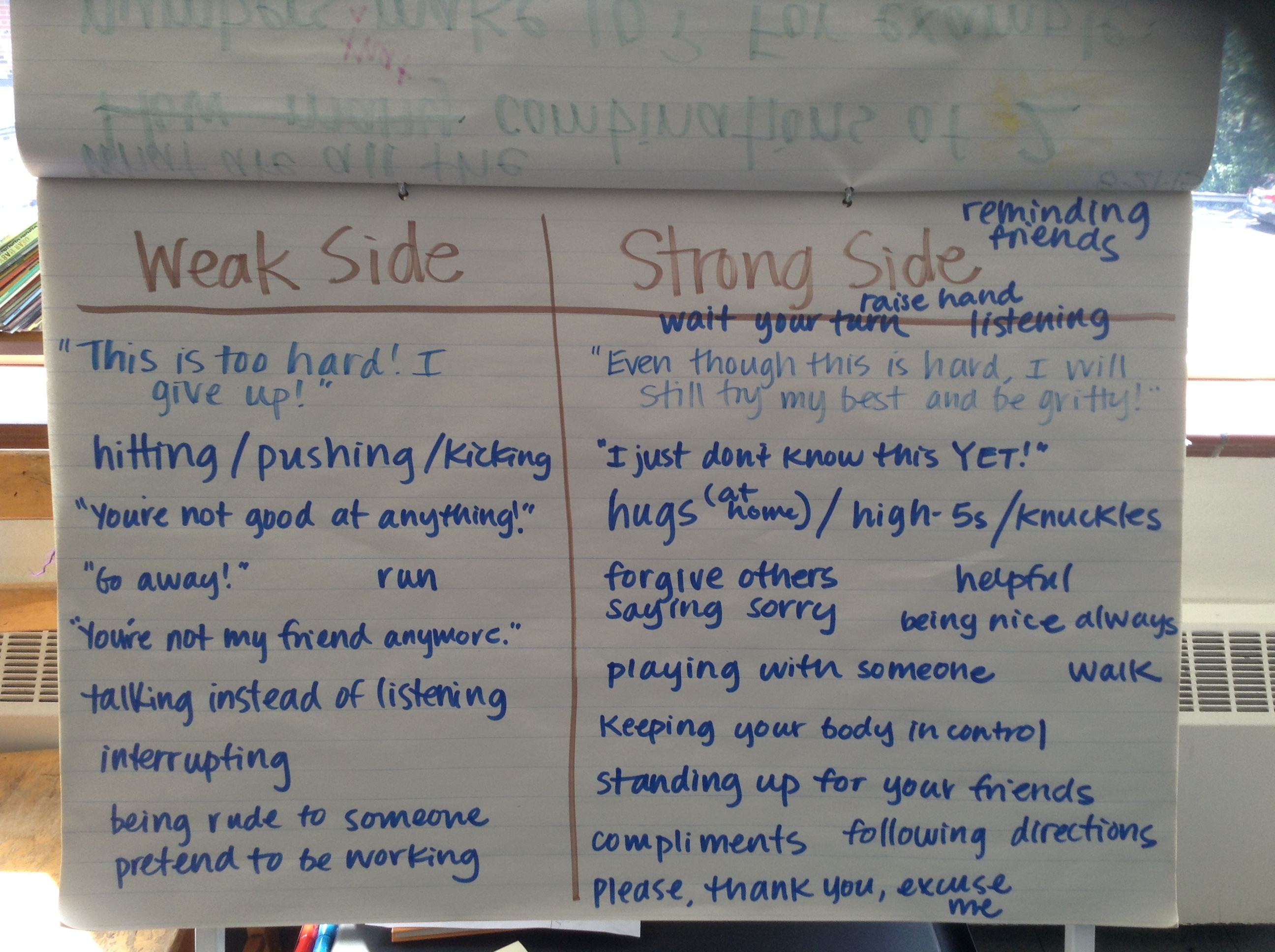
Much of the first days of school is spent learning routines and procedures for how to make the classroom run smoothly, and learning how to be a good learner is part of that.  In second grade, we use the idea of weak side/strong side to illustrate how kids can (and should) make good choices that benefit both themselves and their classmates.

As with many lessons, we began with a book.  We read Stand Tall, Molly Lou Melon.

IMG_5074I explained the idea of weak side/strong side by talking about how everyone has two voices in their head.  You know, that one that encourages you to do your best, think happy thoughts, follow the rules–the shoulder angel.  There’s also that other one that whispers and tells you how great of an idea it is to pinch your sister or blow bubbles in your milk or slide down the banister on the stairs–the shoulder devil.

In order to make the concept a little more concrete, and move visual, we created a class chart (which I will later make a little neater and hang on our anchor chart wall) with our ideas of things we could do or say that would fit under each side.  Students started with partner thinking–where many of them recorded thoughts using a t-chart–then we put our ideas together.  As of today, our chart looks like this (but it is ever-changing–I think we’ve added to it every day!):

IMG_5057It’s definitely sinking in, too, because I am hearing kids use the language of their chart when they speak to each other.  🙂  We’re by no means working perfectly all the time, but we’re on our way!

Self-Portraits 2015

Remember our FABULOUS portraits from last year?  Well, we did it again.  Partly because we had free wall space, partly because we took home the ones from 1st grade, partly because we look different than we did last year at this time, and mostly because it’s a way to reconnect our old community and connect for teh rifrst time with the new friends in Rm. 202.

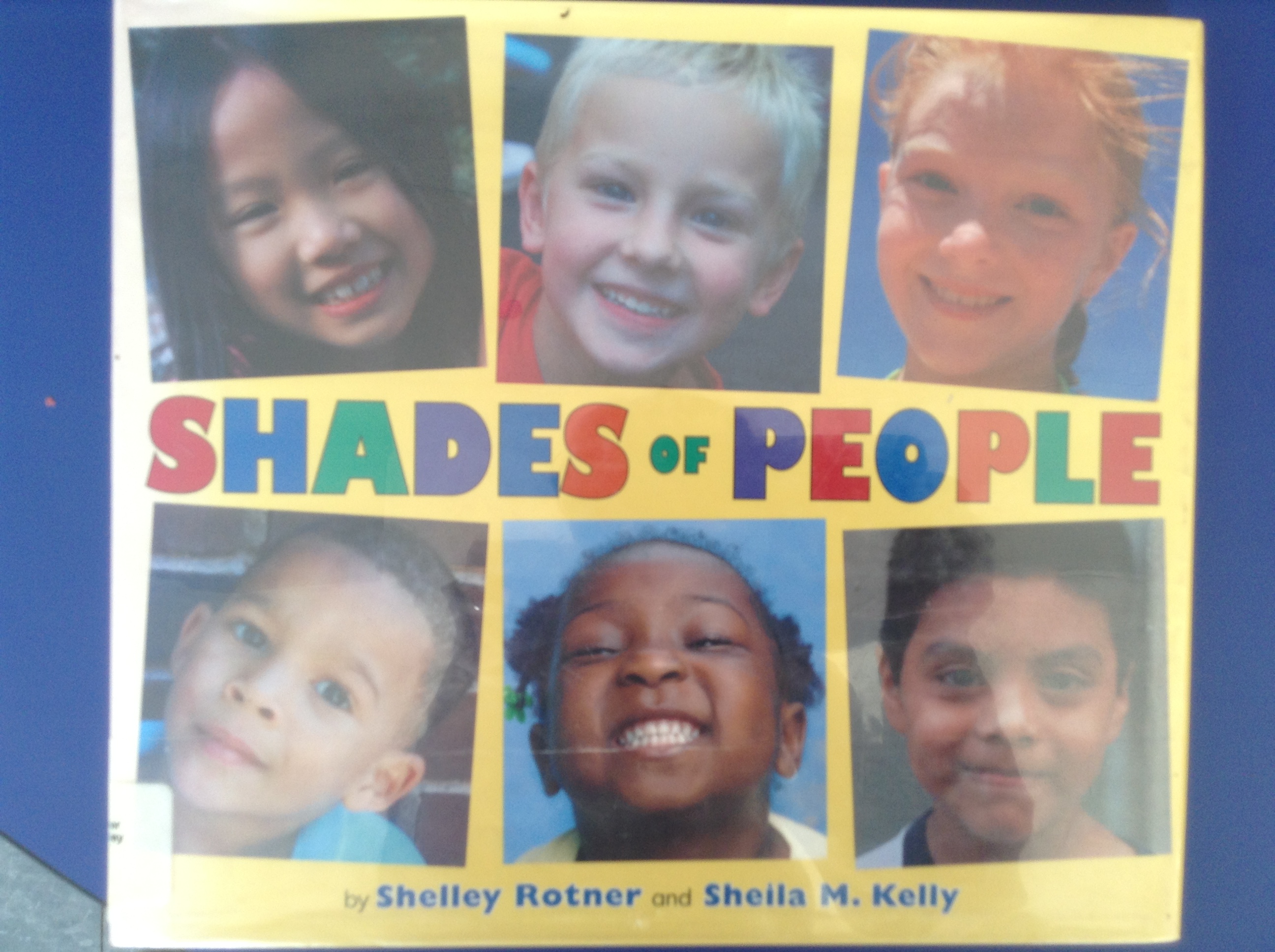
We found a new book this year, which spoke to the idea of how beautiful we are in our own skin, and how that skin can come in such a spectrum of colors:

IMG_5076I really wanted us to paint our portraits, but because of a planning fail, I didn’t have those supplies ready for us when it was time to work.  Instead, we used the same fabric, paper, and yarn that we used last year (plus really anything else that could be found in our room), as well as the many different colors of crayons and colored pencils we have to try to make our portraits match our beautiful selves.

Of course during the process, it was messy:

but once we were finished, and they were hanging, they were magnificent!  I love how much they look like the kiddo who made them. 🙂 (Be sure to click on the pictures to see the full-size version. 🙂 )
Marshmallow Challenge: 2nd Grade Style

If you’ve been here for a while, then you are familiar with the Marshmallow Challenge that I’ve done a couple of times.  Both of the previous times it’s been attempted in Rm. 202, though, it’s been with 5th graders.  Well obviously I don’t have any of those anymore, so I wanted to see how my 2nd graders would rock this challenge.

Now, I must add that since most of us were here together last year, we had a little bit of an advantage, rather than doing with people who are relative strangers.  The activity, however, was new to everyone.

I gave them the same directions and supplies as have been given before:

25 sticks of spaghetti, one yard of string, one yard of masking tape and a marshmallow

25 sticks of spaghetti, one yard of string, one yard of masking tape and a marshmallow

I put everyone together in our new Room Teams, and their first job was to create a name for their team (which is new for us–last year we just went with numbers).  They were super creative, and came up with GREAT names like Cherry, The Blue Angels, The Legendary Black Dragons, The Golden Girls and the Lion Kings.  Cool, right?

Ok, so next step was to plan.  And that was fun to watch; each team had a different way of going about that:

Once I said “GO” the fun began and the teams tried to create the tallest free-standing tower they could.  I was SUPER impressed with how well each team worked together and also with how they built on each others’ ideas.

This slideshow requires JavaScript.

When time was called and everyone stepped away, only one tower was still standing:

Screen Shot 2015-08-22 at 12.47.44 PMBut we did go ahead and give a 2nd place nod to the Legendary Black Dragons for the height of their tower before it fell.  Check it out:

Screen Shot 2015-08-22 at 12.47.38 PM

They admitted that they should have worked on making the bottom stronger. No worries! Next time. 🙂

Now…we could have walked away and left it there, but of course we could not.  We had a debrief on what worked and what didn’t, and talked about plusses and deltas for that activity.  Here’s our chart of what we said:

Screen Shot 2015-08-22 at 12.57.22 PMOur conversation after the challenge was perhaps the best part.  We could have said that most groups failed and that just the tower that stood was successful, but we were not ok with that.  We agreed that we had many points that proved that we were successful in spite of the fact that our towers fell over.  We had focused on the process and the product was not the biggest deal.  We have come back to this chart already a couple of times, too, and used some of the plusses for other activities together!

We’re excited to try again!

Getting Started in Second Grade

Wahoo!  We’re finally getting started!  I spent some time getting ready, and it was fun to stop getting ready and finally get started!  And since we’re looping, it has definitely been fun doing just that.  I was looking back at the beginning of the year from last year to see what I had written about, and MAN–our kiddos were BABIES!!  You should take a look and see how much all those munchkins have grown since last fall.

As is usual fashion for me here on 20somethingkids, I have TONS of stories to tell you!  I am making a list of it all here, partly to help me make sure I get it all in, but also just in case you want a place to land to find it all.  Once I add the post, I’ll link to it on this page and you can easily find it again.  Ok, here we go!!

Over the last few weeks, we have done so many things!:

Marshmallow Challenge: Second Grade Style
Getting Started with Reading: Reading museum
Getting Started with Writing: Tiny Notebooks

Tiny Notebooks: Sharing

Self-Portraits
Appleletters
Reflection with plusses and deltas
2nd Day of 2nd Grade Selfies
Getting Started with Math: How Much is Your Name Worth?
Weak side/Strong side
Anchors of Learning
Math Warm-ups 8-18 to 8-2

…yet

I Hope You Make Mistakes

I know there were many things crammed into those first days together, but when I see it all in a list, I’m still amazed.  Let’s get into it!