More on Spelling Investigations: Kids at Work

I was excited and inspired by the conversation I had last week with my teammate about spelling.  To share with each other this week as we’ve put the investigations into practice has been even better.  Similarly to the punctuation studies I’ve done over the years, kiddos figure out all sorts of amazing things when you get out of the way and let them discover!

We began with a story about names.  As I had talked with Mitzi, my teammate, she started telling me about how they had decided to spelled her new grandson’s name, explaining the rationale behind the combination of letters and connections between his first/last name.  It made me remember doing the same thing when we chose how to spell my daughter, Allison’s name (Allison, Alison, Allyson; should it be Allie, Ally, Ali for a nickname–it was hard work!), and it became clear that this would be how we could introduce the investigation to our kiddos, too.

After I told Allison’s story, I showed them that thinking with my name…
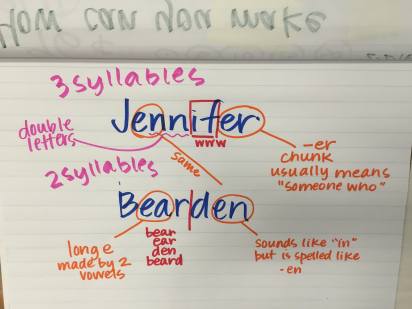
IMG_0335-min

…and then we tried it together with Grant’s:
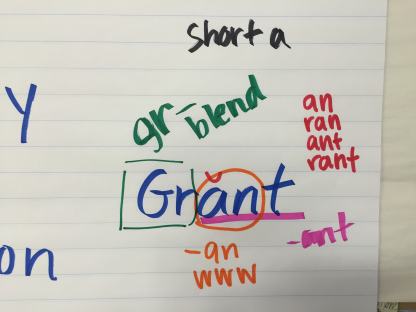
IMG_0336-min

By this point I think they knew what I was going to say was next (and they were excited to do so), and so I gave them the invitation to try their own name.  We talked about how it was easy to see the different sounds/chunks/letters when we did it in different colors, and we talked about the kind of paper to use, but beyond that, they had free reign to find whatever they could.  Before releasing them, though, I made sure to help them see our purpose as I asked this question:  How does knowing about our names help us become better readers and writers? Some kids worked alone, and some talked to their friends while they worked.  Whatever they chose to do, everyone investigated their names. 🙂

The room was abuzz with conversation and electricity as they worked, asking questions, making suggestions and trying things out with their names or their friends’.  By the end of the first day, everyone had found some pretty interesting things about how their names work.

On Day 2, we went a little deeper, and our job was to take the chunks/sounds/letter combinations we’d found the day before and do something with them.  I showed them an example with the -er in my name:

IMG_0354-min

Together we made a list of as many words as we could think of (or find) that had that -er chunk.  Along the way a couple of suggestions were made that I knew had /er/ spelled with -ir, -ur and -or, and we saved those for later (that’s more for Days 3 and 4!).

After this inspiration, kiddos did the same thing with whatever part of their name they wanted to work on.  Again, some worked alone and some worked with partners, some just wrote words they knew, and some used other resources.  It was great to watch how differently each kiddo approached the challenge.  As I looked around the room, I saw iPads, dictionaries, and kiddos using classroom text (including the word wall!) to find words that matched their patterns.  Students had even more energy and excitement about this job today and spent more time digging in and investigating.

As with our punctuation studies, the focus is not on the activity itself, but on how the learning that comes from it will help us in future situations.  Even though we’re only 2 days into this official investigation, there are already glimpses of how kiddos are using this knowledge in other places.  In almost every reading group I worked with this week, someone’s name was used to help us figure out other words.  We kept adding to a big ‘ole list of words where the letter a sounds like a u (like almost half of kiddos in our class!).

I’m excited to see what happens this week as we continue to use our names to connect to new things!

Spelling Investigations

I have been doing spelling differently than others for while.  Even when I used to do spelling tests every week, the way the words were chosen was a little different than what is typical (personalized to each kiddo, often from their writing or frequently misspelled words that mattered to them).  We even used an actual week–not a school week–and kiddos studied from Wednesday to Tuesday.  I never quite felt, though, that what we did was effective; either kids were great spellers and they stayed that way, or they had struggles and those remained as well.  Even when they did well on tests, they didn’t do such a great job of bringing that expertise into their work.  Eventually, the last year I taught 5th grade, I abandoned spelling tests altogether.  No one seemed to notice…

When I moved to 1st grade last year, it was an easy decision to tackle spelling inside of all of the other things we were doing with reading and writing, especially during interactive writing and word work during guided reading groups. My kiddos took to this kind of thinking quickly, and used their new skills interchangeably between subjects, which is a true sign of transfer of knowledge.

So, fast forward to thoughts about 2nd grade.  This one was a little bit tricky; all of the other classes in our grade do spelling in a traditional sense of the word–lists of words each week that follow a pattern, with a test on Friday.  I was pretty sure that I was going to opt out of that choice (but for a long time wasn’t sure how to explain why without sounding like I was right and others were wrong.   I’m actually working on how to do that in many areas; my objective is NEVER to judge or sound like a know-it-all–unfortunately my passion often super cedes and that happens–but instead my goal is to share info I have, offer concerns or questions that arise, or bring up other considerations on the topic that might not have been mentioned.  Believe me, I am FAR from knowing it all!).

I found my “out” when I thought more about interactive writing this summer with my previous 1st grade team and Mrs. Ford, our Director of Professional Learning (and my longtime friend!).  As the rest of the table planned how they’d begin the structure with their 1st graders in the fall, I considered how I might build on the foundation we’d set last year and continue the same kind of thinking, pushed to a new level.  When my friend, Katie, suggested the idea of spelling investigations, I knew they were a good fit with my learners.

Much like we are already in the habit of doing with math, investigations would be centered around conjectures that students brought up about words/letters/sounds/patterns that they notice.  Kiddos were already familiar with this idea as mathematicians, and so it seemed like a natural connection.  We had worked through our first one last year as 1st graders, anyway, and it is a permanent (and well-utilized–we even used it today during a reading group!) fixture on our word wall:

IMG_0352-min

So far in 2nd grade (before we started this study), we’ve added a could of other ideas to our investigations.  They are still in an informal form, as we add to them frequently:

Sometimes small groups investigate them specifically, sometimes we talk about them as a whole group when we’re reading together, and sometimes kiddos just notice things about them as they are reading in their own independent work.

So why am I writing about this now, you ask?  Well, last Friday I was at a staff in-service with the rest of my district 2nd grade cohort.  We broke into smaller groups to discuss a topic we’d been working on throughout the year, and my teammate and I realized we were the only ones there!  So much for a district cohort. LOL  It worked out really great, though, because despite the fact that we work together on a regular basis, we don’t often have time to sit for a long period of time discussing one specific topic.  This day, of course,  it was spelling. ❤

As we talked about what we were doing in spelling (which is completely different for her than it is for me), questions came up about how, why and what results we were looking for, how we knew if what we were doing was working.  We agreed transfer was the goal.

I shared details about the way we had tackled spelling through our word study and investigations, and she began to wonder about how she could try something like that with her learners.  She came up with the idea of doing an investigation with students’ names.  She had experience with a similar procedure from 1st grade, but had yet to get her kiddos thinking about words/names/sounds/ that way as 2nd graders.

She put together a plan for how to start–with kiddos looking for patterns/sounds that they’ve studied (during their traditional spelling work and tests) that occur in their names.  They’d move on to making more words with those patterns/chunks, try to figure out how/why those sounds work that way, and also try to brainstorm other ways their names could be spelled using what they know about sounds.  For me, the best part of the conversation wasn’t even the plan or the ideas we shared, it was how excited she was about trying it!  There was a new energy in her related to spelling, which would of course be spread to her students when they started their own investigations.

Well, as I was also inspired by both her energy and the noticings I had made about our own classroom names, I resolved to do the same studies in my classroom as she would be doing.  We agreed to check in along the way to see what each group of students was doing; my class had already had experienced with this kind of thinking, so we hypothesized that there would be differences in what we noticed and discovered.

More on the details of Rm. 202 spelling investigations soon! (Yep, this post has gotten way too long to keep going! hee hee).  Please check back and see what we’re doing with spelling and words and what we’re discovering about sounds that can help us be better readers and writers. 🙂


Series Reading Groups

We have been working with series of books in Readers’ Workshop lately.  Our newest unit, which has a focus on patterns, characters and changes, is asking students to look at a series of books (one per group) to find similarities and differences.  Each kiddo in the group is reading a different book (which is something I’ve never done before) and when they meet, the team is responsible for talking about what they’ve each found in their books individually.

We’ve worked on looking at what is always the same (patterns in the series), what we can learn about characters, asking ourselves why certain things are important, marking the text with post-its so we don’t forget what we’ve noticed, talking “long and strong” about our post-it notes, making sure we understand what our partners are saying by asking clarifying questions, and using a Venn diagram to model what we notice between the books in our groups.

We’ve chosen books series that match each level of reader in my classroom: Horrible Harry, Roscoe Riley Rules, Berenstain Bears, Clifford, Mercy Watson and Little House on the Prairie.

It’s been really exciting to see what they’ve been able to do with this study.  For many it’s the first time they have really read a chapter book.  While each group has different conversations based on the members and the books, each works with diligence and purpose as they discuss what they are learning about their texts.  They are really thinking deeply about their books, having fun with literacy and their reading conversations are leaking over into other parts of our day.  The other thing I’ve seen is that many have been positively pressured to higher levels of thinking and participating because of what they see their friends doing.  Love that kind of friendly competition!

I know this kind of thing would be best explained with videos, but all I have is pictures.  Imagine that you can hear quiet murmurs of engaging conversations around books that kids love and it would sound just about right!

What series do you enjoy reading?  We’d love some recommendations for our next choices! 🙂


It’s the 100th Day–HOORAY!

In case you’ve missed our 100th Day journey, be sure to catch up on our previous conversations here.  And then stay tuned to read about what actually happened–spoiler alert: it was AMAZING!!

We began the day much like we normally do, with our regular routine of washing our hands and then working on the math apps we use every day: Front Row and Dreambox.  I got together some supplies, Tyrin took our pizza orders for lunch, and then we all got together to start our 100th Day of School.

We had narrowed down our choices to the ones that most closely matched our purpose for the day (reflecting upon or thinking about learning), but still we would not have been able to do all of those things in just the time we’re together on a normal school day, so I had to whittle it down even further.  Also, since we had come up with the SUPER list from our Little Red Riding Hood book as well, we actually had a new (and pretty big) job that we had added.

And since I can’t leave well enough alone, I gave them one more reminder about how this wasn’t truly our “100th” day, so we did a little bit of math: 176 + 176 + 100=452, meaning we were actually celebrating the 452nd day we had been in school!  WOW!  Too bad we couldn’t have had a whole list of activities related to that number!

First, I gave them a framework for book that we had decided to write together about our 100 days of 2nd grade and how much we had learned.  There were stems on each page that kiddos were supposed to fill in, and since we were doing it on our iPads, they could use pictures from their camera roll, drawings (that would then be added by taking a picture), typing or writing on the pages.  We use a Learning Management System called eBackpack to give and receive work, so they were to work on their pages (each kiddo was given 5) and then send them back to me.

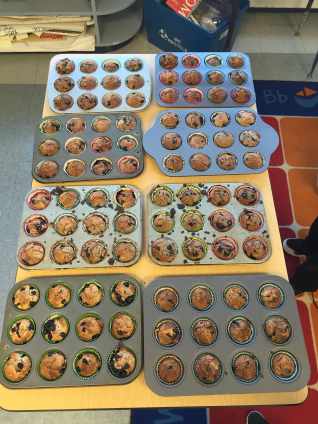
Once they got started working, I began to call small groups over to start making muffins (based on our super smart ideas from Little Red Riding Hood: A Newfangled Prairie Tale by Lisa Campbell Ernst) to share with our 2nd grade friends.  There are conveniently (if you’re connecting to the number 100) 101 kiddos in our grade, so we had a lot of baking to do; we had figured out through some HARD work the day before that we needed to make 9 batches in order to have enough.  Wow.

Well, thankfully, my friend (who typically comes to help us during Math on Thursdays anyway) was free in the morning today, because looking back now there is NO WAY we could have made 100 muffins with 21 kiddos with just me.  Thanks, Mary Beth!  She took one table and I manned another one and we measured and poured, stirred and scooped and ultimately took all of our muffin tins to the Robinson kitchen to be baked.  Again, if not for Ms. Denise in the kitchen who took charge of the ovens, we wouldn’t have had any muffins.  She was a lifesaver today.

This slideshow requires JavaScript.

Although I would have love to add pictures of the many trips we took to the kitchen and back, and share a picture of Ms. Denise, as well as how beautiful our muffins were while they were baking, I was carrying muffin tins and opening doors and having to be a teacher (hee hee), so you’ll just have to imagine that part.  I also wish there was smell-o-vision so I could share how wonderful our muffins smelled while they were baking (believe me, I was told my multiple people that they could smell them all over the school!), but alas, not this time.  Just imagine the most amazing aroma ever and that’s what it was like. 🙂  Ultimately we only ended up making 8 dozen (not sure what happened there), so we had to do some quick math about our shortage (which was a great lesson in scarcity!) and figure out how we could best share with our friends as well as have some muffins for ourselves.

After we figured out how many muffins we had:

IMG_0254-min

we made some plans for how we’d get them to our friends.  We agreed (ok, well they did after I convinced them) that it was the right thing to do to give muffins to the other 2nd graders before we served ourselves and so we go together in groups and created little pitches to share with them about what we did and how we wanted to give so to them.

We had a little bit of time after both muffins and our book (but more about that in another post–we have some revising and editing to do there before we’re ready to share), so kiddos had a choice of a board game, reading, or writing.  I always love to see what they do when they are in charge:

Because our day was filled with two other special events (roller skating in PE and a farewell assembly for a beloved custodian), we only had time for one more thing, and we decided it should be puzzles.  After that conversation the other day and the question from Ja’Mia, we knew it would be fun, hard work and would definitely allow us to use all of the grit, patience and teamwork we’ve been building lately.  Look at what we were able to do!

For all the thought (perhaps OVER-thought) that I put into this day, I am pleased with what happened.  It was all that we wanted it to be (which was to focus on learning and growing) and we had fun along the way.  I think that they things we chose to participate in match up with what we are about everyday (engagement, choice, thinking, teamwork).  I enjoyed the day, and I’m pretty sure they did, too.  The last thing I heard before we left for the day was “This was the best 100th Day EVER!”  I agree, friend, I agree! 🙂


Over the River and Through the Woods

Little Red, Pretty Salma, Petite Rouge, Little Roja, Lon Po Po. The list goes on and on.  And it’s a pretty good list, eh?  Rm. 202 thinks so!  (Do you know what it’s a list of?) We have just begun a study much like one (only better!) that we did last year.  And you know how I told you about this thing I have the other day?  Yeah…well I am afraid that because of that thing I didn’t tell you about that awesome study last year.  UGH!  Luckily things have changed, though, and I’m starting this story much earlier. 🙂

This quarter we’re studying culture, and because of the unit I found last year (I used a variation of this Cinderella unit from First Grade Wow.  It went SMASHINGLY and was a great combination of literature, non-fiction text, culture AND geography.  It was also tons of fun to boot, which increased the engagement with a topic that is already generally interesting for first graders.  Win, win, win all around!

So this year when we came to this culture/geography time of year again (which in our curriculum usually happens in January), I knew I wanted to try something similar to what we had done last year.  The big idea of the unit is that folktales and fairytale can tell you something about culture.  When talking about culture, it is also important to understand the geography related to that culture; where the people live and why they might do the things they do there is essential to the puzzle.  Makes sense then, that all of those things would be connected–integrating subjects gives students multiple ways to make new information fit in with old knowledge and therefore make for stronger pathways to memory and understanding.  And honestly, making the unit include multiple subjects and topics helps time-wise.  Fitting it all in is always a concern for teachers, and this helps me get it all in.

Starting with framework from last year, I collected books.  The Cinderella theme worked so well and I knew I had to find another fairy tale or folktale that both had multiple versions, as well as a story that would interest my students.  There were obviously many choices, but I went with Little Red Riding Hood.  This story was familiar enough (like Cinderella), but also had many variations, and had interesting characters we could study, as well.

Our focus is to be using the fairy tales and folktales to analyze story structure, characters and main idea, as well as compare and contrast different versions.  Eventually we’ll probably write about our favorite version, trying to convince our readers why it’s the best with strong evidence from the text.  We will also study geographical concepts like continents, countries (and how they’re different from states and cities, as well as what our country is), bodies of water and regions–this one is new this year.  Besides just studying cultures of other places (which was our main focus last year), we’re incorporating the idea of regions of our own country this time; there are stories from both different countries and US regions in this unit.  We’ll analyze maps, talk about how they work and what information they give us, put stars on the places from where our stories come, color and label maps and talk about the places we know about (as well as places we wonder about).  Eventually then, students will choose one culture to learn more about, and research it.  This will incorporate with our next writing unit, and then will still touch reading and social studies skills and concepts, too.

And here’s the part where the “messy” of writing about this starts.  Previously, I would have waited until the very end of the study, hoping to include all the details and pictures, including fabulous videos of us presenting our final products.  Like I mentioned earlier, that often meant that I then didn’t even get around to writing about ANY of it–usually because I either forgot the details, ran out of steam or just didn’t have time.  And yeah, it makes me sad that it’s missing on the blog.  So here we go.  You might want to wear gloves.  Or a poncho.  Maybe goggles or a raincoat?

First let me share our booklist. I compiled it from a variety of places online, as well as just by standing forever in front of the fairytale section of my library with a crooked neck reading books spines.  I know–I’m a glutton for punishment.  It’s really not so easy, either, by the way, because they’re organized not just by story, but by author and by country.  Oh, and then they’re the ones that aren’t so obvious because they don’t have ‘Little Red Riding Hood’ in the title.  Anyhow…

We are using stories from Germany (the original), China (we have two from this culture, actually), Ghana, Spain, as well as from at least 4 regions in the US (and maybe another one that I’ve forgotten.  Told you this was messy!!!).

  1. Little Red Cap by the Brothers Grimm and Little Red Riding Hood by Sam McBratney
  2. Lon PoPo by Ed Young and Auntie Tiger by Laurence Yep
  3. Pretty Salma by Niki Daly
  4. Little Roja Riding Hood by Susan Middleton Elya
  5. Petite Rouge: A Cajun Red Riding Hood by Mike Artell
  6. Little Red Riding Hood: A Newfangled Prairie Tale by Lisa Campbell Ernst
  7. Little Red Cowboy Hat by Susan Lowell

 While those are the “official” titles, we are also going to enjoy some others that will be specifically for the reading part of the study, where we can study version, point-of-view and character.  Those include (at least for now!):

  1. Ninja Red Riding Hood by Corey Rosen Schwartz
  2. The Wolf’s Story: What Really Happened to Little Red Riding Hood by Toby Forward
  3. Very Little Red Riding Hood by Teresa Heapy

  4. Red Riding and the Sweet Little Wolf by Rachael Mortimer
  5. Honestly, Red Riding Hood Was Rotten!: The Story of Little Red Riding Hood as Told by the Wolf (The Other Side of the Story) by Trisha Speed Shaskan

  6. Super Red Riding Hood by Claudia Da′vila

I’m excited to share more pages to our story as we go along! 🙂


Library Redo

Remember last year when we worked on organizing our classroom library?  You might not, because I couldn’t find it on the blog….:(  Maybe the post I thought I wrote got lost in the “it-has-to-be-finished-and-perfect” list I told you about yesterday.  Well, since my pledge is to tell all the stories, not just the finished ones, I’ll share the parts of this story that we have finished (and that I have pictures of!).

We left at the end of 1st grade with a (mostly) organized library, which we had worked on together little-by-little last year.  We packed it away in that same way, which always helps when I put the classroom back together the next fall.  We figured out, though, that we had never gotten the boxes fully labeled, and so as we started using the books again this year, they got all mixed up.  We decided we should probably just start over; I was the only one who knew what most of the categories were supposed to be.

We started by pairing up, and first going through the boxes we already had established.  I gave each pair a box, and their job was 1) to figure out what their books had in common, 2) decide if they had any that didn’t match that category, 3) and then make a label that matched their newly decided-upon category.  All of the extras got piled up in the middle of the room for later.

The second year together has been a great learning process in many ways.  Of course, for many reasons, we’re doing many things differently, but there are also some things that are the same that they are doing differently.  This is a perfect example.  The understanding they have of genre and the difference between fiction/non-fiction, as well as the ability to see similarities and differences is deeper than when they did the library sort as first graders, so the same activity is even more meaningful than the first time.  Even the way they “get” why we did it, why we did it together (as opposed to just having ME take care of it), and why we should keep it organized is different than last year.


Global Read Aloud 2015

If you’ve been here for any length of time, you’ve probably figured out my love of all things online–collaborating with other classes through things like Mystery Skype, Edmodo, Twitter, World Read Aloud Day, Dot Day, blogs, etc.  I hope that you’ve also seen how I am willing to try new things, not necessarily knowing how they will work out in the end.  I consider myself to be a risk-taker with technology and with new learning ideas.  I guess I trust that worst that will happen is that whatever it is won’t work and then we’ll try somethign else. 🙂

So, when my friend Tam Scharf, from Yr5sK in Queensland, Australia, invited me to join the Global Read Aloud this year, I knew I had to do it!  I have read about it for a couple years (during my time on Twitter!), but wasn’t really sure what to do to get involved.  Well it’s really pretty simple and has already proven to be a great opportunity for Rm. 202 kiddos!

The basic idea is that our class is reading a chapter book along with many other classes and there have been activities planned by a small group of teachers on our team that each class is trying out and then posting to our blog, or to Padlet, or other online venues.  Some classes are tweeting, and there will be Skype sessions planned, as well.

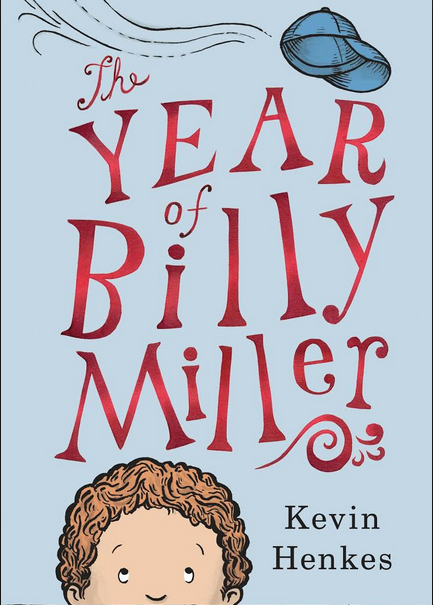
Our class chose to read a great book by a familiar author, Kevin Henkes, called The Year of Billy Miller.  The best part is that I had heard about it and was interested in reading it anyway.  So then when I found out it was a text choice for this project, it seemed like a perfect match.  And it’s about a 2nd grader.  Win/win/win. 🙂

Screenshot 2015-10-15 20.48.04Each week we are reading a different part of the book (it’s broken up into 4 parts that focus on a different relationship), and we do the coordinating activity.

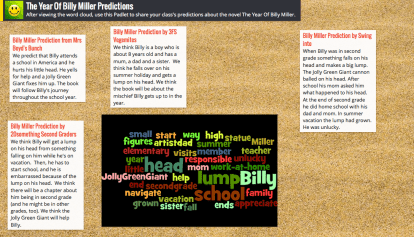
The first week we studied a word cloud about Billy Miller and brainstormed what we thought the book would be about.  We posted our predictions (along with other GRA friends) on a Padlet set up for that activity.

Screenshot 2015-10-15 20.51.41Here’s what we thought about the book:

Screenshot 2015-10-15 20.52.37

It was great to read what other kids thought about the story, and we even revised some of our thinking based on what they shared.  Already a great start and we hadn’t even started reading!

Last week we read the first section (called Teacher) and met Billy and the other main characters in the book.  We are using this book as our study in Readers’ Workshop and it’s matching up perfectly with our work with story elements.  We learned how to use a story map, and recorded the characters, setting adn problem/setting so far in the story.  We’ll keep modifying this organizer as we go on, as well as completing the other planned activities.

We’re excited to join in for this week’s work: a Popplet about what we think about Billy as a character.  We’re not done yet but are excited to share our thinking once we get there.

This story is so fun and kids can easily relate to it; the project is a great motivator for us as readers and citizens of the world!  We found out the other day that there are over 500,000 kiddos signed up doing the same thing as us–WOW!!

I’ll update you with more as we get further into this great collaboration!

Second Grade Read Around–Part 2

I recently posted about how Mrs. Meihaus made Read Around super for second grade.  That wasn’t the whole story….:)

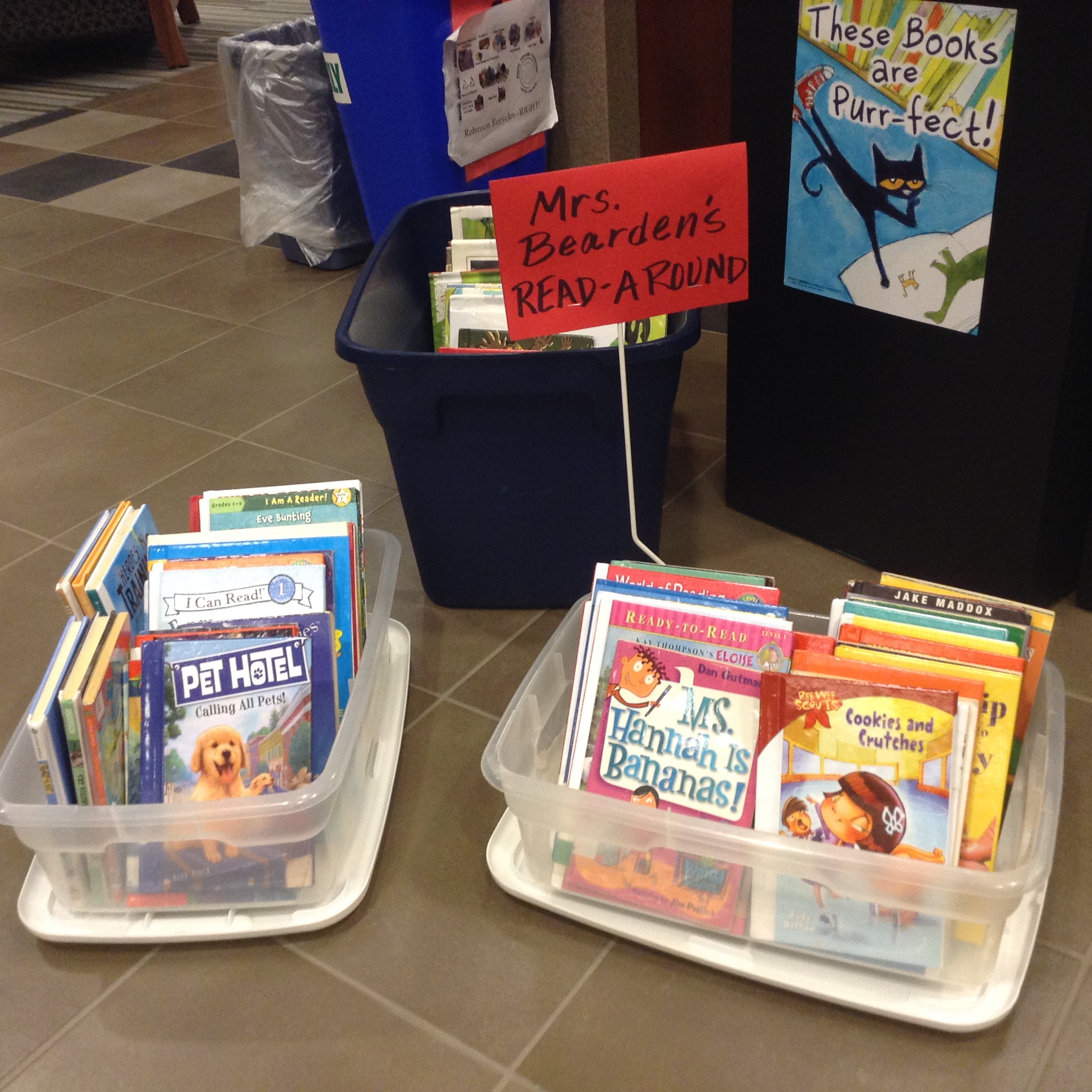
Perhaps one of my favorite parts of the Read Around came after the Read Around, and it looked like this:

IMG_5248

Isn’t that great? She saved all of our favorites from our Read Around for us until we could come back and check them out. It felt a little special that this display was right in front of the circulation desk.

Just a few more pictures that show our library fabulousness.  It’s one of our favorite places to be, and I LOVE that that’s the case.  Readers are made here. 🙂

Ok, one more.  These are new this year and can be seen all over the library (no, they’re not all pictures of me–every teacher took one LOL).

IMG_5254

And in true Mrs. Bearden form, I was told to choose my favorite and I couldn’t do it! There are just too many great books to choose just one! Thanks Mrs. Meihaus for letting me choose 3. 🙂

Second Grade Read Around

The Read Around is a procedure that our librarian learned about several years ago, and I have used a couple of times with my classes (in all grade levels).  This year was no different. 🙂

The big idea for the read around is that readers get a short time to preview (we use the word “peruse!”) a book, so that they can then see what they might be interested in checking out (ha ha, library pun) later.  The best part is that as long as you match the books to the readers, you can do this with anyone of any age!

So….Mrs. Meihaus set it all up and helped us get started by reminding us of the directions:

We spent the next 30 minutes or so (this part varies depending on how many “rounds” you do and how long you spend at each spot) perusing new books that might be interesting to us now that we’re 2nd graders.

Check out some of our favorites.  Mrs. Meihaus had each table choose their top 3 and place them in the middle of the table.  Then, when kiddos traded tables, that was the first place many of them started looking.

What’s On the Agenda?

The beginning of the year brings with it many things: new faces, new clothes, new experiences, new books to read, and assessments.  Lots of assessments.  Luckily for me, I know many of my students really well already, since we were together last year, but even still I need to learn the “2nd grade version” of them.

One particular assessment that I have a love-hate relationship with is the F&P (that’s just what we call it because it’s from Fountas and Pinnell; it’s a reading assessment).  I love it because of the deep, rich information it gives me about my kiddos as readers and how it helps me tailor my instruction to just what they need.  I kind of hate it, though, because it takes FOREVER to administer.  It involves a student reading a book to you aloud and then answering the comprehension questions to demonstrate their understanding of the text (there are both fiction and non-fiction titles included).

Sounds easy, right?  Well it is relatively easy to administer, but when you add in the fact that there are 21 students in my class and sometimes you have to read 2 or 3 stories until you find the student’s instructional level, you can quickly add up to a lot of time necessary to finish the job.

So, that’s where the idea of the agenda comes in.  It’s my attempt at having my students working on meaningful, important learning activities independently so that I can spend time 1-on-1 with students to finish my assessments.  Win-win, right?

We did this kind of thing on a smaller scale last year a couple of times, which gave me the courage to try it again now that we are 2nd graders.  The difference this go-round was that the time frame was longer (two school days instead of a morning) and that the assignments were on a little bit bigger scale (last time it was mostly finish-up work).

Now, before I gave it to my students I ran it by one of my most important helpers–my son, Riley, who was a 2nd grader last year.  Even at 8, he’s really good at looking at things I’m considering and thinking about them in terms of what other students would say.  And he did have some thoughts.  He suggested that there was TOO MUCH on the page and that many kiddos (him included) would be overwhelmed by the number of things they had to do.  I appreciated this insight, and actually had a plan, then, for how to modify the list for those that might need more support.

Wednesday morning came and it was time to share my crazy-cool plan with my students.  I was SUPER excited with how enthusiastic they were about the whole thing.  They were blown away with how they could make so many important choices, with how they got to decide when they would do each thing (meaning we’d have all different subjects and projects happening at the same time!), and with how fun the opportunities sounded!

So here’s what the agenda looked like:

Students could choose to do them in any order and spend as much time as they needed to on each one, with the goal of being done by the end of the second day.  We had a conversation before we got started about different ways to tackle such a big list, as well as how we would have to work responsibly and respectfully so that everyone could complete the challenge.  At several points throughout the days we stopped for check-ins, to have students share insights they were having, ask questions about things they may have been confused about, or make suggestions for how to make the work more manageable.

Overall, I was SUPER impressed with how things went!  I would have to say that the way they were able to manage their time and materials was even beyond what I expected.  Before we started, we made a big deal about how the important part was that they were able to work independently, freeing me up to finish my reading interviews with everyone.  It was great to hear how they problem-solved together, sometimes asking multiple classmates until they found their answer.  I do have to mention on conversation I overhead that I thought was particularly funny (and helpful!).  Someone was asking what they were supposed to do on a certain assignment, and a friend’s matter-of-fact response was “Well did you read the directions yet?  That’s why she wrote all that on there for you–so you’d know what to do!”  Hee hee.  Yes, I giggled a little at her answer.  But she was right. 🙂  And yes, she did offer help when the kiddo came back because he had a question about those directions. 🙂  Many times I heard friends reminding each other not to bother me or even asking “How can I help you?” when they knew their friend needed something.  Nice!

Having done this once, and getting really positive reviews on it from my students, I will definitely be doing it more regularly this year.  Ideally, I’d have some version of this happening all the time, with me having time to pull small groups and do 1-on-1 teaching as often as I could to help meet individual needs.  I feel like there are structures in place already in our classroom that allow for that focused attention, but anytime I can add more student choice into the mix, I’d say that’s a good thing.

So as I go into it a second time, I’m considering these questions:

  1. Were there too many things on the list?  What students may have been overwhelmed by the sheer length of the list? How can I better modify the agenda to meet the needs of every student?
  2. Were the activities the “right” ones?  What else could we have done (with content or with product) to push thinking and challenge kids to dig deep with their learning?
  3. Is it necessary for students to complete everything on the list?  Would a “must-do” and “can-do” type list be more ideal?  Is there a way for students to be more in charge of what was on the list?  Could they be given a learning target or essential question to investigate and then plan the activity they’d do to address that focus?

Regardless of what we decide to do next time, I’m excited for how this first attempt went.  Kids were focused, they had fun, they got things done, they made decisions, they solved problems, and I got some assessments completed.  And I even had a couple of teachers visiting from another school who happened to pop in while we were doing this and they said it was working.  Gotta love outside eyes to help you make sure it’s not all in your head!  Way to go, Rm. 202 kiddos!!