This week was CRAZY busy, so only 4 warm-ups–you know how you have those weeks where NOTHING happens and those where EVERYTHING happens at once? This was one of the latter. 🙂
Monday
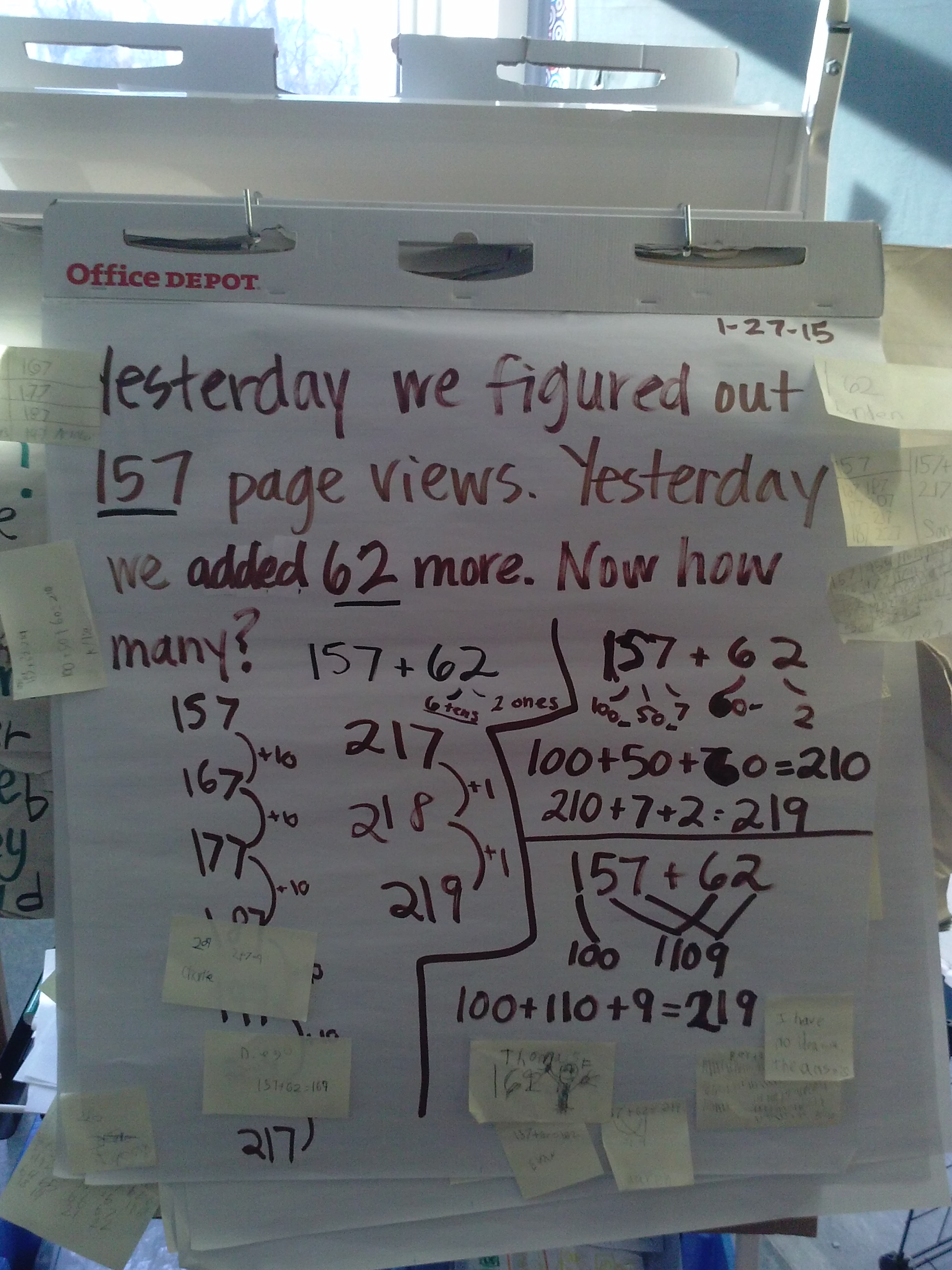
This past weekend, so many people checked out our blog, and it got me thinking about how I could use the scenario in our warm-ups. The numbers were bigger than in the problem, but I knew I could tweak them to get my kids working with adding 2-digit numbers. The idea of adding 3 of them is beyond the benchmark for what they’re asked to do this quarter, but I was pretty sure most of them could do it anyway (and it would be a motivating challenge for those that weren’t quite there yet!). Most of them quickly saw the way they could break the numbers apart by place value and combine those parts back together to find the answer.
Tuesday
This warm-up is related to the day before, and planned so that kids might see the ability to use the counting on strategy to solve it. We’ve been practicing counting on by 10s, and many used that idea to help get to the solution of 219. We recently started looking at the pattern of how the numbers work when you go past 100, so this one asks them to do that.
Wednesday
Happy 100th Day! This one probably explains itself….
Friday
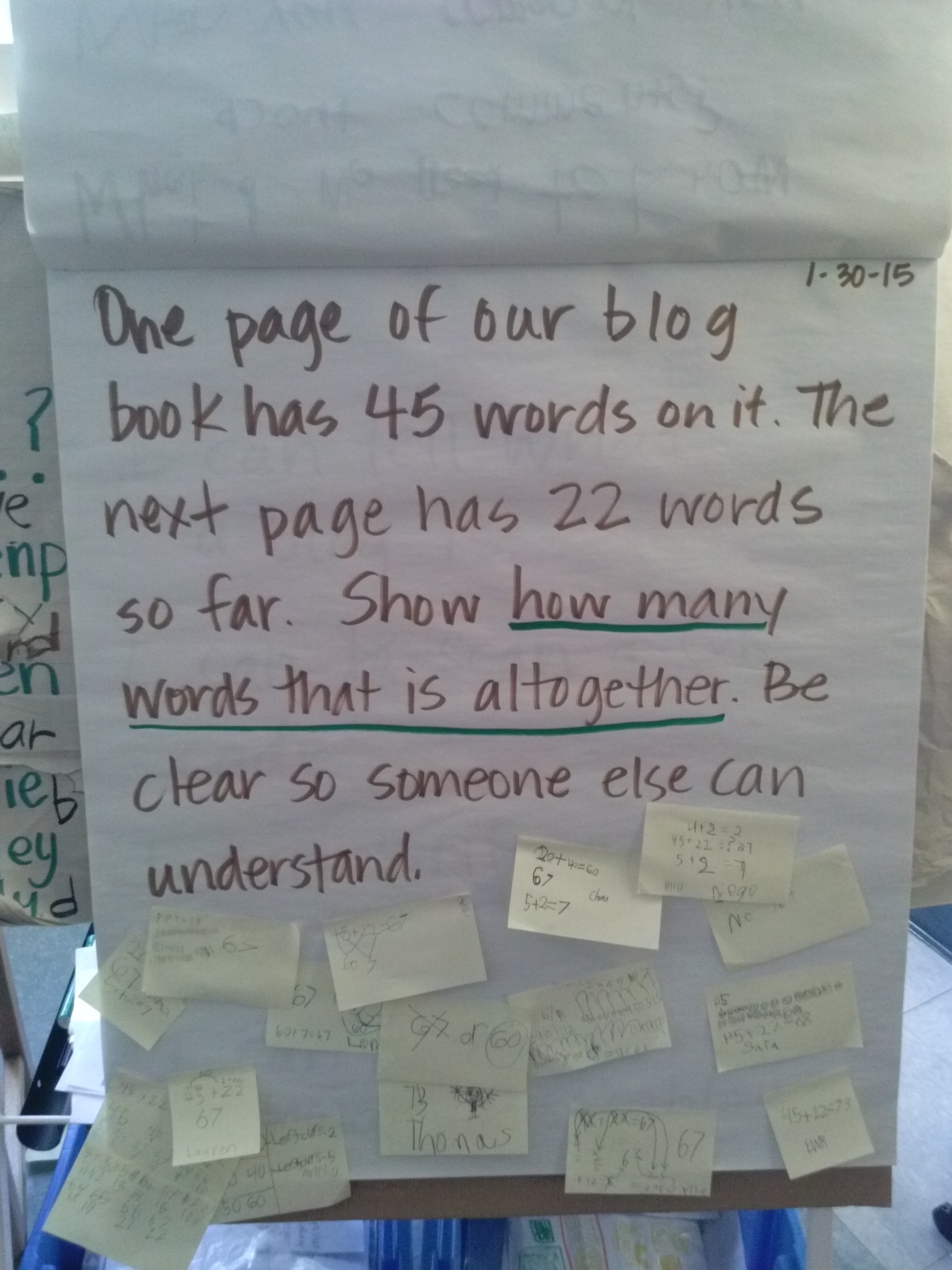
We actually didn’t get to talk about the warm-up from Wednesday until the next day because our 100th Day Blog Challenge kept us so busy! So Thursday had no new warm-up, but here’s the problem from Friday morning. The numbers are easier than the ones from earlier in the week, but the focus with this one was to get kids to think about HOW they were showing their thinking so others could understand.
Happy problem solving! Please let us know how it goes if you try some of these in your class! 🙂
Whew! Our 100th day of school was today! Boy am I tired! WE WERE BUSY!!
I’ve been thinking about how to spend that day (and mainly trying to figure out how to both “celebrate” and still be rigorous and meaningful in my choices), and had landed on several ideas I was pretty excited about. The good news? We were able to use my idea list today. The bad news (well, just the other news I guess…)? We just did one of those things. Let me explain. 🙂
If you were writing down a list of what we accomplished today, it would just say “blogging.” I even had a kiddo say, “All we did was blog today, Mrs. Bearden.” What? That’s ALL we did? In a word, yes, but MAN was there a TON of learning and thinking involved in that day of blogging! I am SUPER AMAZED at what we were able to do today.
I started the day by telling my friends that I had prepared several challenges for them to do and that we could spend the day with those things. We usually start our day with writing, so I shared the writing challenge first, with plans to share the rest of the challenges as we went on through the day. The first thing we planned to work on was a blogging challenge.
With it being the 100th day of school, and the fact that we just went live with our blogs yesterday, I knew they’d appreciate a challenge around the “bigness” of 100 things on their blog. I suggested we try to write 100 blog posts or comments. Or they could challenge themselves to write a post using 100 words (which would be a HUGE STRETCH from the 2-3 sentence posts we’ve written so far). As I had hoped and expected, they were SUPER excited to get started, and were totally up to the challenge!
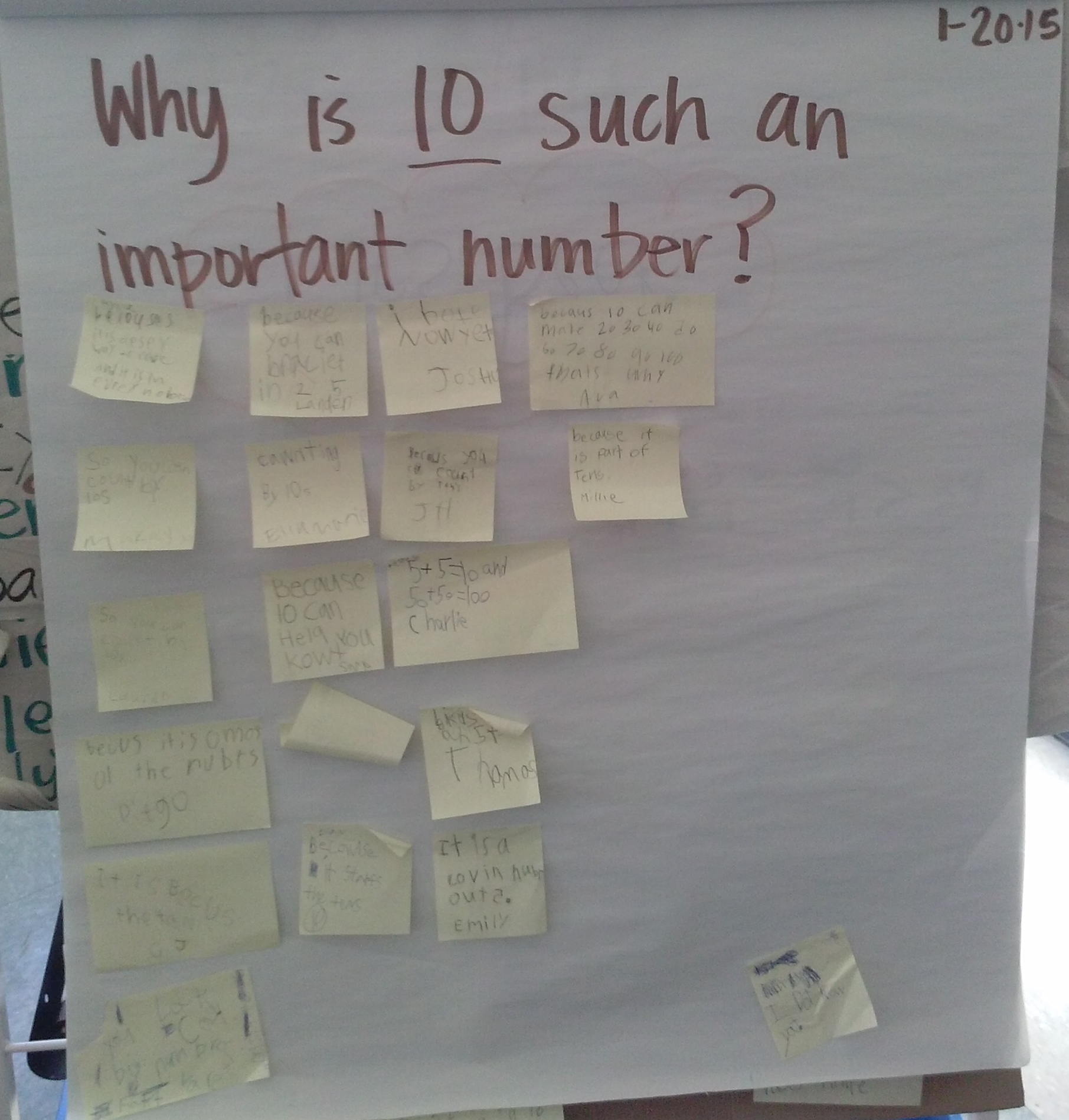
Our next step was to figure out how we could make it happen. This was a great conversation filled with much mathematical knowledge of groups of 10, counting on by 10s (as I told them we had 17 posts right then and wondered how many there would be if we added 100 more today), and splitting 10s into 5s to figure out new groups (someone said they knew that if it took 10 10s to make 100, it would take 20 5s since 5+5=10). We divided (without knowing it) 100 by the 20 people in the room (including me!), and as we went through the challenge we did lots of adding and subtracting to figure how many more we needed and how many we had at any given point.
We got started, and you know what? I don’t have many pictures of the work we did. I was as busy as they were, answering questions, moderating posts and comments and helping everyone as needed. So with 20 people, 12 iPads and 5 MacBooks between us, we were able to complete 100 BLOG POSTS AND COMMENTS today!! YIPPEE!! It took us almost all day, but we did it! And when we were finished, we had this to say:
(Hopefully you can tell they’re saying, “I00 BLOGS ROCK!!”
Now, I go back to that part about “all we did was blog all day,” because even though I didn’t mean to, at one point I even questioned whether I had done enough with the day. We didn’t have a big long list of activities to show for our time together. No one took home anything different than a normal day. We didn’t have any thing to prove we worked hard and stretched our thinking today. We did, however, have this:
It’s a little hard to see, but these are the charts where we kept tally of all of the posts/comments we finished. We counted them by 10s, 1s, and 2s at several points during the day as we figured out what we’d done and how much we had to go. It hangs outside our room for others to see. I’m hoping it will elicit questions for my kids (and for me) about how we spend our100th day! We have a great story to tell!
(ok, we did have a few pictures of the day!)
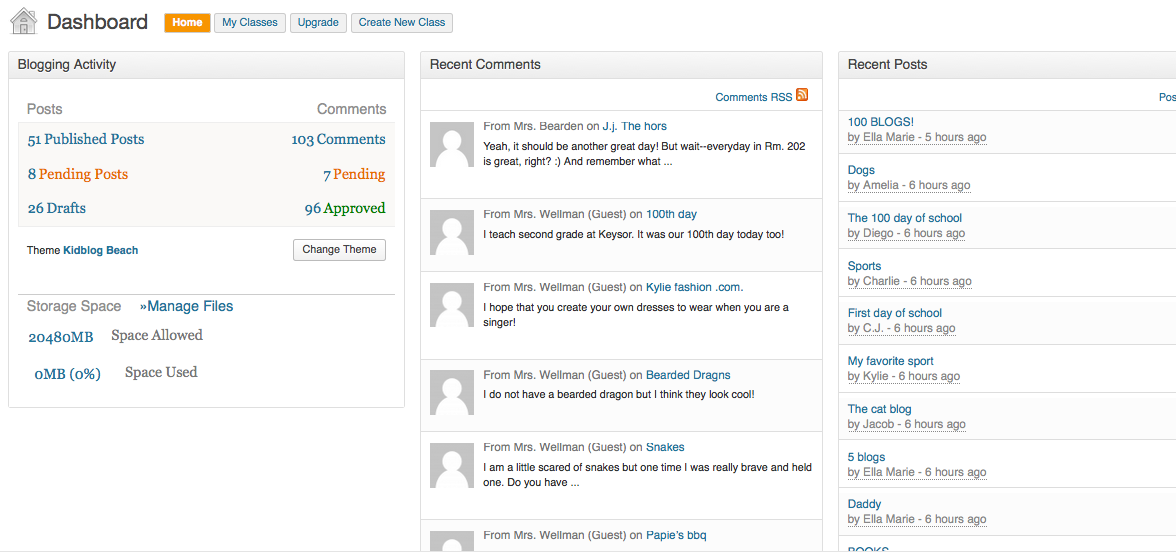
We also have a Kidblog dashboard that looks like this:
Yesterday we had 17 posts and 0 comments! Check out those numbers as of tonight! We have only been on our blogs since yesterday morning–crazy, right? We’re rocking and rolling already!!
And perhaps even better, we have memories. We have encouragement that came from our friends–“We can do this!”–when we wanted to give up. We have full buckets from the words our friends wrote about our stories. We have new knowledge about how to work the iPads and laptops on our own. We have that feeling that comes with accomplishing a goal. We have successful problem solving that happens when we’re allowed to figure things out for ourselves or talk with our classmates. We have practice with creating meaningful writing for a REAL audience; we worked hard to make our words look right, sound right and make sense. We have practice with letters, sounds and words and we have momentum to go forward with our writing. AND we have a great list of things that we didn’t finish today that we’ll use to continue our learning tomorrow! hee hee
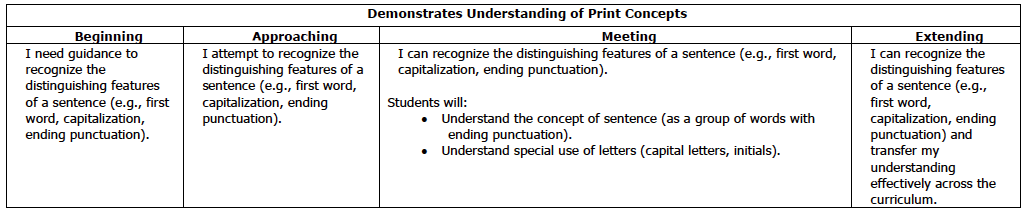
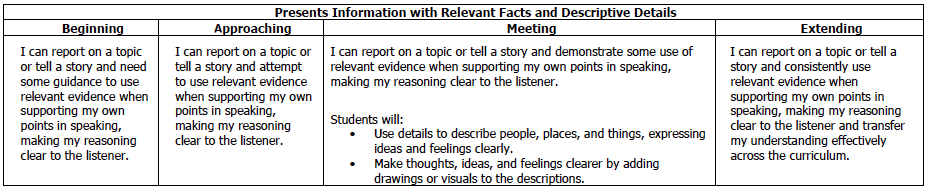
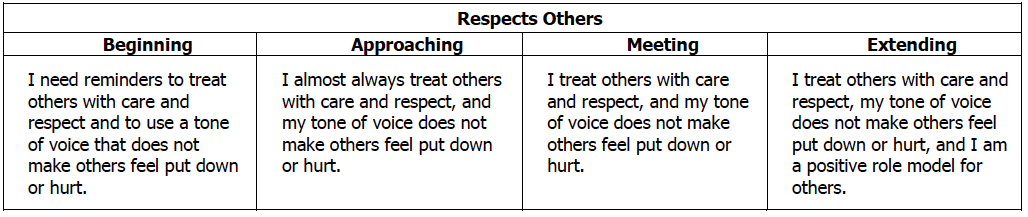
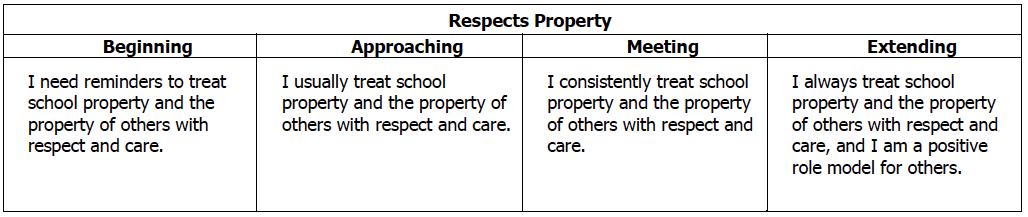
So as I reflected, I thought it would be a great visual (for me at least) to look at our district’s rubrics and match up how today’s work addressed the expectations therein. Check out how many ways this simple blogging challenge touched our 1st grade standards:
Reading
Writing
Speaking and Listening
Learning Behaviors and Study Skills
So needless to say I am tired tonight! I’m pretty sure my kids are, too! The amount of grit they had to use to make today happen and accomplish the HUGE goal set before them was great. And while I know that I am a little biased, I’d say that today was definitely a day we can say we worked to get a little closer to helping Rm. 202 kids meet this mission of Robinson School:
What did you do for your 100th day? What have you heard from Rm. 202 kids about their day? Please share your thoughts with us! We’re learning how blogging is all about the conversation, and we’d love to start a conversation with YOU! 🙂
I have returned to 1st grade this year after about 10 years with 4th-5th graders. Many things have been the same since my return, and of course there are some things I’ve had to readjust to, or that are entirely new, as is the nature of education. One thing, though, that was definitely not a “thing” the last time I was in primary is the 100th Day of School. No, I said that wrong–we definitely HAD the 100th day of school, we just didn’t officially celebrate the 100th day as a holiday. This is new to me, and as I am coming up on that day (it’s next Wednesday, the 28th), I’ve been thinking A LOT about what I will do with that day in my classroom. (Before I go on, I feel like should ask that you presume positive intent in my questions here–my focus is on really understanding the why, not judging what others may choose (or not choose) to do in their own classrooms on any given day. I want to learn here!) 🙂
It seems that other people are also thinking about it, and having similar questions to me. I found a blog post by Aviva Dunsiger (@avivaloca) the other day, after she posted this tweet:
I found myself nodding as I read her post, as she was asking the same thing I have been struggling with: Why do we “celebrate” the 100th day of school? What is the purpose and how can we use this day to continue to help our kiddos think and grow and problem solve? Why is this day any different than every other day? I’ve read many opinions about how it’s a rite of passage and a fun day to celebrate the milestone of getting so far into the year together, and I’ve heard others say it’s about helping students understand the “bigness” and importance of the number 100. Believe me, I’m all for having a great day, and I LOVE the idea of kids understanding numbers and being flexible in their use of them. So the part I’m grappling with is how I can “do” the 100th day in a way that is still high quality and rigorous, while fun and enjoyable–and not just full of things that are “cute” or that we’re doing “just because” they have to do with the number 100 (and let’s be honest–this is really our goal for every day, isn’t it?).
After thinking about this for a couple of weeks, as well as reading about what others are doing, I think I’ve settled on a few things. Most of them are incorporated into our normal routine, but are focused on the idea (that Aviva mentioned in her post) of the learning we’ve done in the last 100 days. I plan on there being a focus on how long those 100 days have been and how much learning we’ve already done! I hope to highlight the “grittiness” we’ve displayed and the fun we’ve had together and how much more fun we’ll have in the rest of the school year. Here’s what I’m thinking:
1. 100 Book Reading Challenge–with my “big” kids, we have done a 40 Book Challenge the last few years, after reading about it in The Book Whisperer by Donalyn Miller. I would love to give my firsties a similar, one-day challenge for our class together to read 100 books. It averages out to 5 books a piece or so, which is TOTALLY doable, and would be a great motivation to reach a goal and work on being better readers. That’s how it happens, right? By reading! I figure we’ll make a chart or list somewhere in the room so we can record the titles as we go.
2. 100 Word writing challenge–I’m not entirely sure how to frame this one, maybe around writing word wall words correctly or creating words from them (like word families), or if we’ll write stories that include 100 words or what…..somehow we’ll write. Like we do everyday. 🙂
3. What Have We Learned in the Last 100 Days?–Taking inspiration from Aviva’s post, I thought it would be great to document all of the things we’ve learned and done in the last 100 days (which I am sure is WAY more than just a 100) with pictures and words. Since I’m a regular blogger, I am also a regular picture-taker. That means I probably have at least one picture from each of our 100 days together. I’m thinking about having kiddos reflect on each day (probably in pairs) and writing something to go along with each picture. These could be put into a book (either paper or digital) and we could add to it as we finish up the year. Again, what a great way to visually see all of the many things they know now that they didn’t know on our 1st Day together!
4. Legos? Blocks? Maker Space?–We are definitely builders in Rm. 202, and incorporate this kind of representation into many things we do on a regular basis. I have seen ideas for “what would you do with 100 Legos?” which could be interesting, as they could answer the question about what they’ve learned or what they are most proud of. We did something similar when we returned from Winter Break where they created and then wrote about their favorite thing/event/present from Christmas. I’d love to give them the same question and have them build something with big blocks or just “stuff” and then have them video their thinking as they explain what they made and why. The video part would be pretty basic, as we’re just getting into documenting our learning digitally. Those videos would be great to share on our blogs–which we’re going live with this week, too!
5. 100s game in Math–this will be an easy extension of what we’re already doing! The unit we’re currently working on is about kids become flexible and efficient with adding numbers within 100. We’re already playing games, solving problems and having great conversations about place value with bigger numbers.
6. Read Aloud–I know that Read Aloud has been a focus around here lately, so maybe we’ll read 100 pages in our book on Wednesday, too, as a way to celebrate a great story together!
I guess we’ll see what I end up going with (as it will happen in just 3 days from now!). I’d love to hear your thoughts on how YOU will be spending the 100th Day of School. What questions did you consider in your planning? Please come back later this week to see the update on what actually happened in Rm. 202, and/or follow us @jbeardensclass to enjoy the day along with us!
Another short week of warm-ups because of MLK, Jr. Day on Monday, but the ones we had this week are goodies! Read on and happy calculating! Please let me know how/if you use these in your classroom! Feel free to add your own warm-ups in the comments, too! 🙂
Tuesday
The unit we’re in right now is math is focusing on adding numbers within 100, and on using place value to do so in an efficient manner. My focus then, this week has been on how to create opportunities to think about tens in a meaningful way determine which strategies and models make sense in each situation. This one was just a great place to start our conversation for the week because it has so many answers.
Wednesday
We’ve been doing many problems around scenarios, and I wanted to see what they could do with straight numbers–especially related to place value. This was a great one to see what they know both about tens/ones, and what they know how to do with them. You can see that there are already many known strategies and models floating around that we can build from as we go forward. YAY!
Thursday
We’ve been playing the 100s Game this week as we practice counting to 100 by different numbers. We’ve had lots of practice with counting to 100 by 5s and then 10s (really fast!), but then we practiced counting by 10s and NOT starting at 0. We used a deck of cards to decide what was our first number, then we went around and stopped at the number that was closest to 100 (for example, if we started with 6, then we’d say 6, 16, 26, 36, 46, 56, 66, 76, 86, 96). This warm up was similar to the game we’d been playing, only I wanted to see if they knew what to do when they went over 100, so asked them to go as high as they could. HA! Man…were those numbers high! One friend went all the way to 867 (and I think he only stopped because he ran out of time!), and many went to the 600s or so. As we discussed the problem and did it together, I quickly found out that they did indeed know the pattern of how it works when you get into the 100s. This will be so handy as we keep going, and many will modify their counting on strategy from numbers within 20 to counting on by 10s with numbers within 100.
Friday
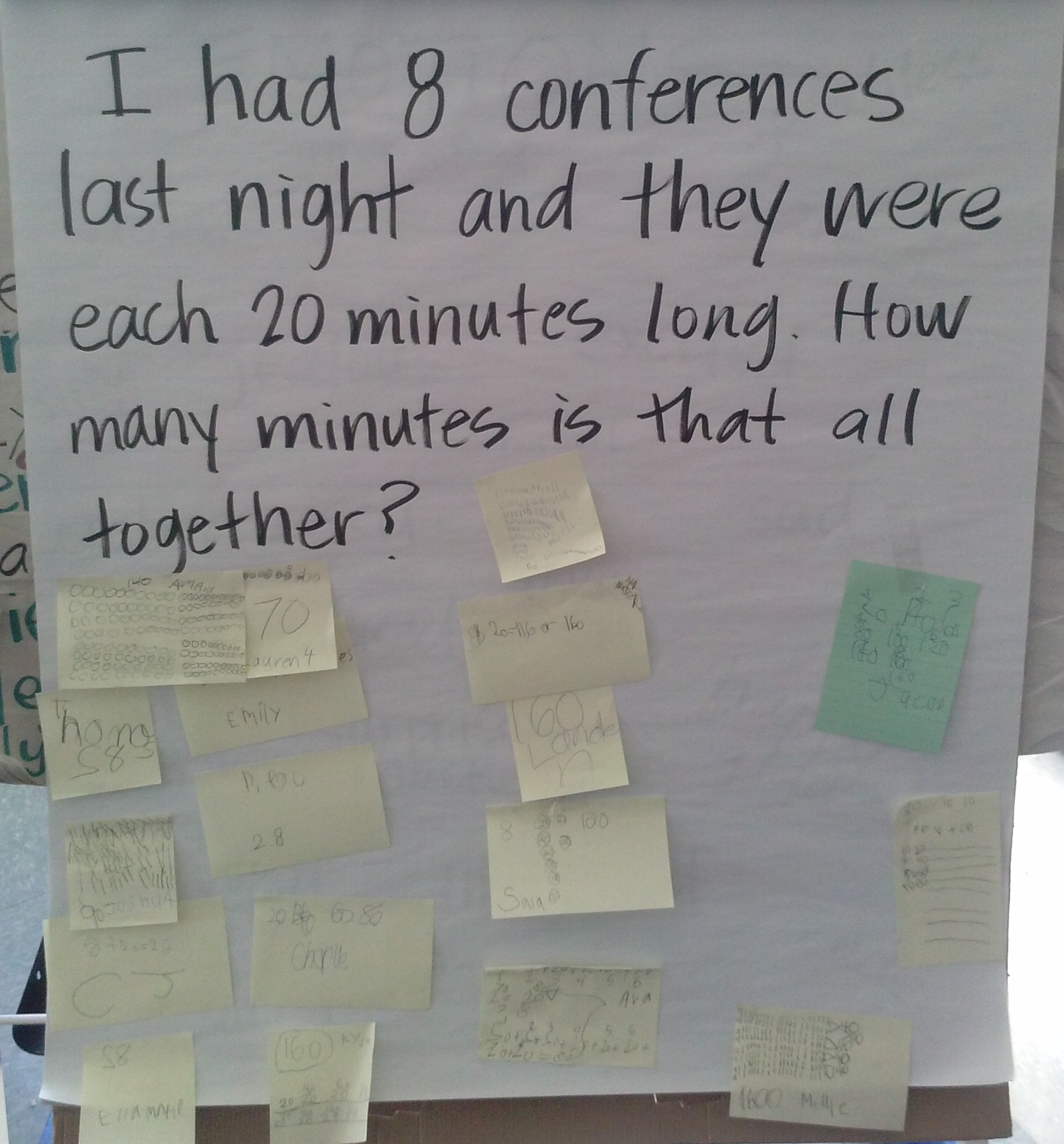
This one was a true story about how I spent my evening last night! While it is really a problem to see what they can do with tens, it’s also the beginning of multiplicative thinking, as it’s also 8 X 20 or 20 X 8; either way, i want them to recognize that it’s 8 groups of 20, not 8 PLUS 20. Most did a SUPER job of this and had great thinking about how to figure it out. Several connected the 20 to counting by 2s, and some saw the 2 10s inside 20 and counted by 10s to get to 160. The best part was that NO ONE sat and did nothing. Everyone tried a strategy, and were willing even if they weren’t quite sure about the answer. I LOVE how gritty these kiddos are!
Our record of how to use 2s to figure out the answer. We made sure to highlight how those 2s can mean 2 10s and so 16 10s is 160. Then, just for fun, we figured out how many hours those minutes would be equal to: 2 hours and 40 minutes!
This week we only ended up with 2 warm-ups because it’s all we had time to talk about! Enjoy! I’d love to hear how you’re using them in your classroom, or with your kiddos at home!
Monday
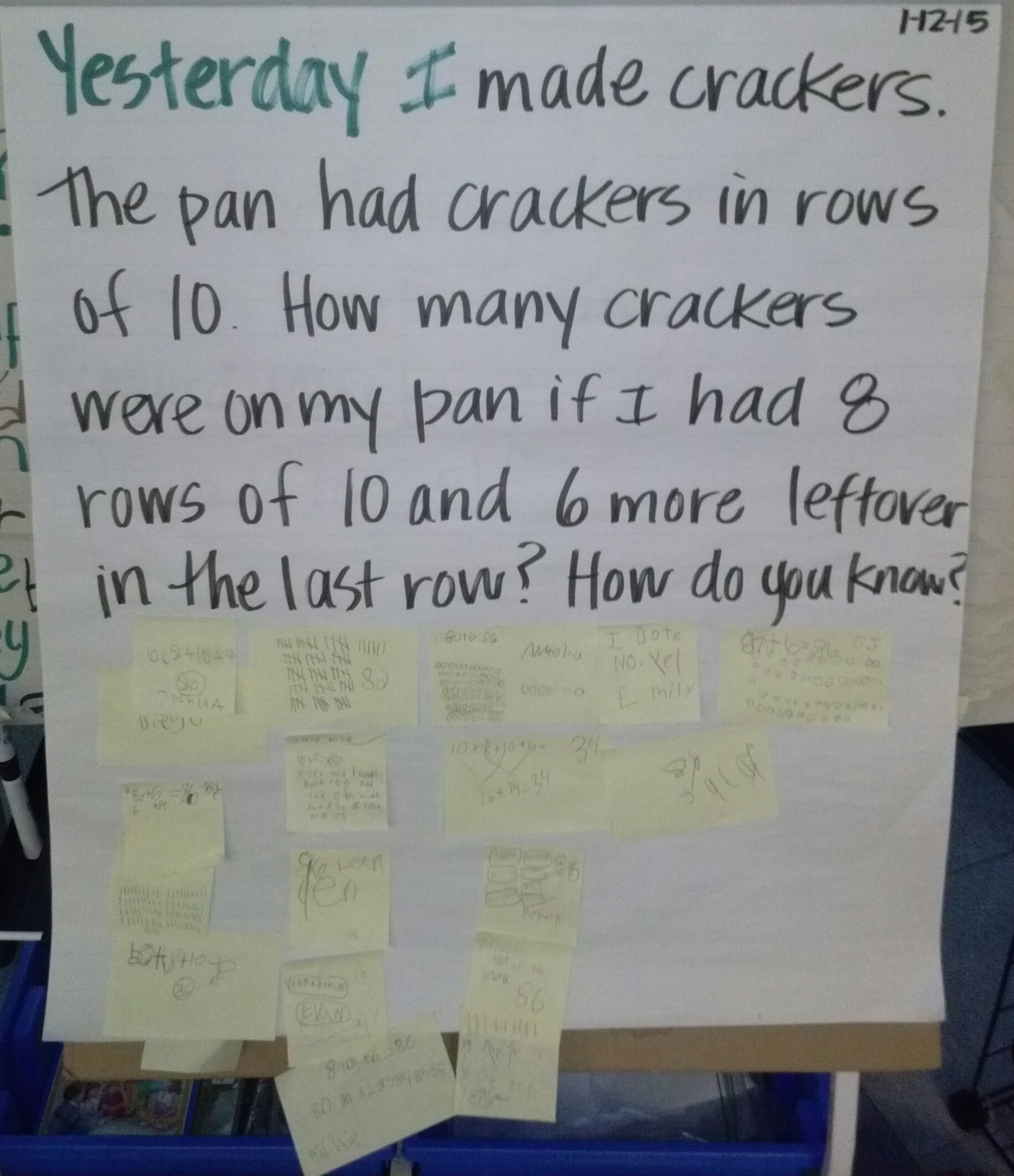
Please ignore the fact that my green markers are never juicy and always make our charts look old. 🙂 Thanks to the fact that my Master’s program is now over, I have at least a little bit of free time, and for me that means baking! Here’s a grouping problem with 10s that’s about some cinnamon honey wheat crackers I made for my kiddos!
Wednesday
Again, all the best math scenarios come from real life, right? This problem is a less-than-true story about my CRAZY drive home on Tuesday evening! The actual time in the car (because of SIX ACCIDENTS on the highway between school and my house, as well as forgetting a pile of papers I needed on my table at school and having to drive all. the. way. back. to. school. again.) was MUCH longer. My littles just weren’t ready for numbers that big yet. Maybe next quarter. 🙂
Happy calculating! Hope you’re having a great week! Stay tuned for this week’s warm-ups soon! 🙂
Welcome back to school! I don’t know what the weather is like where you are (well unless you’re where I am!), but here it has hardly gotten out of the teens and my bones are chilled! It was nice to be able to be warm and cozy in Rm. 202 with my first grade buddies this week! Here’s what we studied:
Monday
Again, true story from my life used for our warm-ups. It really makes them interested in solving the problem when they care about the context!
Tuesday
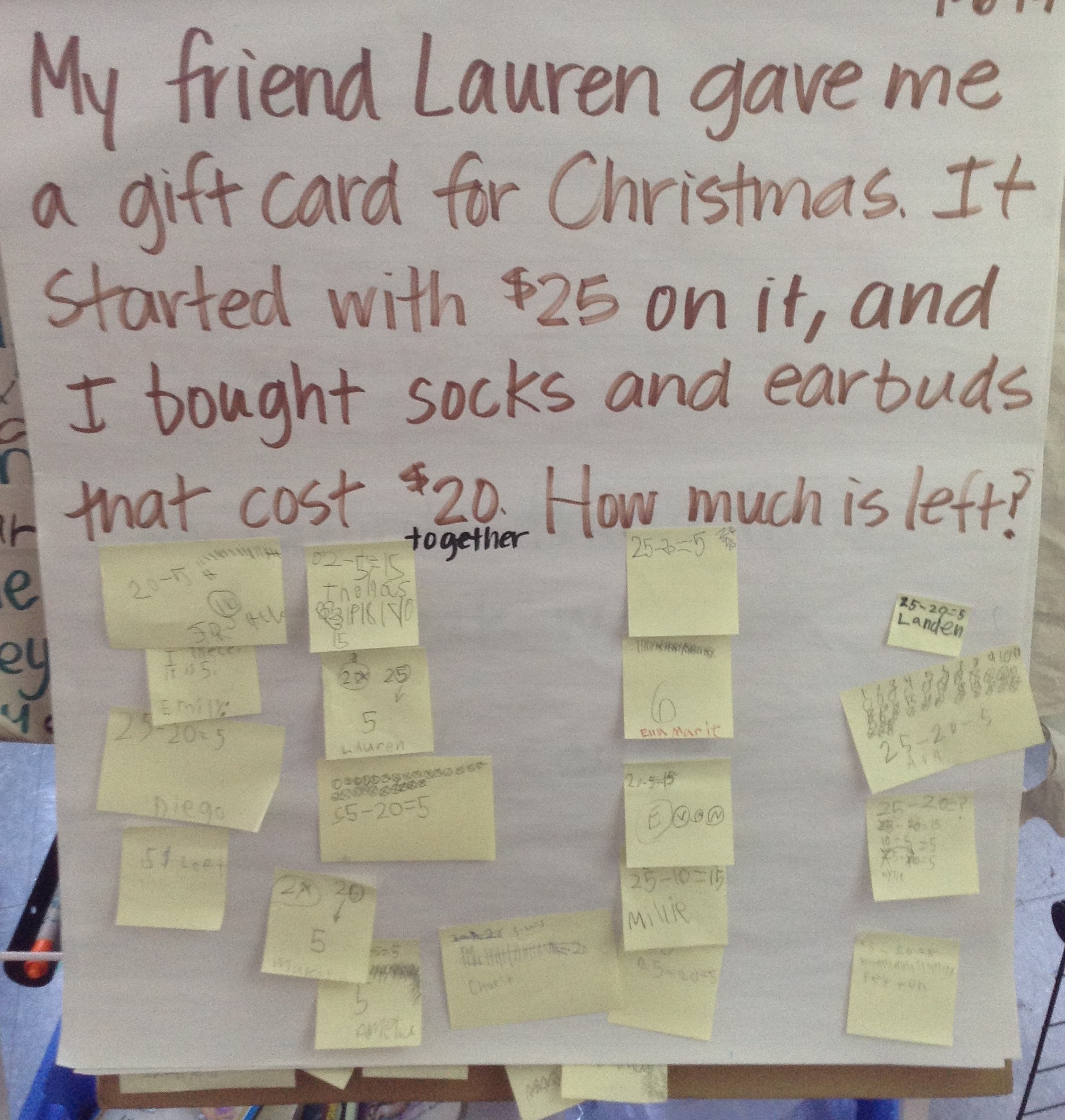
This week we’ve been continuing to work on knowing if we should add or subtract. When we discuss the problems, the question I ask them is not “What answer did you get?” but instead they turn to their partner to tell them what operation they used how they knew what to do. I am listening for explanations related to the context and what is actually happening, rather than specific clue words. Just knowing clue words (like “left,” “in all,” or “how much more”) doesn’t always work; depending on how they are used in a problem, they can sometimes mean addition or subtraction. Or, you can add TO subtract (as in the strategy of counting up), so it becomes even more confusing.
Wednesday
Thursday
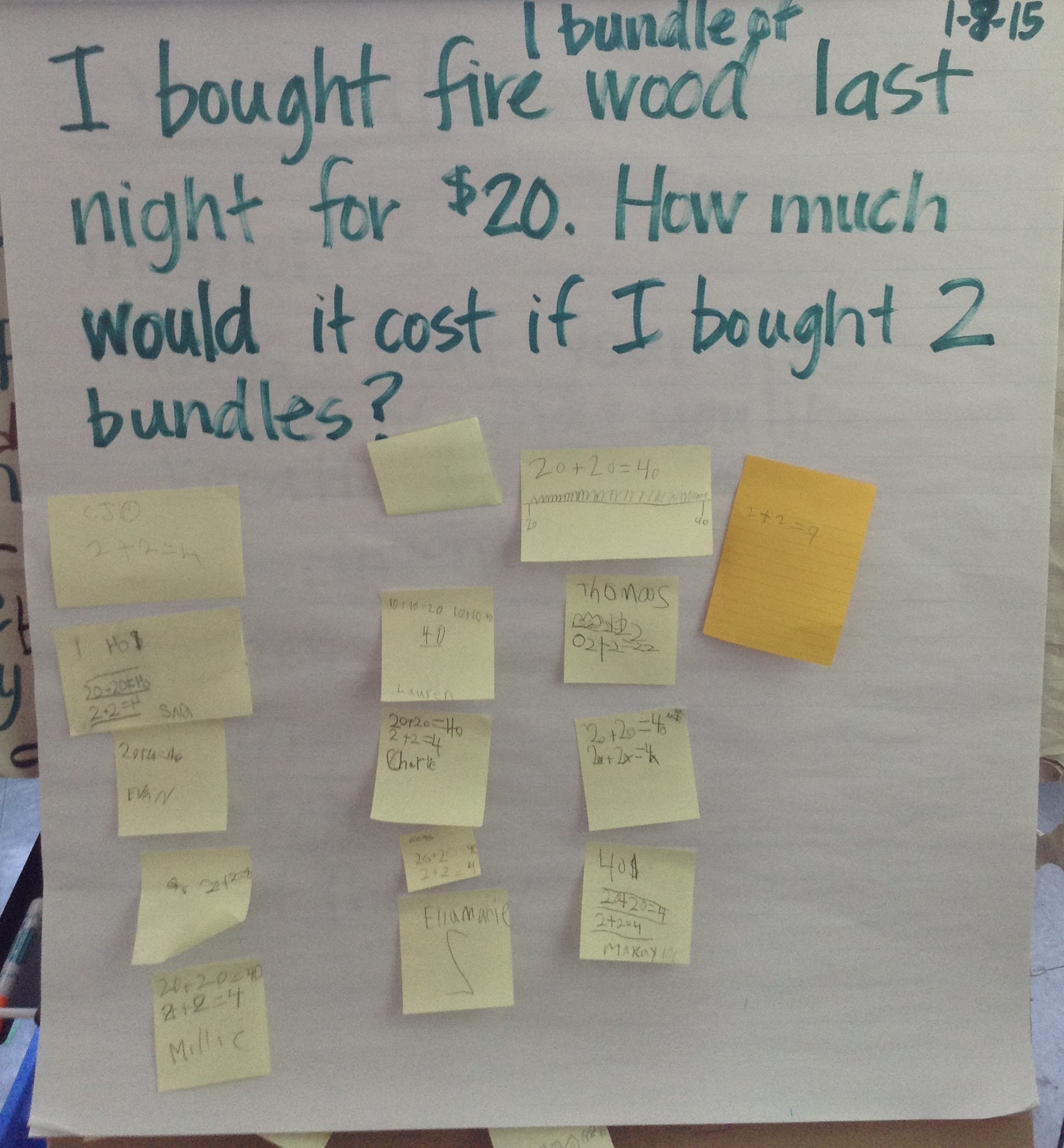
This problem is an addition problem, but also gets kiddos thinking about multiplication without really knowing it. They have to really be thinking about the situation–I bought 2 bundles that each cost $20–or they will use the 2 and 20 and just add or subtract them. It was great to see how many kiddos understood the way the problem worked.
Friday
The focus with the numbers in this problem was to help mathematicians use known combinations to efficiently figure out unknowns. Ideally they would see make 5s to make 10 or see a 6 and a 4 to also equal 10. This idea of grouping connects to our future (well, really continuing) study of place value and addition numbers within 100.
So excited how these are working out, and how they lead to such great conversations during our math time. So easy to get math brains thinking early in the day and then letting it simmer all day. By the time we come back to it at 2:00 it somehow makes even more sense. LOVE!
Monday
We’ve been working on doubles a lot lately, during conversations, in groups and by playing games. The hope is that my mathematicians can then transfer that knowledge to solving problems. This one let them give it a try. And since you’re here, let me show you the doubles games we’ve been playing–I think we might have to make a new version of these for every season:
For years in 5th grade I posted about Math Warm-Ups and how we used them to get our brains ready for flexible math thinking every morning. Last year I didn’t use them much–for one reason or another–and this year they didn’t make sense until just recently. So here we go–join us to see how Math Warm-Ups work with young mathematicians and how we use them to stretch our brains!
Week of December 12-1 to 12-5
Monday
Wait–Monday we didn’t have a Math Warm-Up. Partly because it was the first day after a really long weekend and also because we had some unexpected freezing rain during the morning rush and it took me 2 1/2 hours to get to school that day! I did anything but rush to school. Here’s a picture of how fast we were going at one point. And believe me, I was being really safe while I took this pic:
See that? I think it says 2 miles an hour. On the highway. Seriously.
Tuesday
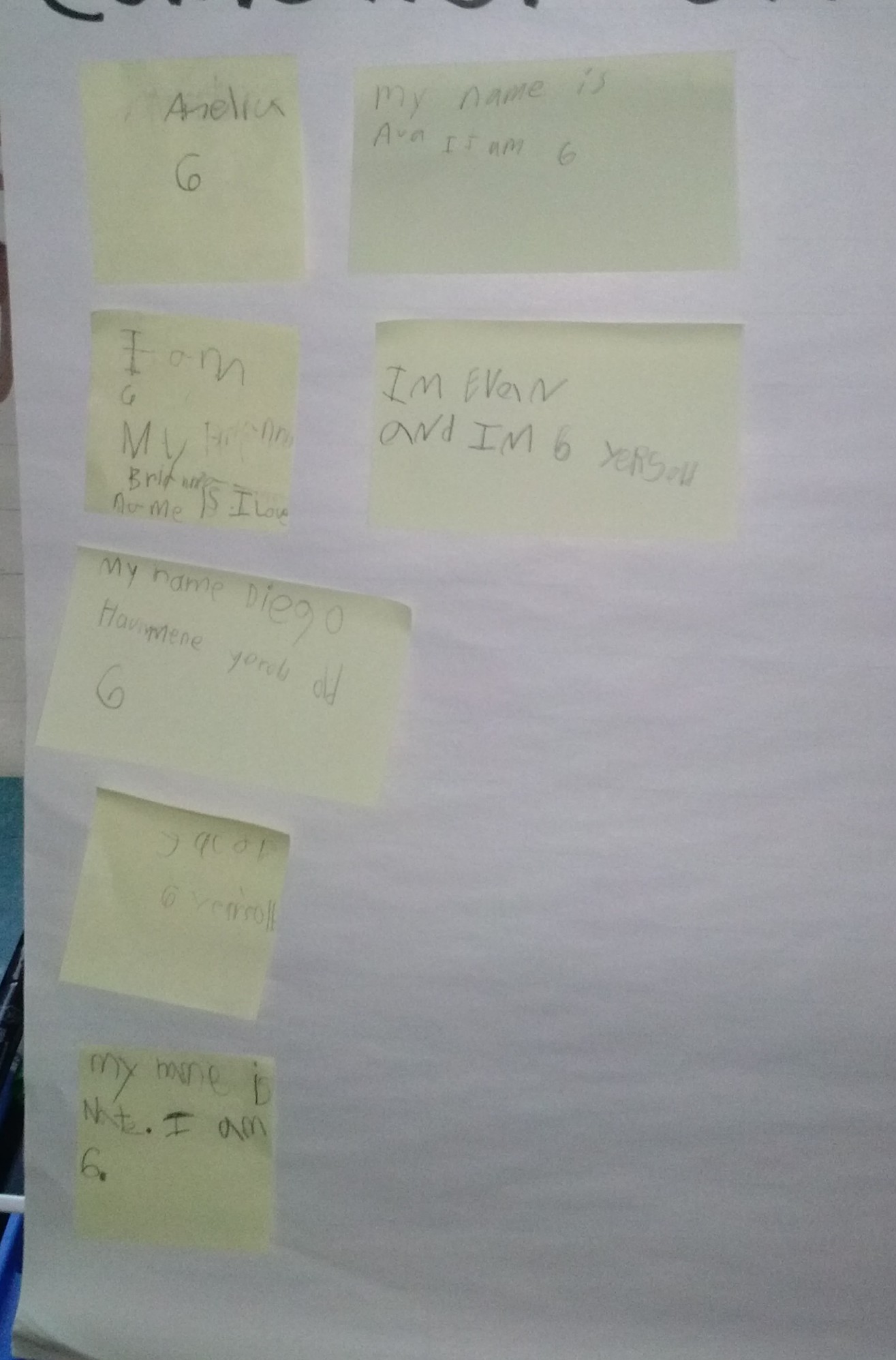
This was the first day of Math Warm-Ups so I asked a question that I knew everyone could answer easily, as the point was to teach the purpose and procedure more than focus on a math concept. Still, we were able to pull in many things we’d been working on in math during our conversation about this warm-up.
Now that I look at that picture, I wish I would have taken one right after we put all the post-its on it, because it was much messier, and that’s actually part of the conversation we had about what we could do with the data we had collected: someone suggested that it needed to be more organized. I also asked them what question we could answer with the information we had up on the easel. There were several good ideas, one of which was “Do we have more 6YOs or 7YOs in our class?,” hence why we ended up with two columns of notes.
It was great to watch and listen when we started to analyze the notes and figure out how many of each age there were: they used what we’ve been learning about grouping objects to count, and recognized that I put them into the same shape as the 10 frames we’ve been looking at lately. They were similar to what our math racks look like, too, and they quickly and easily saw that there were 7 6YOs on this day and 10 7YOs. We talked about other questions we could answer, and also talked briefly about how this data could change based on the day (we had 3 friends absent).
Wednesday
Another one I knew most could answer easily, but a little harder than yesterday. The focus today was on making sure we followed all the directions of the warm-up: answering the WHOLE question and putting our name on our post-it. There were still some who did not, so we made sure to talk about that when we reviewed this question during math. The words LESS and GREATER were also a focus, as was writing the number the way it should actually look–with digits in the right places AND going the right direction (which is still tricky for some friends at this point in 1st grade!).
Thursday
We’ve been working on flexibility with combinations up to 20, as well as most recently practicing doubles and doubles +1. This was interesting, then when most kids put 10+9 as their answer (which is probably the easiest combination to figure out). I noticed many who wrote combos that DIDN’T equal 19, so the conversation was around accuracy as well as how they figured out their answer. It also told me that as a whole, we need some more practice on this skill!
Friday
This question was just one to see where we were with fractions, as we’re about to finish up that unit. The benchmark is just that kids understand 1/2s and 1/4s, but the “extending” on our rubric is 1/3s and I was pretty sure most kids could tackle that as well. And boy was I right! Now…I am not entirely sure if kiddos answered these on their own (like they’re supposed to) or if they worked together, so there’s more work to be done, but for the most part you can see that most of those rectangles (which is also part of this unit) are divided into 3 equal pieces! Even the way I worded the question gave me some information–info that I didn’t expect–when someone said, “I can’t just draw 1 line and make thirds. Can I draw more than 1?” Obviously that friend knew what was going on! I hadn’t done that on purpose, and so made the change on the chart for the rest of the friends who completed it.
This is our first try with warm-ups this year and I am excited to see where they go! Great job, Rm. 202 friends! You did an AWESOME job!
Teachers–What kinds of math warm-ups have you done with your class? Have you tried them with 1st graders? How did it go? We’d love to hear about what’s going on in your class! Parents–did you hear about Math Warm-Ups from your kiddo? What were they saying? 🙂
You may have seen a post floating around Facebook and Pinterest about a STEM Cup Stacking Challenge:
(photo courtesy of corkboardconnections.blogspot.com)
It’s similar to the Marshmallow Challenge that I’ve done several years with my 5th graders: build something really tall with your supplies and your team, using cooperation and problem-solving. Great idea for any group of kiddos, but I especially love it for littler ones who are just beginning to learn about what it takes to work together, try something and have it fail, then rework the plan to try again. This activity fits the focus we have on being gritty, as well as having a growth mindset and trying even when things are hard. And yes, the first time we did it, it was hard. 🙂
Cup Challenge Take 1:
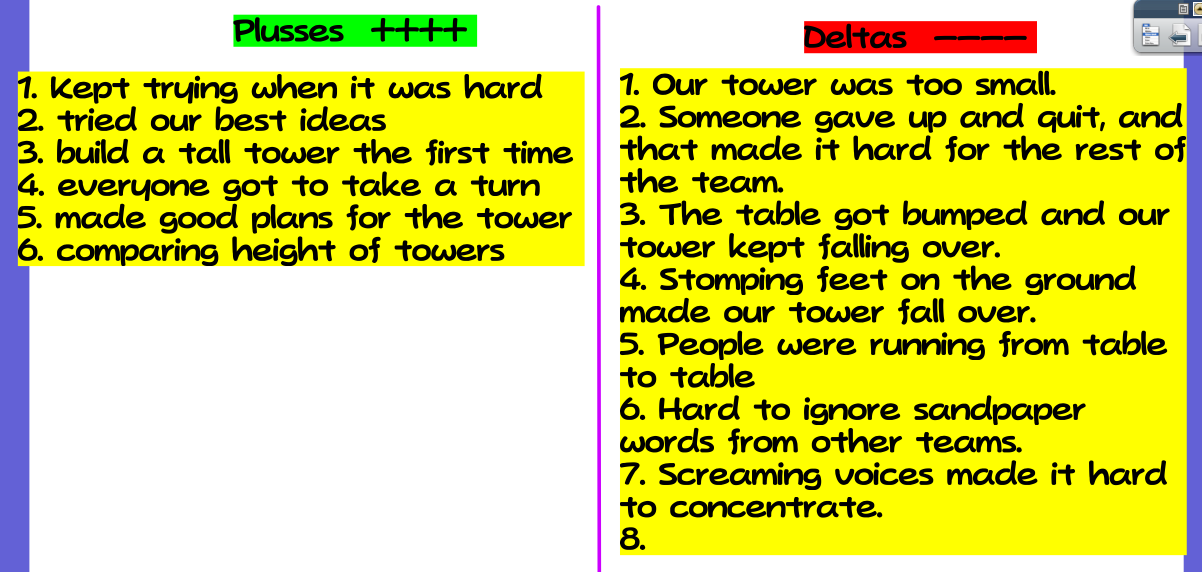
The first time we did this challenge, kiddos had 30 cups, their small group and 12 minutes. Most thought they were done in about 2 minutes, and most used the same strategy. Do you see how all the towers look the same? One thing that also happened during this is talking. Loud talking. And much arguing about what to do next. So when we were finished with this first try, we sat together to talk about it. We talked about plusses (things that went well) and deltas (things we could change next time):
They noticed that our list of things to change was REALLY LONG and go busy thinking of ways to do things differently when we tried it again. (When I mentioned that we could do it again, by the way, there were many cheers from the rug!) Working on the floor instead of tables was suggested, as well as not being able to leave your own team’s spot. We also agreed that they would get one warning about their voices and then any teams that were still loud would have to work the rest of the time in silence. Oh, and one more change was more time–they got 18 minutes instead of 12 (which was really the original plan anyway, we just ran out of time).
Cup Challenge Take 2:
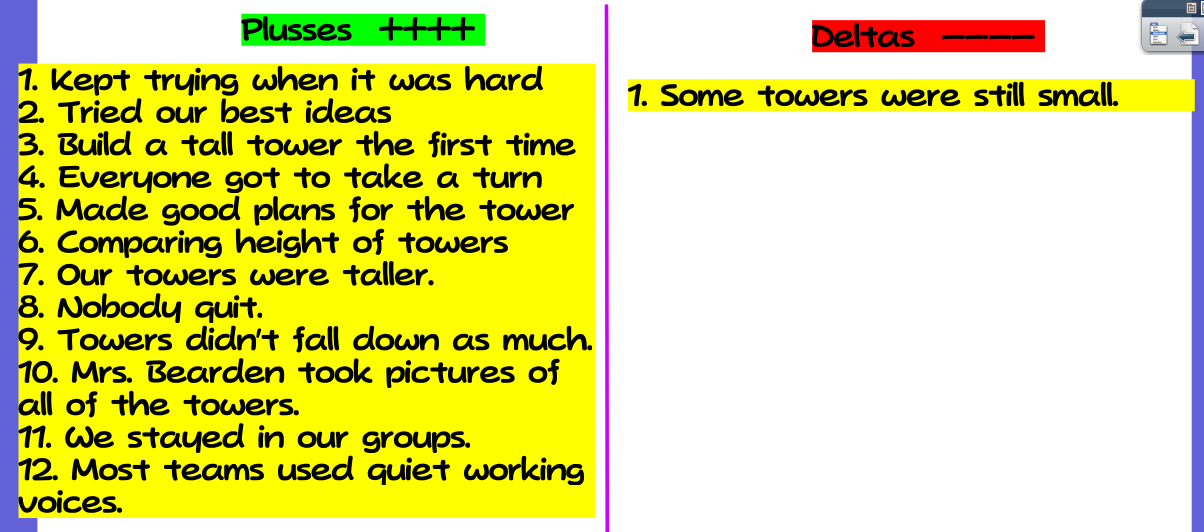
Check out our chart the second time around. They were SO EXCITED about how the columns had changed!
What a change that happened when kiddos reflected on what worked–and what didn’t–and then planned how to redo the challenge in a different way. I’m excited to see all of the many things they learned here, and how those lessons touched so many subjects at one time! Way to go, Rm. 202 kids! 🙂
Wow! What a week we’ve had! Is anyone else tired? I might have been ready for bed by 7 pm on Thursday night–but no, I didn’t actually do it. Lasted until 9. Man–these little ones keep you on your toes!
I’ve been working really hard to figure out how best to tell our first week story, as I didn’t want to just make it a big long list ‘o things we did. But we DID have a big long list of things I want to share!! So, I think I’ve decided that for this first post, I’m going to organize the info around the goals we had for our first days together, and explain some of the rationale for why we did them. Ok? Well, then get ready–this one might be long! Get your coffee. Settle in. Read on. And thank you–I so appreciate your time and your interest. 🙂
During the first week of school in first grade (well in any grade, really), there are some key goals that I work towards. This week those goals were:
Students will learn each others’ names (and mine, too!), as well as learn one thing that a friend likes to do outside of school.
Students will learn–and then practice–the expectations for how our room will run.
Students will be guided through discoveries of some key materials in our classroom that they will be using on a regular basis later on.
Students will present their work to the class (in a whole group, small group and partner setting).
Students will begin the year having fun and seeing our classroom as a positive, happy place to learn and grow!
All that being said, there were MANY things we did this week, and honestly I do not have pictures or videos of them all. (As a side note, I’ll add in a quick observation here: first graders do so many more things in the first week than fifth graders do! The number of activities and directions you prepare for each hour of the day with 6YOs is SO MANY MORE than when you have big kids. That’s probably an obvious statement, and even one I knew going in, but I was definitely reminded of it very quickly this week. Like by lunchtime on Tuesday. 🙂 ).
Getting to Know Each Other
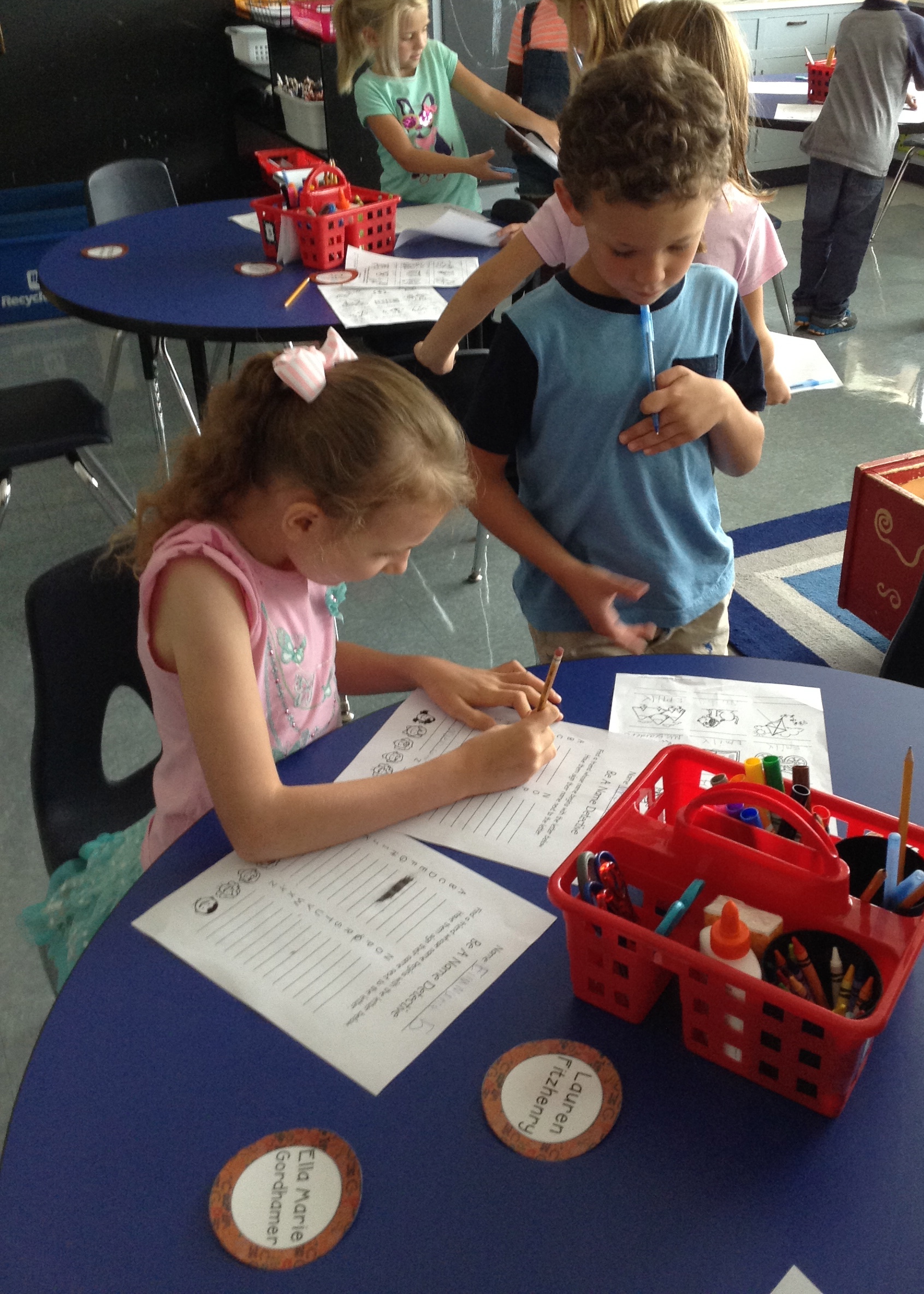
As we began the week, we worked to get to know each other, and did activities together like finding friends who like certain activities (soccer, swimming, reading, etc.); being a name detective and finding friends whose names start with different letters of the alphabet; playing name bingo; and playing together. During our first Morning Meeting, we introduced ourselves and shared our favorite colors. And while I don’t have any pics of it (sorry!), we also started sharing our Brag Bags, which they filled at home with 5 things that tell about them. Kind of like the 3 Things project I’ve done in 5th grade. 🙂
Working on Procedures and Routines
Much of our days are spent learning about where things are, how move around the room, how we sit on the rug, how we each take a turn during conversations, how we come into the room in the morning and get started, how we walk in line–you get the idea. These kiddos have been doing a super job of showing what they know from kindergarten and then adding in the “first grade version” of the routines. We’ll keep working this week as we continue to add new things/places to our repertoire.
Lunch count
Supply caddies are kept on the windowsill when we’re not using them.
Picture to remember what caddies are supposed to look like!
Everybody has a hook with their class number on it so they know where to find their things, as well as a special spot on the bulletin board with their number, too!
Special signs hang on our door to remind us of what to do in the line.
Mailboxes
Sign-out board
Morning Routine
Lunch menu and specials rotation on the side of the mailboxes
Reminders of the hallway routine
Hall passes are on magnets and hang next to the door and sign-out board (thanks for the idea, Mrs. Appelbaum!).
How Do We Get Home?
We got started on a chart to remind us of carpet rules. We’ll add to this in upcoming days.
Guided Discoveries
One way I introduce kiddos to the materials in our room is through guided discoveries (which is an idea put forth in the book The First Six Weeks of School, full of SUPER ideas to start the school year). So far, we’ve investigated Power Polygons (which will be used in a variety of ways in Math), colored pencils (which will be utilized on almost a daily basis, and are organized in a special way), scissors and glue (because you know that could be a trip to CRAZYTOWN if we didn’t learn to use those appropriately!).
With Power Polygons, kiddos were given a pile of polygons and given the task to make a creation. They could make it on the table (and we’d take a picture) or they could trace their creation on paper and color it in with crayons. I was AMAZED (but not surprised! ) by what they made! Check it out:
This slideshow requires JavaScript.
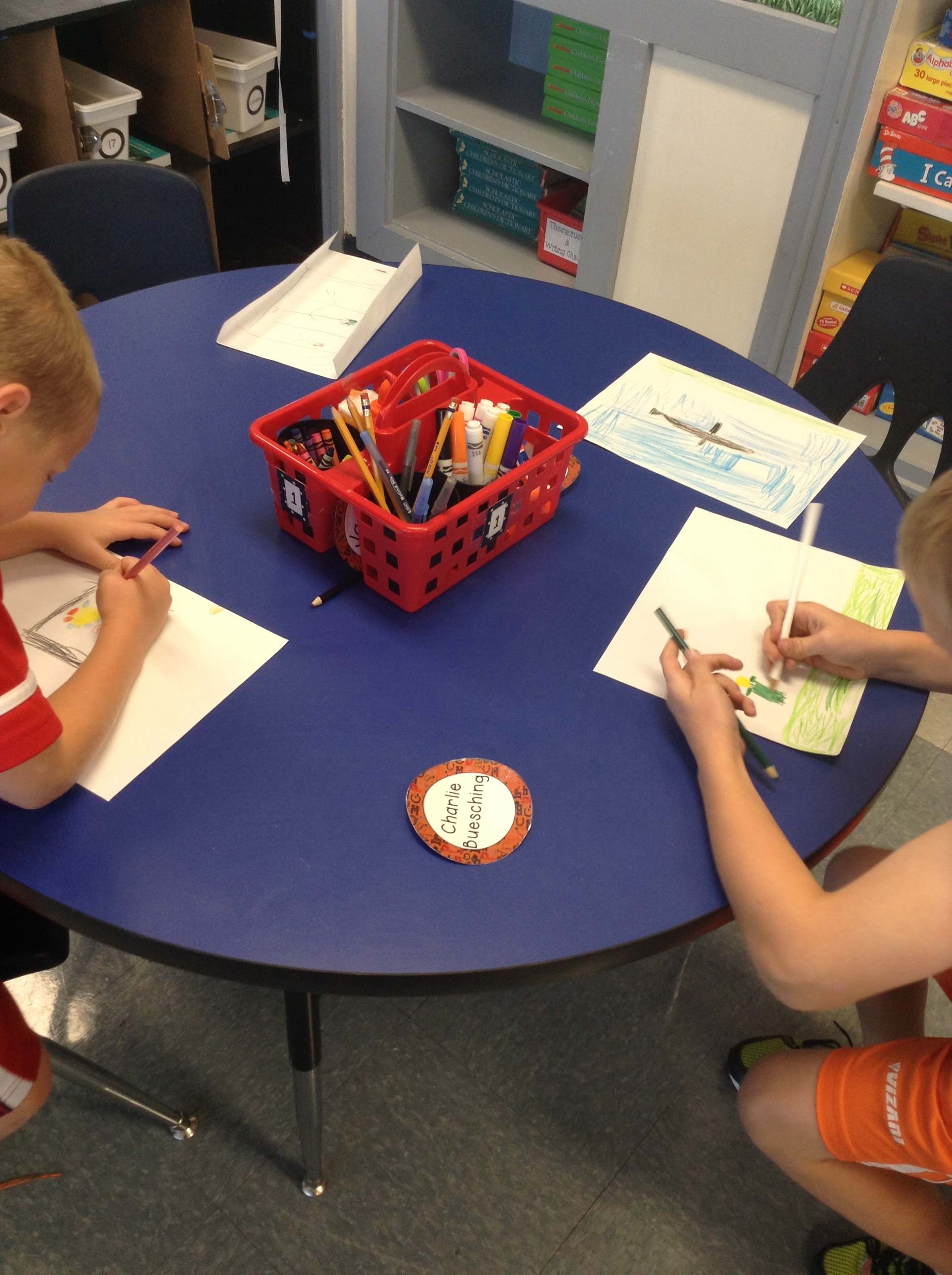
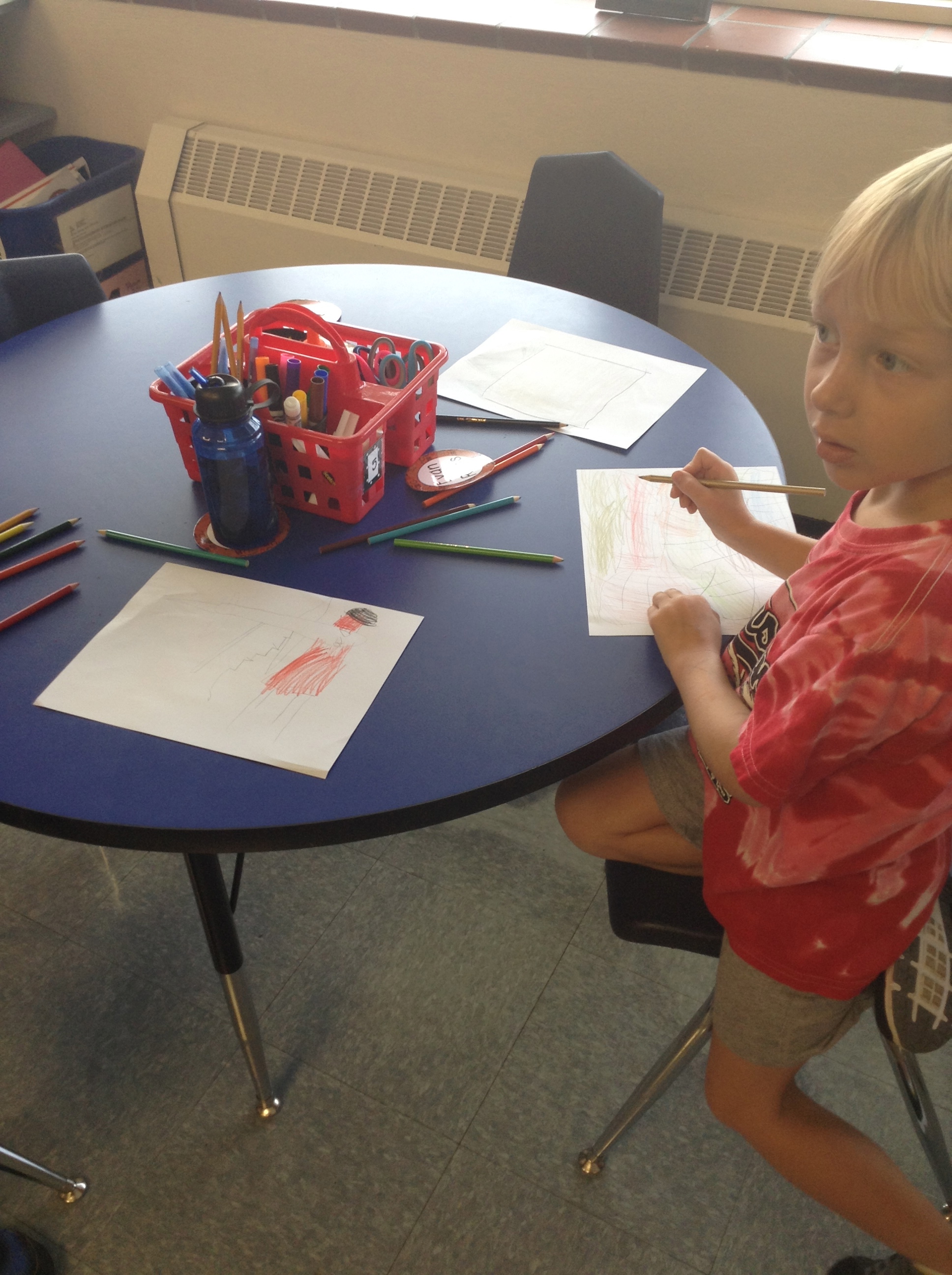
For our guided discovery with colored pencils, we spent a good chunk of time upfront talking about what they noticed about HOW the pencils are organized, WHY they are like that, and WHY it is a must that we keep them that way. I was really proud that once we were finished, all the pencils were back in the right cups! Way to go, first grade! For the guidance on this discovery, they were asked to create a picture of their favorite place to be, using as many details as they can–so that someone else could imagine being there, too.
Friends work together to find the pencils they want.
Friends at Table 4 get started thinking about the place they will create during their discovery.
Lots of friends at Table 3 chose Six Flags as their favorite place to be. I saw lots of roller coasters and a huge Ferris wheel, too!
The challenge to some friends was to keep adding details when they thought they were “done.”
See the Giant Ketchup bottle on that paper? 🙂
The last discovery this week was with glue (we did briefly talk about scissors, too). We read the book Too Much Glue, and practiced the sayings “Just a dot, not a lot” and “glue raindrops” instead of glue puddles that turn into muddles. Then they got busy creating a flower to represent the many ways they will grow this year. We’ll go back and add their pictures to the middle later, as well as a goal for a way they want to grow. This was an activity for fine-motor development as well as art, as they crinkled the tissue and put it just where they wanted it on the glue dots.
Sharing Our Work
This week we had many opportunities to share our work and start developing the skills needed to be effective speakers and listeners. We did this in whole group, small group and partner situations. I’m already impressed with how these kiddos can turn-and-talk to their partners (we call it EEKK, eye-to-eye-knee-to-knee) and keep their conversations going.
We read this book together on the second day of school, and reflected on our first day.
Students completed a sheet to remember important parts of their first day…
then got EEKK with their partner….
and shared what they had written.
After our colored pencil guided discovery, kiddos had to share with their small group at their table and tell about the place they chose and why they chose it. Then, after an activity based on a book we read called David’s Drawings, we shared whole group. Kiddos also took a few minutes to share their first creation with Power Polygons. They answered the question “What do you like best about your work?” It’s great to see the skills that these friends are coming in with from kindergarten, and how proud they are to share what they’ve created. Can’t wait to see them continue to grow in this area!
Having Fun!
Ok, one last video. It’s related to that last goal of having fun and seeing our classroom as a great place to be. While I hope that everything we do makes them feel that way, I know that when I first told them we’d have a dance party there was definitely a BUZZ in the room! Check us out as we move and groove. And while you can’t quite see it yet in this video, we are working on moving our bodies in responsible, controlled ways. We have 4 rules for when we dance: 1) Keep your feet on the floor, 2) Move your body the whole time, 3) Keep your body movements to yourself, and 4) Keep your voice at a level 1 or 2 so we don’t disturb others’ learning. I should also mention that besides just being fun, dancing allows us to release energy, work on self-control, and will also help us make sure we’re working on gross-motor movements that then lend themselves to other skills (like crossing the mid-line). We are definitely very purposeful in all that we do in Rm. 202!
Ok….so I guess it did kinda turn into a big long list ‘o things, but I’m not sure that could be helped. The first week is always like that–I want to make sure you know all about the great stuff happening in our room! After this one, I’ll be better able to highlight certain things, focus in on the methodology behind it and the ways that our work influences our growth as learners. I hope you’ll be along for the ride!

 Tuesday
 Wednesday
 Friday
 Happy problem solving! Please let us know how it goes if you try some of these in your class! 🙂



























 20somethingkids and 1kookyteacher