First Grade Math Warm-Ups: Week of January 12-15, 2015

This week we only ended up with 2 warm-ups because it’s all we had time to talk about!  Enjoy! I’d love to hear how you’re using them in your classroom, or with your kiddos at home!

Monday

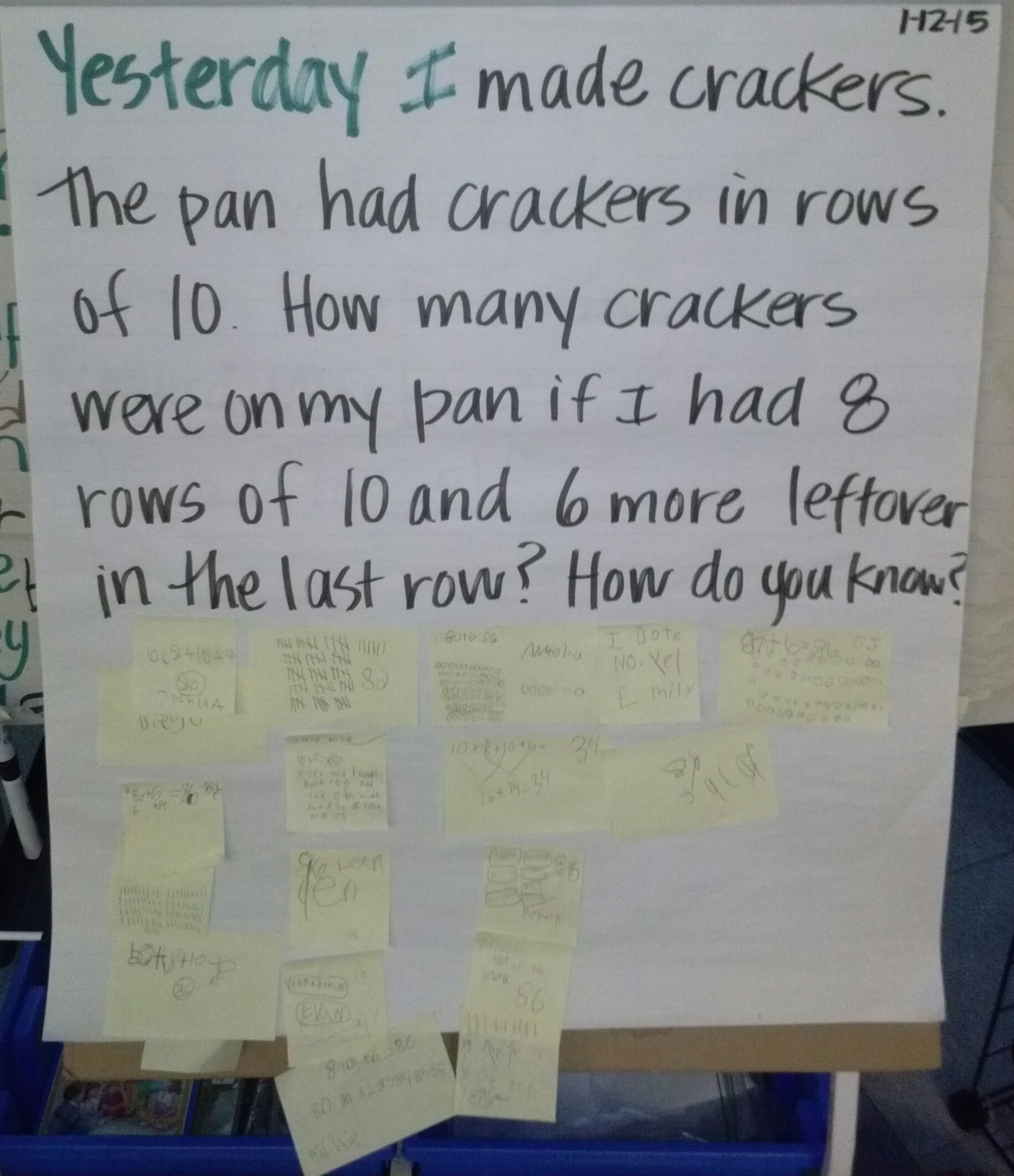
Please ignore the fact that my green markers are never juicy and always make our charts look old. 🙂  Thanks to the fact that my Master’s program is now over, I have at least a little bit of free time, and for me that means baking!  Here’s a grouping problem with 10s that’s about some cinnamon honey wheat crackers I made for my kiddos!

CAM01337-1Wednesday

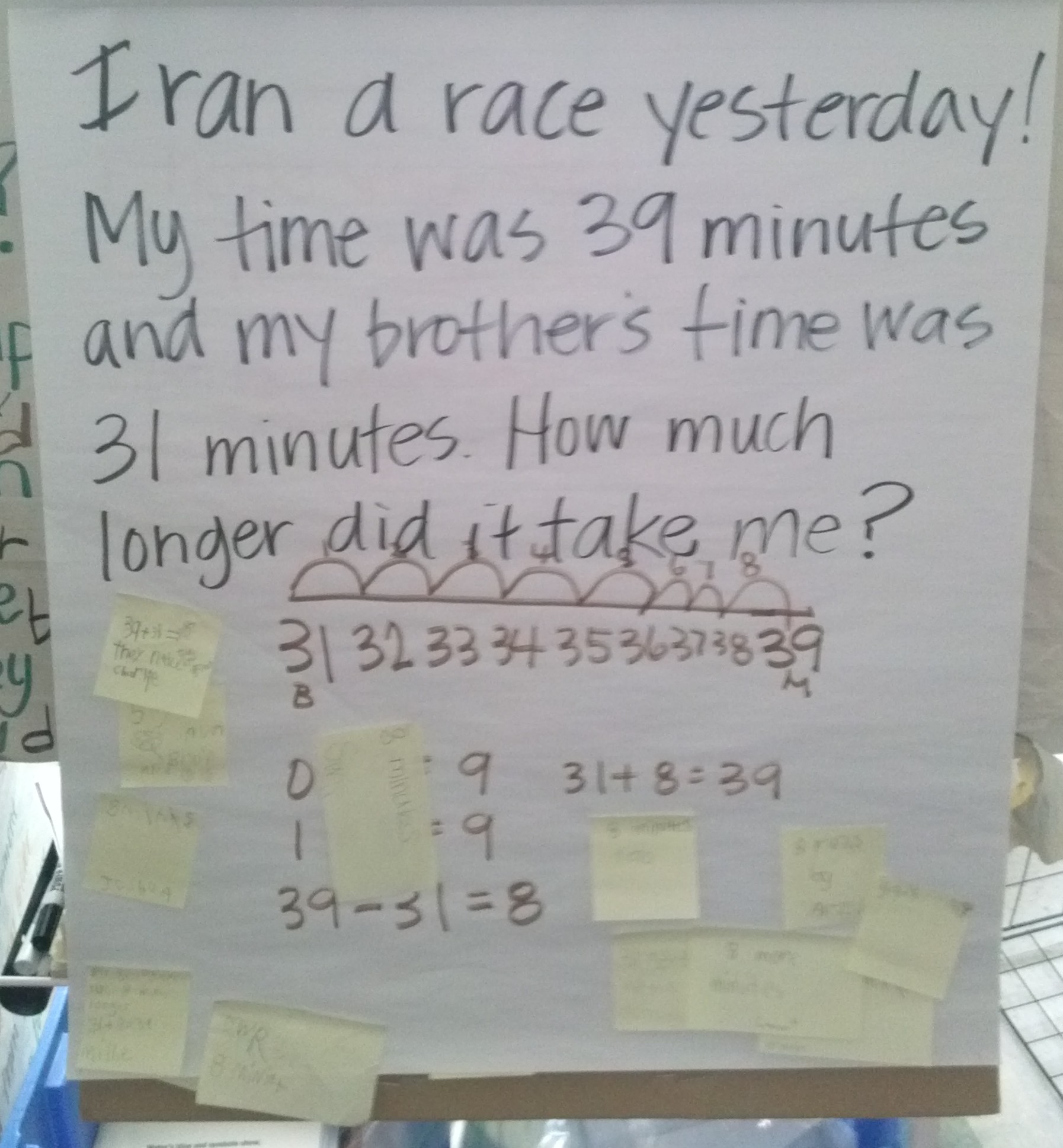
Again, all the best math scenarios come from real life, right?  This problem is a less-than-true story about my CRAZY drive home on Tuesday evening!  The actual time in the car (because of SIX ACCIDENTS on the highway between school and my house, as well as forgetting a pile of papers I needed on my table at school and having to drive all. the. way. back. to. school. again.) was MUCH longer.  My littles just weren’t ready for numbers that big yet.  Maybe next quarter. 🙂

CAM01338-1Happy calculating!  Hope you’re having a great week!  Stay tuned for this week’s warm-ups soon! 🙂

First Grade Math Warm-Ups: Week of January 5-9, 2015

Welcome back to school!  I don’t know what the weather is like where you are (well unless you’re where I am!), but here it has hardly gotten out of the teens and my bones are chilled!  It was nice to be able to be warm and cozy in Rm. 202 with my first grade buddies this week!  Here’s what we studied:

Monday

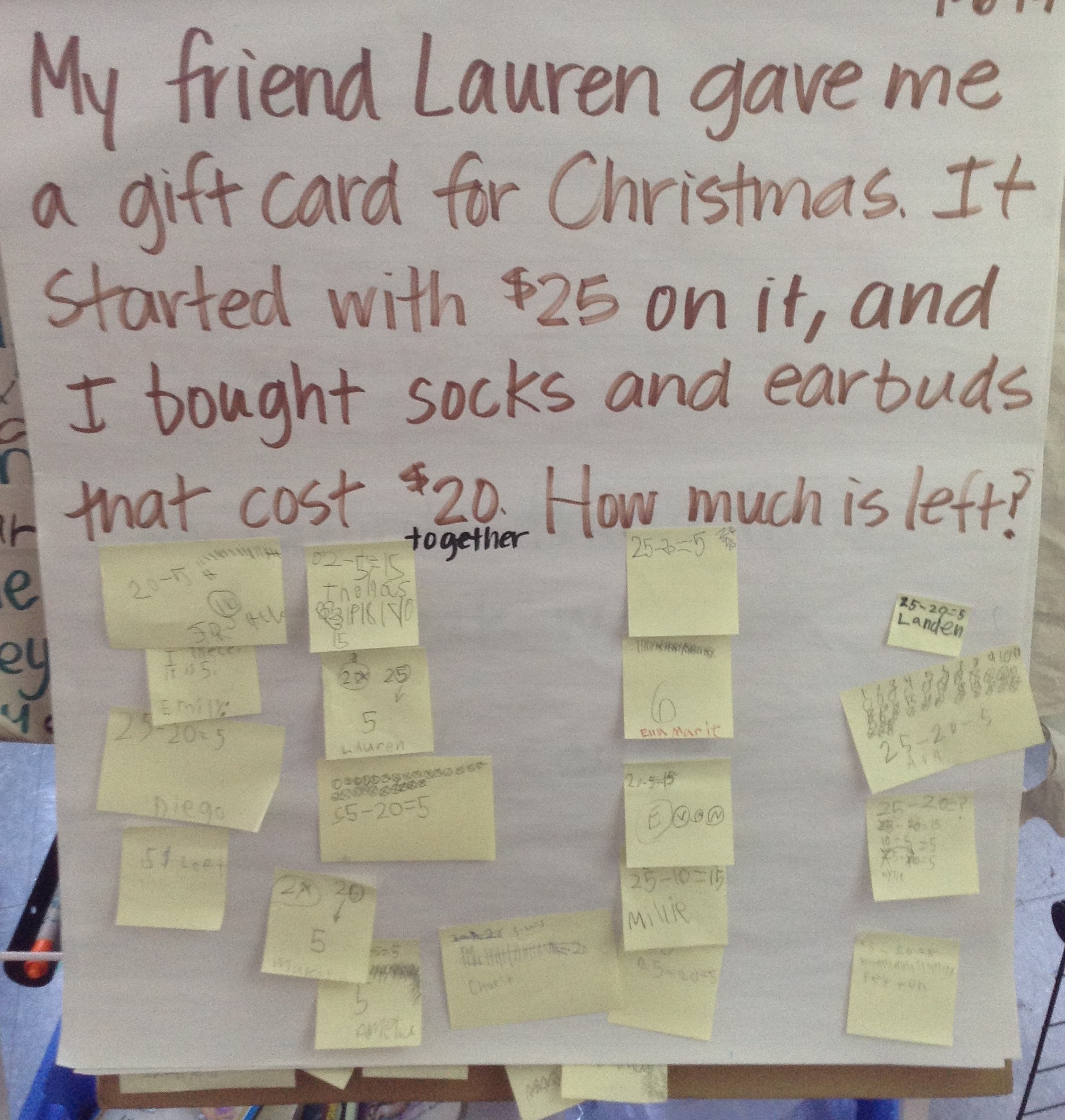
Again, true story from my life used for our warm-ups.  It really makes them interested in solving the problem when they care about the context!

IMG_4093

Tuesday

This week we’ve been continuing to work on knowing if we should add or subtract.  When we discuss the problems, the question I ask them is not “What answer did you get?” but instead they turn to their partner to tell them what operation they used how they knew what to do.  I am listening for explanations related to the context and what is actually happening, rather than specific clue words.  Just knowing clue words (like “left,” “in all,” or “how much more”) doesn’t always work; depending on how they are used in a problem, they can sometimes mean addition or subtraction.  Or, you can add TO subtract (as in the strategy of counting up), so it becomes even more confusing.

IMG_4094

Wednesday

IMG_4095

Thursday

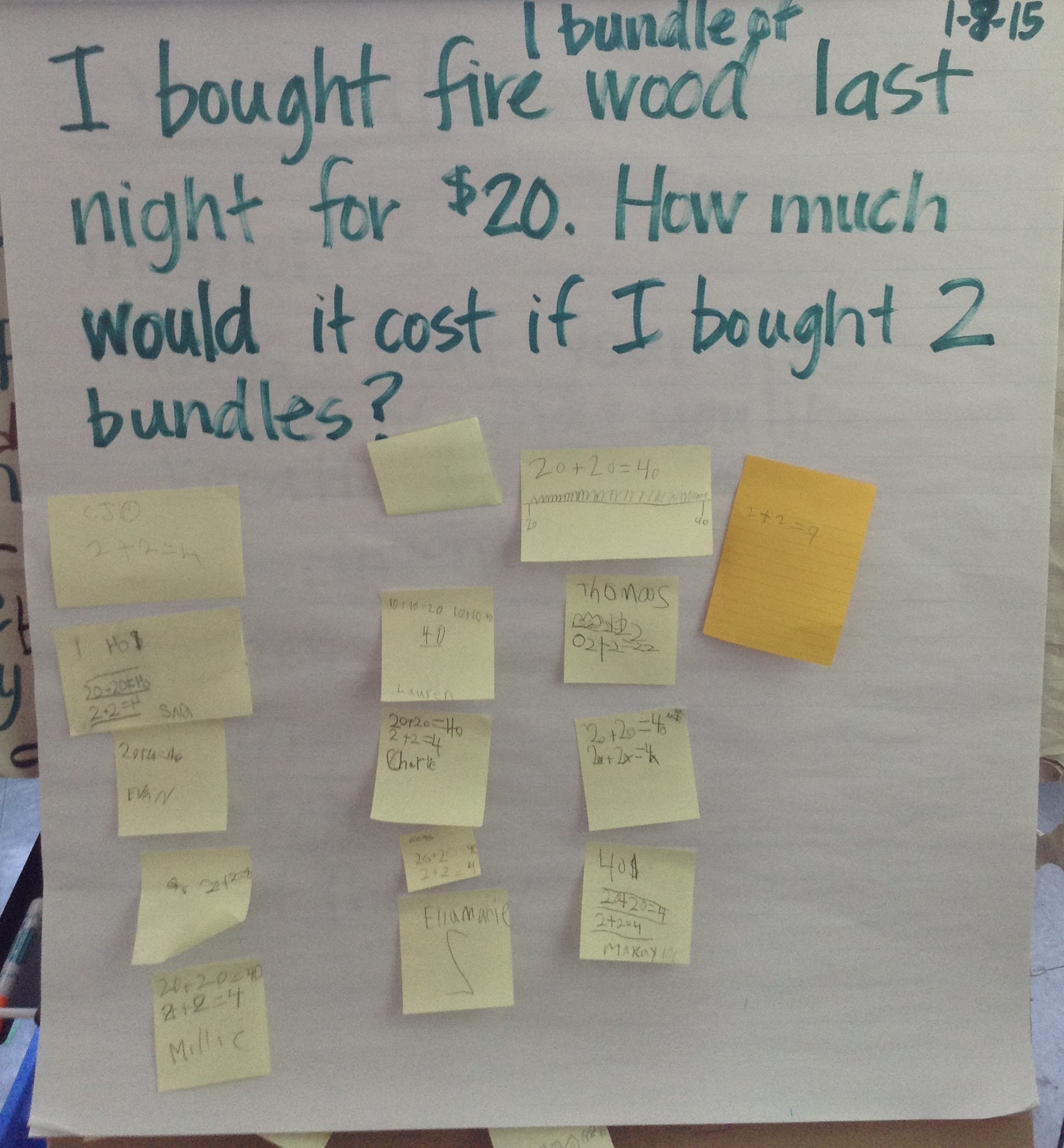
This problem is an addition problem, but also gets kiddos thinking about multiplication without really knowing it.  They have to really be thinking about the situation–I bought 2 bundles that each cost $20–or they will use the 2 and 20 and just add or subtract them.  It was great to see how many kiddos understood the way the problem worked.

IMG_4096

Friday

The focus with the numbers in this problem was to help mathematicians use known combinations to efficiently figure out unknowns.  Ideally they would see make 5s to make 10 or see a 6 and a 4 to also equal 10.  This idea of grouping connects to our future (well, really continuing) study of place value and addition numbers within 100.

IMG_4099

First GradeMath Warm-Ups: Week of 12-15 to 12-19

Monday

I participated in the St. Louis Hot Chocolate 5K with my family on Dec. 14 and of course I had to use it as a context for a problem of the day!  And yes, it is a true story.  I’m really slow. 😦

CAM01255

Tuesday

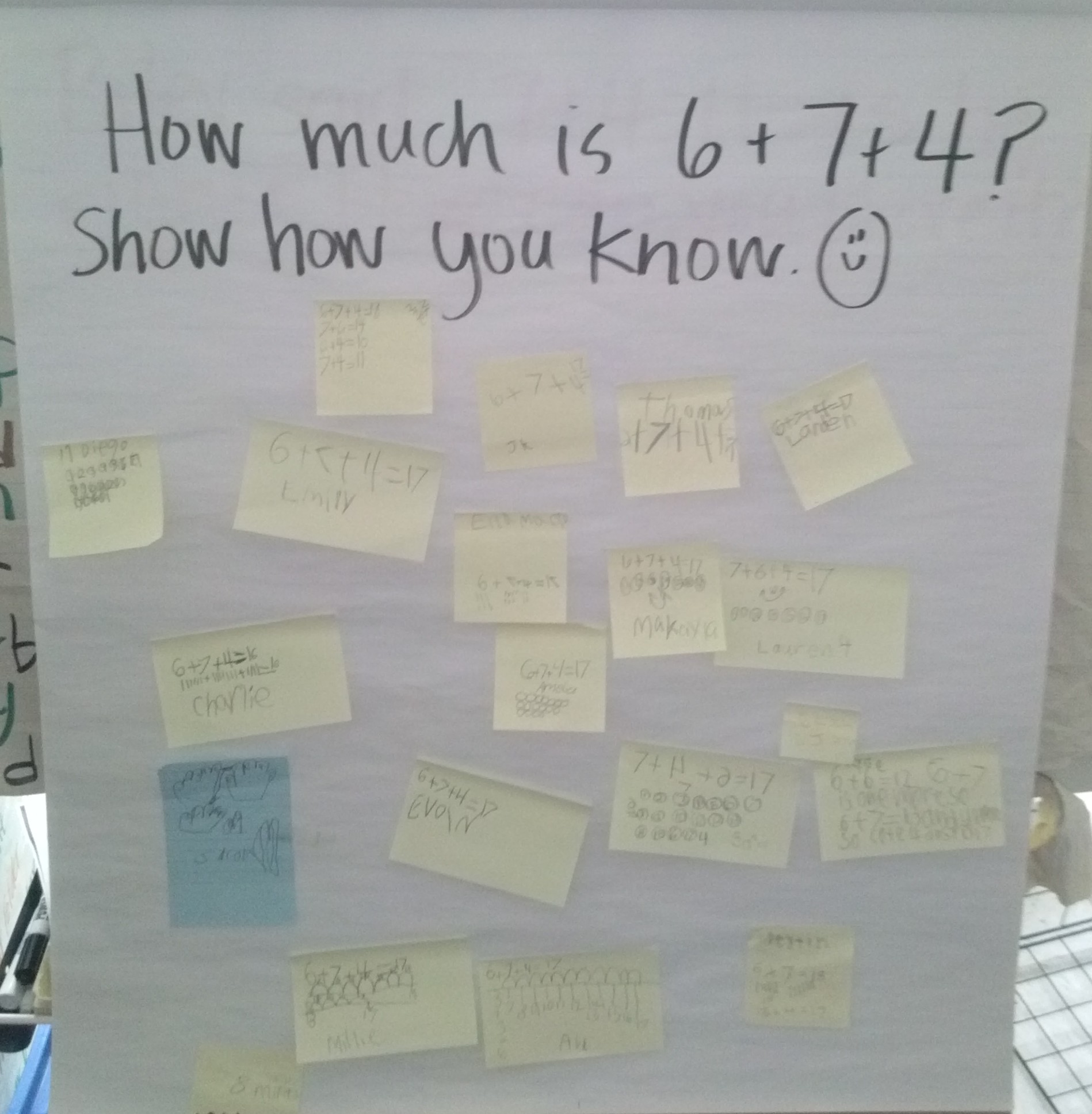
We’ve been working on addition strategies, so the numbers in this one were chosen so that hopefully kids would see the 10 and use it: 6+4 =10 and then 10+7= 17.

CAM01256

Wednesday

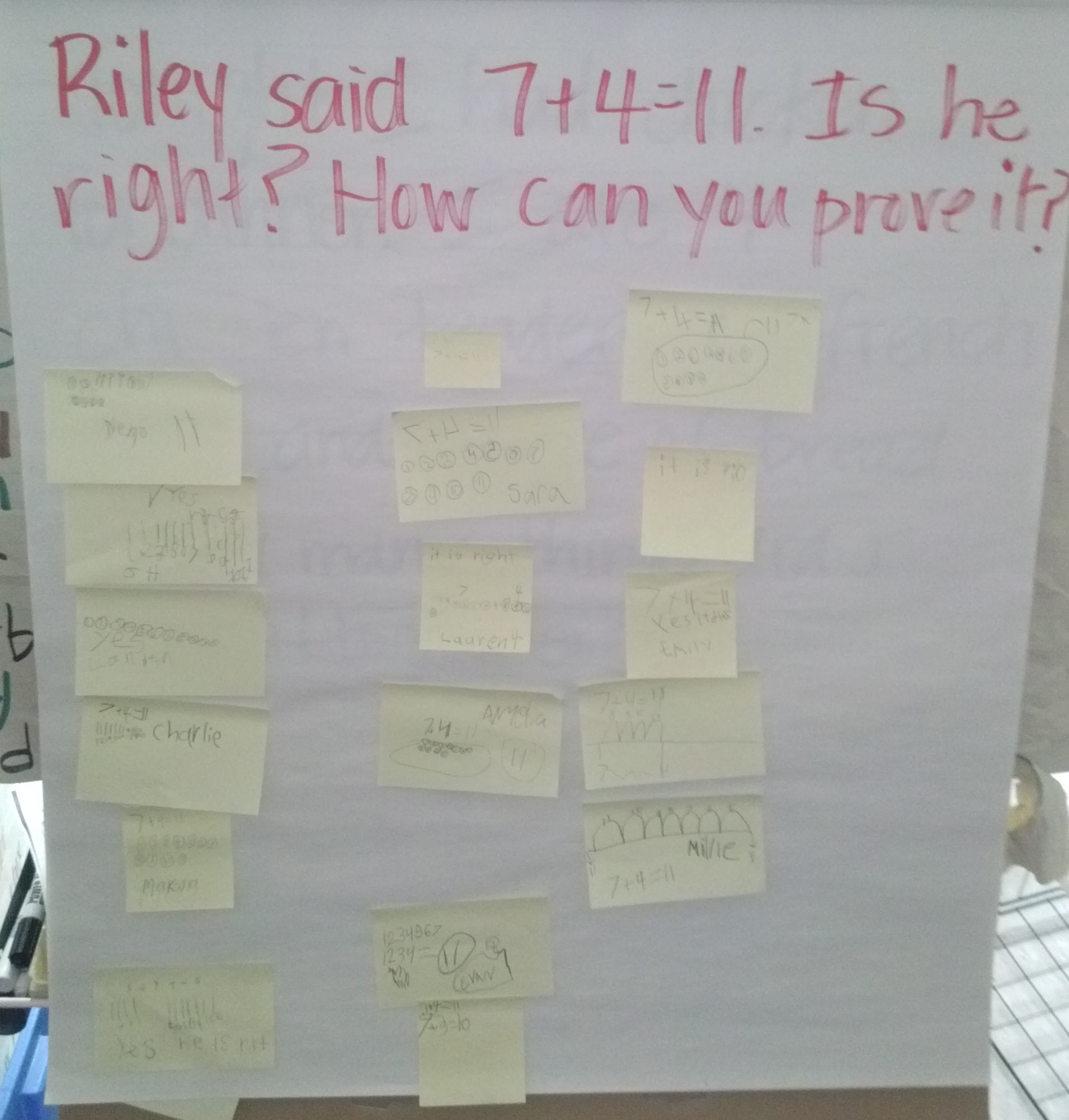
One thing I want my mathematicians to be able to do is think flexibly about numbers.  Sometimes I give the the answer and ask them why it reasonable (or not!).

CAM01257

Thursday

I’m not sure why I wrote the word tonight on this problem (as it doesn’t make any sense since I wrote it the next morning!), but you get the idea. 🙂  The focus was both on adding a string of numbers, as well as determining whether to add or subtract.  We’re getting really good at knowing when to add and when to take away, by thinking about the context and picturing the situation.

CAM01258

Friday didn’t have a math warm-up since we didn’t have math.  We had a delightful Winter Party instead!  Hope you had a great holiday break, math friends, and that you’re back into a positive January groove! 🙂

First Grade Math Warm-Ups: Week of 12-8 to 12-12

So excited how these are working out, and how they lead to such great conversations during our math time.  So easy to get math brains thinking early in the day and then letting it simmer all day.  By the time we come back to it at 2:00 it somehow makes even more sense.  LOVE!

Monday

CAM01132

We’ve been working on doubles a lot lately, during conversations, in groups and by playing games.  The hope is that my mathematicians can then transfer that knowledge to solving problems.  This one let them give it a try.  And since you’re here, let me show you the doubles games we’ve been playing–I think we might have to make a new version of these for every season:

Continue reading

Math Warm-Ups: First Grade Version–Week of 12-1 to 12-5

For years in 5th grade I posted about Math Warm-Ups and how we used them to get our brains ready for flexible math thinking every morning.  Last year I didn’t use them much–for one reason or another–and this year they didn’t make sense until just recently.  So here we go–join us to see how Math Warm-Ups work with young mathematicians and how we use them to stretch our brains!

Week of December 12-1 to 12-5

Monday

Wait–Monday we didn’t have a Math Warm-Up.  Partly because it was the first day after a really long weekend and also because we had some unexpected freezing rain during the morning rush and it took me 2 1/2 hours to get to school that day!  I did anything but rush to school.  Here’s a picture of how fast we were going at one point.  And believe me, I was being really safe while I took this pic:


See that?  I think it says 2 miles an hour.  On the highway.  Seriously.

See that? I think it says 2 miles an hour. On the highway. Seriously.

Tuesday

This was the first day of Math Warm-Ups so I asked a question that I knew everyone could answer easily, as the point was to teach the purpose and procedure more than focus on a math concept.  Still, we were able to pull in many things we’d been working on in math during our conversation about this warm-up.

CAM01121

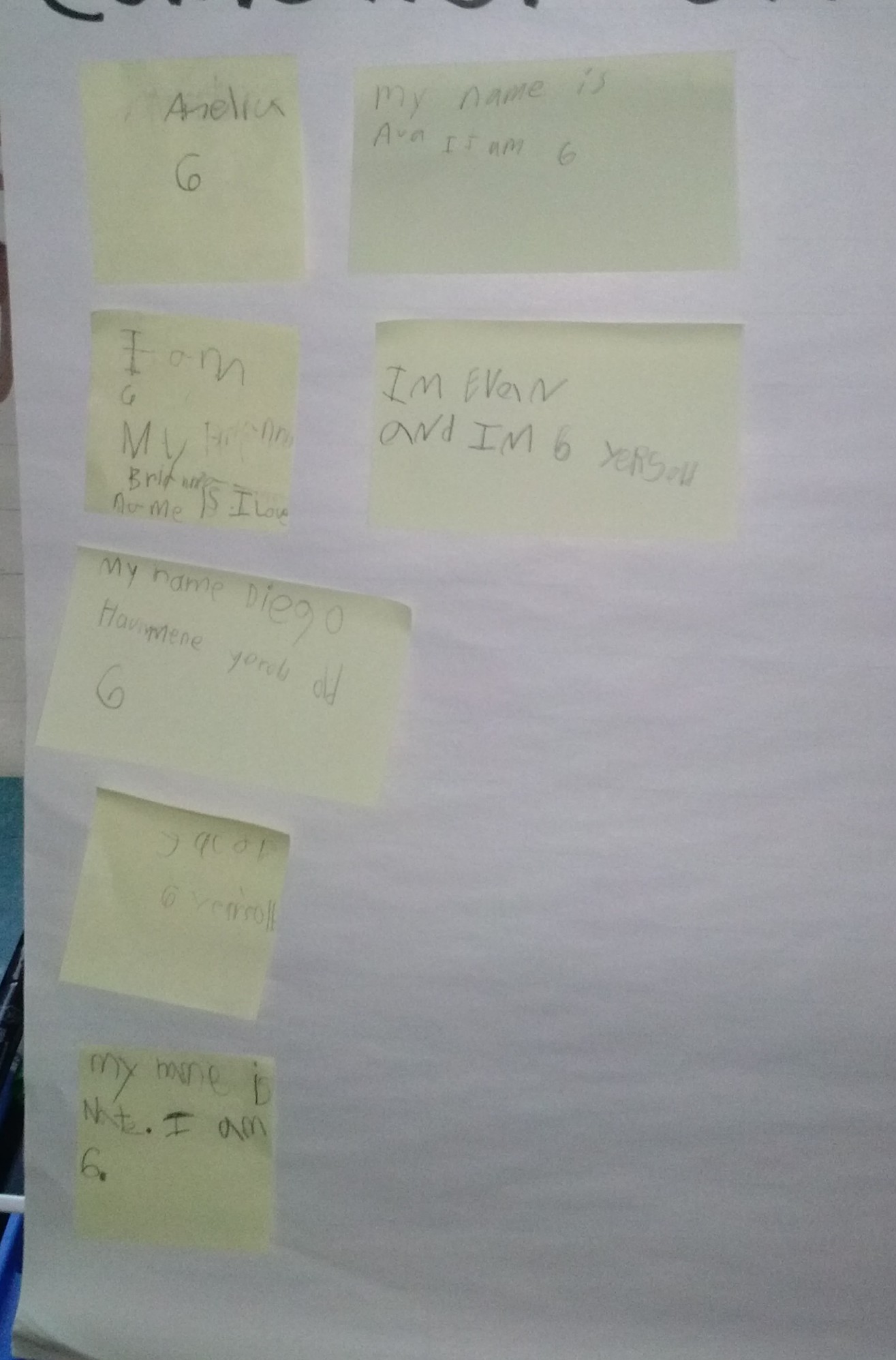
Now that I look at that picture, I wish I would have taken one right after we put all the post-its on it, because it was much messier, and that’s actually part of the conversation we had about what we could do with the data we had collected: someone suggested that it needed to be more organized.  I also asked them what question we could answer with the information we had up on the easel.  There were several good ideas, one of which was “Do we have more 6YOs or 7YOs in our class?,” hence why we ended up with two columns of notes.

           CAM01086    CAM01085

It was great to watch and listen when we started to analyze the notes and figure out how many of each age there were: they used what we’ve been learning about grouping objects to count, and recognized that I put them into the same shape as the 10 frames we’ve been looking at lately.  They were similar to what our math racks look like, too, and they quickly and easily saw that there were 7 6YOs on this day and 10 7YOs.  We talked about other questions we could answer, and also talked briefly about how this data could change based on the day (we had 3 friends absent).

Wednesday
CAM01120

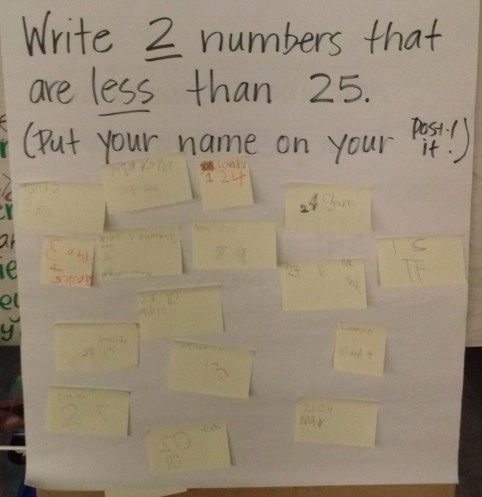
Another one I knew most could answer easily, but a little harder than yesterday.  The focus today was on making sure we followed all the directions of the warm-up: answering the WHOLE question and putting our name on our post-it.  There were still some who did not, so we made sure to talk about that when we reviewed this question during math.  The words LESS and GREATER were also a focus, as was writing the number the way it should actually look–with digits in the right places AND going the right direction (which is still tricky for some friends at this point in 1st grade!).

Thursday

CAM01119

We’ve been working on flexibility with combinations up to 20, as well as most recently practicing doubles and doubles +1.  This was interesting, then when most kids put 10+9 as their answer (which is probably the easiest combination to figure out).  I noticed many who wrote combos that DIDN’T equal 19, so the conversation was around accuracy as well as how they figured out their answer.  It also told me that as a whole, we need some more practice on this skill!

Friday

CAM01118

This question was just one to see where we were with fractions, as we’re about to finish up that unit.  The benchmark is just that kids understand 1/2s and 1/4s, but the “extending” on our rubric is 1/3s and I was pretty sure most kids could tackle that as well.  And boy was I right!  Now…I am not entirely sure if kiddos answered these on their own (like they’re supposed to) or if they worked together, so there’s more work to be done, but for the most part you can see that most of those rectangles (which is also part of this unit) are divided into 3 equal pieces!  Even the way I worded the question gave me some information–info that I didn’t expect–when someone said, “I can’t just draw 1 line and make thirds.  Can I draw more than 1?”  Obviously that friend knew what was going on!  I hadn’t done that on purpose, and so made the change on the chart for the rest of the friends who completed it.

This is our first try with warm-ups this year and I am excited to see where they go!  Great job, Rm. 202 friends!  You did an AWESOME job!

Teachers–What kinds of math warm-ups have you done with your class?  Have you tried them with 1st graders?  How did it go? We’d love to hear about what’s going on in your class!  Parents–did you hear about Math Warm-Ups from your kiddo?  What were they saying? 🙂

Rethinking Multiplication Strategies

First of all, I know.  It’s been forever.  Man, I’ve been saying that a lot lately.  All I can do is apologize, though, and ask that you’ll kindly keep reading.   Life is nuts these days. 🙂

So…we are just about at the end of a study of multiplication and this year I’m asking my friends to think in a different way about the word efficient when it comes to multiplying.

Based on our district rubrics, which have recently been rewritten based on work related to Common Core and an updated curriculum, the standard for 5th grade has changed.  Instead of just being able to use the traditional algorithm, students are expected to be able to fluently use a variety of strategies.  But get this: the strategy they choose to use should be based on the numbers in the problem, rather than personal preference or the strategy they know best.  WHAT??!! I seriously have some friends whose heads might explode.

But it’s not really their fault, I guess, because for years the algorithm was the goal.  And once they learned how to use it, that’s what they stuck with and used every time.  For years, we (or they) saw the other strategies as lower-level–ones used by friends who didn’t yet “get” how the algorithm worked.

District Math Rubric for Multiplication

District Math Rubric for Multiplication

Now we’re thinking more about how mathematicians should be able to be flexible with their thinking, to use place value correctly and to explain their reasoning based on what they know about numbers.  This doesn’t mean that the algorithm isn’t something kids should know how to do, but that it’s not the only thing they should know how to do.  I mean think about it in the real world: there are times when you have to be able to do math in your head, in an efficient way–without paper.  The algorithm doesn’t really fit into that model.

So what does this look like in our room?

First of all, here’s an anchor chart that now hangs in our room (made based on our knowledge of how to solve multiplication problems):

Classroom anchor chart for multiplication strategies

Classroom anchor chart for multiplication strategies

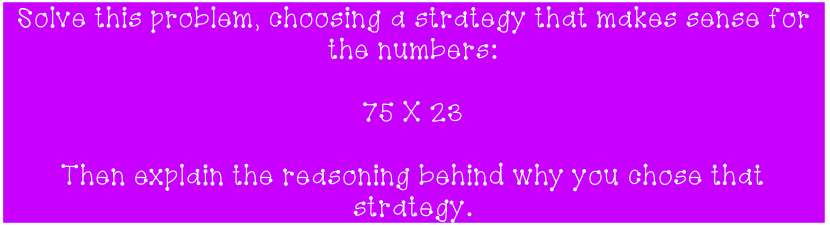
While I don’t have any pictures of the math warm-ups we’re doing right now, this is where many of our opportunities come to try out this thinking.  The problem today, for example looked like this:

Math Warm-Up for October 14

Math Warm-Up for October 14

There are obviously (based on the chart) multiple ways to do this problem.  But based on the numbers (which were chosen on purpose), the strategy that makes the most sense is to either use splitting or a close 10 to solve the problem.  That way, you can solve 75 X 20 and 75 X 3 and then add them together, which can easily be done in your head–without paper.  If you chose to use the algorithm (which most would do–even most adults!) you’d have to do 5 X 3, then 70 X 3, 5 X 2 and then 70 X 2 and add it all together–many more steps than the other strategy.

So while this is still a little tricky for some friends, it will get easier with time.   We just need some more practice. 🙂

What strategy would you have used to solve 75 X 23?  Do you know more than one strategy to multiply?  Is the traditional algorithm your “go to” strategy?  I know my 5th grade mathematicians would love to hear your answers!


First Day of Fifth Grade!

Wow–how is it already the first day of school?  Seems like it was just the last day of school. 🙂

I only have enough energy to share a couple of things from our day–tells you how busy we were!  I need an early bedtime!

First of all, here’s how I introduced myself to my kiddos today:

I was so excited to read about this idea when my friend Michelle shared it with me from here.  I took a little bit of a different twist on the content, but really enjoyed making it!

While we did not really follow our “official” schedule today, since it was just Day 1, we did try to fit our community building and routine learning activities somewhere near the time they would actually happen.  We read aloud some of my favorites–I Want My Hat Back and This is Not My Hat by Jon Klassen, as well as First Day Jitters by Julie Danneberg.  We did a 5th Grade pursuit (the old “find someone who” game where you sign each others’ papers), found a new book for each kiddo to read, started investigating ways we are smart (more with this tomorrow!), did our first Math Warm-Up of the year, introduced Writer’s Workshop and wrote postcards home about the first day of school.  Like I said, we were busy!

But even with all that fun and excitement, I’m pretty sure that the only thing my new kiddos will tell their families when they get home is that

Screen Shot 2013-08-20 at 8.56.15 PM

Yep.  Definitely gonna be needing some snacks this year. 🙂

So all-in-all it was a great day! Can’t wait to get back in there and do it all over again tomorrow.

But before I go, I have one thing to say to all of new my friends–new to me and new to Kirkwood: WELCOME! You belong here. 🙂

Math Warm-Ups April 8-12, 2013

Wow–how has it been a whole month since I last posted math warm-ups?  Oh, yeah, because MARCH was crazy–including a SNOW DAY and SPRING BREAK right next to each other.  And not that April is any less busy, but at least this week could be considered somewhat normal.  Oh, not it wasn’t–I had a sub on Tuesday.  But hey, what’s normal anyway, right?  Regardless, here are some recent math warm-ups I haven’t shared yet.

First of all, a couple from last week:

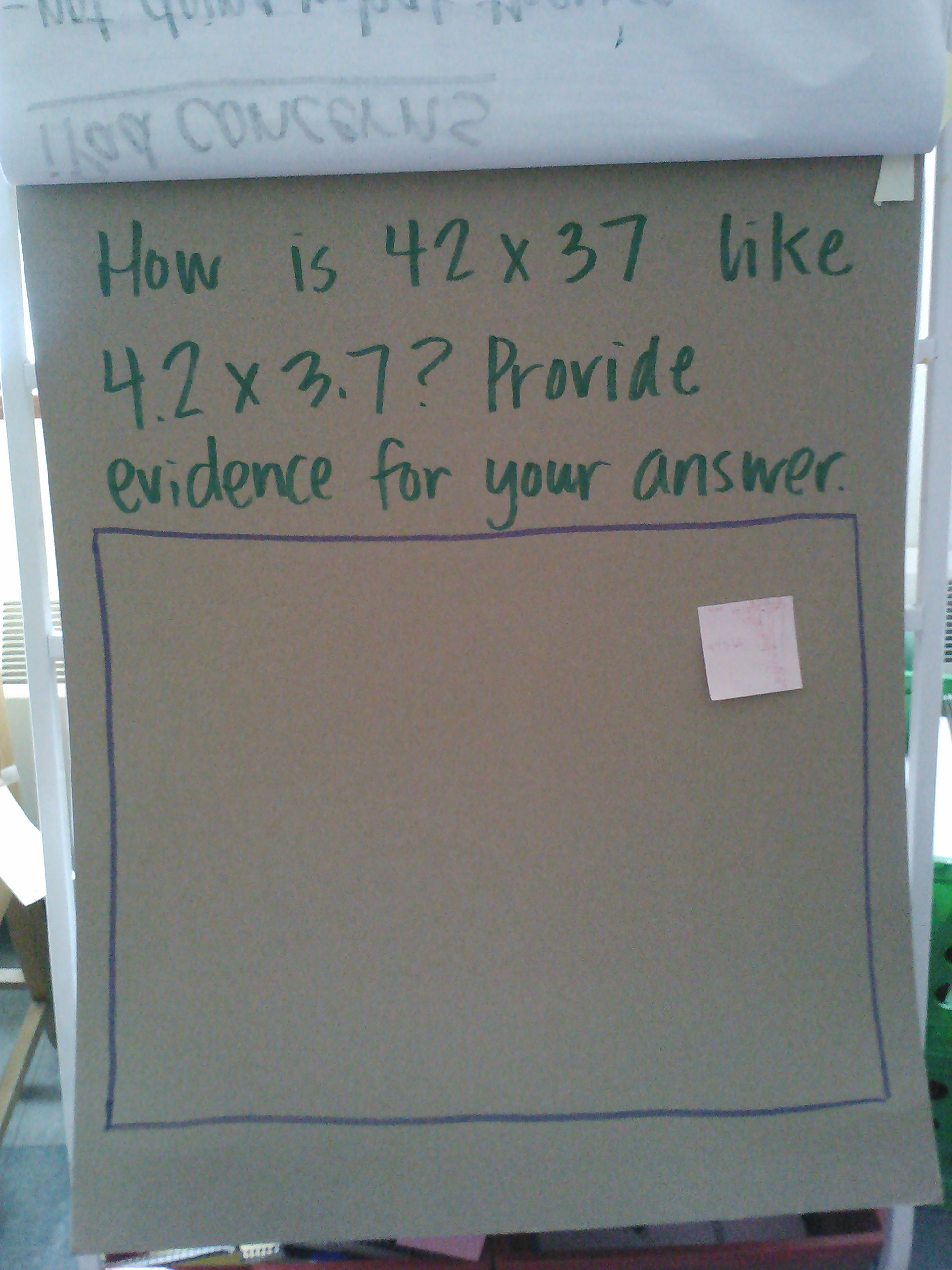
This one was to help discuss fraction place value, and also to help us talk about writing clear and concise answers to questions like these (in preparation for MAP testing in just over a week).

This one was to help discuss fraction place value, and also to help us talk about writing clear and concise answers to questions like these (in preparation for MAP testing in just over a week).

Can you tell I ran out of paper and didn't have a chance to get more for a couple of days?  Sorry. :)  This one is another place value one, hoping that students would see the relationship between money and fractions, and how they can just "move" the decimal (by multplying by 10), rather than having to use the algorithm to solve the problem.

Can you tell I ran out of paper and didn’t have a chance to get more for a couple of days? Sorry. 🙂 This one is another place value one, hoping that students would see the relationship between money and fractions, and how they can just “move” the decimal (by multiplying by 10), rather than having to use the algorithm to solve the problem.

This week’s warm-ups:

Wednesday

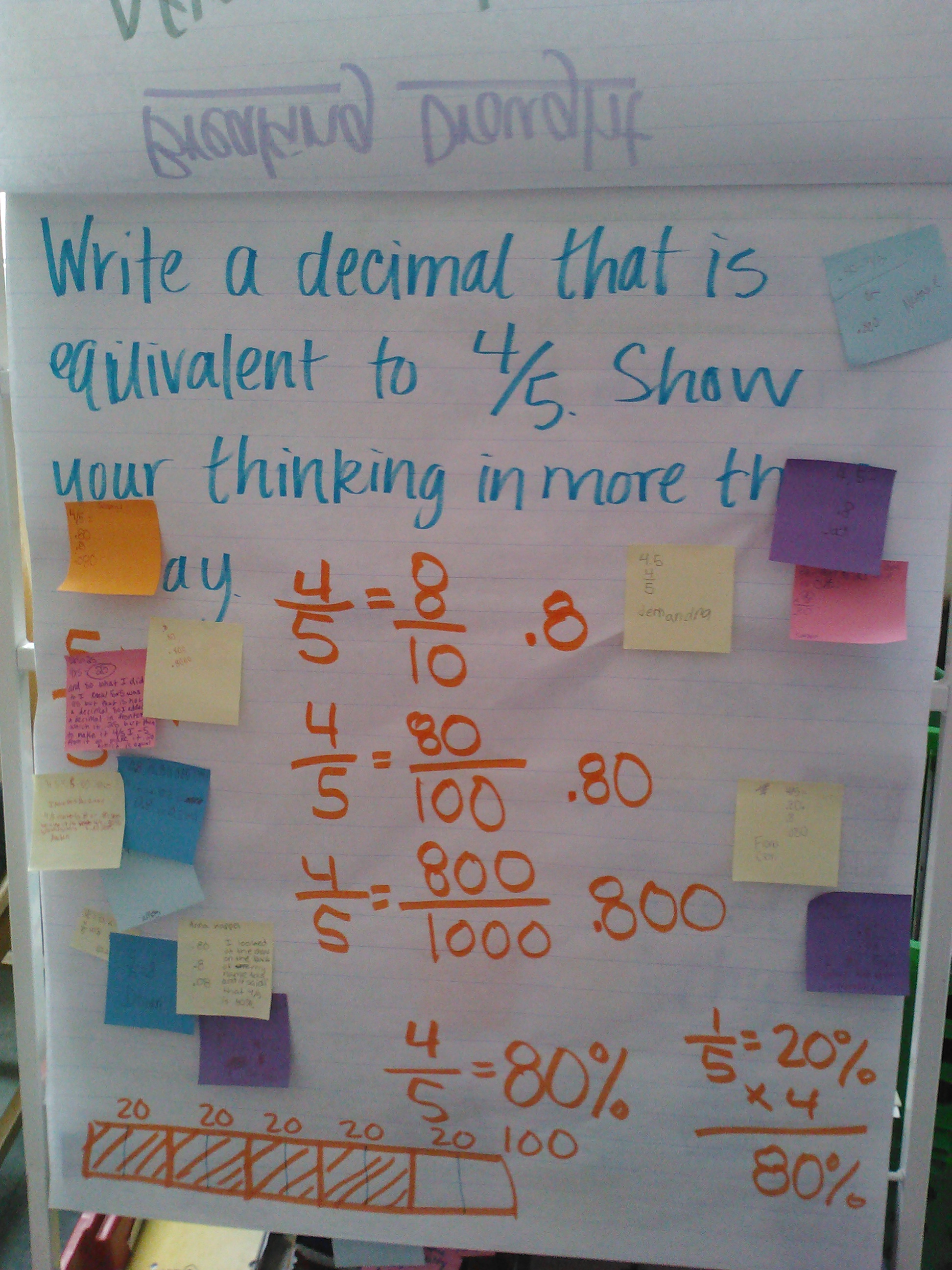
We needed to reminded (again) about equivalent fractions, as well as their tie to decimals.

We needed to reminded (again) about equivalent fractions, as well as their tie to decimals.

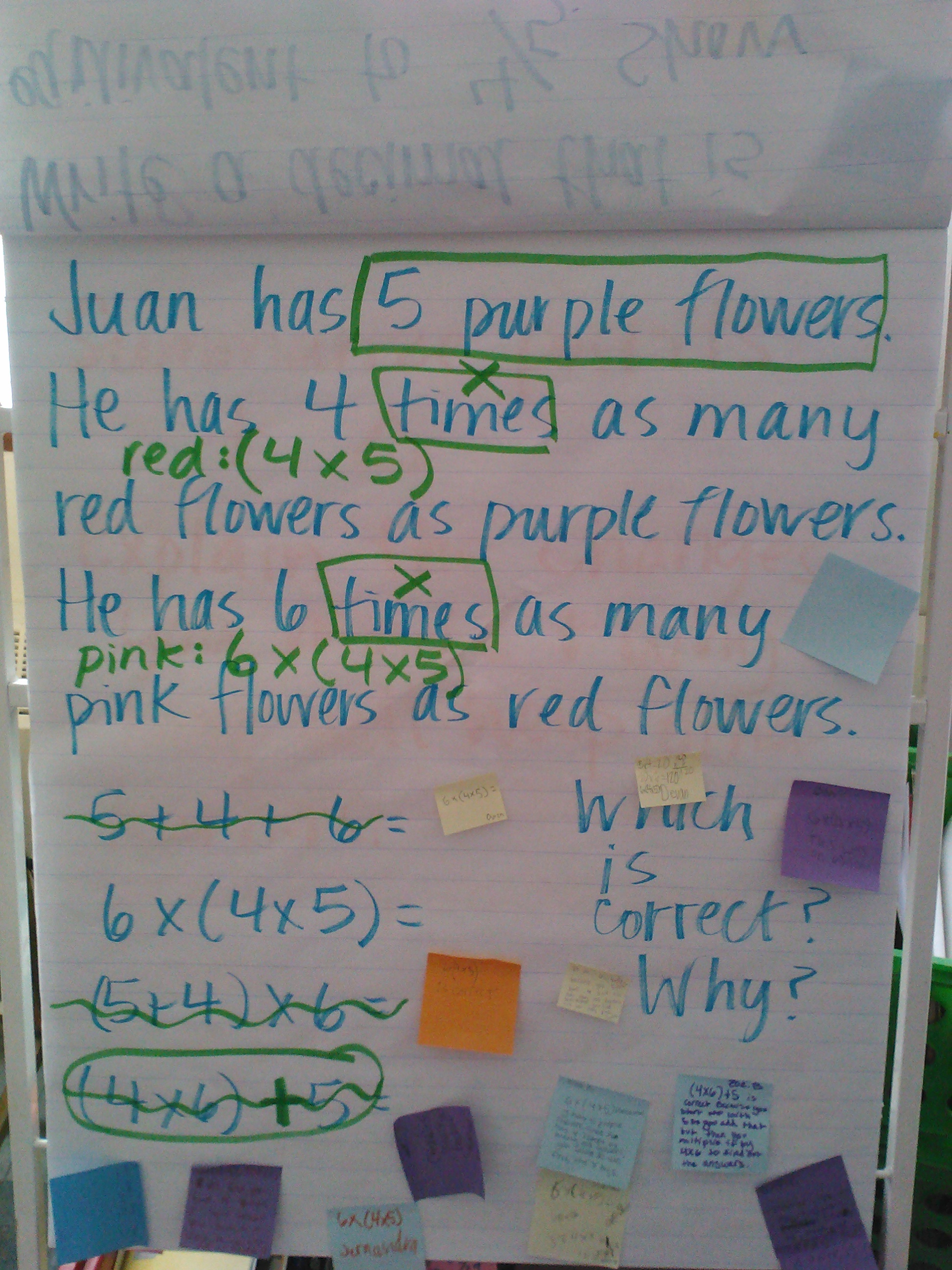
This one came right off of our Edison benchmark practice from this month.  We're using the problems on that assessment to help us analyze the "why" of the ones we get wrong.  This can help us not make those same mistakes again the next time we encounter them.

This one came right off of our Edison benchmark practice from this month. We’re using the problems on that assessment to help us analyze the “why” of the ones we get wrong. This can help us not make those same mistakes again the next time we encounter them.

This is another Edison problem, but I changed the numbers.  Many students are still not remembering to make the denominators the same before they add.  This one also elicited great conversations around simplifying answers--both how and why here as well.

This is another Edison problem, but I changed the numbers. Many students are still not remembering to make the denominators the same before they add. This one also elicited great conversations around simplifying answers–both how and why here as well.


I’m hoping I’m back in the routine of posting warm-ups.  Sorry if you’ve missed them! 🙂


Math Warm-Ups March 4-8, 2013

I’m starting to feel like there’s not really such a thing as a “normal” week; every Friday I say something about how this past week hasn’t been.  So–this week was another “unnormal” week.  Here are our warm-ups:

Monday

Screen Shot 2013-03-08 at 8.10.09 PM

I was out Monday with a sick little girl, and somehow forgot to get a picture of that warm-up. This one is practice with both place value and decimals.


Tuesday

After reading the note from my Monday sub, I knew we needed to review what to do with the decimal point in this multiplication problem.  Then, as in a stroke of genius, we made a connection to our fraction unit where we used fraction bars to help us visualize what the numbers were doing.

After reading the note from my Monday sub, I knew we needed to review what to do with the decimal point in this multiplication problem. Then, as in a stroke of genius, we made a connection to our fraction unit where we used fraction bars to help us visualize what the numbers were doing.


Wednesday

After we stumbled upon fraction bars again Tuesday, I gave them a problem where I had them use that strategy again (on purpose!).  For many it was the visual they needed to help it click.  But, for some others it just made them more confused! :(  We had a great discussion about figuring out which strategy or model works for you and making sure you use that one well.

After we stumbled upon fraction bars again Tuesday, I gave them a problem where I had them use that strategy again (on purpose!). For many it was the visual they needed to help it click. But, for some others it just made them more confused! 😦 We had a great discussion about figuring out which strategy or model works for you and making sure you use that one well.

Close-up of the marking on the fraction bar: we took 1/4 out of each one of the 1/10, which made 6/24.  Eventually we were able to simplify our answer all the way back to something that we could turn back into a decimal (1.5/10 or .150).

Close-up of the marking on the fraction bar: we took 1/4 out of each one of the 1/10, which made 6/24. Eventually we were able to simplify our answer all the way back to something that we could turn back into a decimal (1.5/10 or .150).


Thursday and Friday

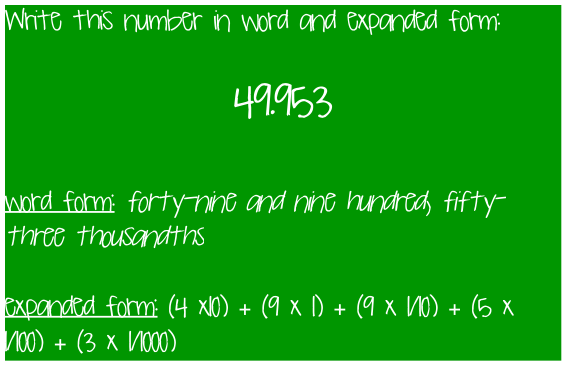
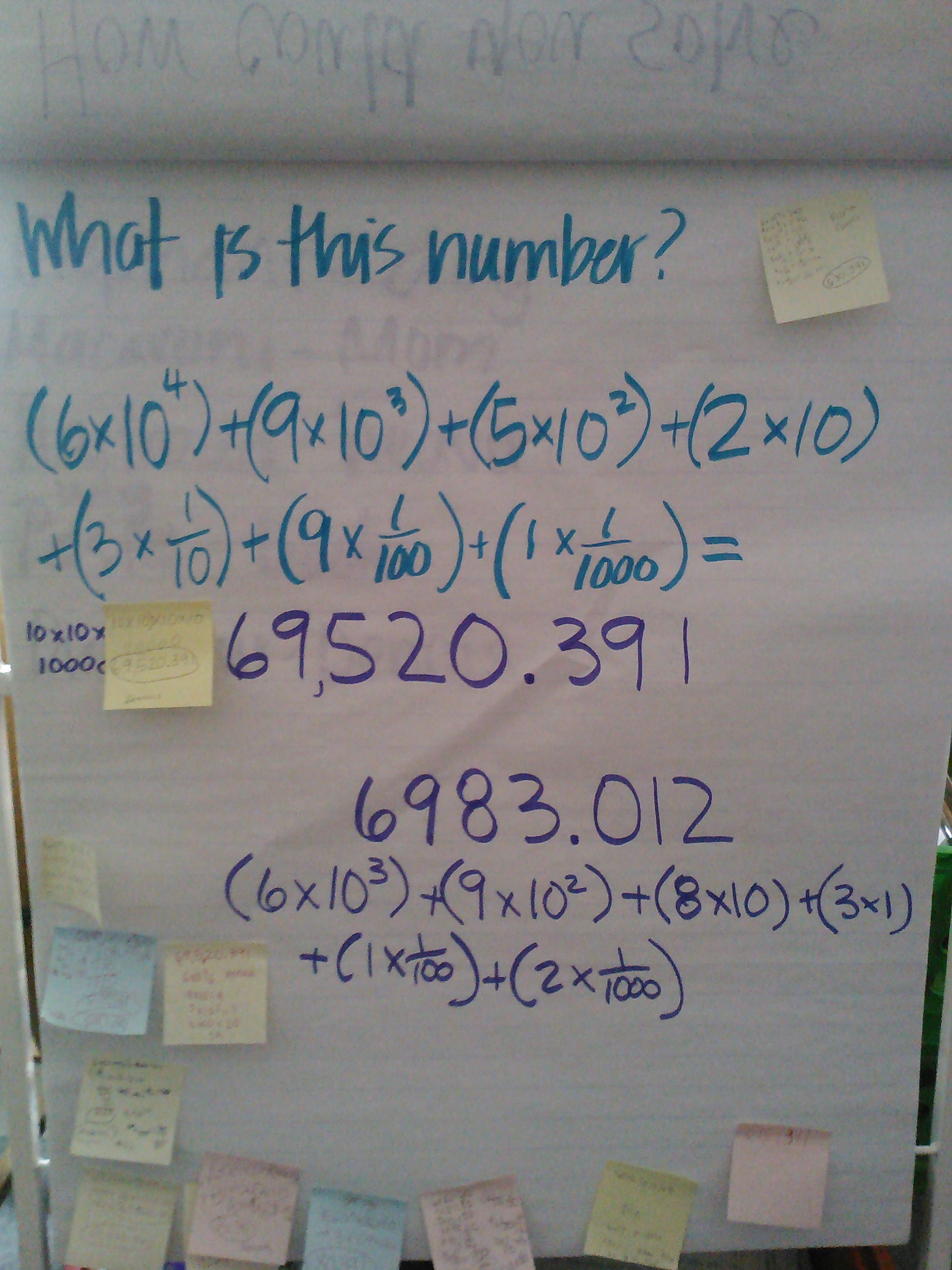
Remember that "unnormal" part of this week?  On Thursday we were only at school for about 20 minutes before we left to head to the middle school for the dress rehearsal of their Spring production of Guys and Dolls Jr. (which was FABULOUS, by the way!), so we didn't have math this day.  We had the discussion over this warm-up today.  Because many people got thrown off by both 1) the exponents in this problem and 2) the "backwards" nature of how I did expanded form, we did another example problem first (the number at the bottom).  This problem is a great example of how the warm-up is often a response of something that happens in our math rotations: as we were reading the rubric for reading and writing decimals, we realized that we needed more practice with expanded form and so that group requested we do more with it in our morning work.  Great idea, friends!

Remember that “unnormal” part of this week? On Thursday we were only at school for about 20 minutes before we left to head to the middle school for the dress rehearsal of their Spring production of Guys and Dolls Jr. (which was FABULOUS, by the way!), so we didn’t have math this day. We had the discussion over this warm-up today. Because many people got thrown off by both 1) the exponents in this problem and 2) the “backwards” nature of how I did expanded form, we did another example problem first (the number at the bottom). This problem is a great example of how the warm-up is often a response of something that happens in our math rotations–as we were studying the rubric for the standard of Reading and Writing Decimals, we realized that we needed more practice with expanded form.  So that group requested we do more with it in our morning work. Great idea, friends!

What are you thinking about our math warm-ups lately?  Do you have a suggestion for a decimal problem we could do?  Feel free to share it and we’ll try it, then leave you the answer!  We’re always ready to try something new!


Math Warm-Ups February 25-March 1, 2013

Last week was a little crazy, so we only had three warm-ups that stretched all throughout the week.

Monday

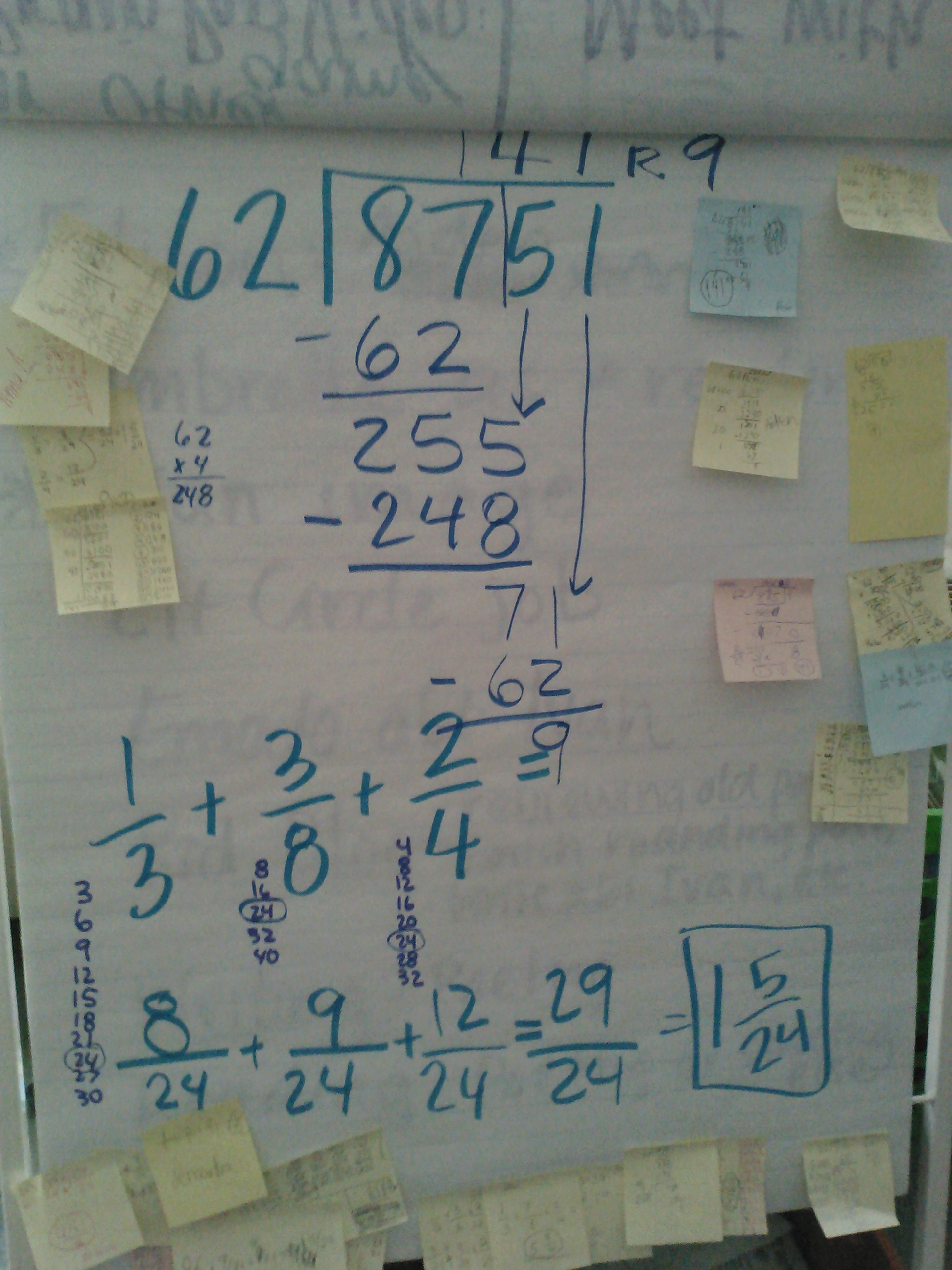
IMG267We came back to division (again) this week, as it’s a skill that many kiddos still have trouble with, even at this point in the year.  We have another unit of it in a couple more weeks, but we need the practice nonetheless.  The difference, too, this time is that we’re working on using a different strategy.  In the past–like when we were first learning how to divide–we thought about the number as a whole, and worked to find groups inside of it, rather than using the traditional algorithm.  Our focus was on understanding what division means, and we incorporated what we knew about multiplication as much as we could, as well.  This time, we’re trying to use the traditional method–still connecting to multiplication–but just organizing our thinking and our numbers in a different way.  We have been talking about reasonableness of answers, too, and use estimation to help us determine if our answers make sense.


The Rest of the Week

IMG269The rest of the mornings during the week were busy, we we actually took a couple of days to work through these problems.  You’ll notice a second division problem and then a good ‘ole adding fractions problem because we’re still fuzzy on this concept.  But truly, this is what is perfect about Math Warm-Ups–being able to easily revisit concepts that we need more time with.