The Bed Boat

Teachers Write: Day 2: Tuesday Quick Write

Directions for today (ok, well yesterday 🙂 ):

Write for two minutes to describe a very specific place.  If you’re just free-writing, it can be a place that you love, or have visited, or a place that frightens you.

Then…When your two minutes are up, stop writing.

Now…if your place is real and you can go there, go there now.  I’ll wait….

If it’s far away, find a picture of it. If it’s not a real place, put yourself there in your mind. Now write for one minute about each of the following:

  • Everything you SEE – Pay attention to big things and tiny things. Search for concrete details.
  • Everything you HEAR – Be specific. Don’t just say “a scraping sound.” Say a “high-pitched, raspity-raspity-screeeeeaking noise.”  You can make up words if you want.If you aren’t in the place, try to find a video. Or guess what you might hear.
  • Everything you SMELL – Especially pay attention to the smells that surprise you. If you’re not in the place, pictures can help you smell. Look carefully…what would that dumpster smell like?
  • Everything you FEEL – Weather, wind, things that land on you or brush against you. Again – pictures help you imagine if you’re not there, and if it’s not a real place, try imagining images and then assigning sensations from a similar place that might be real (desert, tundra, etc.)

Now, go back and rewrite that descriptive paragraph. Include your best tiny, surprising details, and work on senses other than sight. Better?  More vivid?  This is a fun activity to do with kids, too. Have them write about the playground or gym or cafeteria; then go there and hunt for sensory details!

Wow.  If I thought yesterday was hard, then today was worse.  I tried the exercise.  And then I tried it again because the first go-round was so lousy.  I think the problem was that I picked a place that was too big, too broad, so I had a hard time specifically describing those details.  I do have to admit, though, that there was some really important teacher-learning that happened in that first try: I totally get it now how my kids feel when I tell them to share their words with their partner or with the class.  I thought I understood it, but I don’t really think I got it until it happened to me.  Priceless experience really.

So I tried again, and this time tried to focus in on a smaller–and closer–place that was important to me.  It is an actual place, and it is in my house, so that made it easier.  Well a little bit.

So here it is:

We own a boat.  But it’s not made of wood and nails or fiberglass, either.  It’s big, squishy and white–just the perfect combination of soft and strong, and there is always a breeze blowing overhead.  It’s a bed boat, and while it goes nowhere, it takes my family on magical journeys together.

Sometimes I sail there alone,  just me with my thoughts or a good book to keep me company.  Solitude is welcome.  But more often than not, the boat is filled with other passengers on the journey with me: one who is the captain and two who are smaller (and much louder) versions of myself.  As we sail on together, we might share a laugh, a story, a snuggle or even a snack.  We sense the safety of the boat brings; just being on it is enough.

The big, squishy bed-boat is where we begin and end most days, our safe harbor through the storms of life.  Problems are solved, plans are made and great days are joyously relived.  Tears are shed, questions are answered and the sailors are made stronger just by being there.  Together.  Nothing seems too big to tackle.  The bed-boat is safe, it’s strong and it’s special.

What is your favorite place?  Where do you go that’s special to you?  🙂

Other People’s Kitchens

Teachers Write Day 1:  Monday Morning Warm-Up:

Ok, Day 1.  Like I said, I can do this.  So the directions today were to describe the kitchen of our childhood using as many sense as you can.

So I sat down willing–and hopefully able–to do this.  But the more I thought about it, I realized that some of my most vivid memories from childhood are actually not from my own house.  Not that the ones I have form home are bad ones, they’re just not really there.  So I thought of other people’s kitchens that I spent time in as a child, and my assignment came together:

Bowls.  Small bowls made of wood-looking plastic filled with salad.  And that salad is covered in French dressing.  Yep, one of my clearest memories is related to Catalina-drenched lettuce eaten in Christy B.’s kitchen.  Dark kitchen.  Why?  Because we’d eat that soggy plastic-wooden-bowl-salad as a midnight snack after everyone else was asleep.  No Oreos or ice cream for us.  Health food all the way.  Well, covered in salad dressing.  Take the bowl memory several years forward and about 100 miles up I270 and you’ll be in Sheila’s kitchen.  This time it wasn’t salad, but tomato soup.  Why does tomato soup bring such a warm, vivid memory for me? Because it’s tied to a brand new experience (don’t think I knew tomato soup existed before I ate it in Sheila’s kitchen in her big, yellow house on Mignon Dr.) and a close, loving family.  I ate so many meals in that bright, sunny kitchen over the 5 or 6 years we were friends, every one of them lovely.  I can still picture every square inch of that room today–some 20 years after.  Memories of the smiles, laughs and late-night snacks shared in that space warm my heart. So what about my own kitchen as a child? It was hard to pinpoint just which kitchen to tell about, because we moved around alot.  And even when we were at home, my parents didn’t really cook.  Everything came out of a box.  So maybe that means my childhood kitchen smelled like cardboard? 🙂

What are your childhood “kitchen” memories? Tell me about them. 🙂

Teachers Write!

Yes, yes we do.  And for those of you who were wondering, no, we don’t really have the whole summer “off’, either.  No, we do not have to get up and get dressed and go to school, but we spend many, many hours learning new things that we’ll use in the next school year, planning with our grade level teams, reading and writing, and well, just becoming better teachers so we can help out students even more effectively in the fall.  Ok, but I digress….

So that being said, one of the exciting learning adventures I’m taking part in this summer (along with Mrs. Meihaus and Mrs. Berger–a few Robinson teachers you may know!) is an online writing camp called Teachers Write!

Every day for the next couple of months, there are assignments posted on the Teachers Write blog, and we do them and then post what we write for others to read.  Seems easy, right?

That’s totally what I thought going into this.  I mean, I’ve been a writer for many years.  Not a published author, but a writer nonetheless.  I thought that this writing camp thing would be a piece of cake.  But cake it is not.

Ok, let me explain.  It’s not necessarily the writing part that is hard for me, it’s the sharing part.  Up to this point, I’ve primarily written for myself and my students.  If I share my writing, it’s on my terms, when I want to and how I want to.  Usually its pieces that I’ve chosen to write, and I share them during the revision stages, so that my kiddos can help me fix it up and make it better.  That’s scary in itself, because kids can be really honest, but again, it’s on my terms.

This is a whole different ball game.  This time it’s writing prompts, and the “campers” I’m sharing with are other teachers and–get this–published authors!  Talk about pressure.

But I signed up for it, right?  And what an amazing opportunity for growth as both a writer and a teacher of writing.  So I guess I’m game.  Nothing but good things can come of it, and no one will die in the process.  I just need to put my pride aside and let people teach me something.  Goodness knows I have tons to learn!

Alright.  Here I go.  Taking the plunge.  Jumping in with both feet.  Wearing my floaties and nose plug and hoping not to drown. 🙂

Stay tuned for examples of my “homework.”  I’d love your comments.  Really, I would. 🙂

Can You Hear It?

Listen closely as you watch this video….can you hear it?

What, you ask?  Well actually it’s how quiet it is in there.  It was hard to capture, but besides the quiet there were just lots of little click, click, click sounds as everyone was posting to their blogs.  I LOVE that sound!  I love how serious they are about sharing on their blogs, and how much they focus in as they work on them.

And so if you have a minute, because to visit our blogs and catch up on what’s been happening lately.  Yesterday we added posts about something I shared last week, as well as other topics of their choice.  Definitely worth a read!  Thanks in advance!

And I’ll remind you again about our map.  We love to read your comments, and also love to know where you are when you’re commenting, so we can add you to the great many other people around the world who follow our blog! 🙂

You Asked For It!

So while only 11 people responded to my poll about my next post, many of you wanted to read about what’s coming up in the curriculum for 4th quarter.  Well, then a couple of you also voted for Spring Break related topics.  Maybe I’ll just post about it all, then.   So here you go, friends–here’s what’s coming up in 5th grade this quarter!

WRITING:  This quarter starts with us finishing up our expository nonfiction pieces that we started last month.  We’re at the point of proofreading/editing, which we began today.  After we finish conferring with our partners and tweaking the mechanics to make sure our readers understand our message, we’ll publish!  I’m so excited to see what we end up with, as writers in our room will have a choice of presenting the final draft as a poster, feature article or essay, including the text features we studied and the bibliographies we learned about recently.  I am sure to post pictures of that amazingness when we’re finished!  Following this unit, we will also tackle persuasive nonfiction (probably based on either a colonization unit in Social Studies that’s coming up, or a science topic related to our Weather unit) as well as poetry.  As usual in our classroom, this quarter will also bring lots and lots of blogging and Writer’s Notebook writing, as well, since that’s just how we roll in Rm. 201!  I’m excited about what’s coming up with writing.  But then, I generally am excited about anything in writing. 🙂

MATH:  Since we figured out that math rotations work so well for us, we’ll continue with this structure as we finish out the year.  I have loved how I’ve gotten to know each and every mathematician so much better by meeting them in small groups, and also how much more confident so many kiddos are in math now; more specifically meeting needs and checking in more frequently has helped many to better understand concepts and feel more comfortable asking questions when they need to!  We have two units left to work on this quarter: one called Growth Patterns (about patterns, functions and change) and another called How Long Can You Stand on One Foot? ( about data analysis and probability).  We took the pretest on both of these today, as the plan is to combine them.   Another big idea we’ll tackle during the beginning of this quarter is math test prep, since we take our Missouri Assessment Program (MAP) test in mid-April.  Right now I’m thinking the plan will be to combine some whole group lessons with our regular rotations.  There will be some paper/pencil test practice added into the skill practice station, and I will address needs in this area in our small groups, as well.  I’m excited about how this quarter will go, and the continued success we’ll see as we delve into some really active units with fun concepts.  I loved how interested most students were today when I mentioned the topics we would be covering.  Maybe my kiddos just love math now….:)

READ ALOUD:  We are in the middle of an amazing nonfiction book called Chasing Lincoln’s Killer by James L. Swanson.  While it’s the first nonfiction chapter book I’ve chosen for read aloud, I am sure it will not be the last.  Well at least not the last time I read this book.  The story is so amazingly written, and the way that Swanson incorporates firsthand accounts of the action into his writing has kept us on the edge of our seat.  I am sure that this will be a favorite with many kids this year!  After this one, I have plans to read Walk Two Moons by Sharon Creech (one of my all-time favorite authors!), as well as I Am David by Anne Holm.  If there’s any time after that, I may throw in a couple of other shorter reads (again probably by Sharon Creech, like Pleasing the Ghost or Granny Torelli Makes Soup).  Do you have a favorite read aloud that you would suggest to us?

READING: Like in Writing, our first plan is to finish up the expository nonfiction unit we started in 3rd quarter. We’re already spent some time reading articles and using a variety of strategies to understand and discuss them, and we’ll move on now to reading and analyzing functional texts and textbooks.  What great timing, since this is just the kind of text we’ll encounter on our big test next month!  We will also have a unit on determining important ideas/summarizing, as well as synthesizing information as a strategy to comprehend.  This quarter everyone will also be involved in another round of literature circles, as well, with each group choosing their own text this time.  I’m excited about the groups that have formed: The Lost Hero, The Son of Neptune, A Friendship for Today, and Closed For the Season.  There are still a few kiddos who have not joined a group yet, and I’m excited to see what books they end up choosing.  If you have a suggestion for a good read for some amazing 5th graders, please suggest it in a comment after this post!

SCIENCE/SOCIAL STUDIES:  This is one of our favorite times of the day, although I know that most kids in our class would tell you that they HATE that it’s at the very end of our schedule.  I’m excited about the units that we’ll be doing next, though: Earth Systems–Weather and Three Worlds Meet–Colonization.  The weather unit we’re going to do has just been revamped, and is taken from the work of Carol Ann Tomlinson in her book Differentiated Instruction in Practice: Grades 5-9.  It’s an amazing collection of activities, experiments, discussions and writing opportunities (which you know we’ll be blogging about!) that will give EVERY learner in our room a chance to engage at their level of understanding.  I like to think that everything we do is organized this way, but with science and social studies, it can be harder to achieve.  This unit brings exciting promise of making it happen.  Then in our colonies unit, we’ll see how what we’ve learned about Native Americans, Ancient West Africans and Europeans comes together when they all end up here and try to create a world together.  I’m excited to see the light bulb moments in that unit as connections are made to past learning.  Definitely exciting stuff on the horizon here!

There is sure to be much, much more happening in our room during this quarter, but here are the foundations on which all the rest will be built.  We have a service-learning project that we’ll be completing with Stray Rescue of St. Louis (more on that later!), fun with our learning buddies, dance routines that we’ll be performing for A.C.E.S. Day in May, a trip to Nipher Middle School to visit, our 5th Grade Celebration and many other still unknown projects or conversations that will develop based on somebody’s great idea or suggestion.  I know that whatever else we do, we’ll enjoy ourselves and learn a lot together!  Can’t wait to share the rest of this ride with you as we go along!

100! Can You Believe It?!

In honor of the 100th post on our blog (yahoo!), I’m going to ask you to celebrate some amazing work my 5th grade friends have been doing. Check our blogs to see what we’ve written lately! Today we posted about proud moments, math, Spring Break, getting braces and much, much more. Don’t forget to comment to let my friends know you visited. They usually ask really good questions, so answer a few! 🙂

Also, I feel like it’s an ok time to remind you of our class connections project. If you haven’t yet commented, or commented and didn’t tell us where you are from, please do so! We haven’t added a new pin in a while, and would love to see our map connections grow!

Thanks, readers, for all the time you spend here.  We appreciate you!!

We’re off to Spring Break after one more school day tomorrow.  Do you have any exciting Spring Break plans to share?

The Cat’s Away

So I’m home with a sick baby again today.  I HATE to be gone, but sometimes I just have to be a mom, you know?

So today’s absence reminded me of an idea I learned about recently.  I was out a couple of weeks ago, and I used a great idea from a couple of teachers I met when I attended an EdCamp St. Louis conference earlier this month.  They both teach middle school, and are out of the classroom periodically for activities with their school, and so need to leave plans for a substitute.  Rather than just leaving written ones, they record videos to leave for their classes, often teaching the lesson from their couch and giving directions for what they want their students to do.

Last time I was out, I knew ahead of time, since her fever popped up in teh evening.  So with my MacBook, my plans and my couch, I set to work putting together what I hoped would be a great day of learning for my kiddos, even in my absence.  Here’s what I left as a welcome to the day, along with our normal morning routine screen on the ActivBoard:

After they went off to specials, it was time for Writer’s Workshop in our room:

That big blue button sent them here to this video:

Next in our day was Math Workshop.  This video was a little different, but hopefully just as helpful.

Off to lunch and recess they went, and then back into the room for Read Aloud and then Reader’s Workshop.  Again, a flipchart welcomed them with directions:

Ok, well at least it had a place to send them for directions.  Those were here:

And here:

Social Studies followed Reader’s Workshop, as it normally does, and the lesson that they worked on that day was about the Natural Features of Europe:

Unfortunately this was the last day of the week, since we had a Professional Development Day the following day on Friday. We were also going to be out on Monday, too, since it was President’s Day! That meant I wouldn’t see them for what seemed like FOREVER, so I sent them off to their long weekend with this Goodbye and Good Weekend video:

Ok, so if you’re a frequent visitor to our blog, you know that I can’t write anything without ending with my thoughts and reflections.  And of course the topic of this post means that those thoughts and reflections are definitely doosies! (Is that how you spell that?  There was no choice for it in the dictionary. 🙂 )

(Now would be a great time to take a break and grab a snack if you want one!  I know I didn’t warn you that last part would take so long.  Sorry.  It’s ok, I’ll wait for you.)

Thoughts and reflections from using video sub plans:

Ease: The only reason I tried this whole thing originally is because I knew at around 6:00 the night before that I would be gone.  Since that was the case, I had lots of prep time to get it all ready.  This would not have been possible had I woken up and been surprised with an absence (like today, for example!).  Also, this was for an absence for a sick kid, not a sick teacher.  Had I been the one that was ill, this would have been almost an impossibility.  I hope, though, that since I’ve done it once now, and figured out all the logistics, the next time it won’t take me quite so long to put it all together.  And no, I don’t really want to admit how long it took me.  Ask your kiddo if you want.  I told them. 🙂  The other idea I had just now, though, is to prepare a generic “sub plan video” that could be used at any time if I had to suddenly be out.  It could then be added to my normal sub folder or uploaded to the portal that we use online to secure our subs.  Who knows, maybe I’ll start working on that one.

Logistics: I know this is partly related to the “ease” subject I just mentioned, but what I mean with this one is that there are a lot of logistical things on the school end that have to happen in order for my video plans to work like I had hoped they would.  The substitute has to know how to use the ActivBoard flipcharts I made, they have to know how to log on to my YouTube channel so the videos all play, and they have to be willing to follow the directions I gave in my videos.   So, in a perfect world, this would have been a great way for me to be at school with my students even though I wasn’t able to be there in person.

Impact: While the original reason I decided to try it was because it sounded like a great idea, incorporated technology and was something I hadn’t done before (which is often very motivating for me), I decided as I went through my planning, that maybe just seeing my face would be a subconscious reminder to follow the rules.  You know, unfortunately some kiddos tend to move into a different state of mind when they see a substitute at the front of the room instead of their normal teacher. I was also hoping that having me “teach” the normal lesson they were going to have for that day would help as they tried to keep the learning day as predictable and productive as possible.  I wanted to get the most bang for my buck.  I know that the day is never the same without me as when I’m there, but this was my way of trying to do what I could to help make it as normal as possible.

What experience do you have with using video sub plans?  What suggestions do you have for me? If you’re a parent, what do you think?  If you’re a substitute, have you used video sub plans in a classroom you’ve been in?  I’d love to know your thoughts!  Leave a comment for me. 🙂

Ready, Set, Blog!

We did it.  We’re officially online!

After a little technological hiccup yesterday, we set today as the day for our first “real” blog posts.  Remember how I’m always saying my kids are amazing? Well, today they did not disappoint. 🙂

This slideshow requires JavaScript.

I know you will want to read what they’re doing, and I know they will love to have you read it!  And, as most of them remembered to add to their posts, please remember to leave a comment!

Check us out at www.kidblog.org/MrsBeardensClass2!


Entering the Blogosphere

If you would have asked me last school year if I’d ever have a blog, I’d have said you were nuts.  I knew what they were, but didn’t see myself as a blogger; I didn’t have a story that anyone wanted to hear.  I wasn’t really sure what I’d write about–up to that point I’d only written for myself as the audience in my notebook.  So then if your next question would have been if my kids would be bloggers, then I’d have considered you certifiable.

So I guess you’re all crazy–and I am, too!–because my class has a blog, and my kids started their blogging journey this week, too!

Before I go any further, I have to give a shout-out and a thanks to Pernille Ripp (@pernilleripp) and Karen McMillan (@mcteach) for providing many useful blogging resources to teachers like me who have a great idea but don’t really know where to start.  Their assistance via Twitter and their own blogs has been unbelievable!

Now for the story:

I have been talking up blogging since pretty much day one.  I started the class blog that you’re reading in July, after talking alot with my brother, who teaches high school math and just finished his Masters in Educational Technology (or something like that–sorry if I got the title wrong, Chuck!).  I have been writing for a long while now, but I needed another outlet.  At this same time, I also joined Twitter, and have been learning much from my “tweeps” ever since.  That’s actually where I got the idea for blogging with kids.

I was noticing that so many people were tweeting about updated posts by their kids, and so I started reading.  I soon learned that there a tons of kids out there who are learning super important lessons about writing and internet safety (and too many more to name) because they are blogging.  Even kindergarteners.  Yep, 5 and 6 year olds.  So the more I read, and the more I thought about it, the more I knew I wanted my kids to join them.  And so I began planning on how my 5th graders would enter the blogosphere.

We started on Wednesday, with a lesson that I called “Blogging 101.”  It was funny that I had to explain the “101” part to my kids–they had never heard of that before.  We talked about what background knowledge they had for the word LOG, and discussed how a log is a place where someone (like a pilot or ship captain) writes down important things that happen, organized by dates.  They were able to then transfer that idea to web-log, or blog, and we were in business.

They already have experience with this blog that I write, because we read it together almost everyday, and many of them have been following and commenting for months now.  I showed them several of the other blogs I follow, like Make It and Love It, the Candy Blog (that one is one of my hubby’s favorites, actually), Bake at 350 and Daily Daisy (and Caleb, too!).  We talked about what we noticed about both the appearance and theme of each one.  At this point they were chomping at the bit to get going–but there was another very important thing we had to talk about next: safety.

Thanks to an idea I found from Pernille Ripp again, we talked about why internet safety is like the mall.  While my students, who are 10-11-year-olds, don’t spend a lot of time at the mall or other places by themselves yet, they knew some really smart things to do and not do: not talk to strangers, not share their personal information with random people, only go where you tell your parents you’re going and stay there the whole time, and so on.  I was really pleased, because I knew I was going to be talking about how the very same things would keep them safe while they were on the internet on their own.  We talked through an internet safety plan, that they were to take home to share with their parents and have signed.

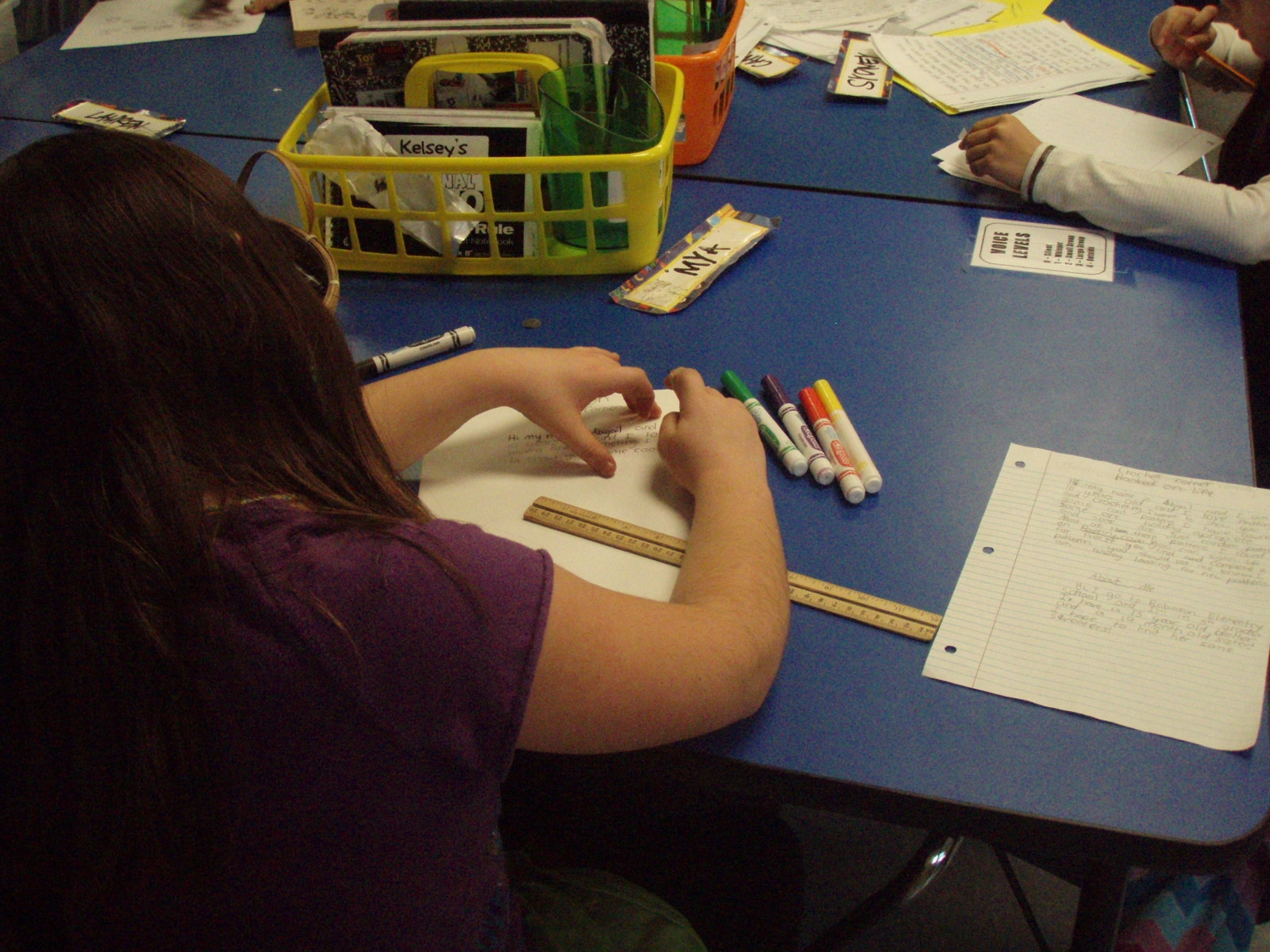
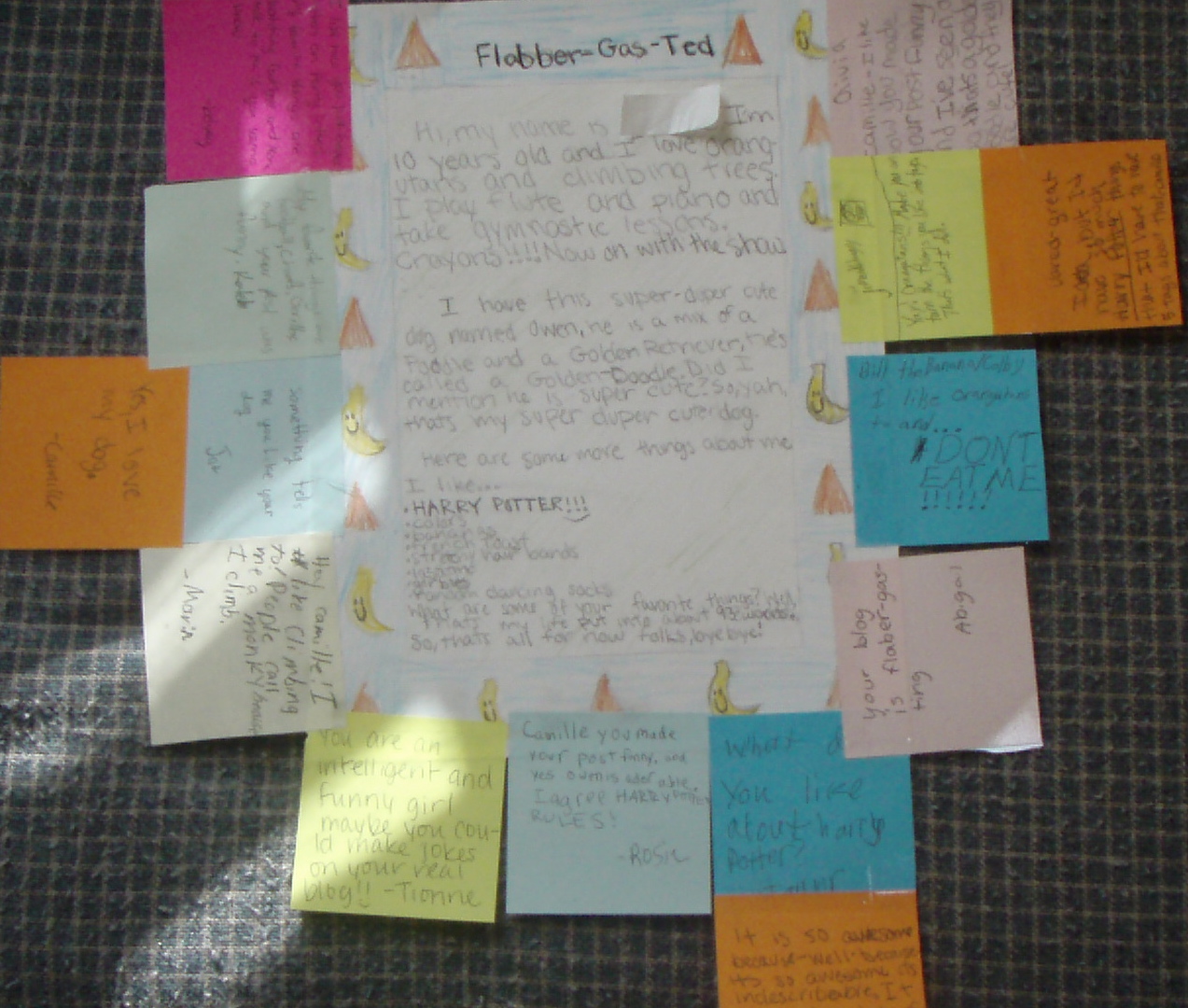
Next step: first blog post.  But not online, on paper.  They created a rough draft to tell about themselves, then edited and made a final draft on 9X12 oak tag.  This was serious business in our room.


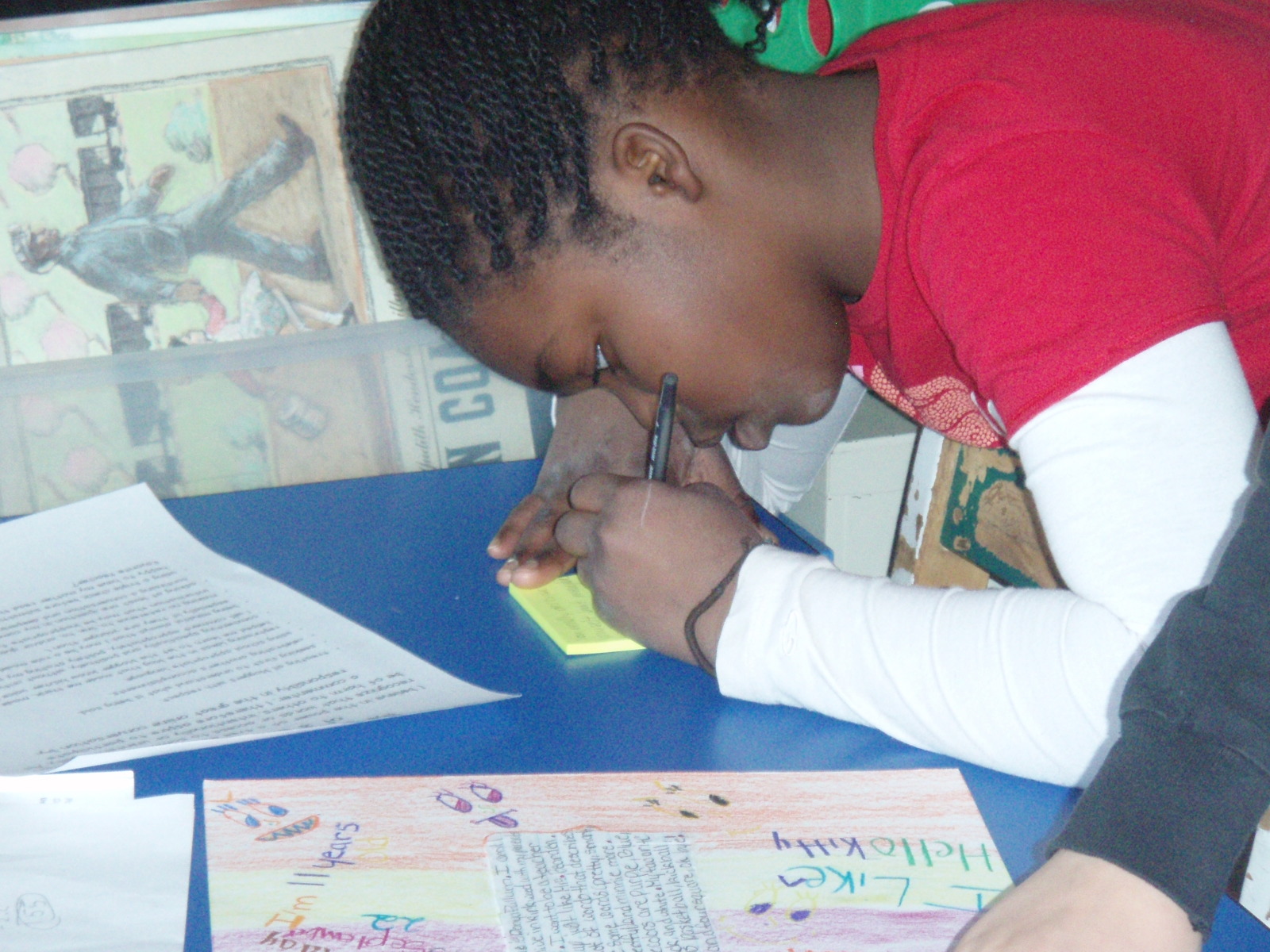
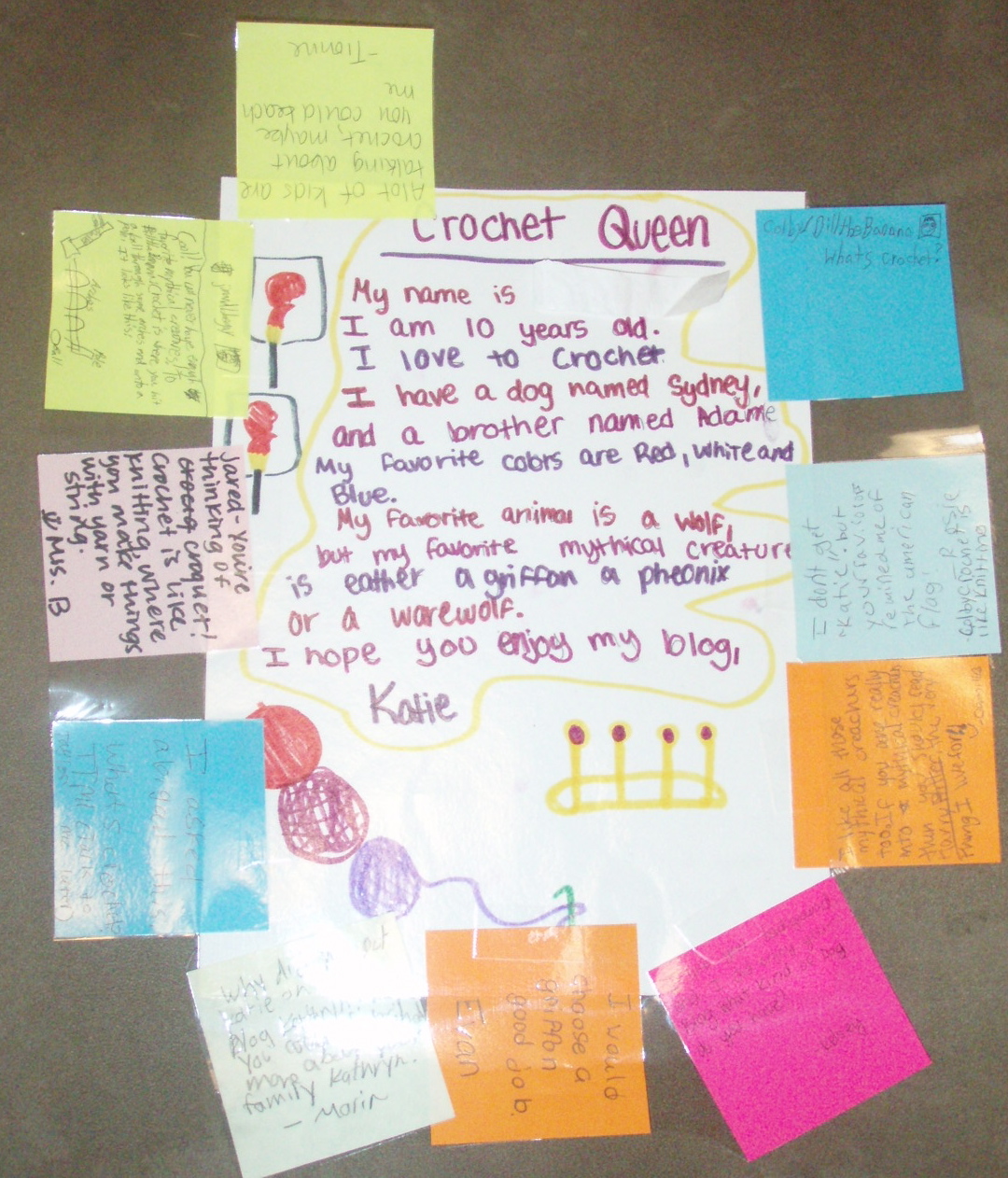
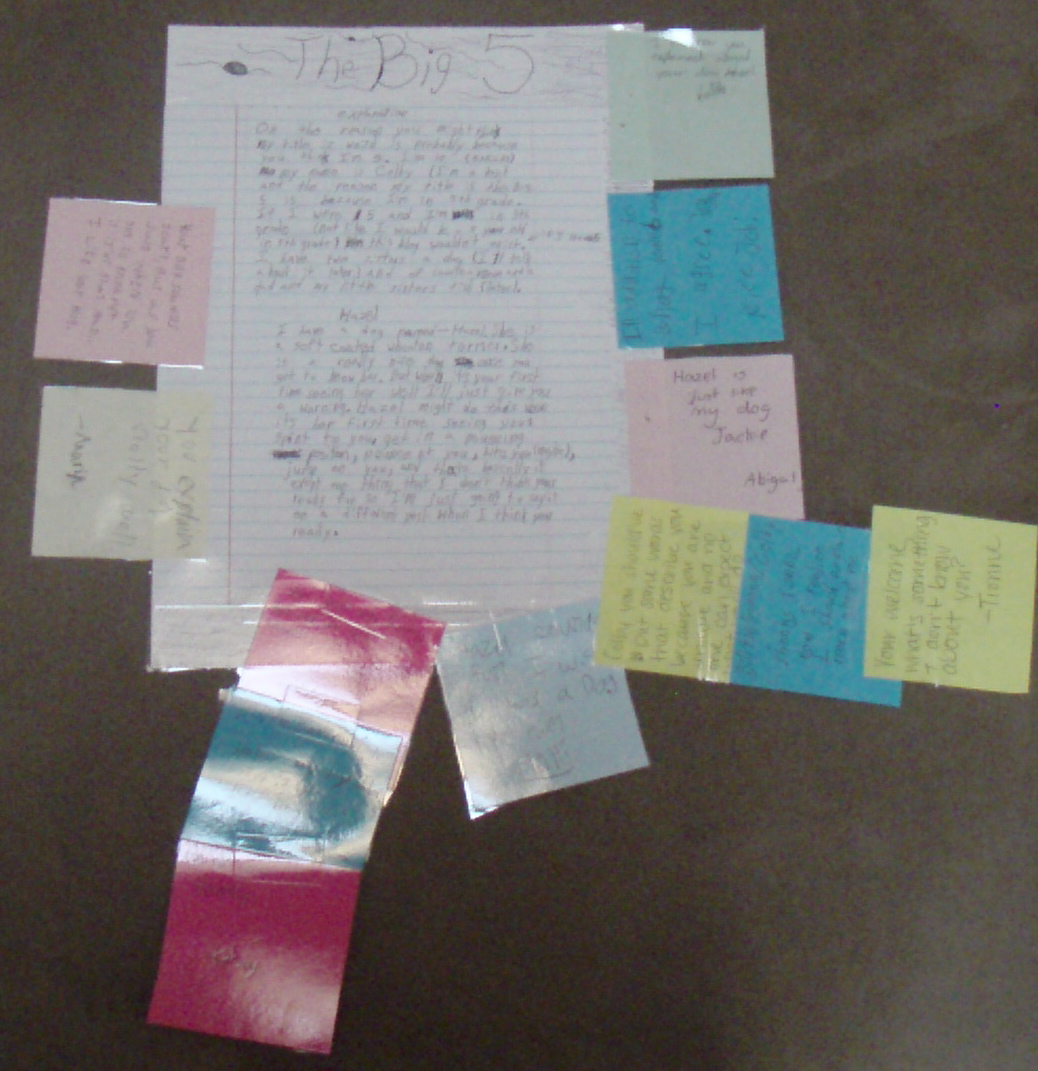
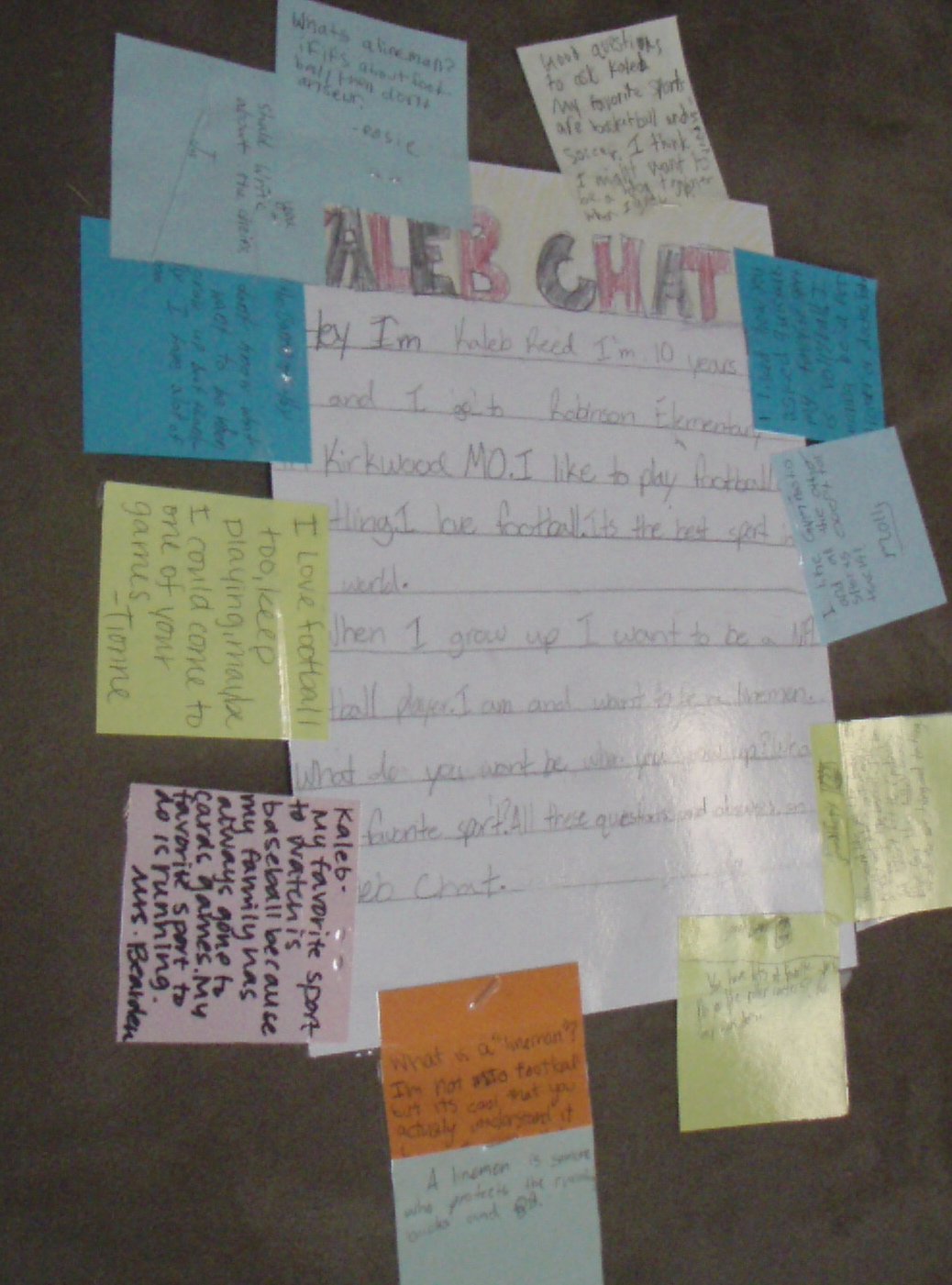
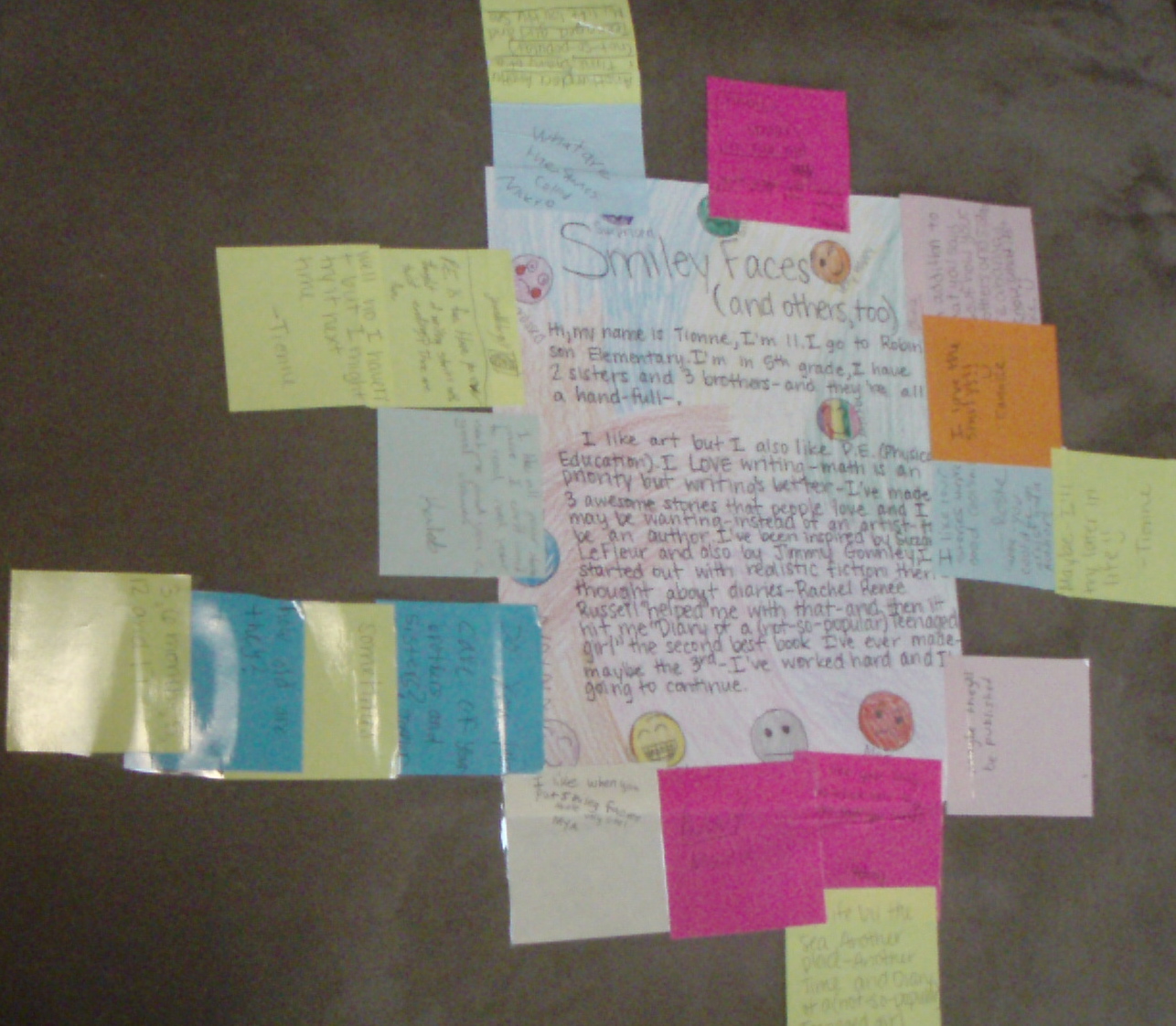
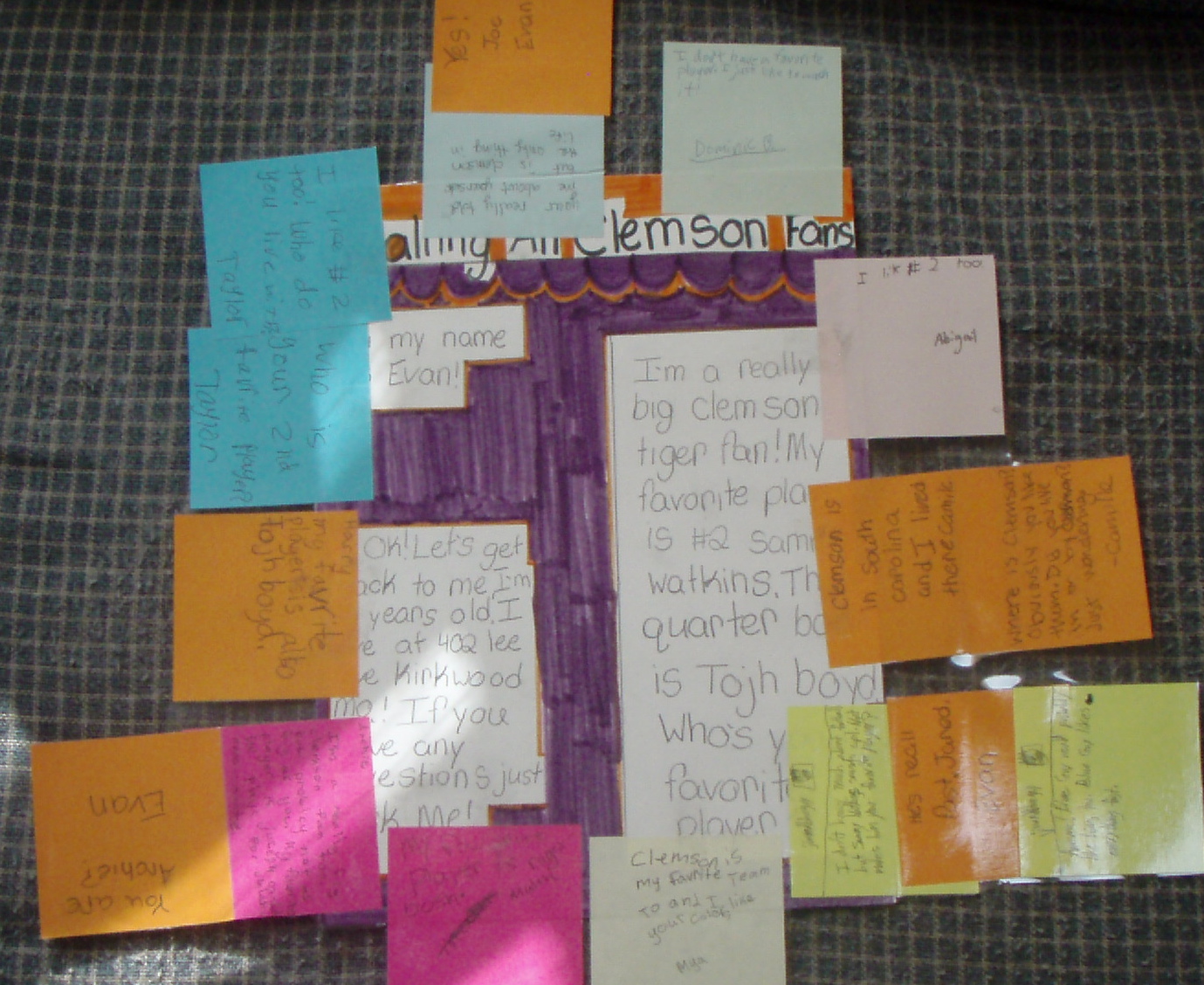
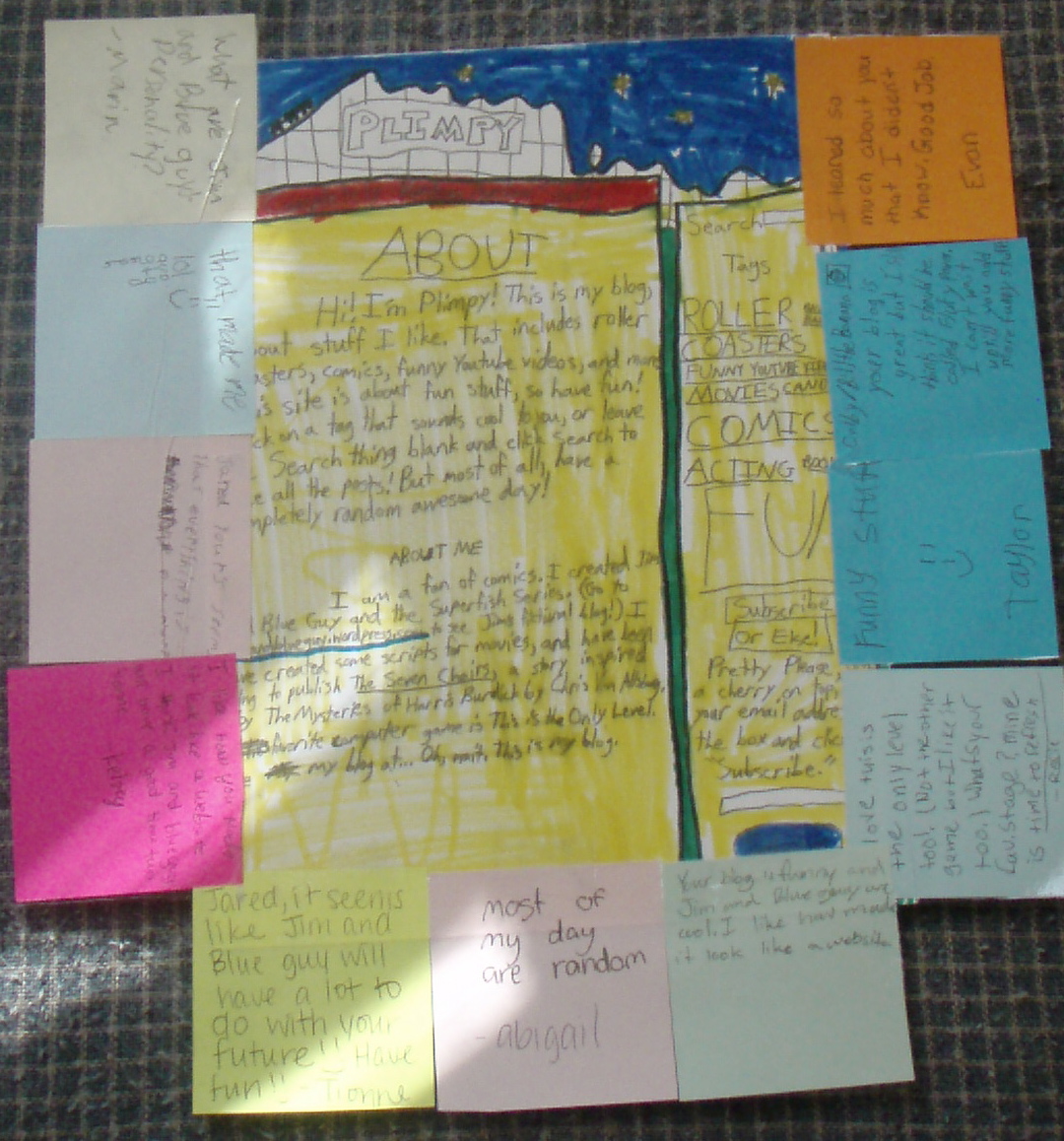
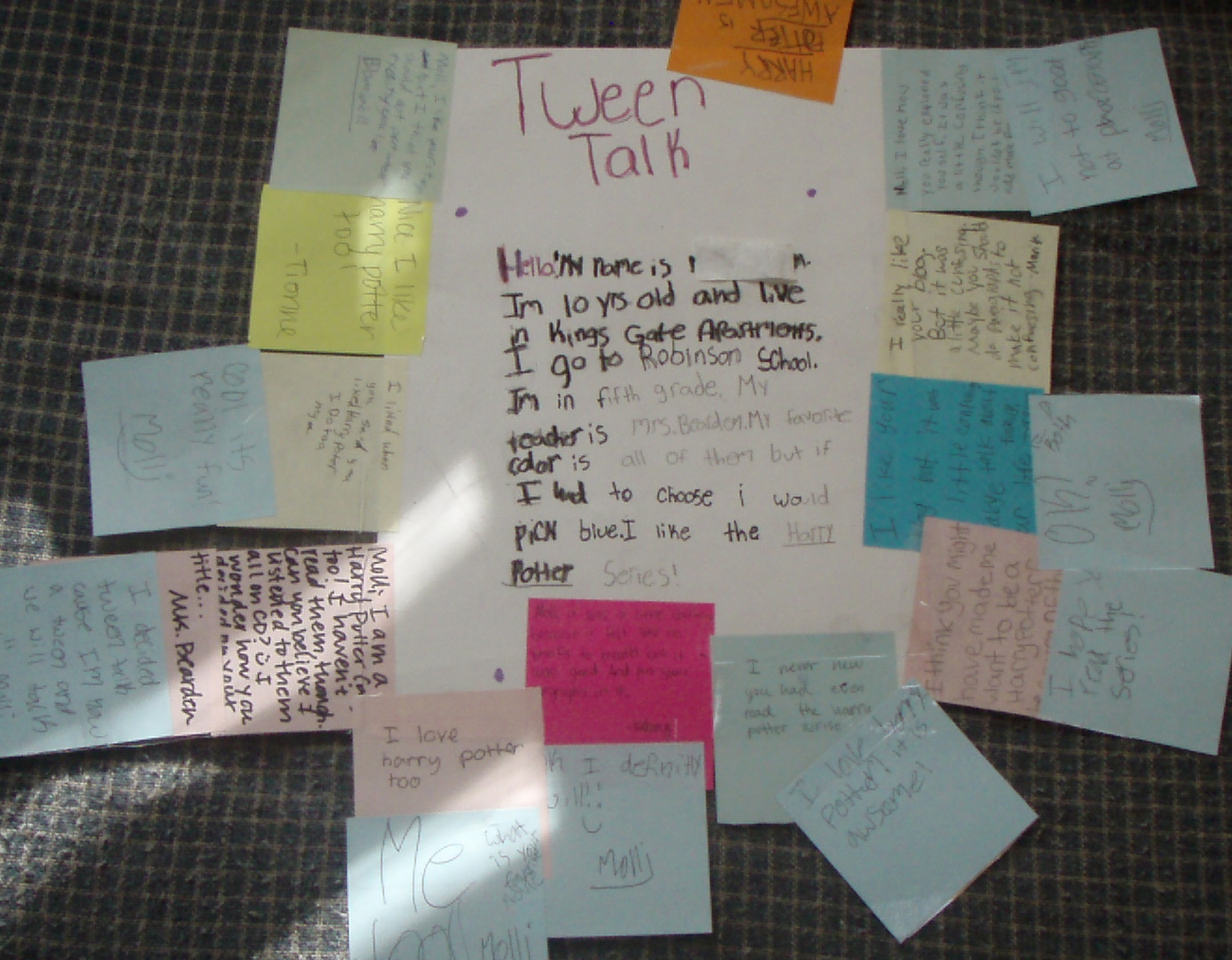
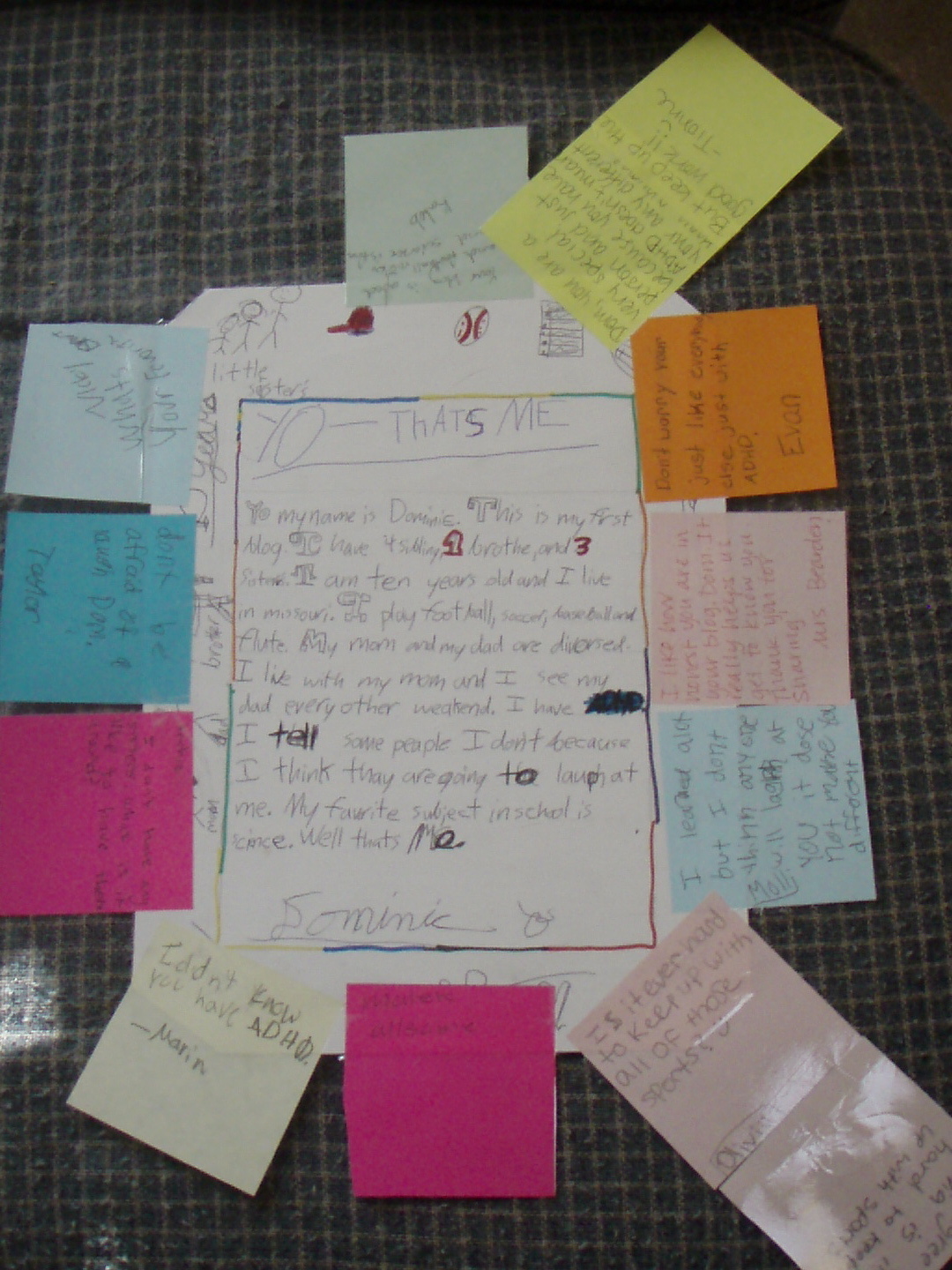
After two days’ worth of work, we had finished paper blog posts and we were ready to learn about what makes blogging interesting: commenting.  I shared some guidelines, and we talked about what they were thinking.  I gave them some ideas for comment starters (shared by Karen McMillan on her blog Notes from McTeach), and my kiddos were great to connect some conversation prompts we already use in our classroom to this new learning.  Each student was given a pad of sticky notes, and the were off.  I turned on some quiet music, and they went to work.  They read, they thought, they commented.  For almost 45 minutes!  Yes, you heard right–45 minutes of silence and students focused on sharing their thoughts with their friends.


After a while, everyone’s blogs started to become a beautiful rainbow of colored post-its, each containing kind and constructive words from their classmates.

Once everyone had had a chance to comment on blogs (and comment on other comments), we took some time to read what others had written, and then sat down to debrief and celebrate.  As we gathered in a circle on our carpet, I asked them to share with each other whatever they were thinking about what we had just done.  Here were some of their words:

I liked it.  I think this was a good experience for knowing what we’re going to do on our “real” blog.

I think it’s cool because we were talking with paper–kind of like having a conversation, but definitely different.

I think that it was really fun.

It was fun because you got to pass notes and you don’t get to do that in class normally.

It’s great that we got to learn something new while we were having fun together.

This reminded me of Harry Potter–like passing owls–we got to come back and reply to a note that someone wrote.  I really felt like someone was noticing me.

I was excited when Kelsey was replying to my answers, I had to reply back!

So we’re on to the internet on Monday, to be introduced to our kidblog.org blogs.  We hope to have our first “real” posts up by Wednesday.  I have to say I’m impressed.  I am amazed.  I knew it would be good, but it went even better than I anticipated.  It was so cool how engaged they were, how eager they were to share their thoughts and read the thoughts of their classmates, how kind and generous they were with their words.  I didn’t have to censor anyone’s comments; they were completely honest and gracious as they told each other how much they liked what they had read, asked questions to dig deeper and to encourage future work, and to make connections to what the blogger had written.  They commented on each others’ comments, too, and we even ended up with one long string of sticky notes that was about 10 long!  I was so proud of my students once this was completed, and am so excited to see what they do next.  I know it will be amazing.  Because they are amazing. 🙂

Enjoy our first finished projects:


More Than Community Service

Many schools participate in service-learning projects.  Ours is one of those.  But I’m not sure that until recently that I really knew what service-learning was.  I think that in years past, I’ve said that I did a service-learning project, but really it was nothing more than a brief activity we did related to a holiday food drive or because there was a hospital next door to our school and we thought it was a good idea.  Not until last month did I learn what I should have been doing in order to really call something service-learning.  And now we’re actually doing it.

Even though the name really does imply its definition, I think it’s easier to start by saying what service-learning is not:

  • It’s not just a one-time episode when you help someone.
  • It’s not an add-on to your curriculum.
  • It’s not logging in community service hours just because you have to.
  • It’s not just something big kids or grown-ups do.  (taken from information on http://www.servicelearning.org)

Service-learning is a strategy that involves meaningful, authentic service to address a problem or issue in your community, where your students learn and then reflect on what they’ve learned.  It benefits both the volunteers and the recipients of your service.

Ok, but how to you do it?  How do you make sure that you effectively combine the service part and the learning part so that your students benefit as well as the ones you are serving? Service-learning includes several important components to help make this happen:

  1. Preparation: As you prepare to do a service-learning project, your class (or school or Girl Scout Troop, etc) should identify a community need that you could address.  Brainstorm possibilities and then choose one.  After your need is chosen, then you will need to work to investigate or learn more about the need.  This can be done through internet research, reading books about the subject, talking with people or groups that might be involved in the work already, or a variety of other methods.  In the service-learning project we just did at our school, we focused on Veteran’s Day.  We had an assembly on Veteran’s Day where we learned more about what veterans are, listened to a current serviceman speak about his experiences in Iraq, met people in our community who were veterans, and sang patriotic songs.  We also read picture books and watched videos to help us get more information on the meaning of Veteran’s Day and why it should be important to every citizen in our country–even elementary students.
  2. Action: Not surprisingly, this is the step in which students actually do the service part of the project.  Again, this should be related to the identified community need, and based on the foundation built while you learned more about the topic during the preparation phase.  For our action step, we wrote letters to veterans.  Most kids in our school wrote to veterans in homes or hospitals.  We were lucky enough to have the name of an airman currently serving in the Middle East.  He was a friend of a classmate, and so we wrote to him and told him how much we appreciated what he does for our country to keep us safe.
  3. Reflection: Part of what makes service-learning more than just community service is the reflection stage.  Once you have completed your action step, it is important to step back and look at what has happened, what you have or can learn from it, and pay attention to the effects your project has had on you and those you were serving.  The reflection step of our Robinson service-learning project actually started with every student in our school receiving a letter of their own in the mail. Every member of our staff wrote letters to students–in their own handwriting, in a hand-addressed envelope–and then there were mailed home.  Later in the the same week, our class (and the rest of our school) sat down to reflect on how it had felt to receive a letter in the mail with their name on it.  The hope was that students could then apply how that might have felt for the veterans to whom we had written. My students did a great job of identifying how special and “noticed” they felt to have gotten mail addressed to them; usually the mail was for the grown-ups in their house or was bills or junk mail.  We had a great discussion about how our airman friend Mark might have felt alot of the same things when he received a big packet of letters from our class.  Our hope was that it helped him to realize that he was doing a good thing and that we had noticed.  We wanted him to feel proud for what he was doing to serve our country.  Many connections were made during our conversation.
  4. Demonstration/Celebration/Evaluation:After you’ve done the amazing work of your service-learning project, take time to celebrate it!  You could do this in a variety of ways, like by writing about what your students learned, in a journal or in a PowerPoint presentation.  You could create banners or posters around the school highlighting the project, coordinate news coverage about your project or post the project on the school website.  Here you also evaluate how the project went, and begin steps for doing your next service-learning project based on what happened this time around.  The celebration phase of our Robinson service-learning project is ongoing, really.  We have shared it on our website, and we are planning a schoolwide assembly in the spring at our school to highlight all of the projects that we will have been involved in throughout the year.  Our class may create Wordles about it (related to my post from yesterday), or blog about it (once we start this next week!).  No matter what we decided to do, it’s vital that we stopped to notice the work we had done and the difference we made!

So what will you do to participate in service-learning? Everyone can make a difference.