Put Your Cub in the Den

If you’ve visited our schedule page, if you’ve been here a while, or if you know me, then you know that writing is a big deal in my classroom.   So getting into Writer’s Workshop is also a big deal.  There is a very special way that I introduce Writer’s Notebooks, a special way I share myself as a writer, and so then writing becomes a very special thing to my students, too.   It works out really nicely.  🙂

So…a couple of years into teaching 4th grade, I came up with what I thought was a great idea.  At that point, Steno notebooks were EVERYWHERE, and I found a new way to use them.  Rather than having my kiddos jump right into their Writer’s Notebooks, I gave them a “practice” notebook where I would teach them my way of using the notebook, a place to give it a try and make mistakes.  Then, once they had proved to me that they were ready, they got to “move in” to their real notebook.  Back then my class came up with the name of “training wheels” for that starter notebook, because of how you go through that learning stage before you ride a real bike.

This year, I knew I wanted to get back to this whole starter notebook idea (I hadn’t done it with my 5th graders yet), so I got to work.  Instead of using Stenos, though, which are strangely hard to find now, I decided to use a half-sized notebook.  Just a few quick slices of the paper cutter and you have a class set like this:

I liked how they are pint-sized, so are therefore portable, but have big enough pages that you can finish most thoughts on one page.

I told my class the story of the training wheels, and set goals for how I wanted them to use these notebooks over the next few weeks.  Then I asked them if they wanted to stick with the old name, or create a new one that was just for us.  And so the idea of the “cub” was born.  Instead of having  training wheels that led them to a bike, they decided that they would instead have a cub that grew up into a bear!  Then, they even renamed our cubbies (the places where they store their stuff) DENS, so they could put their BEAR in the DEN.  Get it?  Like Bearden?  That’s actually how I tell people how to spell my name: like a bear in a den.  HA!  And so the cub was born.  And very soon everyone’s cubs will become bears.  🙂

But what do we put in our cubs?  What am I teaching them to put in their notebooks?

It all started with a definition, courtesy of Ralph Fletcher:
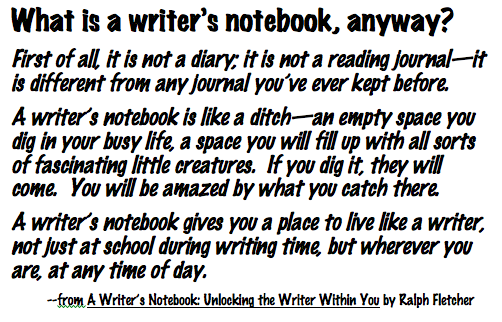

A container.  A ditch.  A place to live like a writer.  I want my writers to think of this little notebook as a place to collect ideas, to save secrets, to start stories.  It’s a place they will visit each day, writing in a variety of different ways, collecting entries that they will come back to over and over again in their future–for sure in their 5th grade futures, but hopefully (if I do my job right!) their farther futures, too.  I am up to my 11th WNB, the first of which dates back to 2005, and I still use them everyday!

So far, we’ve learned these strategies for our writing toolboxes:

1. Lists: you can use this strategy for anything!  A list of favorite things, least favorite things, names, places, foods, story ideas–ANYTHING!  Like this, for example:
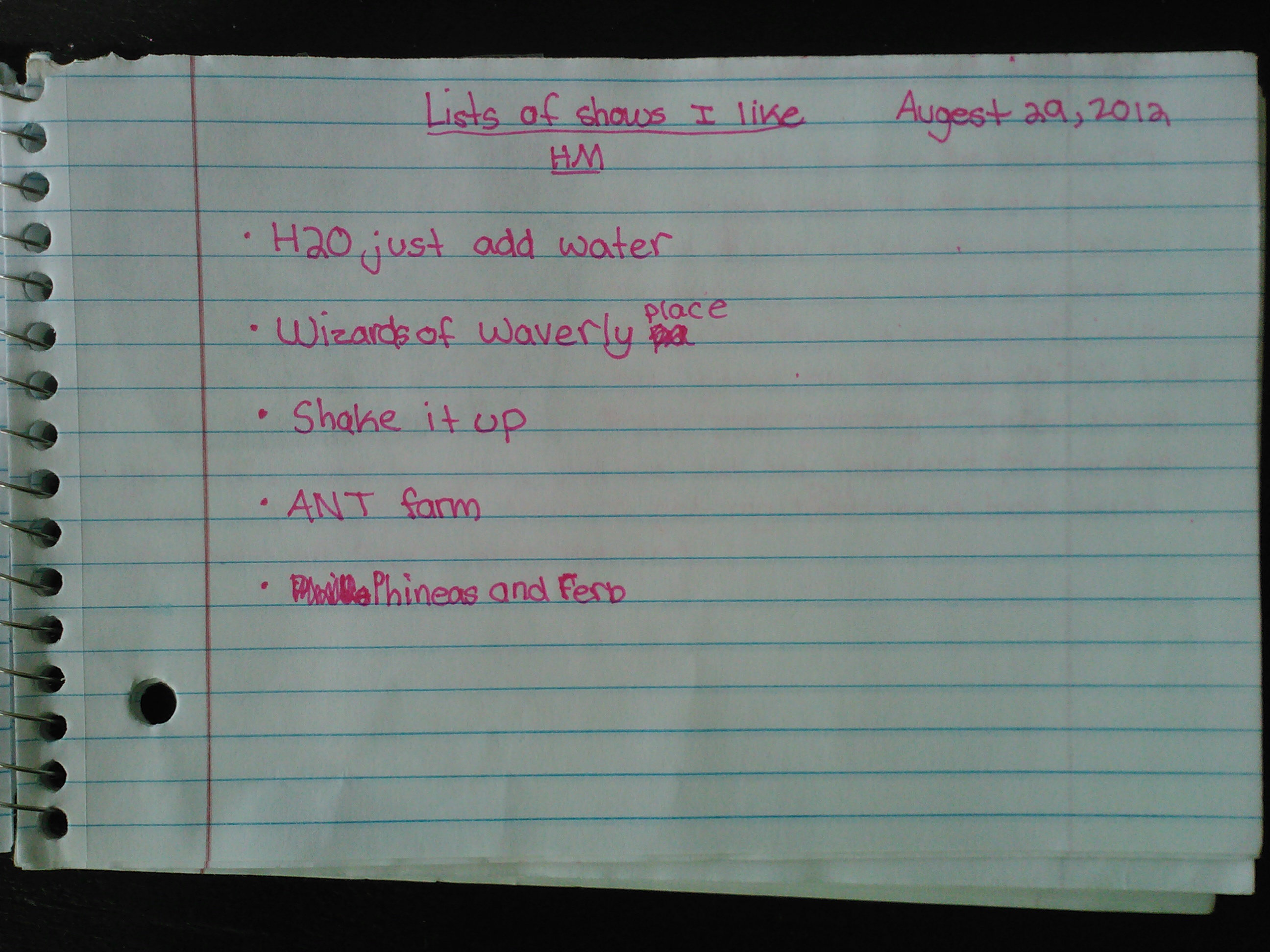
 

2. Memories:  I define a memory as anything that has happened to you in your past (and remember–5 minutes ago is the past!) that you want to remember.  It doesn’t have to be huge or monumental or “special,”  just memorable.  And important to you.  We’re learning that almost anything in our lives is “worthy” to be kept in our notebooks, and that we can write about these ordinary events in an extraordinary way.

A 5th grade memory or two:


3. Artifacts:These are really an extension of memories, and involves the “stuff” you put in your notebook that triggers memories–photographs, newspaper clippings, ticket stubs, candy wrappers, flower petals, cards, notes.  You name it!  Someone even taped a quarter into his notebook the other day because it sparked a story he’d heard before.  For us, it’s been mostly magazines lately.  I give them very specific directions about how the WRITING and THINKING is more important than the picture, and that they should not just cut out any old picture and write “I like…”  They are totally rocking at finding the deeper stories behind plain pictures they find in our classroom magazine bin.

For example:


4. Questions: We call these “fierce wonderings” (again per Ralph Fletcher’s smart thinking!).   We talked about how we wanted the focus to be on big questions that may not have an answer–at least not one that we can find easily or at this point in our lives.  We discovered that often fierce wonderings start with “why.”

5. Observations/Descriptions:  We added these to our strategy list today, and I can’t wait to share them with you soon!

I love the stories I keep hearing from families about how excited their students are to be writing!  They are already doing an AMAZING job with this!  But hey, that’s because they’re AMAZING kiddos!

What do you write about?  Have you ever tried any of these strategies in your own writing?  What can you add to our list of entry suggestions?  Leave a comment and share your thoughts! We LOVE to read comments!
 

Reading Museum

All during the first week of school, we spent our time in activities to get to know each other better.  During our second week, we continued, but with the focus of getting to know each other better as learners.

So on Friday during Reader’s Workshop, we held a Reading Museum.

The idea was simple, really.  Each reader in our room–including me!–set up an “exhibit” that told something about themselves as readers.  Then we went around to each exhibit (after having a quick conversation about expectations–you have to act a certain way in a museum, after all) to see what each person laid out.  We made connections to other readers’ books and asked questions we had, too.

Once we were finished, we debriefed on what we had learned during this activity and how it would help us in the future.   What a fun way to spend a Friday afternoon!

Check out some pictures from our museum:

This slideshow requires JavaScript.

Have you ever been a part of a Reading Museum?  What books would you put in your exhibit?  We chose books that we liked, that we’ve read over and over, that someone read to us when we were little, etc.  We’d love to hear about your selections!  Leave us a comment, please! 🙂

Morning Math Warmups

This being the second week of school, we got a little closer to following our regular daily schedule.  In Math, that meant that we practiced the components of Guided Math.  One of those components is our Morning Math Warm-ups.

Each day when they come in, there will be a question on the easel to get their brains warmed up.  Generally they will be math-related, but sometimes not obviously so–not just “solve this equation” type questions.  These were the warm-ups for the week:


How would you answer these questions?  If you’re a parent: talk to your mathematician about how they answered them.  If you’re a teacher: how do you use warm-ups in your classroom?  Tell us about it! 🙂

Standard Practice

Remember when I told you about figuring out our class norms?  Well, another thing we worked on last week was related to the same idea–how are expected to act in our classroom.  But instead of talking about how to work with each other, this time it was about personal standards.
Now to be fair, I had a little more lead in this activity than I have in others like this.  There were some things I new I wanted to have on this list, and then I wanted them to talk to me about examples of them, or what they needed to think about in order to make them happen.  While I value kid-created ideas in almost everything we do, there are just some times when you have to start the conversation with something and help lead them in a certain direction.  This was one of those times.


This chart now hangs next to our class norms near our meeting area:


I love how these two anchor charts make it very clear the kind of people we want to be every day in our classroom!


Our New “Norm”al

I work at the most amazing school ever.  No really, I do!   But it didn’t get that way by accident.  Our school culture is one built on respect and acceptance, and these things are expected and encouraged by all the adults that work here.  Our school has Road Rules that help our students (and teachers) know how they are to act, and our staff then has another specific set of norms that we follow in our interactions with each other.  My team, then, has also agreed upon norms for our collaboration.

So the next step would be my own classroom, right?  This year, instead of focusing on class “rules,” I had a conversation around norms with my students.  We discussed how norms help us know how to talk to each other, how to act in a group, how we want our room to function.

We started by reviewing the Road Rules, since they are the universals for our school, and everything we do in our room should relate to them.  In our tribes, we brainstormed ideas.  Then we shared out and began the big job of weeding through all the suggestions.  We looked at any norms that were similar or even the same as others, or ones that maybe just were not our best thinking.  Here’s what we ended up with:


And then since we needed a fresh copy that we could easily read (and that matched our theme!), I made the final copy that now hangs next to our meeting space:


These norms help us work together smoothly and productively, and since they were everyone’s ideas, no one can really argue with them!  They’re helping us do great things already!

What norms do you follow in your school or your classroom?  Parents: do you have norms for your house? How are they working for you?

Bananagrams

Have you ever played Bananagrams?  Well, honestly, I haven’t either.   I know that it’s a little like Scrabble, and is a banana-bag filled with letter tiles.  At our “opening day” staff meeting, my fabulous principal, Mrs. Sisul, did this version of Bananagrams with our staff.  I thought it would be really great to try it with my 5th graders.  Here’s how we used it in our room on Thursday.

Every kiddo was given a letter tile out of the banana, and then were given these directions:

1. Find as many different other letters as you can and make a word.

2. No talking.

3. Sit down after you have a word.

4. If you can’t use your letter to make a word, wait by the easel.

 
During our first round, we made the words NUN, PEARS (which later became SPEAR), BOW (which became BROW when we added someone who needed a group), I (it’s a real word, right?), and RIO.  They did great, and followed all of the rules I gave them.  I was a little surprised with how easy it was to do the “not talking” part–that’s usually the rule that gets broken first.  Not these kids, though. 🙂

This slideshow requires JavaScript.


We did another round where we added the rule that they had to make words that were 4 or more letters.  They LOVED this game, and have requested it multiple times since we played it.  I’m excited to come back to it often, with different rules each time.  The possibilities are endless, really.  I’m excited to try it for spelling.  Our program is based around a different “generalization” each week, and so they’d have to make words that follow that pattern, i.e. short vowels, “r”-controlled words, long vowels, etc.  I know they’ll be up for the challenge!

Have you played Bananagrams?  Have you used it in your classroom?  Do you have a suggestion for us for a rule we could add to our game?  We’d love to hear your thoughts!

Binder Day!

So you could have probably called today “Binder Day” in our classroom.  Sounds great, right?  I know you wish you could have been a part of it! 🙂

Why “Binder Day”?  Well, today was the day we put together two very important binders that students will use to keep their papers and data organized.

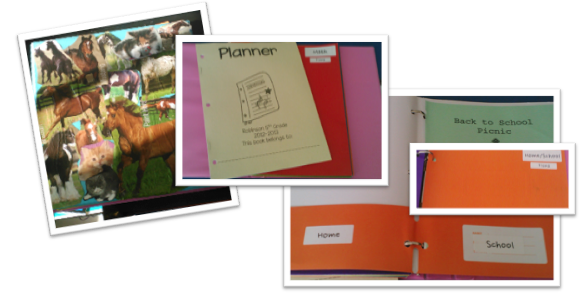
We started with this:

It might be hard to see (or understand), but it’s a binder that has a student planner, as well as 6 folders: Math, Science, Social Studies, Writing,Reading/Spelling, and Home/School.  During the day, this binder will live in their cubby, and they will put papers that they need to keep into the corresponding folder for that subject.  Then they can take the binder back and forth between home and school if they need something for homework.  It’s worked well for many other teachers, and it’s great practice for what they’ll do as big, bad 6th graders next year in middle school.

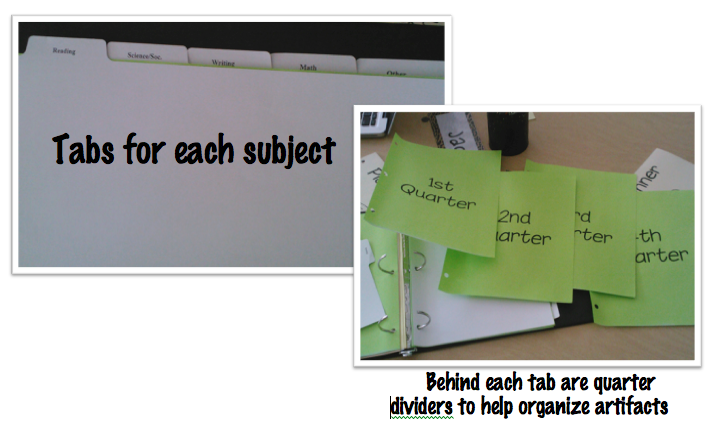
Then we worked on our data binders:


which also house our portfolios:


Tomorrow we’ll start to fill them as we begin to track our progress on beginning of the year basic facts tests.  An important part of being a successful 5th grader in our school is being able to set goals for yourself as a learner, and these two binders are two very important tools in helping our kiddos set and then ACHIEVE their personal goals.

What kinds of organization do you use to help your students?  Do you use data binders or portfolios in your classroom?  Tell us about it!

Marshmallow Challenge!

Welcome back to school!  We have been very busy already this year–hence the reason why I haven’t updated in a while–and are getting into a groove.  Forgive me if the next few posts are out of order (at least the order in which they happened); I still need pictures of certain things before I post about them.
Anyhow…we have spent much of the last 6 days getting to know each other better as learners (and people in general, really), as well as focusing on how to work well with a group.  One thing that our tribes did together early on was to take the Marshmallow Challenge.  What a great idea shared with me by my new friend and teammate Mrs. Hong! When you’re done here, you should definitely check out her class blog. 🙂

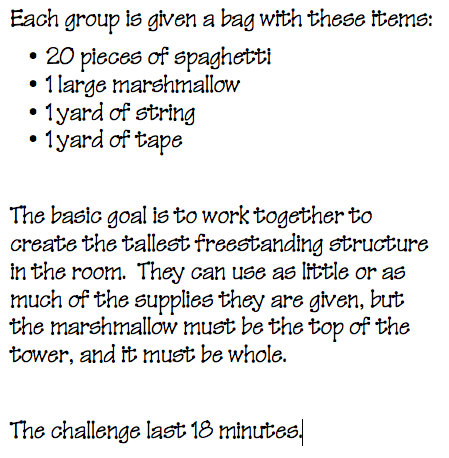
Alright, so here’s the basic idea:


We got ready, and I set the timer.  They built and taped and created, and at the end of the challenge we stepped away from our structures and….Every. Tower. Fell. Over. 😦

For a few minutes my friends wanted to claim “FAIL” on this activity and say it didn’t work.  But instead, I led them to reflect on what went right.  After a conversation, we figured out that many groups had the right idea of focusing on building a strong foundation, many had made a plan first, each group had a common goal and all groups worked well together to create a spaghetti structure.  Even if they fell over, we were successful in a lot of ways.  And so that day, we planned to do the challenge again, knowing that the next time there would  be many things we’d change–but many things we’d try again. 🙂

And so today was that day.  We planned and prepared before we went to lunch, knowing that when we returned we’d get down to business.  It was so great to watch the tribes busy, talking together about what to do this time around.  Many had plans drawn on paper, and most mentioned specific things they wanted to do differently.  Many groups decided that instead of trying to make their tower really TALL, really FAST, they’d focus instead on making it STRONG.

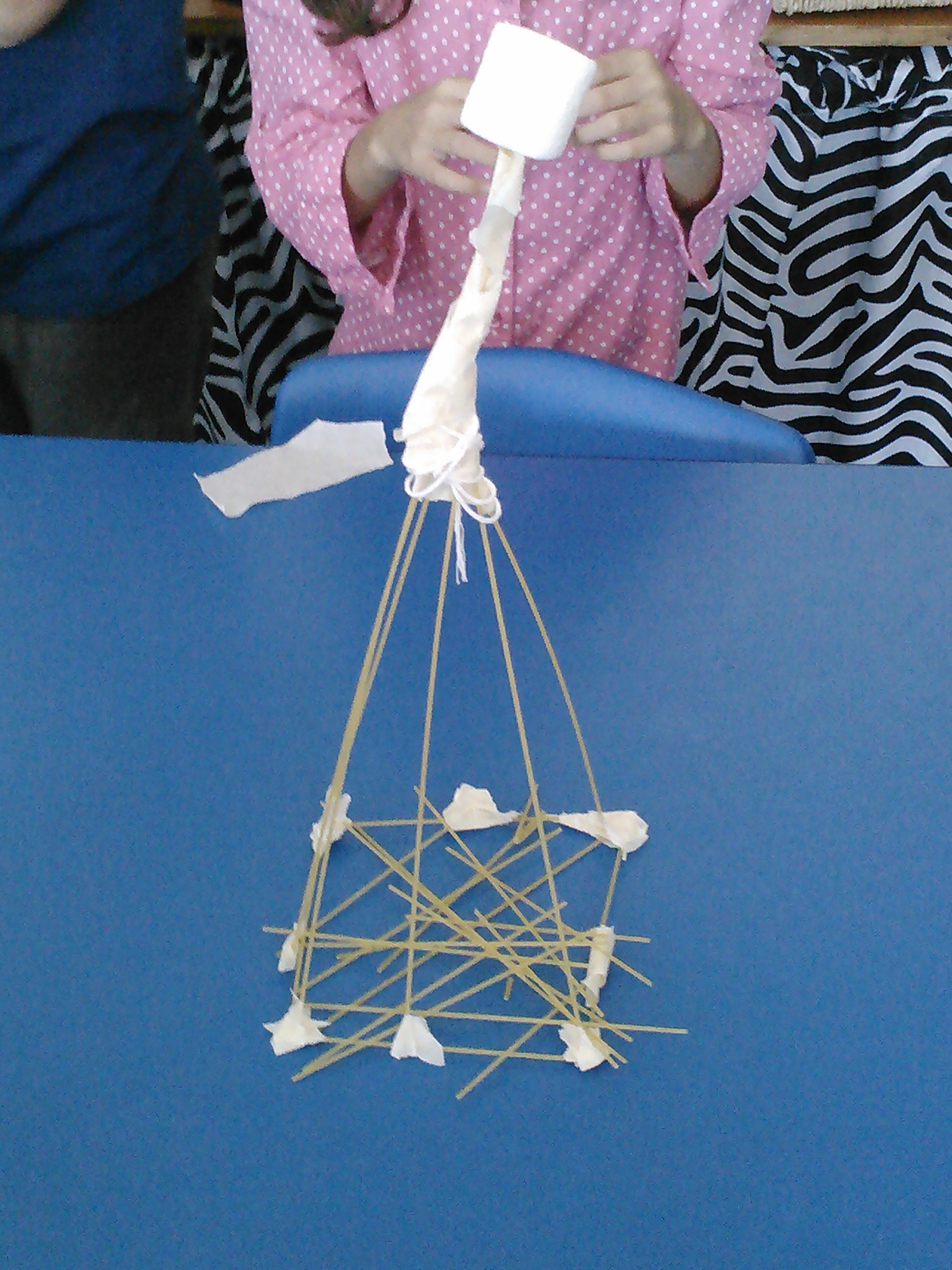
We got ready, and I set the timer.  They built and taped and created, and at the end of the challenge we stepped away from our structures.  This time, this happened:

WAY BETTER, RIGHT?! I was so proud of them!  And yes, granted, two of them still fell over, but sadly it was right at the last minute!  Those last two were upright and fine until the timer buzzed.  Bummer!

Like I said, we focused on what we can learn from this situation.  It wasn’t about the tallest tower, or whether or not it fell over.  It was about the team, the working together, the learning about our strengths and building on them.  And they totally rocked all of those things!  I can’t wait to see the other amazing things they are going to accomplish together this year!

TRIBES!

We have a new theme in the room this year–WILD about learning.  I will add pics to show it later on, but just picture lots of animal print.  Believe me–it’s FABULOUS!

So one thing that I always do at the beginning of the year is create a set of groups that we use all year for a variety of activities.  These groups don’t change, unlike many others in our class.  I always have a name for the groups, which is usually based on our theme.  They originally started back when I taught 4th grade and needed to have groups to vote on laws that we made for our class state.  They were legislatures, in effect.  Back then they were called Districts, and then last year (during a construction theme) they were Zones.

As I thought about this year, I latched on to the “wild” part of our theme, and that lead me to thinking about tribes.  That tribe idea lead me to Survivor.  You know, the show on CBS?

Originally I was just going to use the idea so that I had something clever to call our groups, but then I realized that there was actually more of a connection to that show than I had realized.  We made a link to the purpose of the tribe on Survivor–to help each member of the group “make it,” to focus on the strengths that each member brings to the situation, and to work together to solve problems.  Then I remembered how on the show, each tribe gives themselves a name–a name that tells something about the group as a whole.

So a new tradition was born.  One of our first activities together was to create tribe names and explain what that name meant about the group.

May I introduce to you, the 5 tribes of Rm. 202:


I’m going to save the explanations for another time, but I wonder: do you think you can figure out what they may mean?  And if your kiddo is in one of those tribes, can you figure out which one?  Teachers: do you have groups like these in your classroom?  Tell us about them!