Save the Last Word For Me

I love my job.  I love my school.  I love my principal.  She has such a great way of making meetings so relevant and useful, usually showing us strategies that we could replicate in our classrooms the very next day.  There are actually many meetings I go to around our district that are like that.  It’s kind of refreshing.  So when we were taken through the protocol for discussing an article called “Save the Last Word For Me” on Friday, I decided that this time I would try it with my class.  I teach 5th graders, after all–and amazing ones at that–so I knew they’d do great things with it.

Here’s the big idea:
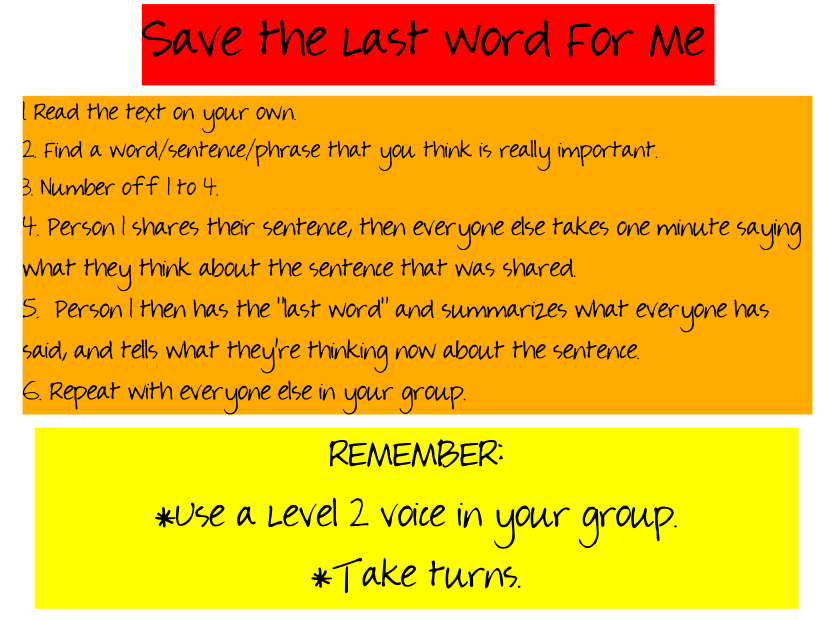
We were using the article that’s in the picture here, which is about cloning.  It gives some background and then highlights the pros and cons of the issue.  As a means of ever more deeply discussing the topic, we tried this protocol in our small “heads together” groups this afternoon.  I tried it with a small group of friends as an example first, and then sent them to work.  I wish the video I had taken was of better quality, because it’s the kind of thing that makes more sense when you see it, rather than just read about it. Sorry.  Maybe next time. 🙂

Overall, most groups did a great job, and most were able to dig a little deeper by hearing other people’s perspectives on what they had individually read first.  Once we were finished, we debriefed and they shared what was hard for them about trying something like this for the first time.  I heard them share the very same things that were hard for me as an adult reader and listener the first time–talking for the whole minute when it was my turn (that’s a lot longer that you realize when you aren’t sure what to say!),  stopping when the minute was over (it’s a long time unless you have a really good idea to share, and then it’s AMAZINGLY short!), and only talking when it’s your turn (which is only once during each cycle of sharing).  That last one didn’t surprise me, because I have a class of talkers.  Or maybe I should call them arguers.  No, debaters.  And during this protocol, you are not allowed to comment on other people’s ideas unless you’re the next one in the circle.  Anyway, they have important things to say and we’re all working together on finding the appropriate times to share our important thoughts.

Like I said before, I am always learning new things in my job as an adult learner, and when I can share those experiences and ideas with my kids, it’s a double bonus.  We’ll use this one again, for sure, and I’ll be excited to share with you how it goes.

And so I’ll end with a short shout out to Mrs. Sisul and Mrs. Ford for using this protocol with me.  Love that I learned it from you. 🙂

So have you heard of protocols before?  Have you tried this one?  What other ways do you use in your classroom to facilitate conversations around a text?

The End of Literature

Literature Circles, that is. 🙂

We have spent the last few weeks meeting in Literature Circles to read and discuss a book together.  The kids have done an amazing job of thinking deeply and talking openly.

At the beginning of our study, we read several texts together, learning the roles that they would later use in their groups independently.  They learned–and then practiced–the roles of Discussion Director, Character Creator and Literary Luminary.

After we worked together, each student was given the choice of which Literature Circle they’d like to join.  Each kiddo gave their first, second and third choices for which group they’d like to join, then were put into groups of 4-6.  For the next three weeks students read and wrote questions about the book they chose.  Their lit group met three different times, and students had different roles each time.

The themes of the unit were responsibility and choice, as students focused on taking turns, making sure their voices were heard, and using the text to support their thinking.

My students did an amazing job with these groups!  They’re excited to try it again later in the spring with different book choices.  What great experiences we had together.

What experiences have you had with literature circles or book clubs?  Do you have any advice for us for the next time we meet? What book would you choose to read?

Right Question, Right Place, Right Time

I sat down today to do reading conferences, unsure who I was going to start with on my list.  I love it, though, when a kid comes at just the right time with just the right question to help me make my decision!

So enter my friend, D.  She came over to me and asked a simple question: “Do you have any good books?”

I LOVE it when a kiddo asks me this question, because it means I can do something to help get the right book in their hands.  So we sat together and started talking about recipes.

Yep, you read it right–recipes.  We started with background, whether or not she had ever cooked before.  She told me about how she had just made brownies, and so we discussed how a recipe helps you make sure you end up with the product you wanted–a recipe for brownies helps you end up with brownies if you follow the steps.

So D and I started writing her “Recipe For a Good Book.”  The idea behind this is that you can use things that you already know you like as a foundation for finding new things you’ll also like.   The end product is the “good book,” and the recipe is how to get there.  Just like how brownie mix + eggs + oil = brownies.

We talked about some of her favorite books, and she told me she really enjoyed Fudge.  So we started her recipe with Fudge and Judy Blume.  When I asked her what she liked about it, she said she liked it because is was funny because of the kids.  So we added funny and kids as main characters  to our recipe.  I got her thinking about some other favorites and she mentioned Ramona.  We talked about how there were some similarities between Ramona books and Fudge books, and so it makes sense that she’d love both!  Next we added Ramona, Beverly Cleary and family stories to our recipe.  After some more thinking and reflecting, we ended up with a list that looked like this (after she made it into a bookmark):

Once we had the recipe, we tried it out together.  We have a basket in our classroom that’s for GOOD BOOKS (some of my favorites that I’ve put together in a collection), so I figured it was a good place to start.  Immediately we found three books that we thought would fit her recipe really well:

The Zebra Wall by Kevin Henkes, Ramona Forever by Beverly Cleary and Clementine by Sara Pennypacker

By going down her list of ingredients for a good book, we realized that all of these were good options for my friend!  They had many things that she was looking for, and they were a good fit for her reading level.  Success!

The original idea for this came out of a conference I had with a student almost 3 years ago, and it has been appropriate for so many more readers since then.  I love getting the right book into the hands of a kid reader, and better yet, she has a plan for when she goes book shopping next time.  It’s a win-win. 🙂

Light Bulb Moments

In case you haven’t noticed, read-aloud (chapter book) time in our room is a big deal.  This ain’t no lay-on-the-floor-and-rest-after-recess-time.  My kids will tell you that read-aloud is one of the most important times of the day–we use the chapter book to connect to reading, writing, vocabulary and many other things.

Right now we are deep in the middle of The Secret of Zoom by Lynne Jonell.  In Reader’s Workshop, we’re working on inferring in fiction text.  So today as we read our chapter book, we focused on noticing and recording inferences we were making about the story.  We reviewed the meaning of inferring (which we defined as background knowledge + text=inference), and then got started.  There were a couple of parts when I paused in my reading to say “You might be able to infer something here,” but for the most part I just left them to their listening and thinking.  Then I read a sentence and K, who was sitting right in front of me made a rather loud noise, somewhere in between a gasp and a screech.   She covered her mouth, grinned, and then scribbled something in her notebook.  And I knew exactly what she was thinking.  She had figured out something in the story–she had made an inference.

Now, every time you infer something in a story, you don’t make a big deal like that; it’s not always so obvious.  But this was a really great illustration for us.  Some kids in my class have a hard time knowing when they are inferring; they know what to do, but they don’t always attend to when they’re doing it.  But I’ll but from today on, they will know that when you have a “light bulb moment”, when you say “Ahh! Now I get it!” or when you think “aha!”, you’re probably inferring.  It was cool to watch several others do the very same thing–most without the screech–as we continued to read.  And I’ll bet we’ll notice more of it tomorrow.  I love how the thing that really made it visible, too, is something I couldn’t have planned for (the best learning moments happen like that!).  It came very naturally, and was really powerful for them.  Next time you think “aha!” or have a “light bulb moment”, pay attention –you might be inferring something, too. 🙂

Getting back into it…reading

I feel like I apologize alot.  Especially about how long it’s been since I’ve posted on here.  But hey, here I am doing it again.  Sorry–that’s just the way it is.  I do have a full-time job, after all.  🙂

So I’m thinking I’m just going to give a quick overview of what’s been going on for the last month, and then I can hopefully come back more often and fill in the gaps.  Hopefully.

Reading:  For most of the month of October, we were working on text features in nonfiction and asking questions that help us better comprehend what we’re reading.  I loved the text features project we did, where the kids were given a plain text (about the Iroquois, which we were studying in Social Studies) and asked to add text features to it that would help their reader better understand what was being presented.  It was a great way to see how much they really understood about how pictures, diagrams, captions, headings, subtitles, etc., impact the reader.  These turned out great, and most kiddos really got into it!  We also practiced a strategy called Stop and Ask Questions, which is a mainstay in Making Meaning.  As we read (picture books during Reader’s Workshop, chapter book during Read Aloud and independently in their own reading), we stopped at several points in the story to record what we were wondering.  The goal was to focus our thoughts in on specific details in the story, then pay attention for when the question was answered.  Like I say often: The other part of a good question is a good answer.   Last week, then, we moved on to a new unit on story elements.  We’ve been looking at how analyzing characters, setting, plot, problem/solution, etc., can help us better understand that story.  Today we read the first half of Star of Fear, Star of Hope and will continue with this text tomorrow.  Stay tuned for more in reading soon!

Read-Aloud Timeline

One of the most important learning times in our classroom is read-aloud (chapter book).  I use this time to introduce kids to authors and books they may not know, as well as working on strategies that good readers use and practicing how to talk about books.

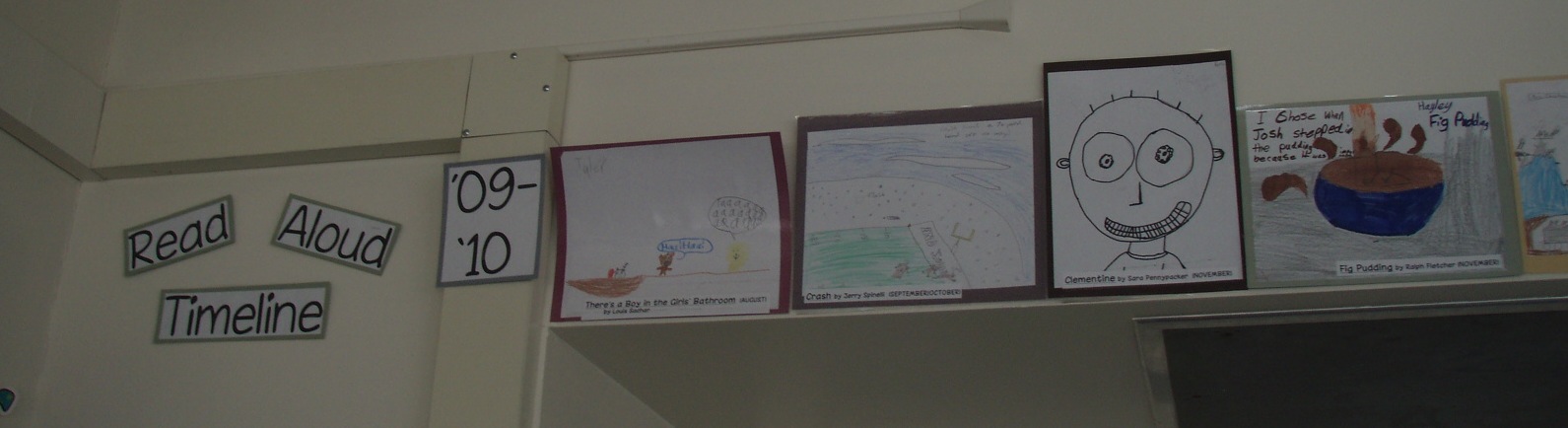
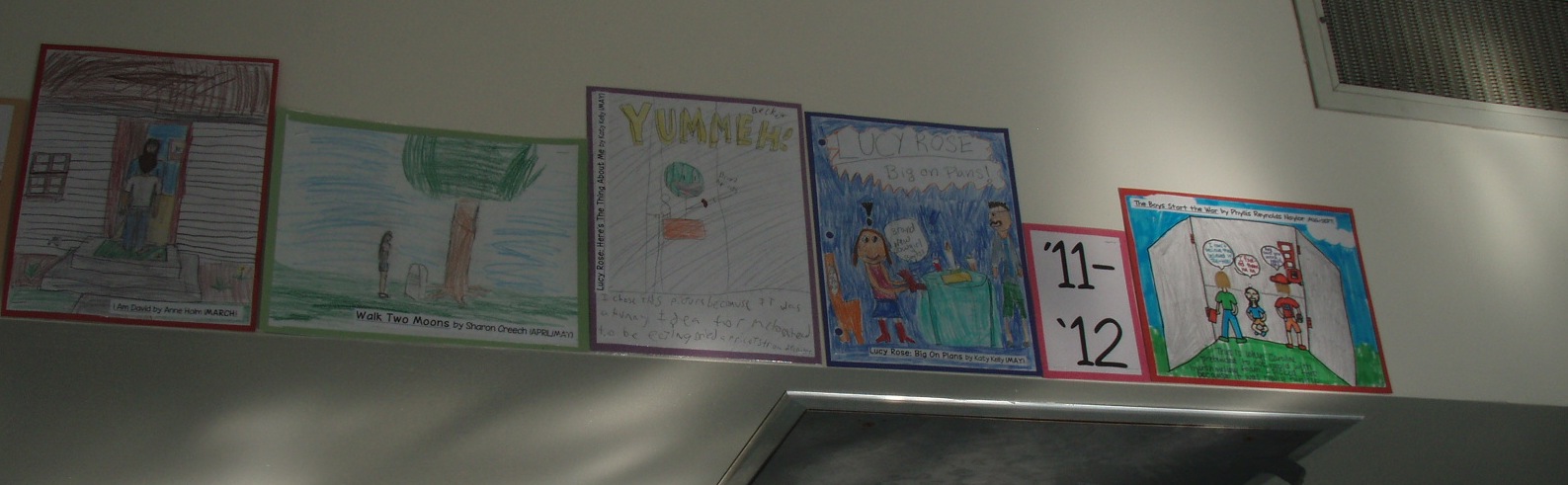
We recently finished The Boys Start the War, by Phyllis Reynolds Naylor.  I’m sure you heard how funny and interesting it was, and how there are at least 12 or 13 other books with these characters that we could read next.  Well, once we were finished, I introduced a structure that we will use after every chapter book we read: the read-aloud timeline.

Here are some pictures of what it looks like in our room:

I know the pictures don’t really do it justice, so make sure you stop by to see the real thing!  It’s been really great to incorporate a good reader strategy (creating images) with remembering what we’ve read.  At the end of the year, each kiddo will get a book of all of their images together, for their own timeline of our reading year.  So glad I’ve started this in our classroom!  Ask your kiddo to tell you what they love about it.  And stay tuned for an update–we just finished Crash yesterday, so it’ll go up this week. 🙂

Highlights: The 1st two weeks of 5th grade

I have had good intentions.  Intentions that included adding new blog posts every day of school.  And obviously those intentions did not end up resulting in new blog posts yet.  But here’s a new one.  And I’ll make it worth your while.  I promise. 🙂

So since it’s called “highlights”, I’m going to give you the big ideas of what we’ve been doing so far, and hopefully your 5th grader can fill in the details.  Hopefully.  There are at school every day, afterall.

Ok, so let’s get started:

Reading: Reader’s Workshop has officially begun in Rm. 201!  We have made reading posters to share our likes/dislikes as readers, taken a reading survey, read The Lotus Seed, Something to Remember Me By and Everybody Cooks Rice together, had our first check-out from the Robinson library, gone on a scavenger hunt in our classroom library, took our first SRI assessment on the computer, read Hansel and Gretel and discussed how to trail our thinking as we read and then–you guessed it–we read!  I love how excited this class is to dig into books!  Next week we’ll start to focus on strategies that good readers use to make sense of text.

Writing:  We have already begun so much work as 5th grade writers!  From day one, your writer was busy thinking about ideas for stories, putting thoughts on paper.  We have gotten our Writer’s Notebooks, and spent sometime making them our own.  We talked about how our WNBs should be a snapshot of who we are; we should be able to tell whose notebook it is without even checking the name, but just by looking at what’s on the cover.  This week we started Being a Writer, which is the program that will support our writing work this year.  So far we’ve read The True Story of the Three Little Pigs by Jon Scieszka (which we learned is pronounced CHESS-ka), as well as The Frog Prince Continued, then talked about how to retell familiar fairy tales in a new way.   As a community-building activity, we played a game called “2 Truths and a Lie”, then lifted a line from what we had written to expand our thinking.  We will dig in further to the Writing Life next week as we continue our journey as writers together.  I cannot say enough how excited I am about sharing my writing life with your kiddos!  I loved this quote from someone today as I was writing in my own notebook: “Wow.  You have a Writer’s Notebook?  I’ve never seen a teacher write in their  notebook during the school day before.”  I’m hoping that there’s already a connection forming there–we are growing as writers together this year!

Math: The mathematicians in Rm. 201 have already been very busy!  We started the year by playing a few math games (Dice Duel and Contig), as well as learning how to correctly roll dice in 5th grade. (Really.  Ask your kiddo to tell you all about how I hate the sound of dice on the tables! 🙂 )  We took a math survey, and then dug right into our first unit in 5th Grade Investigations: Finding Factors and Prime Numbers.  So far we’ve learned (or reviewed) vocabulary related to multiplication–factor, product, multiple, prime number, square number, composite number, array, dimensions–and started working on finding factors of a variety of numbers.  We worked number puzzles, and started an activity called Quick Images for ten-minute-math.  This subject has soo much to tell–be sure to have a conversation with your kiddo about all that’s been going on.  Feel free to use this to help them get started talking about what’s been going on.

Community:  An crucial part of the beginning of our year is beginning to grow our classroom community.  We do this by working together to create things, learn procedures and routines that will be used in our room and throughout Robinson, and learn more about each other so we can celebrate our differences and build on our similarities.  We’ll continue to revisit this idea all throughout the year, to keep our connections strong.

Read- Aloud: Read aloud (chapter book) is a integral part of our classroom.  While it is fun, it is also an important time when we think and talk about books.  The choices I make for books during Read Aloud are often Mark Twain award nominees, or have topics related to the curriculum in our class.  The first book this year is called The Boys Start the War, and is a big hit already!  Have your reader tell you about how we use the strategy of “say something” to share with our partners, and have them introduce you to BOT graphs.

I am sure that there’s probably something I’ve missed.  I’m amazed at how quickly time flies when we’re so busy and having so much fun!

Stay tuned for more updates on the fun and learning in Rm. 201.  Maybe next time there’ll be pictures. 🙂

What I did on my summer vacation–Part 3: Read

I am a reader and a writer.  So here’s a peek into some of the reading I did this summer.  Some titles were obviously ones we might read together in class, and some were obviously for me!

1. Love, Aubrey by Suzanne LeFleur   (Mark Twain Award nominee 2011-2012)

2. The Boys Start the War by Phyllis Reynolds Naylor

3. The Secret of Zoom by Lynne Jonell (Mark Twain Nominee 2011-2012)

4. Mudville by Kurtis Scaletta  (Mark Twain Nominee 2011-2012)

5. Practical Punctuation by Dan Feigelson

6. Strengths Finder 2.0 by Tom Rath

7. What to Expect The First Year by Heidi Murkoff, Arlene Eisenberg, and Sandee Hathaway, B.S.N.

8. Other people’s blogs–I’ve found several really interesting ones that I like.  Most were related to sewing or decorating, but I also have started following many from other teachers who use blogs in their classrooms.  I hope to make our blog useful like the ones I’ve discovered.  I also have several friends who post pictures and stories about their families on their blogs and I like those, too.

Now it’s your turn:  What did you read this summer?  Even if it wasn’t a book, I know you read something!  Share some of your favorites here in the comments section. 🙂