#FDOFG: First Grade Menagerie

As I look over the pictures I’ve taken the last 8 days, as well as think about what we’ve been doing during our first days, I’ve found some things that don’t really fit into their own blog post, but are all connected because they’re all about the friends in Rm. 202.  Hope you’ll stay to check out the first grade menagerie I have to share. 🙂

First Grade Victory Dances!

If you’ve been here since the beginning of our first grade journey, you’ll remembering reading the welcome post I put up for my new friends.  Well, I got two fabulous videos from two very brave first graders that I keep forgetting to share.  So forget now I no more!

Keira

Callahan

Who’s That Smiley 1st Grader?

I had a picture posted on our welcome screen for a couple of days, with a question of who they thought the smiling face might be.  Strangely (at least I thought!), not many figured out that it was me.  None of them thought it looked like me.  Well, I guess when you add 30 years and change the hair it messes people up. LOL

IMG_2957

My favorite part of this picture? It was the year I decided I wanted to be a teacher when I grew up!  My first grade teacher Mrs. LeGrand was pretty much the most amazing lady I had ever met and I wanted to become her some day.  I am not sure I did that–but I think (hope) I have become my own version of a great teacher! 🙂

Day 2 Plusses/Deltas Reflection

We don’t have the opportunity to sit down to “officially” reflect (although we almost always talk about how things went), but this was a fun one to talk about.  After we worked super hard on our 2nd day together, we sat down to practice more with “plusses and deltas” and we were SO EXCITED to see the things we were able to write down.  We also talked about how easily we could work the next day to solve the struggles we had on Day 2. To be able to see brand new first graders doing such fabulous things so early in the year together was so commendable.  Way to go, Rm. 202 friends!

IMG_3076

Grit and Growth Mindset  AT RECESS!!

The other day at recess, Cal came running to me to show me something he can do now that he couldn’t do before.  He told me he’s been working for a really long time and now he can do it!  Way to keep trying, friend!

Ok…there are other things I could add, but really–what could follow that awesome video?  🙂

#FDOFG–Guided Discovery: Pattern Blocks

The last time I was in first grade, I followed suggestions I found in The First Six Weeks of School, and many of the first days started with guided discoveries of materials in the classroom.  I shared the discovery we did with Play-Doh the other day, and this one was very similar, but with pattern blocks and Power Polygons.

We started by talking about what they might be for, as well as why the pattern blocks, Power Polygons and other items on the shelf  (dice, counters, clocks, square tiles) had in common.  We figured out they were all about math, and that later in the year we would be using them as we learned more about geometry, but for our first “visit” kiddos were supposed to make something, and then write what they made on a card so we would all know what it was.  As with all open-ended activities like this, I was amazed at how each kiddo attacked the assignment–how they started, what they made, how they figured out what to call it, how many different pictures they were able to make (based on the complexity of their design or the speed at which they worked).  If we had already gotten our iPads, we could have practiced taking our own pictures, then uploading them into something and writing about them (or using the recorder and telling about them), but instead we just talked.  And smiled because we were so proud of our creations.  It was easy to tell that kiddos were learning and having fun at the same time!

Check out our creations below!

Students: What did you create with your blocks?  How did you decide what you would make?  What would you do if you were given the assignment again?  What was easy and what was hard?

Parents: What did your kiddo tell you about this experience?  What questions do you have?

Teachers: What explorations/discoveries do you have with pattern blocks?  Other manipulatives? What suggestions do you have?

Please leave us a comment!  We love to be connected! 🙂


#FDOFG–Guided Discovery: Play-Doh

On Open House night, I had up a wish list that families could grab from and donate items to our class if they liked.  One thing on the list was play-doh.  I hadn’t ever asked for it before, but got the idea from another teacher, and thought I’d give it a try. Play-Doh is one of those things (kind of like Legos and blocks) that can be used in so many ways.  Thanks to the Ella and her family, we got a huge box of Play-Doh a couple of days before school started!  THANK YOU, KOHRINGS!!

On Thursday is was time to whip it out and discover what we could do with it!  Part of a guided discovery is for kiddos to just play and have fun, to figure out what they can and want to do with a certain item/manipulative.  So after we went over some basic guidelines (only use the color from your can, keep it on the table, be sure to clean up all the bits and pieces when you’re finished, etc.) Rm. 202 kids got the first 5 or so minutes to do whatever they wanted.  Then we spent some time using the Play-Doh to share some of our thinking.

Kiddos were asked do create something that represented the following things: 1) their FAVORITE thing to do when they aren’t at school (by the way, lots of Rm. 202 kiddos made TVs), and 2) their FAVORITE thing to do at school.

Then I had kiddos make their names.  Not a hard thing, really, but some kiddos needed encouragement with figuring out how to use the amount of Play-Doh they had to make the letters they needed or to shape the “curvy” letters so we knew what they said.  Some kiddos had time to make both their first and last names, and we even had a couple of Rm. 202 friends share tips for how to make their dough super flat (Allie used her forearm, and Peter used his fist and pushed real hard!).

This slideshow requires JavaScript.

I was excited for how they were excited, as well as for the things we learned about each other during this seemingly “easy” activity.  It’s a first time I’ve done an intro survey this way, and am glad that I did.  After we had had a chance to investigate and play, then Play-Doh then became a choice during afternoon choice time. I’m excited to see the other ways we’ll use it to represent our learning as we go further into the year, too!

Students: What did you make with your Play-Doh to show what you like to do outside of school?   What did you find that was easy about this?  What was tricky for you?

Parents: What did your kiddos tell you about our Play-Doh investigation?  Were you surprised with what they made? 

Teachers:  What ways have you used Play-Doh in your classroom with your learners?

We’d love to hear from you!!

Lego Organization: From a Builder’s Perspective

For my son’s 7th birthday I promised him a “new” room.  He had grown out of his “big boy” transportation room (which was really just a more grown-up version of his nursery), and needed something that could last a few more years as he got older.  As may 7YOs, he was TOTALLY into Lego, and it seemed a likely theme that would work for now, as well as for many more years.  I knew that if I made sure the background was neutral and the “changeable” stuff was where the Lego came in, that would also ensure that he’d have longer before it was dated.

Well, lucky for us me, I had just painted my living room/kitchen in a fabulous gray color that is pretty close to the color of Lego base plates, and had almost a gallon leftover!  This was the foundation we needed!  The walls were quickly gray and then I worked to figure out bedding, curtains, arts, etc.  I was hoping to sew most of it, but who knew that Lego doesn’t have fabric?  Well maybe somewhere and it sells for hundreds of dollars a yard, but I could not find any in the traditional fabric stores around me, or anywhere I could think of online.  It ended up being a blessing in disguise, however, because we ended up finding options that were far more basic, and which allowed me to be a little crafty.

We landed on this bedding, and I found the pillows (and some other ideas we didn’t end up using) here.   It is reversible, too, so I think right now it’s even turned over the other way.

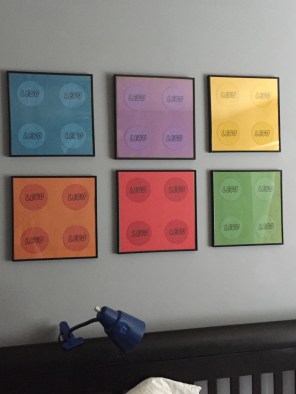
For art, we had many ideas, but only ended up using a few of the ones we started with.  One was pretty basic, and is just paper, made to look like Lego 2x2s, and the other stuff we added is not Lego-related, but is instead kid-made art from my master builder’s work at school.  Made it even more special!
IMG_2407

We used record album frames because they’re cheap and the size shape!  Just paper, with paper glued on top. 🙂

FullSizeRender

Every year our art classes do a project through Art to Remember, and parents can buy all sorts of “stuff” with their kid’s artwork on it.  We have ornaments and magnets and other things, but decided to use the original pieces as room art.  There are two empty ones because he has 4th and 5th grade to go!  (And yes, I realized they are neither perfectly-spaced or entirely-straight, but for now it’s working pretty well!  (That’s the closet wall)

Ok, so that’s all well and good, right, but I know you’re asking “so where’s the Lego organization part?” Well, ok, I promise it’s coming, but first I must sneak in a little bit of info (that you may have already figured out), and that is the fact that my 7YO just turned 9.  (We are a little slow to finish things around here! LOL)

Part of our problem was that the Lego organization was the project that required the most work and planning in order to complete.  We had ideas for adding a window seat with cubbies, that would allow for block storage as well as a place to play.  We did LOADS of research, and finally decided upon buying pre-made shelves that we turned on their sides so they’d fit under the window.  The detail that took me FOREVER to figure out, though, was that there is a vent right in the middle of the floor under the window.  We didn’t want to cover it up, and couldn’t decide how to deal with it.  Somehow, 2 years into it, I figured out that just adding legs to the cubbies would raise them above the vent, as well as making them the right height for the window seat we wanted.  A couple of coats of black paint (to match the other furniture in the room) and voila!  Win/win.  Well except that he waited on it for 2 whole years. 🙂

IMG_2318

Again, though, as we like to find the positive in all things, the two years he has spent collecting and building with Legos actually helped us in completing this project because of the knowledge he’d gained and the opinions he had on how he wanted his Legos organized.

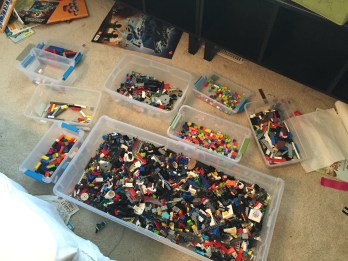
Oh, and those two years also afforded him time to collect thousands and thousands of tiny bricks and so many specialty pieces I can’t even begin to tell you how many there are (most of his Legos come in sets, which contain loads of really specific blocks).  And those thousands of blocks have been living in a giant under-the-bed sweater box like this:

IMG_2326

which meant that our first job was to pull out every. single. piece. and figure out what we were working with.  After that, we could decide what kinds of containers we needed to put them all away again.  This step honestly took two full 8-hr days to complete.  And it was mostly me working on it.  Yep, the kids were there to start us out, but they quickly had much less energy (or excitement??) for it than me.  I was bothered by this for a minute, seeing as it seemed like it was more for me than for my master builder, but I think it was just too big of a job for kids to be able to finish.  They couldn’t exactly see my vision for the end-product anyway, and so this detail-oriented part was ok for me to finish on my own.  The introvert in me kind of likes that sometimes anyway. 🙂
IMG_2325

I spent much of last week surrounded by lots of little boxes and piles of different kinds of Lego bricks.

In the time when I was doing my first round of research for how to organize our blocks, I found many examples of how moms had used IKEA products, and honestly they were all very nice looking.  And probably very expensive.  But, they also didn’t look very user friendly.  Most were organized by color…which I’m pretty sure is not how most kiddos build (or at least not mine….seems more like something a mom would do for herself, not for her kid.  Regardless of how other families did it, though, that method was not going to work for our mounds of Lego bricks). I mentioned that those 2 years gave my builder time to really understand himself and his preferences and this was great as we sorted through them all.  So I started by asking him what he thought we should do, and he agreed that color didn’t make sense, and that instead, we should do it by type or size of block.

After those 2 days of sorting, an afternoon of planning for containers and then shopping (we ended up choosing Sterilite containers that I found for a steal at Big Lots), gave us what we thought ended up looking great and being REALLY user-friendly.  I have been told by my kiddo that it is working really well, and I would agree, since every piece has it’s place now.

And the best part is that there are labels on each box, that art both specific to our Lego pieces and our names for them.  Yep, there’s a box for “slanty” Legos, and one that says “holey” and well as once that just says “special,” which he uses for particular pieces he’s pulled out for a project and isn’t ready to put back in their appropriate box yet.

Oh, wait, and the top has a dual-purpose, too: it’s both for building and for reading.  We added two base plates to the top of the middle (attached with velcro), and I made pillows to cover the whole thing for when they’re not being used from a sheet I already had, and a tutorial I found here.

We are so happy with our final product, and it’s a part of our house that gets used (and cleaned up up!) every day. 🙂

IMG_2374

Design Challenge: Earthquake Proof Buildings

A week or so ago I saw this tweet:

Since we had been studying slow changes and fast changes in Science for a while anyway, it made perfect sense to try it out!  And unfortunately, there had also just been some major earthquakes in both Japan and Ecuador that same weekend, so the idea of creating earthquake proof buildings was a real life one to solve.  And yeah, it would be fun. 🙂

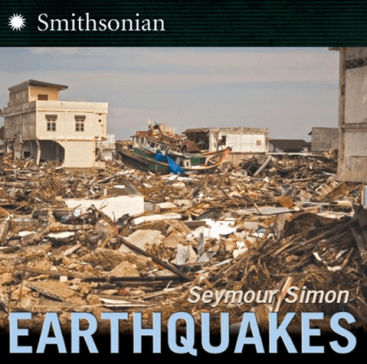
We began by reading a pretty great Seymour Simon book on earthquakes to gain more information, and answer any questions that might come up about how they work.  Knowing exactly what happens helps us build stronger buildings that would withstand the tremors.

Screenshot 2016-05-01 21.37.27

We talked and discussed and made predictions and inferences.  Then we got with our partners and planned–most on paper and some with some help from their iPad.

Then we got busy building.  The 1st building part was actually spread over two days (an afternoon and then the next morning) because we ran out of time.

This slideshow requires JavaScript.

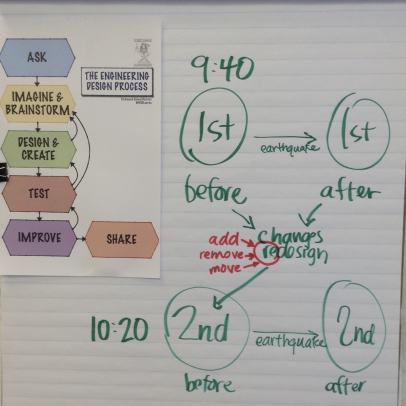
We used this design cycle protocol to help us know what to do, and wrote down the timing so we could keep on track.

IMG_5810-min

Some even tried out their prototype on the earthquake machine before the “real” deal.  They got some ideas about redesign or shoring up their foundations.

Caught some groups in their planning stages:

We took videos of our trials, and many kiddos voiced their ideas for redesign in their recordings.  We all did some writing/thinking about it, but I’ll share those in another post, since after I add our videos, this piece will already take you 7 hours to read it!  Thanks for hanging in there–it’s worth it, I promise!!

Charlie, Evan and Joshua


Ella Marie and Emily


Millie, Amelia, Ja’Mia and Tyrin


Makayla and Ava


Amber, Sara and Thomas


Peyton, Baron and Landen

Forces that Shape the Earth: Slow and Fast Changes

I shared some building challenges we had done a couple of weeks ago, where we solidified our understanding of both bodies of water and landforms.   We still had some thinking to do, as well as demonstrating that we understood the difference between slow changes and fast changes that happen on Earth.  Besides using things like Legos, big blocks, pattern blocks, and other things to build with, we often incorporate art into our science and social studies work and represent ideas with pictures.  This was one of those times.  It was a mural/collage project, much like these that have happened in 5th grade (with both regular units as well as with test preparation).

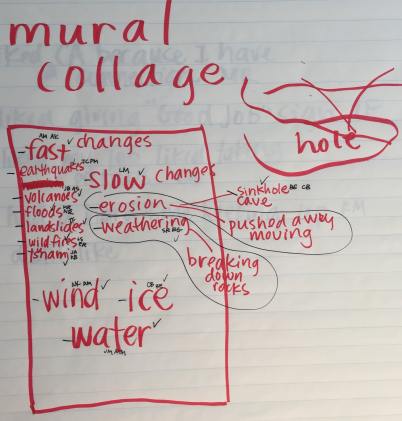
Our first step was to jot down what we remembered about slow and fast changes we’d already learned about.  We made this chart together:

FullSizeRender 147-min

We brainstormed what we knew about the difference between slow/fast, as well as examples of each, and the causes for these effects on the land: wind, water and ice.  Their directions were then to create a representation (2D with paper and other art supplies) that everyone could recognize and explain when they looked at the poster.  No words (except for the two parts of EROSION and WEATHERING since these were important vocabulary terms) were allowed.

While kiddos worked, they went through the design cycle as they planned, created, tested (by sharing their representation with another group or two to see if others could recognize the concept they were trying to display), redesigned and then shared by putting their creation on our poster.  This mural did a couple of things for Rm. 202 learners–helped them solidify understanding of concepts, demonstrate that understanding, as well as remind them of that learning as they connect the picture to the idea in their heads.  I plan on using the images on this poster as a part of our assessment at the end of the unit (I just haven’t fleshed out exactly what that will look like yet…still in the design phases!).

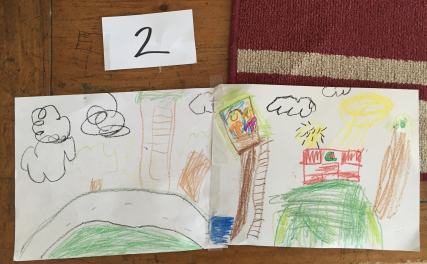
Here are the images on our mural.  Can you tell what each of them represent?

FullSizeRender 139-min

Each one up close.  Half are slow changes and half are fast changes.  Oh, and there is one image that we thought was an example of both:

I was really impressed with the diligence portrayed while they worked on this project.  There were a couple of pairs who had to go through 2 or 3 versions of their creation before they figured out one that made sense to someone but themselves.  There was lots of cooperation and suggestion that happened during our work session, too, as kiddos bounced ideas off each other, shared supplies and asked other pairs for help.  Another example of an engaging, motivating and focused way to practice science without pencil/paper or just reading about it.  Way to go, Rm. 202 scientists!

If you want, leave us a comment about what you think our pictures are images of.  We’d love to share our learning with you.  What questions do you have?  We’re becoming experts on these ideas of forces that shape the land! 🙂

Mystery Skype–April 14 (#3)

We’re on #3 Skypes in about 2 weeks!  YEHAA!!  Today was the 2nd in two days!

Like last time, we had jobs, but at the end of the last session we decided to trade.  Unlike last time, our camera worked, though (did I mention that?  They were Skyping with a blank screen the whole time! 😦 ).

By the way, this post has made me think it might be a good idea to start a new page just devoted to Mystery Skypes.  Would make it easier for us (and everyone else!) to find the archives when we need them.

This was another great session, and at the end I’ll share what we know now that we didn’t know just three short sessions ago. 🙂

Screenshot 2016-04-18 21.14.57

Screenshot 2016-04-18 21.15.23

This slideshow requires JavaScript.

The debrief this time was a question about how much more they know now than they did just a couple of short days ago.  Here where their responses when I asked “What do you know now?”

  • “I am a better greeter because I’ve practiced three times. I don’t need my dos/don’ts sheet anymore!” JH
  • “Now I can visualize a map in my head when they ask a question.” KB
  • “My job was easier today [than yesterday] because I wrote shorter words.” EM
  • “I think doing a job more than once makes it easier.” AM
  • “I know more about maps.” PM
  • “I know more about what to do as task manager.  I can just sit and watch what’s going on [and give reminders when they need them] instead of walking around.” AK
  • “I know where to stand and use better angles to take better pictures.” CB
  • “I am better at Twitter.  I did it almost alone!” JM

What great thinking, Rm. 202 friends!  As always, you amaze me with your reflection and insight. 🙂  Keep it up–excited to see what happens as you keep going with Mystery Skypes!

Mystery Skype–April 13 (#2)

Remember our Mystery Skype last week?  Well after that AMAZING experience, the first things that came out of my kiddos’ mouths were “When are we doing this again?”  That meant that I had to get busy because I needed to schedule another one for them! I tweeted out a request and quickly I got many requests.  One of them was today.  Here’s the story. 🙂

We are all about learning in Rm. 2o2 and so the first thing we did was reflect on the experience from last week and talk about what had happened.  I showed them the blog post I had written and asked them to think about what they saw.  We analyzed the photos and talked about what we would do the same and what we would change.  Some noticed that there were not pictures of everyone, and we agreed that the next photographers would make sure to get images of each job that we had on our list.

Next I showed them the video from our first try.  We did the same analysis and noticed somethings we could change.  Many of the “issues” just came from the fact that this was the first try at something like this for our videographer.  We talked about some technical things like shooting at people’s faces (and not their legs and feet), not moving the camera too fast (because it makes the watcher d-i-z-z-y!), not talking over the recording  and making sure–just like the photographer–to get the WHOLE room in the video.  We made sure everyone knew that we were only working on how to make our next try even better, not saying that anybody did anything wrong.

It was time to pick jobs and so we sat down to decide what each person would do.  After our debrief from last time, we had decided to add in Tweeters (check out the AMAZING job Mrs. Sisul, Ja’Mia and Makayla did today!) and Closers, so that made just two people doing each job.  Rather than the chart we made the first time around, I thought I’d try to start digitizing some things, so I made our job list in a Google Doc like Mr. Solarz’s example.   I just made a doc that we can add pages to for each MS (at least that’s my plan for now) so we can keep track of who’s done what during each session.

Screenshot 2016-04-13 19.58.54

I hope to start using a Google Doc for questions next time, too.  For today we hand wrote them and I entered it into the table:

Screenshot 2016-04-13 21.12.45

We had to go to PE right after this, but before we left, we agreed we should get everything set up, since we only had 10 minutes from when we got back until we got started.  I was SUPER pleased that this was what I saw them do:

The Data Enterers had their area ready, the maps for the Researchers were laid out, the chairs for the Questioners, Greeters and Closers were in place and the Photographers and Videographers had their iPads raring to go!  Isn’t it amazing what 7-8YOs can do when they are motivated and have a purpose? LOVE!

Here are the photos we collected from our session today:

This slideshow requires JavaScript.

And the video.  Don’t worry–this one’s a bit shorter than the one from last time.  And you should get sick and dizzy either.  At least I hope not. 🙂

Then, when we were finished we sat down to debrief.  We said many of the same positive comments as last time, but I noticed many kiddos were a little unhappy about their jobs this time around.  Well, some of them were.  When we went through the assigning of jobs, obviously some kiddos got the one they wanted, and the others didn’t.  We talked about what to do about it, and we were divided about how to fix the problem.  We suggested that we could stay with our original jobs, since we felt that we had done a great job of finding the right person for each one (which we had agreed upon after we finished the first time around).  Not surprisingly, not everyone liked this idea.  We also considered just staying with the new ones we made today, since we didn’t really have time to reassign before our next scheduled Skype tomorrow morning.  Again, not everyone agreed this was the best.  Then, someone quietly suggested that we could trade.  He said, “What if I want a new job and so does someone else. Can we trade jobs?  That might work.”  BINGO!  Everyone loved this idea and so we quickly had the “traders” meet on the rug and most got a satisfying trade out of the deal and walked away happy.  Unfortunately, since there was an odd number, one person did have to stay with a job they don’t really like, but I’m sure it will all work out and next time she’ll be able to try something new.  Oh, and I had forgotten until now, but I would be remiss if I didn’t mention that one of the reasons someone gave for trying new jobs every time was “I like to make mistakes so I can learn something.  That happens when you try new things.”  HA!  Pretty amazing, right?

And you know, as fun as this is, and as much as it reinforces geography and inquiry and does loads for engagement and motivation, I just love watching what happens when you get out of the way, let kids do their thing and they run the show in ways that are far beyond what you’d think the realm of 2nd graders would be.  But then again, I continue to see it over and over, so I should stop being so surprised, right? 🙂

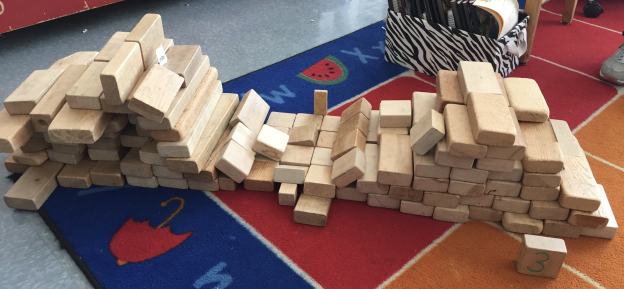
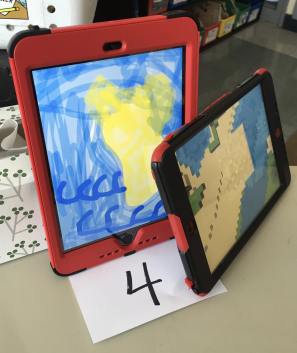
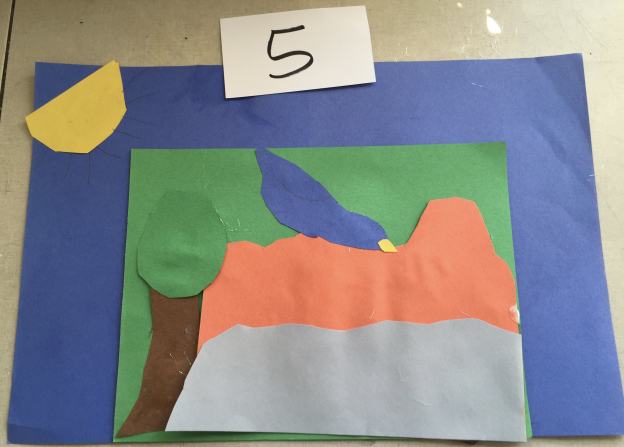
Design Challenge: Landforms

Last week we tried a challenge in Science where kiddos had to create a representation of a body of water.  Since then, I’ve heard multiple times “When are we doing this again?”  Then, when my friend, Mona, asked me if I was planning on doing the same thing with landforms I knew we just had to!

I didn’t want to make the situation exactly the same, however, so I thought of ways I could change the parameters to up the level of the challenge.  Last time, students chose their own group, as well as the materials they used to build.  It was great that somehow everyone chose something different and there was no arguing about who used what.  That doesn’t happen a lot in our room, but I was super glad it didn’t come up here.  So this time I again let them choose who they worked with (which because of numbers was groups or 2 or 3), but there as more chance in both their landform AND their building material.  I wrote the choices on index cards (very high tech, I know) and put them in two cans.  Each group chose one from each container.

I was impressed with how easily kiddos accepted both of the cards without complaining.  Again, not much of that happens with Rm. 202 friends, but I was pleased with how quickly they got to work planning their next moves.  After about 3-4 minutes, most were ready.  There was only one pair who did fuss a teeny bit about how they’d be done really fast and how their cards were not a challenge.  We talked about how that meant that they needed to figure a way to challenge themselves, ask themselves “What could we do differently than we had originally planned?”

Much like last time, they had 25 minutes to work on their representations and then we’d do a gallery walk to see if we could guess what everyone had created.  They were to work for the entire time and had to use their assigned medium, but other than that there weren’t too many rules.

Ok, here’s your chance to see if you can figure out our landform creations, and then I’ll give you the answers.

IMG_1219-min

IMG_1220-min

IMG_1221-min

IMG_1226-min

IMG_1223-min

IMG_1224-min

IMG_1225-min

What do you think? Did you guess them?  Here are the answers:

  1. plains
  2. hills
  3. valley
  4. barrier islands
  5. canyon
  6. plateau
  7. mountains

We love how building challenges work for learners in Rm. 202, and we want to know how they work for you.  Any stories to tell us?  What suggestions do you have for future design challenges we could try?


I Saw Pacifique! Pacifique is HERE!

Remember last fall when we were able to host some amazing Rwandans in our school? Well, since he is now forever connected to our Robinson family (and some teachers in our school, too), he comes back now and then to visit.  When he was here at the beginning of March, we joined Mrs. Appelbaum’s class next door to learn more about his Rwandan culture (since were in a culture study of our own at that time!).

He answered our questions, and even sang and danced a little for us.  What a great visit with an old friend!  He really is a celebrity around our school now. 🙂