Math Warm-Ups Oct. 8-12, 2012

This week we were working with volume and surface area, so our warm-ups had to do with those topics.

Monday
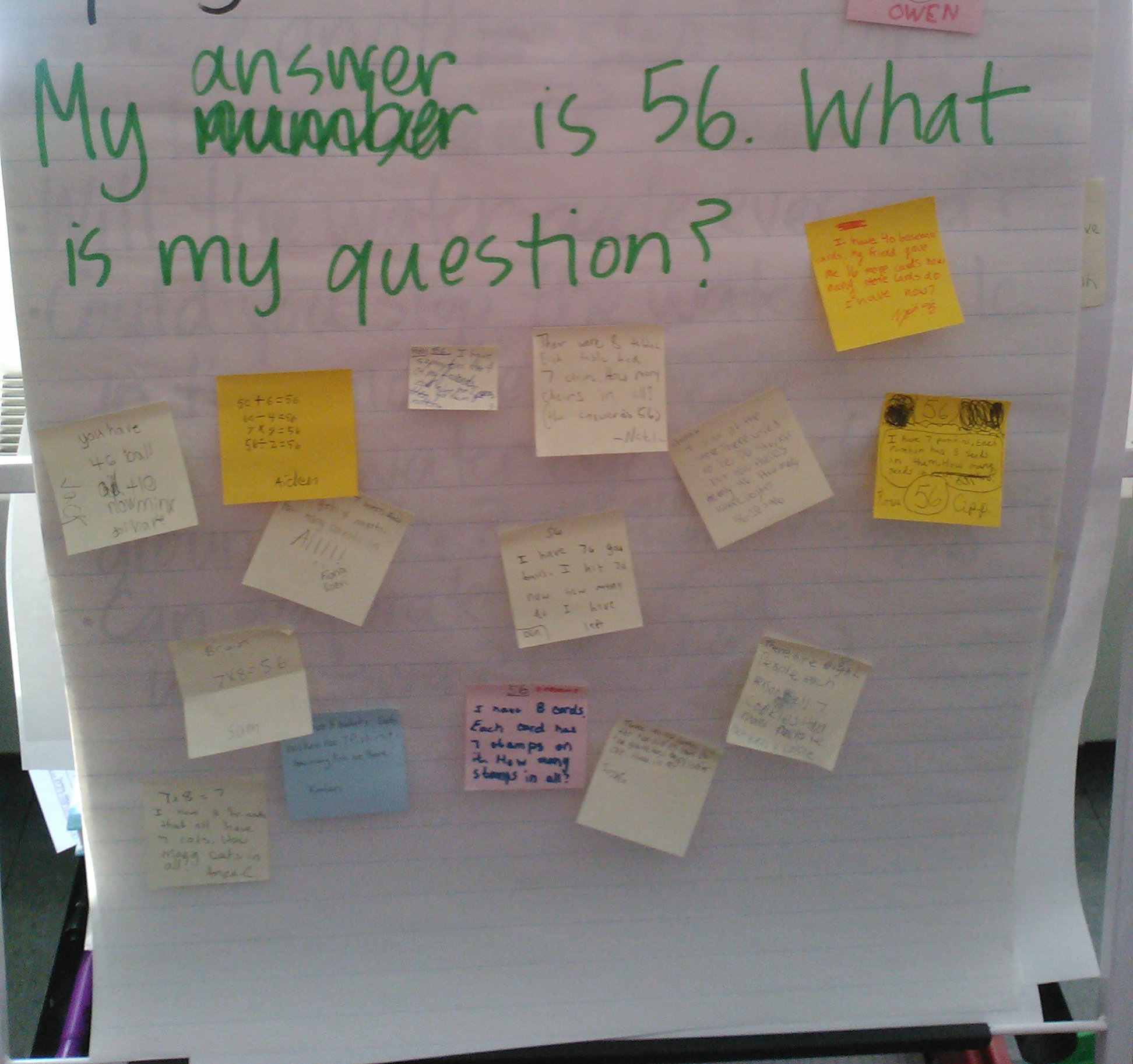
 

Tuesday
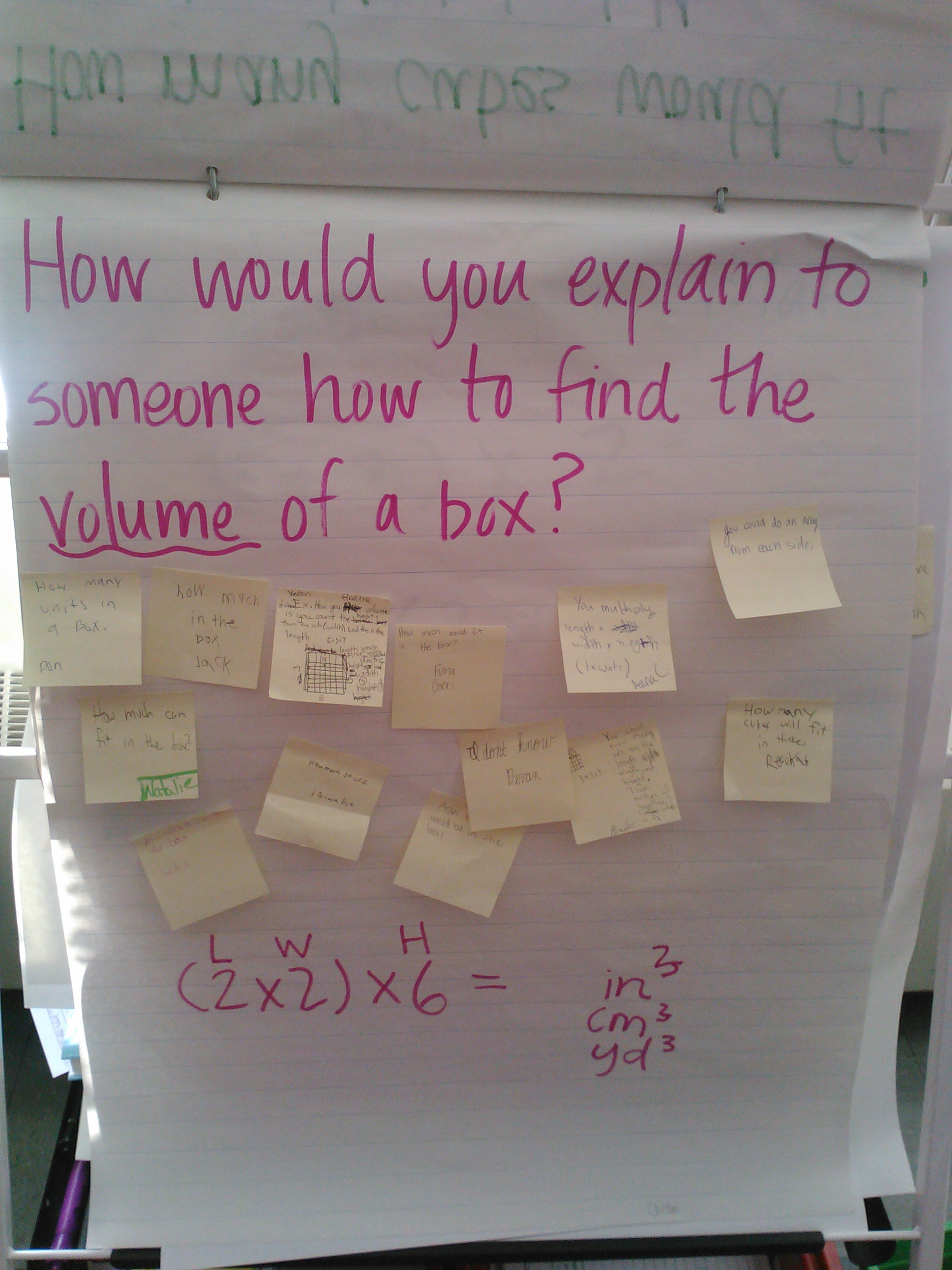
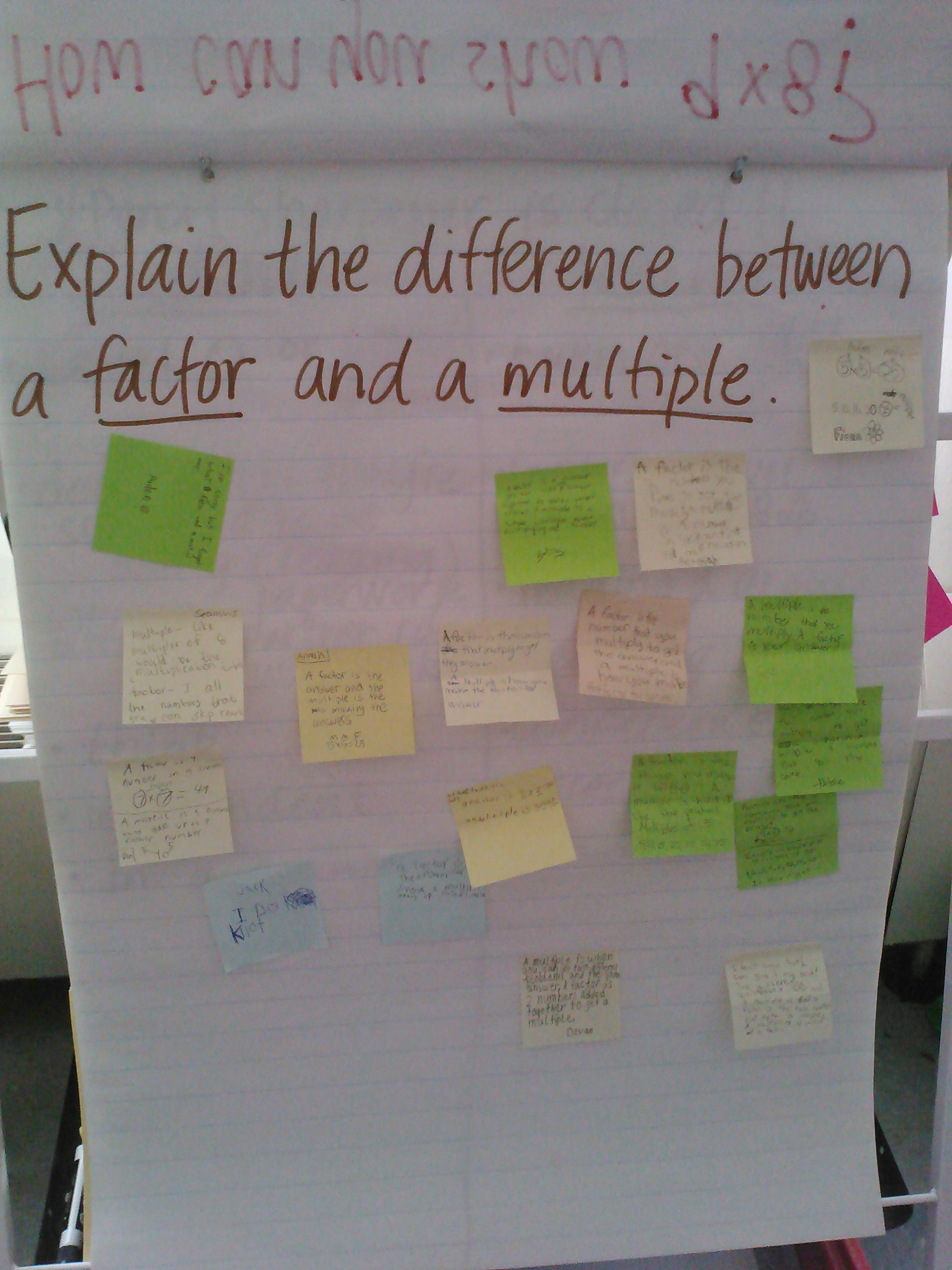
This one was interesting.  I asked it purposely because of the work we had been doing with The Box Factory investigation  for the last week–which is all about how to build boxes that hold 24 objects–and was about volume.  We hadn’t named it as volume yet, though, and I wanted to see how many people would make that connection.  Many of them did not.  I saw many “thinking faces” as they struggled with how to answer this one.  I heard someone say, “I don’t remember what volume is…” and then several people answered with what it was, but didn’t tell how you’d find it.  We had a great conversation about this one, and I heard lots of “oh!” when I told them that they’d been working with volume for a whole week.


Wednesday

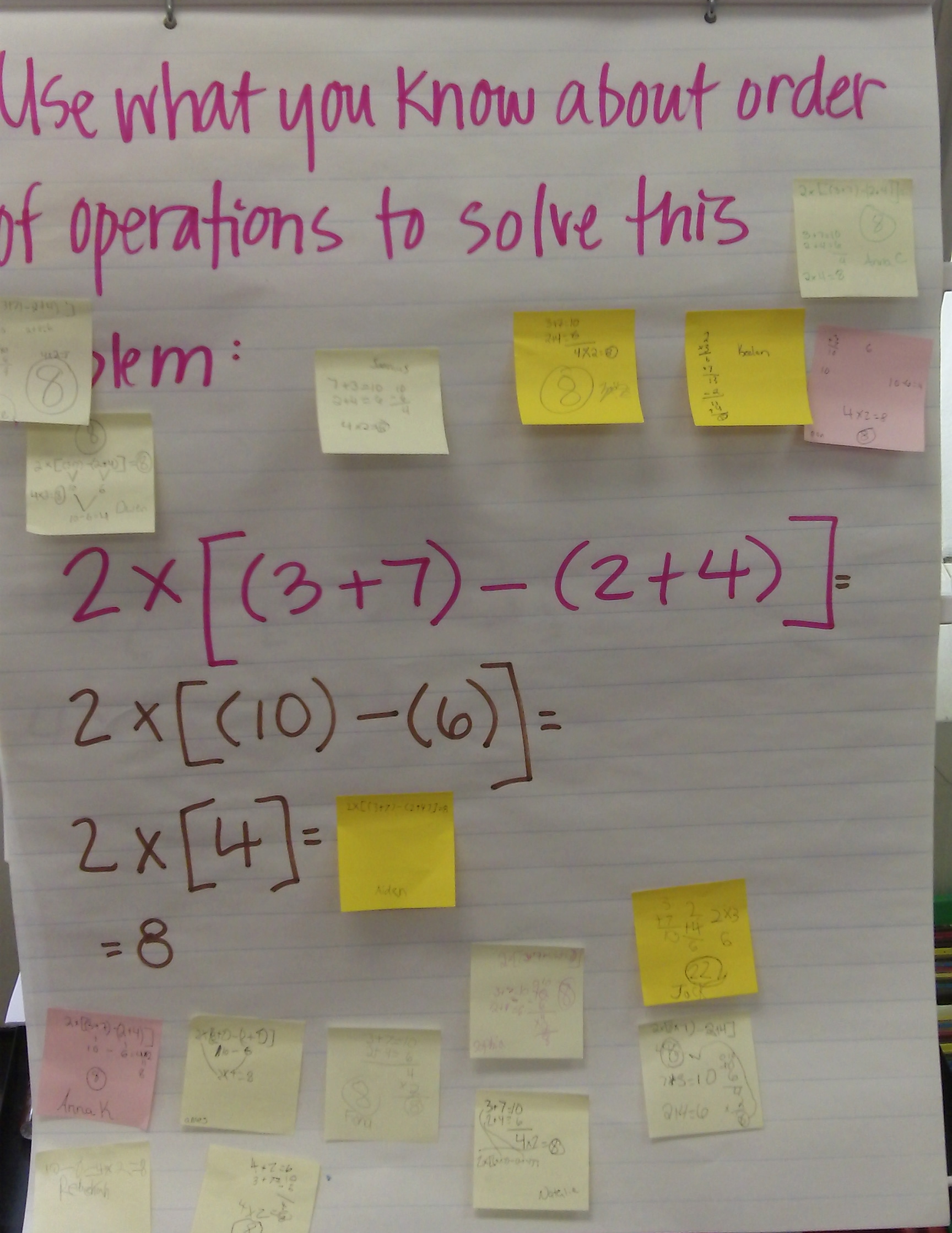
This one was again related to the work we’d been doing during Math Workshop.  They are used to seeing this kind of equation, since we’d spent a couple of weeks on order of operations recently, and we had been using this kind of equation in our volume work–the parentheses told the equation for the bottom of the box, and the last number told how many layers there were.  But I wanted to see if they could explain the formula for finding volume, and tell how they multiplied length x width x height.  They don’t need to know this yet, but I thought they were ready for it, so I threw it at them.  And many–probably most really–figured it out.  We brought the rest of them along through the conversation we had around it.


Thursday

There was not a math warm-up on Thursday because we needed those ten minutes to work on our volume projects.


Friday

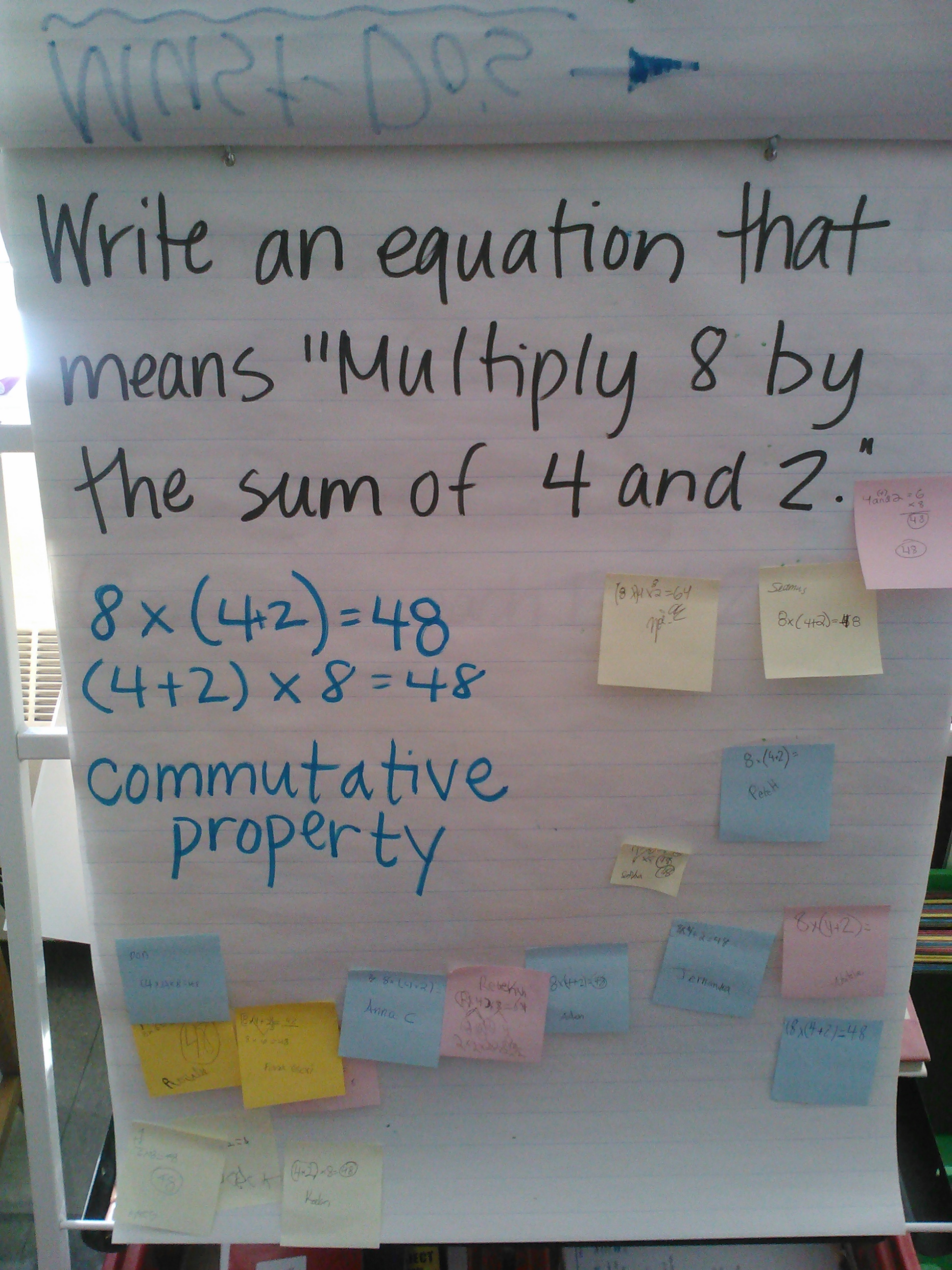
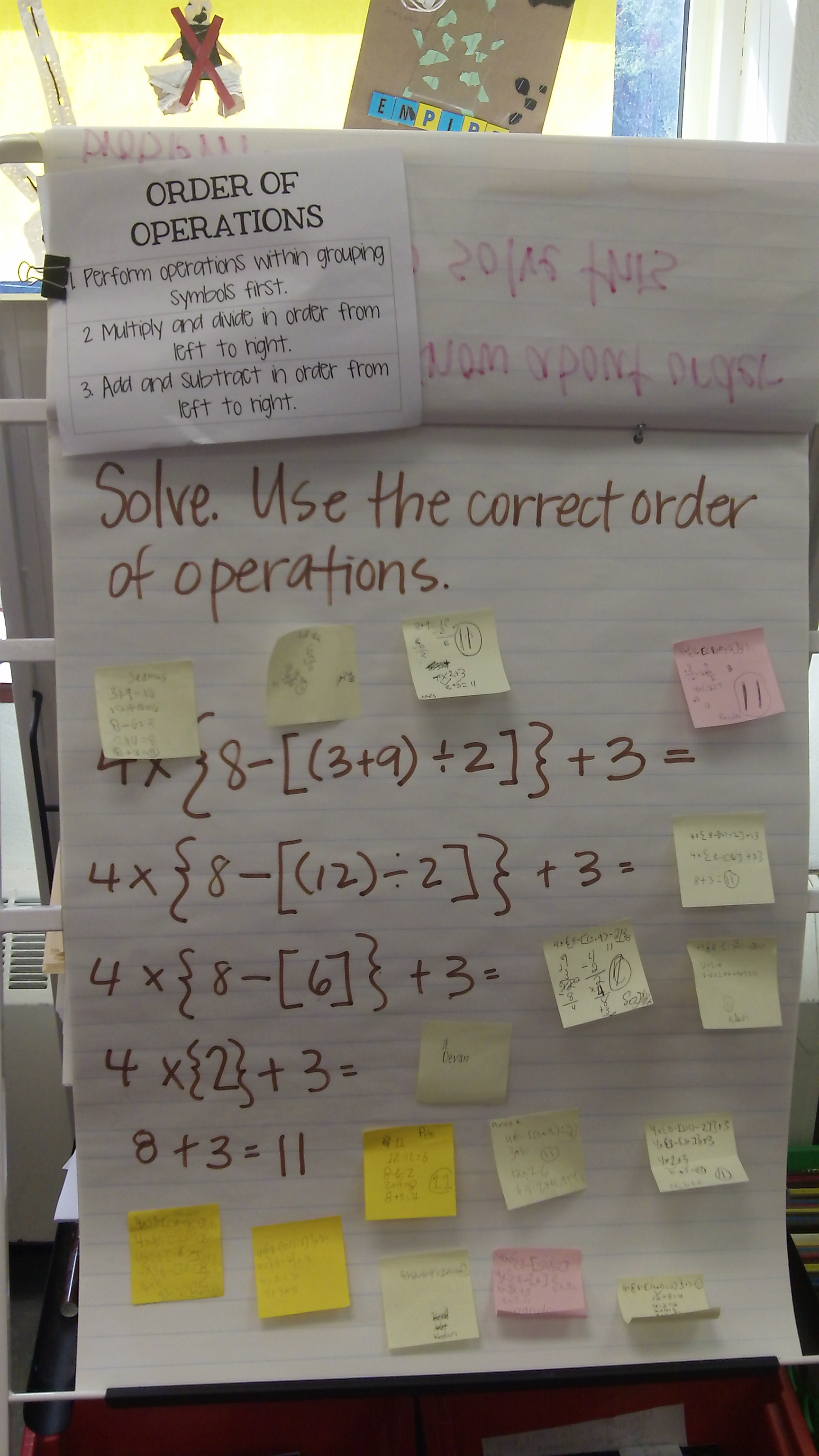
The dimensions on this warm-up were from three boxes we’d been working with this week.  We’d talked several times about how this was really the same box, turned two different ways to make a new base, so with different dimensions.  We’d already talked about the Commutative Property in warm-ups, and so I wanted to see if anyone knew about how this illustrated the Associative Property. Again, a great conversation and many connections were made as we talked.  Have I said before how much I LOVE these warm-ups?  So many great things happen in just a quick discussion.  Love it!

Happy solving!  What do you know about volume and surface area?  What can you teach us? 🙂

Math Warm-Ups Sept. 17-21, 2012

I think I said it in my last post, but golly–being sick is hard!  Someone around my house has had a cough for at least a month now, and I’ve had one for at least 2 weeks!  Hence my absence from blog-world for that long.  All I could stand to do was fall into my bed and sleep when I got home.  Luckily, though, I’ve been to the doctor and gotten some medicine and am on the mend.  So here I am. 🙂

The horrible thing about not writing for two weeks is that I have a million and one things to post about that have happened, but I’m not really sure how and when I will get them all done–because new things keep getting added everyday!  So I guess I’ll start here and see where it takes me.

Last week we were working on division in math, but then added in some practice (an introduction really) with order of operations.  Here’s what our warm-ups looked like:

Monday

Tuesday

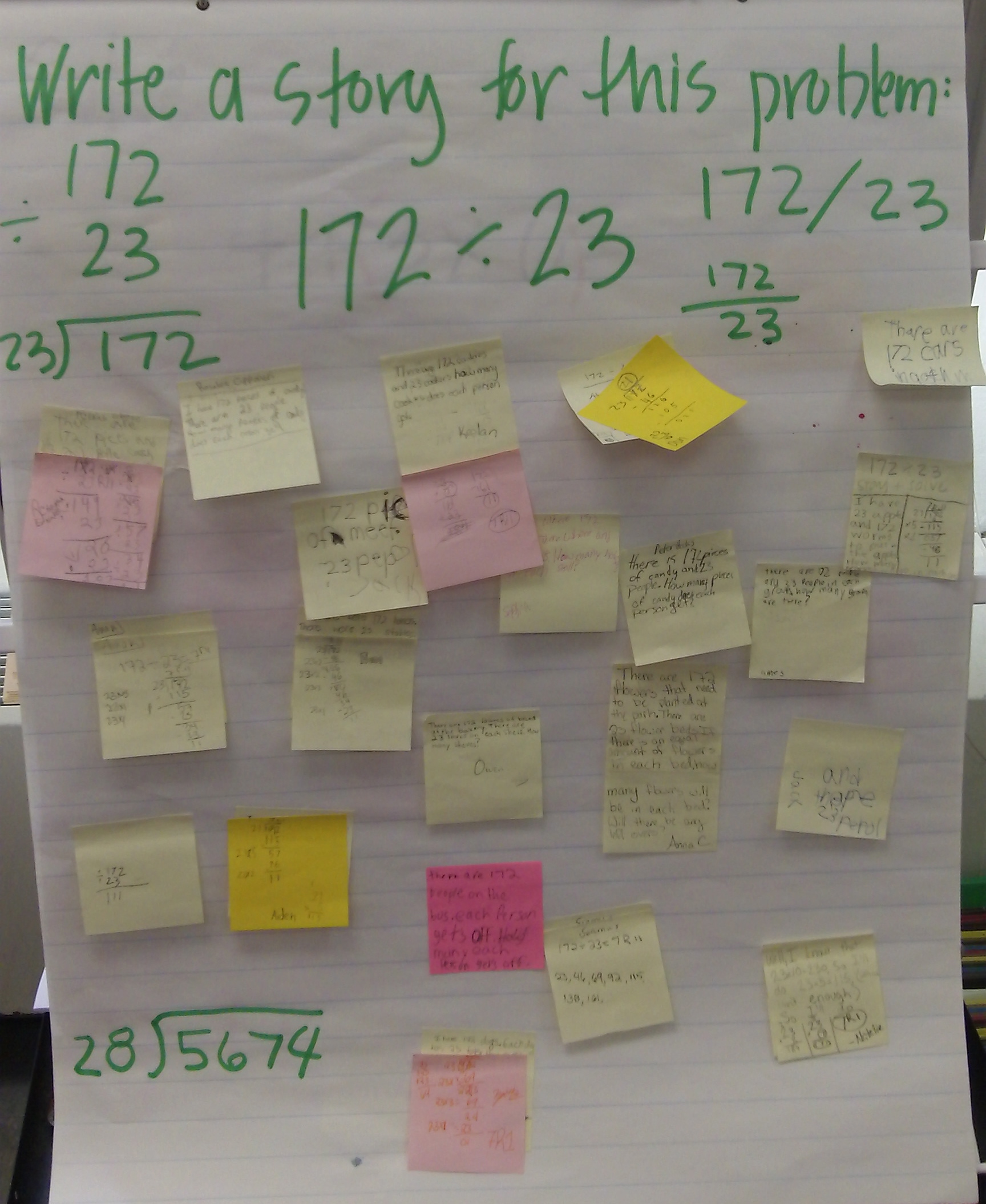
I was gone and so don’t have a pic of this one, but they solved the problem that they wrote the story for on Monday, using an efficient strategy.

Wednesday

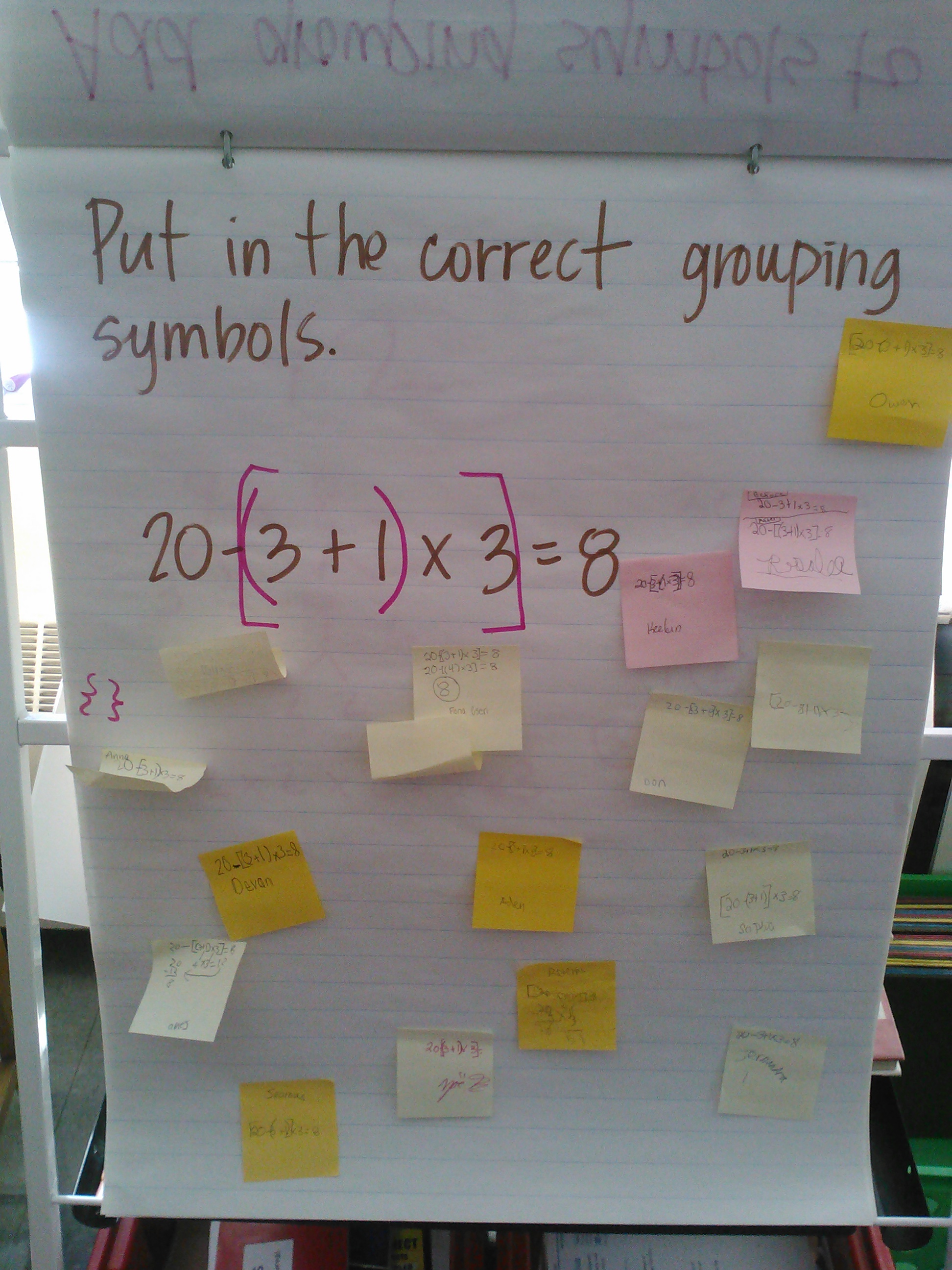
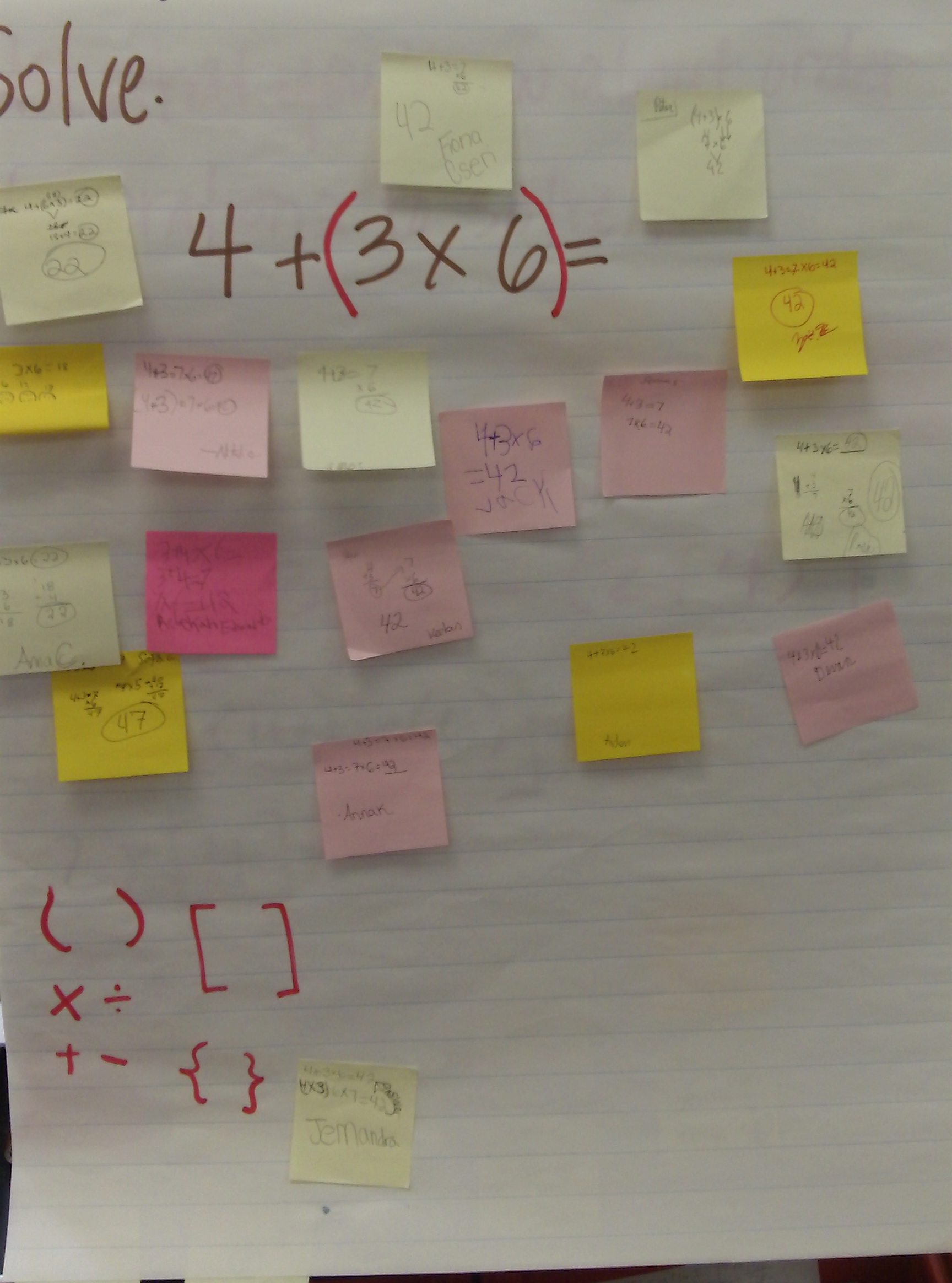
When we started, the red parentheses were not there, and so many were not sure which part to do first.  This was the introduction to using order of operations.

Thursday

The original problem is what’s written in pink, and the brown is our work after we talked about how to tackle it.

Friday

I love how complicated this one is!  This one tricked many friends, but we’re getting a hang of it now that we’ve done it several days in a row.  This was a brand new concept to most mathematicians in my room.

How did you answer our math warm ups?  What can you tell us about using Order of Operations to solve problems?  Any advice you can give us?  Thanks for leaving your comments to help continue our learning. 🙂


Math Warm-Ups Sept 4-7, 2012

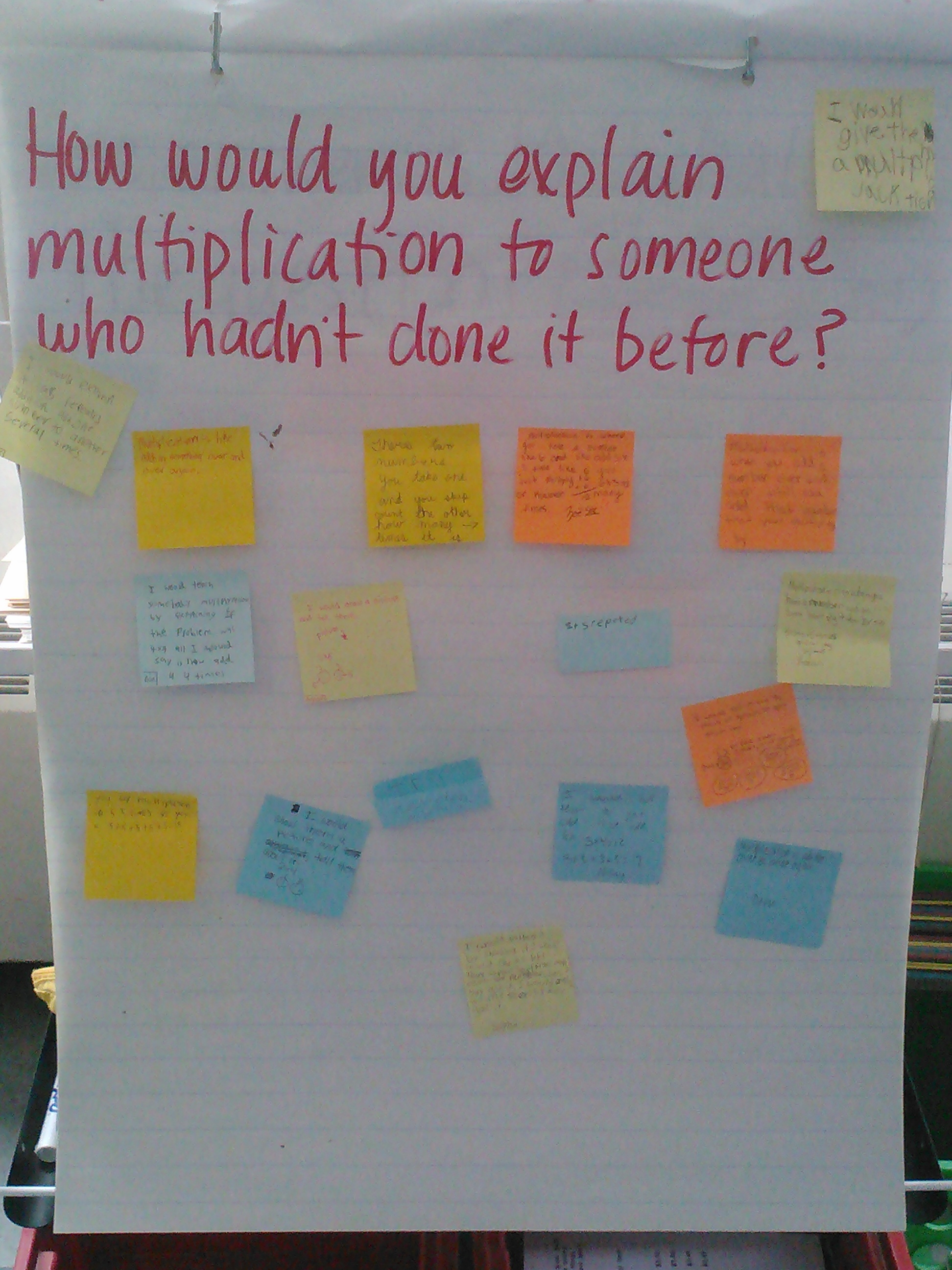
So after I posted about our Morning Math Warmups last week, I figured I would start doing that every week.  It will be great to see all of them once we’re finished this year.  We would really appreciate it if you followed along with our learning this year, and even comment with your own answers.  We could learn from you!

Since Monday was Labor Day, there are only four this week:


How would you answer these?  What warmups would you use for factors and multiples? Leave us a comment!

Morning Math Warmups

This being the second week of school, we got a little closer to following our regular daily schedule.  In Math, that meant that we practiced the components of Guided Math.  One of those components is our Morning Math Warm-ups.

Each day when they come in, there will be a question on the easel to get their brains warmed up.  Generally they will be math-related, but sometimes not obviously so–not just “solve this equation” type questions.  These were the warm-ups for the week:


How would you answer these questions?  If you’re a parent: talk to your mathematician about how they answered them.  If you’re a teacher: how do you use warm-ups in your classroom?  Tell us about it! 🙂

Skype!

Remember how I told you about how lucky we were to be able to Adopt-a-Pilot?

Well, since that first visit, he’s come back two other times, teaching us all sorts of awesome things about geography and flight, as well as life-lessons related to doing our best and working to achieve our goals.

During this second-to-last visit with Mr. Smith, we got to Skype with him while he was out-of-town!  We got to guess “Where in the USA was Mr. Smith?” using clues he gave us.  We used our big map to mark where we thought he might be:

Molli guessed on the FIRST CLUE that it was Birmingham!  Way to go, kiddo!

Check out a clip of our Skype session:

This was only the second time I’d ever Skype’d (and the first was the end of Adopt-a-Pilot last year!), and it was so great!  I know lots of teachers use it in really creative ways in their classrooms for mystery read-alouds, conversations with authors and for class-to-class chats.  I can’t wait to see what else is out there that I might try next year!

How do you use Skype? I’d love to hear about it! 🙂

We’re Adopting!

Hey–now that I have your attention, let me take a minute to tell you all about something new and great that started in our room today:


We are now officially a part of Southwest Airline’s Adopt-a-Pilot program!  Marcus Smith, a pilot and a 5th grade parent, came to visit us for the first time today.  Over the next few weeks, he is going to work with us, both in person and via Skype as we learn about all sorts of topics related to math, science, and communication arts.

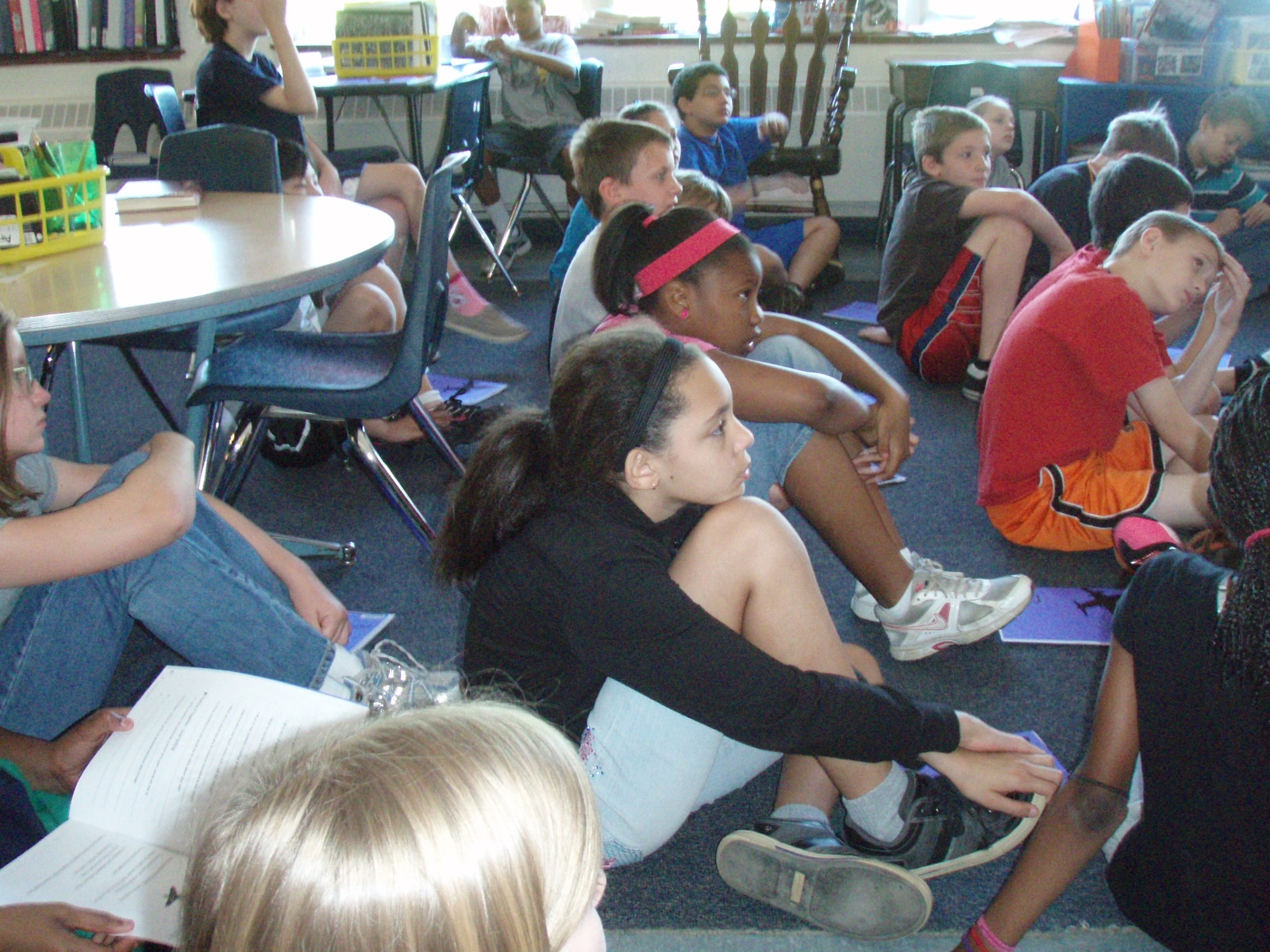
The purpose of today’s visit was really just for us to meet him and build a foundation for the program.  First up, meet Mr. Smith:


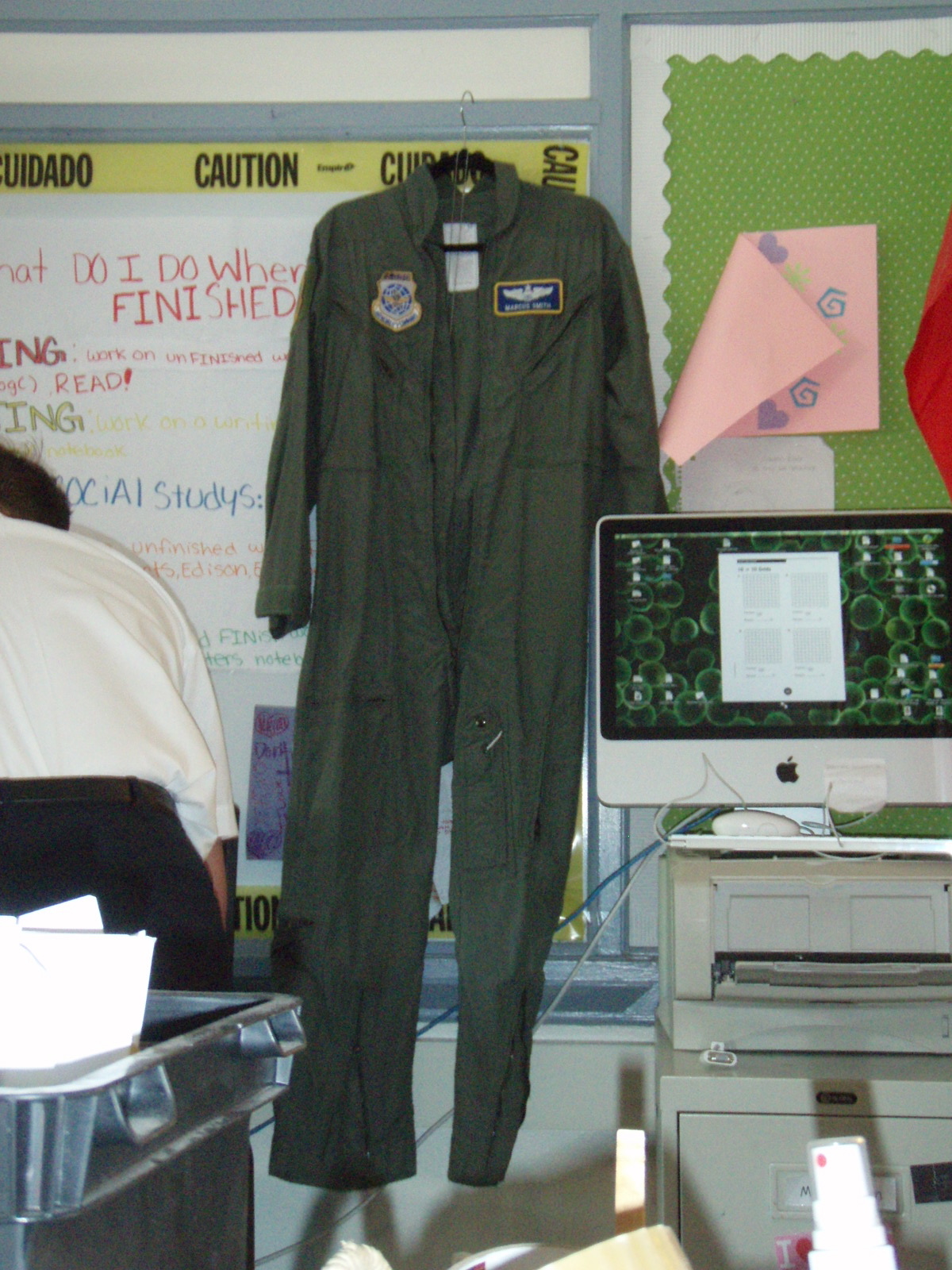
He told us about his journey to his current job, and we found out about how he had wanted to fly since he was in high school.  He told us about his time in the military, and even showed us some uniforms he’s worn in his past “lives.”

After the introduction, he asked us a question: “What do you want to be when you grow up?”  We went around the room and told our names and the answer to that question.  I heard answers ranging from teacher and veterinarian to dermatologist and architect.  Stay tuned this week for more on this topic–I hope to share videos or blog posts later!

Throughout the rest of the lesson, we watched a video or two about flight (he was a pilot, after all!) and talked about goal setting.  He shared a great acronym with us to remember as we work toward those goals.  It’s based on the word FLIGHT (which makes sense, right?):

As we go through this program (and beyond that, I hope), we’ll keep coming back to these qualities.


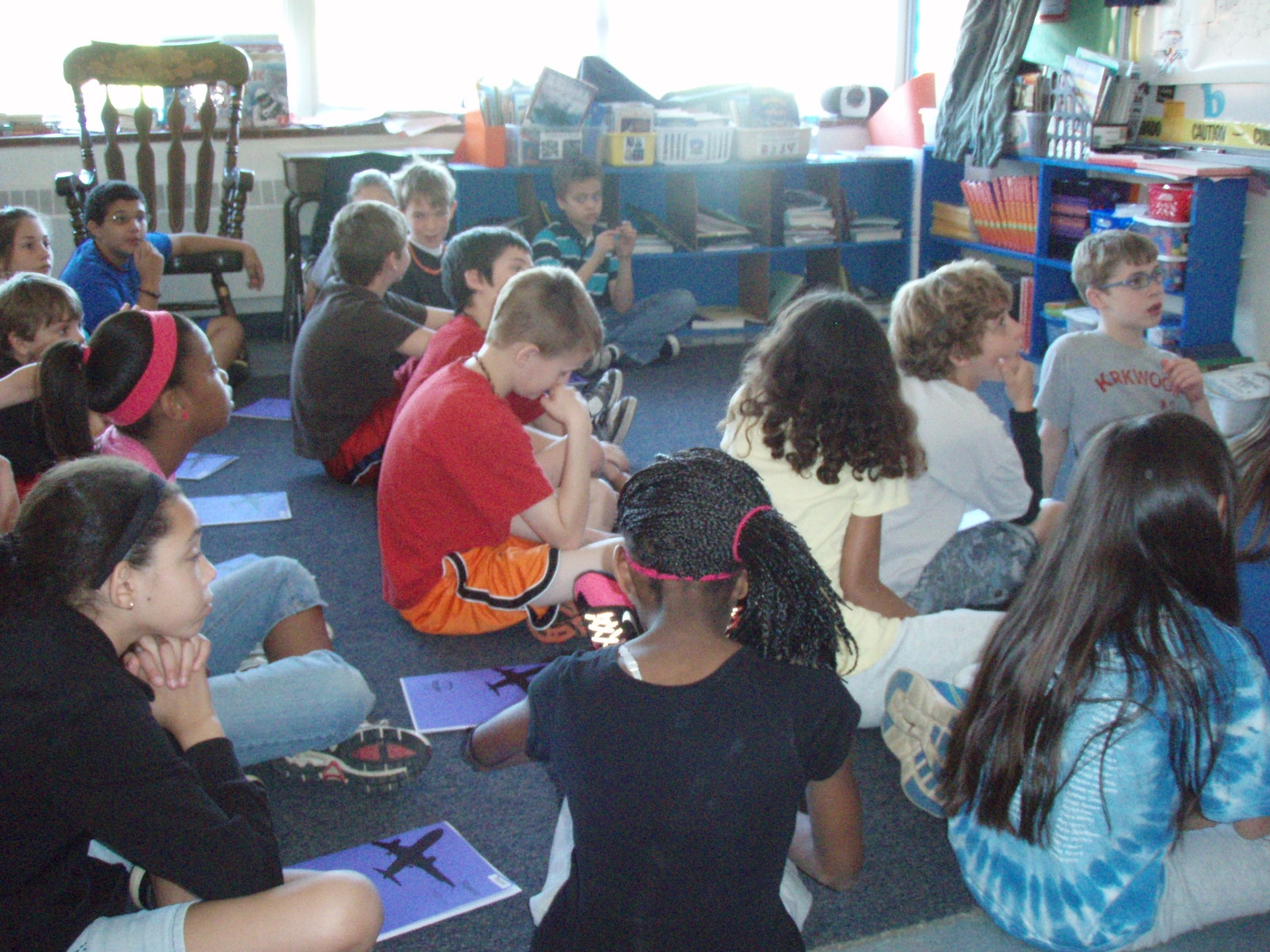
We really enjoyed today and are looking forward to next week when he comes back to teach us more!  A few more pics before I’m done:

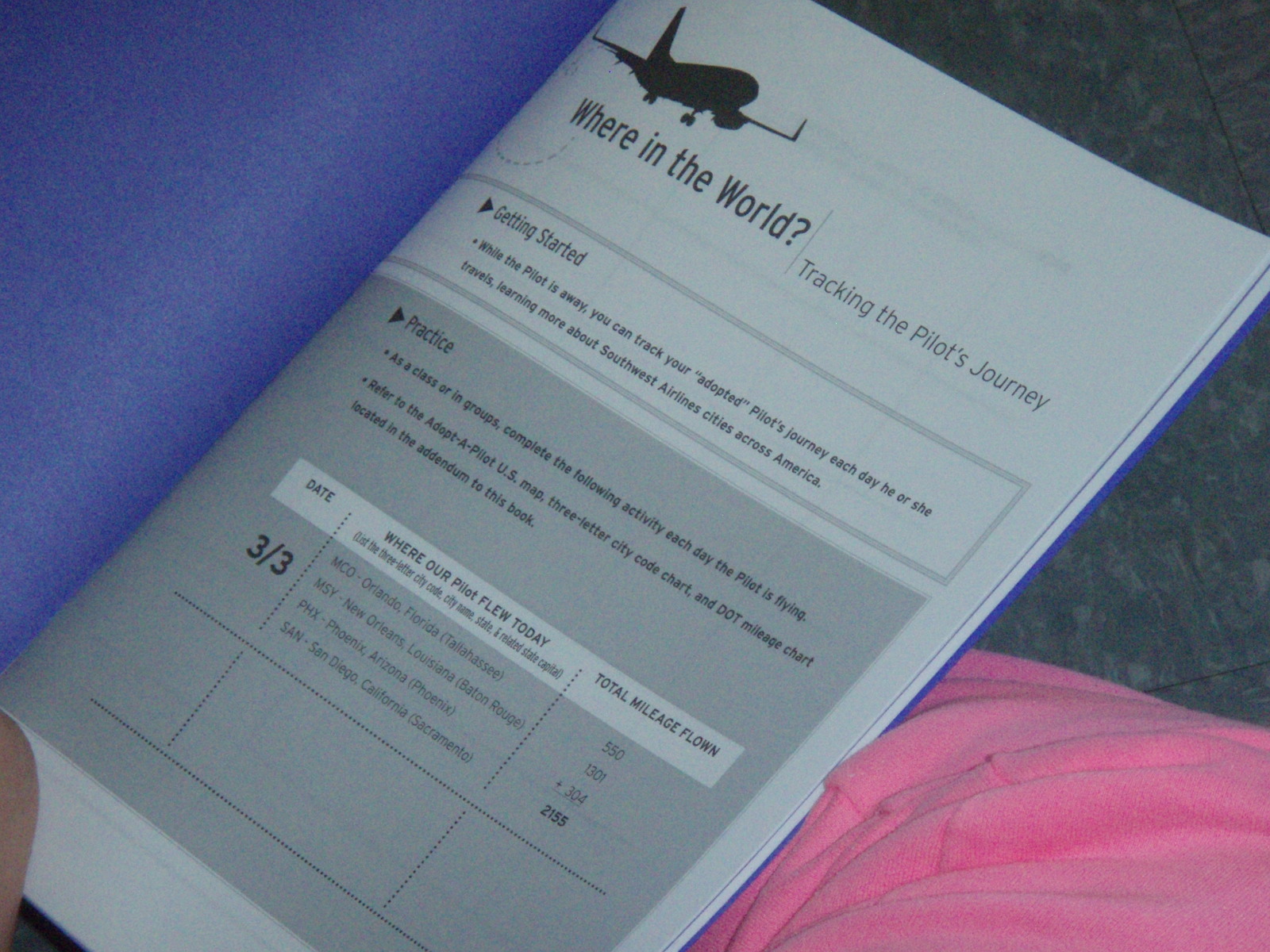
One of the things we’ll do each week in between visits is figure out how many miles he’s flying.  We’re hoping to find out if he can fly the equivalent of the distance around the world before we’re done with our program–that’s almost 25,000 miles!

We’re excited to see what’s to come! 🙂

Meet S.H.A.D.O.

I really hate it when I have an idea for a post and then time gets away from me.  Eventually I find the time (or I remember the post that I had forgotten to write!) and it happens.  Eventually.  Today is one of those posts.

We actually met S.H.A.D.O. weeks ago.  She is now our good friend.  And boy is she helpful!

Who’s S.H.A.D.O., you ask?  And why is her name spelled like that?  Let me tell you all about it.

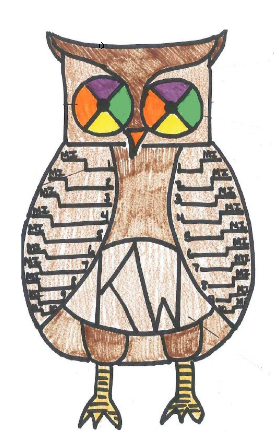
This is S.H.A.D.O.:

And she is one smart cookie.  No wait–she’s an owl.  Ok, so she is one wise owl.

Her name stands for:

And while I would love to take credit for creating her, I can’t.  I found her when I was on www.prometheanplanet.com, which is a support site for the interactive whiteboard we use at school.  The flipchart she came from (and that we now reference frequently in our classroom!) was submitted by Melissa McGahan.  So, like many great ideas that I use in my classroom, I did not think it up, I just figured out the right time and place to use it!

Ok, back to S.H.A.D.O.  She has been helping us during the recent weeks as we prepare for MAP testing (which I talked about related to science the other day here ).  She helps us remember that there are some basic strategies that good test-takers use when they tackle a test (whether it’s a state test or just a plain ‘ol end-of-unit test) to help make sense of it.  There are different parts of her body that remind us of these strategies.

Here’s what they are:

I have been amazed at how this representation–in picture form–has been so helpful to so many of my students.  While I have always taught these strategies, I’ve always done it with words, not images.  We have always created a list of “smart” things to do, then had that list displayed in a variety of places around our classroom.  Just like in the past, S.H.A.D.O. is now displayed all around our room, as a reminder when you look at her to do what she suggests.  (As a side note, I love how the other day someone wrote a blog post about how they love S.H.A.D.O., but she’s a little creepy because she’s always watching us with those big eyes of hers!  HA!  The minds of 5th graders kill me sometimes!).  It’s simple, really, and I don’t know why I didn’t think of using a picture before–I’m a very visual learner myself, so it’s something that would have helped me, too!

So since we’ve become introduced to S.H.A.D.O., we’ve tried out her strategies on various assessments we’ve done in our classroom.  Is she helpful to everyone? No.  Does everyone need her reminders? No.  Do we always go through all of the steps she suggests?  No.  Just like every strategy I share with my students, they have learned which steps at what time with which assignment she is helpful.  That’s the key actually–know how to use the tools at your disposal.  So she’s there in our toolboxes if and when we need her.

And as a side note, I believe that S.H.A.D.O. was originally created to help with reading/communication arts tests, but we’ve found that you can apply most of her strategies to other subjects as well.  The other day we tried them with a math test and they were perfect.  Nice how that works out.

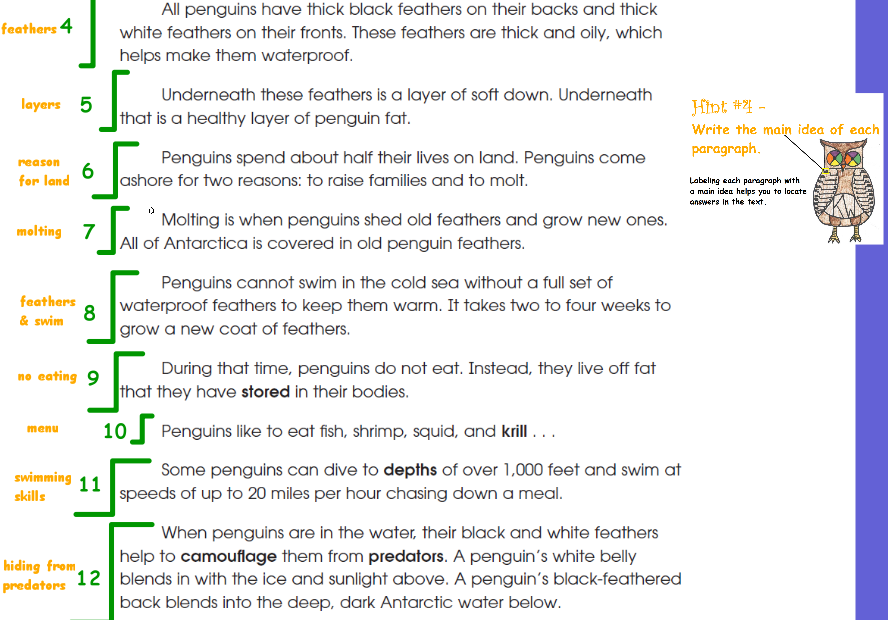
If you are a teacher, and you got through this post and you’re still thinking “Great idea, but I already do other things to prepare my kids,” I ask that you focus in on a part of S.H.A.D.O.’s suggestions that maybe you don’t specifically do.  For me, it was the steps related to bracketing and numbering the paragraphs, then marking the main idea next to each one.  Using that step has forced (in a good way!) my students to slow down and really think through each and every part of the texts they read on tests (both fiction and nonfiction–and heck, we even used it on poetry today!).  I think that if there is a magic bullet here, it’s that one.  Having the paragraphs marked like that has made it so much easier to go back to the text to find support for answers.  They now know so much more quickly exactly which paragraph to go to find the information they need.  Genius. 🙂

I’m adding a screen shot of what that step looks like next, because for me the words I just wrote wouldn’t make much sense (See?  Me=very visual):

So, I invite you to introduce S.H.A.D.O. to your class.  Come on, she has great ideas.  And hey, S.H.A.D.O. knows. (Ah, you didn’t think I could get to the end of this post without a joke like that, did ya?)

One more thing…if you’re a parent, I am interested in knowing what your kids are saying about S.H.A.D.O.  Maybe you were already introduced to her, or maybe you have another story about how she’s helped your student in class.  Share with us!

You Asked For It!

So while only 11 people responded to my poll about my next post, many of you wanted to read about what’s coming up in the curriculum for 4th quarter.  Well, then a couple of you also voted for Spring Break related topics.  Maybe I’ll just post about it all, then.   So here you go, friends–here’s what’s coming up in 5th grade this quarter!

WRITING:  This quarter starts with us finishing up our expository nonfiction pieces that we started last month.  We’re at the point of proofreading/editing, which we began today.  After we finish conferring with our partners and tweaking the mechanics to make sure our readers understand our message, we’ll publish!  I’m so excited to see what we end up with, as writers in our room will have a choice of presenting the final draft as a poster, feature article or essay, including the text features we studied and the bibliographies we learned about recently.  I am sure to post pictures of that amazingness when we’re finished!  Following this unit, we will also tackle persuasive nonfiction (probably based on either a colonization unit in Social Studies that’s coming up, or a science topic related to our Weather unit) as well as poetry.  As usual in our classroom, this quarter will also bring lots and lots of blogging and Writer’s Notebook writing, as well, since that’s just how we roll in Rm. 201!  I’m excited about what’s coming up with writing.  But then, I generally am excited about anything in writing. 🙂

MATH:  Since we figured out that math rotations work so well for us, we’ll continue with this structure as we finish out the year.  I have loved how I’ve gotten to know each and every mathematician so much better by meeting them in small groups, and also how much more confident so many kiddos are in math now; more specifically meeting needs and checking in more frequently has helped many to better understand concepts and feel more comfortable asking questions when they need to!  We have two units left to work on this quarter: one called Growth Patterns (about patterns, functions and change) and another called How Long Can You Stand on One Foot? ( about data analysis and probability).  We took the pretest on both of these today, as the plan is to combine them.   Another big idea we’ll tackle during the beginning of this quarter is math test prep, since we take our Missouri Assessment Program (MAP) test in mid-April.  Right now I’m thinking the plan will be to combine some whole group lessons with our regular rotations.  There will be some paper/pencil test practice added into the skill practice station, and I will address needs in this area in our small groups, as well.  I’m excited about how this quarter will go, and the continued success we’ll see as we delve into some really active units with fun concepts.  I loved how interested most students were today when I mentioned the topics we would be covering.  Maybe my kiddos just love math now….:)

READ ALOUD:  We are in the middle of an amazing nonfiction book called Chasing Lincoln’s Killer by James L. Swanson.  While it’s the first nonfiction chapter book I’ve chosen for read aloud, I am sure it will not be the last.  Well at least not the last time I read this book.  The story is so amazingly written, and the way that Swanson incorporates firsthand accounts of the action into his writing has kept us on the edge of our seat.  I am sure that this will be a favorite with many kids this year!  After this one, I have plans to read Walk Two Moons by Sharon Creech (one of my all-time favorite authors!), as well as I Am David by Anne Holm.  If there’s any time after that, I may throw in a couple of other shorter reads (again probably by Sharon Creech, like Pleasing the Ghost or Granny Torelli Makes Soup).  Do you have a favorite read aloud that you would suggest to us?

READING: Like in Writing, our first plan is to finish up the expository nonfiction unit we started in 3rd quarter. We’re already spent some time reading articles and using a variety of strategies to understand and discuss them, and we’ll move on now to reading and analyzing functional texts and textbooks.  What great timing, since this is just the kind of text we’ll encounter on our big test next month!  We will also have a unit on determining important ideas/summarizing, as well as synthesizing information as a strategy to comprehend.  This quarter everyone will also be involved in another round of literature circles, as well, with each group choosing their own text this time.  I’m excited about the groups that have formed: The Lost Hero, The Son of Neptune, A Friendship for Today, and Closed For the Season.  There are still a few kiddos who have not joined a group yet, and I’m excited to see what books they end up choosing.  If you have a suggestion for a good read for some amazing 5th graders, please suggest it in a comment after this post!

SCIENCE/SOCIAL STUDIES:  This is one of our favorite times of the day, although I know that most kids in our class would tell you that they HATE that it’s at the very end of our schedule.  I’m excited about the units that we’ll be doing next, though: Earth Systems–Weather and Three Worlds Meet–Colonization.  The weather unit we’re going to do has just been revamped, and is taken from the work of Carol Ann Tomlinson in her book Differentiated Instruction in Practice: Grades 5-9.  It’s an amazing collection of activities, experiments, discussions and writing opportunities (which you know we’ll be blogging about!) that will give EVERY learner in our room a chance to engage at their level of understanding.  I like to think that everything we do is organized this way, but with science and social studies, it can be harder to achieve.  This unit brings exciting promise of making it happen.  Then in our colonies unit, we’ll see how what we’ve learned about Native Americans, Ancient West Africans and Europeans comes together when they all end up here and try to create a world together.  I’m excited to see the light bulb moments in that unit as connections are made to past learning.  Definitely exciting stuff on the horizon here!

There is sure to be much, much more happening in our room during this quarter, but here are the foundations on which all the rest will be built.  We have a service-learning project that we’ll be completing with Stray Rescue of St. Louis (more on that later!), fun with our learning buddies, dance routines that we’ll be performing for A.C.E.S. Day in May, a trip to Nipher Middle School to visit, our 5th Grade Celebration and many other still unknown projects or conversations that will develop based on somebody’s great idea or suggestion.  I know that whatever else we do, we’ll enjoy ourselves and learn a lot together!  Can’t wait to share the rest of this ride with you as we go along!