Happy (Chinese) New Year!!

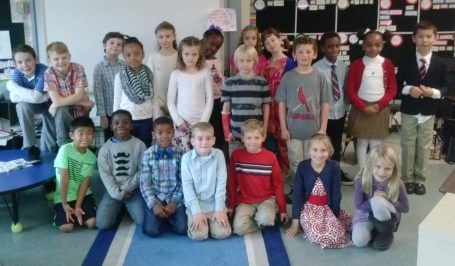
We did something this past week that has never happened in Rm. 202–or in any classroom I’ve taught in: celebrated Chinese New Year!  Our friend Baron’s mom, Mrs. Eyrick, was born in Taiwan, and offered to come share some of their Chinese culture with us.  It was perfect because we both got to see a little more about our friend and his family, and also, it fit in with our Social Studies unit right now.  Match made in heaven!

She showed up a little early and got busy decorating with some traditional Chinese New Year symbols and colors.  We learned that red and gold are important, as they stand for life and fortune.  Mrs. Eyrick brought us a dragon, lanterns (realized I didn’t get any pictures of those! :(), some fish as well as decoration for our door and a big Happy New Year sign.  So festive!

We sat down together on the rainbow rug and she told us all about the history of Chinese New Year, and how the Western Hemisphere (where we live) bases their calendar on the sun, and how the Eastern Hemisphere (where China is) bases their calendar on the moon (lunar) phases.  She explained the Chinese Zodiac, and told us how friends in China celebrate this happy time.

She even brought us a treat!  She shared traditional Chinese New Year “lucky” food–clementines–and gave each kiddo a lucky red envelope.  It had real money inside!!  We also got to enjoy some other Chinese tasty treats together.

What a great afternoon and a fabulous celebration! Thanks, Mrs. Eyrick, for coming to teach us about your culture. 🙂


A Little Further Into the Woods

Since we’ve begun our Little Red Riding Hood culture study, some exciting things have happened!  Let me tell you about what’s going on!

Alongside the LRRH books that we shared was another book, full of all sorts of organizers, charts, and a map.  This would be where we’d record our thinking and learning throughout the study.

Screenshot 2016-02-07 15.22.10LRRH_culture

As we read a book, kiddos would fill in a chart that marked certain features of each story, which we would later use to compare stories and use the information to learn more about each culture represented.

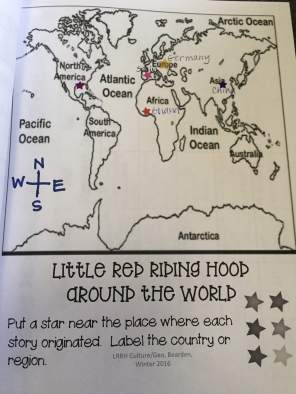
Additionally, we kept track of where our countries are in the world, by adding a star on the map for every one we read.  Later on, we added a US map to our book (which I don’t have a picture of yet) as we learned about regions.

IMG_0392-min

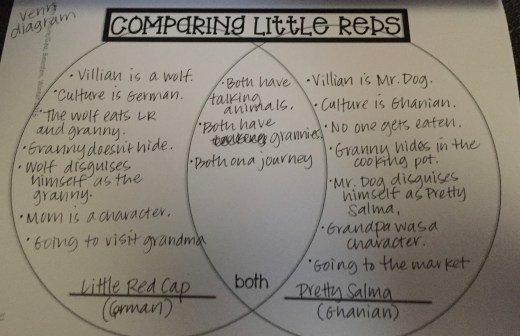
As we read different versions, we also compared how certain books were alike and different…

IMG_0395

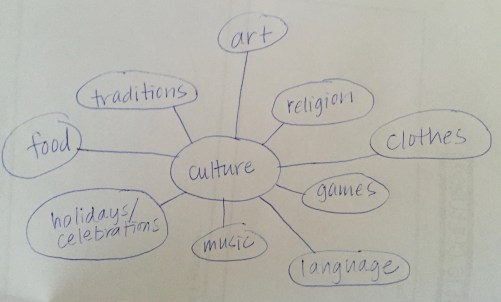
…as well as finding other things that we needed to add into our book (note to Mrs. Bearden to make sure to put this in there next year!):

IMG_0393

Once we got the background of the stories, talked about characters, compared and contrasted and decided on our favorites, we were ready for the really fun part–researching more about the cultures from our books.

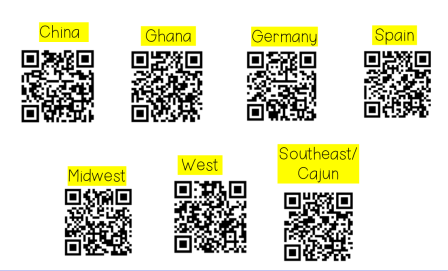
Each kiddo chose their top 3, then randomly came and declared which culture group they wanted to be in.  I wanted it to be about the country/region/culture, not the people in the group, so this part was all done first, then I shared their groupings.  Each group has 3 people, which is kind of ideal.  I could hardly get the directions out before they were ready to get going (kind of like with our spelling investigations this week–they were eager!).  I had found books for each group to start their research, but groups had to go book shopping to find the right ones.  Once they had books, they were busy digging in, collecting information about land (not culture, but related to the geography focus), language, holidays, food, games, religion, school, music, art and then a topic of their choice.

After our initial book search, kiddos were allowed to use website that I had found, as well as World Book Online and Kid Info Bits, which we have subscriptions to from our library.

Screenshot 2016-02-07 17.09.06

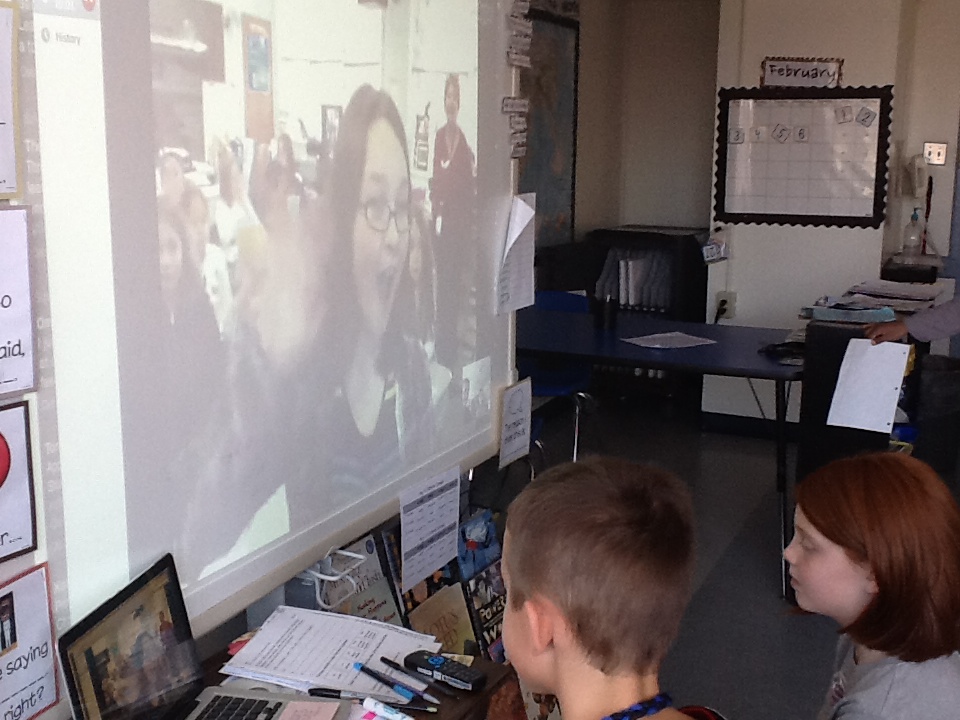
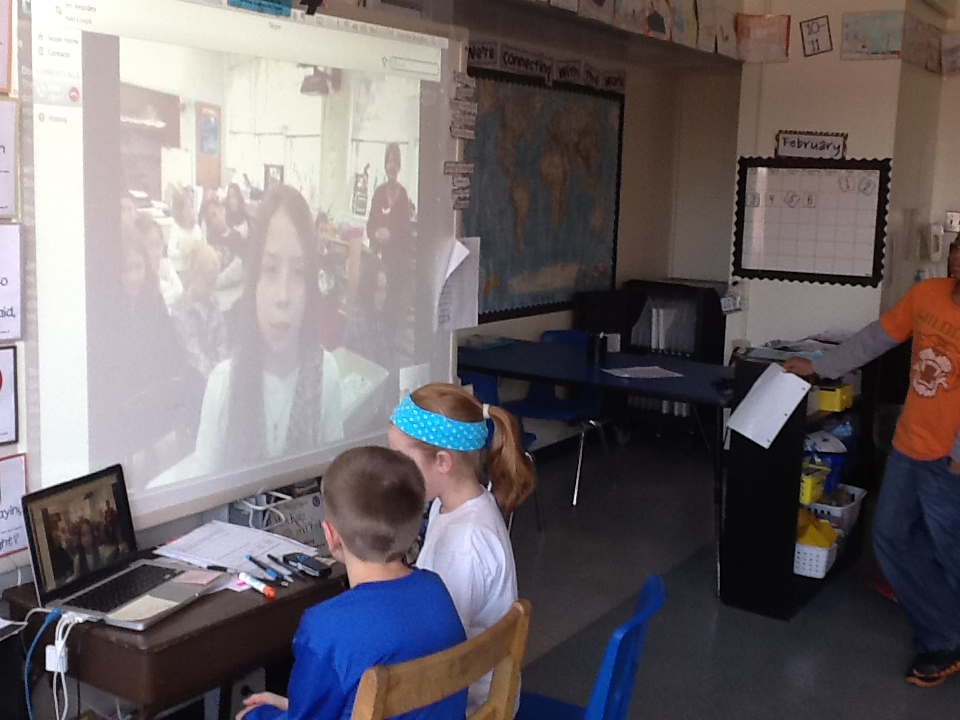
We even had an opportunity to learn about German culture from someone in Germany! I sent out a request on Twitter for friends from our countries/regions of choice, but was unable to work out any Skyping situations.  Then I remembered that Mrs. Appelbaum’s daughter is studying German in GERMANY and that she might be available to help us out!  She was more than willing and so we worked out a FaceTime call for last Thursday afternoon.  Those girls were so excited (and so was I!)!

We are just about done with research and are excited to start writing–we’re going to take all of our information and make books to share with other Robinson kiddos!  Stay tuned for updates on that part of our work!


LRRH–Inspiring Sharing and Caring

I started the story recently about our culture/geography/literature study of Little Red Riding Hood.  We’ve done many things along the way with stories and maps and learning about regions (which I promise to share later!), but today there’s another story to tell.

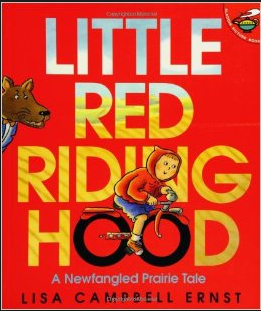
Today we read Little Red Riding Hood: A Newfangled Prairie Tale by Lisa Campbell Ernst.  The connection was to the Midwest region (at least as far as our SS unit was concerned), but my kiddos made many others kinds of important to connections in addition!

Screenshot 2016-01-20 13.44.55

The Little Red story here is very different than most others (and I won’t spoil the ending for you), and so gave us some new things to think about and respond to as readers and thinkers.  Before I was even finished, the suggestions came spilling over and kiddos could not contain themselves.  Many of them were related to this picture, which is on the last page:

FullSizeRender 21-min

Like I mentioned, the muffin-related ideas came quick and fast and I grabbed a marker and started recording so we wouldn’t forget the conversation:FullSizeRender 22-min

There are many layers to this list, and they’re not all related to the 100th Day, but that was a catchy title that Tyrin suggested.  We did decide, though, that we wanted to make these as part of our 100th Day festivities and share them with our 2nd grade friends–and there happen to be about 100 of them.  Seems like a match made in heaven. 🙂

We hope to address some of the others (and I’m sure add many more!) in the days to come.  Many of them could relate to a service-learning project and all will touch the hearts (and stomachs!) of our community.  As I keep saying, I can’t wait to continue to share this story!


Over the River and Through the Woods

Little Red, Pretty Salma, Petite Rouge, Little Roja, Lon Po Po. The list goes on and on.  And it’s a pretty good list, eh?  Rm. 202 thinks so!  (Do you know what it’s a list of?) We have just begun a study much like one (only better!) that we did last year.  And you know how I told you about this thing I have the other day?  Yeah…well I am afraid that because of that thing I didn’t tell you about that awesome study last year.  UGH!  Luckily things have changed, though, and I’m starting this story much earlier. 🙂

This quarter we’re studying culture, and because of the unit I found last year (I used a variation of this Cinderella unit from First Grade Wow.  It went SMASHINGLY and was a great combination of literature, non-fiction text, culture AND geography.  It was also tons of fun to boot, which increased the engagement with a topic that is already generally interesting for first graders.  Win, win, win all around!

So this year when we came to this culture/geography time of year again (which in our curriculum usually happens in January), I knew I wanted to try something similar to what we had done last year.  The big idea of the unit is that folktales and fairytale can tell you something about culture.  When talking about culture, it is also important to understand the geography related to that culture; where the people live and why they might do the things they do there is essential to the puzzle.  Makes sense then, that all of those things would be connected–integrating subjects gives students multiple ways to make new information fit in with old knowledge and therefore make for stronger pathways to memory and understanding.  And honestly, making the unit include multiple subjects and topics helps time-wise.  Fitting it all in is always a concern for teachers, and this helps me get it all in.

Starting with framework from last year, I collected books.  The Cinderella theme worked so well and I knew I had to find another fairy tale or folktale that both had multiple versions, as well as a story that would interest my students.  There were obviously many choices, but I went with Little Red Riding Hood.  This story was familiar enough (like Cinderella), but also had many variations, and had interesting characters we could study, as well.

Our focus is to be using the fairy tales and folktales to analyze story structure, characters and main idea, as well as compare and contrast different versions.  Eventually we’ll probably write about our favorite version, trying to convince our readers why it’s the best with strong evidence from the text.  We will also study geographical concepts like continents, countries (and how they’re different from states and cities, as well as what our country is), bodies of water and regions–this one is new this year.  Besides just studying cultures of other places (which was our main focus last year), we’re incorporating the idea of regions of our own country this time; there are stories from both different countries and US regions in this unit.  We’ll analyze maps, talk about how they work and what information they give us, put stars on the places from where our stories come, color and label maps and talk about the places we know about (as well as places we wonder about).  Eventually then, students will choose one culture to learn more about, and research it.  This will incorporate with our next writing unit, and then will still touch reading and social studies skills and concepts, too.

And here’s the part where the “messy” of writing about this starts.  Previously, I would have waited until the very end of the study, hoping to include all the details and pictures, including fabulous videos of us presenting our final products.  Like I mentioned earlier, that often meant that I then didn’t even get around to writing about ANY of it–usually because I either forgot the details, ran out of steam or just didn’t have time.  And yeah, it makes me sad that it’s missing on the blog.  So here we go.  You might want to wear gloves.  Or a poncho.  Maybe goggles or a raincoat?

First let me share our booklist. I compiled it from a variety of places online, as well as just by standing forever in front of the fairytale section of my library with a crooked neck reading books spines.  I know–I’m a glutton for punishment.  It’s really not so easy, either, by the way, because they’re organized not just by story, but by author and by country.  Oh, and then they’re the ones that aren’t so obvious because they don’t have ‘Little Red Riding Hood’ in the title.  Anyhow…

We are using stories from Germany (the original), China (we have two from this culture, actually), Ghana, Spain, as well as from at least 4 regions in the US (and maybe another one that I’ve forgotten.  Told you this was messy!!!).

  1. Little Red Cap by the Brothers Grimm and Little Red Riding Hood by Sam McBratney
  2. Lon PoPo by Ed Young and Auntie Tiger by Laurence Yep
  3. Pretty Salma by Niki Daly
  4. Little Roja Riding Hood by Susan Middleton Elya
  5. Petite Rouge: A Cajun Red Riding Hood by Mike Artell
  6. Little Red Riding Hood: A Newfangled Prairie Tale by Lisa Campbell Ernst
  7. Little Red Cowboy Hat by Susan Lowell

 While those are the “official” titles, we are also going to enjoy some others that will be specifically for the reading part of the study, where we can study version, point-of-view and character.  Those include (at least for now!):

  1. Ninja Red Riding Hood by Corey Rosen Schwartz
  2. The Wolf’s Story: What Really Happened to Little Red Riding Hood by Toby Forward
  3. Very Little Red Riding Hood by Teresa Heapy

  4. Red Riding and the Sweet Little Wolf by Rachael Mortimer
  5. Honestly, Red Riding Hood Was Rotten!: The Story of Little Red Riding Hood as Told by the Wolf (The Other Side of the Story) by Trisha Speed Shaskan

  6. Super Red Riding Hood by Claudia Da′vila

I’m excited to share more pages to our story as we go along! 🙂


Veterans’ Day 2015

Until just a few years ago, Veterans’ Day came and went at Robinson without much fanfare.  I mean, yeah, we’d mention it to our classes, perhaps watch a video or read a book about why the day was special, but that was pretty much it.  There was not a whole-school focus, an assembly or any other type of celebration.  Then ( I believe the year Mrs. Kesler became our FABULOUS music teacher), that all changed and Veterans’ Day became one of the most special days on the calendar. 🙂 Remember last year?

Even before the day came we were hard at work: writing letters of thank you to veterans, as well as creating the centerpiece place mats for the tables in the cafeteria for the reception.

This slideshow requires JavaScript.

And pretty much since school started, too, kiddos have been working on the music for the assembly we hold yearly now to celebrate those who give/gave their very best to keep us safe and sound.  While I would love to invite each and every one of you to experience what is now Veterans’ Day at our school, I only have a couple of short videos to share.  It’s a taste at least, right? 🙂  Oh, and I HATE to admit this, but it always seems that my phone runs out of memory right in the middle of someone’s video I’m trying to record–yep, at just the WRONG moment–and this time it was during the girls’ song. 😦  (Since we split boys and girls for specials, our grade level had two songs).  Hopefully you’ll get the idea.  Again–super sorry I didn’t catch it all. 😦

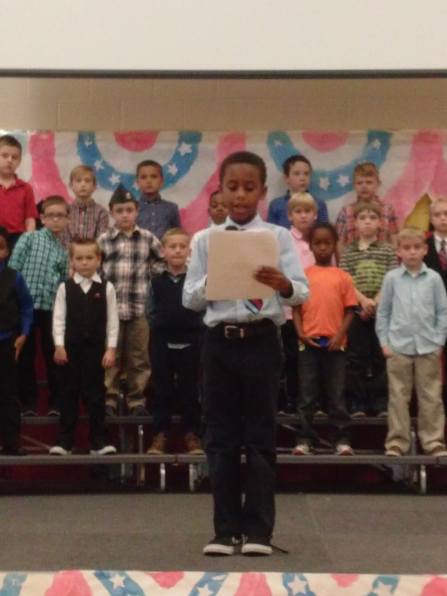
Before 2nd grade started, Khalani got to represent our grade and read a special thank you poem for the veterans.  Our theme was HEROES.

CAM02434-min

Then the boys sang their tribute:

Girls took their turn next:

I found two more pictures of how handsome and beautiful we look all dressed up:

CAM02442-minCAM02445-min

Happy Veterans’ Day!  How did you celebrate the special day? 🙂

Field Trip Fun in Downtown StL

We are lucky to be able to take field trips–pretty much to anywhere we want to go!  This year our team was trying to think outside-the-box a little more than usual, planning for field studies that not only connect to our 2nd grade curriculum, but that are important experiences for all kids to have in general.  We’ve thrown out some amazing ideas, and this fall we ended up with a trip that I’m pretty sure no one had ever gone on before. It was related to our study of economics, and was loads of fun, too. 🙂

Mrs. Driscoll worked it out for us to be able to visit the Federal Reserve Bank (and I hate to admit I didn’t even know we had one in our city!), as well as the Old Courthouse, which is a great historical building to visit.  But wait–the best part (or at least the fancy-schmanciest part) is that we got to eat lunch in a hotel ballroom!  Yep–she worked hard to secure a venue that would accommodate us no matter what St. Louis fall weather would throw at us–and we ended up being welcomed by the Crowne Plaza hotel, which was right across the street from both of the places we were visiting.  And yes, it was a lucky find–by the time it was time for lunch it was pouring down rain!  Way to go, Mrs. Driscoll, and thanks Crowne Plaza!

One more picture:

CAM02420-min

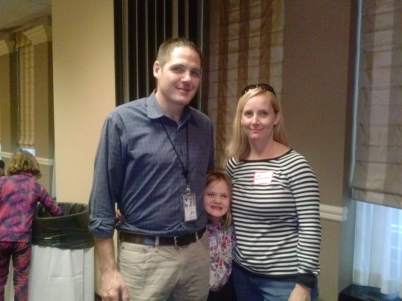
Look! Ava got to have both of her parents on our trip–Mom came along as a chaperone, and Dad works at the Federal Reserve Bank and got to join us for lunch! He was working that day and planned it so he could be on duty when we visited the museum at the bank.  What a special surprise!

We learned much, laughed a lot and had a great time!

Weak side/Strong side

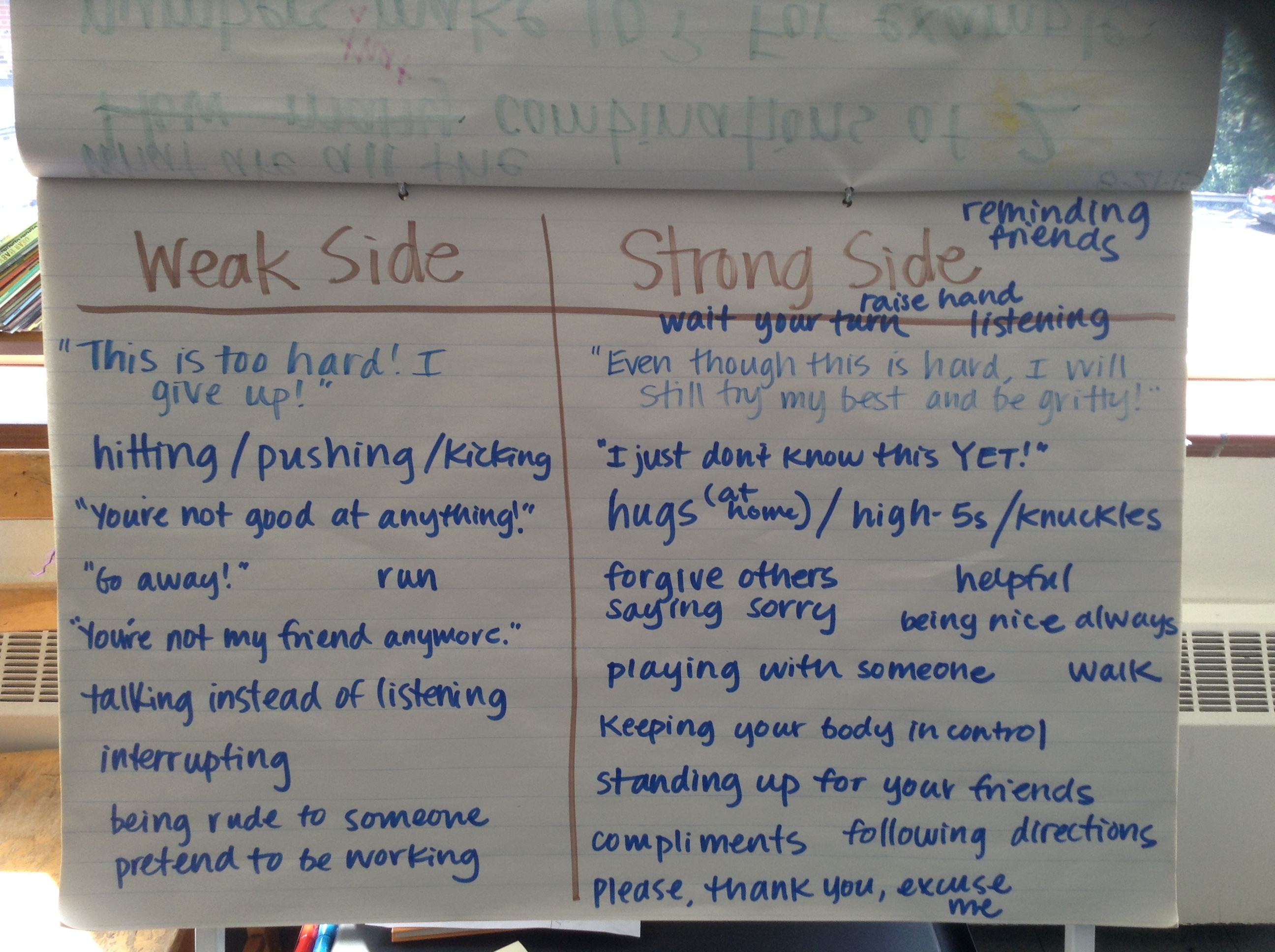
Much of the first days of school is spent learning routines and procedures for how to make the classroom run smoothly, and learning how to be a good learner is part of that.  In second grade, we use the idea of weak side/strong side to illustrate how kids can (and should) make good choices that benefit both themselves and their classmates.

As with many lessons, we began with a book.  We read Stand Tall, Molly Lou Melon.

IMG_5074I explained the idea of weak side/strong side by talking about how everyone has two voices in their head.  You know, that one that encourages you to do your best, think happy thoughts, follow the rules–the shoulder angel.  There’s also that other one that whispers and tells you how great of an idea it is to pinch your sister or blow bubbles in your milk or slide down the banister on the stairs–the shoulder devil.

In order to make the concept a little more concrete, and move visual, we created a class chart (which I will later make a little neater and hang on our anchor chart wall) with our ideas of things we could do or say that would fit under each side.  Students started with partner thinking–where many of them recorded thoughts using a t-chart–then we put our ideas together.  As of today, our chart looks like this (but it is ever-changing–I think we’ve added to it every day!):

IMG_5057It’s definitely sinking in, too, because I am hearing kids use the language of their chart when they speak to each other.  🙂  We’re by no means working perfectly all the time, but we’re on our way!

Cup Stacking Challenge

You may have seen a post floating around Facebook and Pinterest about a STEM Cup Stacking Challenge:

Screen Shot 2014-10-05 at 8.45.16 PM(photo courtesy of corkboardconnections.blogspot.com)

It’s similar to the Marshmallow Challenge that I’ve done several years with my 5th graders: build something really tall with your supplies and your team, using cooperation and problem-solving.  Great idea for any group of kiddos, but I especially love it for littler ones who are just beginning to learn about what it takes to work together, try something and have it fail, then rework the plan to try again.  This activity fits the focus we have on being gritty, as well as having a growth mindset and trying even when things are hard.  And yes, the first time we did it, it was hard. 🙂

Cup Challenge Take 1:

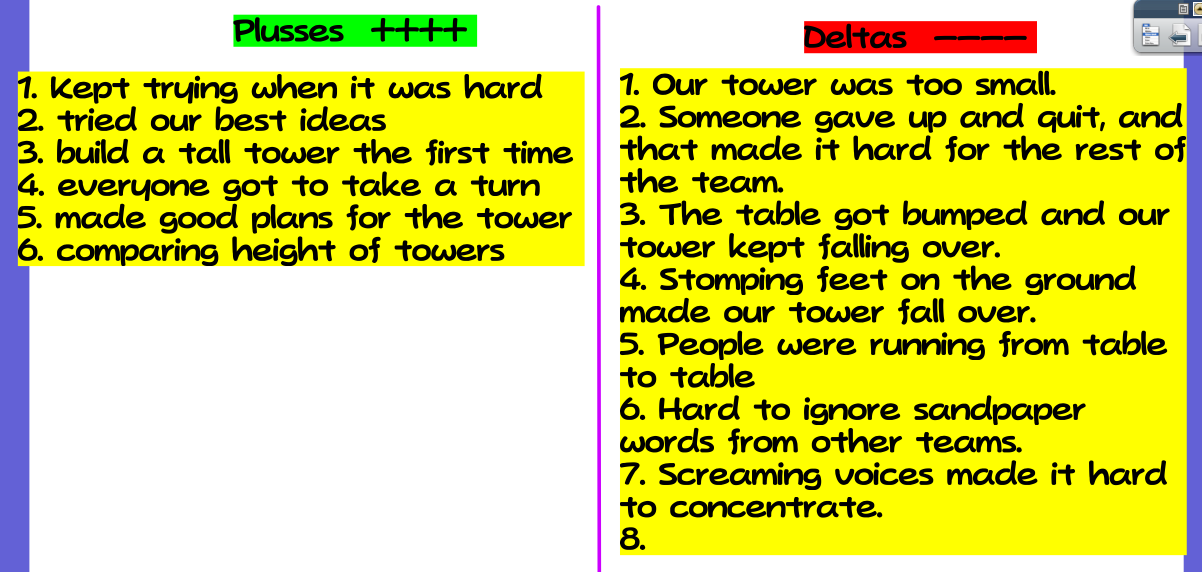
The first time we did this challenge, kiddos had 30 cups, their small group and 12 minutes.  Most thought they were done in about 2 minutes, and most used the same strategy.  Do you see how all the towers look the same?  One thing that also happened during this is talking.  Loud talking.  And much arguing about what to do next.  So when we were finished with this first try, we sat together to talk about it.  We talked about plusses (things that went well) and deltas (things we could change next time):

Screen Shot 2014-10-05 at 8.57.06 PM

They noticed that our list of things to change was REALLY LONG and go busy thinking of ways to do things differently when we tried it again. (When I mentioned that we could do it again, by the way, there were many cheers from the rug!) Working on the floor instead of tables was suggested, as well as not being able to leave your own team’s spot.  We also agreed that they would get one warning about their voices and then any teams that were still loud would have to work the rest of the time in silence.  Oh, and one more change was more time–they got 18 minutes instead of 12 (which was really the original plan anyway, we just ran out of time).

Cup Challenge Take 2:

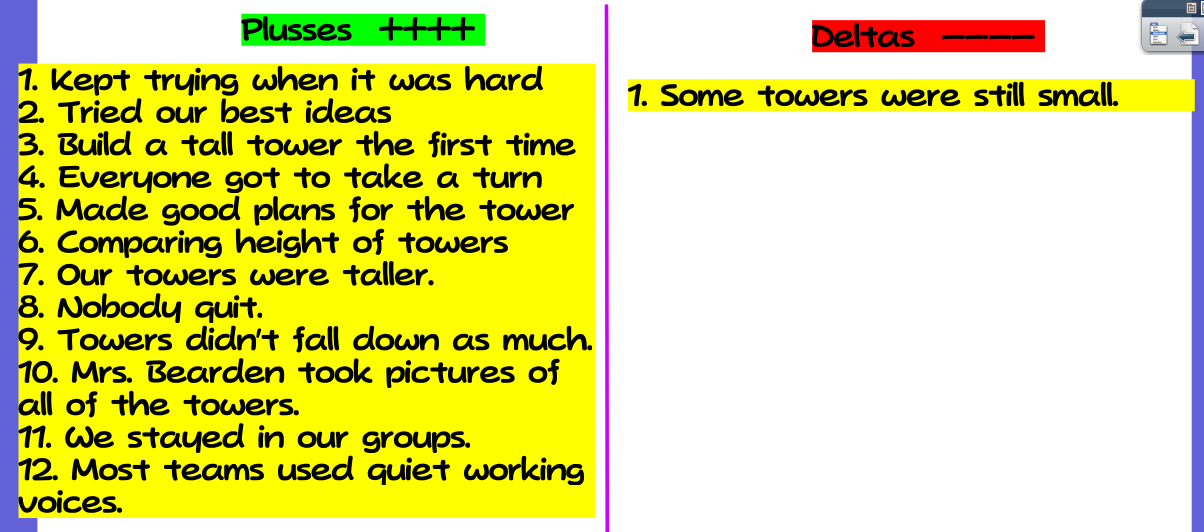
Check out our chart the second time around.  They were SO EXCITED about how the columns had changed!

Screen Shot 2014-10-05 at 9.06.54 PM

What a change that happened when kiddos reflected on what worked–and what didn’t–and then planned how to redo the challenge in a different way.  I’m excited to see all of the many things they learned here, and how those lessons touched so many subjects at one time! Way to go, Rm. 202 kids! 🙂

An Uncertain Future

I met with my team today–the fabulous Mrs. Hong and Ms. Turken–to talk about how to integrate reading, writing and sci/ss, as well as to update our curriculum calendar.  We only had 2 hours blocked out on the calendar, and so in some ways those were really big plans.  And we started 45 minutes late.  🙂

So, as we sat down and tried to tackle reworking the curriculum calendar (based on new Common Core standards, district resources and just things we wanted to change), we realized we had lots of work to do BEFORE we could address that problem.  You know how it goes, before you can do the job you actually sat down to do, you have to do this and before that you have to do this….we were in that boat.

We are wanting to reorganize our thinking and our schedule to allow for more integration, working Social Studies and Science topics into everything rather than having things so compartmentalized and isolated from each other.  But we had plans to UbDize (yep, just made up that word) our SS curriculum and organize our units around common EQs for each quarter.  But like I said before, it’s easier said than done.

And then there’s my crazy brain that isn’t just quite ready to think about these things.  For one thing, I have to have my space all done before I can planning for what we will do in that space.  Since it’s not even August, I do not have my classroom put together yet.  Granted, I do have all of my furniture where it will go and have big ideas for where things will go and what it will look like, but it’s not done yet.  And I have plans for how I want to redo parts of my classroom library.  And I haven’t met my class yet.
That last part is really the biggest piece of the puzzle that makes it hard for me to complete the calendar.  So in the mean time, I feel like I am facing an

Screen Shot 2013-07-31 at 1.09.33 PM

I know–you’re thinking, “Well, duh, Mrs. Bearden.  Isn’t the beginning of the year always uncertain?  You never really know what the school year will bring or what every detail of every day will look like.”  And no, I don’t have a crystal ball or any tarot cards, and so I guess in a way I always face an uncertain future at this point in the year.

But the reason why it so affects me is because I have such a hard time making decisions about things I’ll do and ways to go without actually knowing my students.  So much of where we go and how we get there depends on what my students need, and where they are when we start.  I have information and data about these things on paperwork (transition reports, testing scores, Lexile levels, etc.) from previous teachers, but until I really see what it looks like for actual kids in my actual space, I can’t really get a feel for it.  (My family has always said that I don’t have much of an imagination–maybe this is proof of that! 🙂 )

But obviously I can’t just not make plans.  I can’t not work with my team.  I can’t not try to figure it out now, because I owe it to these new students of mine to have at least an idea of where we will go, and how we might get there.  If not, then we’ll never get there.  And that’s definitely not an option.

Along the way I’ll tweak the plans–adjusting and reworking based on personalities, learning styles, academic and social needs, interests–and I’ll be totally ok with that.  And then, at the end of the year, I’ll look back at the plans we made around the table today in the summer and laugh, because of how different they are.  But I gotta start somewhere.

How does your “summer brain” work?  In what order do you do your work–space first or plans first? How does your team work before school starts to map our curriculum/unit plans?  I’d love your thoughts and/or advice! 🙂

New Friends in New Jersey

Yes, we did it again.  Third Skype in three weeks!  This one was a little different from the first Mystery Skype and the second one we did last week.  This time the location wasn’t a mystery; 4th graders from Lakehurst, NJ wanted to connect with students in the Midwest since their class was studying our region, so we just chatted.  SO many thanks to Mr. Bedell (@jasontbedell) for setting it up and Ms. Lambusta for being game to try Skype for the first time with her class!

The structure was similar to what we’ve done before, but since we knew that our new “friends” were going to ask us a whole slew of questions, we decided to find a way to give everyone more “screen time” during our Skype session.  I paired everyone up and they had two jobs: answer a question and ask a question.  We went through the first round and they asked us, then we asked them some questions.

IMG_0706IMG_0712 IMG_0711 IMG_0708

We were really interested to find out that one of the “specials” classes the 4th graders went to was Spanish.  There were lots of ooohs and ahhhs when they shared that nugget; kids in our school district don’t have an option for a foreign language until middle school.  We learned that Minecraft is a big deal both in NJ and MO, that they lived close to the ocean and were affected by Hurricane Sandy, and that their school is near a naval base.  Pizza was a popular school lunch (as are chicken nuggets!), and kids from both classes like to play sports games on their game systems.

IMG_0713

We had a great conversation with our new friends in New Jersey and then began thinking and talking.  We talked about whether we liked Mystery Skype or this type of chat better.  It was pretty much 50/50; many liked the “guessing” part of a Mystery Skype because it was a challenge to their brains, and many others liked the “regular” Skype because they liked the opportunity to ask and answer questions more related to them than geography.

That got us thinking about other ways we could use Skype.  Ames suggested that there were probably lots of other things that could be a mystery when we Skype besides location.  That comment made me think of a list I read from Krissy Venosdale (@ktvee) where she shared ideas for just that!  We also thought we could combine them both and first figure out the location, then get to know them better like we did this time.  Both great ideas!

I am so excited with how excited my students are during these types of activities.  They thirst for new ideas and enjoy trying new things, especially when they involve technology.  I LOVE that they trust me when I say, “Hey, I heard about this–how about we try it?!”  They are game for ANYTHING!

Besides being excited to try this again, we’re excited to invite other classes to join us!  One of our 5th grade neighbors is going to sit in on our next Mystery Skype so they can learn more about it.  Maybe we could even start marking our Skypes on our map of connections and try to get every state!  Wouldn’t that be cool?!

So…do YOU want to Skype with us?  Comment here or contact me on Twitter (@jenbearden).  We’d love to meet you!