It’s Summer, What are You Reading?

Yep.  It’s that time again.  Summertime!  And of course, as a teacher, it means I have time to READ!!  Ok, I am reading all the time, but this is prime sit-and-read-a-whole-book-in-one-sitting time!  So, I thought I’d share what I’ve been reading with you, and then I’d love to hear from you about what you’d suggest!

What I’ve read…

What I’m reading…

In my TBR pile…

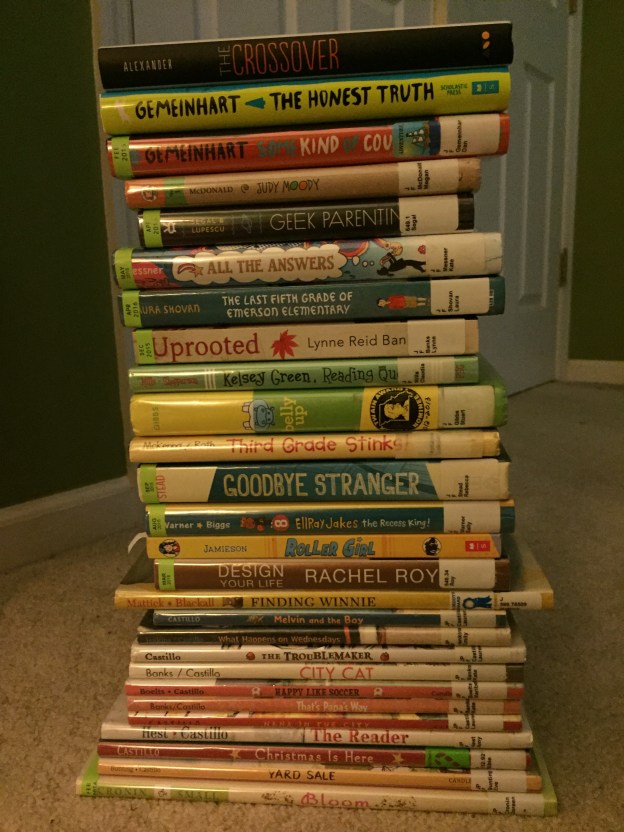
Is there anyone who ever has time to read everything in their TBR pile?  I have the problem that mine keeps getting taller (from great suggestions) before it gets shorter (by me finishing something)!  It is totally silly, but at this point it’s up to my knees! See?

FullSizeRender 2

Oh, wait–you probably want to see the spines…here’s another version (sans me!):

IMG_2415

Bets on how long it’ll take?  I’m sure there’s a great math opportunity in there somewhere, but I’ll save that for another day!

Ok, now it’s your turn! What are you reading?  What do you suggest I read? 🙂


Rm. 202 Kids Take Over–Read Aloud Take 2

I am so excited with what’s happening in our room with Read Aloud lately.  The level of excitement, confidence and pride that is present because of all of these super 2nd grade readers sharing their skills is definitely impressive.  Some kiddos have even signed up more than once on the calendar!!

The only thing I have to say that makes me really sad is that there are couple of kiddos who only have pictures (rather than videos) because my devices were not cooperating on those days.  I HATE that, because everyone of them has done a SUPER job, and you’ll miss them.  Just take my word–every read aloud has been A. Maz. Ing.

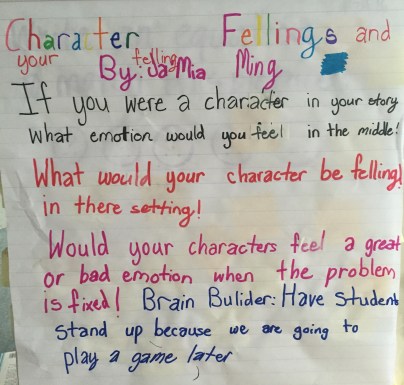
Gotta share that chart that she used, too. 🙂  It needs some edits (so please look past the typos 🙂 ), but it was such a great idea that she came up with on her own.  She was very prepared for her lesson. 🙂

IMG_1624

Please take a minute to leave a comment for our brave, super talented, 2nd grade readers! Way to go, Rm. 202 kiddos!

Rm. 202 Kids Take Over–Read Aloud!

Last week I was having a reading conference with a friend, and as we were talking about TBR piles and good book recipes, another idea came to me that would help one reader, and then in turn many others: kiddos doing read aloud.

As I continued to talk to this friend about books, I suggested that he choose a book from his new TBR pile to share with the class.  We talked about how he would have to prepare to do this, including practicing holding the book up so that everyone could see the pictures.  It was totally picture-worthy while he was working.

And maybe the best part was when he turned to me and said, “Wow, this is hard.  My arm hurts!  Is it hard for you, too?” We had a great little chat about how teachers have to have strong arms. 🙂

He continued to work and was ready to present to us.  Man was he excited!

Check out the stories he shared with us:

Well…as you can imagine, this sparked interest by many other people to be able to share with us at read aloud time.  And what a great idea, as I considered all of the many things kiddos learn on both sides of this opportunity.

We began to schedule read alouds in a couple of ways: I gave some friends the assignment based on books we were reading in our small group together, and some friends just began to request a spot.  And since then it’s become a “have-to” for everyone.  It’s just such a good idea that we (ok, probably I) decided all should participate!

Amber took the next turn, and did a super job of matching up to what my lesson would have been that day anyway–good readers use evidence from the text to support their thinking.

Then on Friday, Emily took her turn and taught us about fiction/non-fiction (as well as using some pretty great teacher moves for management!) with The Little Work Plane.

Now don’t worry if you don’t see your favorite Rm. 202 friend in this post–each will get their turn.  While I had originally never intended to take this path with readers in our room, it’s a SUPER example of how organically ideas come up for us, and how kids’ ideas are often the BEST ideas! Thanks, Rm. 202 kiddos for taking chances, learning new things and then sharing that learning with the rest of us!

What’s in Your TBR Pile?

Many, many years ago I was a presenter for Project Construct.  I had a super responsibility of teaching Missouri teachers about how to incorporate Readers’, Writers’ and Math Workshop into their classroom routine.  It was during this time that I learned about “nightstand books” and TBR piles.  Oh, you know, that 12-inch stack of books that sit next to your bed so you have them ready to go when you have a few minutes to read before bed?

Well, often my pile sits elsewhere than my nightstand, but for sure it’s always there.  And sometimes it’s taller than 12-inches.  Like in the summer when it’s about as tall as my 5-YO (she’s 40 inches right now, by the way. 🙂 ).  My current TBR pile looks like this:

IMG_1175 2-min

Anyhow, after we had learned about recipes and how they help guide us with book choices, we talked about something else readers do–make plans.  I started our conversation by asking a simple question: Why do people make plans?  I didn’t specifically say readers at this point because I wanted them to think broader and try not to guess my specific plan for the day just yet. Kids turned and talked to their partners and came up with SUPER ideas.  They connected this to how builders use blueprints and how important those are to making the building look “right” in the end.  They mentioned how writers make plans so they know what their stories are supposed to be (can you tell what we’ve been doing in Writers’ Workshop lately?).  They talked about how plans keep your organized and help you know what to do.

After that great start, it was easy to then expand the idea to how readers make plans for what they will read next.  This allows them to move smoothly from one book to another, without wasting reading time wandering around the library.  It helps readers think critically about what they want to read and why (I explained to my kiddos why each of those books is in my pile), and to be more purposeful in their choices.  This becomes especially easy if you choose books that are in a series, or if you “trust an author” and read all the books that they’ve written. I can TOTALLY do this with Ralph Fletcher, Sharon Creech, Jerry Spinelli, Joan Bauer and Liane Moriarty.

Kiddos had a great time trying out this strategy, and then send me their lists when they were finished.  We’re going to use them now and I plan to hold kids accountable to try out the books they put on their list.  While they can change, these piles (which are saved as pictures/notes on their iPads) help them think ahead and more purposefully use their time both in the classroom and at home.  I’m excited to see how they continue to help us grow as readers through this year and even beyond!


Recipe For a Good Book

I remember vividly the first time I ever taught about recipes in my classroom.  It was towards the end of the year, when I was teaching 4th grade (ok, I don’t remember the exact year–maybe 2006?–but I do remember the kiddo!), and during a reading conference a kiddo was struggling with finding a book that was a good fit for her.  For some reason I was thinking about how what she really needed was a plan–a recipe–for how to find a good book for her.  And since that first conference so many years ago, I’ve found that this lesson is one that almost every kiddo (and probably some adults, too!) could find helpful.  I went back to look at when I had written about it here, and I found this post from about 4 years ago.  Rather than try to explain the whole thing again, I ask you to take a few minutes and read about it from back then.  Really, I’ll wait. It won’t take long.  Just come back when you’re finished and I’ll tell you about how it worked in 2nd grade the other day (See? Told you all kinds of kids could benefit from it!  I think I’ve used it in every grade level I’ve taught over the years, and even for myself!) 🙂

Are you back?  Well, like I said before, this issue seems to come up every year and now that I think about it, maybe that speaks to the lessons I teach at the beginning of the year on how to choose books.  I wonder why they aren’t “sticking” and why kiddos eventually need this secondary explanation of “good book” recipes.  I wonder if it has to do with the fact that they change so much as readers over a given school year (especially if they are younger readers, or struggling readers making big gains) and so the books that were just-right or “good” for them in August are certainly not the same for them in March.  I guess like anything else, as well, just telling them once probably isn’t enough.  Perhaps I should find a way to incorporate book choice lessons into every unit that I teach.  In many ways choosing a just-right fiction book is very different from choosing a just-right non-fiction book anyway.  Oh, and I feel like I should mention that my definition of “just-right” book doesn’t have so much to do with a level as it does with student interest, motivation and desire.  All of that other stuff can be worked on once you help them find THE book for them.  Many times the kiddos who first need my recipe lesson are ones who don’t really see themselves as readers yet.  They don’t really know what to do when they’re standing in the aisles of the school library or looking at the buckets in our classroom library and need a hook to get them started.  That’s really what I’m thinking about when I help guide them here.

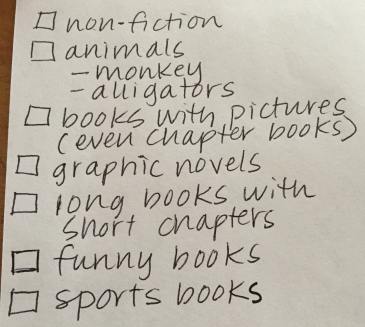
Ok, well, just like it happened in that example from 5th grade many years ago, I had a conference with a kiddo the other day who needed some guidance to find his version of a good book.  We talked about books he has read that he really liked and what it was about them specifically that he liked.  We used those things as our “recipe” and wrote them down:

FullSizeRender 30-min

This now becomes a shopping list when he’s in our classroom, the school library, the bookstore, the book fair, the county library, etc.  The big idea is that if he knows what he likes he knows when he’s found it.  This is a HUGE idea that kids often miss.  They so often just wander through the shelves not really knowing what they’re looking for, expecting that they will just know what it is when they find it.  It’s like traveling to a new place without a map AND without really knowing your destination.  You will NEVER get there.

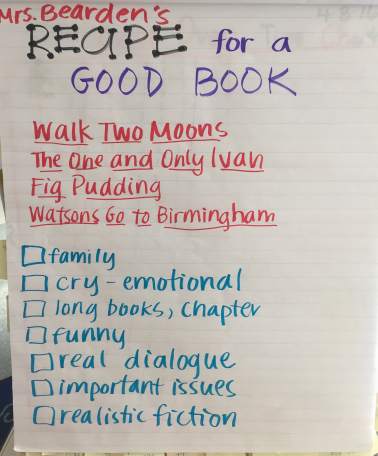
Well, after this first conference, I ran into two other friends in the same day that needed the same lesson and so it quickly got moved to my “everybody-needs-this-as-a-mini-lesson” list.  I then showed everyone in Rm. 202 the plan the next day by sharing my own example:

FullSizeRender 49-min

Not everyone is necessarily ready for this right now, but everyone had a go at trying their own list and we will tweak over the coming days as they practice using it for book shopping.  The great part is that it is customizable, personal, and specific to each reader.  And it can be easily changed as they change as readers.  LOVE!

Learning Buddies: Read-a-Thon

We have not had a chance to see our Learning Buddies very much lately.  5th Graders are busy people!  When we heard they were busy tackling a Read-a-Thon on Friday, we knew we wanted to join in!  While they were spending their whole day (6 hours!) enjoying a book, we were only able to be there for a little chunk of that time.  Some Rm. 202 friends suggested we should plan our own read-a-thon, though, for a future date, too!

Before we came to visit them, Dr. Grayson’s room had a lesson with Mrs. Meihaus, our amazing librarian, about how to read to a younger student.  Our buddies were then armed with their “lesson plan” and shared really great books with us after lunch.  It was so much fun!  Oh, and it was also Hat Day at our school to raise money for the NIYO Cultural Center in Rwanda (Hi, Pacifique!), which added to the festive spirit.  Enjoy some pictures of our afternoon!


Series Reading Groups

We have been working with series of books in Readers’ Workshop lately.  Our newest unit, which has a focus on patterns, characters and changes, is asking students to look at a series of books (one per group) to find similarities and differences.  Each kiddo in the group is reading a different book (which is something I’ve never done before) and when they meet, the team is responsible for talking about what they’ve each found in their books individually.

We’ve worked on looking at what is always the same (patterns in the series), what we can learn about characters, asking ourselves why certain things are important, marking the text with post-its so we don’t forget what we’ve noticed, talking “long and strong” about our post-it notes, making sure we understand what our partners are saying by asking clarifying questions, and using a Venn diagram to model what we notice between the books in our groups.

We’ve chosen books series that match each level of reader in my classroom: Horrible Harry, Roscoe Riley Rules, Berenstain Bears, Clifford, Mercy Watson and Little House on the Prairie.

It’s been really exciting to see what they’ve been able to do with this study.  For many it’s the first time they have really read a chapter book.  While each group has different conversations based on the members and the books, each works with diligence and purpose as they discuss what they are learning about their texts.  They are really thinking deeply about their books, having fun with literacy and their reading conversations are leaking over into other parts of our day.  The other thing I’ve seen is that many have been positively pressured to higher levels of thinking and participating because of what they see their friends doing.  Love that kind of friendly competition!

I know this kind of thing would be best explained with videos, but all I have is pictures.  Imagine that you can hear quiet murmurs of engaging conversations around books that kids love and it would sound just about right!

What series do you enjoy reading?  We’d love some recommendations for our next choices! 🙂


Over the River and Through the Woods

Little Red, Pretty Salma, Petite Rouge, Little Roja, Lon Po Po. The list goes on and on.  And it’s a pretty good list, eh?  Rm. 202 thinks so!  (Do you know what it’s a list of?) We have just begun a study much like one (only better!) that we did last year.  And you know how I told you about this thing I have the other day?  Yeah…well I am afraid that because of that thing I didn’t tell you about that awesome study last year.  UGH!  Luckily things have changed, though, and I’m starting this story much earlier. 🙂

This quarter we’re studying culture, and because of the unit I found last year (I used a variation of this Cinderella unit from First Grade Wow.  It went SMASHINGLY and was a great combination of literature, non-fiction text, culture AND geography.  It was also tons of fun to boot, which increased the engagement with a topic that is already generally interesting for first graders.  Win, win, win all around!

So this year when we came to this culture/geography time of year again (which in our curriculum usually happens in January), I knew I wanted to try something similar to what we had done last year.  The big idea of the unit is that folktales and fairytale can tell you something about culture.  When talking about culture, it is also important to understand the geography related to that culture; where the people live and why they might do the things they do there is essential to the puzzle.  Makes sense then, that all of those things would be connected–integrating subjects gives students multiple ways to make new information fit in with old knowledge and therefore make for stronger pathways to memory and understanding.  And honestly, making the unit include multiple subjects and topics helps time-wise.  Fitting it all in is always a concern for teachers, and this helps me get it all in.

Starting with framework from last year, I collected books.  The Cinderella theme worked so well and I knew I had to find another fairy tale or folktale that both had multiple versions, as well as a story that would interest my students.  There were obviously many choices, but I went with Little Red Riding Hood.  This story was familiar enough (like Cinderella), but also had many variations, and had interesting characters we could study, as well.

Our focus is to be using the fairy tales and folktales to analyze story structure, characters and main idea, as well as compare and contrast different versions.  Eventually we’ll probably write about our favorite version, trying to convince our readers why it’s the best with strong evidence from the text.  We will also study geographical concepts like continents, countries (and how they’re different from states and cities, as well as what our country is), bodies of water and regions–this one is new this year.  Besides just studying cultures of other places (which was our main focus last year), we’re incorporating the idea of regions of our own country this time; there are stories from both different countries and US regions in this unit.  We’ll analyze maps, talk about how they work and what information they give us, put stars on the places from where our stories come, color and label maps and talk about the places we know about (as well as places we wonder about).  Eventually then, students will choose one culture to learn more about, and research it.  This will incorporate with our next writing unit, and then will still touch reading and social studies skills and concepts, too.

And here’s the part where the “messy” of writing about this starts.  Previously, I would have waited until the very end of the study, hoping to include all the details and pictures, including fabulous videos of us presenting our final products.  Like I mentioned earlier, that often meant that I then didn’t even get around to writing about ANY of it–usually because I either forgot the details, ran out of steam or just didn’t have time.  And yeah, it makes me sad that it’s missing on the blog.  So here we go.  You might want to wear gloves.  Or a poncho.  Maybe goggles or a raincoat?

First let me share our booklist. I compiled it from a variety of places online, as well as just by standing forever in front of the fairytale section of my library with a crooked neck reading books spines.  I know–I’m a glutton for punishment.  It’s really not so easy, either, by the way, because they’re organized not just by story, but by author and by country.  Oh, and then they’re the ones that aren’t so obvious because they don’t have ‘Little Red Riding Hood’ in the title.  Anyhow…

We are using stories from Germany (the original), China (we have two from this culture, actually), Ghana, Spain, as well as from at least 4 regions in the US (and maybe another one that I’ve forgotten.  Told you this was messy!!!).

  1. Little Red Cap by the Brothers Grimm and Little Red Riding Hood by Sam McBratney
  2. Lon PoPo by Ed Young and Auntie Tiger by Laurence Yep
  3. Pretty Salma by Niki Daly
  4. Little Roja Riding Hood by Susan Middleton Elya
  5. Petite Rouge: A Cajun Red Riding Hood by Mike Artell
  6. Little Red Riding Hood: A Newfangled Prairie Tale by Lisa Campbell Ernst
  7. Little Red Cowboy Hat by Susan Lowell

 While those are the “official” titles, we are also going to enjoy some others that will be specifically for the reading part of the study, where we can study version, point-of-view and character.  Those include (at least for now!):

  1. Ninja Red Riding Hood by Corey Rosen Schwartz
  2. The Wolf’s Story: What Really Happened to Little Red Riding Hood by Toby Forward
  3. Very Little Red Riding Hood by Teresa Heapy

  4. Red Riding and the Sweet Little Wolf by Rachael Mortimer
  5. Honestly, Red Riding Hood Was Rotten!: The Story of Little Red Riding Hood as Told by the Wolf (The Other Side of the Story) by Trisha Speed Shaskan

  6. Super Red Riding Hood by Claudia Da′vila

I’m excited to share more pages to our story as we go along! 🙂


Library Redo

Remember last year when we worked on organizing our classroom library?  You might not, because I couldn’t find it on the blog….:(  Maybe the post I thought I wrote got lost in the “it-has-to-be-finished-and-perfect” list I told you about yesterday.  Well, since my pledge is to tell all the stories, not just the finished ones, I’ll share the parts of this story that we have finished (and that I have pictures of!).

We left at the end of 1st grade with a (mostly) organized library, which we had worked on together little-by-little last year.  We packed it away in that same way, which always helps when I put the classroom back together the next fall.  We figured out, though, that we had never gotten the boxes fully labeled, and so as we started using the books again this year, they got all mixed up.  We decided we should probably just start over; I was the only one who knew what most of the categories were supposed to be.

We started by pairing up, and first going through the boxes we already had established.  I gave each pair a box, and their job was 1) to figure out what their books had in common, 2) decide if they had any that didn’t match that category, 3) and then make a label that matched their newly decided-upon category.  All of the extras got piled up in the middle of the room for later.

The second year together has been a great learning process in many ways.  Of course, for many reasons, we’re doing many things differently, but there are also some things that are the same that they are doing differently.  This is a perfect example.  The understanding they have of genre and the difference between fiction/non-fiction, as well as the ability to see similarities and differences is deeper than when they did the library sort as first graders, so the same activity is even more meaningful than the first time.  Even the way they “get” why we did it, why we did it together (as opposed to just having ME take care of it), and why we should keep it organized is different than last year.


Global Read Aloud 2015

If you’ve been here for any length of time, you’ve probably figured out my love of all things online–collaborating with other classes through things like Mystery Skype, Edmodo, Twitter, World Read Aloud Day, Dot Day, blogs, etc.  I hope that you’ve also seen how I am willing to try new things, not necessarily knowing how they will work out in the end.  I consider myself to be a risk-taker with technology and with new learning ideas.  I guess I trust that worst that will happen is that whatever it is won’t work and then we’ll try somethign else. 🙂

So, when my friend Tam Scharf, from Yr5sK in Queensland, Australia, invited me to join the Global Read Aloud this year, I knew I had to do it!  I have read about it for a couple years (during my time on Twitter!), but wasn’t really sure what to do to get involved.  Well it’s really pretty simple and has already proven to be a great opportunity for Rm. 202 kiddos!

The basic idea is that our class is reading a chapter book along with many other classes and there have been activities planned by a small group of teachers on our team that each class is trying out and then posting to our blog, or to Padlet, or other online venues.  Some classes are tweeting, and there will be Skype sessions planned, as well.

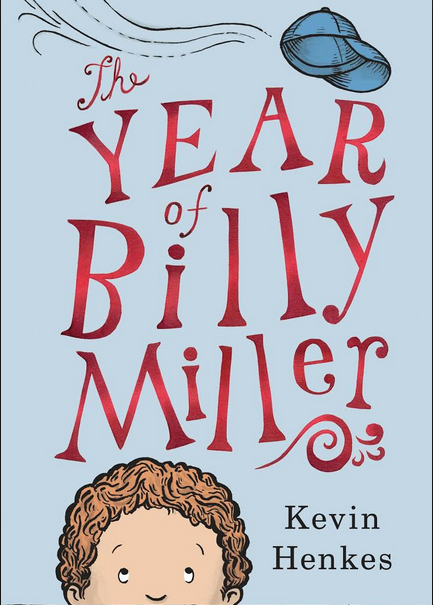
Our class chose to read a great book by a familiar author, Kevin Henkes, called The Year of Billy Miller.  The best part is that I had heard about it and was interested in reading it anyway.  So then when I found out it was a text choice for this project, it seemed like a perfect match.  And it’s about a 2nd grader.  Win/win/win. 🙂

Screenshot 2015-10-15 20.48.04Each week we are reading a different part of the book (it’s broken up into 4 parts that focus on a different relationship), and we do the coordinating activity.

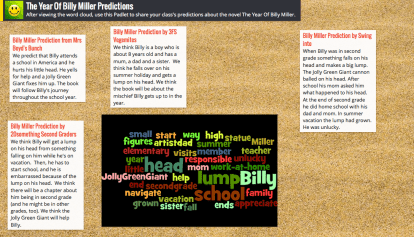
The first week we studied a word cloud about Billy Miller and brainstormed what we thought the book would be about.  We posted our predictions (along with other GRA friends) on a Padlet set up for that activity.

Screenshot 2015-10-15 20.51.41Here’s what we thought about the book:

Screenshot 2015-10-15 20.52.37

It was great to read what other kids thought about the story, and we even revised some of our thinking based on what they shared.  Already a great start and we hadn’t even started reading!

Last week we read the first section (called Teacher) and met Billy and the other main characters in the book.  We are using this book as our study in Readers’ Workshop and it’s matching up perfectly with our work with story elements.  We learned how to use a story map, and recorded the characters, setting adn problem/setting so far in the story.  We’ll keep modifying this organizer as we go on, as well as completing the other planned activities.

We’re excited to join in for this week’s work: a Popplet about what we think about Billy as a character.  We’re not done yet but are excited to share our thinking once we get there.

This story is so fun and kids can easily relate to it; the project is a great motivator for us as readers and citizens of the world!  We found out the other day that there are over 500,000 kiddos signed up doing the same thing as us–WOW!!

I’ll update you with more as we get further into this great collaboration!