Meet S.H.A.D.O.

I really hate it when I have an idea for a post and then time gets away from me.  Eventually I find the time (or I remember the post that I had forgotten to write!) and it happens.  Eventually.  Today is one of those posts.

We actually met S.H.A.D.O. weeks ago.  She is now our good friend.  And boy is she helpful!

Who’s S.H.A.D.O., you ask?  And why is her name spelled like that?  Let me tell you all about it.

This is S.H.A.D.O.:
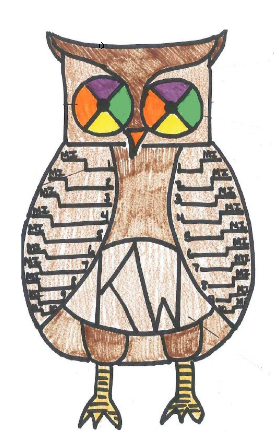
And she is one smart cookie.  No wait–she’s an owl.  Ok, so she is one wise owl.

Her name stands for:

And while I would love to take credit for creating her, I can’t.  I found her when I was on www.prometheanplanet.com, which is a support site for the interactive whiteboard we use at school.  The flipchart she came from (and that we now reference frequently in our classroom!) was submitted by Melissa McGahan.  So, like many great ideas that I use in my classroom, I did not think it up, I just figured out the right time and place to use it!

Ok, back to S.H.A.D.O.  She has been helping us during the recent weeks as we prepare for MAP testing (which I talked about related to science the other day here ).  She helps us remember that there are some basic strategies that good test-takers use when they tackle a test (whether it’s a state test or just a plain ‘ol end-of-unit test) to help make sense of it.  There are different parts of her body that remind us of these strategies.

Here’s what they are:

I have been amazed at how this representation–in picture form–has been so helpful to so many of my students.  While I have always taught these strategies, I’ve always done it with words, not images.  We have always created a list of “smart” things to do, then had that list displayed in a variety of places around our classroom.  Just like in the past, S.H.A.D.O. is now displayed all around our room, as a reminder when you look at her to do what she suggests.  (As a side note, I love how the other day someone wrote a blog post about how they love S.H.A.D.O., but she’s a little creepy because she’s always watching us with those big eyes of hers!  HA!  The minds of 5th graders kill me sometimes!).  It’s simple, really, and I don’t know why I didn’t think of using a picture before–I’m a very visual learner myself, so it’s something that would have helped me, too!

So since we’ve become introduced to S.H.A.D.O., we’ve tried out her strategies on various assessments we’ve done in our classroom.  Is she helpful to everyone? No.  Does everyone need her reminders? No.  Do we always go through all of the steps she suggests?  No.  Just like every strategy I share with my students, they have learned which steps at what time with which assignment she is helpful.  That’s the key actually–know how to use the tools at your disposal.  So she’s there in our toolboxes if and when we need her.

And as a side note, I believe that S.H.A.D.O. was originally created to help with reading/communication arts tests, but we’ve found that you can apply most of her strategies to other subjects as well.  The other day we tried them with a math test and they were perfect.  Nice how that works out.

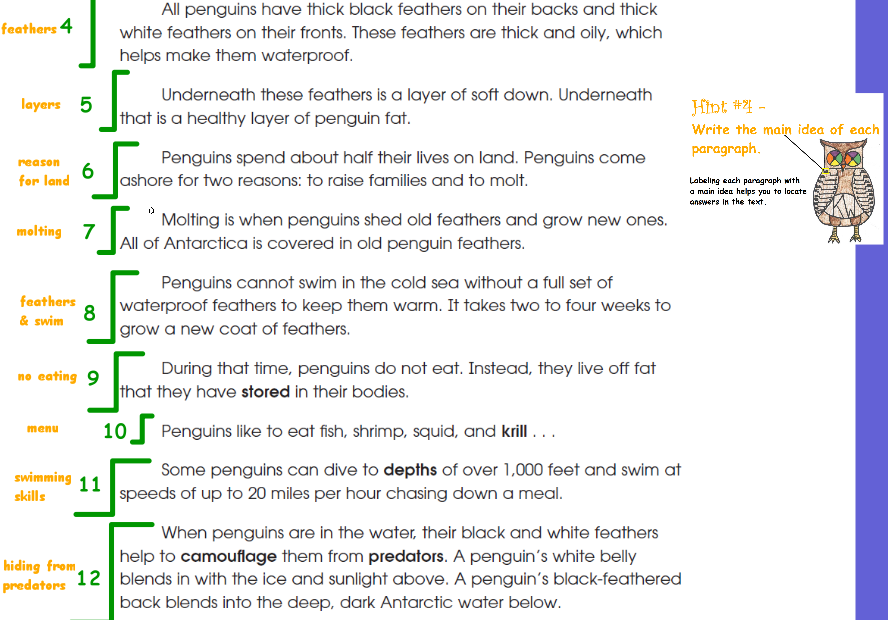
If you are a teacher, and you got through this post and you’re still thinking “Great idea, but I already do other things to prepare my kids,” I ask that you focus in on a part of S.H.A.D.O.’s suggestions that maybe you don’t specifically do.  For me, it was the steps related to bracketing and numbering the paragraphs, then marking the main idea next to each one.  Using that step has forced (in a good way!) my students to slow down and really think through each and every part of the texts they read on tests (both fiction and nonfiction–and heck, we even used it on poetry today!).  I think that if there is a magic bullet here, it’s that one.  Having the paragraphs marked like that has made it so much easier to go back to the text to find support for answers.  They now know so much more quickly exactly which paragraph to go to find the information they need.  Genius. 🙂

I’m adding a screen shot of what that step looks like next, because for me the words I just wrote wouldn’t make much sense (See?  Me=very visual):
So, I invite you to introduce S.H.A.D.O. to your class.  Come on, she has great ideas.  And hey, S.H.A.D.O. knows. (Ah, you didn’t think I could get to the end of this post without a joke like that, did ya?)

One more thing…if you’re a parent, I am interested in knowing what your kids are saying about S.H.A.D.O.  Maybe you were already introduced to her, or maybe you have another story about how she’s helped your student in class.  Share with us!
The Cat’s Away

So I’m home with a sick baby again today.  I HATE to be gone, but sometimes I just have to be a mom, you know?

So today’s absence reminded me of an idea I learned about recently.  I was out a couple of weeks ago, and I used a great idea from a couple of teachers I met when I attended an EdCamp St. Louis conference earlier this month.  They both teach middle school, and are out of the classroom periodically for activities with their school, and so need to leave plans for a substitute.  Rather than just leaving written ones, they record videos to leave for their classes, often teaching the lesson from their couch and giving directions for what they want their students to do.

Last time I was out, I knew ahead of time, since her fever popped up in teh evening.  So with my MacBook, my plans and my couch, I set to work putting together what I hoped would be a great day of learning for my kiddos, even in my absence.  Here’s what I left as a welcome to the day, along with our normal morning routine screen on the ActivBoard:

After they went off to specials, it was time for Writer’s Workshop in our room:

That big blue button sent them here to this video:

Next in our day was Math Workshop.  This video was a little different, but hopefully just as helpful.

Off to lunch and recess they went, and then back into the room for Read Aloud and then Reader’s Workshop.  Again, a flipchart welcomed them with directions:

Ok, well at least it had a place to send them for directions.  Those were here:

And here:

Social Studies followed Reader’s Workshop, as it normally does, and the lesson that they worked on that day was about the Natural Features of Europe:

Unfortunately this was the last day of the week, since we had a Professional Development Day the following day on Friday. We were also going to be out on Monday, too, since it was President’s Day! That meant I wouldn’t see them for what seemed like FOREVER, so I sent them off to their long weekend with this Goodbye and Good Weekend video:

Ok, so if you’re a frequent visitor to our blog, you know that I can’t write anything without ending with my thoughts and reflections.  And of course the topic of this post means that those thoughts and reflections are definitely doosies! (Is that how you spell that?  There was no choice for it in the dictionary. 🙂 )

(Now would be a great time to take a break and grab a snack if you want one!  I know I didn’t warn you that last part would take so long.  Sorry.  It’s ok, I’ll wait for you.)

Thoughts and reflections from using video sub plans:

Ease: The only reason I tried this whole thing originally is because I knew at around 6:00 the night before that I would be gone.  Since that was the case, I had lots of prep time to get it all ready.  This would not have been possible had I woken up and been surprised with an absence (like today, for example!).  Also, this was for an absence for a sick kid, not a sick teacher.  Had I been the one that was ill, this would have been almost an impossibility.  I hope, though, that since I’ve done it once now, and figured out all the logistics, the next time it won’t take me quite so long to put it all together.  And no, I don’t really want to admit how long it took me.  Ask your kiddo if you want.  I told them. 🙂  The other idea I had just now, though, is to prepare a generic “sub plan video” that could be used at any time if I had to suddenly be out.  It could then be added to my normal sub folder or uploaded to the portal that we use online to secure our subs.  Who knows, maybe I’ll start working on that one.

Logistics: I know this is partly related to the “ease” subject I just mentioned, but what I mean with this one is that there are a lot of logistical things on the school end that have to happen in order for my video plans to work like I had hoped they would.  The substitute has to know how to use the ActivBoard flipcharts I made, they have to know how to log on to my YouTube channel so the videos all play, and they have to be willing to follow the directions I gave in my videos.   So, in a perfect world, this would have been a great way for me to be at school with my students even though I wasn’t able to be there in person.

Impact: While the original reason I decided to try it was because it sounded like a great idea, incorporated technology and was something I hadn’t done before (which is often very motivating for me), I decided as I went through my planning, that maybe just seeing my face would be a subconscious reminder to follow the rules.  You know, unfortunately some kiddos tend to move into a different state of mind when they see a substitute at the front of the room instead of their normal teacher. I was also hoping that having me “teach” the normal lesson they were going to have for that day would help as they tried to keep the learning day as predictable and productive as possible.  I wanted to get the most bang for my buck.  I know that the day is never the same without me as when I’m there, but this was my way of trying to do what I could to help make it as normal as possible.

What experience do you have with using video sub plans?  What suggestions do you have for me? If you’re a parent, what do you think?  If you’re a substitute, have you used video sub plans in a classroom you’ve been in?  I’d love to know your thoughts!  Leave a comment for me. 🙂

Save the Last Word For Me

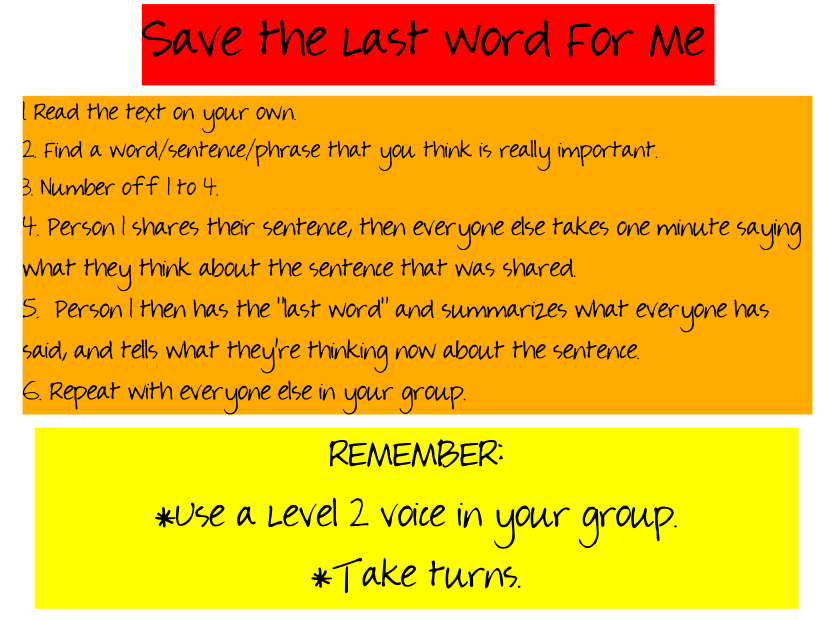
I love my job.  I love my school.  I love my principal.  She has such a great way of making meetings so relevant and useful, usually showing us strategies that we could replicate in our classrooms the very next day.  There are actually many meetings I go to around our district that are like that.  It’s kind of refreshing.  So when we were taken through the protocol for discussing an article called “Save the Last Word For Me” on Friday, I decided that this time I would try it with my class.  I teach 5th graders, after all–and amazing ones at that–so I knew they’d do great things with it.

Here’s the big idea:

We were using the article that’s in the picture here, which is about cloning.  It gives some background and then highlights the pros and cons of the issue.  As a means of ever more deeply discussing the topic, we tried this protocol in our small “heads together” groups this afternoon.  I tried it with a small group of friends as an example first, and then sent them to work.  I wish the video I had taken was of better quality, because it’s the kind of thing that makes more sense when you see it, rather than just read about it. Sorry.  Maybe next time. 🙂

Overall, most groups did a great job, and most were able to dig a little deeper by hearing other people’s perspectives on what they had individually read first.  Once we were finished, we debriefed and they shared what was hard for them about trying something like this for the first time.  I heard them share the very same things that were hard for me as an adult reader and listener the first time–talking for the whole minute when it was my turn (that’s a lot longer that you realize when you aren’t sure what to say!),  stopping when the minute was over (it’s a long time unless you have a really good idea to share, and then it’s AMAZINGLY short!), and only talking when it’s your turn (which is only once during each cycle of sharing).  That last one didn’t surprise me, because I have a class of talkers.  Or maybe I should call them arguers.  No, debaters.  And during this protocol, you are not allowed to comment on other people’s ideas unless you’re the next one in the circle.  Anyway, they have important things to say and we’re all working together on finding the appropriate times to share our important thoughts.

Like I said before, I am always learning new things in my job as an adult learner, and when I can share those experiences and ideas with my kids, it’s a double bonus.  We’ll use this one again, for sure, and I’ll be excited to share with you how it goes.

And so I’ll end with a short shout out to Mrs. Sisul and Mrs. Ford for using this protocol with me.  Love that I learned it from you. 🙂

So have you heard of protocols before?  Have you tried this one?  What other ways do you use in your classroom to facilitate conversations around a text?

The End of Literature

Literature Circles, that is. 🙂

We have spent the last few weeks meeting in Literature Circles to read and discuss a book together.  The kids have done an amazing job of thinking deeply and talking openly.

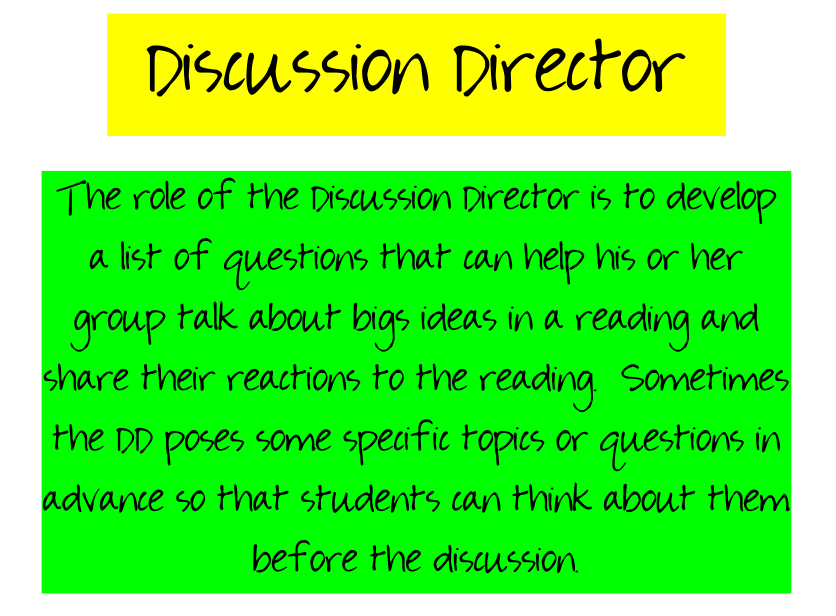
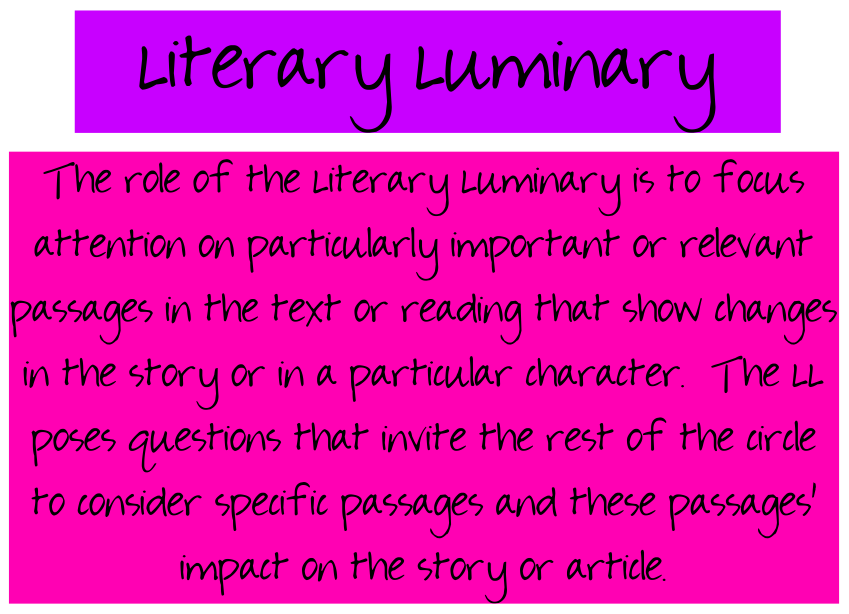
At the beginning of our study, we read several texts together, learning the roles that they would later use in their groups independently.  They learned–and then practiced–the roles of Discussion Director, Character Creator and Literary Luminary.

After we worked together, each student was given the choice of which Literature Circle they’d like to join.  Each kiddo gave their first, second and third choices for which group they’d like to join, then were put into groups of 4-6.  For the next three weeks students read and wrote questions about the book they chose.  Their lit group met three different times, and students had different roles each time.

The themes of the unit were responsibility and choice, as students focused on taking turns, making sure their voices were heard, and using the text to support their thinking.

My students did an amazing job with these groups!  They’re excited to try it again later in the spring with different book choices.  What great experiences we had together.

What experiences have you had with literature circles or book clubs?  Do you have any advice for us for the next time we meet? What book would you choose to read?

Right Question, Right Place, Right Time

I sat down today to do reading conferences, unsure who I was going to start with on my list.  I love it, though, when a kid comes at just the right time with just the right question to help me make my decision!

So enter my friend, D.  She came over to me and asked a simple question: “Do you have any good books?”

I LOVE it when a kiddo asks me this question, because it means I can do something to help get the right book in their hands.  So we sat together and started talking about recipes.

Yep, you read it right–recipes.  We started with background, whether or not she had ever cooked before.  She told me about how she had just made brownies, and so we discussed how a recipe helps you make sure you end up with the product you wanted–a recipe for brownies helps you end up with brownies if you follow the steps.

So D and I started writing her “Recipe For a Good Book.”  The idea behind this is that you can use things that you already know you like as a foundation for finding new things you’ll also like.   The end product is the “good book,” and the recipe is how to get there.  Just like how brownie mix + eggs + oil = brownies.

We talked about some of her favorite books, and she told me she really enjoyed Fudge.  So we started her recipe with Fudge and Judy Blume.  When I asked her what she liked about it, she said she liked it because is was funny because of the kids.  So we added funny and kids as main characters  to our recipe.  I got her thinking about some other favorites and she mentioned Ramona.  We talked about how there were some similarities between Ramona books and Fudge books, and so it makes sense that she’d love both!  Next we added Ramona, Beverly Cleary and family stories to our recipe.  After some more thinking and reflecting, we ended up with a list that looked like this (after she made it into a bookmark):

Once we had the recipe, we tried it out together.  We have a basket in our classroom that’s for GOOD BOOKS (some of my favorites that I’ve put together in a collection), so I figured it was a good place to start.  Immediately we found three books that we thought would fit her recipe really well:

The Zebra Wall by Kevin Henkes, Ramona Forever by Beverly Cleary and Clementine by Sara Pennypacker

By going down her list of ingredients for a good book, we realized that all of these were good options for my friend!  They had many things that she was looking for, and they were a good fit for her reading level.  Success!

The original idea for this came out of a conference I had with a student almost 3 years ago, and it has been appropriate for so many more readers since then.  I love getting the right book into the hands of a kid reader, and better yet, she has a plan for when she goes book shopping next time.  It’s a win-win. 🙂

Light Bulb Moments

In case you haven’t noticed, read-aloud (chapter book) time in our room is a big deal.  This ain’t no lay-on-the-floor-and-rest-after-recess-time.  My kids will tell you that read-aloud is one of the most important times of the day–we use the chapter book to connect to reading, writing, vocabulary and many other things.

Right now we are deep in the middle of The Secret of Zoom by Lynne Jonell.  In Reader’s Workshop, we’re working on inferring in fiction text.  So today as we read our chapter book, we focused on noticing and recording inferences we were making about the story.  We reviewed the meaning of inferring (which we defined as background knowledge + text=inference), and then got started.  There were a couple of parts when I paused in my reading to say “You might be able to infer something here,” but for the most part I just left them to their listening and thinking.  Then I read a sentence and K, who was sitting right in front of me made a rather loud noise, somewhere in between a gasp and a screech.   She covered her mouth, grinned, and then scribbled something in her notebook.  And I knew exactly what she was thinking.  She had figured out something in the story–she had made an inference.

Now, every time you infer something in a story, you don’t make a big deal like that; it’s not always so obvious.  But this was a really great illustration for us.  Some kids in my class have a hard time knowing when they are inferring; they know what to do, but they don’t always attend to when they’re doing it.  But I’ll but from today on, they will know that when you have a “light bulb moment”, when you say “Ahh! Now I get it!” or when you think “aha!”, you’re probably inferring.  It was cool to watch several others do the very same thing–most without the screech–as we continued to read.  And I’ll bet we’ll notice more of it tomorrow.  I love how the thing that really made it visible, too, is something I couldn’t have planned for (the best learning moments happen like that!).  It came very naturally, and was really powerful for them.  Next time you think “aha!” or have a “light bulb moment”, pay attention –you might be inferring something, too. 🙂

Exciting Things Coming!

The end of October brings with it an exciting feeling for me.  November and December are two of the best months in school, in my opinion.  We have multiple units that are my favorites to teach, I share some of the best read alouds of the year (again, my person opinion), and the excitement of the fall/winter holidays is everywhere.  Because of all of this, I get a needed 2nd-quarter energy boost.  So join me as we dive into fractions/decimals, fiction stories, The Secret of Zoom, Fig Pudding, Ancient West Africa and inferring in poetry!  Along the way we’ll ride on a magic carpet with Alladin (thanks to the Nipher musical next week); take a few days off for Thanksgiving; talk about the science fair and make plans for the projects to start in January; drink some cocoa together on cold days and then eventually celebrate the season at our Winter Party at the end of the quarter.  I don’t know about you, but I am ready!  Happy Fall!

Getting back into it…reading

I feel like I apologize alot.  Especially about how long it’s been since I’ve posted on here.  But hey, here I am doing it again.  Sorry–that’s just the way it is.  I do have a full-time job, after all.  🙂

So I’m thinking I’m just going to give a quick overview of what’s been going on for the last month, and then I can hopefully come back more often and fill in the gaps.  Hopefully.

Reading:  For most of the month of October, we were working on text features in nonfiction and asking questions that help us better comprehend what we’re reading.  I loved the text features project we did, where the kids were given a plain text (about the Iroquois, which we were studying in Social Studies) and asked to add text features to it that would help their reader better understand what was being presented.  It was a great way to see how much they really understood about how pictures, diagrams, captions, headings, subtitles, etc., impact the reader.  These turned out great, and most kiddos really got into it!  We also practiced a strategy called Stop and Ask Questions, which is a mainstay in Making Meaning.  As we read (picture books during Reader’s Workshop, chapter book during Read Aloud and independently in their own reading), we stopped at several points in the story to record what we were wondering.  The goal was to focus our thoughts in on specific details in the story, then pay attention for when the question was answered.  Like I say often: The other part of a good question is a good answer.   Last week, then, we moved on to a new unit on story elements.  We’ve been looking at how analyzing characters, setting, plot, problem/solution, etc., can help us better understand that story.  Today we read the first half of Star of Fear, Star of Hope and will continue with this text tomorrow.  Stay tuned for more in reading soon!