Class Pet Petitions

I don’t know how long you’ve been reading, or how far back you’ve gone through the post archives, so I’m wondering if I’ve told you about class meetings yet?  I wrote about the big idea behind them here, and the story was pretty great.  This class is doing an amazing job with class meetings, too.  Each week, though, when we sit down together to reflect upon the week and talk over things we want to improve upon, there aren’t really any problems to solve.  Oh, come on.  No way, right?  No really–we had to change the last question on our meeting protocol to “What do you want to talk about?” rather than “What do we need to improve upon?” because of how well these kids work together, learn together and just generally follow the rules and procedures of our school.  Don’t get me wrong, they’re not perfect.  We do work things out together.  This week was an example of two kinds of issues to discuss.

 
Like class pet petitions, for instance.  Here is what the flipchart from this week’s class meeting:
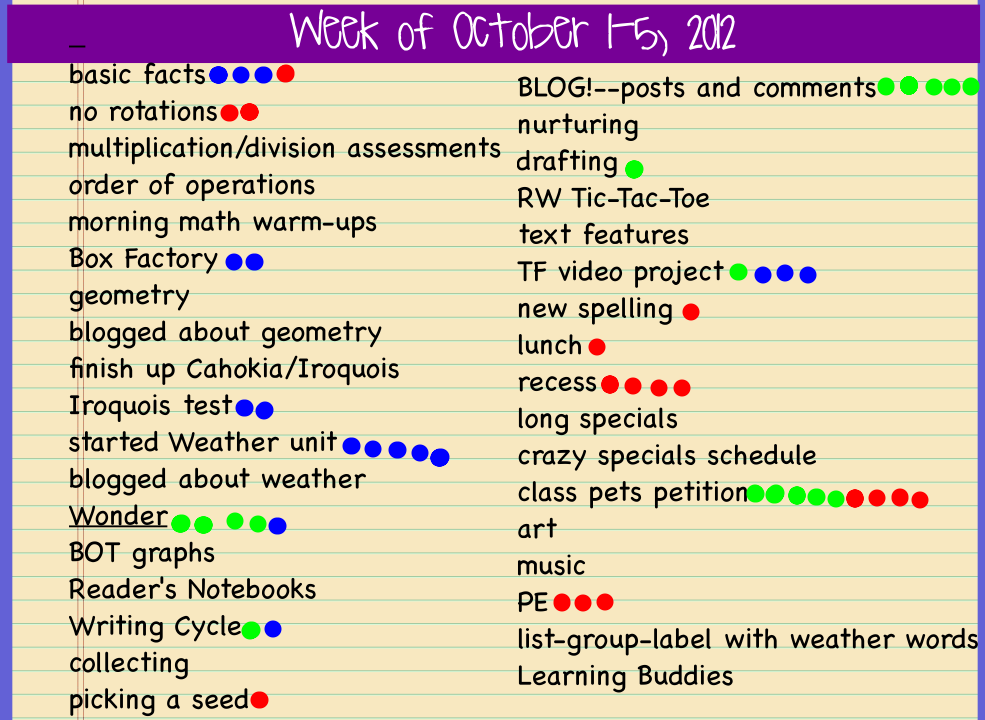
So, see all those dots after “class pets petition?”  It meant that several people wanted to talk about that topic.  But again, it wasn’t because it was a problem.  They just wanted to talk about it.  They needed to decide whether or not it was a good idea for Ames to make us an origami class pet, and if so, what type of animal we’d want to have.  We decided that Ames (as the origami master of our class) would narrow the list down to four of his best creatures, and we’d vote on the one we liked best out of those four.  Then we’ll chat about it again next week.

Ok, so there did end up being a concern they did want to try to work out, and it was related to recess.  A question was posed about what to do when you try to play with people and they tell you you can’t.  We had a great conversation about strategies to try, words we could use and how it felt when someone told you you couldn’t be a part of the group.  The idea of “popular” kids was brought up, and the concern was raised that there are some people in our grade who won’t play with certain kids because they’re friends with certain other people who are considered weird or different.  It hurt my heart as I heard them talk about what was going on outside on the playground, and we decided that it might mean we needed a grander conversation.  We agreed that we would do what we could to support each other outside–like paying attention to when people are alone and inviting them to play, or standing up for our classmates if we see or hear something mean being done to them–but we agreed that this might be a topic that would be better discussed with our whole grade level.  So I have “homework” to coordinate a 5th grade recess conversation in the next few days.  This was definitely a problem worth tackling, and one that we want to see solved.


Mental Models and The Mississipians at Cahokia

Our first Social Studies unit of the year (well, the first “official” one after we set up our classroom community) was a doozey (is that how you spell that??).  Let me back up.  The theme for 5th grade SS is Three Worlds Meet, and so we study the Native Americans, Ancient West Africa and Medieval Europe, then look at how all of those cultures merged and became the Colonies.  The first unit, while being about Native Americans–specifically the Mississippians at Cahokia and the Iroquois–was also about bigger things related to mental models.

What are mental models, you ask?  Check out this example that we use to help explain them to kiddos (taken from the text we use during this unit):

We begin by looking at the mental models that many kids have about Native Americans.  Many of these are things like that they live in tepees, they wear buffalo skin or feather headdresses, they are savage hunters and that they danced and chanted.  None of these mental models are wrong, so to speak, but as we go through the unit, we hope that by learning new things about specific groups of Native Americans, their mental models will be challenged.  And maybe changed because of their new knowledge.
We specifically study the Mississippians at Cahokia, or just Cahokians, because they are from an area very close to where we live in Missouri.  Cahokia, Illinois is just a hop, skip and a jump across the Mississippi River from the area that these kiddos know so well. For that reason, they are more easily able to make connections and inferences about how the Cahokians may have lived–and they realize that in many ways these people are more similar to them than they are different.

I mentioned before that there is a text we use, which is broken down into the five disciplines of Social Studies (history, economics, geography, culture and civics) and these disciplines provide the framework for all of the conversations and activities that we do during this unit.  First we learn what each of those are generally, then are able to zoom in on them more specifically to Cahokia (and later to the Iroquois, but I’ll tell about that in a later post).

Before we jump into our text, however, we have a lesson about figuring out the difference between important and interesting when you’re reading, so you know which parts to pay most attention to as a reader and learner.  We discovered that it all looks important, until we look more closely at the purpose of why we’re reading.  For example, if we are reading to find the answer to a certain question, then the only important things are the ones related to answering that question–all the rest is just interesting for now.  If we are reading just to find out about economics, then only the ideas related to economics (not history, culture or any of the other groups) are important for now.  As we also discovered, what’s important changes based on your goal.

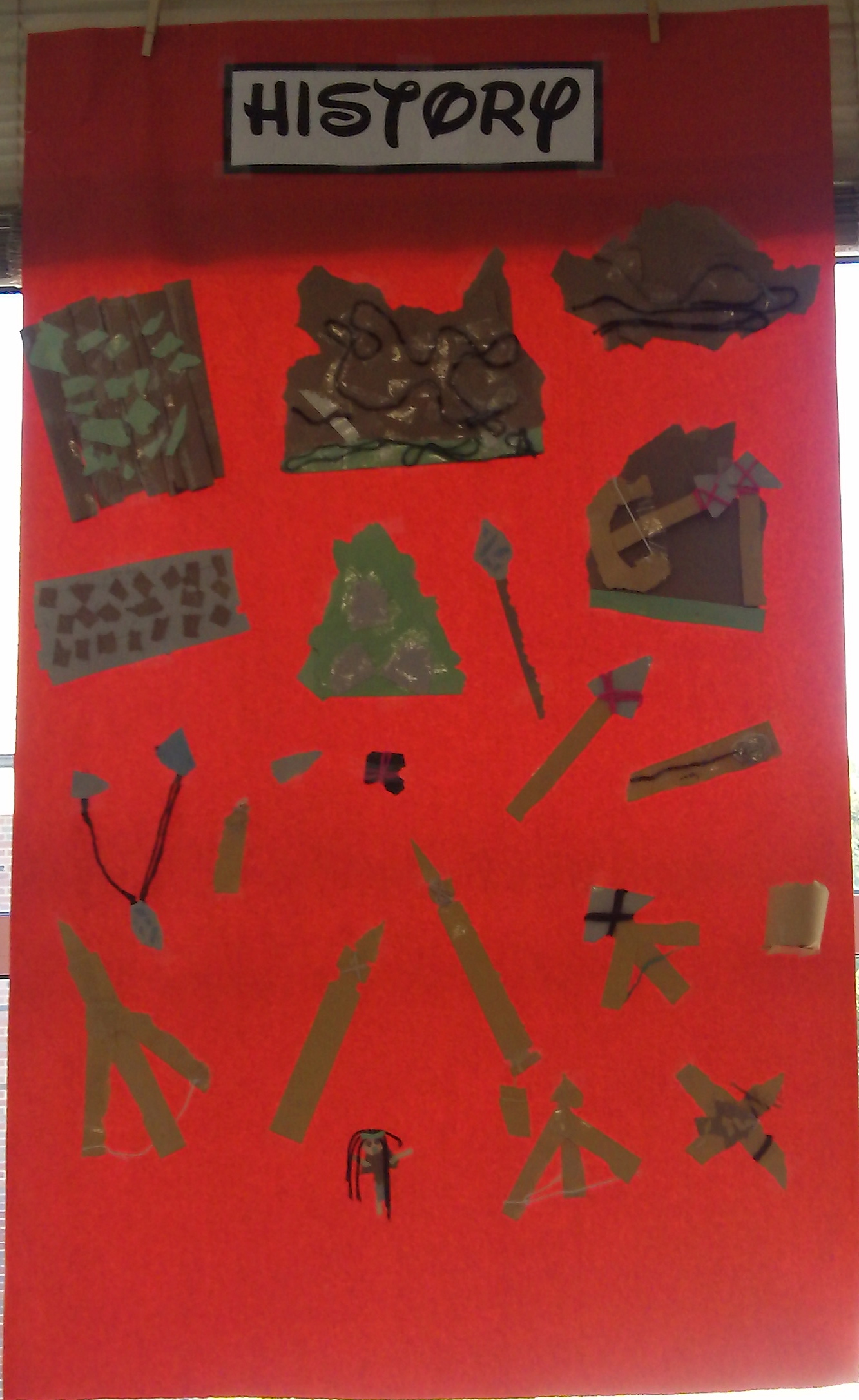
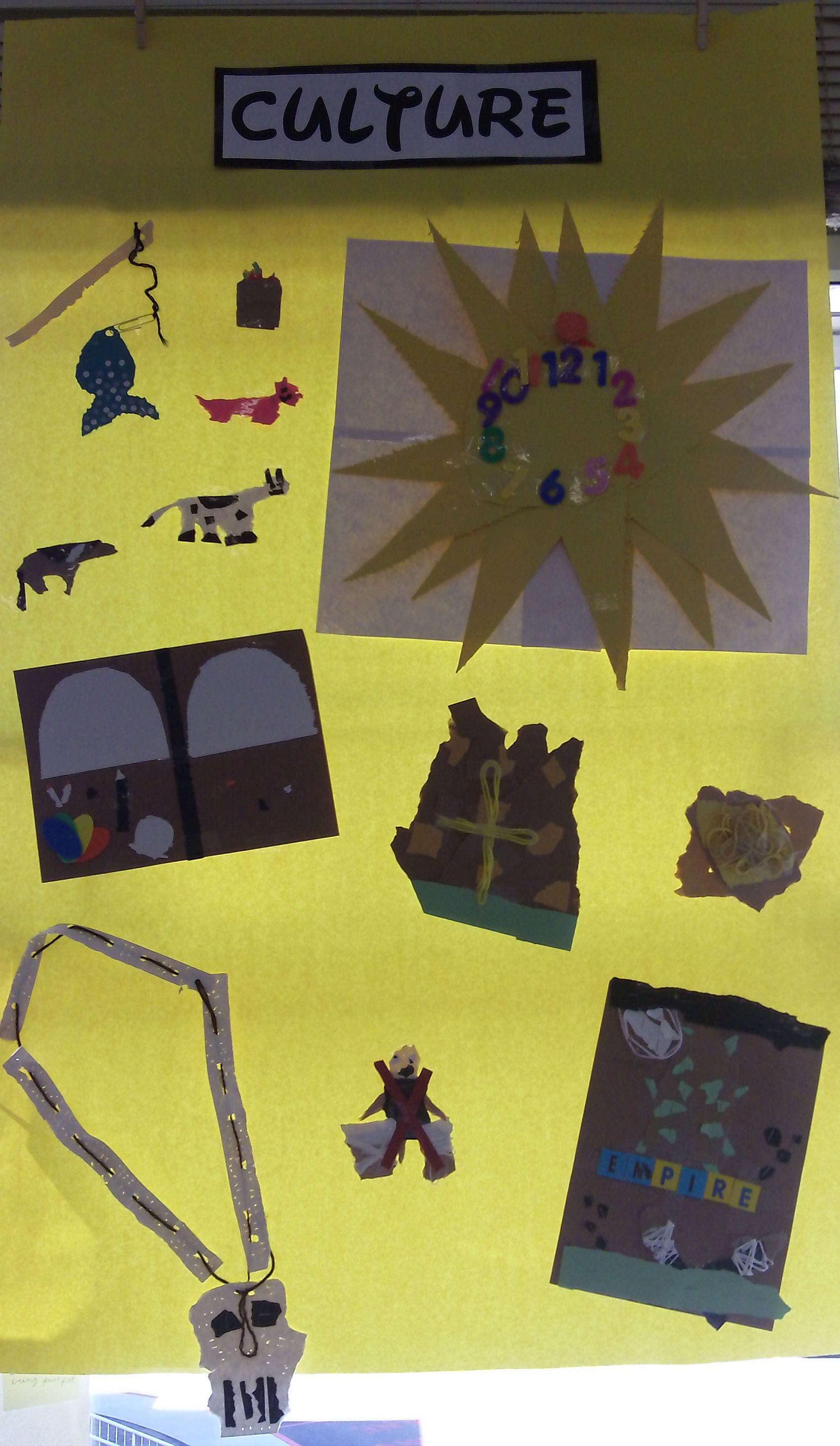
Ok, now that we know how to pick out the parts we need to remember, we got busy into the real work of this unit.  In short, for every discipline, we read a section of the text and underlined what was important, then made a class list of those key ideas.  After that, we created big window-sized posters with representations we made to show each of the big ideas.

Nice, right?  An art project to help us remember what we read about.  Fun, too.  Yes, but it’s not that simple.  There are very specific rules about how you are to go about creating your representation:

1. You may use paper and anything that holds paper together (i.e. paper clips, tape, glue, glue sticks, etc.).

2. You may not use scissors.

3. You may not use any writing utensils.

What was once just a simple show-me-what-you-remember-from-what-you-just-read type activity is now a challenge to think outside the box, to be creative, to solve problems.  So I was all the more impressed with what they came up with, the quality of their images, and the creative ways that they figured out to get their job done–like using the edge of a ruler or a paper clip to score paper so you can tear it neatly in the shape you want it, rather than cutting.  Or using the punched-out pieces from a hole punch together to create a picture.  Amazing, really.

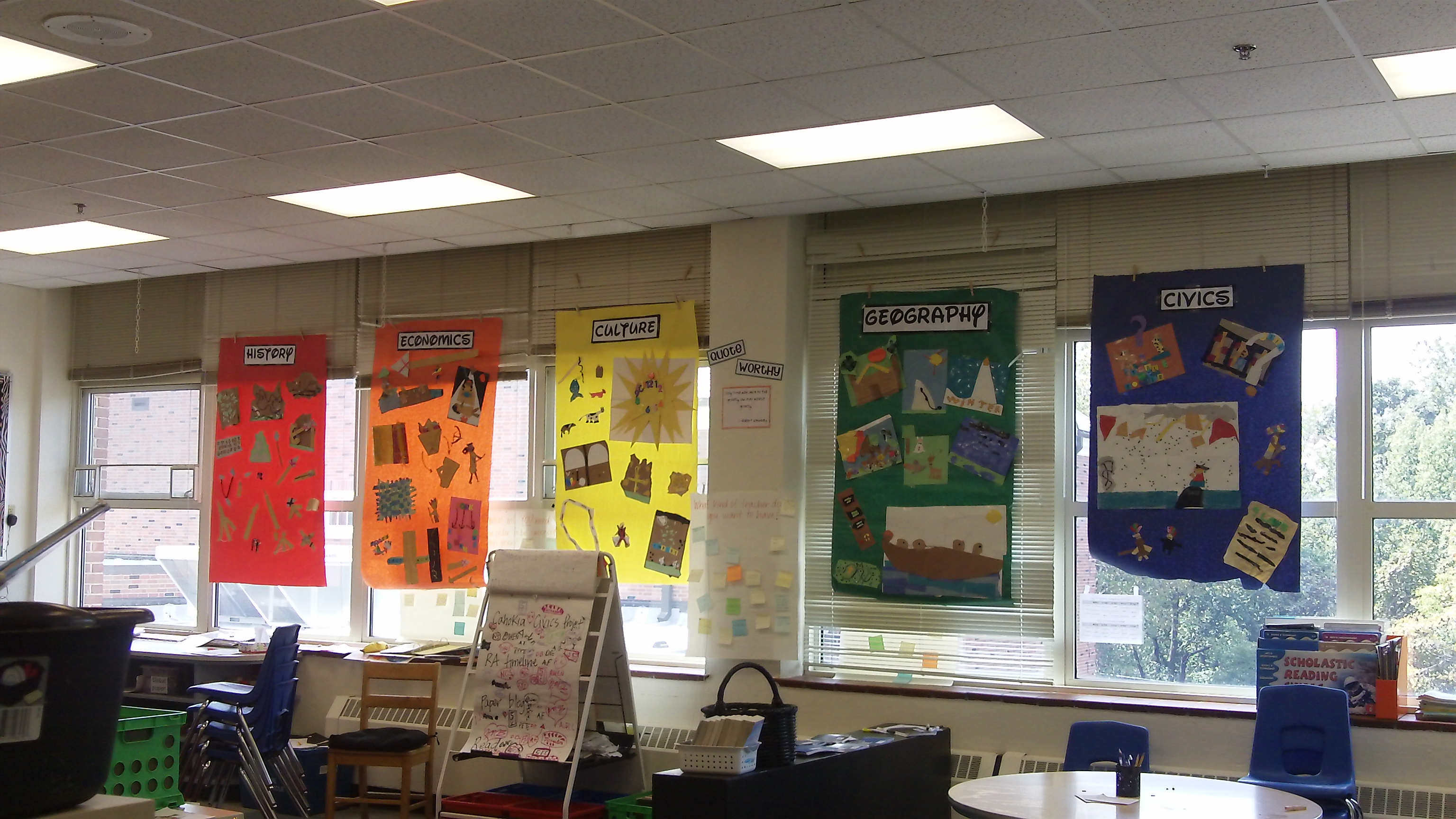
Here’s what our posters look like once we were finished–which really took us about 6-7 school days to accomplish:


Besides the fact that these hold a lot of information and show what we’ve learned about what’s important about the Cahokians, I love how they look hanging on the windows:

As we were working on these projects, it was so great to see the group/partner work that was taking place, the problems that were being solved as they created their pieces, and the smiles on their faces as they worked.  I was so glad at how many kiddos voiced to me how much they loved doing this because it was “so different from anything I’ve ever done before.”  They told me how the rule of not using scissors and pencils “made their brains think in a new way and challenged me in a new way.”  Gotta love it when kiddos say those things out loud!  It’s exactly what I had hoped was happening.

On a side note, these posters hung in our room throughout the whole Cahokia unit, and we came back to them time after time, as we made connections between different aspects of Cahokia, our own lives, and then as we moved into learning about the Iroquois.  I’m actually going to be sad later this week when they have to come down to make room for other things. 😦


Geocaching!

Today our class went geocaching!

First we had a reminder lesson about latitude and longitude, and a how-to with the GPS devices.  Oh, and we talked about what GPS was, too. 🙂  We needed our plan and our GPS devices:


Then we were off!  And how lucky we were they today’s weather broke just before we were scheduled to go outside on our hunt.  We’d been watching it rain all morning out our windows, but it was reasonably dry by 1:00.  Yay!


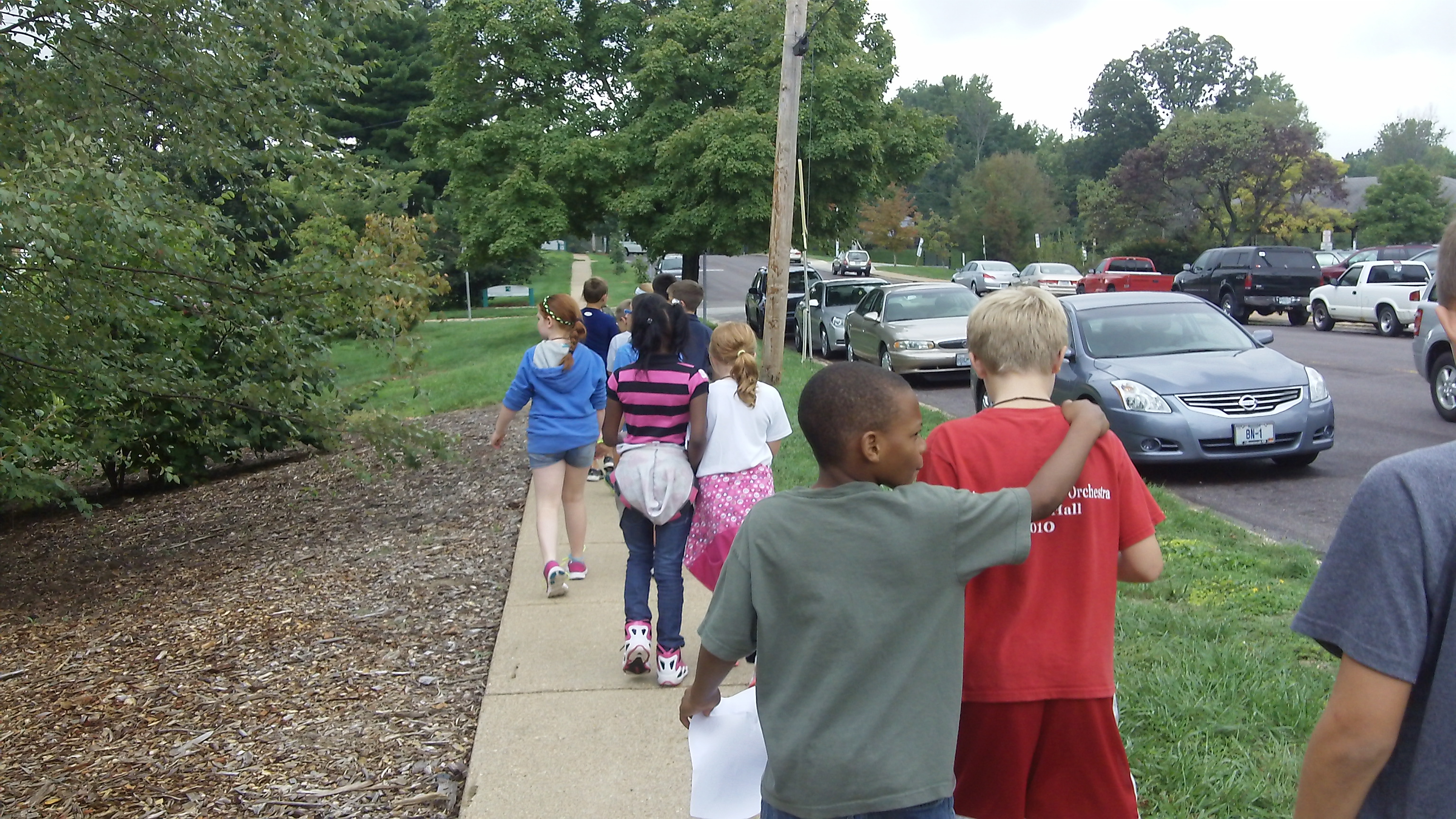
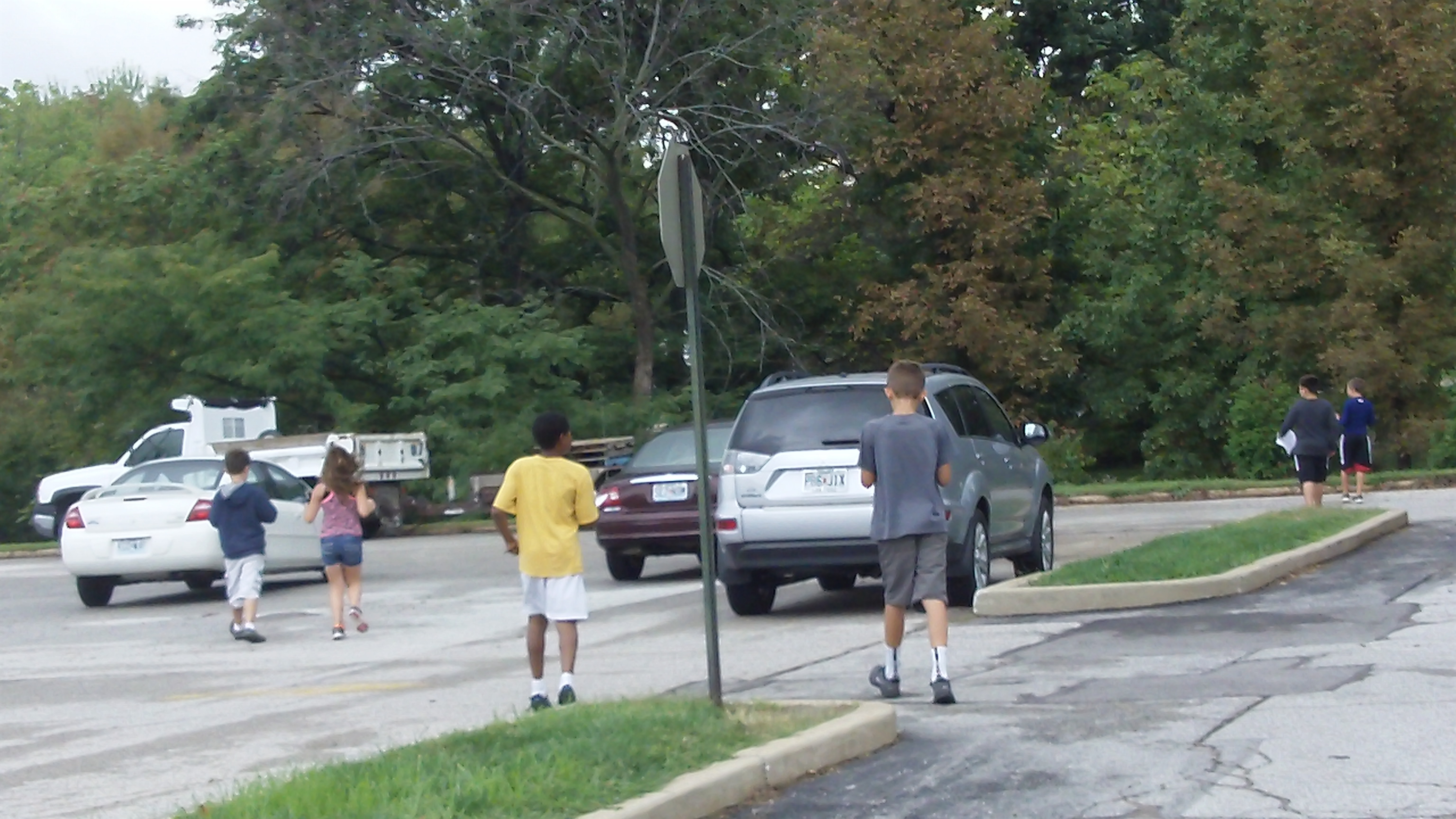
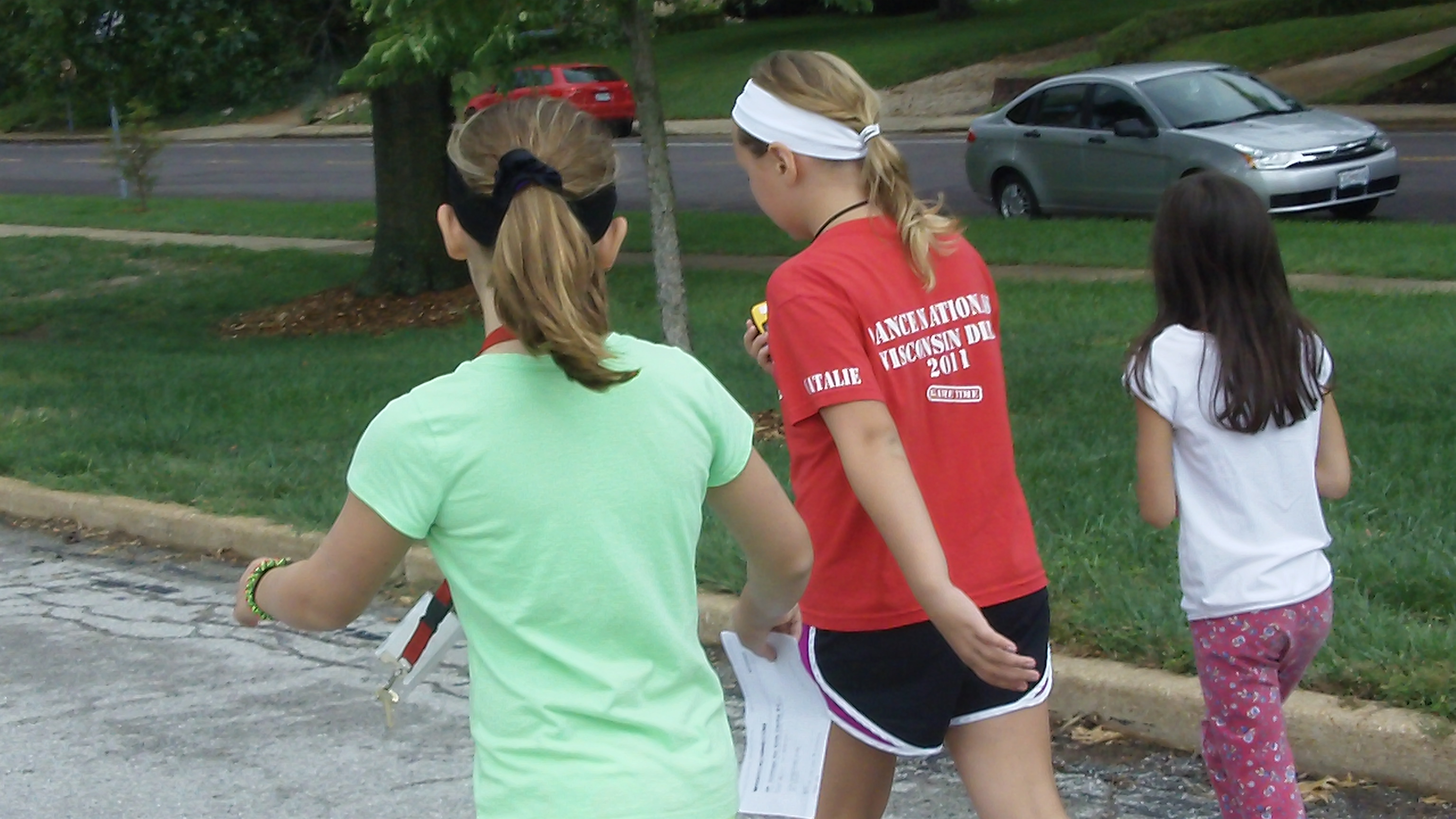
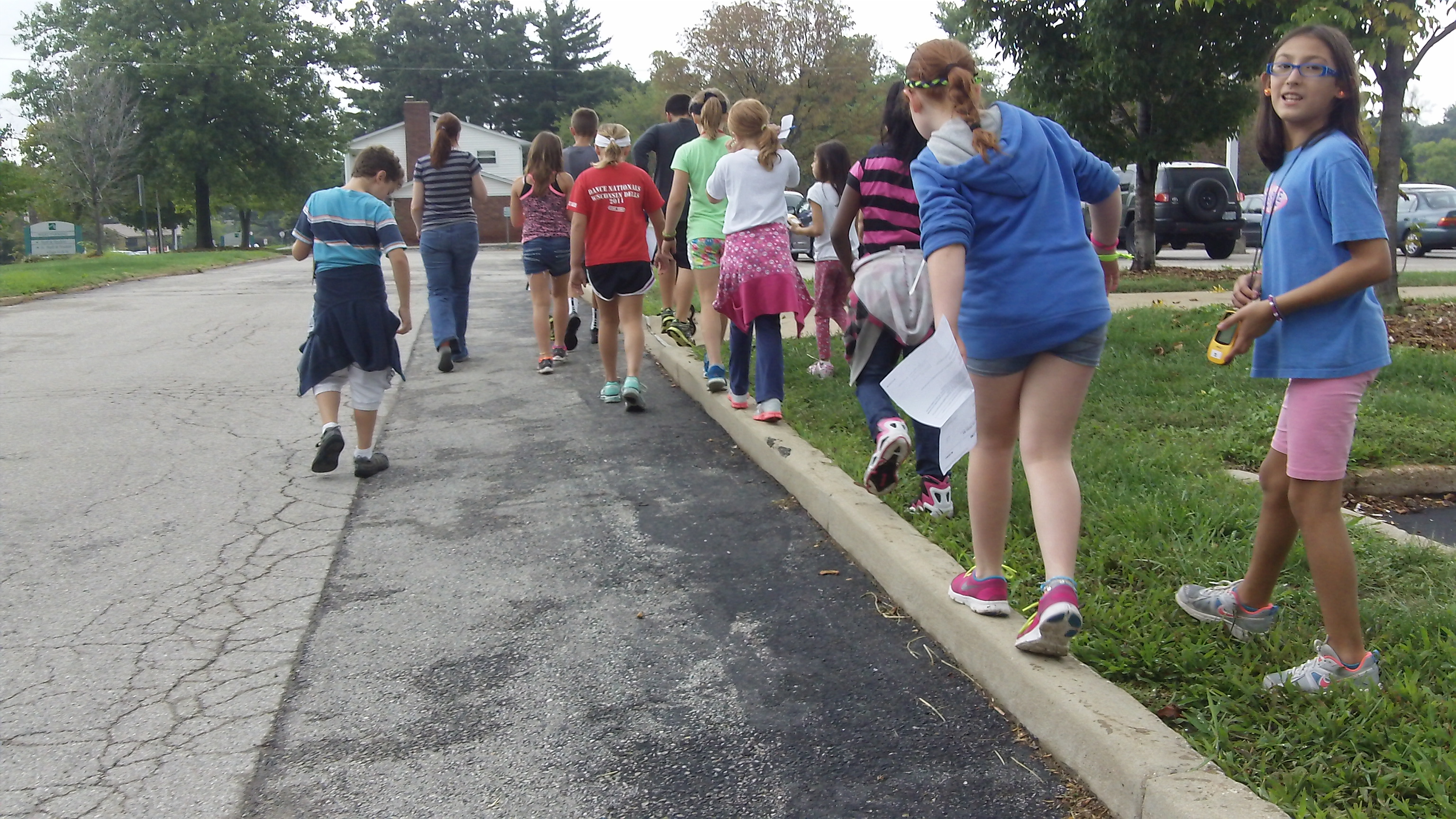
The cache we were looking for was hidden across the street from our school at Meramec Community College and was put there by a College for Kids class that learned about geocaching a couple of years ago.  We went walking in that direction, checking our GPS’s as we went.


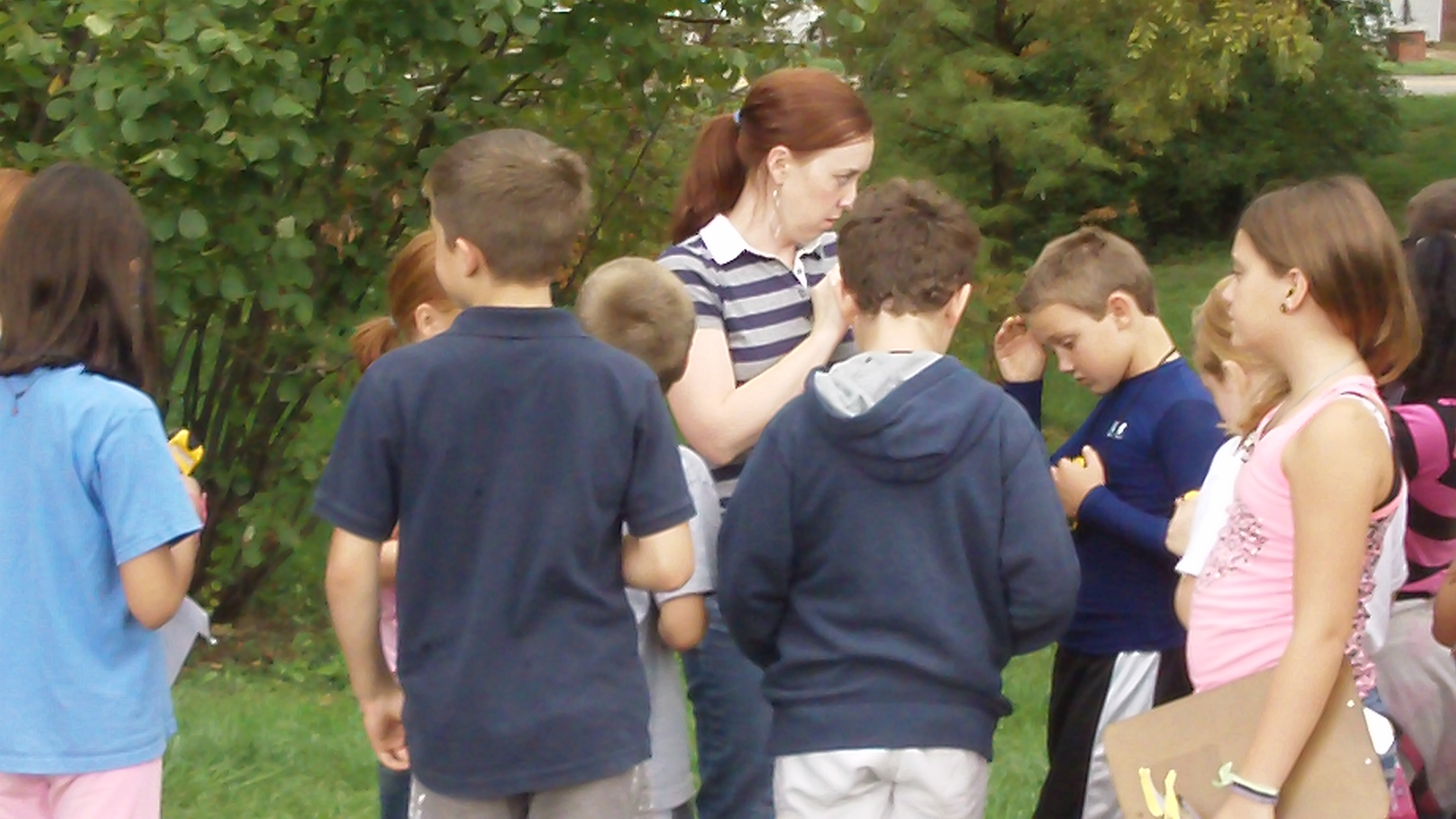
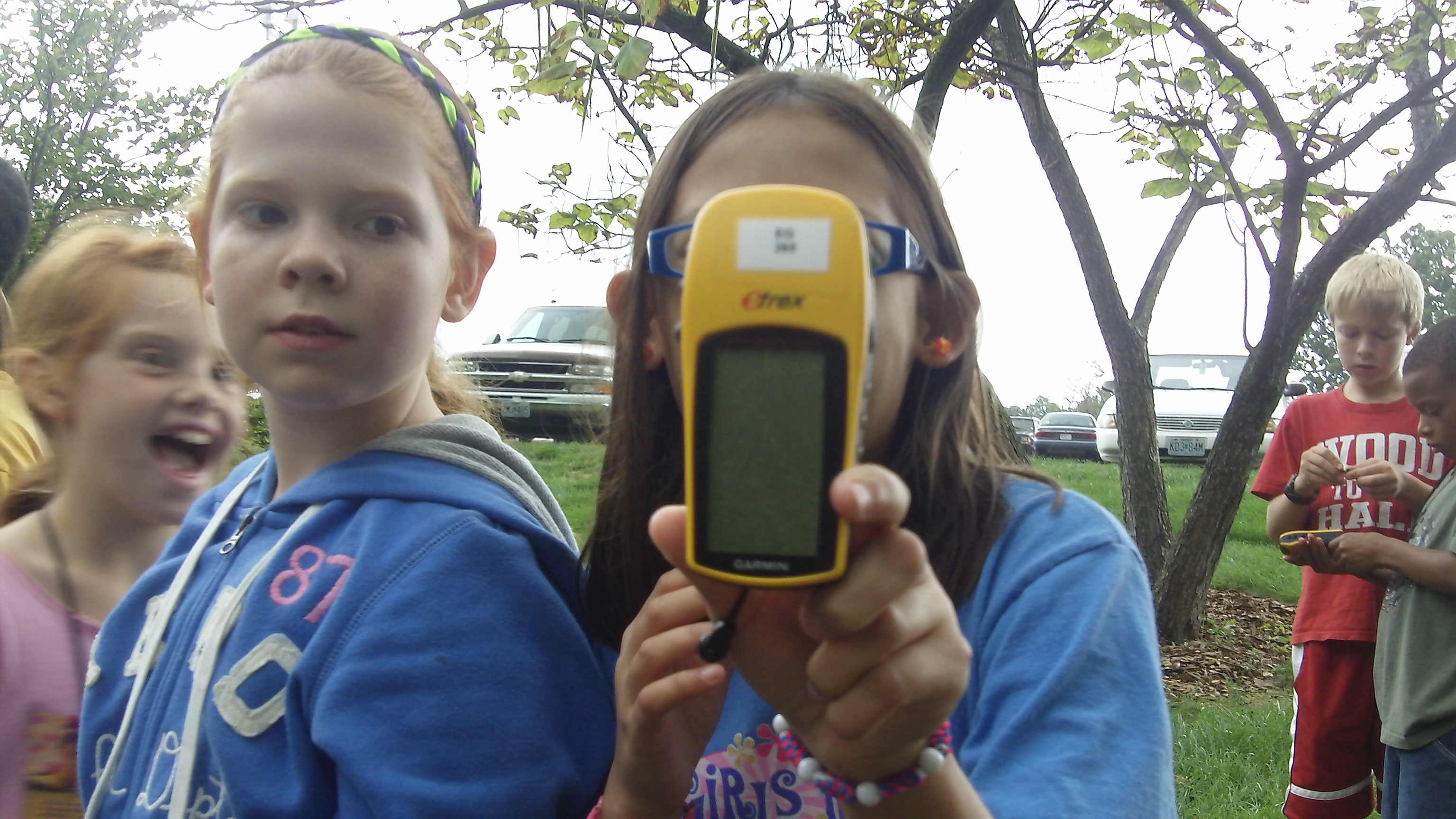
Then we new we were getting close when lots of kiddos started to gather around this tree.  Their directions were to just stand there if they thought they found it–rather than yelling and screaming and spoiling it for everyone else.


Then…

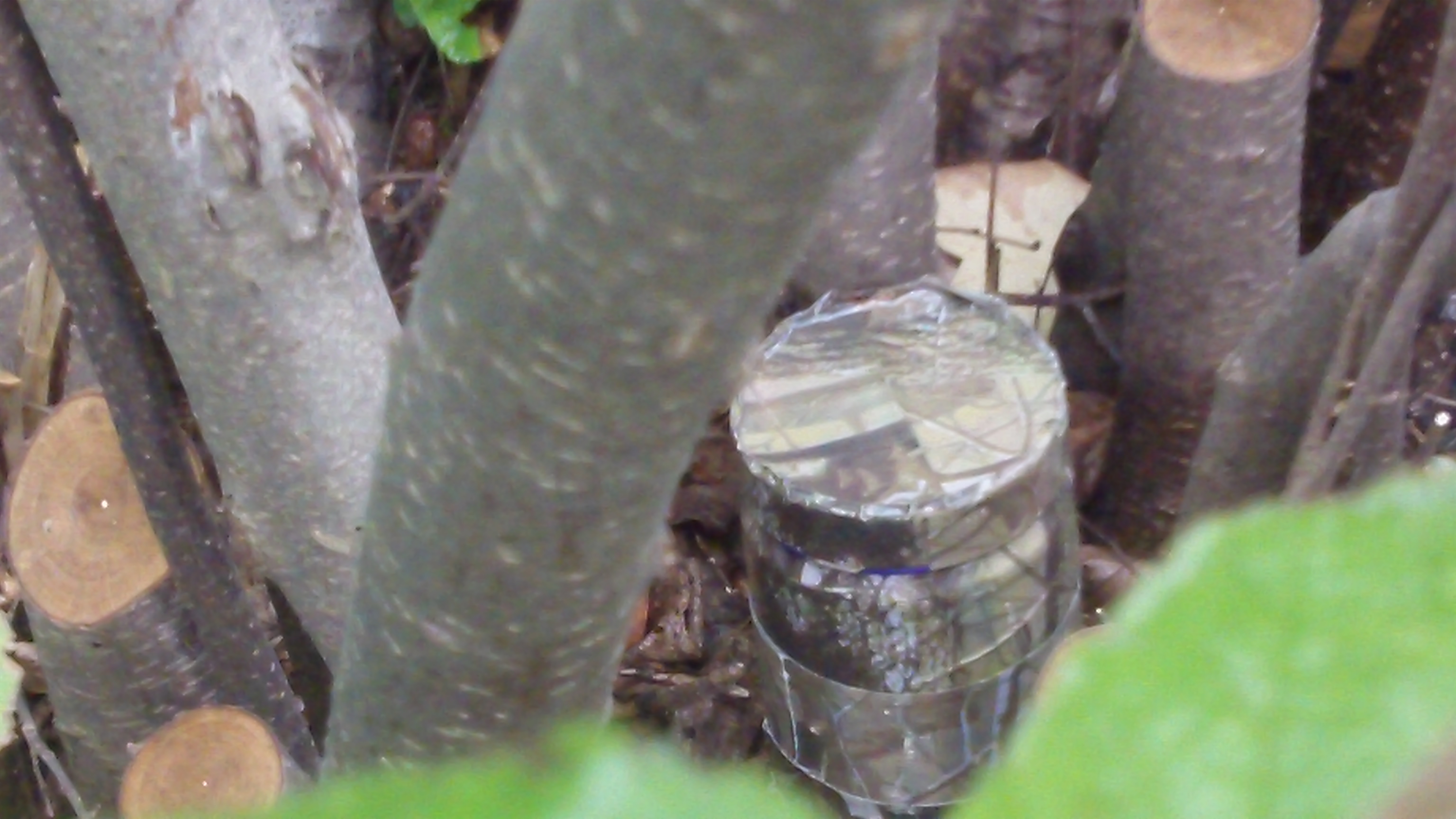
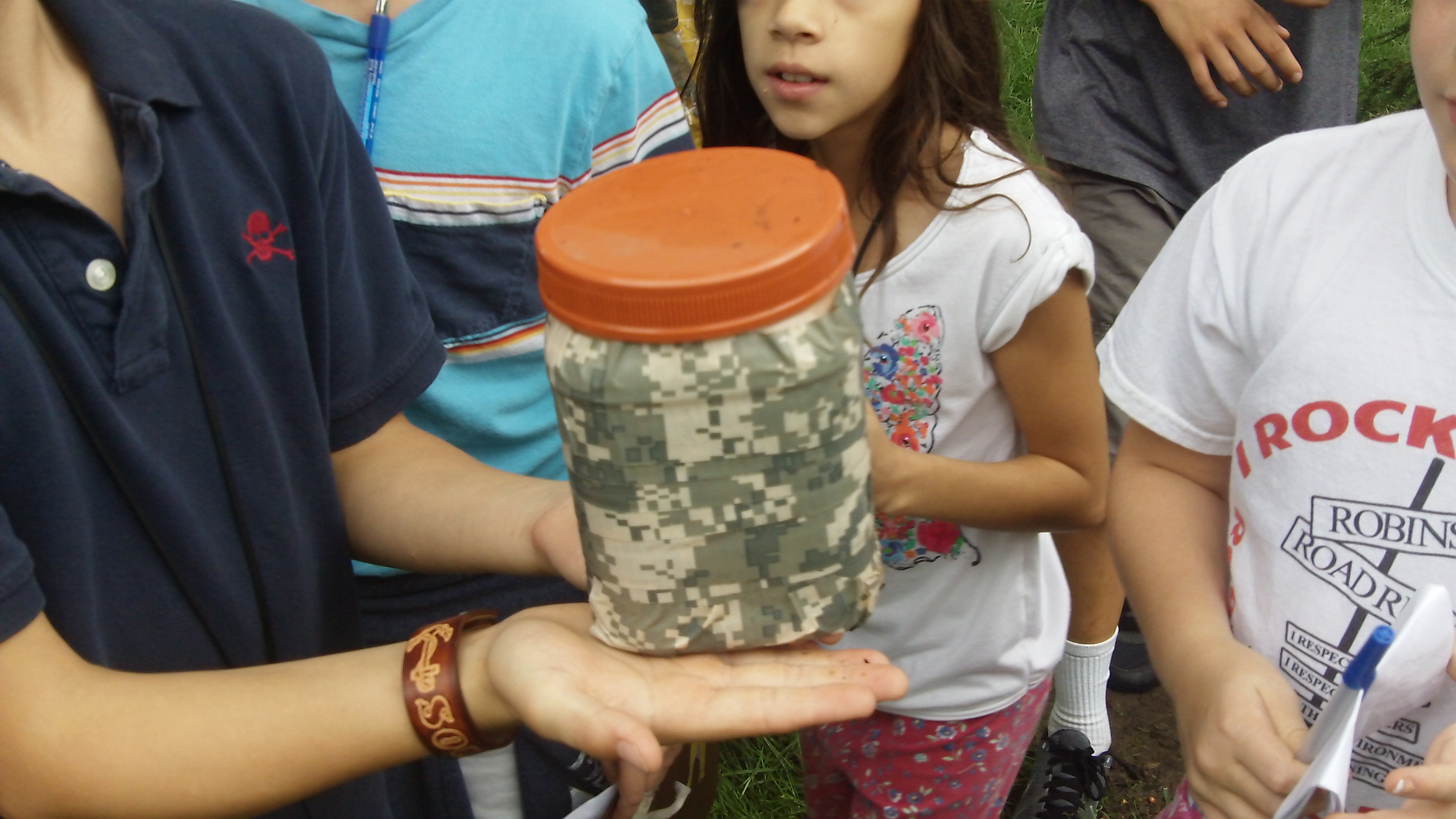
We found it!!  Can you see it there?  Even though we didn’t need it, there was a clue on the directions to help if you got stuck.  The clue was: the container is a camouflaged plastic jar.


Now, to open it!

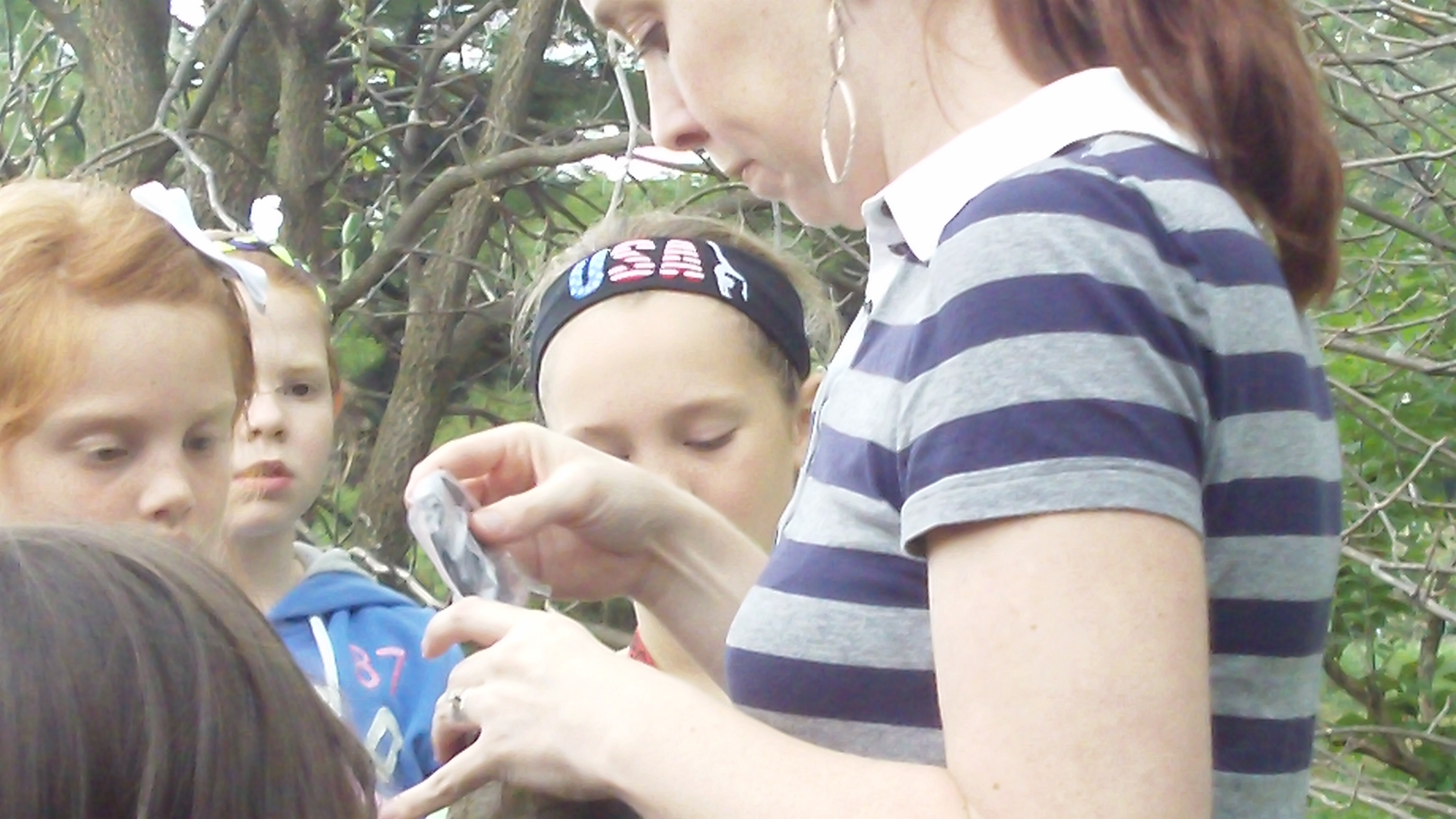
Yeah, I know–horrible picture! But inside we found a log book, directions and an explanation, and lots of little trinkets that other geocachers had left before us.  We signed the log book, and I showed them all the other goodies that were inside.


We logged in: 9/17/12 Robinson 5th Grade 2012.  We saw that lots of other people had been there since the cache made in 2010.  One entry was from the  Trailblazers group at our school on June 29, 2011, and one was even Anna’s family!  I took a picture of the log book to prove it, but alas, it was blurry, too.  Believe me, her dad signed it with song lyrics! 🙂

I know–corny pic, right?  This one was a card that the person made solely for the purpose of using it to geocache.  He was San Diego, CA!  All the way to that geocache in Missouri.  Very cool.
So after we found this one, Keelan and I took the class to the geocache that Trailblazers (a science/technology club that our librarian, Mrs. Meihaus, and I let the last two years) had created and placed.  We were originally going to hunt for that cache, but we couldn’t find it when we searched for it online. BUMMER!  We took them there and found another huge bummer.

Looked great on the outside, but the bummer was what we found on the inside of our cache:

Half of the things we put in there were gone, and it was all wet and moldy!  YUCK!  This will definitely take some tender-loving-care to get back to the state it was in when we hid it last year.  Boo. 😦


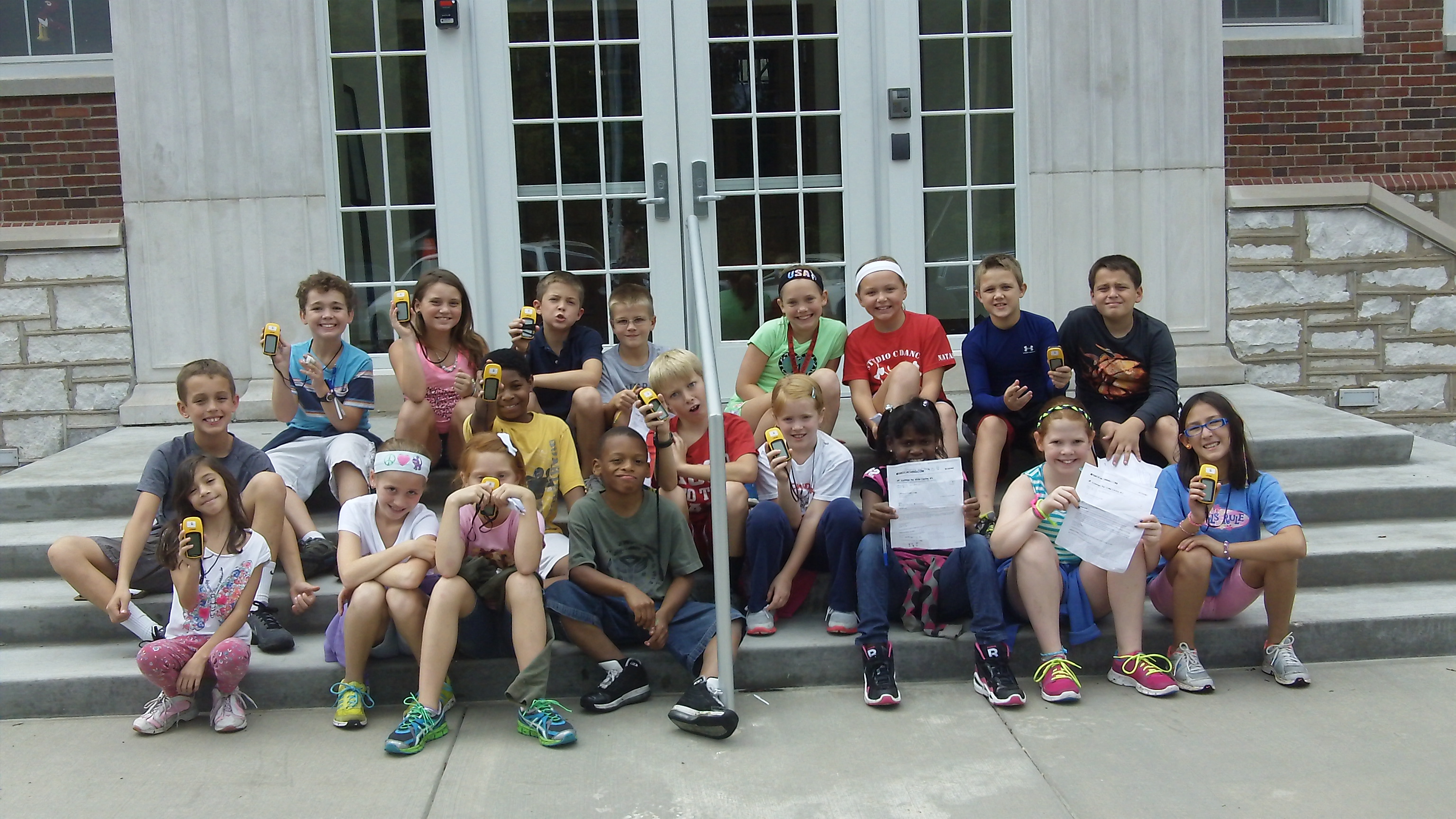
Ok, now a few more fun pics that were taken when I gave Fiona the camera, and a group shot.

Say cheese!


What a great afternoon of geocaching fun with friends! I know I wish I learned about geography like this when I was a kid. 🙂

Have you ever been geocaching before?  Do you have any suggestions for any good caches we could find? Tell us your stories!

I Remember!

I remember it like it was yesterday, in my first year of teaching–1st graders.  It was extra eerie on this anniversary as that morning was very much like it was today: bright, cool, and with promise of exciting things to come.  Who knew what tragic events would unfold as I was driving to work that morning?   And while you and I have memories of that fateful day, our friends do not.

This is the first class I have where most of my kiddos (well, all but 2!) were not even born on September 11, 2001.  Everything they know about September 11, 2001 is from stories, TV, books, etc.  And I wonder if even the stories they’ve heard are true, or if they’re more based on bias and opinion–intentional or not.

So how do you deal with a major topic in their history in a way that both makes sense and doesn’t scare them?  How do you share truth in an appropriate way for a 10- or 11-year-old?

I decided to tackle the anniversary first in Writer’s Workshop.  First we read Fireboat: The Heroic Adventures of the John J. Harvey, and then talked about what we were thinking.  We used this as an opportunity to both teach a strategy for writing (responding to literature and what’s going on in the world around us) as well to work through their thoughts and feelings of the day.  Everyone wrote entries about what they knew about 9/11 or what they were wondering.

Later we took some time to watch a news segment made just for kids. It was from Nick News and was called What Happened?: The Story of September 11th.   It did a super job of explaining what actually happened as well as addressing questions that many kids have about that day.  They went back to the entries they wrote earlier in the day and listened for answers, or to add information they wanted to remember. Hopefully your student came home talking about it, and you were able to have a discussion with them about it, too.

Let’s help them learn, so that they, too, can remember. 🙂

Our New “Norm”al

I work at the most amazing school ever.  No really, I do!   But it didn’t get that way by accident.  Our school culture is one built on respect and acceptance, and these things are expected and encouraged by all the adults that work here.  Our school has Road Rules that help our students (and teachers) know how they are to act, and our staff then has another specific set of norms that we follow in our interactions with each other.  My team, then, has also agreed upon norms for our collaboration.

So the next step would be my own classroom, right?  This year, instead of focusing on class “rules,” I had a conversation around norms with my students.  We discussed how norms help us know how to talk to each other, how to act in a group, how we want our room to function.

We started by reviewing the Road Rules, since they are the universals for our school, and everything we do in our room should relate to them.  In our tribes, we brainstormed ideas.  Then we shared out and began the big job of weeding through all the suggestions.  We looked at any norms that were similar or even the same as others, or ones that maybe just were not our best thinking.  Here’s what we ended up with:


And then since we needed a fresh copy that we could easily read (and that matched our theme!), I made the final copy that now hangs next to our meeting space:


These norms help us work together smoothly and productively, and since they were everyone’s ideas, no one can really argue with them!  They’re helping us do great things already!

What norms do you follow in your school or your classroom?  Parents: do you have norms for your house? How are they working for you?

Skype!

Remember how I told you about how lucky we were to be able to Adopt-a-Pilot?

Well, since that first visit, he’s come back two other times, teaching us all sorts of awesome things about geography and flight, as well as life-lessons related to doing our best and working to achieve our goals.

During this second-to-last visit with Mr. Smith, we got to Skype with him while he was out-of-town!  We got to guess “Where in the USA was Mr. Smith?” using clues he gave us.  We used our big map to mark where we thought he might be:

Molli guessed on the FIRST CLUE that it was Birmingham!  Way to go, kiddo!

Check out a clip of our Skype session:

This was only the second time I’d ever Skype’d (and the first was the end of Adopt-a-Pilot last year!), and it was so great!  I know lots of teachers use it in really creative ways in their classrooms for mystery read-alouds, conversations with authors and for class-to-class chats.  I can’t wait to see what else is out there that I might try next year!

How do you use Skype? I’d love to hear about it! 🙂

You Asked For It!

So while only 11 people responded to my poll about my next post, many of you wanted to read about what’s coming up in the curriculum for 4th quarter.  Well, then a couple of you also voted for Spring Break related topics.  Maybe I’ll just post about it all, then.   So here you go, friends–here’s what’s coming up in 5th grade this quarter!

WRITING:  This quarter starts with us finishing up our expository nonfiction pieces that we started last month.  We’re at the point of proofreading/editing, which we began today.  After we finish conferring with our partners and tweaking the mechanics to make sure our readers understand our message, we’ll publish!  I’m so excited to see what we end up with, as writers in our room will have a choice of presenting the final draft as a poster, feature article or essay, including the text features we studied and the bibliographies we learned about recently.  I am sure to post pictures of that amazingness when we’re finished!  Following this unit, we will also tackle persuasive nonfiction (probably based on either a colonization unit in Social Studies that’s coming up, or a science topic related to our Weather unit) as well as poetry.  As usual in our classroom, this quarter will also bring lots and lots of blogging and Writer’s Notebook writing, as well, since that’s just how we roll in Rm. 201!  I’m excited about what’s coming up with writing.  But then, I generally am excited about anything in writing. 🙂

MATH:  Since we figured out that math rotations work so well for us, we’ll continue with this structure as we finish out the year.  I have loved how I’ve gotten to know each and every mathematician so much better by meeting them in small groups, and also how much more confident so many kiddos are in math now; more specifically meeting needs and checking in more frequently has helped many to better understand concepts and feel more comfortable asking questions when they need to!  We have two units left to work on this quarter: one called Growth Patterns (about patterns, functions and change) and another called How Long Can You Stand on One Foot? ( about data analysis and probability).  We took the pretest on both of these today, as the plan is to combine them.   Another big idea we’ll tackle during the beginning of this quarter is math test prep, since we take our Missouri Assessment Program (MAP) test in mid-April.  Right now I’m thinking the plan will be to combine some whole group lessons with our regular rotations.  There will be some paper/pencil test practice added into the skill practice station, and I will address needs in this area in our small groups, as well.  I’m excited about how this quarter will go, and the continued success we’ll see as we delve into some really active units with fun concepts.  I loved how interested most students were today when I mentioned the topics we would be covering.  Maybe my kiddos just love math now….:)

READ ALOUD:  We are in the middle of an amazing nonfiction book called Chasing Lincoln’s Killer by James L. Swanson.  While it’s the first nonfiction chapter book I’ve chosen for read aloud, I am sure it will not be the last.  Well at least not the last time I read this book.  The story is so amazingly written, and the way that Swanson incorporates firsthand accounts of the action into his writing has kept us on the edge of our seat.  I am sure that this will be a favorite with many kids this year!  After this one, I have plans to read Walk Two Moons by Sharon Creech (one of my all-time favorite authors!), as well as I Am David by Anne Holm.  If there’s any time after that, I may throw in a couple of other shorter reads (again probably by Sharon Creech, like Pleasing the Ghost or Granny Torelli Makes Soup).  Do you have a favorite read aloud that you would suggest to us?

READING: Like in Writing, our first plan is to finish up the expository nonfiction unit we started in 3rd quarter. We’re already spent some time reading articles and using a variety of strategies to understand and discuss them, and we’ll move on now to reading and analyzing functional texts and textbooks.  What great timing, since this is just the kind of text we’ll encounter on our big test next month!  We will also have a unit on determining important ideas/summarizing, as well as synthesizing information as a strategy to comprehend.  This quarter everyone will also be involved in another round of literature circles, as well, with each group choosing their own text this time.  I’m excited about the groups that have formed: The Lost Hero, The Son of Neptune, A Friendship for Today, and Closed For the Season.  There are still a few kiddos who have not joined a group yet, and I’m excited to see what books they end up choosing.  If you have a suggestion for a good read for some amazing 5th graders, please suggest it in a comment after this post!

SCIENCE/SOCIAL STUDIES:  This is one of our favorite times of the day, although I know that most kids in our class would tell you that they HATE that it’s at the very end of our schedule.  I’m excited about the units that we’ll be doing next, though: Earth Systems–Weather and Three Worlds Meet–Colonization.  The weather unit we’re going to do has just been revamped, and is taken from the work of Carol Ann Tomlinson in her book Differentiated Instruction in Practice: Grades 5-9.  It’s an amazing collection of activities, experiments, discussions and writing opportunities (which you know we’ll be blogging about!) that will give EVERY learner in our room a chance to engage at their level of understanding.  I like to think that everything we do is organized this way, but with science and social studies, it can be harder to achieve.  This unit brings exciting promise of making it happen.  Then in our colonies unit, we’ll see how what we’ve learned about Native Americans, Ancient West Africans and Europeans comes together when they all end up here and try to create a world together.  I’m excited to see the light bulb moments in that unit as connections are made to past learning.  Definitely exciting stuff on the horizon here!

There is sure to be much, much more happening in our room during this quarter, but here are the foundations on which all the rest will be built.  We have a service-learning project that we’ll be completing with Stray Rescue of St. Louis (more on that later!), fun with our learning buddies, dance routines that we’ll be performing for A.C.E.S. Day in May, a trip to Nipher Middle School to visit, our 5th Grade Celebration and many other still unknown projects or conversations that will develop based on somebody’s great idea or suggestion.  I know that whatever else we do, we’ll enjoy ourselves and learn a lot together!  Can’t wait to share the rest of this ride with you as we go along!

The Cat’s Away

So I’m home with a sick baby again today.  I HATE to be gone, but sometimes I just have to be a mom, you know?

So today’s absence reminded me of an idea I learned about recently.  I was out a couple of weeks ago, and I used a great idea from a couple of teachers I met when I attended an EdCamp St. Louis conference earlier this month.  They both teach middle school, and are out of the classroom periodically for activities with their school, and so need to leave plans for a substitute.  Rather than just leaving written ones, they record videos to leave for their classes, often teaching the lesson from their couch and giving directions for what they want their students to do.

Last time I was out, I knew ahead of time, since her fever popped up in teh evening.  So with my MacBook, my plans and my couch, I set to work putting together what I hoped would be a great day of learning for my kiddos, even in my absence.  Here’s what I left as a welcome to the day, along with our normal morning routine screen on the ActivBoard:

After they went off to specials, it was time for Writer’s Workshop in our room:

That big blue button sent them here to this video:

Next in our day was Math Workshop.  This video was a little different, but hopefully just as helpful.

Off to lunch and recess they went, and then back into the room for Read Aloud and then Reader’s Workshop.  Again, a flipchart welcomed them with directions:

Ok, well at least it had a place to send them for directions.  Those were here:

And here:

Social Studies followed Reader’s Workshop, as it normally does, and the lesson that they worked on that day was about the Natural Features of Europe:

Unfortunately this was the last day of the week, since we had a Professional Development Day the following day on Friday. We were also going to be out on Monday, too, since it was President’s Day! That meant I wouldn’t see them for what seemed like FOREVER, so I sent them off to their long weekend with this Goodbye and Good Weekend video:

Ok, so if you’re a frequent visitor to our blog, you know that I can’t write anything without ending with my thoughts and reflections.  And of course the topic of this post means that those thoughts and reflections are definitely doosies! (Is that how you spell that?  There was no choice for it in the dictionary. 🙂 )

(Now would be a great time to take a break and grab a snack if you want one!  I know I didn’t warn you that last part would take so long.  Sorry.  It’s ok, I’ll wait for you.)

Thoughts and reflections from using video sub plans:

Ease: The only reason I tried this whole thing originally is because I knew at around 6:00 the night before that I would be gone.  Since that was the case, I had lots of prep time to get it all ready.  This would not have been possible had I woken up and been surprised with an absence (like today, for example!).  Also, this was for an absence for a sick kid, not a sick teacher.  Had I been the one that was ill, this would have been almost an impossibility.  I hope, though, that since I’ve done it once now, and figured out all the logistics, the next time it won’t take me quite so long to put it all together.  And no, I don’t really want to admit how long it took me.  Ask your kiddo if you want.  I told them. 🙂  The other idea I had just now, though, is to prepare a generic “sub plan video” that could be used at any time if I had to suddenly be out.  It could then be added to my normal sub folder or uploaded to the portal that we use online to secure our subs.  Who knows, maybe I’ll start working on that one.

Logistics: I know this is partly related to the “ease” subject I just mentioned, but what I mean with this one is that there are a lot of logistical things on the school end that have to happen in order for my video plans to work like I had hoped they would.  The substitute has to know how to use the ActivBoard flipcharts I made, they have to know how to log on to my YouTube channel so the videos all play, and they have to be willing to follow the directions I gave in my videos.   So, in a perfect world, this would have been a great way for me to be at school with my students even though I wasn’t able to be there in person.

Impact: While the original reason I decided to try it was because it sounded like a great idea, incorporated technology and was something I hadn’t done before (which is often very motivating for me), I decided as I went through my planning, that maybe just seeing my face would be a subconscious reminder to follow the rules.  You know, unfortunately some kiddos tend to move into a different state of mind when they see a substitute at the front of the room instead of their normal teacher. I was also hoping that having me “teach” the normal lesson they were going to have for that day would help as they tried to keep the learning day as predictable and productive as possible.  I wanted to get the most bang for my buck.  I know that the day is never the same without me as when I’m there, but this was my way of trying to do what I could to help make it as normal as possible.

What experience do you have with using video sub plans?  What suggestions do you have for me? If you’re a parent, what do you think?  If you’re a substitute, have you used video sub plans in a classroom you’ve been in?  I’d love to know your thoughts!  Leave a comment for me. 🙂

Kids Have the Best Ideas

Remember this? We started this map a little bit ago and have been so excited to watch the pins get added to mark all the connections we’re making!

Friday was class meeting day, and so the thing that everyone wanted to talk about was our Making Connections Map.  I thought that was odd at first, because I didn’t know what there was to talk about with it.  But that’s what’s really cool about how our class meetings work (if you haven’t read about them yet, check it out here): they’re in charge of what they want to talk about, and usually their ideas are WAY better than what I would have suggested anyway. It’s there classroom, too, after all, and they know what issues are bugging them as well as I do (sometimes better!).

So it ended up that they wanted to talk about the process of putting the pins on the map.  And they wanted to talk about how I shouldn’t have to do it all by myself.  Somebody even said, “Come on, guys, Mrs. Bearden was nice enough to not give us any homework, and so we should be nice to her and take care of this ourselves.”  Love it, right?  Then they decided that since the Manager’s job (maybe I should post about our classroom jobs some day soon) to check in homework, and they don’t have that responsibility anymore, then the Manager should be the one who is in charge of adding new pins to the map each week.  Which actually makes perfect sense, since we want the map to be interactive and usually I am the only one interacting with it!  Loved the idea of how it meant they could each get their paws on it, and be responsible to find the places for the pins.  I actually though, “Duh, Mrs. Bearden.  You probably should have thought of that initially–it’s kind of the point of the whole project.”  But now it’s even better because it was my 5th grade friends who reminded me of this fact.  Thank you, friends.

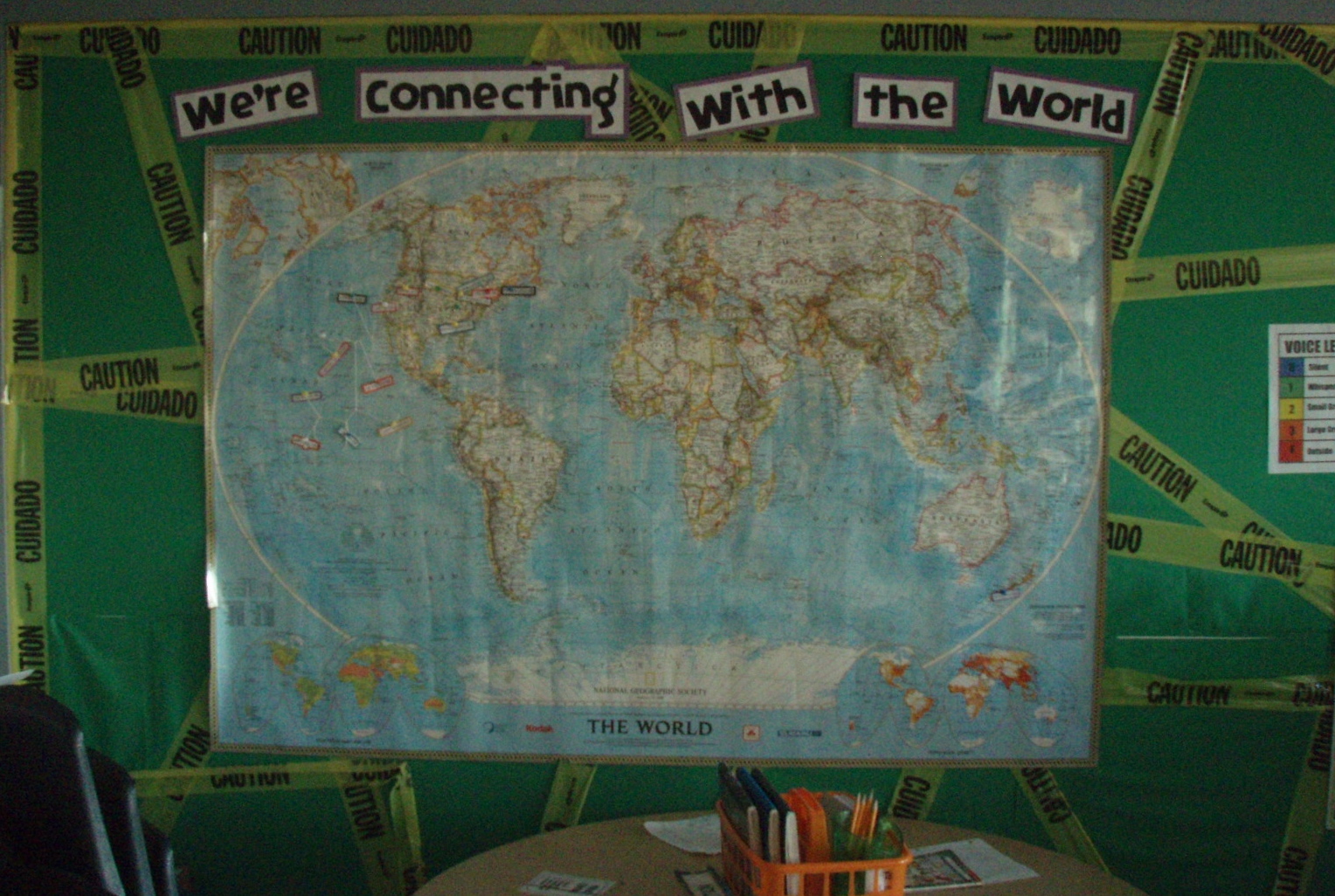
Another decision they made–which I agreed with again–was that our map was entirely too small!  We had so many pins already and they were all on top of each other.  Just St. Louis alone had about 6 or 7 because we marked them as each individual town.  So we found a bigger map and hung it up and we LOVE IT!  Check it out:

They decided to move it to the other side of the room to that big wall by the door.  It’s easier to get to, and it’s somewhere we’re always walking by, so we could look at it and talk about it really easily, too.

Most of our pins right now are in the US and Canada, and our new map makes them much easier to see.

It might look like we have a lot of blog followers in the middle of the Pacific Ocean (or like my map friends don’t know where Missouri is!), but those are actually linked to a pin that’s on St. Louis.  We had a really interesting conversation about how we could label our own hometown in all of those ways.  So far we have blog commenters from St. Peters, Florissant, Fenton, Webster Groves, Crestwood, Kirkwood, and Bel Ridge–all part of the metropolitan St. Louis area.

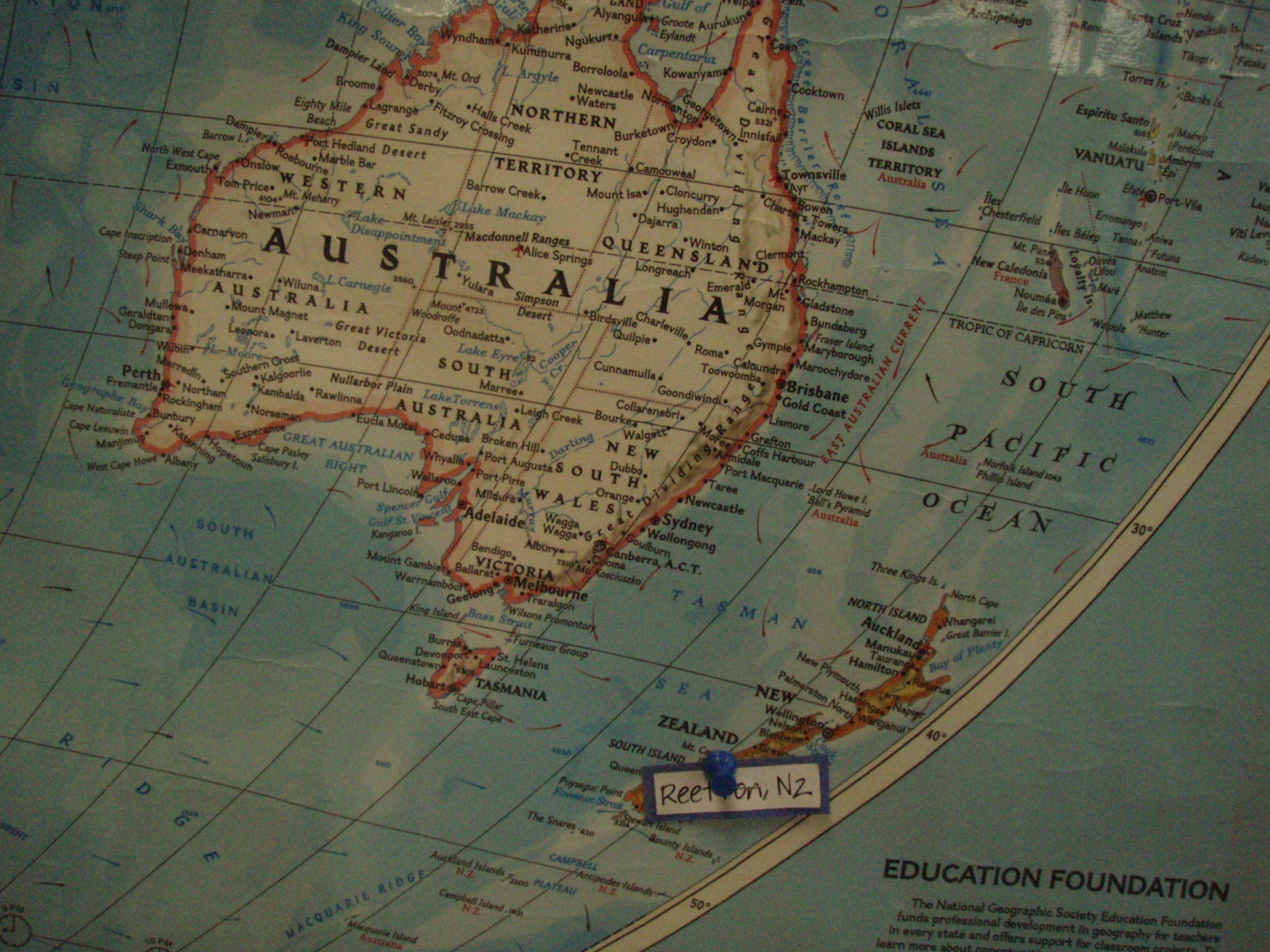
But this still might be my favorite pin.  Courtesy of Judy McKenzie in New Zealand.  Check out her class blog here. 🙂