#ISWAYR–Take 2

Last week I finally decided to update my reading progress after I had had actual time to sit and digest some really good books.  I changed the typical meme It’s MONDAY What are You Reading to SUMMER and jumped in.  My favorite picture was the one where my TBR pile was up to my knees! Remember?  As of last night (when I finished a book in a half hour!), my pile is half as tall.  LOVE seeing the progress.


So, to update you, this week this is what we read…

This year I have more picture books in my piles than I usually do.  Partly because since I’m in primary again I need to try out some new titles for my class this fall, partly because picture books are awesome, partly because I have had many great ones recommended to me lately, and also partly because they are quick. 🙂

When I was at the Scholastic Reading Summit a couple of weeks ago, I was reminded (by Colby Sharp) of a book I had meant to read, but hadn’t yet.  And since I had first been introduced to it, it had become a Caldecott winner and so there was another reason why I needed to enjoy it.  It was kind of a long story, but Colby told a great story of how his class does its own Mock Caldecott unit, where they vote for their favorite, and they were SURE that this book should win.  And then it did!  He even shared a heartfelt video from the winning illustrator herself, Sophie Blackall.  I was already sold on the book, but this just added to my interest.

And in case you don’t know, that book was Finding Winnie: The True Story of the World’s Most Famous Bear.

IMG_2450-min

What a joy to be able to read a book with that shiny gold sticker!!

This one was instantly a hit with my kiddos, and somehow it was a story I had never heard!  I guess I had never been a huge Winnie the Pooh fan, so perhaps that’s why, but whatever the reason, this was a great story to learn.  And of course, the pictures were BEAUTIFUL.  I think that’s possibly what I liked the best: the story and the illustrations were equally magical, making for a beloved book that we will surely return to again and again.  This book was made to be reread over and over and over.

And so on today’s list of to-dos: another trip to the library to see what new treasures we can find!

What have you been reading? How tall is your TBR pile?? 🙂


It’s Summer, What are You Reading?

Yep.  It’s that time again.  Summertime!  And of course, as a teacher, it means I have time to READ!!  Ok, I am reading all the time, but this is prime sit-and-read-a-whole-book-in-one-sitting time!  So, I thought I’d share what I’ve been reading with you, and then I’d love to hear from you about what you’d suggest!

What I’ve read…

What I’m reading…

In my TBR pile…

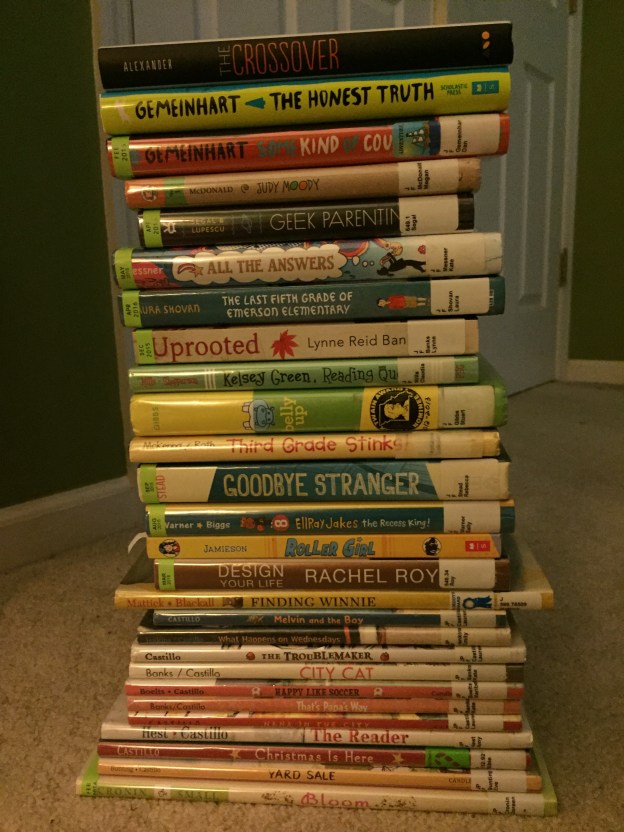
Is there anyone who ever has time to read everything in their TBR pile?  I have the problem that mine keeps getting taller (from great suggestions) before it gets shorter (by me finishing something)!  It is totally silly, but at this point it’s up to my knees! See?

FullSizeRender 2

Oh, wait–you probably want to see the spines…here’s another version (sans me!):

IMG_2415

Bets on how long it’ll take?  I’m sure there’s a great math opportunity in there somewhere, but I’ll save that for another day!

Ok, now it’s your turn! What are you reading?  What do you suggest I read? 🙂


Rm. 202 Kids Take Over–Read Aloud Take 2

I am so excited with what’s happening in our room with Read Aloud lately.  The level of excitement, confidence and pride that is present because of all of these super 2nd grade readers sharing their skills is definitely impressive.  Some kiddos have even signed up more than once on the calendar!!

The only thing I have to say that makes me really sad is that there are couple of kiddos who only have pictures (rather than videos) because my devices were not cooperating on those days.  I HATE that, because everyone of them has done a SUPER job, and you’ll miss them.  Just take my word–every read aloud has been A. Maz. Ing.

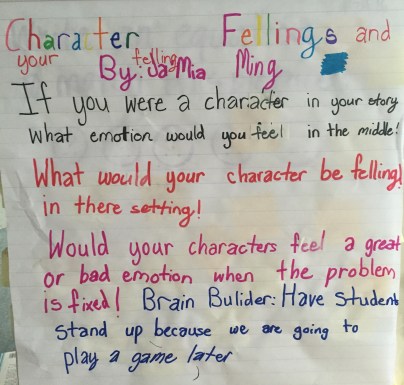
Gotta share that chart that she used, too. 🙂  It needs some edits (so please look past the typos 🙂 ), but it was such a great idea that she came up with on her own.  She was very prepared for her lesson. 🙂

IMG_1624

Please take a minute to leave a comment for our brave, super talented, 2nd grade readers! Way to go, Rm. 202 kiddos!

Rm. 202 Kids Take Over–Read Aloud!

Last week I was having a reading conference with a friend, and as we were talking about TBR piles and good book recipes, another idea came to me that would help one reader, and then in turn many others: kiddos doing read aloud.

As I continued to talk to this friend about books, I suggested that he choose a book from his new TBR pile to share with the class.  We talked about how he would have to prepare to do this, including practicing holding the book up so that everyone could see the pictures.  It was totally picture-worthy while he was working.

And maybe the best part was when he turned to me and said, “Wow, this is hard.  My arm hurts!  Is it hard for you, too?” We had a great little chat about how teachers have to have strong arms. 🙂

He continued to work and was ready to present to us.  Man was he excited!

Check out the stories he shared with us:

Well…as you can imagine, this sparked interest by many other people to be able to share with us at read aloud time.  And what a great idea, as I considered all of the many things kiddos learn on both sides of this opportunity.

We began to schedule read alouds in a couple of ways: I gave some friends the assignment based on books we were reading in our small group together, and some friends just began to request a spot.  And since then it’s become a “have-to” for everyone.  It’s just such a good idea that we (ok, probably I) decided all should participate!

Amber took the next turn, and did a super job of matching up to what my lesson would have been that day anyway–good readers use evidence from the text to support their thinking.

Then on Friday, Emily took her turn and taught us about fiction/non-fiction (as well as using some pretty great teacher moves for management!) with The Little Work Plane.

Now don’t worry if you don’t see your favorite Rm. 202 friend in this post–each will get their turn.  While I had originally never intended to take this path with readers in our room, it’s a SUPER example of how organically ideas come up for us, and how kids’ ideas are often the BEST ideas! Thanks, Rm. 202 kiddos for taking chances, learning new things and then sharing that learning with the rest of us!

What’s in Your TBR Pile?

Many, many years ago I was a presenter for Project Construct.  I had a super responsibility of teaching Missouri teachers about how to incorporate Readers’, Writers’ and Math Workshop into their classroom routine.  It was during this time that I learned about “nightstand books” and TBR piles.  Oh, you know, that 12-inch stack of books that sit next to your bed so you have them ready to go when you have a few minutes to read before bed?

Well, often my pile sits elsewhere than my nightstand, but for sure it’s always there.  And sometimes it’s taller than 12-inches.  Like in the summer when it’s about as tall as my 5-YO (she’s 40 inches right now, by the way. 🙂 ).  My current TBR pile looks like this:

IMG_1175 2-min

Anyhow, after we had learned about recipes and how they help guide us with book choices, we talked about something else readers do–make plans.  I started our conversation by asking a simple question: Why do people make plans?  I didn’t specifically say readers at this point because I wanted them to think broader and try not to guess my specific plan for the day just yet. Kids turned and talked to their partners and came up with SUPER ideas.  They connected this to how builders use blueprints and how important those are to making the building look “right” in the end.  They mentioned how writers make plans so they know what their stories are supposed to be (can you tell what we’ve been doing in Writers’ Workshop lately?).  They talked about how plans keep your organized and help you know what to do.

After that great start, it was easy to then expand the idea to how readers make plans for what they will read next.  This allows them to move smoothly from one book to another, without wasting reading time wandering around the library.  It helps readers think critically about what they want to read and why (I explained to my kiddos why each of those books is in my pile), and to be more purposeful in their choices.  This becomes especially easy if you choose books that are in a series, or if you “trust an author” and read all the books that they’ve written. I can TOTALLY do this with Ralph Fletcher, Sharon Creech, Jerry Spinelli, Joan Bauer and Liane Moriarty.

Kiddos had a great time trying out this strategy, and then send me their lists when they were finished.  We’re going to use them now and I plan to hold kids accountable to try out the books they put on their list.  While they can change, these piles (which are saved as pictures/notes on their iPads) help them think ahead and more purposefully use their time both in the classroom and at home.  I’m excited to see how they continue to help us grow as readers through this year and even beyond!


Recipe For a Good Book

I remember vividly the first time I ever taught about recipes in my classroom.  It was towards the end of the year, when I was teaching 4th grade (ok, I don’t remember the exact year–maybe 2006?–but I do remember the kiddo!), and during a reading conference a kiddo was struggling with finding a book that was a good fit for her.  For some reason I was thinking about how what she really needed was a plan–a recipe–for how to find a good book for her.  And since that first conference so many years ago, I’ve found that this lesson is one that almost every kiddo (and probably some adults, too!) could find helpful.  I went back to look at when I had written about it here, and I found this post from about 4 years ago.  Rather than try to explain the whole thing again, I ask you to take a few minutes and read about it from back then.  Really, I’ll wait. It won’t take long.  Just come back when you’re finished and I’ll tell you about how it worked in 2nd grade the other day (See? Told you all kinds of kids could benefit from it!  I think I’ve used it in every grade level I’ve taught over the years, and even for myself!) 🙂

Are you back?  Well, like I said before, this issue seems to come up every year and now that I think about it, maybe that speaks to the lessons I teach at the beginning of the year on how to choose books.  I wonder why they aren’t “sticking” and why kiddos eventually need this secondary explanation of “good book” recipes.  I wonder if it has to do with the fact that they change so much as readers over a given school year (especially if they are younger readers, or struggling readers making big gains) and so the books that were just-right or “good” for them in August are certainly not the same for them in March.  I guess like anything else, as well, just telling them once probably isn’t enough.  Perhaps I should find a way to incorporate book choice lessons into every unit that I teach.  In many ways choosing a just-right fiction book is very different from choosing a just-right non-fiction book anyway.  Oh, and I feel like I should mention that my definition of “just-right” book doesn’t have so much to do with a level as it does with student interest, motivation and desire.  All of that other stuff can be worked on once you help them find THE book for them.  Many times the kiddos who first need my recipe lesson are ones who don’t really see themselves as readers yet.  They don’t really know what to do when they’re standing in the aisles of the school library or looking at the buckets in our classroom library and need a hook to get them started.  That’s really what I’m thinking about when I help guide them here.

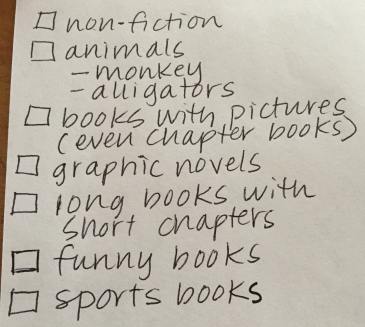
Ok, well, just like it happened in that example from 5th grade many years ago, I had a conference with a kiddo the other day who needed some guidance to find his version of a good book.  We talked about books he has read that he really liked and what it was about them specifically that he liked.  We used those things as our “recipe” and wrote them down:

FullSizeRender 30-min

This now becomes a shopping list when he’s in our classroom, the school library, the bookstore, the book fair, the county library, etc.  The big idea is that if he knows what he likes he knows when he’s found it.  This is a HUGE idea that kids often miss.  They so often just wander through the shelves not really knowing what they’re looking for, expecting that they will just know what it is when they find it.  It’s like traveling to a new place without a map AND without really knowing your destination.  You will NEVER get there.

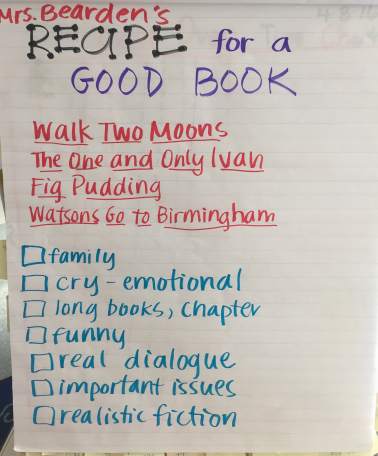
Well, after this first conference, I ran into two other friends in the same day that needed the same lesson and so it quickly got moved to my “everybody-needs-this-as-a-mini-lesson” list.  I then showed everyone in Rm. 202 the plan the next day by sharing my own example:

FullSizeRender 49-min

Not everyone is necessarily ready for this right now, but everyone had a go at trying their own list and we will tweak over the coming days as they practice using it for book shopping.  The great part is that it is customizable, personal, and specific to each reader.  And it can be easily changed as they change as readers.  LOVE!

28 Days That Changed the World

Last year I found the most amazing book.  Books, really.  I am almost certain it as a Twitter find–since that’s where most of my teaching gems come from–but regardless, I ran out to get it and it became the basis for the conversations in our classroom during our history unit.

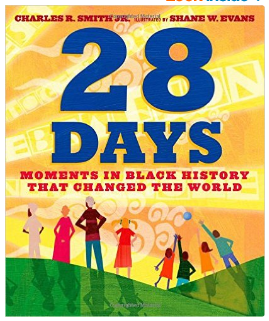
Here’s the main one, written by Charles R. Smith, Jr. :
Screenshot 2016-02-21 19.48.16

It goes through all the days of February and gives a little story about an important figure in African-American history, working forward from the 1700s to today.  The synopses are short, interesting and my favorite part is that they are not just the “big” ones taht you are used to reading about.  There are women and men, as well as children, and often the moment that changed history wasn’t even a person, but a court case or event.  We read through this book last year during our history unit–where our focus was on people who change the world–and loved it, as well as learned a lot we didn’t know.  OH, and I didn’t tell you anything about it.  Since  I have this thing–well used to–where I wait until the end of a unit/project/story to tell about it.  And then don’t actually do it.  So here’s to telling you this time around. 🙂

Oh, just a quick mention of some other FABULOUS books I found at this same time: the I Am series by Brad Meltzer.  They are along the same vein as the 28 Days book, and are little biographies about important people (not just African-Americans, though).  The illustrations are SUPER cool, and make it a really interesting narrative non-fiction text to share together.  The voice of the famous person comes through and kids are hooked from the first page.  We’ve read almost all of them (I just got Lucille Ball and haven’t had a chance to share that one yet!):

IMG_0319

Somehow I only took a picture of a few of them. 😦  We also have Amelia Earhart, Abraham Lincoln, Albert Einstein, Helen Keller and Lucille Ball.  They are pretty great!

This year as we got ready to start February, I knew I wanted to incorporate this book again, but obviously in a different way than we had done it previously.  I was really glad that my kids were as excited as me to reread the stories again, and it’s been great to see how they anticipate who will be highlighted each day.  We really enjoy this time of our day, and I can really tell that they are learning about the people/events and their impact on our world, as they make connections between them and other things we talk about in the course of our day.  This book is more than just a book for the friends in Rm. 202.

One thing I wanted to be able to do to deepen our understanding (or at least solidify our memory) was to do some writing about each day’s text.  We had been doing some work with non-fiction, as well as main idea/details, so I figured it would make sense to write a summary paragraph to tell others about what we were learning (we had decided we’d hang them on our bulletin board outside our room).

We have been using the 4-Square organizer to make sure we have all of our thoughts (in read aloud, during Social Studies, in Writers’ Workshop as we write opinions about things), and so we decided they would make sense for this, as well.  And ultimately, I want kiddos to learn how to use the organizer to meet their needs, not just to use it when I say to, or to see it as being just for one time or place.  We wrote the first few together, discussing our topic sentence and then adding in details to explain the text for the day, like this:
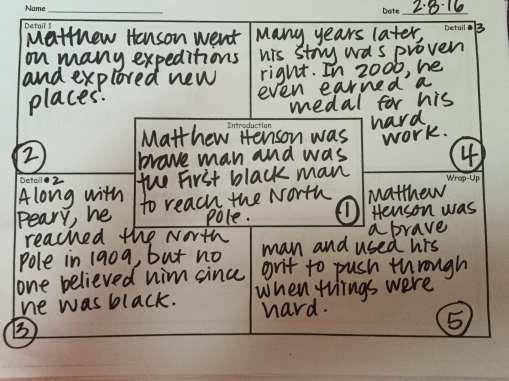
IMG_0616-min After we got our thinking down on the planner, someone would “publish” it and we’d hang it outside on our board.

Last week, we had a short week with a weird schedule, which made for a little bit of a problem.  We didn’t get to finish our text for Feb. 11, then we weren’t in school for February 12-15 (that’s 4 days) and so when we returned on February 16, we had 7 pages to work on!!  There was NO WAY that we would have been able to sit and do all that work together as a whole group (can you say behavior problems?!), so we needed a new plan.

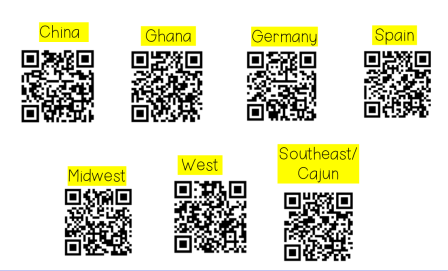
Well…it worked out SUPER well that we just happened to have 7 groups already in place for our culture study.  Each group was in charge of planning and then writing one of the  paragraphs after we all read them together.  Great plan, huh?? We thought so. 🙂

Kiddos knew what to do, since we’d been using the planner already, and I was really  impressed with how well they have been able to add appropriate, relevant details to the topic sentences (which I had given them already in their planner).

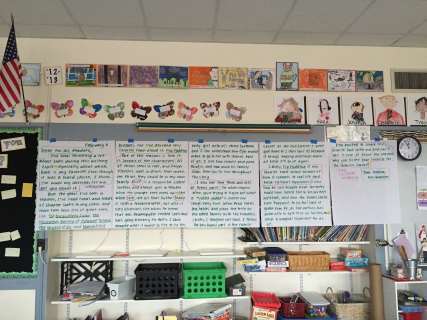
While I have a REALLY WONKY panoramic picture of it (the end of our bulletin board is inconveniently up a flight of stairs 😦 ), I’m really excited about how it all looks out there, and I love that there are things for us to share with our Robinson neighbors!

IMG_0596-min

We still have another week or so before we’re finished with the book again, but I’ve got other plans for continuing our study far beyond the end of February.  I have been doing some behind-the-scenes work with our librarian and some other teachers to find even more recent stories of Robinson personalities, or other Kirkwood figures that these friends might know.  I think it is essential to teach kiddos that change-makers are not just old people, in black-and-white pictures who have been dead forever.  Important figures in their lives are not just from long ago and far away, nor are they just “famous” people they read about in books.  I want them to see versions of themselves in the smart, successful people I teach them about; I want them to see the possibilities for their own futures.  I’m excited to finish the plan I have for this next step.  And yes, I’ll be sure to share!

**UPDATE:  GREAT story that happened today as we were reading about Thurgood Marshall for Day 22….I was talking about how he was a Supreme Court Justice and how often that means that a judge has been an important lawyer. I explained how the Justices are appointed by the President, which is a BIG DEAL, and how Thurgood Marshall had been part of a big deal court case that we knew about.  “Do you mean Plessy vs. Ferguson?”  WHAA??  Love that they could throw that one out there.  “Nope, not that one.”  “Are you talking about the 14th Amendment?” “No, not that one, either.” “Oh, I know!!  Brown vs. the Board of Education!”  Um, yeah–that one. 🙂  Isn’t it pretty great that 2nd graders can whip out those names like that?  I think so.  Way to go, Rm. 202 friends!  Love that you’re soaking it in, and making connections, and more importantly I think you’ll make CHANGES with that knowledge someday.**

Learning Buddies: Read-a-Thon

We have not had a chance to see our Learning Buddies very much lately.  5th Graders are busy people!  When we heard they were busy tackling a Read-a-Thon on Friday, we knew we wanted to join in!  While they were spending their whole day (6 hours!) enjoying a book, we were only able to be there for a little chunk of that time.  Some Rm. 202 friends suggested we should plan our own read-a-thon, though, for a future date, too!

Before we came to visit them, Dr. Grayson’s room had a lesson with Mrs. Meihaus, our amazing librarian, about how to read to a younger student.  Our buddies were then armed with their “lesson plan” and shared really great books with us after lunch.  It was so much fun!  Oh, and it was also Hat Day at our school to raise money for the NIYO Cultural Center in Rwanda (Hi, Pacifique!), which added to the festive spirit.  Enjoy some pictures of our afternoon!


Writing About Reading

I figured out today why I have such a hard time deciding what to write on this blog: I like for things to fit nicely into categories/tags/subjects/projects, and so often, the things we do around Rm. 202 are not that way.  I find that maybe I’ve gotten to that place where many of our subjects overlap–just like I’ve always hoped they would!  I know, that sounds like I’m not doing it on purpose (which of course I am, as I carefully plan how and when and why), but I think sometimes when you’re in the middle of something you can’t really see the big picture (isn’t there some quote about forests and trees that would fit here? LOL).

So as I think about how to describe what we’ve been doing in Writing lately, it’s hard to explain just the writing part, because it includes reading (which is perfect, as those two subjects go hand-in-hand anyway, right?).  We have been working on writing opinion letters, with most of our topics being about the series books we’re reading in our book clubs.  Luckily, though, there are lots of other things to have opinions about, so we’ve been trying out that structure with other topics, too.

We’ve gone through many versions, with me teaching mini-lessons and kiddos then trying out the big ideas.  We’ve talking about format of a letter; stating opinions; adding reasons as well as details and support for those reasons; using transition words like one reason is, another reason is, last but not least (which many kiddos were doing already just based on learning them last year!); as well as just using interesting words and making our letter match our audience.  The procedure became that they would write a letter, but then rather than actually delivering it to that person, they’d give it to me, and I’d note what they did right and what they could work on for next time.

We wrote about books, 100th Day of school suggestions, ideas about why their weekends were good, as well as many other things about which you could have an opinion.  I was noticing, though, that over the last few weeks our letters had been getting shorter and less detailed (which was obviously not the goal!).  We had a class meeting and Millie suggested that the reason this was happening was because they had written so many letters that actually they were getting really sick of it and weren’t trying their best anymore.  While this was sad, I totally saw how that could be, and as impressed by her insight.  Others agreed and so I made a plan that we would work our hardest to create our best final letters (to Mrs. Meihaus, our librarian, about our vote for the Show-Me Reader Award) over the next 3 days and then be done.

So as I thought about what we would do for those next 3 days, I knew I needed to give another model to my writers about what that letter should look and sound like.  And since I wanted them to write about books, I did, too.  My letter was about my favorite read-aloud choice, Fig Pudding by Ralph Fletcher.  It looked like this:

IMG_0368-min

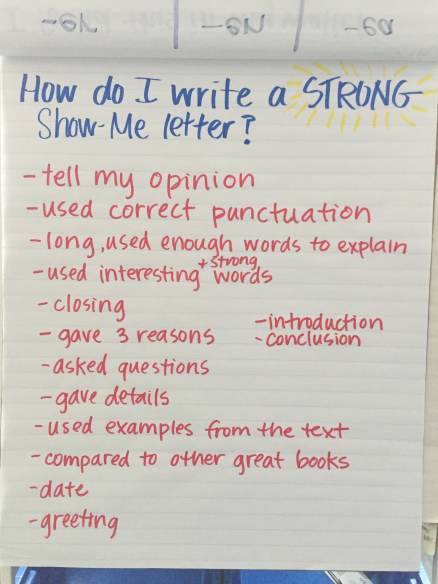
I had hung the letter up there before the day started, and it was one of the first things (thankfully) that kiddos noticed when they came in.  Yeah, the first response was “Wow, that’s long!”  Later on, I had them look at it, studying it to answer this question: How do I write a STRONG Show-Me letter?  Not surprisingly, they were able to notice a whole page full of things that I had in my letter that they needed to put in theirs.

IMG_0367-min

As they made their list, I marked their ideas on the actual letter (notice the different colors and the things we boxed in) so we could reference it later.  I was impressed to see that they had been paying attention, and that they could come up with that all on their own!

After this, I gave kiddos a graphic organizer to use to plan their letter and we got busy.  We’re almost done, so I’ll share our progress in the next few days.  It’s pretty good stuff!

A Little Further Into the Woods

Since we’ve begun our Little Red Riding Hood culture study, some exciting things have happened!  Let me tell you about what’s going on!

Alongside the LRRH books that we shared was another book, full of all sorts of organizers, charts, and a map.  This would be where we’d record our thinking and learning throughout the study.

Screenshot 2016-02-07 15.22.10LRRH_culture

As we read a book, kiddos would fill in a chart that marked certain features of each story, which we would later use to compare stories and use the information to learn more about each culture represented.

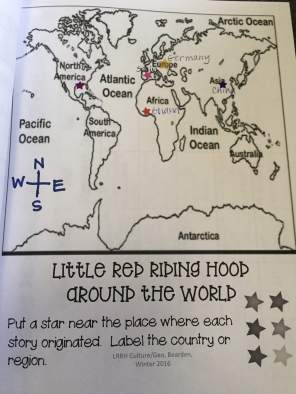
Additionally, we kept track of where our countries are in the world, by adding a star on the map for every one we read.  Later on, we added a US map to our book (which I don’t have a picture of yet) as we learned about regions.

IMG_0392-min

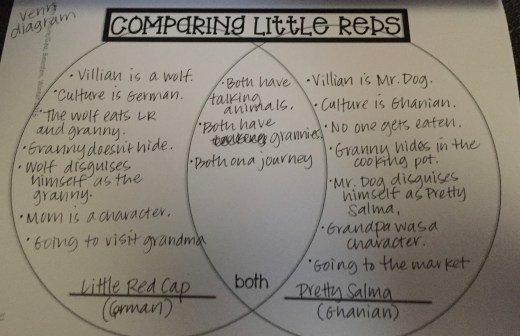
As we read different versions, we also compared how certain books were alike and different…

IMG_0395

…as well as finding other things that we needed to add into our book (note to Mrs. Bearden to make sure to put this in there next year!):

IMG_0393

Once we got the background of the stories, talked about characters, compared and contrasted and decided on our favorites, we were ready for the really fun part–researching more about the cultures from our books.

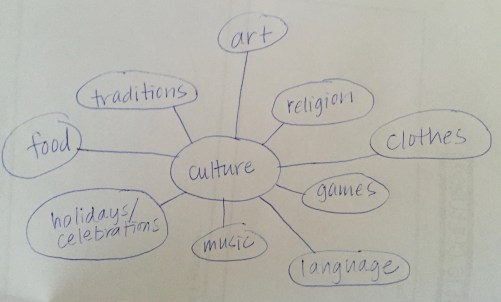
Each kiddo chose their top 3, then randomly came and declared which culture group they wanted to be in.  I wanted it to be about the country/region/culture, not the people in the group, so this part was all done first, then I shared their groupings.  Each group has 3 people, which is kind of ideal.  I could hardly get the directions out before they were ready to get going (kind of like with our spelling investigations this week–they were eager!).  I had found books for each group to start their research, but groups had to go book shopping to find the right ones.  Once they had books, they were busy digging in, collecting information about land (not culture, but related to the geography focus), language, holidays, food, games, religion, school, music, art and then a topic of their choice.

After our initial book search, kiddos were allowed to use website that I had found, as well as World Book Online and Kid Info Bits, which we have subscriptions to from our library.

Screenshot 2016-02-07 17.09.06

We even had an opportunity to learn about German culture from someone in Germany! I sent out a request on Twitter for friends from our countries/regions of choice, but was unable to work out any Skyping situations.  Then I remembered that Mrs. Appelbaum’s daughter is studying German in GERMANY and that she might be available to help us out!  She was more than willing and so we worked out a FaceTime call for last Thursday afternoon.  Those girls were so excited (and so was I!)!

We are just about done with research and are excited to start writing–we’re going to take all of our information and make books to share with other Robinson kiddos!  Stay tuned for updates on that part of our work!