Second Grade Math Warm-Ups: Catching Up

If you’ve been around here for a while (thanks!), then you know that one of the “regular” posts I do is to share our math warm-ups each week.  For many reasons that hasn’t happened for the last few months.  So this post is to catch up on some of the best ones from recently. 🙂

Measurement

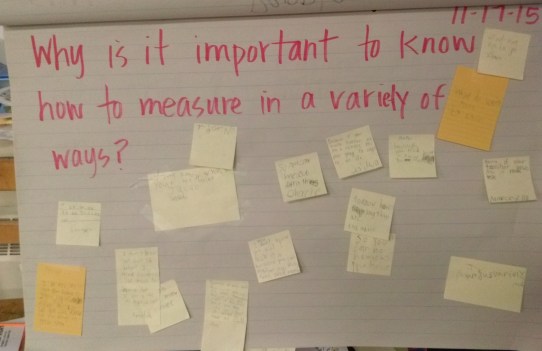
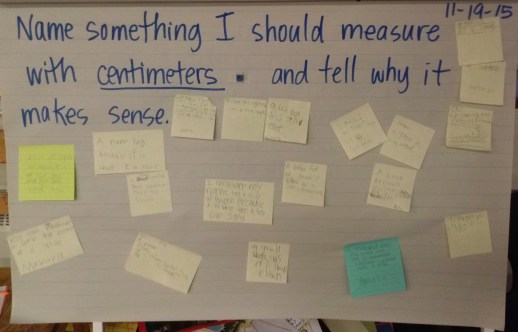
Before the holidays we were working on measurement (mostly length) and had some questions at the beginning to get minds thinking about how and why we should know how to measure.  The last one also addresses being able to visualize the size of a unit (centimeters) and apply it to appropriate situations.  In between and after all of these, we did lots and lots of measuring with different units, tools and objects.

Measurement (Time)

I only ended up with one picture (sorry!) of this round of warm ups, but after we came back from Winter Break we were still working on measuring, only with time!  There were several days of questions related to where the hands would fall on the clock, how many minutes would have passed if the minute hand were on a certain number, as well as one where the had to tell all the ways to describe a certain time (4:30, half past 4, etc.).

IMG_0062-min

Measurement (Money)

Now we’re on to money, and so we’re working on some foundational questions that get kiddos thinking about the numbers behind it first.  Then we’ll work more specifically on counting amounts, giving change, etc.

IMG_0116-min

This first one was just to get kids thinking about groups.  What was great (and what happens often when we discuss the problem later in the day) is that while I never mentioned anything about money, someone used that model to help them figure out the answers and then once we made that connection, it made sense to other friends, too.  Then we could explicitly connect the numbers to coins and amounts we knew (or needed to learn!).

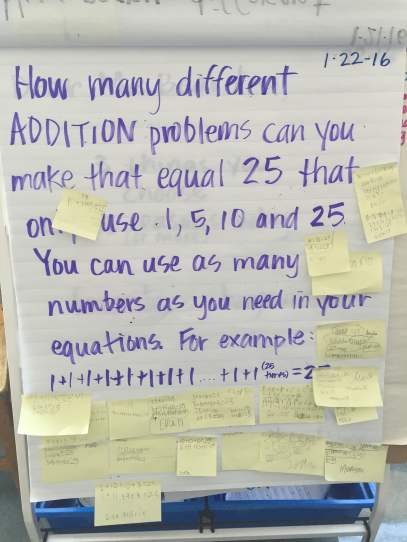
This one got kiddos thinking about combinations that make 25 (which I knew meant a quarter, but wasn’t saying that yet)…

…and then the next day I asked that same question with new parameters (which again I knew was connected to money) to connect to that previous thinking:

IMG_0118-min

As with most everything else I throw at them, kiddos are doing great things with making connections to previous knowledge and incorporating new concepts.  It’s great to watch them think like teachers and figure out the method to my math warm-up madness–often kids will say “Hey, you asked this question because….”  Good stuff!

If you’re doing math warm-ups, do you have any to share about measuring length, time or money?  We’d love to try them!

Second Grade Math Warm-Ups: Week of November 16-20, 2015

I apologize for the fact that it’s been nearly THREE WEEKS since I last wrote on this blog.  I’m not even sure what happened.  Oh wait, I do.  Life happened.  And I was tired.  It was one of those times in life when you have to do really cool things and take pictures of really cool things, but not write about it, you know?  Oh well, here’s to trying to fix that.  Starting now.  So onward we go!

Monday

We were starting a new unit in math this past week, so the warm-ups were no longer addition and subtraction.  This one is connected to some essential questions we will be chewing on throughout the unit, as well as serving as a way for me to know with what background knowledge everyone is starting.

CAM02480-min

Tuesday

Another essential question from our unit…

CAM02482-min

Wednesday

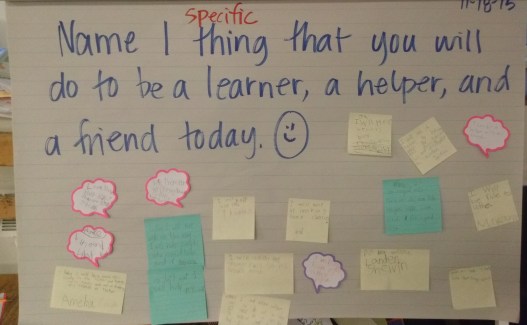
This pic is obviously NOT a math warm-up but is instead a view of where we were on this particular morning.  I sometimes use our warm-up routine as a way to make plans for our day, or to highlight a goal that we will all be working on together.  This was related to the work we were doing last week with remembering to focus on caring for others rather than just ourselves first.

CAM02484-minThursday

Back on track with measurement.  🙂

CAM02485-min

This last one isn’t a math warm-up, nor do I remember what day it’s from, but it was a great example of how math happens all the time in our room!  Oh, and it used skills we had just learned in our last unit, so it was great practice.  We were starting a new chapter book (Thanksgiving on Thursday by Mary Pope Osborne–a Magic Treehouse book), and were interested in knowing when the first Thanksgiving took place.  We figured out we could subtract or count up to figure it out.  We decided to use the Circle, Split, Subtract with a Number line strategy that we had learned.  It worked! 🙂 And….Thanksgiving started a long time ago. 🙂

CAM02481-min

Whew!  It feels good to be back in the blogging game again. 🙂  Thanks for coming back to read!

Second Grade Math Warm-Ups: Week of October 12-16, 2015

This week we began a new unit on adding and subtracting within 100 (which is actually a unit we had last year, as well, so should be something that we remember.  Should…time will tell if that’s true. LOL 🙂 ).

This time around we’re focusing more on making sure mathematicians are flexible and can show their thinking in more than one way.  As with last time, we’ll also make sure they can choose a strategy appropriately based on the numbers (rather than just which strategy the like best or is easiest for them), and we’ll also continue to work on being clear with our communicating our mathematical thinking.

Here we go!

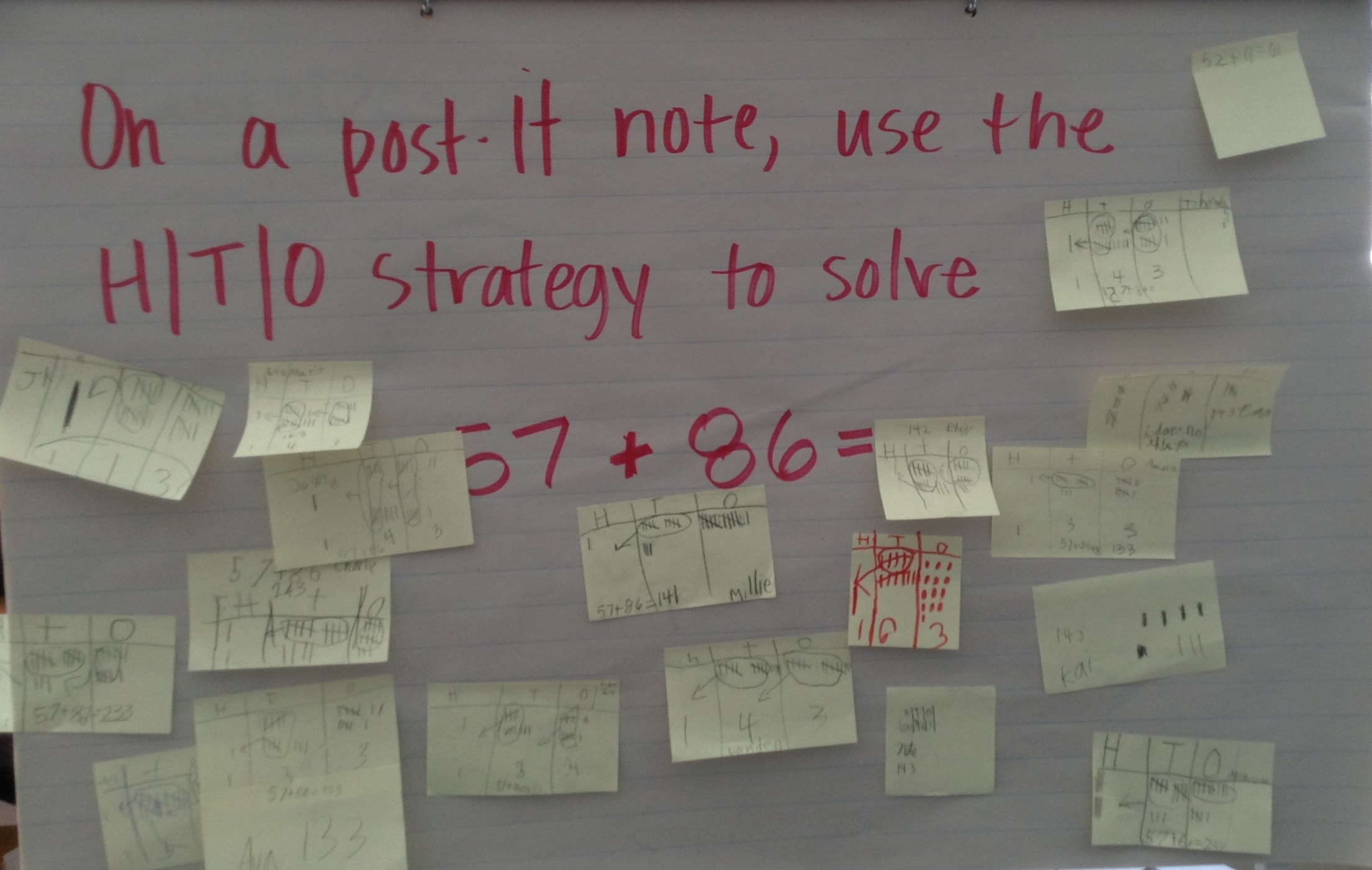
The first strategy we worked on for this unit is called HTO, or hundreds/tens/ones.  Yeah, it’s kind of an obvious name for what they are doing, so I guess it works. 🙂

IMG_5508-minEach kiddo has a workbook where we’re showing our thinking, and I had to share what Emily’s looked like after I taught this strategy.  She kind of liked it. 🙂

 Here’s more about how that strategy works:

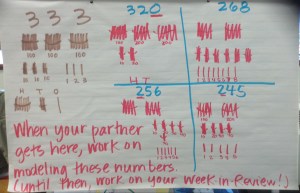
HTO_strategy-min

First you mark the first number on the chart (98) and then add on tallies to show the second number (31). Then look to see if you can find any tens or ones you need to move over to the next column. Finally, add down the columns to find your answer.

Ok, so this post is a little misleading, because that was the only warm-up I have to share.  The rest is more from what we did in our conversations in math.  Hope that’s ok. 🙂

On Friday, we started another strategy that is Adding on the Numberline (and actually using another strategy called Circle/Split/Add):

We still have a strategy or two to teach, and then we’ll just practice them until they’re solid.  The thing I have to keep reminding kiddos (especially those that are focused on being RIGHT and being FAST) is that this unit is as much as communicating and being flexible as it is about finding the right answer (although, OF COURSE that’s also expected. 🙂 ).

The Writing Process–in Math??

Yep, you read correctly.  We’ve been learning the writing process–mainly in regards to our work in Writers’ Workshop–but also in math!

A few years ago, when our school started working with Cathy Fosnot and Mathematics in the City, I learned about how many parallels there are between communicating in mathematics and communicating in most any other setting.  At the time it was kind of mind-blowing to think about how mathematicians revise and edit their work just like authors.  After hearing more, and thinking it through, and then trying it with kids, it made sense.

So…as with many other things I learned about with older kids, and protocols that I know work well with any age, we’re talking about the writing process in mathematics again.  In 2nd grade. 🙂

The first unit we worked through this year was about place value, and was related in many ways to money; this made sense to kiddos and helped them think through how to “trade” 1s for 10s, 10s for 100s and just how to make groups in different ways to “make” a number.

One day they were challenged to consider this story:

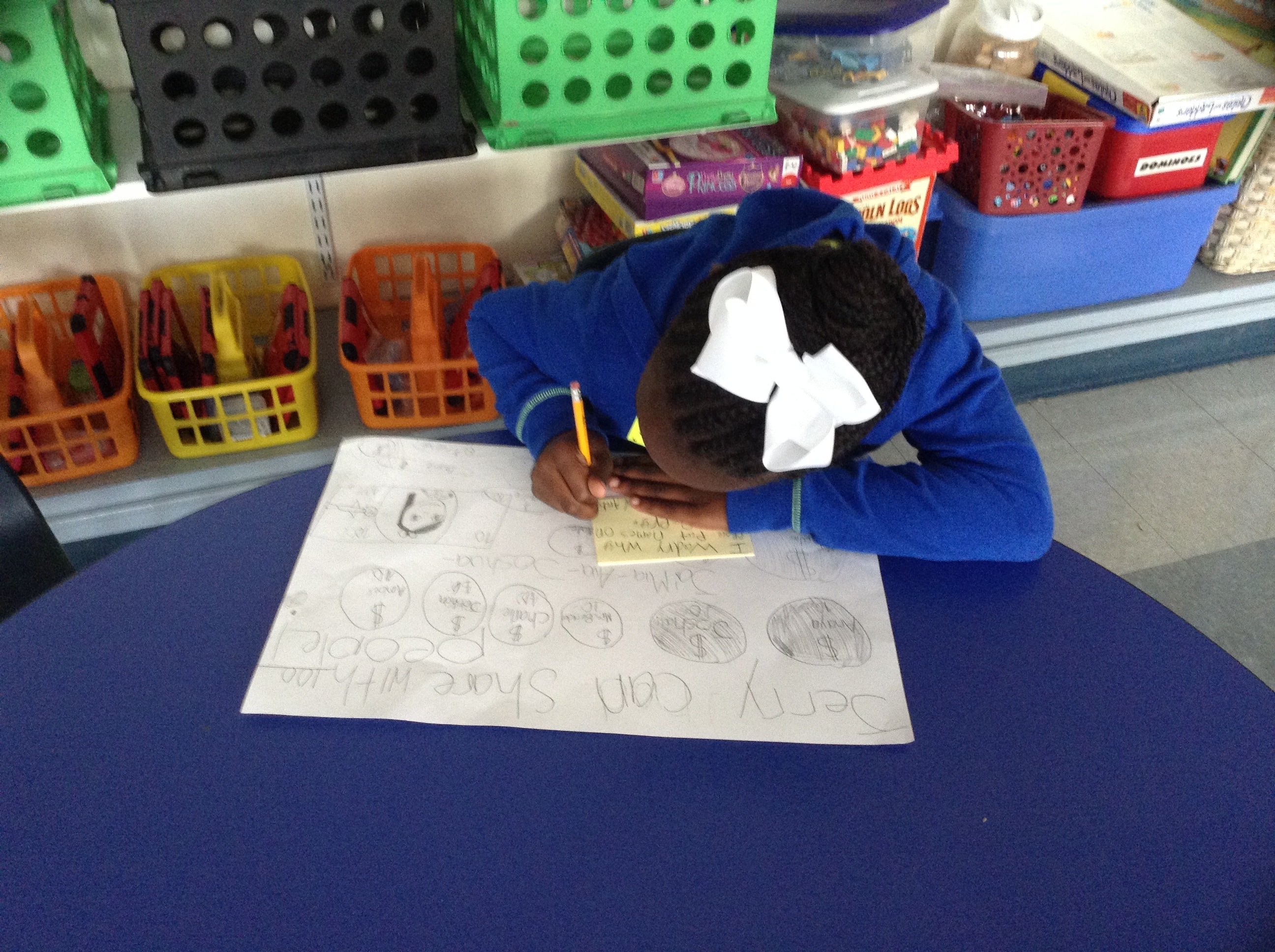
Screenshot 2015-10-08 20.37.03-minWith their elbow partner they were supposed to figure our the answer to that question: If Jerry has $1000 to share, with how many people could he share a $10 bill?

Kiddos worked for almost 2 math periods to figure out their answer (which was really the answer to the question of how many 10s are in 1000) and clearly share their thinking on a poster.  For many, the answer of how many people was easy, the way to share their ideas not so much.

As a means of helping them know when they were “finished,” we discussed these parameters for their work:

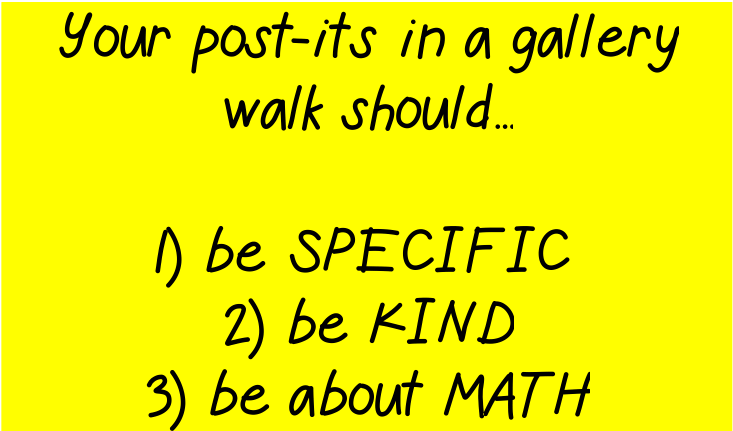
Screenshot 2015-10-08 18.51.45-minAfter we had our posters finished, we were ready for our gallery walk.  During a Gallery Walk, students put their posters out for other mathematicians to read and comment upon–with the goal of helping deepen mathematical thinking and help create more meaningful representations.  It works much like a writing celebration, which is a great connection because all of our kiddos know how to do that. 🙂

Before we were ready to start commenting on others’ work, we needed a review of how to make effective, meaningful notes on our friends’ work.  We sat for a quick refresher using this flipchart:

Screenshot 2015-10-08 18.51.56-minThen we practiced recognizing helpful comments that followed the guidelines.  I gave examples and non-examples, and then we modified the ones we have given a thumbs-down (which mean they were not specific, kind or math-related).

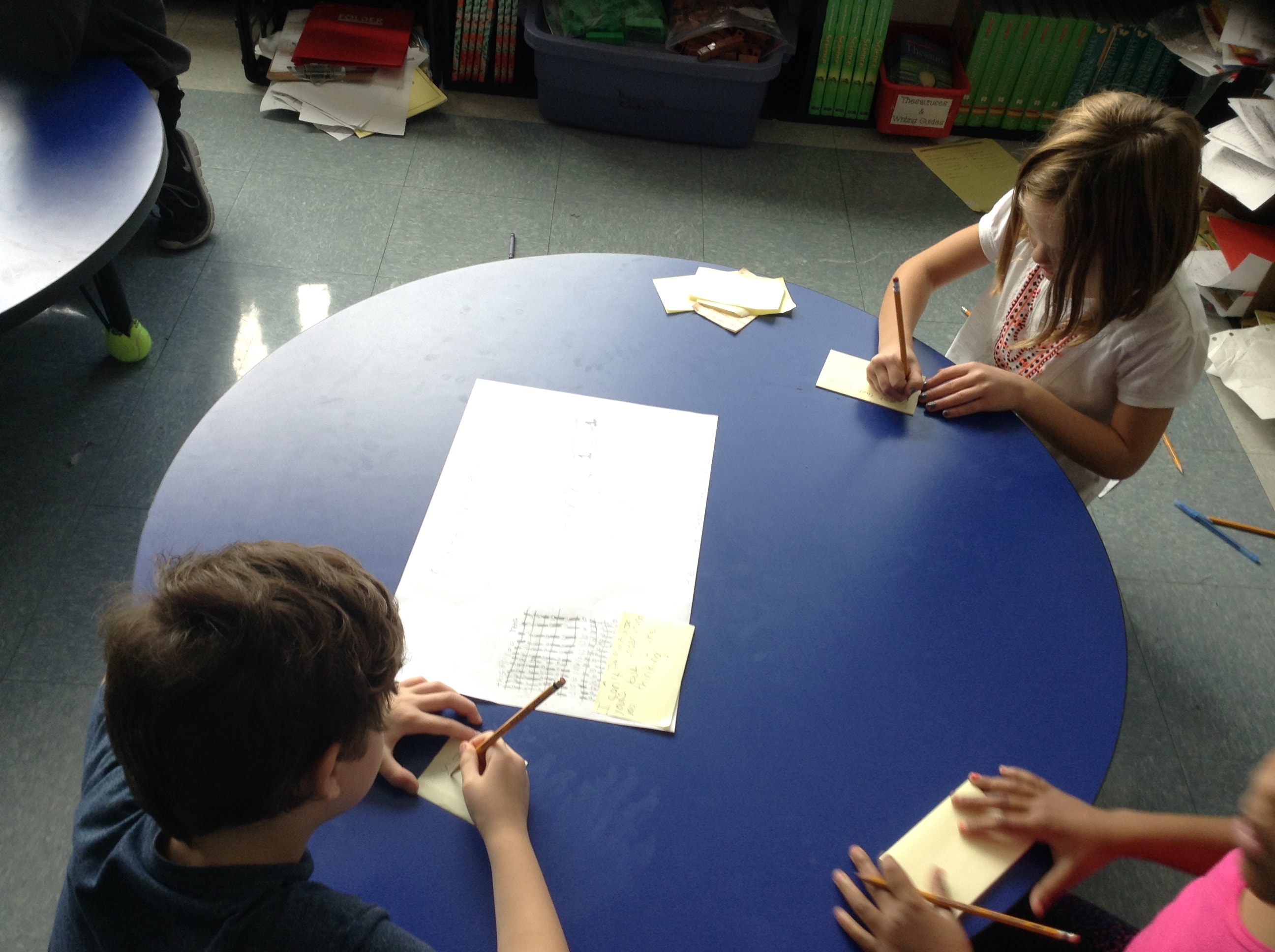
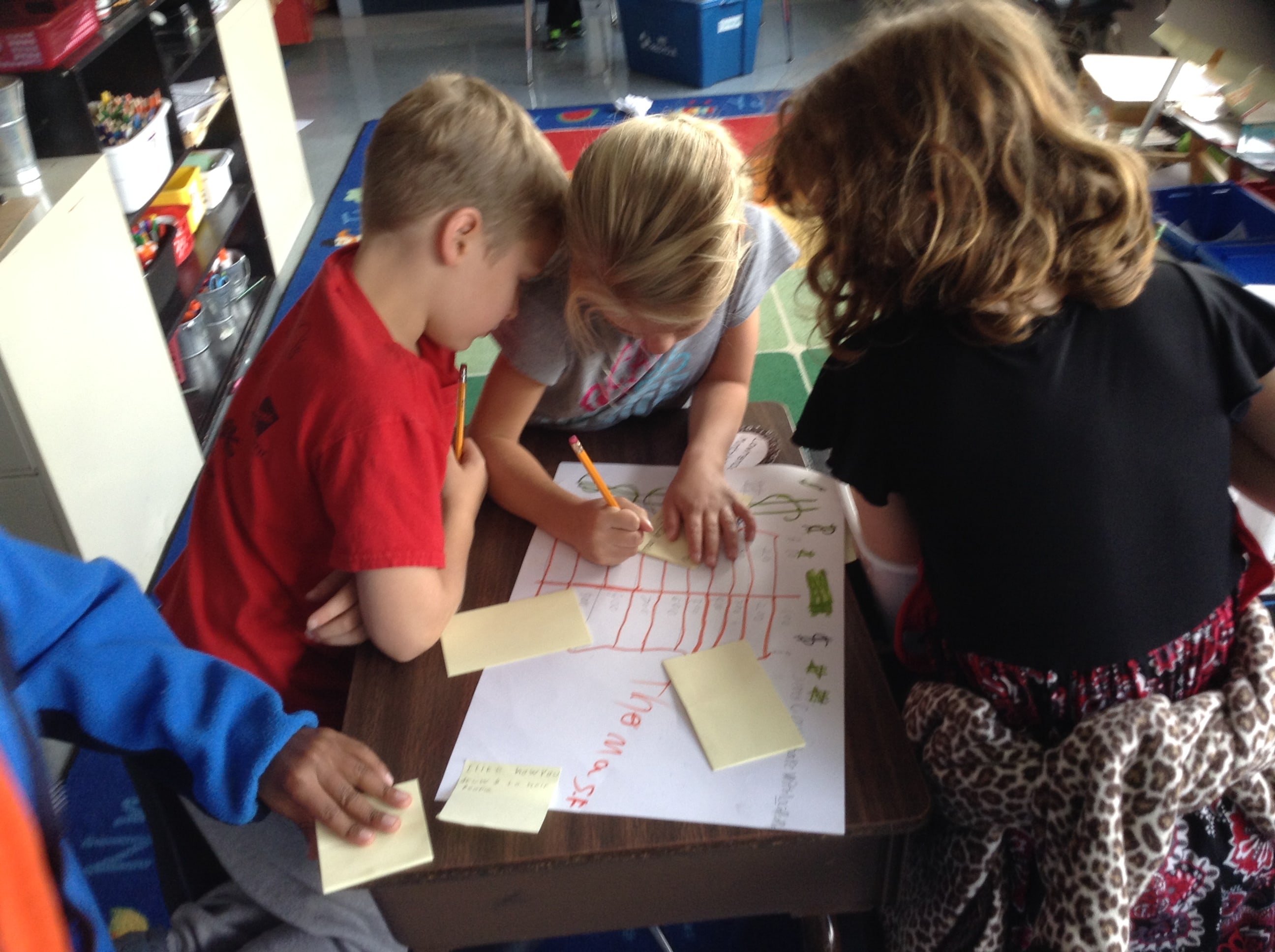
After that, we were off to work in our gallery walk.

IMG_5395-min IMG_5396-min IMG_5397-min IMG_5398-min

We did pretty great with our first walk of the year, and I’m sure kiddos brought their kindergarten and first grade knowledge with them to help as they shared their thoughts with other groups.  I was impressed with how questions were used and kids were specific with what parts didn’t make sense or that they thought others could improve upon.

After adding comments, partners were given a few minutes to review what others had shared.  In order to debrief and think about how to use this to help us next time, partners had to share out with the larger group one thing they would do to revise their poster to make it better (and ideally we’d have taken time to actually revise them, but we ran out of time!).  Next time we are ready for a math congress and gallery walk, we’ll definitely come back to this moment and remember what we learned. 🙂

Second Grade Math Warm-Ups: Week of 9-14 to 9-18, 2015

We are in the middle of a unit on place value in second grade.  The warm-ups this week took on a little bit of a different spin, as a couple of times kiddos were expected to finish up work from the previous day’s Math Workshop.  That then became how we started math groups later in the day (I hope that last sentence wasn’t confusing…).

Monday

On this day, we were working on modeling numbers in bundles of 100s, 10s and 1s, like we had done during our place value challenge the week before.

IMG_5360

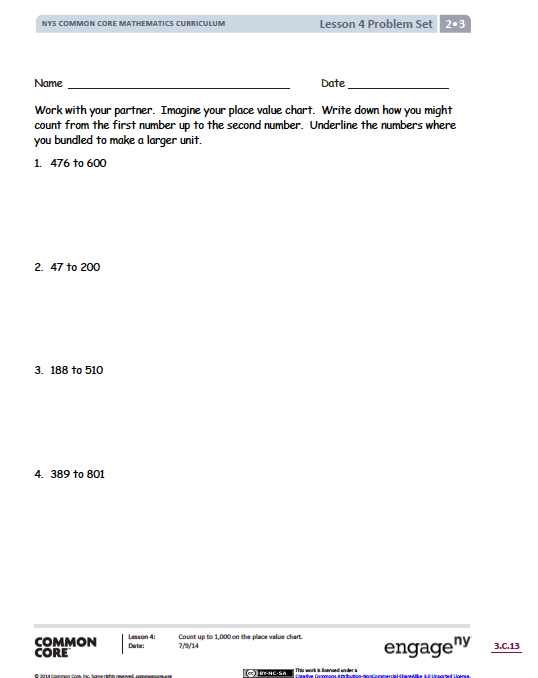
Lesson 2 Problem Set:

Tuesday

Pretty exciting question, huh?  See the example of what this page looked like below the picture.

IMG_5361

Screen Shot 2015-09-20 at 9.32.42 AM

Thursday

On Tuesday during math we had been focusing on representing a number in many ways, so I gave them a quick one to remind them of word form and expanded form.

IMG_5362

Friday

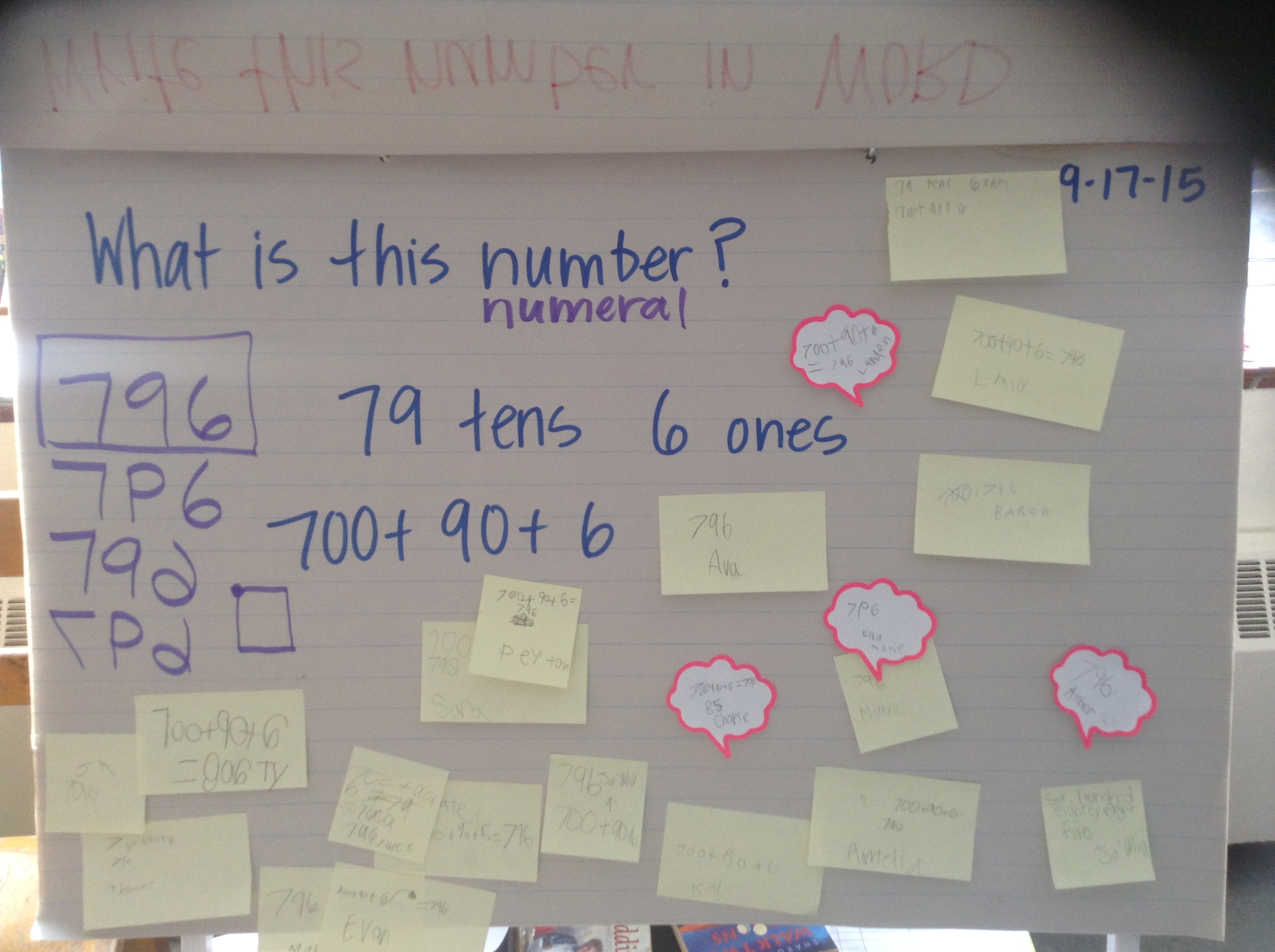
Another one….we also practiced the word numeral for number form, as well as focusing on making sure our numbers go the right way (as we still have some friends who forget. 🙂 ).

IMG_5363

What’s On the Agenda?

The beginning of the year brings with it many things: new faces, new clothes, new experiences, new books to read, and assessments.  Lots of assessments.  Luckily for me, I know many of my students really well already, since we were together last year, but even still I need to learn the “2nd grade version” of them.

One particular assessment that I have a love-hate relationship with is the F&P (that’s just what we call it because it’s from Fountas and Pinnell; it’s a reading assessment).  I love it because of the deep, rich information it gives me about my kiddos as readers and how it helps me tailor my instruction to just what they need.  I kind of hate it, though, because it takes FOREVER to administer.  It involves a student reading a book to you aloud and then answering the comprehension questions to demonstrate their understanding of the text (there are both fiction and non-fiction titles included).

Sounds easy, right?  Well it is relatively easy to administer, but when you add in the fact that there are 21 students in my class and sometimes you have to read 2 or 3 stories until you find the student’s instructional level, you can quickly add up to a lot of time necessary to finish the job.

So, that’s where the idea of the agenda comes in.  It’s my attempt at having my students working on meaningful, important learning activities independently so that I can spend time 1-on-1 with students to finish my assessments.  Win-win, right?

We did this kind of thing on a smaller scale last year a couple of times, which gave me the courage to try it again now that we are 2nd graders.  The difference this go-round was that the time frame was longer (two school days instead of a morning) and that the assignments were on a little bit bigger scale (last time it was mostly finish-up work).

Now, before I gave it to my students I ran it by one of my most important helpers–my son, Riley, who was a 2nd grader last year.  Even at 8, he’s really good at looking at things I’m considering and thinking about them in terms of what other students would say.  And he did have some thoughts.  He suggested that there was TOO MUCH on the page and that many kiddos (him included) would be overwhelmed by the number of things they had to do.  I appreciated this insight, and actually had a plan, then, for how to modify the list for those that might need more support.

Wednesday morning came and it was time to share my crazy-cool plan with my students.  I was SUPER excited with how enthusiastic they were about the whole thing.  They were blown away with how they could make so many important choices, with how they got to decide when they would do each thing (meaning we’d have all different subjects and projects happening at the same time!), and with how fun the opportunities sounded!

So here’s what the agenda looked like:

Students could choose to do them in any order and spend as much time as they needed to on each one, with the goal of being done by the end of the second day.  We had a conversation before we got started about different ways to tackle such a big list, as well as how we would have to work responsibly and respectfully so that everyone could complete the challenge.  At several points throughout the days we stopped for check-ins, to have students share insights they were having, ask questions about things they may have been confused about, or make suggestions for how to make the work more manageable.

Overall, I was SUPER impressed with how things went!  I would have to say that the way they were able to manage their time and materials was even beyond what I expected.  Before we started, we made a big deal about how the important part was that they were able to work independently, freeing me up to finish my reading interviews with everyone.  It was great to hear how they problem-solved together, sometimes asking multiple classmates until they found their answer.  I do have to mention on conversation I overhead that I thought was particularly funny (and helpful!).  Someone was asking what they were supposed to do on a certain assignment, and a friend’s matter-of-fact response was “Well did you read the directions yet?  That’s why she wrote all that on there for you–so you’d know what to do!”  Hee hee.  Yes, I giggled a little at her answer.  But she was right. 🙂  And yes, she did offer help when the kiddo came back because he had a question about those directions. 🙂  Many times I heard friends reminding each other not to bother me or even asking “How can I help you?” when they knew their friend needed something.  Nice!

Having done this once, and getting really positive reviews on it from my students, I will definitely be doing it more regularly this year.  Ideally, I’d have some version of this happening all the time, with me having time to pull small groups and do 1-on-1 teaching as often as I could to help meet individual needs.  I feel like there are structures in place already in our classroom that allow for that focused attention, but anytime I can add more student choice into the mix, I’d say that’s a good thing.

So as I go into it a second time, I’m considering these questions:

  1. Were there too many things on the list?  What students may have been overwhelmed by the sheer length of the list? How can I better modify the agenda to meet the needs of every student?
  2. Were the activities the “right” ones?  What else could we have done (with content or with product) to push thinking and challenge kids to dig deep with their learning?
  3. Is it necessary for students to complete everything on the list?  Would a “must-do” and “can-do” type list be more ideal?  Is there a way for students to be more in charge of what was on the list?  Could they be given a learning target or essential question to investigate and then plan the activity they’d do to address that focus?

Regardless of what we decide to do next time, I’m excited for how this first attempt went.  Kids were focused, they had fun, they got things done, they made decisions, they solved problems, and I got some assessments completed.  And I even had a couple of teachers visiting from another school who happened to pop in while we were doing this and they said it was working.  Gotta love outside eyes to help you make sure it’s not all in your head!  Way to go, Rm. 202 kiddos!!

Math Place Value Challenge

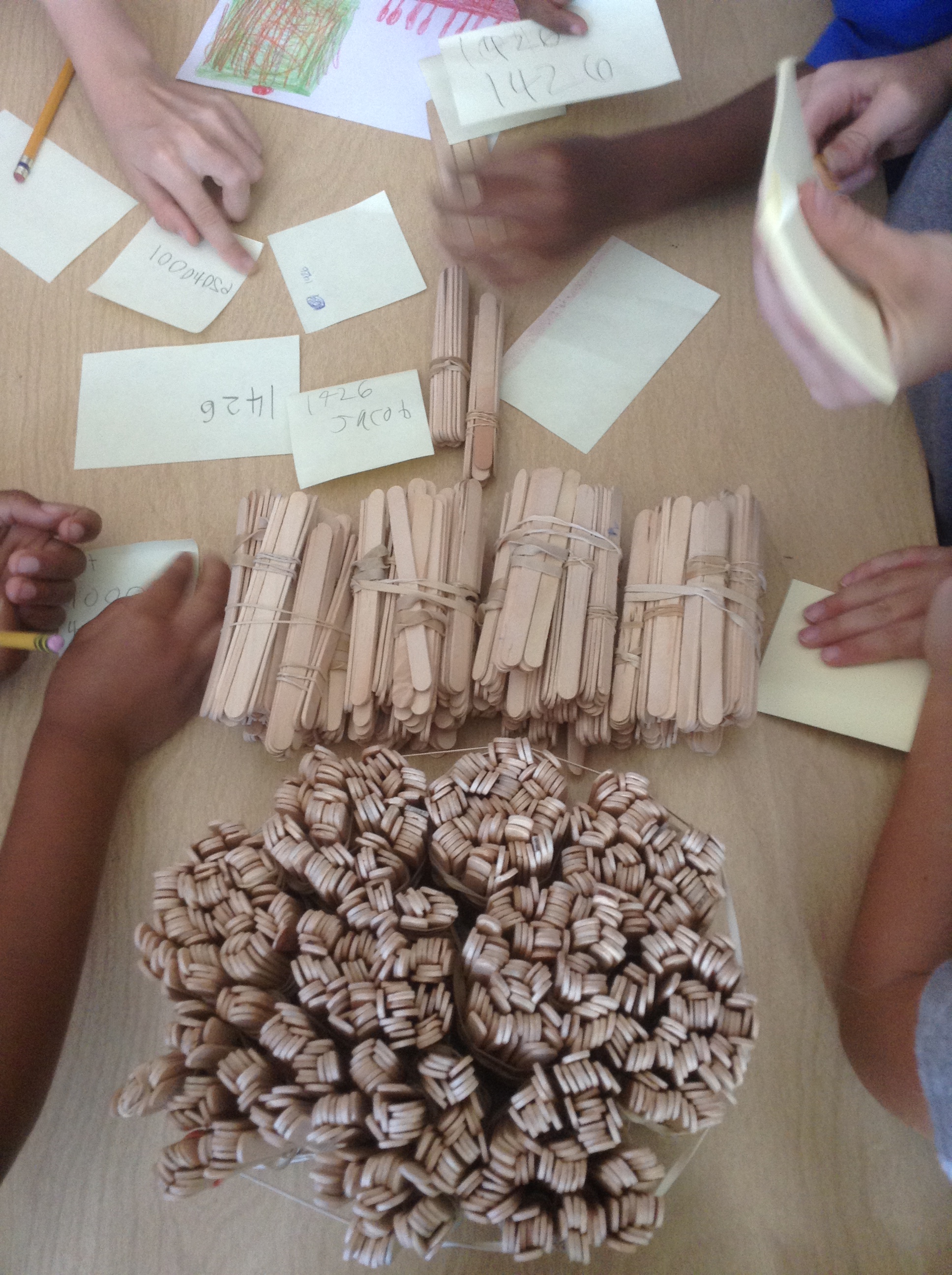
I mentioned on the math warm-ups post that we had been working on place value, and that mathematicians had a challenge to figure out how many sticks were in a big ‘ole pile.  They were given a small group (their partner plus another partnership) and two questions: How many sticks do you have? How can you count them in a way that will be easy to show someone else what you’re doing?

Each group was given a pile of popsicle sticks and they got busy!

As I went around to each group, I asked how they had decided what to do, and how they were determining how many sticks they had.  Most were bundling in 10s (yay!) and I nudged them to make an even easier way to see how much is in a big pile.  Could they continue to bundle and make a bigger group?

In the end, most groups ended up with bundles of 100, some 10s and–if their pile had any–some leftover 1s.  They put their collections back in the tubs, and marked how many they had with a post-it note.

Then we worked for a bit on how to model the numbers we had made.

IMG_5304The next step was to figure out how many we had altogether.  Many suggested that we could put our bundles together, but weren’t (at first) sure how to do that.  We talked about how they had made their 100s bundles–with 10 10s–and then guessed that we might be able to make some more 100s from the loose 10s in everyone’s tubs.

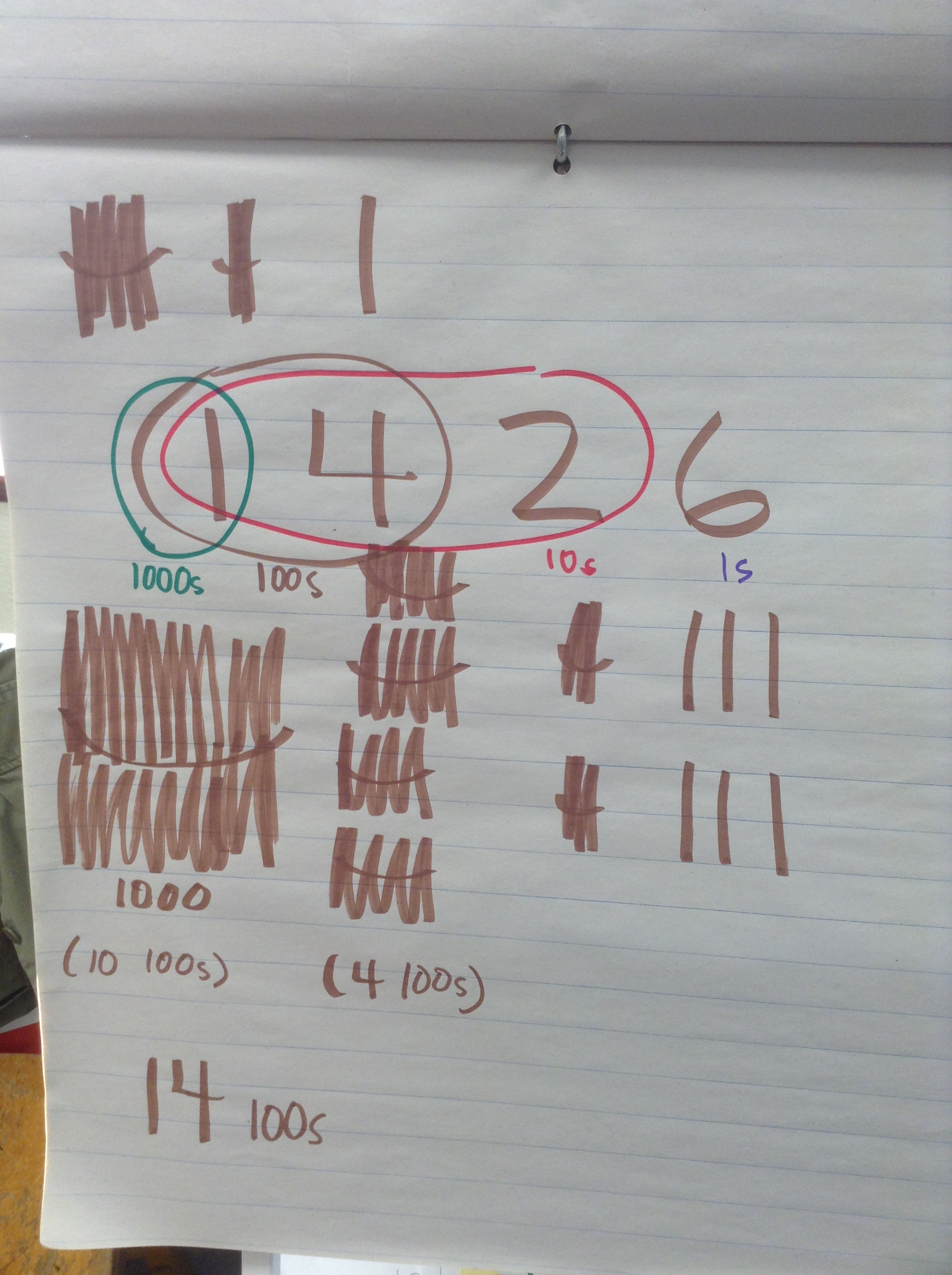
Left with a massive pile of 100s, that eventually led us to thinking there must be a better way to show how much that pile had in it.  I asked if they thought we could bundle any bigger numbers and honestly most of them thought I was crazy!  I just began collecting 100s in my arms and counting: 100, 200, 300, 400….and they got the idea.  They going until they got to…10 100s!  That was a great conversation next about what number we had just made.  10 100?  We figured out that it was a 1000, and that when we said “10 100” that helped us know about how many bundles were inside, but that it wasn’t the right way to say the number.  We stretched a big ‘ole rubber band and made a 1000 bundle!!  We counted the whole thing and agreed that we had one-thousand, four-hundred twenty-six sticks!

IMG_5288But how in the world do you WRITE the number one-thousand, four-hundred, twenty-six?  We gave it a go.  Many of us remembered that when we went from 2-digits to 3-digits it was a 100s number, and since we had 4 groups of sticks, maybe that meant our number had 4-digits…

IMG_5287 Our model of this number–1,426–looked like this:

IMG_5306Many minds were blown as we figured out how many 100s and 10s were inside that big number.  We figured out that it was actually than just what the digit said, because of all of the groups inside of groups.  I loved how many kiddos kept saying, “Wow, this is fun!” and “Man, we’re learning so much today!”  Definitely lots of great mathematical thinking happening here!

UPDATE:  I got this email after the first posting of this story.  Love this stuff!  Thanks for sharing, Shannon. 🙂

Hi Jennifer!  
You had so many math posts on the blog this weekend, that I wanted to share a story with you.  We have a Curious George story CD in the car that we listen to a LOT and in one of the stories George gets 10 dozen doughnuts.  The other day when this story was on, Millie asked me if 10 dozen was 120!  I was so surprised!  I said that it was and asked her how she knew that.  She told me “5 2’s are 10, and then another 5 2’s makes 20 and 10 10’s is 100 so, 120”.  It took me more than a minute to follow the math just because it wasn’t how I was used to thinking of problems, but she was totally right and I saw this “new” math stuff in action :).  It was kinda cool!  She was doing multiplication and didn’t even know it.  Thanks for teaching her such great foundational skills that allow her to do these kinds of problems in her head!

Second Grade Math Warm-Ups: 8-24 to 9-4 (2 weeks worth!)

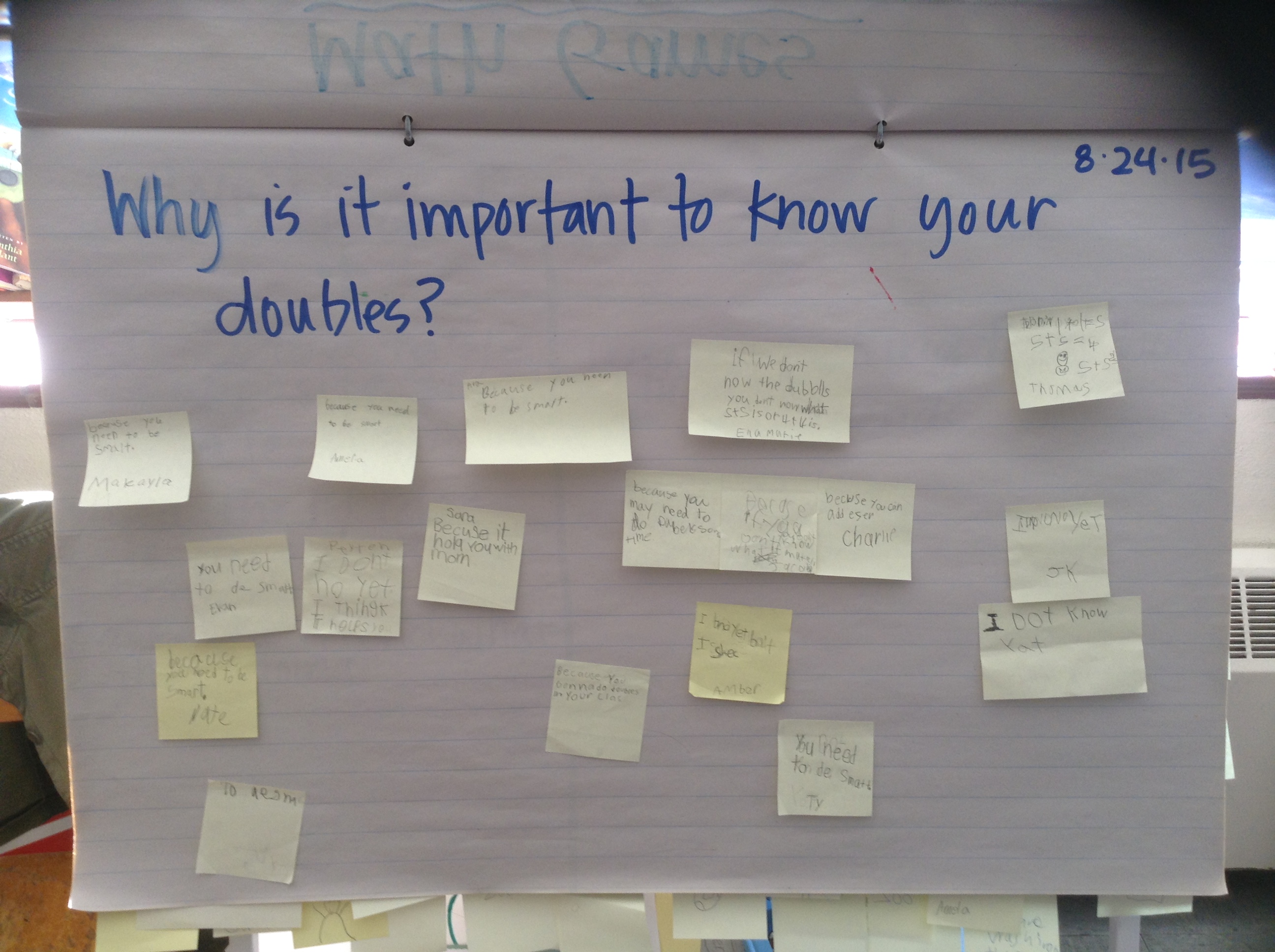
We’re in the swing of some things in 2nd grade.  Math warm-ups are one of those things–just I’m not yet in the swing of writing about them!  Here are last few warm-ups we’ve been working on:

Monday

Even though we worked on this last year, many kiddos had a hard time with the answer to this question.  We’ve since been doing many things (games, two-pen tests, conversations) to help us remember (or learn!) our doubles, near doubles and combos of 10.  They all form the basis for the bigger things we’ll do with numbers later on.

IMG_5294Tuesday

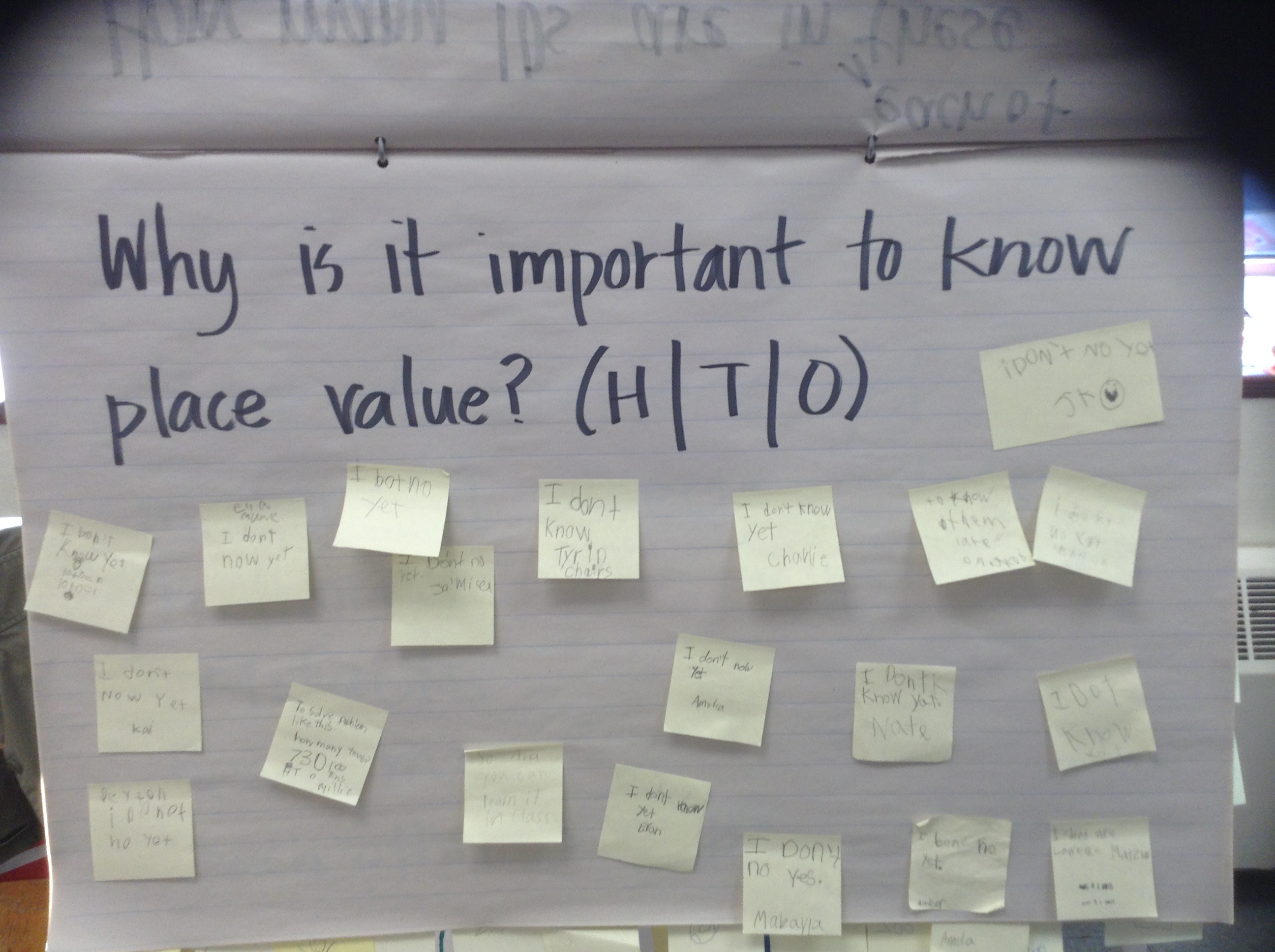
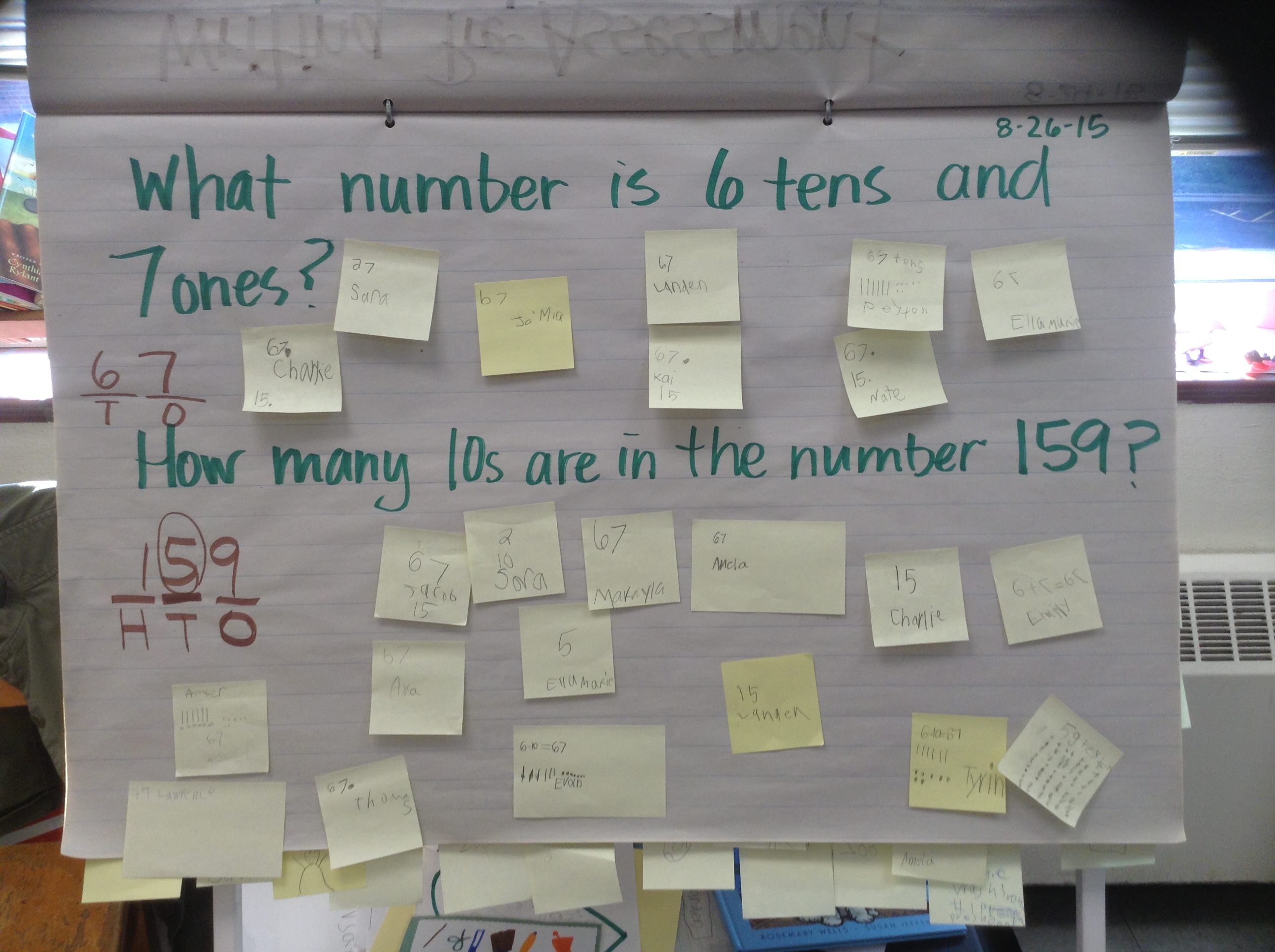
While I’m not entirely sure about the order of these next few warm-ups, the concept that is highlighted in them all is certain–the importance of place value.  Here was another that many had a hard time with.  Most of their answers were “I don’t know yet...”

IMG_5298

Wednesday

IMG_5295

Thursday

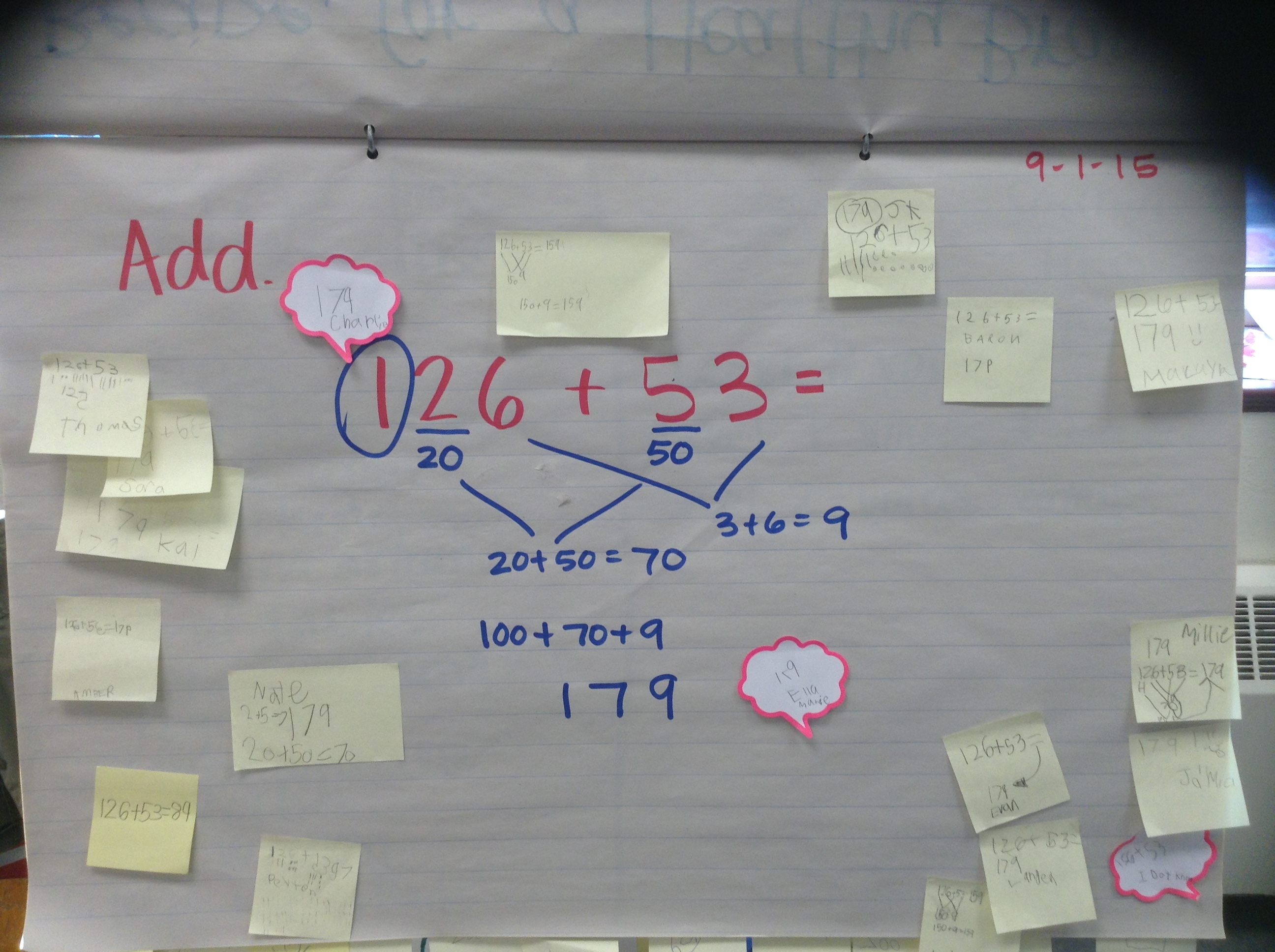
IMG_5297Tuesday, 9-1

This one was an easy connection to the essential question (EQ) I had asked earlier.  They had to think about place value to answer this one, knowing which numbers to add to each other.

IMG_5300Wednesday

Although not related to place value, this warm-up was related to a conversation we had had in math workshop the day before, and is definitely something all 2nd graders need to know how to do–tell time!  Often I will spiral older concepts into math warm-ups to keep them on the front of our minds!

IMG_5302

Thursday

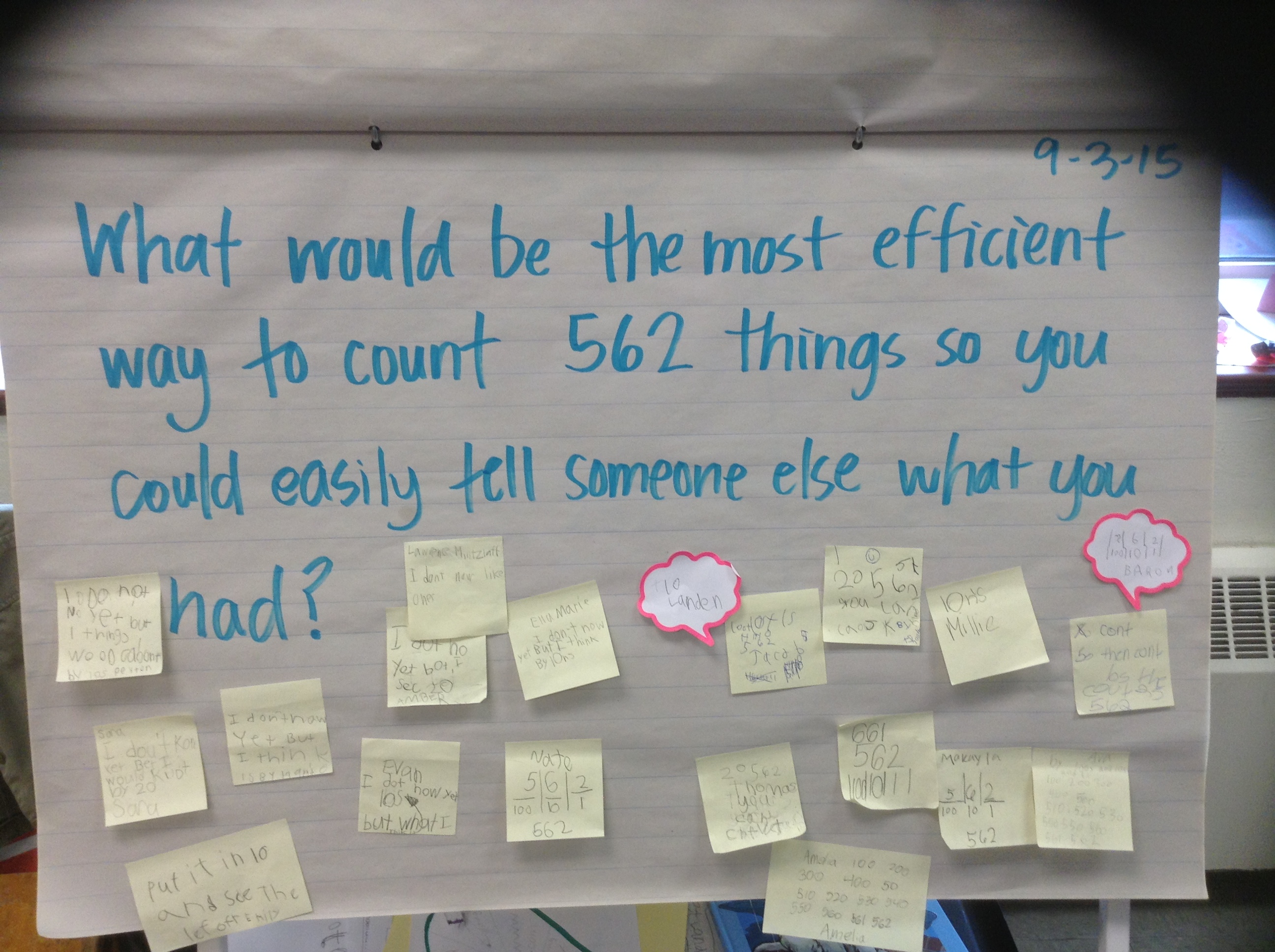
This warm-up, although badly worded, gave kiddos a little peek into a task I would have them do later that day in math workshop.  The question was really about the most efficient way to count a big ‘ole stack of something, which they’d have to do with a pile of popsicle sticks in a group that afternoon. I was happy to see how many of them were already thinking about bundling into 10s and 20s (rather than counting them all by 1s).

IMG_5303Friday

The warm-up on Friday was actually the end of the lesson from Thursday, and mathematicians completed their thinking with their learning partner in their math journal, which is different from how they MWU normally works.  I love how we can adapt this structure to work for our needs!  Since many of us have been doing this for a whole year now, it was easy to make that little tweak and still have them know what to do.  In this warm-up, kiddos were asked to model the counting we had done together the day before.

IMG_5304

Second Grade Math Warm-Ups: 8-18 to 8-21

When I first started using math warm-ups a couple of years ago, I had no idea how useful they would end up being in my classroom.  They are quick, easy and definitely give me a bank for the buck.  So of course I am using them again now that my mathematicians are second graders!  Here is how we got started this year:

Wednesday

I waited until the second day of second grade to start, and since we spent all last year doing this, most of my friends knew exactly what to do.  I just had to introduce my new friends (there are 4 of them) to this routine.  I started with a question everyone could answer (and if I remember correctly, it’s one of the first problems we did last year, too).

Screen Shot 2015-08-23 at 2.49.46 PMFriday

As I think about how we’re getting started in Math this year, our focus will be on making sure we have a firm foundation of basic skills and facts before we move on to other things.  That means we’re going to review combinations that make 10, doubles, doubles +/- 1 and basic addition/subtraction facts.  Hence the next question:

Screen Shot 2015-08-23 at 2.50.00 PMNote that I had to revise my question, since kiddos wrote 1 combination and thought they were finished.  I drew the visual of the 10s “rainbow” as we discussed the problem, and it was good to hear a couple of friends say, “Oh, now I get it!”  Like me (who is a visual learner), seeing how those numbers connect is important to their understanding.  This is definitely become an anchor chart in our classroom!

Getting Started with Math: How Much is Your Name Worth?

In the first days of school, our goals are both that kids get into subjects as well as that they build relationships with each other (just like last year!).  One of our first forays into math this year was with a challenge about names.

The original activity was called “How Much is Your Name Worth?” and was all about how each letter of your name is worth a certain amount (i.e. a=1, b=2, c=3, etc.).  While it was definitely a math challenge for some (we might have forgotten how to add over the summer!! LOL), it was also a reminder of how sometimes things are harder than we thought and we need to work through the tough parts.

For me, it was also an invitation to revisit the activity I was asking them to do and change what was tricky.  Not because I wanted to make it easier, but because we realized that the directions on the first try were really confusing.  Some were stuck with what to do, not how to do it.  So I made a new sheet, and also invited a new question to the challenge that they could attempt with a partner (which added another level to the activity).  Their new question was:

Screen Shot 2015-08-22 at 2.01.44 PM

The other thing that happened here was watching kids as they solved the problem of who’s name was most expensive by thinking about both the length of the names, and which letters were included.  There were resources everywhere that could help them if they knew they were there: the lunch sheet, our checkoff grids, the word wall, the helper chart, our mailboxes, our cubbies–the list went on and on!

In the end we didn’t really ask the question of who’s name was most expensive, but we all got our math brains moving, solved some problems together and worked with our friends!  That’s a great start in my book!