Ok, so I’m open to any and all readers/comments, but this one is especially for my 5th grade (or any other student) readers! Think about our Math Warm Up today, and answer these questions:
1. Write the number 143, 674, 998 in expanded and word form.
2. Round that number 143, 674, 998 to the nearest 10, 100, 1,000 and 10,000.
So I’m home with a sick baby again today. I HATE to be gone, but sometimes I just have to be a mom, you know?
So today’s absence reminded me of an idea I learned about recently. I was out a couple of weeks ago, and I used a great idea from a couple of teachers I met when I attended an EdCamp St. Louis conference earlier this month. They both teach middle school, and are out of the classroom periodically for activities with their school, and so need to leave plans for a substitute. Rather than just leaving written ones, they record videos to leave for their classes, often teaching the lesson from their couch and giving directions for what they want their students to do.
Last time I was out, I knew ahead of time, since her fever popped up in teh evening. So with my MacBook, my plans and my couch, I set to work putting together what I hoped would be a great day of learning for my kiddos, even in my absence. Here’s what I left as a welcome to the day, along with our normal morning routine screen on the ActivBoard:
After they went off to specials, it was time for Writer’s Workshop in our room:
That big blue button sent them here to this video:
Next in our day was Math Workshop. This video was a little different, but hopefully just as helpful.
Off to lunch and recess they went, and then back into the room for Read Aloud and then Reader’s Workshop. Again, a flipchart welcomed them with directions:
Ok, well at least it had a place to send them for directions. Those were here:
And here:
Social Studies followed Reader’s Workshop, as it normally does, and the lesson that they worked on that day was about the Natural Features of Europe:
Unfortunately this was the last day of the week, since we had a Professional Development Day the following day on Friday. We were also going to be out on Monday, too, since it was President’s Day! That meant I wouldn’t see them for what seemed like FOREVER, so I sent them off to their long weekend with this Goodbye and Good Weekend video:
Ok, so if you’re a frequent visitor to our blog, you know that I can’t write anything without ending with my thoughts and reflections. And of course the topic of this post means that those thoughts and reflections are definitely doosies! (Is that how you spell that? There was no choice for it in the dictionary. 🙂 )
(Now would be a great time to take a break and grab a snack if you want one! I know I didn’t warn you that last part would take so long. Sorry. It’s ok, I’ll wait for you.)
Thoughts and reflections from using video sub plans:
Ease: The only reason I tried this whole thing originally is because I knew at around 6:00 the night before that I would be gone. Since that was the case, I had lots of prep time to get it all ready. This would not have been possible had I woken up and been surprised with an absence (like today, for example!). Also, this was for an absence for a sick kid, not a sick teacher. Had I been the one that was ill, this would have been almost an impossibility. I hope, though, that since I’ve done it once now, and figured out all the logistics, the next time it won’t take me quite so long to put it all together. And no, I don’t really want to admit how long it took me. Ask your kiddo if you want. I told them. 🙂 The other idea I had just now, though, is to prepare a generic “sub plan video” that could be used at any time if I had to suddenly be out. It could then be added to my normal sub folder or uploaded to the portal that we use online to secure our subs. Who knows, maybe I’ll start working on that one.
Logistics: I know this is partly related to the “ease” subject I just mentioned, but what I mean with this one is that there are a lot of logistical things on the school end that have to happen in order for my video plans to work like I had hoped they would. The substitute has to know how to use the ActivBoard flipcharts I made, they have to know how to log on to my YouTube channel so the videos all play, and they have to be willing to follow the directions I gave in my videos. So, in a perfect world, this would have been a great way for me to be at school with my students even though I wasn’t able to be there in person.
Impact: While the original reason I decided to try it was because it sounded like a great idea, incorporated technology and was something I hadn’t done before (which is often very motivating for me), I decided as I went through my planning, that maybe just seeing my face would be a subconscious reminder to follow the rules. You know, unfortunately some kiddos tend to move into a different state of mind when they see a substitute at the front of the room instead of their normal teacher. I was also hoping that having me “teach” the normal lesson they were going to have for that day would help as they tried to keep the learning day as predictable and productive as possible. I wanted to get the most bang for my buck. I know that the day is never the same without me as when I’m there, but this was my way of trying to do what I could to help make it as normal as possible.
What experience do you have with using video sub plans? What suggestions do you have for me? If you’re a parent, what do you think? If you’re a substitute, have you used video sub plans in a classroom you’ve been in? I’d love to know your thoughts! Leave a comment for me. 🙂
I thought I was going to share an update about what’s been going on with our math rotations, but when I went back to look for the posts to link to, I realized I haven’t actually done it yet. So now I will. 🙂
I will remind you of how I’ve been learning and reading about math lately. You can read about that here and here and here. Go ahead. I’ll wait. Hee hee….
One of the biggest changes that can be seen in our room during Math Workshop is the use of rotations and small groups. I guess I have always done groups of some sort, but I’m not usually a follow-this-strict-time-frame-and-schedule kind of person. They usually happen spontaneously. After a mini-lesson when kids have questions, or when some need review of some part of a concept. We might just meet once or twice to meet a specific need and then move on to the next one. So the whole idea of planning strict, timed math rotations with a predictable schedule and routine was a big rigid for me. Believe me, there is structure and routine in my room, but many would say it’s a more relaxed version.
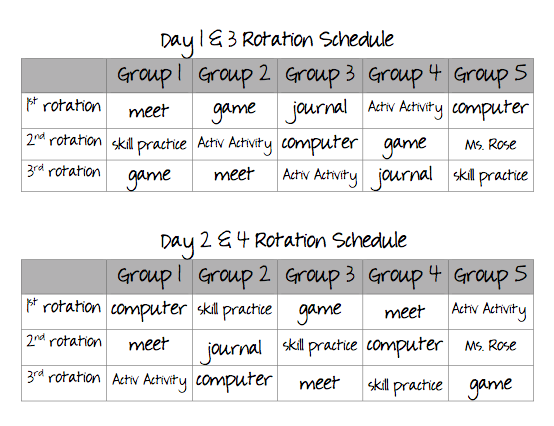
Well, hearing how great it was working in some other classrooms around my school (and especially in my neighbor Pam’s 5th grade next door!), I decided to try it. So now, at least during math, we have a schedule. It’s built on a 4 day cycle of rotations, with days 1 & 3 and days 2 & 4 being the same (thanks again to Pam –this was not my idea. She TOTALLY created it and shared with me. Gotta give major credit where it’s due. 🙂 ) The schedule looks like this:
Now, I am lucky enough to have another teacher push-in to my room for math support during the second half hour of our math time, so she takes one group and meets with them, and I spend time with the others. We get to do double duty and it works really well.
Every 15 minutes, kiddos rotate through stations and work on something math related (I know, duh, right?):
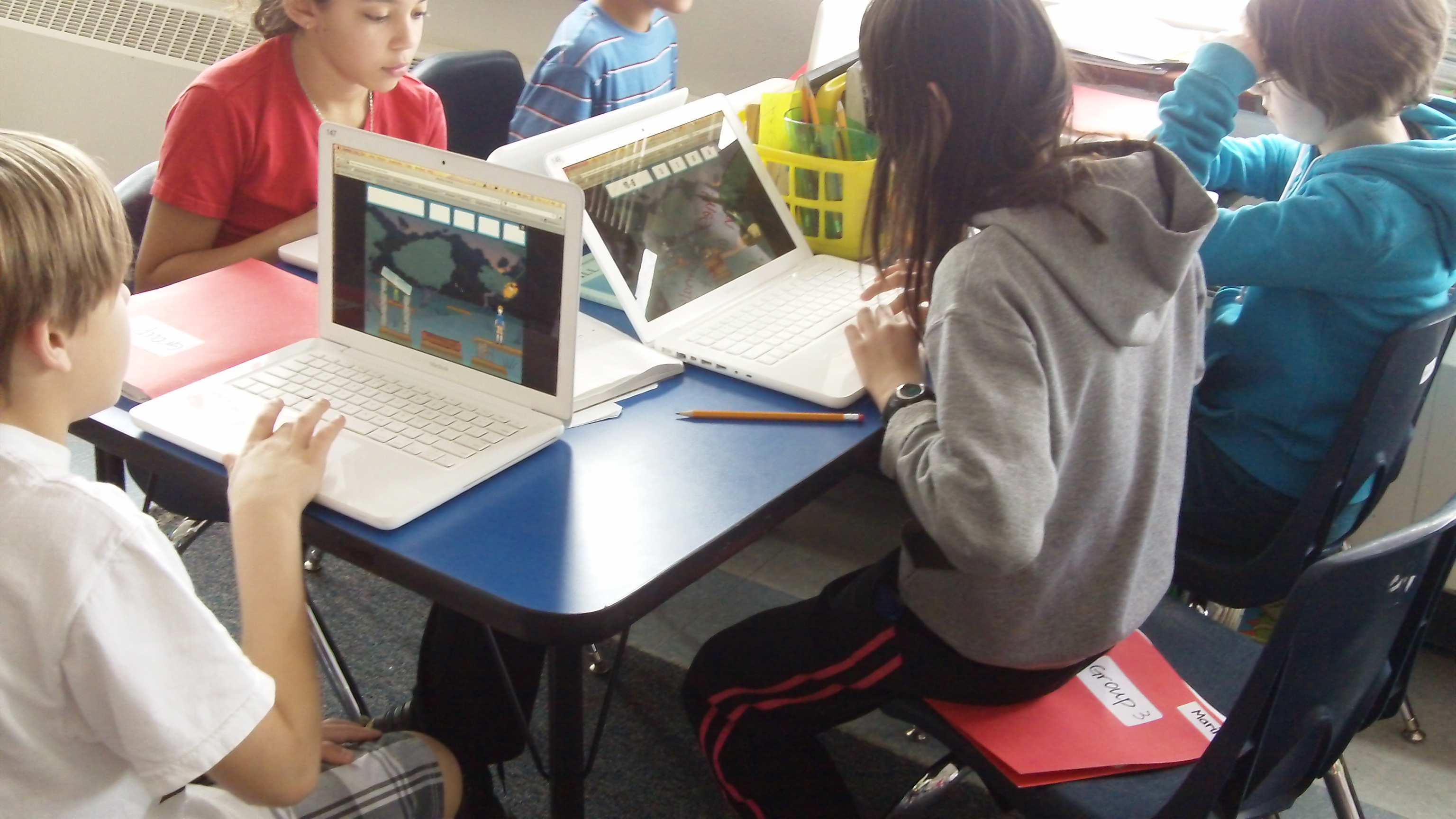
COMPUTER:
We have a laptop cart that is shared by my teammates and I, so we grab 5 and set them up in a mini-lab situation during math. Most days we play games on www.sumdog.com, which my kids are absolutely in love with (again, a find by my ubersmart friend Pam). I love that I can set up which skills they work on. Each kid has their own username and password, and it keeps track of how they do. I get periodic emails about what’s happening there, so I can keep up on what’s going on when they’re in that station. Double nice for all of us.
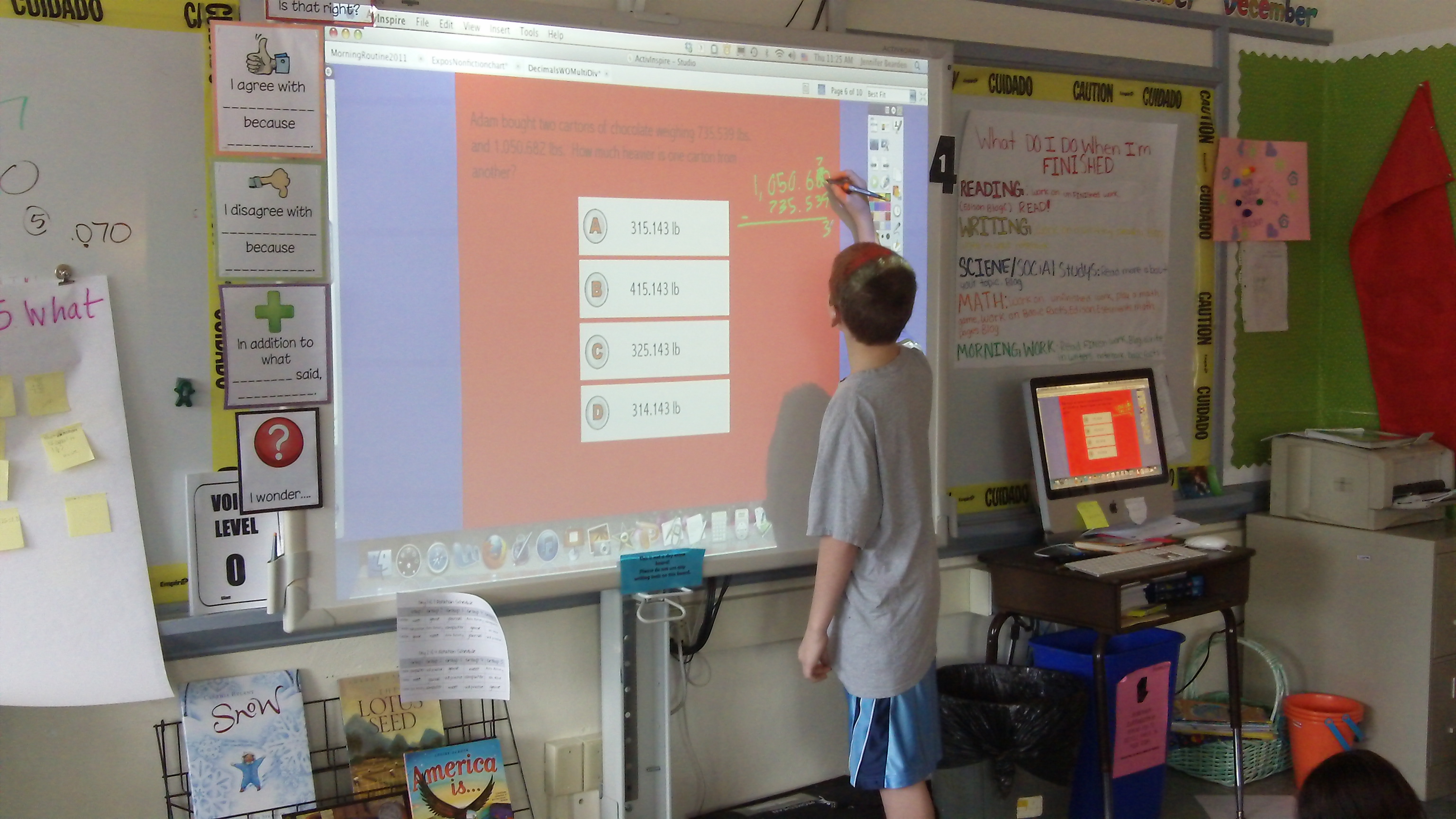
ACTIV ACTIVITY:
I’m pretty sure that it’s meant to be called Active, like with an E on the end, but since our interactive whiteboards are ActivBoards, I thought that name was catchy. I know, it’s weird, but that’s what I do. So, at this station, students work on something I’ve got ready for them on the ActivBoard, and it usually related to the unit we’re studying. The one they’re doing in these pictures is one I found from Promethean Planet, and has word problems about decimals. I just made a flipchart for next week, however, that has sudoku puzzles. I’m excited to share that one. The take turns in their group working at the board–“sharing the pen”–and then work out the problems on their own when it’s not their turn. Of all of our rotations, this is the one that seems the hardest for us for some reason. We’re working on making it go more smoothly.
GAME:
This is a basic math game station. When kiddos come here, they play a game with their partners that is about a concept we’ve already learned about. Usually it’s from the last unit we just completed, or is related to basic facts or operations that most everyone needs practice with, like multiplication and division. Usually I tell them which game to play, but everyone in a while they have a “free” day where they can play a game of their choice.
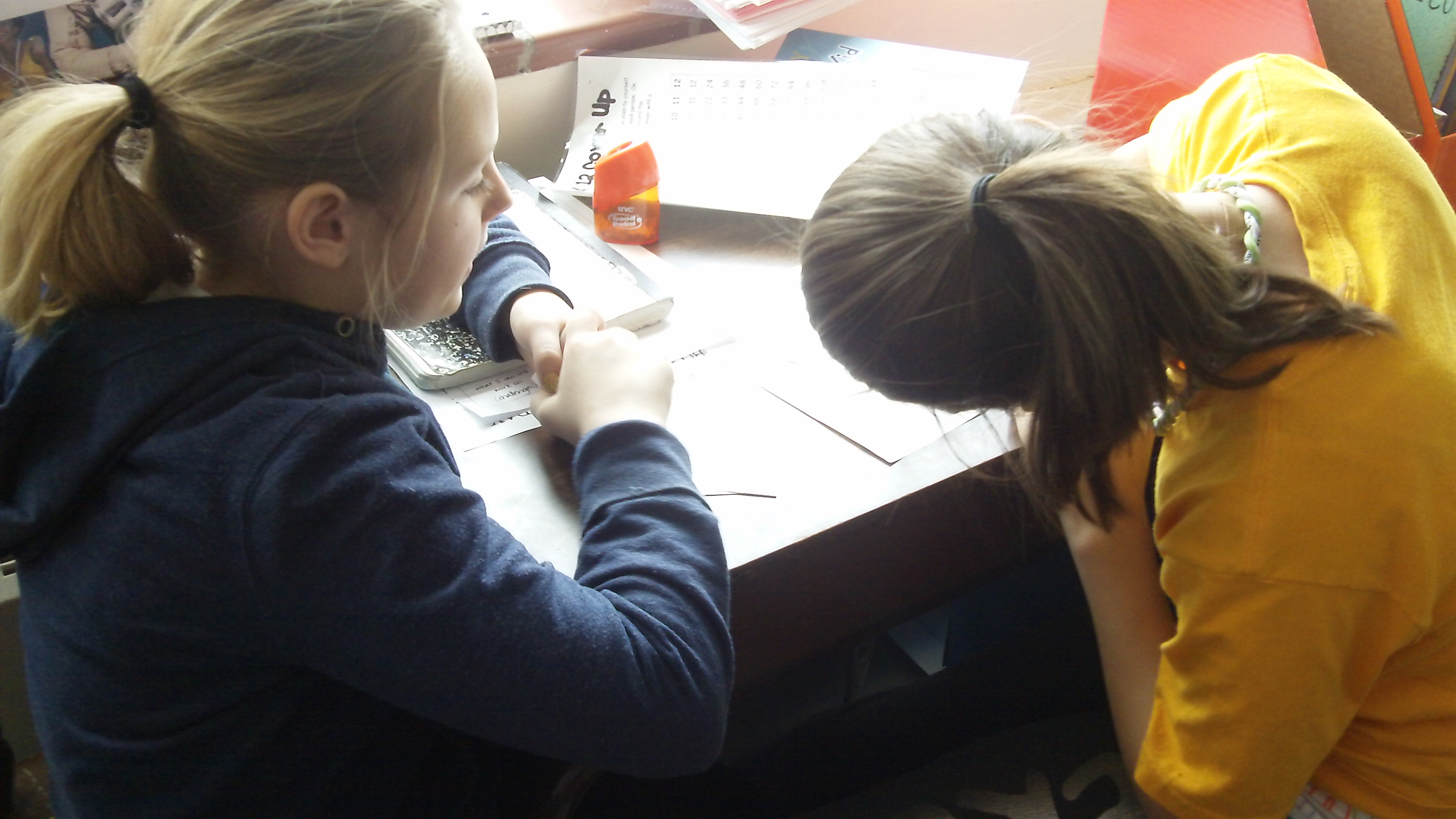
JOURNALS:
I don’t have a picture of this one–probably because it would just look like a bunch of kids writing in a notebook. During this rotation, kids work on problems that might require writing, or that are an “extra” thing we’re not directly doing in our math unit. They are usually higher level, and are meant to stretch them a bit. One group was working on problems related to whether or not the Harry Potter franchise was successful at the box office (this one was a big treat for some MAJOR HP fans in my class!), one group solved problems about conversation hearts, and then there was one related to volume of chocolate Valentine’s candy. These were all found on yummymath.com.
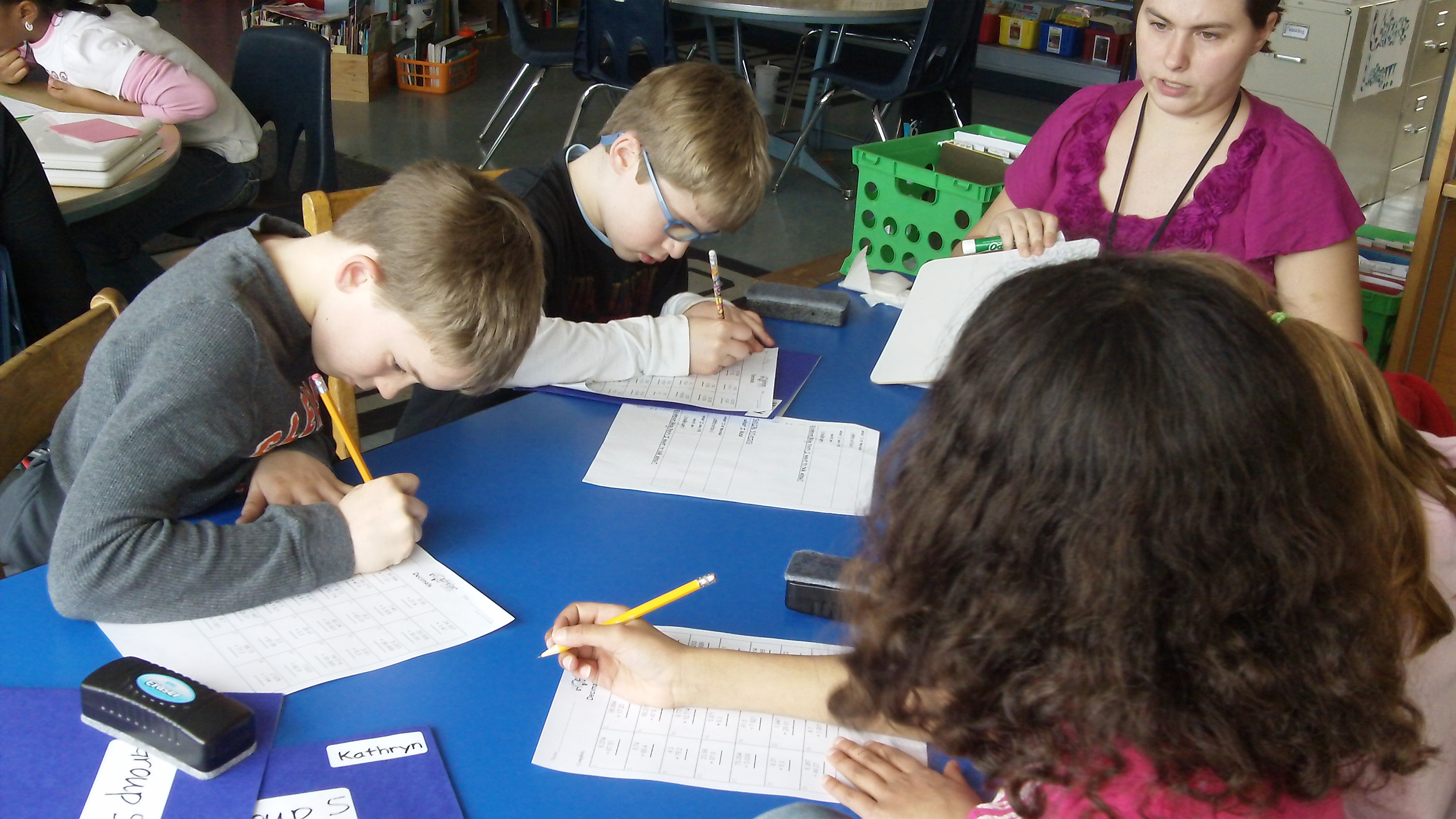
MEET WITH TEACHER:
So since I was taking the pictures, you get a glimpse of my teaching partner, Ms. Rose. She’s pretty great, and this is the group she works with on most days. Whether they are meeting with her or with me, these times are used to meet the specific needs of the group, based on info from a pretest (in the beginning stages) and the work we do together (which I use to know where we should go and how fast).
SKILL PRACTICE:
Sorry. Again a pretty boring picture, but it’s of kids practicing. Makes sense, right? This is a station they go to after we’ve learned something together. The work they do here helps me know where to go the next time our group meets together.
We are in week 4 of this whole Guided Math math rotations thing and I think it’s going pretty well. Check out what my kids had to say about it the other day by reading what they wrote about it on their blogs. Their words speak volumes to how beneficial it seems to already be for them as learners. Can’t wait to see where it goes!
***MAJOR SHOUT OUT: I’ve mentioned all over this post that these ideas are not mine. They are not original to me, and come from some really hard work shared with me by my colleague and teammate Pam LeSeure. She found the whole Guided Math framework to begin with and then ran with it! I have been lucky enough to benefit from her blood, sweat and tears as she figured it all out. She’s been an amazing support to me! Thanks again, Pam. 🙂 ***
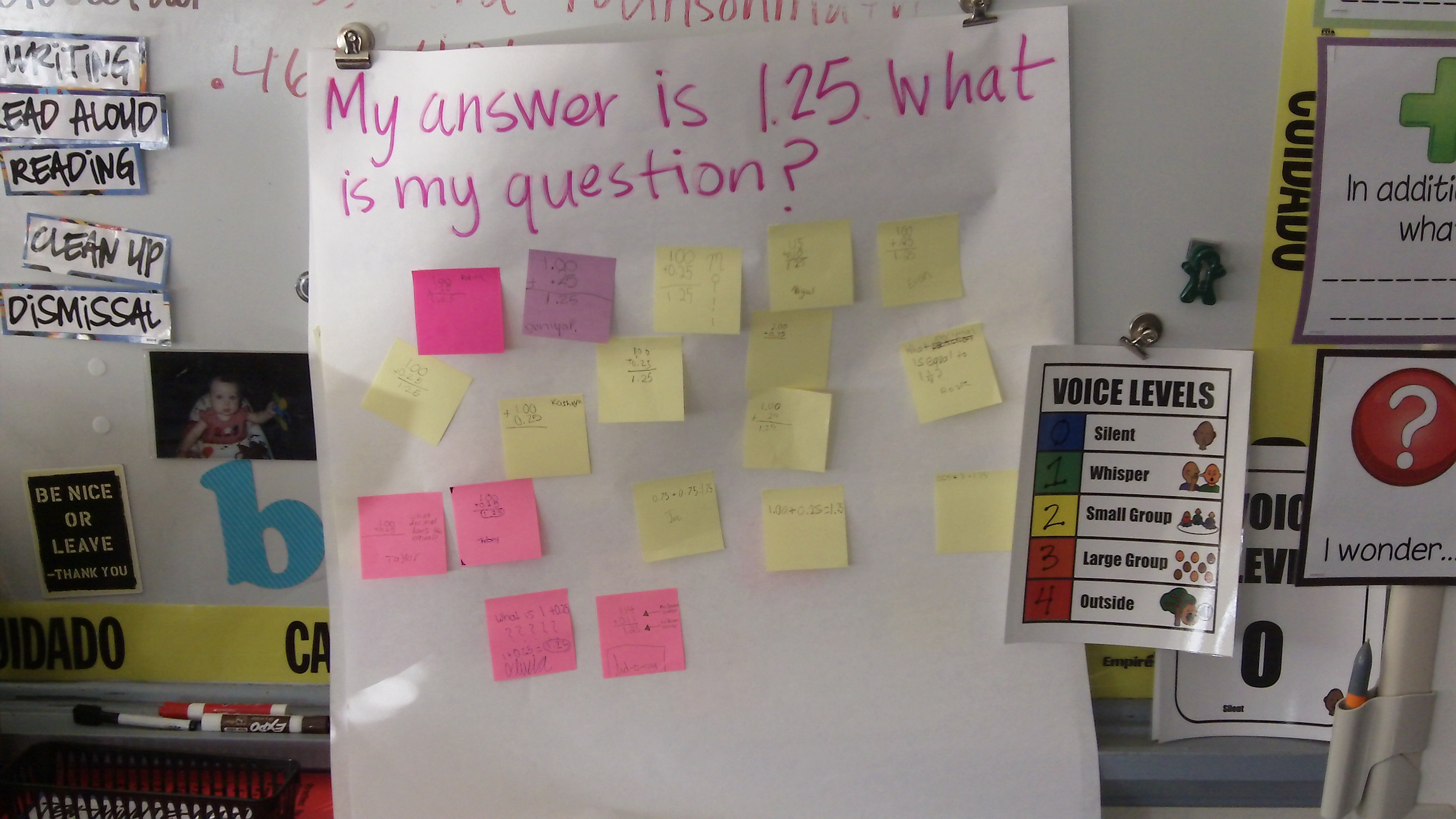
Remember when first told you about math warm ups? These were the warm ups we did this week, focused on decimals for our current math unit. How would you answer them?
Remember this? Since then we’ve done several other math warmups about geometry and decimals. But we’ve also been doing some other things–things that started out with math and quickly spread to other areas of our life together in Rm. 201.
Let me explain…
The other day I asked my kiddos a question, and after I did, I realized–by listening to the crickets and seeing their confused faces–that they didn’t get it. So I rephrased it, and also took them on a little tour to help explain what I meant.
One of the things I’m working on is making our room look and feel like it’s as much a place for mathematicians as it is for readers, writers, and scientists. So I took them to a place that I knew would help them get a feel for what that looks like–our neighbor next door, Mrs. LeSeure’s 5th grade class.
We sneaked in very quietly and looked around. The directions were to pay attention to what they saw that told them that math happened in that room, things that maybe they didn’t see in our own classroom. We then came back and brainstormed what we noticed.
Here’s what our list looked like:
Ok, I know–you’re distracted by the messy handwriting. I promise, it’s not usually that bad. I was writing fast. 🙂
What was really great about what they put on the list was that they noticed things that I know that Pam specifically did for her math environment, but they also caught on to the things about how the room felt, the subliminal messages that were being sent in that space.
As you can see on our chart, Mrs. LeSeure’s class has things that help her students in math, like anchor charts from things they’ve just learned about, like area/perimeter and the difference between similar and congruent, both from our recent 2D geometry unit. But my students also talked about how her classroom felt. They said that it felt relaxed. It was clean and neat and colorful. This was where I had to be brave. I had to remember that just because they said her room was like that didn’t mean that ours wasn’t, or that I am a bad teacher, or that her class is better than ours. It just meant that Rm. 202 had some things that ours doesn’t have, different things. Things that we want to add to our own room.
Most of what they were saying actually went way beyond the original math-related question I asked. They went deep. And they made me nervous. But like I said, I had to be brave. Their statements dug deep to the reasons why some things happen in our room, the reasons why we sometimes struggle with paying attention and why it seems like we don’t know what to do next, or why we waste our learning time. They were really great comments, actually, and come down to the fact that our room just really isn’t working for us anymore. That was the part I had to be brave about–I am, after all, the one who designed that room, and created the environment in the first place.
Remember when I showed you what it looked like the first time I came in during the summer? And then how it started to change as I put it together? Well, even since then, many things have changed since we first started together in August. But on Wednesday we were talking again about how more change needed to be made. I loved how Evan put it when he said, “I don’t mean to be mean, but you arranged the room without us, and we’re the ones who spend the most time here.” And you know what? He’s totally right! It’s really funny how that whole thing works, really, with the teacher planning and arranging and setting up the room for a group of kiddos she doesn’t even know yet, without their input. I know it’s just what has to be done, but it would make sense that the people spend all that time and energy there every day should have some say in how it looks. And feels.
So that’s when it happened. I gave them a chance to suggest changes they thought should be made. I asked them to tell me, and to even draw a map if they wanted to, what they thought about what we could take out and what we needed to move. Everyone got busy, some by themselves and some in pairs or small groups, making lists and floor plans to help us all see the vision of what we could do.
It was so very cool to “see” the classroom through so many new sets of eyes. I obviously look at and pay attention to different things than my students do as I go through the learning day. It was also really cool how similar their maps were when we sat down to look at them. For example, there at least 3 different groups who suggested that our classroom library move to another part of our room (a place where I originally was going to put it, actually, but then changed my mind about) and how everyone agreed that the cubbies as a divider between the carpet and Table 3 just didn’t work. Most of them had the same idea for how “my” area could change, by turning my desk 90 degrees and putting my computer in a different place. And I appreciated how they used their new geometry vocabulary to explain it to me!
So I began that very afternoon to make some of the changes that they suggested. And you know what? IT LOOKS AMAZING! These kiddos are so darn smart about what they need and what works for them as learners. They teach me every day, in a respectful and appropriate way, that I don’t know everything! The room has taken on a new and different feel, and most people who have come in have commented on how they like what’s happening. We’re not quite done yet, but believe me, I’ll definitely show it to you when we’re finished. I’m really pretty excited about it. And they are, too. I love how many kiddos said to me how much they appreciated that they have a say in this. I’m glad I gave them a say, too. Because they are saying some pretty great things.
How do you make decisions about your room/environment? When have you had to be brave? What ideas do you have for us as we work on the environment of numeracy (and literacy and so on…) in our classroom?
I just started a book study, led by Mrs. Bell and Mrs. LeSeure, on the book Guided Math by Laney Sammons. I have only read the first few chapters so far, but am really loving it already. The book is based on the idea of using the strategies that kiddos already know as readers (visualizing, connecting, questioning, rereading, summarizing, etc) in relation to math; the same things that we do to understand what we read can help us understand math (or any other subject, for that matter!).
So, like I said, we’re just at the beginning, but have learned the overview of the big ideas in Guided Math. Then we were supposed to choose one that we were going to commit to change or add to our math class as we work through the book together. My goal was to add to the environment of numeracy in my classroom: to find new and innovative ways to add math to parts of our day outside of “math time.” The goal is to get kids thinking like mathematicians in all parts of their life at school.
One way to do this, even from the minute they walk into the room in the morning is with warm-ups. These are quick, math-focused questions that kids answer on a chart for everyone to learn from together. This was our warm-up from this morning:
It wasn’t a ground-breaking question, nor is it the most deeply I’ll ever ask my kids to think, but it got us focused on math right from the beginning. I loved it when someone said they had no idea what to write and with just one question from a friend, were able to add “I used math when I had to figure out how long I had until I had to leave to go to my dad’s house” to the chart. That’s what it’s all about really, supporting each other in our learning.
So what math did you use this weekend? How do you involve your kids in mathematical thinking outside of “math time?” What suggestions do you have for math questions we can use for a warm-up? We’ve love to hear your thinking and add to ours!
Today was one of those days when I decided to totally change my plan for math and it worked out tremendously better than the original plans. Let me tell you about it. 🙂
My kids are used to what I call “geometry challenges”, where they have to prove that a statement is true, by using what they know as mathematicians. The first one we did was to prove that the shortest distance between two points is a straight line. They worked alone or with a partner to show how that was true, or to find a way to prove that it wasn’t. Then next one was to prove that a straight angle equals 180 degrees. With that one, they used Power Polygons with angles that they know to show whether that statement was true or untrue. Needless to say, they’ve totally rocked each of those situations, and really shown what they know about geometry.
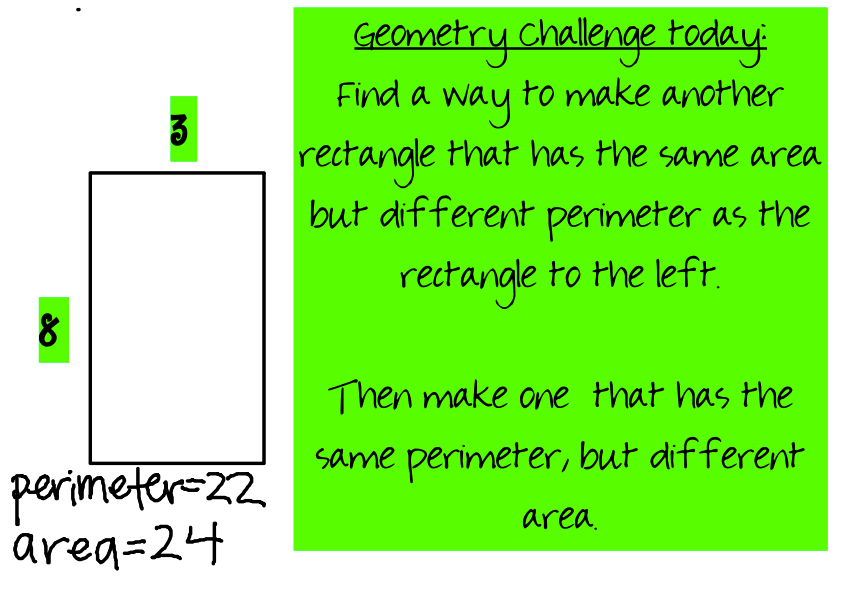
So today I was headed in a totally different direction, but decided to do today’s lesson as a challenge again. Here is what they were asked to do:
Like in the past, they had amazing things to show for the work on this challenge. Before I show you what they did, I’m curious to know what your answer would be. Could you answer this challenge?
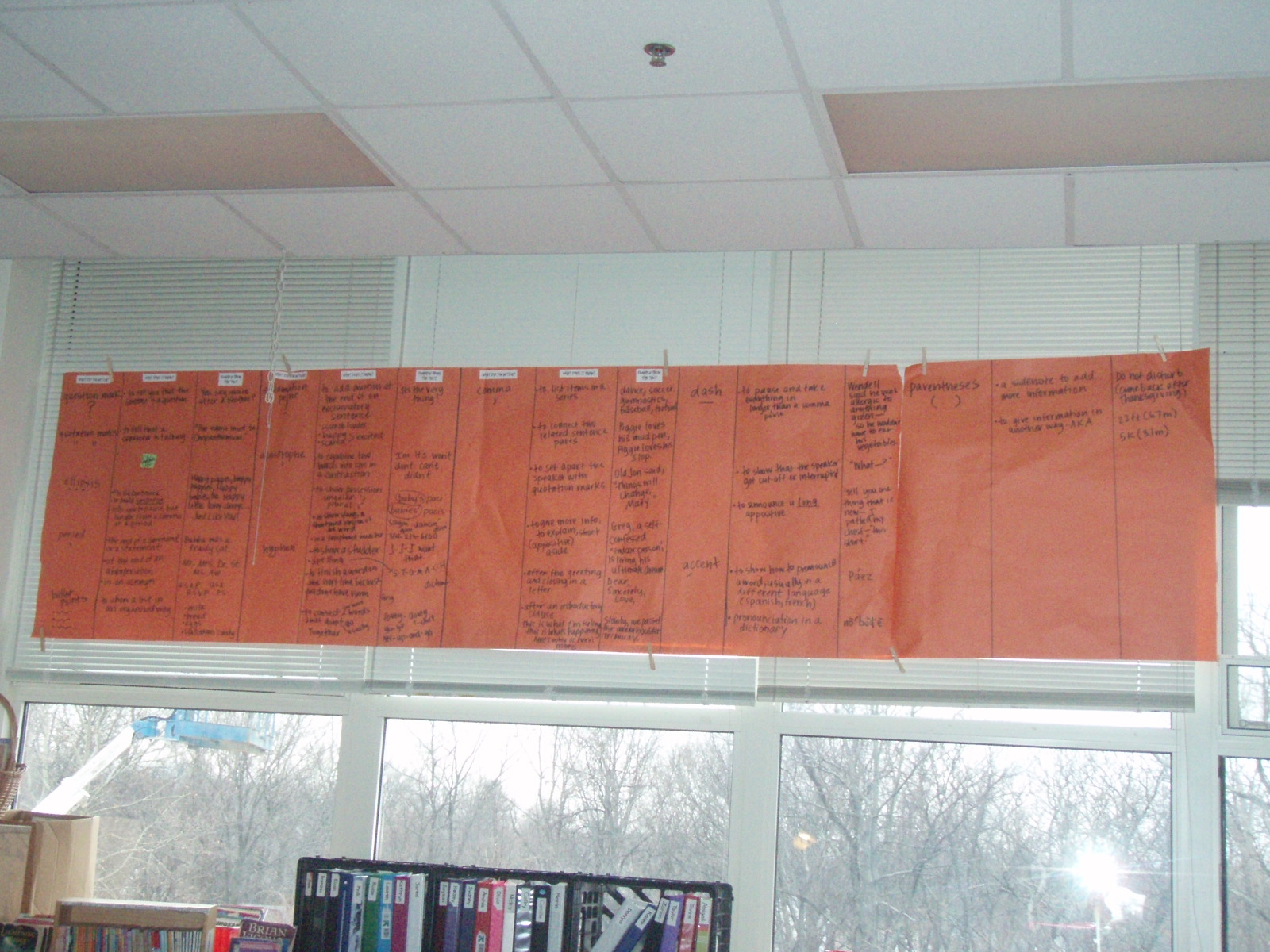
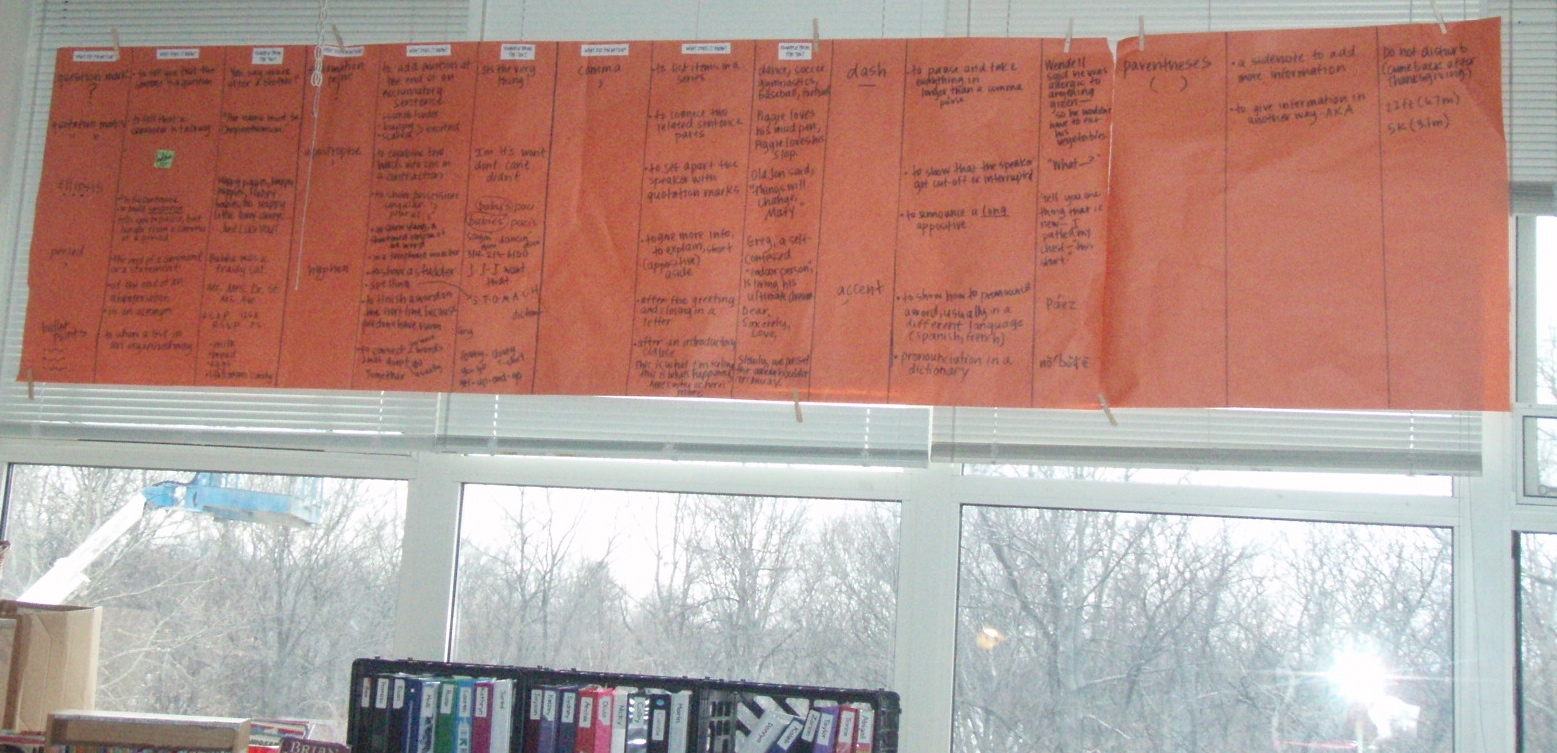
We moved our “We’re Connected with the World Map“, remember? Well, in order to have space to do that, we had to move the class chart we had made during our punctuation study. Our class had the great idea of using our blinds to hand the chart, so we could see it more easily and refer to it during our conversations on the carpet. That is, indeed, the whole point of the chart anyway, but where I had decided to hang it did not facilitate that happening. Again–my kids had a great idea that I wish I had done in the first place! So now our smart thinking about punctuation hangs above our heads while we work and think together in our meeting space–right where it should be!
Ok, so the other day I posted about our first lesson in our new geometry unit. I was a little frustrated by not being able to post videos, because I caught a great conversation about rotational symmetry that one group had.
After some smart thinking by my brother-in-law, I am attempting it again, using our newly created YouTube channel. Let’s see if it works:
But anyhow, I hope you caught what was happening in that conversation. The boys were working to put their geometry terms into groups and label them, and got to talking about rotational symmetry related to triangles. Evan was trying to explain to Harry about how all triangles have rotational symmetry and was showing him with the picture on the post-it. Harry–and then Dom, who you only hear but not see–help him with the idea that regular triangles, but not all triangles have rotational symmetry.
I love how you ask kids to do one thing, and then they take the conversation to other (and many times deeper) levels. Great job, kiddos!
(And sorry to those of you who were annoyed by the quality of that video. I’m still new to this part of blogging and uploading! I’ll get better, I promise. 🙂 )






 20somethingkids and 1kookyteacher