Sometimes I have posts that fit into the “boring” category. This is probably one of them. It’s our daily schedule. But it’s important so you know when we’re doing what we’re doing. 🙂
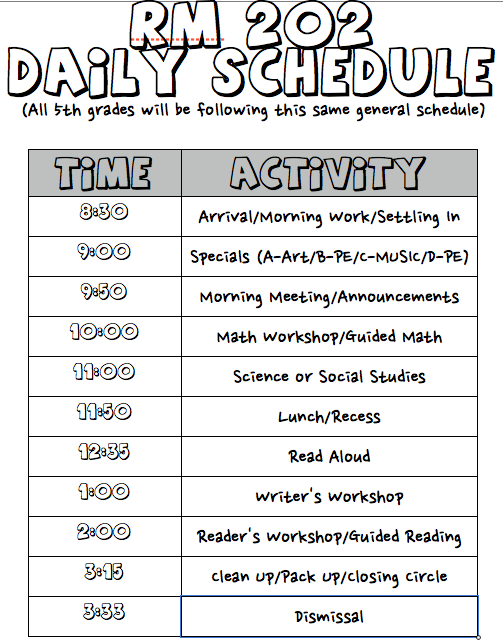

Sometimes I have posts that fit into the “boring” category. This is probably one of them. It’s our daily schedule. But it’s important so you know when we’re doing what we’re doing. 🙂
Remember when I told you about figuring out our class norms? Well, another thing we worked on last week was related to the same idea–how are expected to act in our classroom. But instead of talking about how to work with each other, this time it was about personal standards.
Now to be fair, I had a little more lead in this activity than I have in others like this. There were some things I new I wanted to have on this list, and then I wanted them to talk to me about examples of them, or what they needed to think about in order to make them happen. While I value kid-created ideas in almost everything we do, there are just some times when you have to start the conversation with something and help lead them in a certain direction. This was one of those times.
This chart now hangs next to our class norms near our meeting area:

I love how these two anchor charts make it very clear the kind of people we want to be every day in our classroom!
I work at the most amazing school ever. No really, I do! But it didn’t get that way by accident. Our school culture is one built on respect and acceptance, and these things are expected and encouraged by all the adults that work here. Our school has Road Rules that help our students (and teachers) know how they are to act, and our staff then has another specific set of norms that we follow in our interactions with each other. My team, then, has also agreed upon norms for our collaboration.
So the next step would be my own classroom, right? This year, instead of focusing on class “rules,” I had a conversation around norms with my students. We discussed how norms help us know how to talk to each other, how to act in a group, how we want our room to function.
We started by reviewing the Road Rules, since they are the universals for our school, and everything we do in our room should relate to them. In our tribes, we brainstormed ideas. Then we shared out and began the big job of weeding through all the suggestions. We looked at any norms that were similar or even the same as others, or ones that maybe just were not our best thinking. Here’s what we ended up with:

And then since we needed a fresh copy that we could easily read (and that matched our theme!), I made the final copy that now hangs next to our meeting space:

These norms help us work together smoothly and productively, and since they were everyone’s ideas, no one can really argue with them! They’re helping us do great things already!
What norms do you follow in your school or your classroom? Parents: do you have norms for your house? How are they working for you?
Have you ever played Bananagrams? Well, honestly, I haven’t either. I know that it’s a little like Scrabble, and is a banana-bag filled with letter tiles. At our “opening day” staff meeting, my fabulous principal, Mrs. Sisul, did this version of Bananagrams with our staff. I thought it would be really great to try it with my 5th graders. Here’s how we used it in our room on Thursday.
Every kiddo was given a letter tile out of the banana, and then were given these directions:
1. Find as many different other letters as you can and make a word.
2. No talking.
3. Sit down after you have a word.
4. If you can’t use your letter to make a word, wait by the easel.
During our first round, we made the words NUN, PEARS (which later became SPEAR), BOW (which became BROW when we added someone who needed a group), I (it’s a real word, right?), and RIO. They did great, and followed all of the rules I gave them. I was a little surprised with how easy it was to do the “not talking” part–that’s usually the rule that gets broken first. Not these kids, though. 🙂
Have you played Bananagrams? Have you used it in your classroom? Do you have a suggestion for us for a rule we could add to our game? We’d love to hear your thoughts!
 20somethingkids and 1kookyteacher