Tag Archives: writing
The Cat’s Away
So I’m home with a sick baby again today. I HATE to be gone, but sometimes I just have to be a mom, you know?
So today’s absence reminded me of an idea I learned about recently. I was out a couple of weeks ago, and I used a great idea from a couple of teachers I met when I attended an EdCamp St. Louis conference earlier this month. They both teach middle school, and are out of the classroom periodically for activities with their school, and so need to leave plans for a substitute. Rather than just leaving written ones, they record videos to leave for their classes, often teaching the lesson from their couch and giving directions for what they want their students to do.
Last time I was out, I knew ahead of time, since her fever popped up in teh evening. So with my MacBook, my plans and my couch, I set to work putting together what I hoped would be a great day of learning for my kiddos, even in my absence. Here’s what I left as a welcome to the day, along with our normal morning routine screen on the ActivBoard:
After they went off to specials, it was time for Writer’s Workshop in our room:
That big blue button sent them here to this video:
Next in our day was Math Workshop. This video was a little different, but hopefully just as helpful.
Off to lunch and recess they went, and then back into the room for Read Aloud and then Reader’s Workshop. Again, a flipchart welcomed them with directions:
Ok, well at least it had a place to send them for directions. Those were here:
And here:
Social Studies followed Reader’s Workshop, as it normally does, and the lesson that they worked on that day was about the Natural Features of Europe:
Unfortunately this was the last day of the week, since we had a Professional Development Day the following day on Friday. We were also going to be out on Monday, too, since it was President’s Day! That meant I wouldn’t see them for what seemed like FOREVER, so I sent them off to their long weekend with this Goodbye and Good Weekend video:
Ok, so if you’re a frequent visitor to our blog, you know that I can’t write anything without ending with my thoughts and reflections. And of course the topic of this post means that those thoughts and reflections are definitely doosies! (Is that how you spell that? There was no choice for it in the dictionary. 🙂 )
(Now would be a great time to take a break and grab a snack if you want one! I know I didn’t warn you that last part would take so long. Sorry. It’s ok, I’ll wait for you.)
Thoughts and reflections from using video sub plans:
Ease: The only reason I tried this whole thing originally is because I knew at around 6:00 the night before that I would be gone. Since that was the case, I had lots of prep time to get it all ready. This would not have been possible had I woken up and been surprised with an absence (like today, for example!). Also, this was for an absence for a sick kid, not a sick teacher. Had I been the one that was ill, this would have been almost an impossibility. I hope, though, that since I’ve done it once now, and figured out all the logistics, the next time it won’t take me quite so long to put it all together. And no, I don’t really want to admit how long it took me. Ask your kiddo if you want. I told them. 🙂 The other idea I had just now, though, is to prepare a generic “sub plan video” that could be used at any time if I had to suddenly be out. It could then be added to my normal sub folder or uploaded to the portal that we use online to secure our subs. Who knows, maybe I’ll start working on that one.
Logistics: I know this is partly related to the “ease” subject I just mentioned, but what I mean with this one is that there are a lot of logistical things on the school end that have to happen in order for my video plans to work like I had hoped they would. The substitute has to know how to use the ActivBoard flipcharts I made, they have to know how to log on to my YouTube channel so the videos all play, and they have to be willing to follow the directions I gave in my videos. So, in a perfect world, this would have been a great way for me to be at school with my students even though I wasn’t able to be there in person.
Impact: While the original reason I decided to try it was because it sounded like a great idea, incorporated technology and was something I hadn’t done before (which is often very motivating for me), I decided as I went through my planning, that maybe just seeing my face would be a subconscious reminder to follow the rules. You know, unfortunately some kiddos tend to move into a different state of mind when they see a substitute at the front of the room instead of their normal teacher. I was also hoping that having me “teach” the normal lesson they were going to have for that day would help as they tried to keep the learning day as predictable and productive as possible. I wanted to get the most bang for my buck. I know that the day is never the same without me as when I’m there, but this was my way of trying to do what I could to help make it as normal as possible.
What experience do you have with using video sub plans? What suggestions do you have for me? If you’re a parent, what do you think? If you’re a substitute, have you used video sub plans in a classroom you’ve been in? I’d love to know your thoughts! Leave a comment for me. 🙂
Love This Quote
I just had this quote on the side of my WordPress screen and thought it was great:
Writing, to me, is simply thinking through my fingers. — Isaac Asimov
Love what it means about how writing is not just mechanics and conventions. Yes, those things are important, but more importantly it is thinking. It is figuring out what you want to say and how you want to say it. It’s deciding on who your audience is and how to best get your message out to them so that they “get it.” The mechanics and conventions are then the part you fix, as a courtesy to your reader, so that they can clearly understand what you’re saying.
What do you think?
Window Dressing
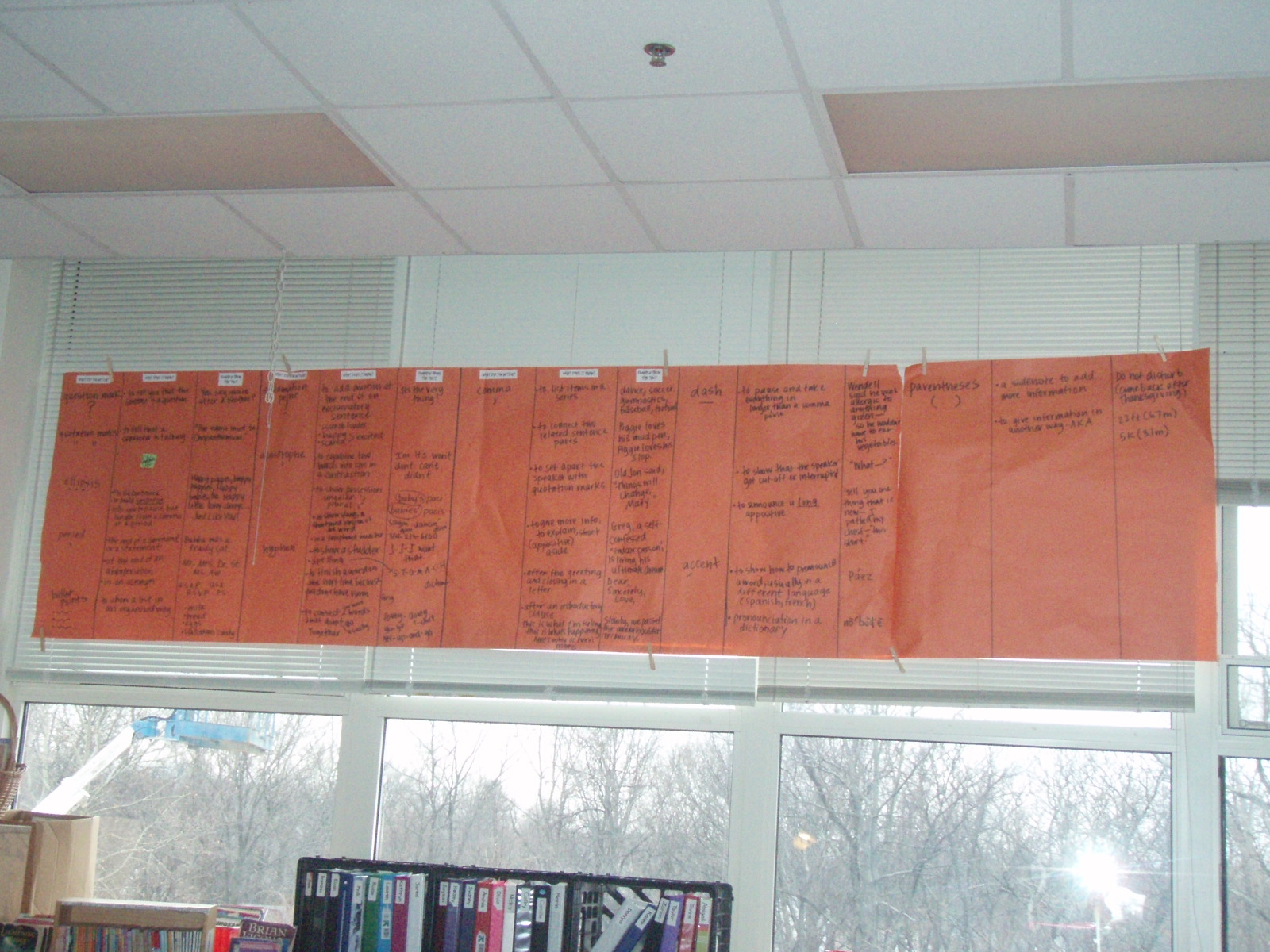
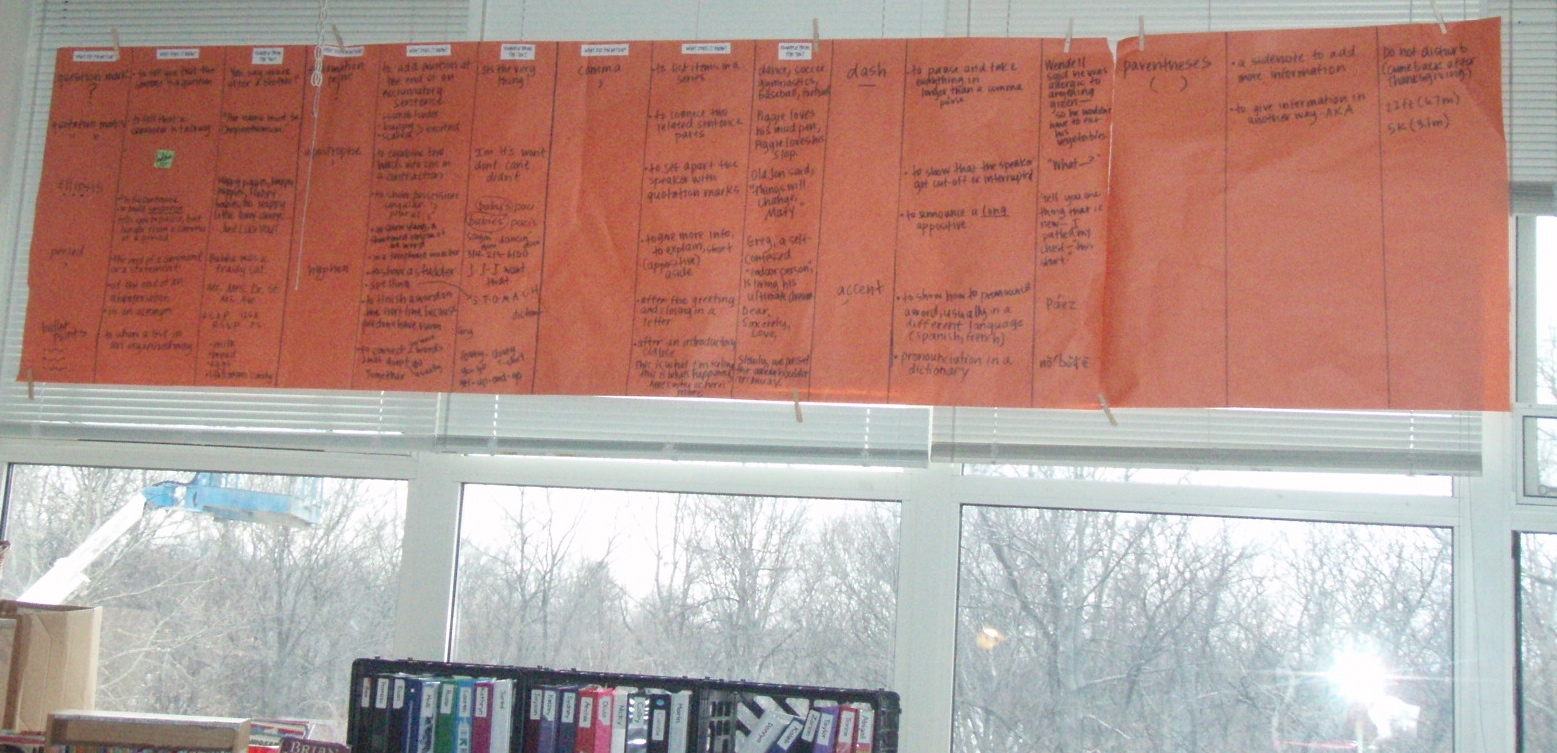
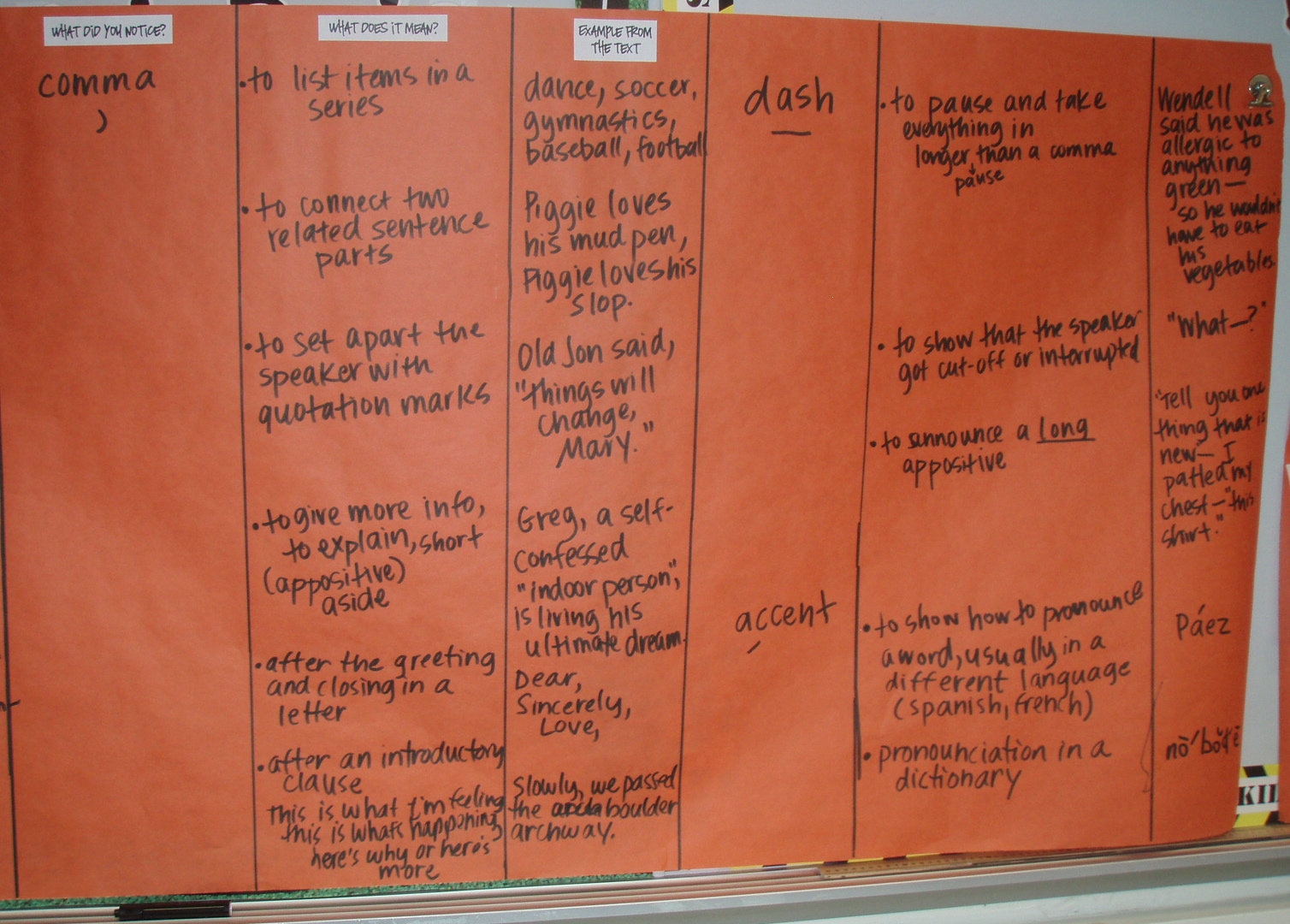
We moved our “We’re Connected with the World Map“, remember? Well, in order to have space to do that, we had to move the class chart we had made during our punctuation study. Our class had the great idea of using our blinds to hand the chart, so we could see it more easily and refer to it during our conversations on the carpet. That is, indeed, the whole point of the chart anyway, but where I had decided to hang it did not facilitate that happening. Again–my kids had a great idea that I wish I had done in the first place! So now our smart thinking about punctuation hangs above our heads while we work and think together in our meeting space–right where it should be!
Ready, Set, Blog!
We did it. We’re officially online!
After a little technological hiccup yesterday, we set today as the day for our first “real” blog posts. Remember how I’m always saying my kids are amazing? Well, today they did not disappoint. 🙂
I know you will want to read what they’re doing, and I know they will love to have you read it! And, as most of them remembered to add to their posts, please remember to leave a comment!
Check us out at www.kidblog.org/MrsBeardensClass2!
More Than Community Service
Many schools participate in service-learning projects. Ours is one of those. But I’m not sure that until recently that I really knew what service-learning was. I think that in years past, I’ve said that I did a service-learning project, but really it was nothing more than a brief activity we did related to a holiday food drive or because there was a hospital next door to our school and we thought it was a good idea. Not until last month did I learn what I should have been doing in order to really call something service-learning. And now we’re actually doing it.
Even though the name really does imply its definition, I think it’s easier to start by saying what service-learning is not:
- It’s not just a one-time episode when you help someone.
- It’s not an add-on to your curriculum.
- It’s not logging in community service hours just because you have to.
- It’s not just something big kids or grown-ups do. (taken from information on http://www.servicelearning.org)
Service-learning is a strategy that involves meaningful, authentic service to address a problem or issue in your community, where your students learn and then reflect on what they’ve learned. It benefits both the volunteers and the recipients of your service.
Ok, but how to you do it? How do you make sure that you effectively combine the service part and the learning part so that your students benefit as well as the ones you are serving? Service-learning includes several important components to help make this happen:
- Preparation: As you prepare to do a service-learning project, your class (or school or Girl Scout Troop, etc) should identify a community need that you could address. Brainstorm possibilities and then choose one. After your need is chosen, then you will need to work to investigate or learn more about the need. This can be done through internet research, reading books about the subject, talking with people or groups that might be involved in the work already, or a variety of other methods. In the service-learning project we just did at our school, we focused on Veteran’s Day. We had an assembly on Veteran’s Day where we learned more about what veterans are, listened to a current serviceman speak about his experiences in Iraq, met people in our community who were veterans, and sang patriotic songs. We also read picture books and watched videos to help us get more information on the meaning of Veteran’s Day and why it should be important to every citizen in our country–even elementary students.
- Action: Not surprisingly, this is the step in which students actually do the service part of the project. Again, this should be related to the identified community need, and based on the foundation built while you learned more about the topic during the preparation phase. For our action step, we wrote letters to veterans. Most kids in our school wrote to veterans in homes or hospitals. We were lucky enough to have the name of an airman currently serving in the Middle East. He was a friend of a classmate, and so we wrote to him and told him how much we appreciated what he does for our country to keep us safe.
- Reflection: Part of what makes service-learning more than just community service is the reflection stage. Once you have completed your action step, it is important to step back and look at what has happened, what you have or can learn from it, and pay attention to the effects your project has had on you and those you were serving. The reflection step of our Robinson service-learning project actually started with every student in our school receiving a letter of their own in the mail. Every member of our staff wrote letters to students–in their own handwriting, in a hand-addressed envelope–and then there were mailed home. Later in the the same week, our class (and the rest of our school) sat down to reflect on how it had felt to receive a letter in the mail with their name on it. The hope was that students could then apply how that might have felt for the veterans to whom we had written. My students did a great job of identifying how special and “noticed” they felt to have gotten mail addressed to them; usually the mail was for the grown-ups in their house or was bills or junk mail. We had a great discussion about how our airman friend Mark might have felt alot of the same things when he received a big packet of letters from our class. Our hope was that it helped him to realize that he was doing a good thing and that we had noticed. We wanted him to feel proud for what he was doing to serve our country. Many connections were made during our conversation.
- Demonstration/Celebration/Evaluation:After you’ve done the amazing work of your service-learning project, take time to celebrate it! You could do this in a variety of ways, like by writing about what your students learned, in a journal or in a PowerPoint presentation. You could create banners or posters around the school highlighting the project, coordinate news coverage about your project or post the project on the school website. Here you also evaluate how the project went, and begin steps for doing your next service-learning project based on what happened this time around. The celebration phase of our Robinson service-learning project is ongoing, really. We have shared it on our website, and we are planning a schoolwide assembly in the spring at our school to highlight all of the projects that we will have been involved in throughout the year. Our class may create Wordles about it (related to my post from yesterday), or blog about it (once we start this next week!). No matter what we decided to do, it’s vital that we stopped to notice the work we had done and the difference we made!
So what will you do to participate in service-learning? Everyone can make a difference.
So Which Comes First?
I have so many thoughts swimming around in my head tonight! Which to post about first?
I hope to be able to share my thoughts this weekend about:
- Wordles!
- Service Learning
- Riley’s Trip to Kirkcare
- Narrative Writing
- Kid blogging
Can’t promise them all, but I hope to be busy posting for you! (Well for me, too. 🙂
If I Didn’t Write to Empy My Mind, I’d Go Crazy
Anyone who spends time in my classroom for longer than five minutes can (hopefully) see these things about me as a teacher:
- I love natural light. The overhead lights are almost never on. We’re lucky that we have a whole wall of really tall windows that make our classroom nice and bright without artificial light. Amazing.
- I love to make my classroom as “homey” as possible. You’ll find rugs and lamps, a coffee table and other touches all over the place.
- I like to have things organized. There are not many things that I care about in my classroom–as far as what things look like or how you do your work–but labels and neatness are two of them. I spend a lot of time labeling things before my kids come, so that everyone knows which things are theirs and where those things are supposed to go. There are baskets for supplies on the window sills, boxes for books all around the room, tubs on table tops for keeping Writer’s Notebooks, Read-Aloud Journals, pens and pencils.
- I love to write. Not just like it, love it. I talk about it all the time. I can probably find a way to turn almost any conversation around to writing. What, when, how–you name it.
Ok, so maybe you couldn’t see that by looking in my classroom, but you could certainly tell it after a 5 minute conversation with me. Or with my students. And the foundation of this obsession goes way back. Here’s my story:
I have always loved to write. When I was a kid, author was on my short list of things to be when I grew up–right next to nurse and teacher. I always loved writing in school, and was a pretty talented writer all the way through. I still remember an epic poem I wrote in high school called The Hostage Gown (complete with footnotes and style and humor and wit) that I got a 100% on. Mrs. Jessen was not an easy grader, either, so that was a bigger deal than it even seems. But up to that point, most of the writing I did was because somebody else told me to. Even in college, I was in an advanced comp class, and did pretty well. But I still only wrote for teachers. Never for myself.
Once I started teaching, writing became a bigger part of my life, but still only on a “school” level. I started out in primary, and right or wrong, I found it easy to wing it teaching 1st grade writers; I didn’t need much practice to explain how to make a sentence or to use capital letters in the right places. It wasn’t until 2005 that things changed for me.
A lot of things were new that year. I was apprenticing to be a Project Construct facilitator for the state of Missouri, and I was also making a huge leap from 1st grade to 4th grade as a teacher. So I spent a lot of time during that summer thinking and learning about writing. I was excited about the prospects of teaching “big kids writers;” kids whose stories consisted of more than just a sentence or two and some pictures. Kids who knew the basics and who could be stretched to a level I hadn’t yet be able to go with my students.
Enter some mentors of mine from Project Construct–Kristen Painter and Joyce Coats. Both had this advice for me as we worked that summer: “If you’re going to teach 4th and 5th grade writing, you HAVE to have your own Writer’s Notebook. All of your mini-lessons and teaching will come from there.” Great! I can do that. I thought. But then I remembered that I didn’t have one. I was a primary teacher who wasn’t really a writer myself, outside of functional writing I did everyday just to get things done. And I didn’t even really know what a Writer’s Notebook was, much less how to use it or what to write in it.
Luckily, since it was summer and I was “off,” so I had lots of time to figure it out. The very day or two after Joyce gave me that advice, I found myself in Border’s in front of the journal section shopping for just the right book in which to start. It had to be the right size–small enough to fit in my purse so I could take it with me–but have the right kind of insides so my handwriting would look nice and neat. I figured out it needed to be spiral bound so I could lay it flat, and then it needed to look just a certain way, too (but at that point I wasn’t sure what that really meant). After what seemed like more than a half-hour’s work, I ended up with a small, black spiral notebook with rainbow edges. Then I got busy making it mine. Here’s what my very first Writer’s Notebook looked like:

As you can see, the front of it is specific to me. It’s 6 years old, so a little worn, but you can see my family and friends; my dog, Floyd (who has since gone to live somewhere else); the year I was married (1998); my job (teacher in Kirkwood School District); and an old greeting card business I was into at the time (Paper Soup Cards). I love how Ralph Fletcher describes a Writer’s Notebook like a dorm room. When you first start, it’s plain and white and boring. They all look the same. But slowly, as you “move in,” it starts to look like you, to take on your personality.
That first summer, I did all I could to fill that notebook up. I wrote and wrote and wrote. I used many of Ralph Fletcher’s suggestions, as well as those from my friends, about the what to write. I had to figure out the when and the why. And I guess that I did, because 6 years and almost 10 Writer’s Notebooks later, I’m still at it! What I write and where I put my words has changed a little, but I’m still writing and loving it.
But why does it matter so much that I am a writer? Well, because I am a writer, I know how writers work. I understand how it’s hard to think about what to write sometimes. I understand how great it feels to write on the last page (or the first page, for that matter!) of your Writer’s Notebook. I have been where my students are, and have worked through some of the same problems they encounter in their work in our classroom. I use my own writing during writing conferences, and talk with them about what I did when I had a problem. And there’s something really special and powerful about the message of “I’ve been in your shoes.” I think they trust me more. They know I know what I’m talking about, and they try what I suggest. The excitement in our room every year is contagious, and I like to think it’s because from day 1 they understand that we are all writers and that we’re going to do amazing things together. And if for no other reason than I annoy them will all of my talk of writing, everyone leaves my class feeling a little more confident as a writer than when they came in–no matter where they started.
Oh, and one last thing. I write so that I have material, so to speak, to use in Writer’s Workshop, but I really write for myself. The quote I used in the title is from Lord Byron, I believe, and is totally the truth: If I didn’t write to empty my mind, I’d go crazy. I am a thinker and a planner. So that means that most of the time I have a million-and-one thoughts rolling around in my head, and they have to have somewhere to go. So I collect them in my Writer’s Notebook. Some of them I come back to and use again, some of them are just written down and left there. Everyone has a stress-reliever, and mine is to write. It’s therapy for me. And it’s free therapy, which is a great thing.
So there’s my story, and I’m sticking to it. And I wonder from you: Do you write? If so, what/why do you write? If not, what is keeping you from doing so? Comment and tell us about it!
Ok, sorry–one last quote: “Here’s the secret of writing: there is no secret.” Ralph Fletcher
Nope. Not done. One more: “I write every day for two hours. But it’s what I do for the other twenty-two hours that allows me to write.”
Don Murray 🙂
Punctuation Study Charts
A couple of days ago I posted about the amazing work my writers did during our Punctuation Study. Here are the pics of our class charts that I promised you. Like I told you, it’s AMAZING!


Exciting Things Coming!
The end of October brings with it an exciting feeling for me. November and December are two of the best months in school, in my opinion. We have multiple units that are my favorites to teach, I share some of the best read alouds of the year (again, my person opinion), and the excitement of the fall/winter holidays is everywhere. Because of all of this, I get a needed 2nd-quarter energy boost. So join me as we dive into fractions/decimals, fiction stories, The Secret of Zoom, Fig Pudding, Ancient West Africa and inferring in poetry! Along the way we’ll ride on a magic carpet with Alladin (thanks to the Nipher musical next week); take a few days off for Thanksgiving; talk about the science fair and make plans for the projects to start in January; drink some cocoa together on cold days and then eventually celebrate the season at our Winter Party at the end of the quarter. I don’t know about you, but I am ready! Happy Fall!
 20somethingkids and 1kookyteacher