First GradeMath Warm-Ups: Week of 12-15 to 12-19

Monday

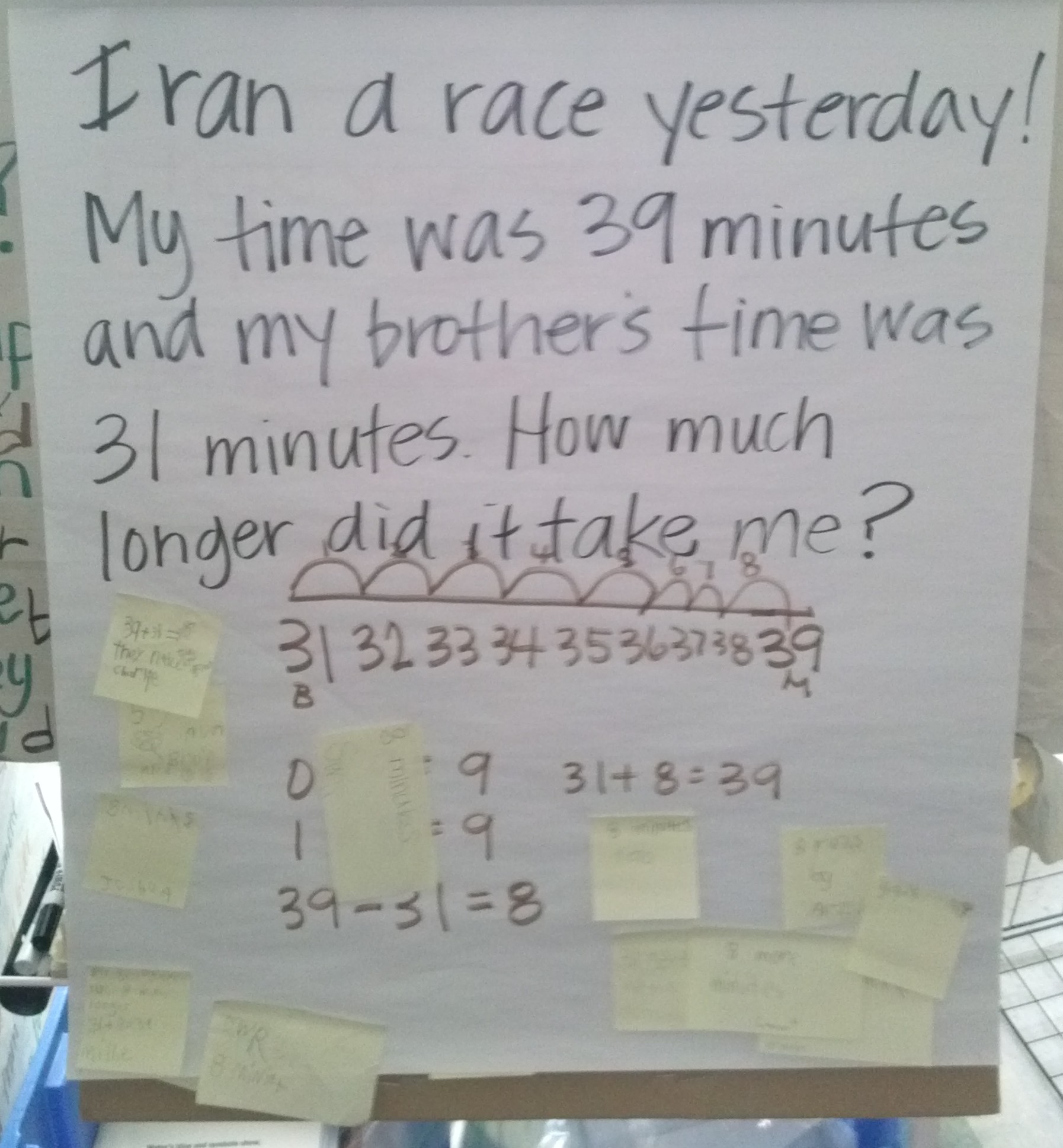
I participated in the St. Louis Hot Chocolate 5K with my family on Dec. 14 and of course I had to use it as a context for a problem of the day!  And yes, it is a true story.  I’m really slow. 😦

CAM01255

Tuesday

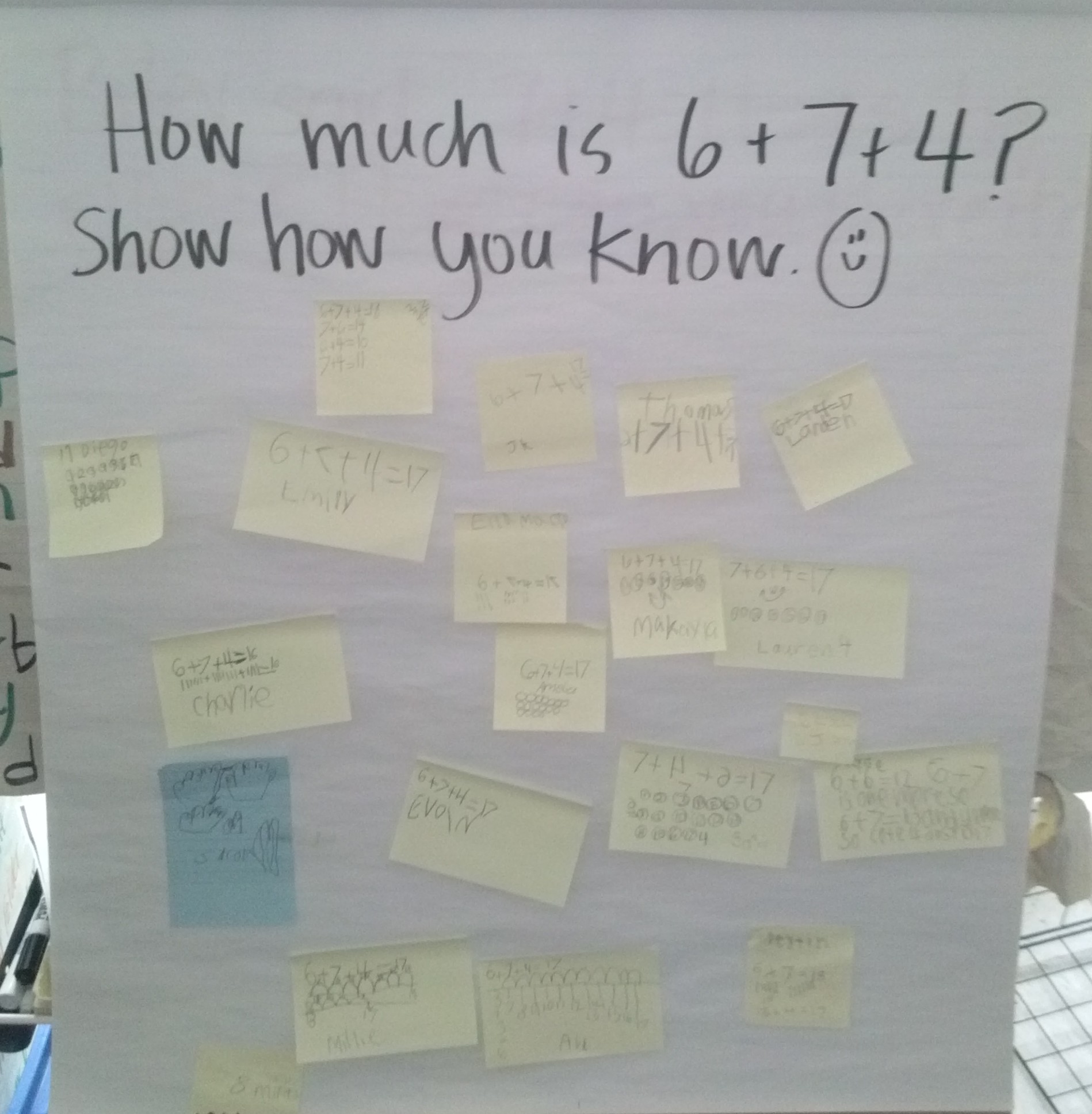
We’ve been working on addition strategies, so the numbers in this one were chosen so that hopefully kids would see the 10 and use it: 6+4 =10 and then 10+7= 17.

CAM01256

Wednesday

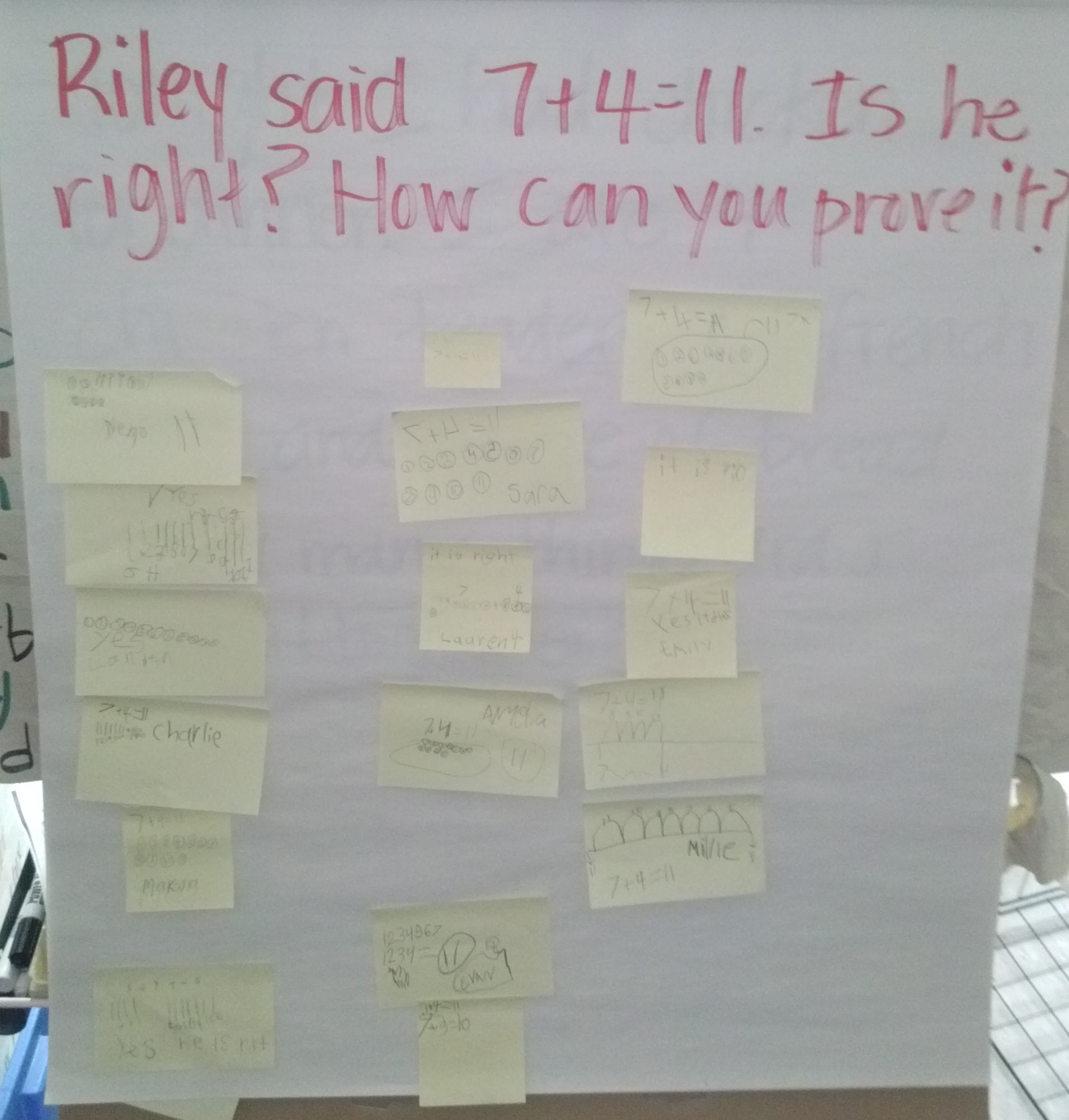
One thing I want my mathematicians to be able to do is think flexibly about numbers.  Sometimes I give the the answer and ask them why it reasonable (or not!).

CAM01257

Thursday

I’m not sure why I wrote the word tonight on this problem (as it doesn’t make any sense since I wrote it the next morning!), but you get the idea. 🙂  The focus was both on adding a string of numbers, as well as determining whether to add or subtract.  We’re getting really good at knowing when to add and when to take away, by thinking about the context and picturing the situation.

CAM01258

Friday didn’t have a math warm-up since we didn’t have math.  We had a delightful Winter Party instead!  Hope you had a great holiday break, math friends, and that you’re back into a positive January groove! 🙂

Narrative Writing Lessons

Happy Tuesday, friends!  It’s our first it’s-so-dark-and-rainy-we-had-to-turn-on-the-lights days of the fall.  Kind of gloomy, but also one of my favorite things about this time of year!  Weird, huh?

So..today we’re going to do some thinking together about writing RIGHT HERE ON THE BLOG!  I’m going to give you your job and then you will leave a comment on this post to share your thoughts with me and with the other writers in our room.  Ready?  Ok, here we go!

Below are two of the anchor charts we’ve been using during our study of narrative writing.  Reread them to yourself.

                       CAM00089              CAM00090

Now I want you to think about something from these charts that you know you have tried during this unit, either in your Writer’s  Notebook or your story.  Tell me about how you have used it in your comment below.   You could start your sentence with something like: “During our study of narratives, I learned…and I tried it in my writing by…”  Your words might sound different than that, but use the starter if you need it!  I can’t wait to hear about your smart thinking!  The pieces you are writing are pretty great, Rm. 202, and I’m excited to see where we continue to go as writers this year!

Rethinking Multiplication Strategies

First of all, I know.  It’s been forever.  Man, I’ve been saying that a lot lately.  All I can do is apologize, though, and ask that you’ll kindly keep reading.   Life is nuts these days. 🙂

So…we are just about at the end of a study of multiplication and this year I’m asking my friends to think in a different way about the word efficient when it comes to multiplying.

Based on our district rubrics, which have recently been rewritten based on work related to Common Core and an updated curriculum, the standard for 5th grade has changed.  Instead of just being able to use the traditional algorithm, students are expected to be able to fluently use a variety of strategies.  But get this: the strategy they choose to use should be based on the numbers in the problem, rather than personal preference or the strategy they know best.  WHAT??!! I seriously have some friends whose heads might explode.

But it’s not really their fault, I guess, because for years the algorithm was the goal.  And once they learned how to use it, that’s what they stuck with and used every time.  For years, we (or they) saw the other strategies as lower-level–ones used by friends who didn’t yet “get” how the algorithm worked.

District Math Rubric for Multiplication

District Math Rubric for Multiplication

Now we’re thinking more about how mathematicians should be able to be flexible with their thinking, to use place value correctly and to explain their reasoning based on what they know about numbers.  This doesn’t mean that the algorithm isn’t something kids should know how to do, but that it’s not the only thing they should know how to do.  I mean think about it in the real world: there are times when you have to be able to do math in your head, in an efficient way–without paper.  The algorithm doesn’t really fit into that model.

So what does this look like in our room?

First of all, here’s an anchor chart that now hangs in our room (made based on our knowledge of how to solve multiplication problems):
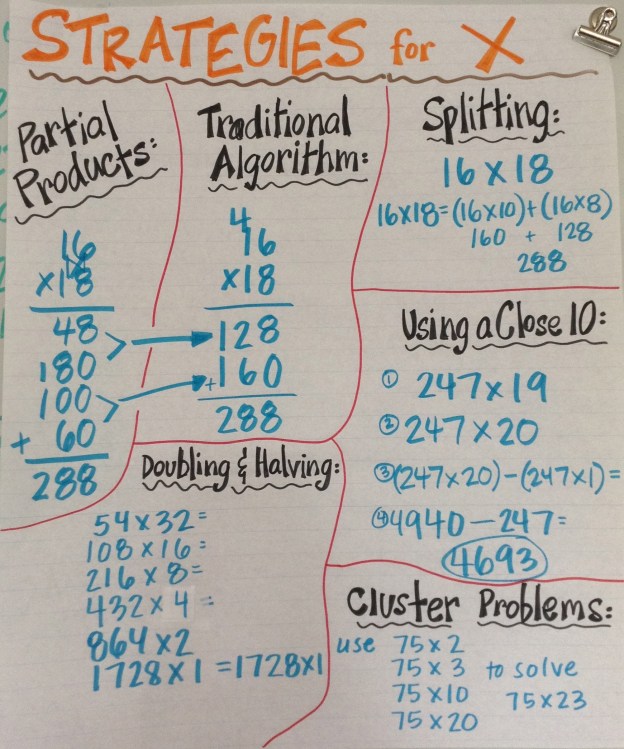
Classroom anchor chart for multiplication strategies

Classroom anchor chart for multiplication strategies

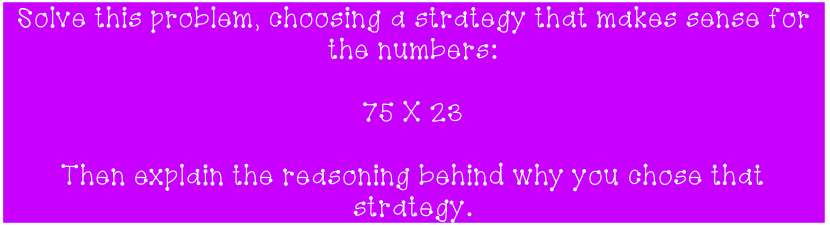
While I don’t have any pictures of the math warm-ups we’re doing right now, this is where many of our opportunities come to try out this thinking.  The problem today, for example looked like this:

Math Warm-Up for October 14

Math Warm-Up for October 14

There are obviously (based on the chart) multiple ways to do this problem.  But based on the numbers (which were chosen on purpose), the strategy that makes the most sense is to either use splitting or a close 10 to solve the problem.  That way, you can solve 75 X 20 and 75 X 3 and then add them together, which can easily be done in your head–without paper.  If you chose to use the algorithm (which most would do–even most adults!) you’d have to do 5 X 3, then 70 X 3, 5 X 2 and then 70 X 2 and add it all together–many more steps than the other strategy.

So while this is still a little tricky for some friends, it will get easier with time.   We just need some more practice. 🙂

What strategy would you have used to solve 75 X 23?  Do you know more than one strategy to multiply?  Is the traditional algorithm your “go to” strategy?  I know my 5th grade mathematicians would love to hear your answers!


Just Goofing Around

Think of the feeling when you have to wear “church” clothes.  Or maybe for you, it’s easier to think about wearing a formal, like for a wedding or a fancy dinner.  You probably feel all stiff and uncomfortable, maybe itchy and hot.  If you’re in the wedding, you might feel like everyone is watching you, just waiting for you to make a mistake or drop something.  If you’re at that fancy dinner, you might be nervous that you’ll use the wrong fork, or not be able to read the menu because it’s in another language.  I remember that from prom when my date and I went to a really expensive French restaurant.  I couldn’t even have fun because I was so stressed out!

Now I don’t know about you, but at the end of a long day (even a great day like we had today), the first thing I do when I get home is put on my pjs.  I get comfortable–kind of like what you (or a kiddo) might do after that wedding, after you get home from church, after that fancy dinner is over.   From constricted to comfortable, into our “play clothes.”
That first example is how many people–kids and adults alike–feel about writing.  It’s uncomfortable and hard, with a  when-will-this-be-over kind of feeling.  Writer’s Workshop is a hated time, when all the pressure is on, and the teacher is watching your ever move.  Students may feel like they can’t do anything right, and they’re afraid they might make a mistake.

I want my writers to remember instead their play clothes; the way they feel and they freedom they are allowed in them.  When you’re wearing your play clothes you can get messy, run around, fall down and make mistakes.  There are no rules, really.  You feel alive!

So I want it to be in their Writer’s Notebook.  I want the writers I work with to feel energized when they sit down to write, ready to play with words and see what happens.  Their notebooks are allowed to be messy; it’s from the mess that masterpieces may emerge.

And so another notebook strategy was added today: Goof Around Writing.

First, I shared two entries from my own Writer’s Notebooks.  One was called “Ode to Mashed Potatoes” and the second was “Oh Sewing Machine, You are my Enemy!”  Each was just for fun, about how mashed potatoes tease me with their goodness but make me “fat, fat, fat” and then about a “fight” I had with my sewing machine last year when it wouldn’t work right.  Both were written in a playful manner, meant to sound silly and make you laugh.  But still, they were both based on my life.
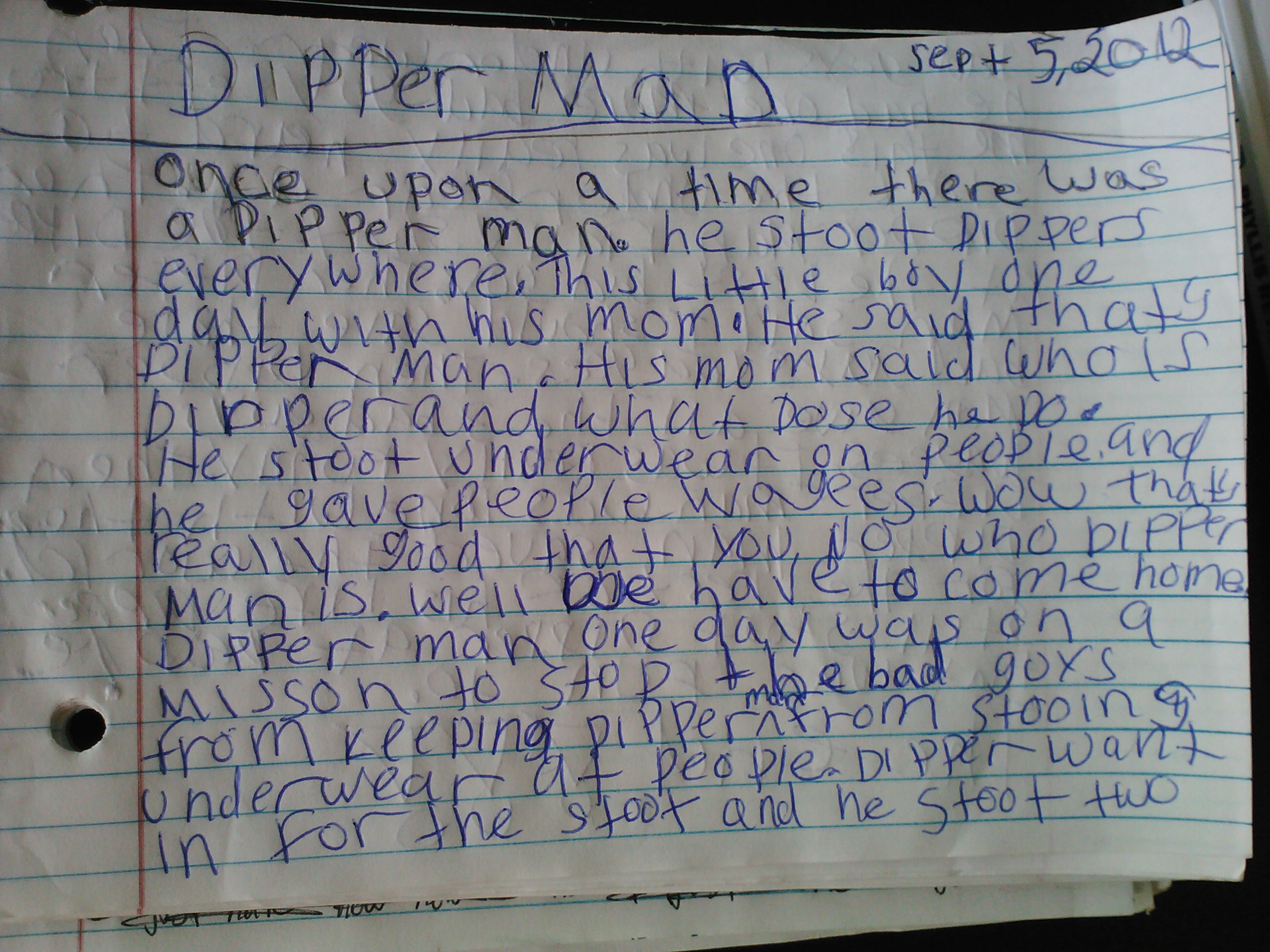
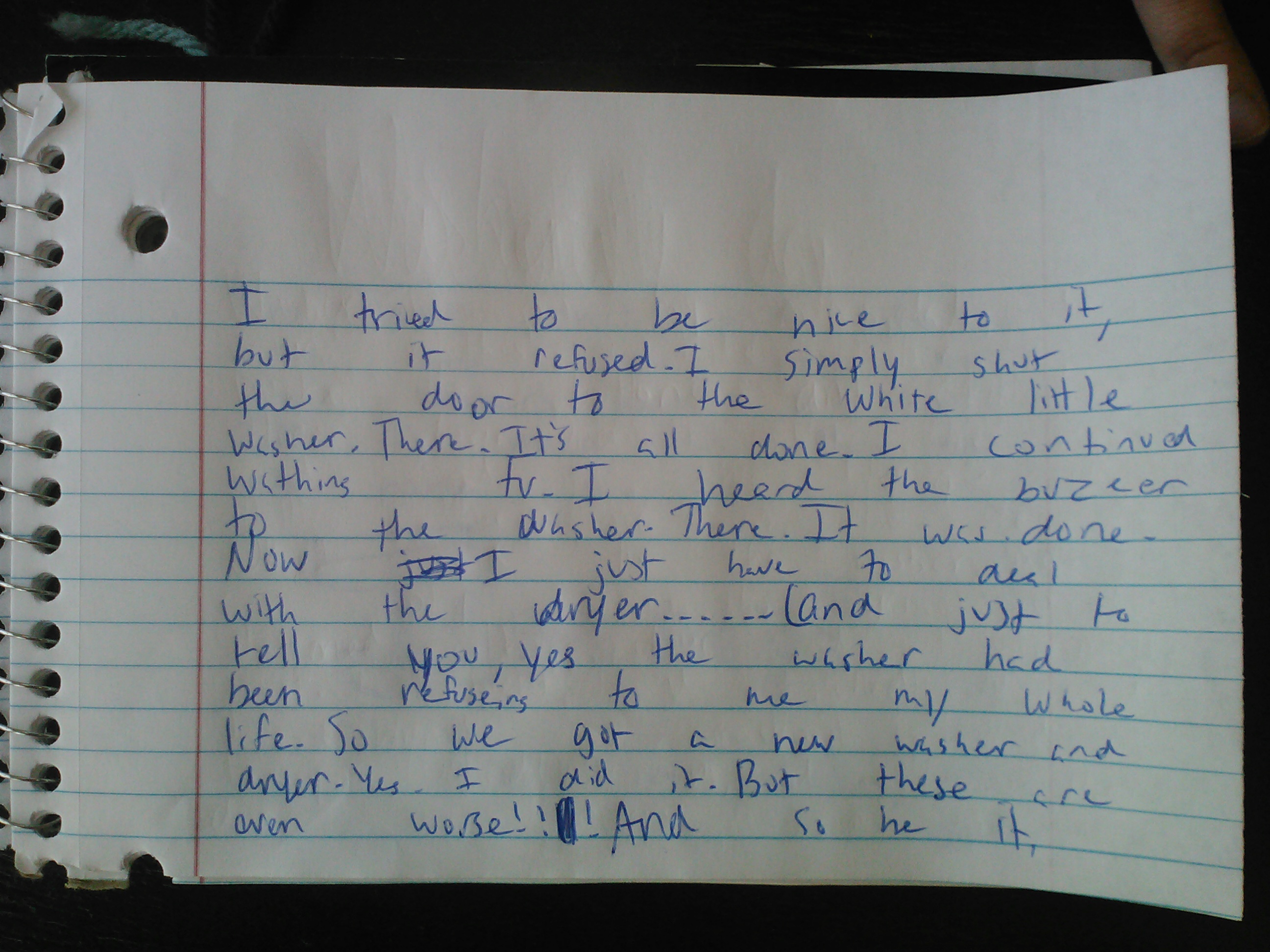
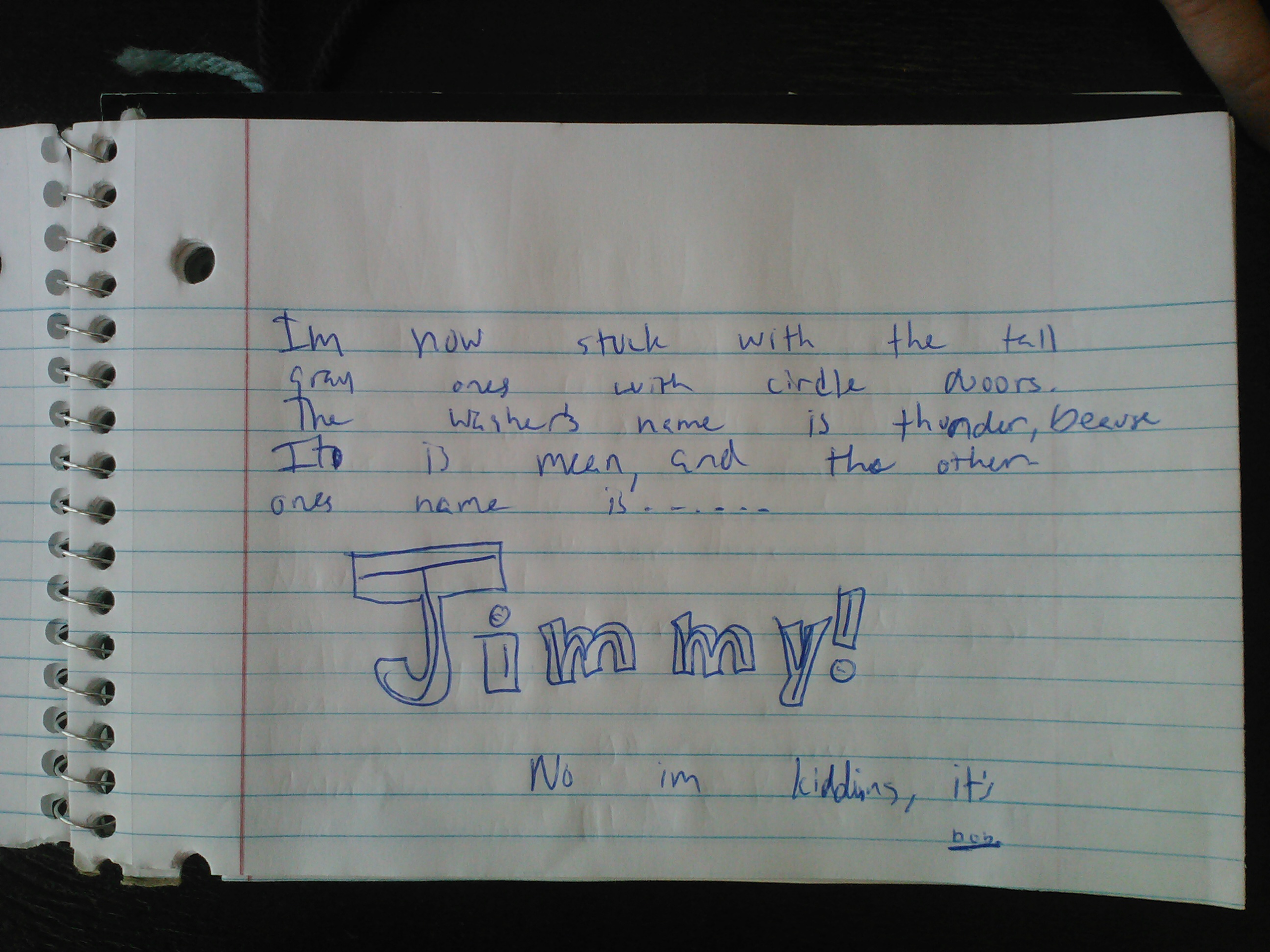
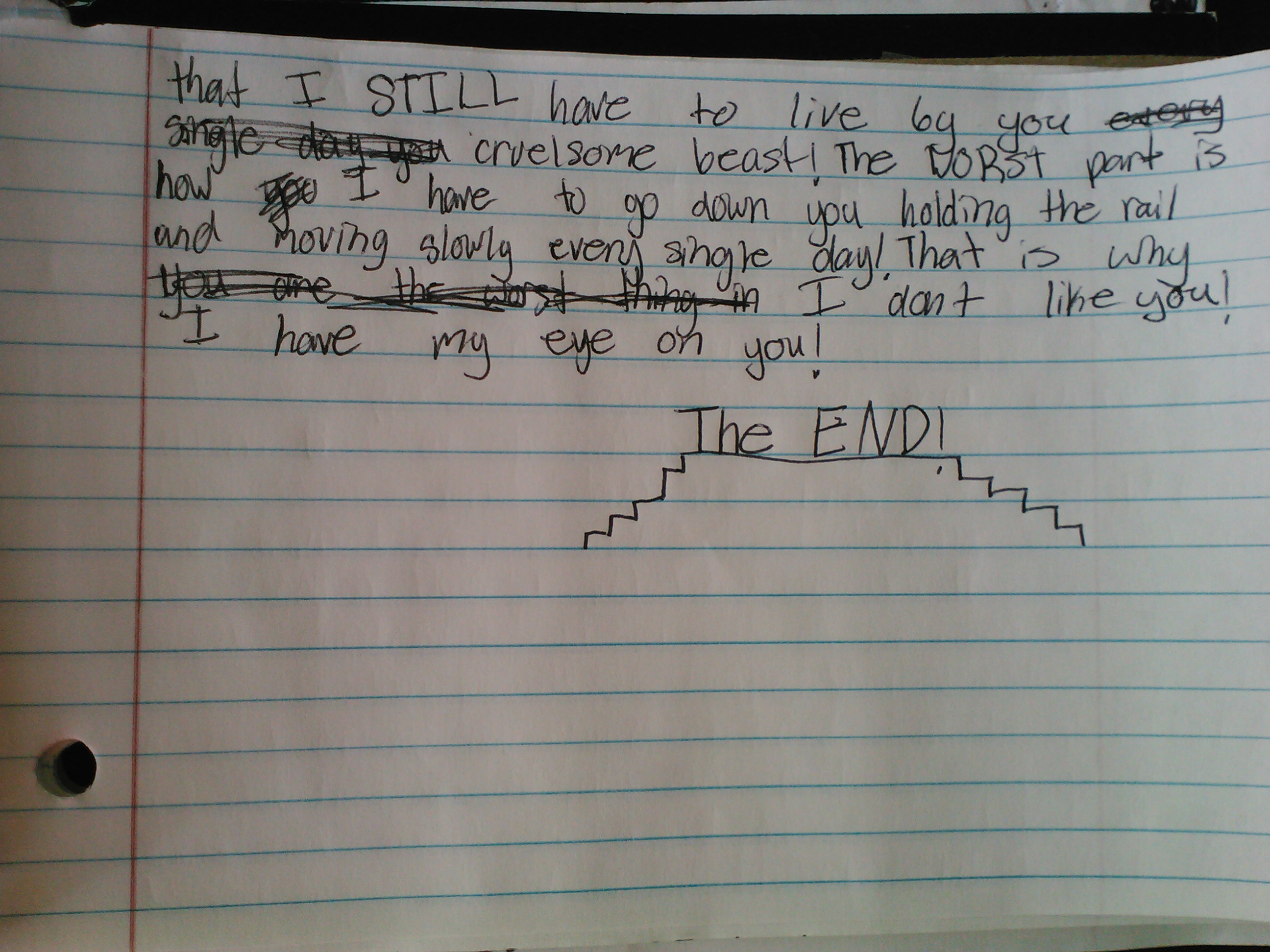
Then my friends had a go.  They LOVED this, and there was much giggling as we shared our entries.  There were MANY kiddos who thought that you, dedicated blog reader, should be able to see what they did.  So here are some examples of what we did in our play clothes when we were just goofing around with our writing:


What do you do when you’re “goofing around” with writing?  What do your play clothes look like?  Please leave us a comment and tell us about it!  We’d love to read your thoughts! 🙂