Reflecting on Data: Rm. 202 BOT Graphs

Last week I shared our story of the tightening up that has happened lately in Rm. 202.  It was based on this picture of our day last Wednesday:

IMG_0965-min

We decided (ok, well Evan and Emily really had the idea) to keep track of our behavior every day, and to use our Behavior Over Time charts to help better guide our choices.

We started by drawing a blank chart, and then over the last week have gotten in the routine of stopping briefly after each portion of our day to reflect on how it went.  Kiddos think about where they think the dot should go (based on their behavior + or – or so/so) and then I move my finger up the chart and kids raise their hands to show when they think I should stop.  Once we draw the dot, we talk about what evidence they have that supports that choice.  Instead of just saying “It’s good,” they have to provide real reasons why that makes sense.  As a class we come to a consensus about what is the right dot placement.

IMG_0966-min

Our first day’s try.  We decided after this day that we needed to define the top of the chart so we could show what the highest choice was for our dot.  We were excited that the line on this graph went up throughout the day.
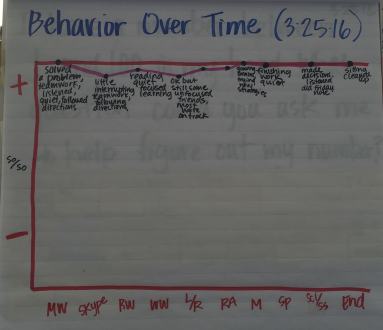
IMG_0997-min

Sorry about the lighting on this one!  We added the top line, as well as the “so/so” on the side today to help us better define our choices.  We also focused on giving really specific reasons for our dots, as well as positive ones.  Instead of saying we weren’t doing this or we weren’t doing that, we tried to make sure we listed what we WERE doing that helped our behavior be at that particular level on the graph.  This one made us happy because it was straighter than yesterday’s and almost the whole day was at the top of the graph!

We left for the weekend feeling really great about the changes we’d made in our classroom, and agreed during our class meeting that we were on a much better track than we had been even just a few days before.  We had been thinking about how our choices impacted the whole class (not just ourselves!), and how if we certainly can try to influence our friends, we are ultimately only in charge of our own decisions.  When I asked kiddos to tell me what they thought the last two days had been so much better, many said it was our Xs system and their wanting to make sure they got the reward, but I think Sara really nailed it when she said that our BOT graphs help us see how we’re doing.  We are definitely a bunch of visual learners (me included!), and having things around that remind us of what to do or help us better understand what’s going on is extremely helpful.

On Monday, our graph looked like this:

IMG_1040-min

We noted that something odd much have happened during math, and the data we were keeping was helpful in our seeing how our behavior really trends during the day.

As we started Tuesday, we talked briefly about a goal that we could make for ourselves after looked at the behavior data we had collected the day before.  Many mentioned that we had to do a better job of listening, working hard and cooperating during math so our dot could move up.

Here is our Tuesday BOT graph:
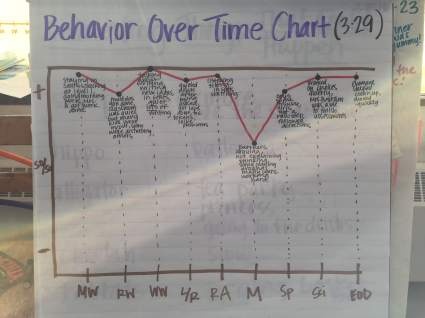
IMG_1041-min

Notice anything? 

Let me show you again, side-by-side:

We founded it the oddest thing that they were almost identical!  This was puzzling to us, but obviously gave us good data that we had something specific to work on for Wednesday: math time.

As we started our day today, I had them think about goals again, but had them write them down.  This way we could be more clear on what we had decided to work on, and by announcing our intentions, it made it more likely that we would make them happen.
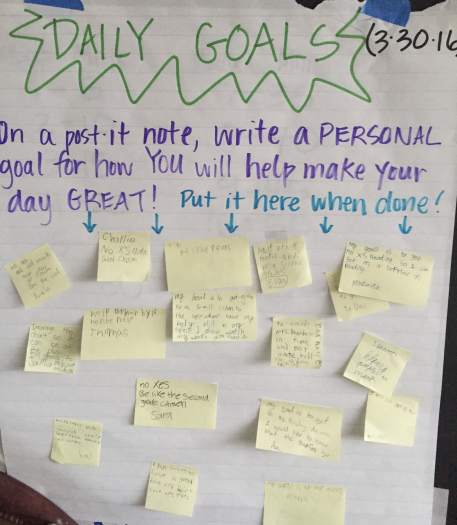
IMG_1051-min

Another thing that we added to our routine today was that each kiddo got their own BOT graph to mark.  Amber and Millie had started doing this independently the other day, and it seemed like a super idea to share with the whole group.  We us a LMS called eBackpack that allows me to easily push out documents to kiddos, lets them mark them up and then send them back to me.  Easy as pie I took a picture of our blank chart at the beginning of the day and each student was responsible to mark THEIR behavior throughout the day today.  This also added a level of authenticity to our class dots, as kiddos used their personal marks to inform their decision for our collective one.

They were pleased to try this for themselves, and were very motivated to give good evidence for their dot choices, as well as keep their graph up at the top.  I heard lots of kids say things like “Wow, this is a great day!” or “Look at my graph, it’s practically straight!” or “I need to make my dot move up next time.”  It was great to listen to how they were really thinking through the cause and effect of the whole thing, their motivation to do well and how we had good evidence for that description of the day as a “good one.”  We could point to specific things we had done (or not done!) that helped make our day successful.

IMG_1047-min

Here’s today’s graph:

IMG_1052-min

We were SO pleased with where our math dot ended up today!

Here are a few of kiddo graphs from the day:

We were also able to have a great conversation about our afternoon today; it was Wednesday last week when this whole mess started anyway.  Reflecting on our behavior using hard data was so helpful!

I’m not sure how long we will keep this up.  As with most things we do it’ll be around as long as we need it, and usually it’s the kiddos who help me decide when that is.  We’ll try the personal graphs again tomorrow and Friday and maybe even find a way to incorporate them with weekly reflection sheets.  I hope to be able to send them home at some point, too, to help spur conversations around dinner tables about data collection at school!

If you have a second, please leave us a comment and tell us what you think, or better yet, what questions you have.  We LOVE to know that people are reading about our learning!
Tightening Up

I CANNOT believe that we are already in the 4th quarter of the year.  Well, really I guess it’s the 8th quarter for some of us, since it’s our second year together! LOL  This time of year brings with it warmer weather (followed by colder weather, then warmer, then maybe some snow or ice, then finally Spring for real!), excitement about being outside more, comfort and ease the comes with having a well established community, and sometimes it brings kiddos who are SO comfortable and at ease with things that they forget the rules and start to act like crazy people.  Ok, not really, but everyone teachers can sometimes get lax and kids quickly take advantage of that.  And so this time of year often also brings with it a tightening up of the procedures and routines, reminders of the rules and lots of reteaching and practicing to help ensure we end the year in the best way we can!

“Tightening up” in Rm. 202 looks a little different than it probably does in some other places, mainly because the structure in my classroom looks different from many others to begin with.  I guess what I mean is that there are a few things that I find it necessary to be totally in charge of, and there are many more others that I leave my kids to decide upon or choose for themselves.  In general, students in my room choose their table seats (they are not assigned and are usually very fluid even throughout a school day); choose their carpet spots and  learning partners (unless I deem it necessary for specific learning goals to assign them); make decisions both about how they learn and show their learning; and they are in charge of much of how our classroom runs on a given day (like lunch count, attendance, cleaning, making announcements, using each other as resources for info and answers, etc.).  Most of the time, this works seamlessly, and we all spend our day happily working and learning together, supporting our friends, challenging each other, offering kind words of encouragement and taking care of each others’ needs.  It ‘s a beautiful thing.

And then days like yesterday happen.  While I know that no kid is perfect, and that everyone has their moments and makes mistakes, our Wednesday was a kind of day which I have not seem in a very long time.  Perhaps never with this class even.  Their behavior was screaming out to me that what we are doing in our room right now is not working.  We were loud, unfriendly, unproductive, messy, disruptive, disrespectful, slow…all words that do not describe a healthy, happy learning environment.

So what was I to do?  I certainly could have gotten really annoyed, mad, frustrated, had hurt feelings, yelled, etc., but obviously none of those options made sense.  They wouldn’t have been good for me or for my friends, and they wouldn’t have solved our problems that had happened during the day.  So instead, I decided to tighten up the reins a little bit.  Since they were showing me that right now they couldn’t handle choice and freedom, I’d give them less until they could prove again that they could.  Makes sense, right?

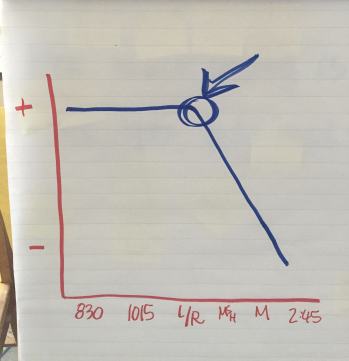
This meant a couple of new things, then, happened on Thursday.  First of all, kiddos had new table spots (ok, when they had assigned table spots to begin with–which was new) that were chosen by me.  They also had assigned carpet spots–again chosen by me–based on who they could best work with and be quiet and respectful next to.  As we started our day together, Evan made another suggestion that would end up being very helpful to us.  Let me back up for a second–at the end of Wednesday, I drew a graph of what our behavior looked like over the course of the day.  It looked like this:

IMG_0965-min

Evan’s idea was that we draw a behavior-over-time graph like that at the end of every day so that we could see how we were doing.  Even better than that, Emily suggested that instead we should keep track of our day DURING the day.  Otherwise we would have a hard time changing the way our graph looked; knowing in the moment that we were off track would allow us to fix things.  SUPER IDEAS friends!

One more thing that was a part of our tightening up plan was a little bit of a whole-class  behavior chart system with Xs for misbehavior (based on expectations we already have in place in our classroom) and a reward for friends that fit a certain criteria.  Basically everyone starts with the reward, and it’s up to you to make sure you don’t lose it.  We put together a chart where everyone has a label, and you get an “X” for choices that do not line up with our classroom expectations and Road Rules.  IF you have a certain number (or less) by the end of the time period (which will change as we go along), you can participate in our reward (this will also change with every period).  This first go-round, the Xs is 3 and the time frame was from Thursday morning to Friday afternoon (2 days).  The next chunk starts over on Monday and will go for more days or have less Xs (haven’t decided yet).

So…we put our new things in place and went through our days Thursday and Friday and kept track of our behavior over time.  Here’s what our charts looked like:

AMAZING, right?  One thing I love about Behavior-Over-Time graphs is that you have to justify why you’re putting each dot where it is.  Kids had to really reflect on our choices and evaluate whether our behavior counted as + or -.

At the end of the day on Friday we talked about why we thought that our last two days had been so much improved over what had happened earlier in the week.  Some friends of course pointed out our new reward system, some said it was our spots, but Sara mentioned that she thought it was our system AND our BOT graphs; being able to SEE how we were doing was super helpful in keeping those choices positive.  I agree, friend. 🙂

What stories can you tell about “tightening up?”  Does 4th quarter bring new procedures and routines for you and your kiddos?  How does the end of the year look different than the beginning?  Please comment and let us know!  Here’s to another great week starting tomorrow!

Lego Challenges With Mrs. Sisul

We had an amazing 1st-day-back-from-Spring-Break today!  Our principal, Mrs. Sisul, has been learning about engineering and STEM with Legos, and volunteered to come set us up with some Lego challenges if we were interested.  Well, yes, of course, Rm. 202 friends were interested!  Luckily she was free this afternoon and came on up with her big ‘ole box of Legos!  Check out what happened! 🙂

She started with a quick reminder of what STEM means (Science, Technology, Engineering and Mathematics), and then introduced what we would be doing: every kid would get a card with a challenge and they would work to do that challenge with Legos.  Pretty straightforward, right?  Well, they she led us through a great line of thinking about how we work best, and how kiddos would have the choice of how they tackled the challenge: alone, with a partner, a group of 3, a group of 4–whatever worked for each kiddo.  She shared her example that she knows that as a learner she likes to be able to bounce ideas off of another learner, and so she’d focus on finding another person to work with.  She asked me to share my strategy, and I talked about how I knew that that plan would DEFINITELY not work for me.  I am the kind of learner who needs to process and plan by myself first, and then I might want to work with someone else to blend ideas, get a critique or ask a question.  I know that if I went with a partner right off the bat, I wouldn’t have anything to share with them–so if I was Mrs. Sisul’s partner, I wouldn’t be a very helpful partner!  Right off the top I could tell that Rm. 202 kiddos were thinking about what would work for them, and they knew what would be best.  We had all sorts of groups–singles, partners and groups of 3.  Some kiddos worked alone, but right next to another friend so they could get feedback that way.

Ok, once teams were developed, Mrs. Sisul gave the guidelines for how kiddos would get their Legos.  She walked them through a planning session where they were to really think through what kinds of Legos they’d need.  She would call names of kiddos 3-4 at a time, and they’d have 30 seconds to “block shop” and then get started.  Once everyone had an initial visit to the pile, they were free to come back for more.  And since it would be virtually impossible for me to explain the amazingness with which these kiddos followed this protocol, I had to record it.  Check out what it was like when Mrs. Sisul dumped the Legos:

Once we got started, I roamed around and got some footage of them working. I know, kiddos wanted me to do the challenges, too–but I couldn’t document it to share with you if I did that!  Maybe next time. 🙂

Here are some videos that share more of their thinking while they got started:

This one has some great thinking about what happens when things are hard (which this was for some of us!):

There’s one more, and it’s really the one I’m the most tickled about.  It’s an example of what happened in our room when we put 20 kids and 2000 Legos together.  I want you to think about what you see first, but then I’ll tell you why I liked it:

As I watched this video, I noticed these things:

  • quiet voices
  • pleases and thank yous
  • kiddos finding pieces for others
  • sharing
  • everyone just taking what they needed
  • no one grabbing, hogging or arguing
  • kiddos respectfully letting others into the circle
  • focus
  • engagement
  • motivation
  • laughter
  • encouragement
  • respect for self, learning, others and the environment

What did you see? (Please leave us a comment and let us know–Rm. 202 kiddos would LOVE to hear what you thought and would LOVE to know you watched their super hard working!)

Ok, I know you’re wondering what some of those challenges looked like, and how they tackled them.  Here are some examples.  And yes, they told me I could. 🙂

This was definitely one of those touchstone moments in our classroom that we will return to for many days and weeks to come (darn, I only wish we’d done it earlier in the year!).  I know that we walked away with many things (and I hope to share what those were in THEIR WORDS soon), but one of them definitely was that there is not one way to solve a problem.  We could each access each of these challenges in our own way, and use whatever skills, ideas–and Legos!–that we wanted to in order to achieve our goal.  One friend even decided to do the same challenge twice to make it even harder for himself!  We are builders and thinkers and problem-solvers in Rm. 202 and this was definitely right up our alley!  Come back any time, Mrs. Sisul!

Teachable Moments

We had one of “those” moments recently.  One of those moments when we had to stop and deviate a little bit and take a different path.  It was one of those moments when I knew that the lesson I was supposed to teach was bigger than the writing lesson I had planned for the morning.

Let me tell a little bit of a back story.  We had just finished Readers’ Workshop, and were heading towards the rainbow rug to start our Writers’ Workshop mini-lesson.  I had met with three groups, done at least 4 individual conferences and assessments, and the room had been quiet and productive.  At least it looked and sounded productive.

And then it all kind of went downhill.  Evidently, there was a group of kiddos who were not, in fact, making an acceptable reading or writing choice during our work time.  They were playing a game.  Oh, and a game that was not appropriate for school, for that matter. 😦

We stopped what we were doing right then and there and talked through all the many layers of what was going on.  First of all, the group of kiddos who had been playing were do so in such a way that NO ONE was the wiser that it wasn’t what they were actually supposed to be doing.  Many kiddos in the room were baffled (ok, as was I!) how that was possible.  Many said they had been sitting right there and didn’t even know.  That’s just it–they were quiet, they were busy and they seemed like they were doing the right thing.  We talked about how and why that could have happened and what we could all do to help ensure that every learner in our room was using their work time in the most useful way at all times.  We agreed that this had been a bad call and everyone should do better to do the right thing next time.

Secondly, there was a layer of “I-saw-it-and-didn’t-join-in-but-also-didn’t-stop-it.”  We had a really heartfelt conversation about why it was important NOT just to NOT join in, but also to be strong enough to say something when they see someone doing something they know isn’t ok.  While I know they don’t truly understand the gravity of this, I have to begin to teach them this skill now, because they will need it for much bigger decisions in their future.  Imagine what middle school would look like for them without being confident enough to stand up for what’s right.  Or high school. Or LIFE for that matter.  Yep, it begins now with these small lessons when they’re 7- and 8-years-old.

Then, there were a couple of friends who actually did wander over and join the fun because it looked really interesting.  They took the “it’s-not-my-fault-because-it-was-my-idea” stance.  Again, we had a great conversation about how this explanation doesn’t make sense because they actually participated in what was going on.  Yeah, I know as adults this is clear, but for these 2nd grade friends, it was really hard for them to understand (or at least accept) that not being the originator of the idea doesn’t make them exempt from the consequence or responsibility.  It wasn’t their idea to start it, but it was their idea and their choice to continue it and join in.

While this was obviously not one of our proudest moments as a group of learners (as far as choices and wise time usage goes), we definitely used the moment to our advantage and had some really important conversations.  I am sure that by the end of the class meeting, everyone walked away learning something, ready to make a different decision next time–even the ones who didn’t really have any part in the trouble of the morning.  Some will be stronger and stand up when they see something go awry, some will be wiser and use their time in a more appropriate way, some will choose to not go along with the crowd, and some will continue to do the right thing as an example to the rest of us.  The best part is that everyone has the choice to do each of those things in whatever situation they find themselves in.  And the even better part is that because of the community of friends and learners we have, we will do well to encourage each other to make the right choice as we go forward.  What better lesson could we have had that day?  Sometimes the best lessons are not the ones you plan for but the ones that just happen instead. 🙂


Second Grade Math Warm-Ups: Week of February 29-March 4, 2016

Remember last week when my kiddos were my teachers?  This week it kind of happened that way again–again without my real planning it that way.  And you know, sometimes those are the best kinds of warm-ups–when they happen at just the right time as just the right response to something that happened in our classroom.  Here we go. 🙂  (Oh, and I think somehow we ended up with a warm-up for every morning this week!  Hot dog!)

Monday

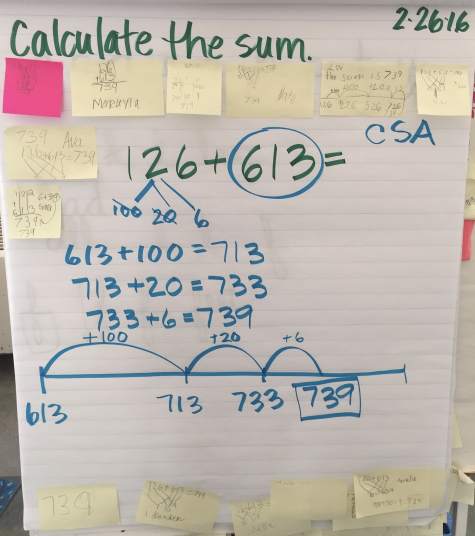
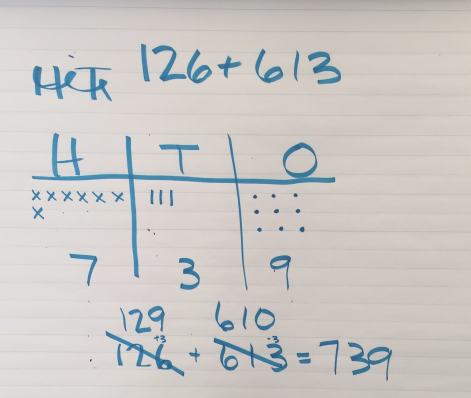
We ended last week with the beginning of our new addition/subtraction unit, so I started with a 3-digit problem.  And no, it wasn’t until we sat down to talk about the solution that I realized that the answer went up and over 1,000.  Oops.  But hey, if you can do those hard ones, then everything else is just cake, right?  No one seemed to notice.  And many of them got it right, which was nice and exciting.  We talked about both compensation (making the problem easier by making 620 + 541) and splitting it by place value to add.

IMG_0779-min

Tuesday

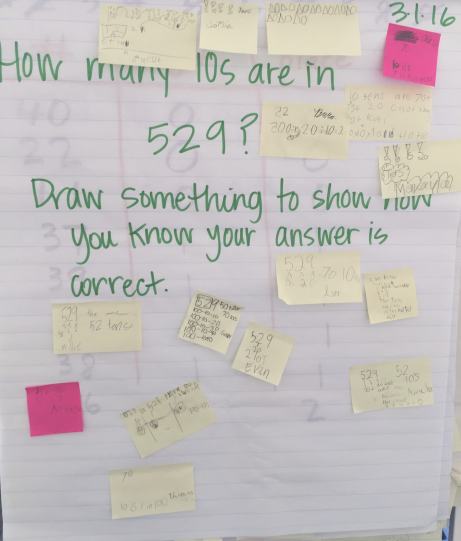
Ok…so Tuesday’s warm-up didn’t end up the way I thought it would.  (Man is there a theme here lately?)  I wrote this problem BEFORE school, knowing that it would tie into our place value work, as well as remind them of work we had done previously with this topic.  And then I had some AMAZING professional development work in math with Kara Imm (an amazing teacher from Mathematics in the City out of NYC) and the rest of my 2nd grade team that afternoon.

(Sorry, she’s so amazing I have to stop and introduce you to her for a second. 🙂 )

Screenshot 2016-03-04 20.56.11

During our planning we decided that we were working to launch a new investigation called The T-Shirt Factory, which is based in the context of a family who starts a t-shirt factory.  Nicholas, the son in the story, works with rolls and loose shirts to organize and keep inventory, and the kiddos work alongside and within this context to solve similar problems to the ones he encounters.

Anyhow, after I had written this problem, we planned our lesson and I soon realized that my warm-up didn’t really fit in the pacing and sequence we’d decided upon.  It wouldn’t make sense further on down the line if we discussed it on that day.  So instead of fulling working it out and digging into how and why and what their strategies were, we just shared our initial thoughts.  And then, like  a happy accident, I figured another way I could use this debrief and the results I got to help plan my next lesson–just not in the way I thought I would originally.

IMG_0778-min

When we met on the rug to talk about this problem, I started with questions.  They were to listen for the number of 10s they had marked on their post-it and then stand in a certain place in the room.  I called all combinations that kiddos could have said (9, 2, 5, 52, 29, 20, 500), and we ended up with two groups: 52 and 2.  This was not surprising, based on two common understandings of what I mean when I say “tens” and how numbers are “inside” other numbers.  Next, instead of sharing out how and why 52 was the correct answer or why one group only said 2, each group talked to a partner in their SAME group to share why they had decided upon 52.  The focus was on communicating how they knew; this is something that is tricky for many of my friends to whom mathematics comes easily.  The “2” group did the same thing within their ranks.  Then, I paired them up with someone from the opposite group and they had to then work to convince their new partner why their number made more sense.  And then we stopped, knowing we’d pick up that same conversation again on a later day during our t-shirt factory work.

Wednesday

Remember the theme of unexpected results?  Here’s another example of that.  Usually when it’s time to talk about the math warm-up, we meet together on the rug and talk about the problem.  We don’t necessarily refer to specific post-its, these just serve as the kiddos’ opportunity to think about it prior to our conversation.  On Wednesday I was out of the classroom during our normal debriefing time (because of more math conversations with Kara and the team), so I only had their morning work to look at.  I gathered info about who knew what to do with these 3-digit numbers and who still showed that they needed to continue to practice (it was about 50/50 I’d say).  It gave me an idea, then, for the next day’s problem, building on the solutions I saw given here with this one.

Thursday

First of all, I have to giggle as I remember when Ja’Mia asked me today if this story was true.  Of course, my friend’s son volunteered to help us with our math lesson! (wink, wink!).  But really, I did see my friend’s son that day, so there’s something. 🙂

Ok, this one taught me something I had forgotten about 2nd graders: 1) they haven’t yet done a problem like this one where I’d asked them to analyze someone else’s thinking, and 2) they answered ONLY the question I ask.

IMG_0773-min

See?  The question (which I crossed off today during our conversation as we talked about what the problem really wanted us to think about) could simply be answered with a quick and simple “yes” and so most of them did that.  They probably thought I had lost my mind by giving them a question like that!

IMG_0775-min

I did have a couple who did get to the thinking I was looking for (but who knows how since I asked the question in the TOTAL wrong way!).  For example, I wanted kiddos to notice that rather than just taking jumps by place value (200 + 70 + 5), the tiny jump of 3 made sense next because it got us to a 10, which is easier to work with.  That resulting 570 also creates an easy double to add mentally (570 + 70, like 7 + 7), leaving a quick +2 to finish up.  Here’s Khalani’s answer example:

IMG_0774-min

Friday

The whole “my friend’s son” thing got me to ask my real son for some help and he was more than willing to do so (plus it meant that if he was helping me with my homework that he didn’t have to work on his own!).  I gave him the problem 519 + 365 and asked him to solve it using a number line to model his thinking since that’s what we’ve been working on.  He did not do it on purpose, but we realized after he finished that he had left out a part, and we actually decided that was a great thing to have happen; my kiddos might have more to talk about if they weren’t just reviewing their own work and saying “yep, it matches.”  Having a different answer and having to figure out why it is different was a new kind of thinking for them.

IMG_0769-min

We didn’t have time to completely finish the debrief, but we were able to talk about how he started, like why he put 519 first as well as why his first jump was just 1 rather than 300, which would have been a typical “place value” jump.  They talked through what he had done and noticed that he misrecorded his +30 jump as only a +3, and that his answer seemed too small; most figured he had forgotten to add on the last 300.

This week’s warm-ups took on a new role.  Our thinking was really deepened, and we dug into how and why in a way we haven’t done in a while. Plus it was great to be able to have 5 in a row!!

What do you think about our thinking?  What had you tried with analyzing others’ mathematical thinking?  Do you have any problems you can share with us?  We’d love to hear from you!!

Teamwork is Tops in Rm. 202!

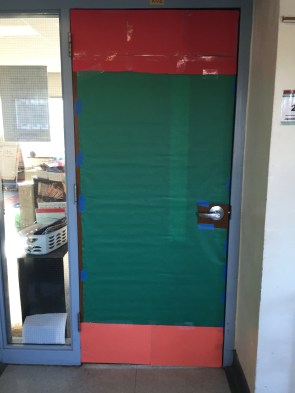
This month at our school there has been a door decorating contest.  Since our class seems to always be doing 10,000 things at once–all fun and motivating, of course!–I chose not to participate in this project.  It was running for the last two weeks and the classes on both sides of us (Hi, Ms. Turken and Mrs. Appelbaum!) have been creating amazing displays, and no one in my class has really said anything.  A couple of friends inquired in passing, but were fine with my answer of “We are doing so many other things right now!”  It wasn’t until the last few days of the contest when someone finally asked me about it and wasn’t so happy with my answer….instead of “ok,” he asked, “What if I do it?”  I am almost always on board with kiddos taking the lead on things, so I was willing to play the game with him.  I told him he could TOTALLY do it, if he was in charge of the whole thing and that the only time I had to give them to work was recess.  I have to admit I was a little surprised, but he was instantly on board.  This was Friday, so he was given the weekend “homework” of figuring out the theme, the plan and the ideas for how the rest of the class could help get it done.

I have to be honest that I was expecting him to come back on Monday having changed his mind, but instead he had a pretty well developed plan and excitement to include his classmates.  We made plans for who would come to join us at lunch and recess, and almost the whole class wanted to help!!

We only had from Monday until Thursday after lunch to complete our BIG job, so on the first day we brought our lunches up and worked for as much of our 40 minute lunch period as we could.  By the end of that day, we had the background up and a great plan for what we would do the next day.  Oh, and we ate our lunches. LOL

Can you tell our theme just by this picture?

IMG_0674

Well, if you know my friend who planned it, that would be an easy give-away, too, but I’ll just tell you that we had the theme of teamwork, shown through a football game.  We have a HUGE rival down the road in Webster Groves, so that’s the reason for the red and orange end zones. Our rough-draft plan looked like this:

IMG_0655

On this first day we had about 16 kiddos working and not many jobs, so I worked it out with one friend to be our photographer.  I needed pictures to document our work and he wanted to help, so bingo!  I am super happy I did it, now, too, because it’s so great to get a kids-eye-view on what we’re doing.  Obviously he took very different pictures than I would have (and I’m even in some of them! Thanks for being kind–LOL), and it makes me think I should hand over the iPhone more often!  Check out the work we did on our first day. Oh, and I didn’t edit them at all.  I kind of thought it was very organic and “real” with his fingers were in some of them.  I also love that you can see conversations happening in many of them, as well as how messy it is working with 2nd graders; I think often I try to crop and edit our life into just the right picture.  But you know, honestly sometimes we just watch.  And sometimes we leave big piles of paper laying around, and often it takes 6 people to do the job of 1 person.  But no matter what, we work together, solve problems together and have fun with each other.

This slideshow requires JavaScript.

Our second stop in the process was to create the field, with yard lines, names and goalposts.  Some friends started on bleachers and a crowd, but we quickly had to scrap that part for time’s sake.  Next decide about teams, then create football player and cheerleader versions of us to play the game.  For this job, I did give them some class time, as there really wouldn’t have been enough with just recesses to make that part happen.  We divided in half, created the parameters (7 inches tall), and even decided that we should have a mascot (Remember my photographer friend?  He was cast as Pioneer Pete!).  Again, here’s what it looked like while we were working, from a kids’-eye-view of the room:

Once we were all said and done, our entry into the door decorating contest looked like this:

I was SUPER impressed with how quickly it came together, with how well everyone worked together towards a common goal, and how willing my friend was to lead us all to this great product!  On Tuesday at the end of the day, as we were having our closing circle, more than one kiddo thanked him for being a bold leader.  What a great way to end the day! Way to go, Rm. 202 friends!!


Second Grade Math Warm-Ups: Week of February 22-26, 2016

I have three warm-ups to share this week.  We had a surprise snow day (which was a little funny because where I live there was no snow!) on Wednesday, so no warm-up that day!  We are in the middle between our money unit and addition/subtraction up to 1000, so the problems reflect that.

Monday

IMG_0741-min

As we discussed this problem, we tried a similar one:

IMG_0739-min

Tuesday

IMG_0740-min

Friday

IMG_0738-min

IMG_0737-minWe modeled the solution to this one in three different ways (which we related to the ways we had done 2-digit addition earlier this year).

Ok, now for a confession…I was surprised when my kids made some of the connections they did this week between money and 3-digit addition.  I know, right?  Probably shouldn’t happen that way, but it was honestly something I hadn’t really noticed, or at least thought about it as specifically as they did.  I think it was nicely pictured in the problem from Tuesday, where we solved each problem in red–they made connections between how you can add whole dollars just like the hundreds in the 2nd problem (and that’s just like 100 cents, making the amount with pennies); the tens were dimes and then the ones were pennies.  Ok, so that part is not surprising to me–obviously I have this knowledge as an adult–but I honestly didn’t expect kiddos to use this to help them solve the 3-digit addition.

It went even farther yesterday when I had a kiddo working on a pre-assessment for this next unit and was doing the problem 451-238.  He told me he needed the money bag so he could use coins to help him.  Since I always allow kiddos to use whatever manipulatives or strategies they need to figure things out I said “ok,” but I honestly was thinking this would hinder him more than help him, or that he’d end up more confused.  When we first looked it he seemed confused with how he’d subtract 8 from 1 (which told me he wasn’t really solid with regrouping yet).  He started by making $4.51 with half dollars, dollar coin, dimes and a penny, and seemed a little unsure about it as this point, too, asking me about names and values as he made his amount.  But once he got his $4.51, he could easily take about the $2 from $2.38, as well as the $.30, which he did with 3 dimes (and I wonder if he made that $.50 that way on purpose since he could think ahead to having to break it apart later on).  Then he sat with only 1 penny, and the need to subtract 8 cents.  And so yes, here’s where the money came in handy–the concrete nature of being able to think about trading a dime for 10 pennies (which is what he is doing abstractly when regrouping) helped him see the constant value and how he could then actually take about the 8 pennies (8 ones) from what was there.  He then counted the money he had left and told me it was $2.19.  We then talked about what that would be if we were just talking about hundreds/tens/ones instead of money and by drawing it in a chart he eventually saw it as 219.

I’m excited to see how this connection to money plays out for some of my friends who need to actually hold/touch/feel the addition and subtraction.  Yes, it’s something we’ve done with other kinds of math tools and strategies, but I wonder if this might even be the best connection, yet, since it’s all based on place value anyway.  Oh yeah, and maybe that’s why this unit was placed after this one in the sequence….

The conversation around this problem the other day was the kind of thing that reminds me that I don’t know everything.  Obviously I know this, but it’s refreshing when kiddos remind me that they are figuring out things I hadn’t thought of.  I love sharing with them those moments, too.  It reiterates the fact that I am not the only teacher in the room, and that I have things to learn as well as they do.  And I hope it’s a lesson that all of us will remember–and use–for days to come.

Learning Buddies: Read-a-Thon

We have not had a chance to see our Learning Buddies very much lately.  5th Graders are busy people!  When we heard they were busy tackling a Read-a-Thon on Friday, we knew we wanted to join in!  While they were spending their whole day (6 hours!) enjoying a book, we were only able to be there for a little chunk of that time.  Some Rm. 202 friends suggested we should plan our own read-a-thon, though, for a future date, too!

Before we came to visit them, Dr. Grayson’s room had a lesson with Mrs. Meihaus, our amazing librarian, about how to read to a younger student.  Our buddies were then armed with their “lesson plan” and shared really great books with us after lunch.  It was so much fun!  Oh, and it was also Hat Day at our school to raise money for the NIYO Cultural Center in Rwanda (Hi, Pacifique!), which added to the festive spirit.  Enjoy some pictures of our afternoon!


Privacy

Recently I read a post by Pernille Ripp that was a topic I had never really thought of before.  She writes about all things education, and I always learn something when I read her words (i.e. I first learned about kid blogging from her work, and read about many other topics like homework, classroom management, genius hour, etc. from her as well).  This time I was drawn to her blog by a tweet she posted related to privacy–a topic I had not yet thought much about related to myself and my students.  Ok, yes, I had thought about privacy related to not sharing student personal information and keeping them safe in their online spaces, but not related to privacy in other terms.

Her blog post was about student work and stories and how important it is to ask their permission before you post their words to social media.  She proposed that not every kid wants you to share their news.  Not every kid wants you to tell the world about their ideas, their projects, their problem solving–even if it’s good.  And she proposes that students have the right to tell you if they want you to share on their behalf.

Wow….that was never a thought I had ever had before.  OF COURSE my friends want me to share their projects, their pictures, their super-smart ideas.  OF COURSE my friends want me to toot their horns on Twitter and our blog so that loads of other people can celebrate with them.  That’s what I would want so that’s everyone else would want, too.  Right?  Of course.  Well that’s what I used to think.  And now I’m not so sure…

After reading that post I immediately started looking at things that happen in our classroom a little differently.  While I’ve always said that it’s “ours” and not “mine,” I’m not so sure that I’ve worked that way in regards to what I have shared on Twitter and our blog.  I think I always thought: “Well no one has ever told me NOT to share their work;” “No students has ever told me that didn’t want me to put their stuff on our blog;” “Everyone is proud when they have a great idea, and so they’d want me to tell everyone about it!” I guess what I really mean is that I didn’t really think about it.  And then I had a moment (again, after reading Pernille’s post) where I thought I should ask.  Something awesome had happened, and I was taking pictures of the moment, but thought to ask permission form a friend to post his picture and he told me no.  I was a little taken aback, but then it started to make me wonder how many other times if I’d had asked that question of him if he’d have said no.  I went back to those statements I’d had previously and thought this: “Well, of course, no one told you not to post.  They didn’t know they could.  You didn’t ask them.  Maybe they just thought  ‘She’s the teacher and so she’ll do what she wants to do.”  Sure, it may also have been because they really didn’t care.  But the point is, I don’t really know.  I had never given them the opportunity to tell me.  (And for the record, if I think more about that friend and his hesitance to post his picture online, he has probably felt that way about many other things and just not told me.  Oops.)  I wonder how many others in the last five years would have said “no,” too, if they’d have had the chance.

So…going forward, I will be the one who stands for the student who never says yes.

I will be the one who asks before I tweet about something my kiddo does (and yes that counts for the ones who live in my house, too.).  They may not want me to tell everyone.  Even if it’s something really great.

I will be the one to ask before I put their picture or artwork or Keynote or writing piece–whatever–on my blog, and I will not expect them to automatically post it to their own blog, either.  They are allowed to be in charge of what is public and what is kept between us.

I will be the one to ask before I assume that everyone loves praise and digital high-fives like I do.  I can’t assume that everyone is just like me.  Ha!  Guess I already knew that was true, but just hadn’t thought about it in this sense before.

So what do you think?  How will you think differently about what you post or share about the kiddos in your care?  What will you continue to do in the same way?  I’d love to hear your thinking! 🙂