Do You Remember It All?

Of course, not, silly, but I can help you pull some of it out of the depths of your memory!  Wait–let me back up a little bit.  Remember when I mentioned the other day about how we are going to be starting MAP testing in a couple of weeks? Well, one thing that we have been doing to help us prepare for the Science section of that test is to review concepts that they have learned about previously.  Because, of course, they probably wouldn’t remember all of it without a few reminders.  And pretty much anything they’ve ever learned about (yep, since 1st grade!) is fair game on this test.  So we had some work to do.

This week we went back to an activity we’d done with past units in Social Studies in our classroom.  Since I knew that it worked to help us remember big ideas and I knew they had fun doing it, I figured it was perfect to pull out again.  Plus, unfortunately, the last few units we’d been doing in Social Studies had been more of the sit-and-read-from-this-book-and-tell-me-what-you-learned type units, so they were ready for a change.

We have access to Safari Montage through our school district, which is an amazing resource for videos to supplement your curriculum.  There is a great series by Schlessinger Science Library that presents concepts in a fun and informative way with short, interesting videos.  This week we watched several videos and then created window murals to help us remember the big ideas.  We worked with a partner or in a group of 3, and created representations for each big idea on the mural.

Here’s what we’ve been working on this week–

This one was after a video called All About Plant Life:

Can you see the big ideas of leaves, roots, what plants need, how plants are different from animals, photosynthesis, and how they give us oxygen?

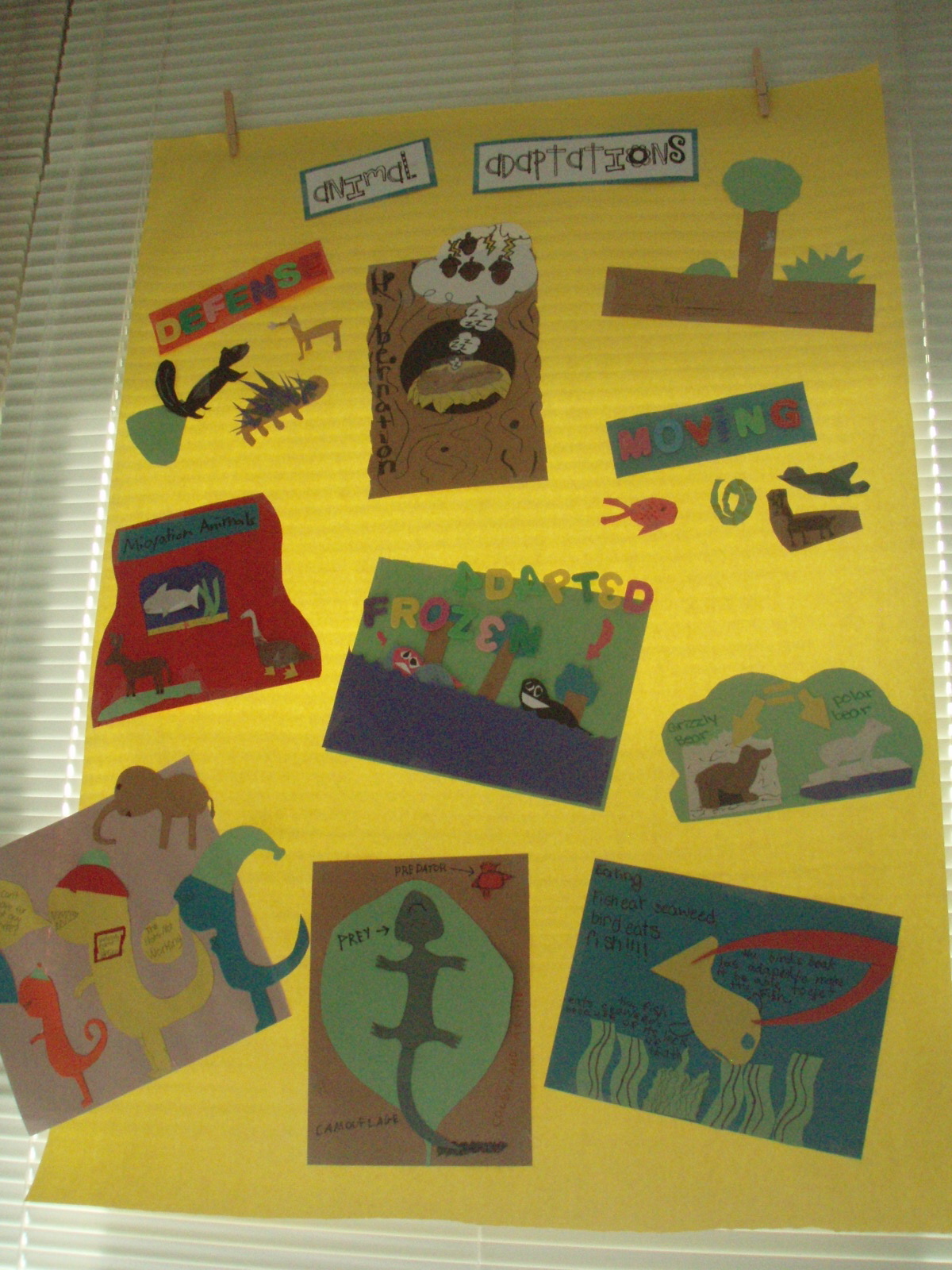
Next we watched a video called All About Animal Adaptations:

I wish the picture had turned out better, but this one had big ideas about how animals have to adapt to their environments to help them survive.

On Thursday, the topic was animals again, but this time Life Cycles:

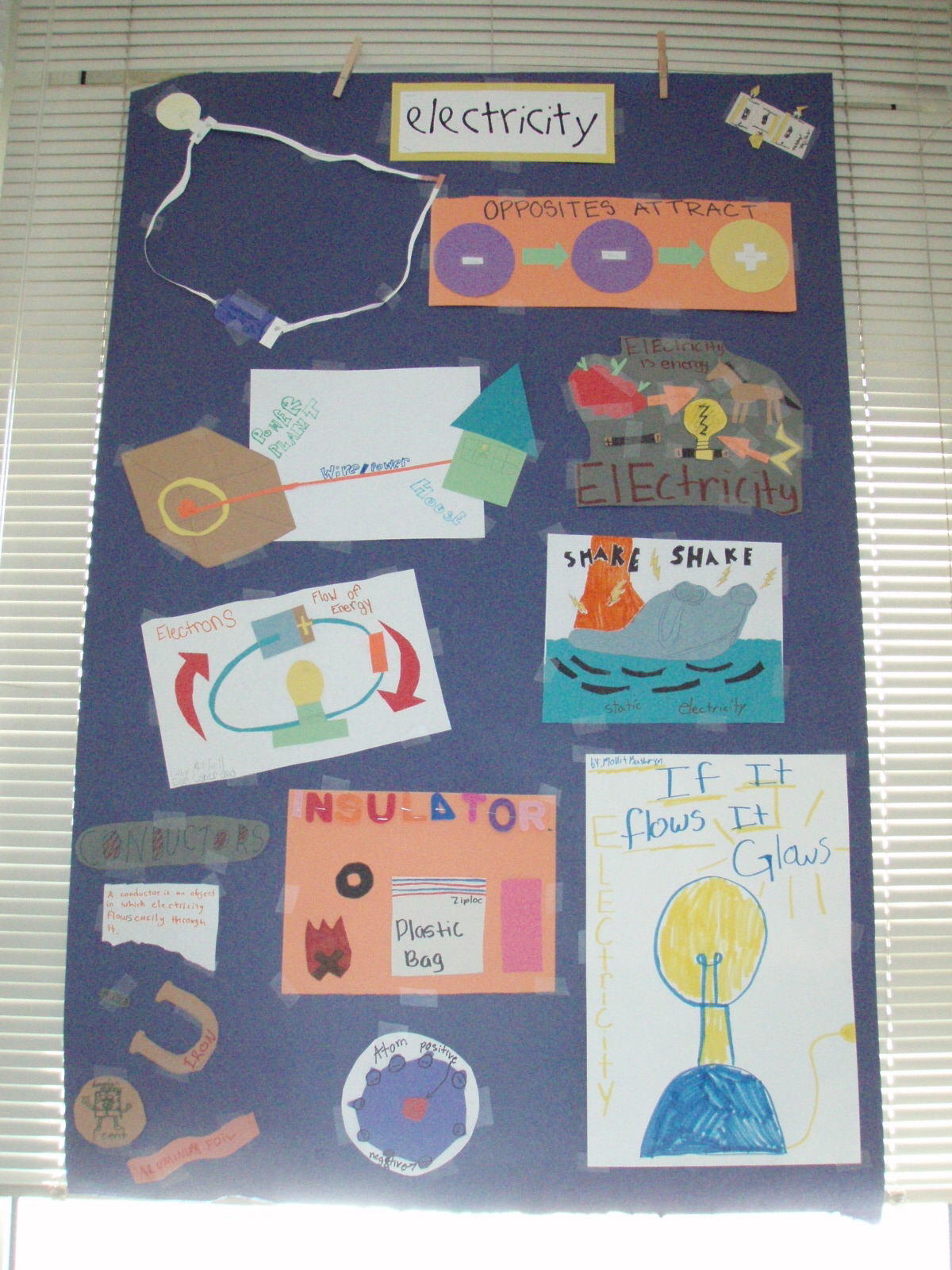
And then Friday we moved on to Electricity:

It is always great to see what my students do when they are given a challenge, and how much fun they have doing it.  I loved how so many kiddos mentioned this activity when they shared in our closing circle on Friday.  The Friday question is almost always “What did you like or what did you learn?” and a majority of kiddos mentioned that they liked going back to this again.  And any time we can learn in a fun way, I’m all game.  We have more window space and more science to review, so there are surely more of these in our future next week!  I am sure my class will be just fine with that. 🙂

You Asked For It!

So while only 11 people responded to my poll about my next post, many of you wanted to read about what’s coming up in the curriculum for 4th quarter.  Well, then a couple of you also voted for Spring Break related topics.  Maybe I’ll just post about it all, then.   So here you go, friends–here’s what’s coming up in 5th grade this quarter!

WRITING:  This quarter starts with us finishing up our expository nonfiction pieces that we started last month.  We’re at the point of proofreading/editing, which we began today.  After we finish conferring with our partners and tweaking the mechanics to make sure our readers understand our message, we’ll publish!  I’m so excited to see what we end up with, as writers in our room will have a choice of presenting the final draft as a poster, feature article or essay, including the text features we studied and the bibliographies we learned about recently.  I am sure to post pictures of that amazingness when we’re finished!  Following this unit, we will also tackle persuasive nonfiction (probably based on either a colonization unit in Social Studies that’s coming up, or a science topic related to our Weather unit) as well as poetry.  As usual in our classroom, this quarter will also bring lots and lots of blogging and Writer’s Notebook writing, as well, since that’s just how we roll in Rm. 201!  I’m excited about what’s coming up with writing.  But then, I generally am excited about anything in writing. 🙂

MATH:  Since we figured out that math rotations work so well for us, we’ll continue with this structure as we finish out the year.  I have loved how I’ve gotten to know each and every mathematician so much better by meeting them in small groups, and also how much more confident so many kiddos are in math now; more specifically meeting needs and checking in more frequently has helped many to better understand concepts and feel more comfortable asking questions when they need to!  We have two units left to work on this quarter: one called Growth Patterns (about patterns, functions and change) and another called How Long Can You Stand on One Foot? ( about data analysis and probability).  We took the pretest on both of these today, as the plan is to combine them.   Another big idea we’ll tackle during the beginning of this quarter is math test prep, since we take our Missouri Assessment Program (MAP) test in mid-April.  Right now I’m thinking the plan will be to combine some whole group lessons with our regular rotations.  There will be some paper/pencil test practice added into the skill practice station, and I will address needs in this area in our small groups, as well.  I’m excited about how this quarter will go, and the continued success we’ll see as we delve into some really active units with fun concepts.  I loved how interested most students were today when I mentioned the topics we would be covering.  Maybe my kiddos just love math now….:)

READ ALOUD:  We are in the middle of an amazing nonfiction book called Chasing Lincoln’s Killer by James L. Swanson.  While it’s the first nonfiction chapter book I’ve chosen for read aloud, I am sure it will not be the last.  Well at least not the last time I read this book.  The story is so amazingly written, and the way that Swanson incorporates firsthand accounts of the action into his writing has kept us on the edge of our seat.  I am sure that this will be a favorite with many kids this year!  After this one, I have plans to read Walk Two Moons by Sharon Creech (one of my all-time favorite authors!), as well as I Am David by Anne Holm.  If there’s any time after that, I may throw in a couple of other shorter reads (again probably by Sharon Creech, like Pleasing the Ghost or Granny Torelli Makes Soup).  Do you have a favorite read aloud that you would suggest to us?

READING: Like in Writing, our first plan is to finish up the expository nonfiction unit we started in 3rd quarter. We’re already spent some time reading articles and using a variety of strategies to understand and discuss them, and we’ll move on now to reading and analyzing functional texts and textbooks.  What great timing, since this is just the kind of text we’ll encounter on our big test next month!  We will also have a unit on determining important ideas/summarizing, as well as synthesizing information as a strategy to comprehend.  This quarter everyone will also be involved in another round of literature circles, as well, with each group choosing their own text this time.  I’m excited about the groups that have formed: The Lost Hero, The Son of Neptune, A Friendship for Today, and Closed For the Season.  There are still a few kiddos who have not joined a group yet, and I’m excited to see what books they end up choosing.  If you have a suggestion for a good read for some amazing 5th graders, please suggest it in a comment after this post!

SCIENCE/SOCIAL STUDIES:  This is one of our favorite times of the day, although I know that most kids in our class would tell you that they HATE that it’s at the very end of our schedule.  I’m excited about the units that we’ll be doing next, though: Earth Systems–Weather and Three Worlds Meet–Colonization.  The weather unit we’re going to do has just been revamped, and is taken from the work of Carol Ann Tomlinson in her book Differentiated Instruction in Practice: Grades 5-9.  It’s an amazing collection of activities, experiments, discussions and writing opportunities (which you know we’ll be blogging about!) that will give EVERY learner in our room a chance to engage at their level of understanding.  I like to think that everything we do is organized this way, but with science and social studies, it can be harder to achieve.  This unit brings exciting promise of making it happen.  Then in our colonies unit, we’ll see how what we’ve learned about Native Americans, Ancient West Africans and Europeans comes together when they all end up here and try to create a world together.  I’m excited to see the light bulb moments in that unit as connections are made to past learning.  Definitely exciting stuff on the horizon here!

There is sure to be much, much more happening in our room during this quarter, but here are the foundations on which all the rest will be built.  We have a service-learning project that we’ll be completing with Stray Rescue of St. Louis (more on that later!), fun with our learning buddies, dance routines that we’ll be performing for A.C.E.S. Day in May, a trip to Nipher Middle School to visit, our 5th Grade Celebration and many other still unknown projects or conversations that will develop based on somebody’s great idea or suggestion.  I know that whatever else we do, we’ll enjoy ourselves and learn a lot together!  Can’t wait to share the rest of this ride with you as we go along!

New Technology!

Wait–it’s not new to the world, or new to the school, but new to us!

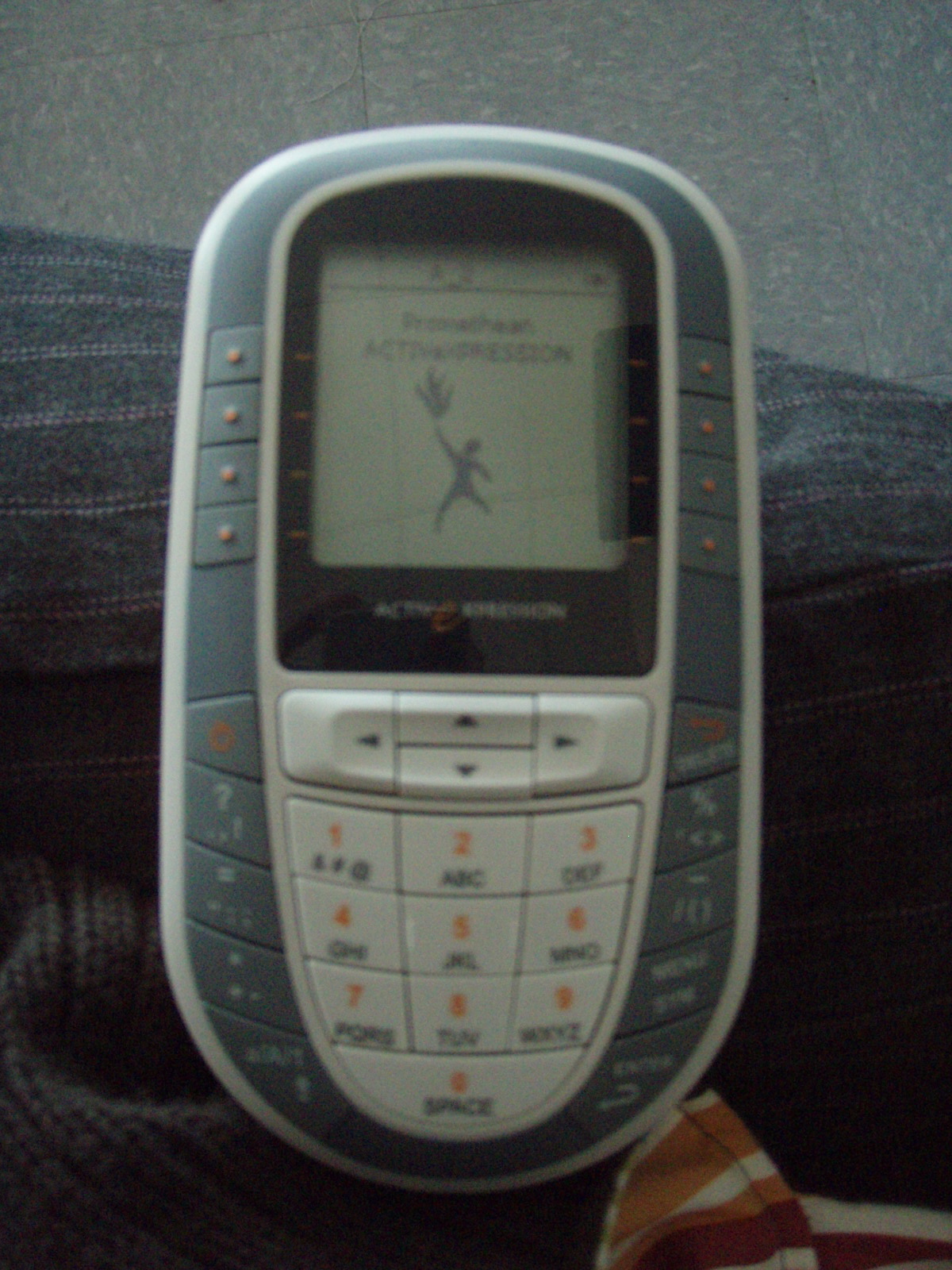
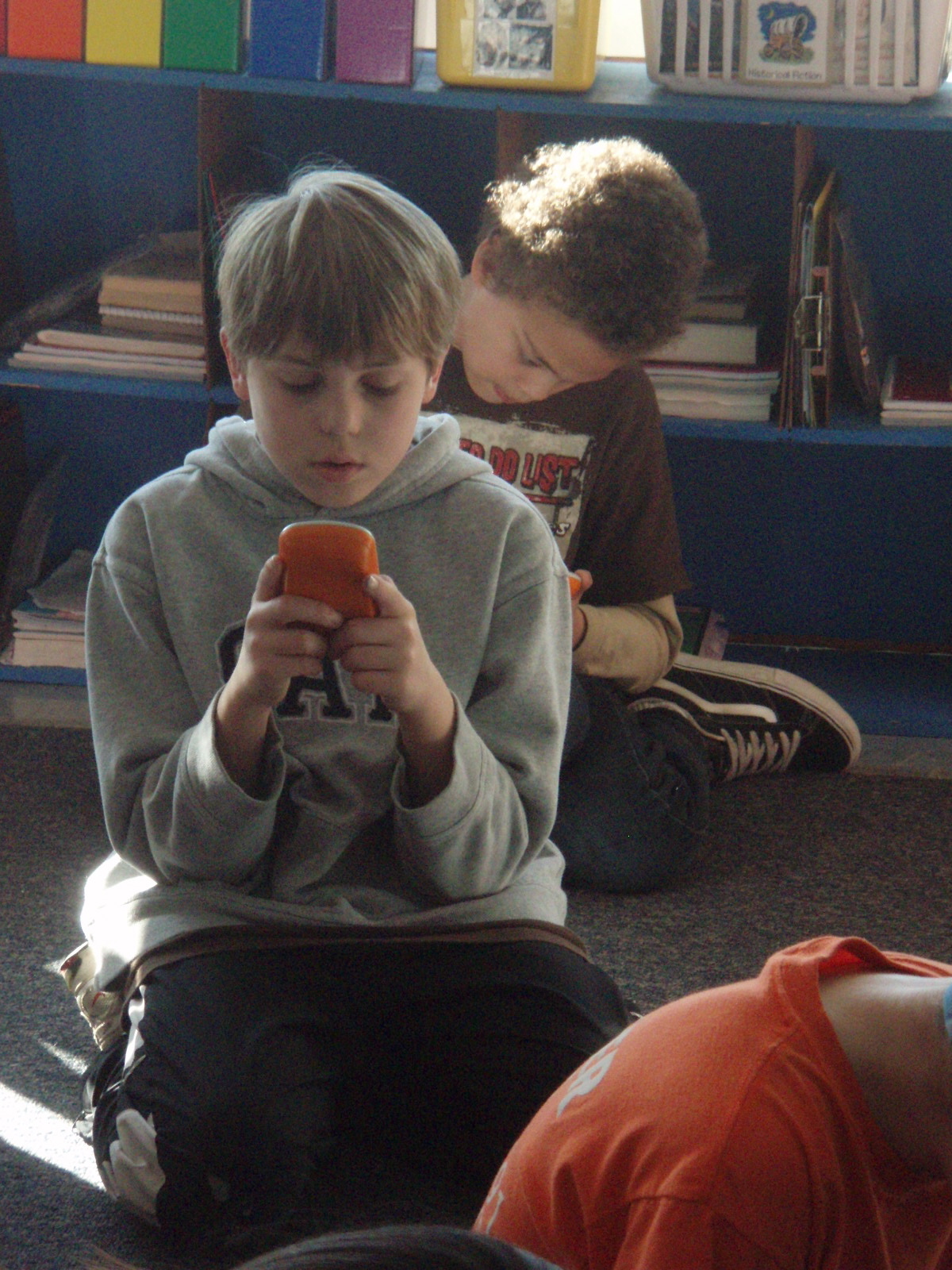
Today we used ActivExpressions for the first time.  Don’t know what I mean?  Check out this picture:

Ok, sorry for the quality of that pic, but hopefully you get the idea.  It looks alot like a cell phone, but is connected to our ActivBoard, and can be used to answer questions (using multiple choice format), or you can even text in your answer to a constructed response question!

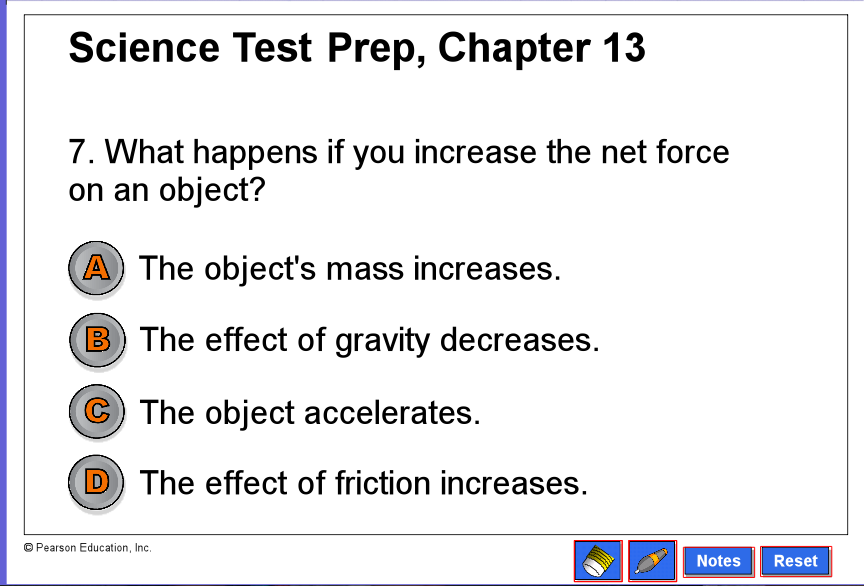
We are getting ready to take a test at the end of our Force and Motion unit in science, and so were ready to review today.  Instead of playing a game, or just answering questions out of the book, we used a flipchart on the ActivBoard that had questions we could answer using the ActivExpressions.  Here’s a random page from the flipchart we were using, to give you a better idea of what we were doing:

There were a couple of questions where the kiddos had to text in their answer, and they TOTALLY LOVED that part of our science review:


I loved how I kept hearing them say that, “This is so fun!”  My class loves science and socials studies (well they love everything we do, really), but you gotta love how a little change in the format, and an addition of a gadget and you’ve got their attention.   We will definitely we using these again soon.  Well, tomorrow, actually, because we didn’t finish today. 🙂

Are You Hungry?

If you’re anything like me, then you love to eat.  And you really like to eat out.  My family loves to find new restaurants around town and try them out; “chain” restaurant is kind of a bad word in my house.  So, if you’ve ever eaten out, then you know the idea behind a menu–you are offered a variety of choices of yummy things to eat.  Most times you will choose a main course, side dishes and dessert.  Maybe if you’re really hungry, or if something looks really interesting, you might add an appetizer to your meal.

Ok, so what?  This is a blog about school, about education.  Why all the restaurant talk?  Well, if you’ve spent any time in our classroom lately, or if you’ve seen a 5th grade homework sheet this year at school, then you’re familiar with the idea of a menu.  But why, you ask, would you use a menu in school?

Let me tell you. 🙂

The big idea that makes a restaurant menu work, that makes it desirable, is the idea of choice.  When you sit down to eat, no one tells you “Eat this.  Chew it 25 times.  Swallow it.”  You’re not forced to eat things you don’t want to (well, unless maybe you’re a kid!), and there are many ways to achieve your goal of filling your empty stomach.

That’s what we’re trying to do with menus in school.  We have a goal–based on subject and unit–and then students are given a choice of ways to show their knowledge and learning related to that subject.  The idea is not new, really; I’ve been doing a variation of it for years.  Long ago we called them “invitations” or had a list of “must-dos and can-dos”, but the idea behind it is the same: children are going to have more ownership over their work and probably ‘dig in’ and little deeper when they have choice in what they do and what the final product looks like.

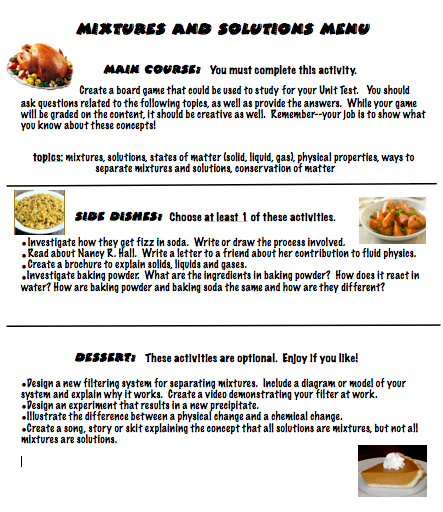
Here are some examples of menus we’ve used this year so far:


I must add, though, that besides giving students a say in what their work looks like, menus are an important tool in differentiation.  The categories are tiered, so that every learner can be engaged wherever they are in their understanding of the concept; the main course is something that everyone can do (still at their own level with their own creativity), side dishes are a little deeper, and then desserts are activities and projects that allow and enable students to stretch themselves and think in a deeper way.  Everyone in my classroom has their needs met regardless of what they are, and everyone has activities that are appropriate for them.

So, are you hungry for learning? Menus are for you. 🙂


“Blog Worthy” Part 3: Talk-a-Mile-a-Minute

My students love to talk.  I do, too, so I can’t blame them.  I remember myself as a 5th grader, even, and remember that the thing I got in trouble for most often was talking when it was somebody else’s turn.  So whenever I can, I try to give them opportunities to talk while we’re learning.  Partly so that they won’t fill in the space with talk about non-learning things, but also because learning is a social thing; talking is part of how you make meaning.

So frequently we play a game called Talk-a-Mile-a-Minute.  It’s a vocabulary game, and can be used in any subject, with any set of words.  I think I introduced it in math (because there is a TON of vocabulary there!), but we have also played it with science and social studies terms.  Today we played it with new terms from our Ancient West Africa unit in social studies.  It’s fun, they can talk and be active, and they learn something.

Here’s how it works:

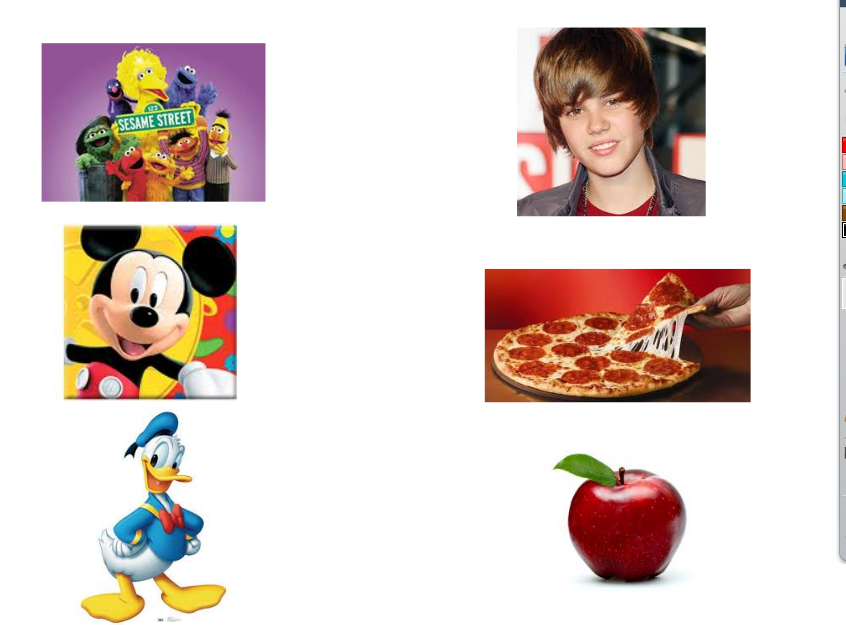
Kids choose a partner to work with.  Partners sit “eye-to-eye, knee-to-knee” in front of the ActivBoard.  The person with their back to the board is the guesser, and the person who can see the board is the describer.  I put up a screen with words they should know (or that they are working on), and the describer has one minute to get the guesser to say all of them.  The first time we played it, we did several practice rounds, and instead of words there were pictures, like this:

The goal is to be as descriptive as you can, without saying what the word starts with or rhymes with.

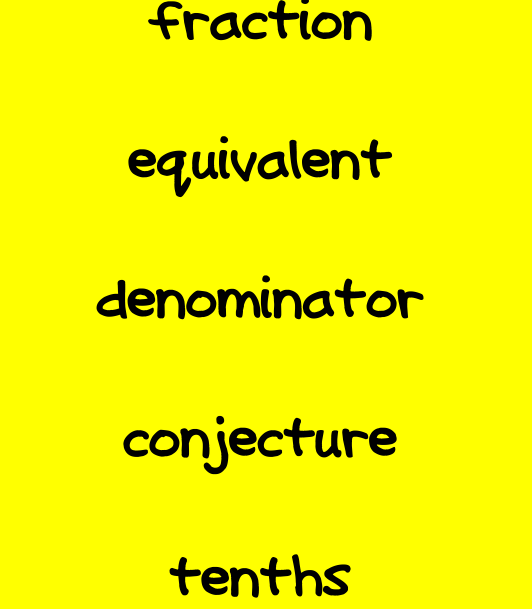
The first round was pretty easy, so then we tried it with words:

Here are some terms we used yesterday in math:

And here’s today’s version for Social Studies:

How well do you know these words?  Play with your child and see how it goes!