Lessons from a 4-year-old

Kids say the darndest things.  And if we really listen to what they say, we can usually learn something from them.  This was the case the other night when I was having a conversation at dinner with my son, Riley, who is 4-years-old.  He announced very matter-of-factly that “If you wanna have a friend, you gotta be a friend.”  I asked him to tell me more about that, and he told me “That’s what Ms. Liz says.” Now I know that she probably says that to the class as a whole, but I also know that she probably needs to say that specifically to my son more often then I’d like.  We continued the conversation with more about what that saying meant, and how he knew if he was being a friend.  I was glad to hear his thoughts and could tell that he’d really been working on how to do just those things.

We talked about this phrase on Friday in our own classroom.  I shared it with a small group of friends who were trying to work out how to really care about each other and work together as a team.  We decided that as simple as that phrase is–a 4YO can understand it, afterall, on some level–that is is really more involved that you might first think.  We discussed at length what it might look like to a 5th grader.  And then we put a plan in place to start living it out.

And then even as I’ve gone through this weekend, I’ve realized that there are implications for me, too, as an adult.  I’m learning the same lesson that my son and my students are, just on a different level.

So it’s true what they say: “If you wanna have a friend, you gotta be a friend.”

What does that mean to you?  Feel free to add your thoughts and comment!

1/8 is 12 1/2%

At our school we use Investigations for math.  One thing I love about the program is that it usually digs into the why of each math concept instead of just the how.   It encourages students to create their own strategies for solving problems, emphasizing that there is not just one way to come to a solution. In the case of our fraction/decimal unit that we’re in now, we are doing more than just learning the rote definition of a fraction and coloring in fractional parts of pictures or just adding or subtracting them using the method I directly taught them–like I know I did in 5th grade.  Instead, we are investigating and creating and figuring out and–most importantly in my opinion–using what we already know to discover something we don’t.

Here’s an example of what I’m talking about:

We are at the beginning of a unit called What’s the Portion?, which includes experiences with fractions, decimals and percents. Yesterday and Thursday we were working on figuring out the percent that is equivalent to a fraction.  We started by making drawings on a 10X10 grid (which helped us “see” what was going on) since we know that percent means “out of a 100.”

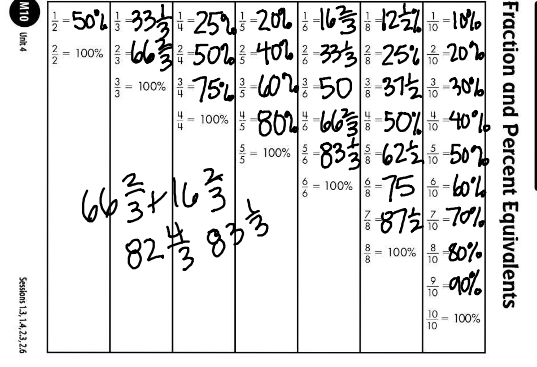
We used this visual, and what we knew about fractions and percents already to figure out that 1/8 is equivalent to 12 1/2%, because 1/4 is 25% and an eighth is half of a fourth. Our music teacher, Mrs. Kesler, will be tickled to know that I even had one kiddo make the connection between this and what he knows about music notes to help him figure it out.

So after the initial idea of fraction and percent equivalents was presented, they were to dig in a little deeper.  I gave them a chart to fill in, that had lots of other fractions to work with.  I told them to fill in all that they could with the directions to NOT do thirds and sixths, that we’d do them the next day.  But what they did instead, was make it their goal TO DO the thirds and sixths.  In this case I didn’t really care that they did the opposite of what I said, because it meant that they were going to try something that might be a challenge, might stretch them a little, might give them questions to ask when we worked on it together.

And for the most part, they all totally rocked it.  They made it look really easy.  Like they’d been figuring out fraction and percent equivalents for years. (Ok, 5th grade readers—which character from one of our favorite read-alouds did that sound like?  Comment on this post with your answer if you know!!)

Here’s what our chart looked like when we were done:

The thing that I think is really remarkable about the thinking behind this is that they are already getting comfortable with going back and forth between fractions and percentages, and can tell you how that relates to a group of things, like how getting 10 out of 20 of your spelling words right is 50% or that 3/4 of a class of 24 is 18.  There is understanding being created that goes far beyond just memorizing definitions.  I like that.  And they like it, too.

Light Bulb Moments

In case you haven’t noticed, read-aloud (chapter book) time in our room is a big deal.  This ain’t no lay-on-the-floor-and-rest-after-recess-time.  My kids will tell you that read-aloud is one of the most important times of the day–we use the chapter book to connect to reading, writing, vocabulary and many other things.

Right now we are deep in the middle of The Secret of Zoom by Lynne Jonell.  In Reader’s Workshop, we’re working on inferring in fiction text.  So today as we read our chapter book, we focused on noticing and recording inferences we were making about the story.  We reviewed the meaning of inferring (which we defined as background knowledge + text=inference), and then got started.  There were a couple of parts when I paused in my reading to say “You might be able to infer something here,” but for the most part I just left them to their listening and thinking.  Then I read a sentence and K, who was sitting right in front of me made a rather loud noise, somewhere in between a gasp and a screech.   She covered her mouth, grinned, and then scribbled something in her notebook.  And I knew exactly what she was thinking.  She had figured out something in the story–she had made an inference.

Now, every time you infer something in a story, you don’t make a big deal like that; it’s not always so obvious.  But this was a really great illustration for us.  Some kids in my class have a hard time knowing when they are inferring; they know what to do, but they don’t always attend to when they’re doing it.  But I’ll but from today on, they will know that when you have a “light bulb moment”, when you say “Ahh! Now I get it!” or when you think “aha!”, you’re probably inferring.  It was cool to watch several others do the very same thing–most without the screech–as we continued to read.  And I’ll bet we’ll notice more of it tomorrow.  I love how the thing that really made it visible, too, is something I couldn’t have planned for (the best learning moments happen like that!).  It came very naturally, and was really powerful for them.  Next time you think “aha!” or have a “light bulb moment”, pay attention –you might be inferring something, too. 🙂

“Blog Worthy” Part 3: Talk-a-Mile-a-Minute

My students love to talk.  I do, too, so I can’t blame them.  I remember myself as a 5th grader, even, and remember that the thing I got in trouble for most often was talking when it was somebody else’s turn.  So whenever I can, I try to give them opportunities to talk while we’re learning.  Partly so that they won’t fill in the space with talk about non-learning things, but also because learning is a social thing; talking is part of how you make meaning.

So frequently we play a game called Talk-a-Mile-a-Minute.  It’s a vocabulary game, and can be used in any subject, with any set of words.  I think I introduced it in math (because there is a TON of vocabulary there!), but we have also played it with science and social studies terms.  Today we played it with new terms from our Ancient West Africa unit in social studies.  It’s fun, they can talk and be active, and they learn something.

Here’s how it works:

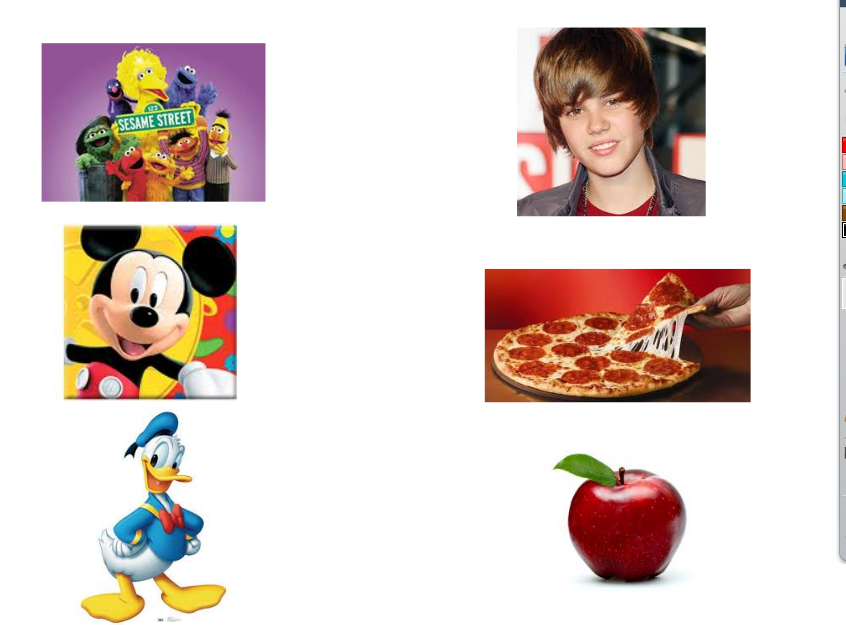
Kids choose a partner to work with.  Partners sit “eye-to-eye, knee-to-knee” in front of the ActivBoard.  The person with their back to the board is the guesser, and the person who can see the board is the describer.  I put up a screen with words they should know (or that they are working on), and the describer has one minute to get the guesser to say all of them.  The first time we played it, we did several practice rounds, and instead of words there were pictures, like this:

The goal is to be as descriptive as you can, without saying what the word starts with or rhymes with.

The first round was pretty easy, so then we tried it with words:

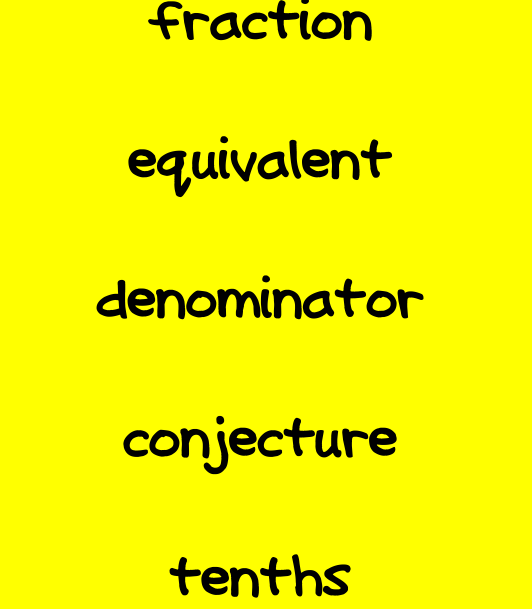
Here are some terms we used yesterday in math:

And here’s today’s version for Social Studies:

How well do you know these words?  Play with your child and see how it goes!

“Blog-Worthy” Part 2: Closing Circle

One of my favorite parts of the day is the last few minutes.

Ok, I know what you’re thinking.  No, it’s not because they’re about to leave, it’s because that’s when we have our Closing Circle.  We end our day together reflecting on what we did as learners.

I know I got the idea for the Closing Circle from someone–probably several someones–and I’m not sure who it was, but I will officially say thanks to Mike Holdinghaus, Heidi Ford and Grant Bearden for this idea.  I am sure I’ve probably tweaked and changed it a little, like teachers often do, but the general idea is the same–appreciate those people we’ve spent the day with and compliment them for the hard work we’ve done together.

The name implies alot: we sit in a circle at the close of the day.  I choose someone to start (this is usually random) and that person starts off by complimenting someone who helped them as a learner at some point during the day.  We go around the circle and each person shares, using the starter “I compliment ________ for…”  They are allowed a “pass” the first time around, if they can’t think of something, and then we fill in with all of those people in the second go-round.

One of the reasons I love this time of day is because it allows us time to reflect on what has actually happened; what we’ve learned, the fun we’ve had, the struggles we may have overcome.  Another reason is because usually they notice things that I didn’t, or think about them in a different way than I would have.  I love that even this early in the year, they’ve figured out that giving a compliment like “You helped me think about that in a way I’d never thought of before” is more thoughtful than “You played with me at recess today.”  Obviously there are times when the compliments are on the surface level like that–but then, sometimes, that’s what really matters to the kid who says it.

There are many days when we don’t get to the closing circle because the last few minutes are nutty and we run out of time.  Those days just don’t feel “right” to me.  And usually someone notices it, too, and makes sure to say so.  Then we always make sure that the next afternoon we make time to meet and close together.  Love it that they love this time as much as me.  It’s just a part of our classroom culture, and is a part that helps everyone leave on the same high note, ready to come back for more tomorrow. 🙂

“Blog-Worthy” Part 1: Table Points

We started something new in our classroom today.  Well, we  do that almost every day, so really it was just like every other day.  But today my students requested that I blog about this one.

Starting today, we’re tracking “Table Points.”  Every week, each table group can earn points for their table for doing the right thing; for following the universals of our school (we call them the Robinson Road Rules).  They never know when I will award them, or how many I will give.  They can be earned as a whole group or I can decide to give them just to one person (but they count for the whole table) for doing something extra amazing.  At the end of the week, the table with the most points earns lunch with me on the following Monday.

I got the idea for table points from my hubby, who also teaches elementary school.  He started using table points in his classroom a few years ago, and after seeing it work really well and hearing how excited his kids were about it, I was interested in trying it in my own classroom.

I think kids intrinsically really want to do the right thing.  Sometimes things get in the way of that and they do kooky things like talk in line and stare out the window during reading time or doodle on their paper instead of answering the math problems.  But deep down in there most kids want to follow the rules and act in a respectful way.  Sometimes they need some motivation and encouragement to do so–or just recognition when they do it without being asked.

That’s where table points come in.  Today I gave 10,000 points for being the first table to be cleaned up and quiet for lunch.  I gave 10,000 more points to every table for waiting quietly in the line for us to go to lunch (this is hard for us to do most days).  Table 1 and Table 4 earned 5,000 points for spending all of their writing time really focused on adding new, thoughtful entries to their notebooks.  Tomorrow I might give points for doing morning work quietly or picking up other people’s messes up off the floor without being asked.   It might be 10,000 points or 5,000 points or just 1 point.  The amount of points is not important, and neither is when they earn them.  I think it’s that they earn them, and that they never know how I’m going to do it.

During our Closing Circle today (an activity that happened to be another thing that they thought was blog-worthy), I loved how S complimented her tablemates for helping her earn so many points today.  She thanked them for staying focused and working together.  Together.  They had decided at the beginning of the day that they were going to do whatever they could to make sure they were on task, engaged and doing the right thing.  And since they had all made it their goal, they achieved it.  Each person had a small part in the success of the whole group.

I am excited to see who “wins” lunch with me on Monday.  It could be anybody, but no matter who it is who, we’re all winners because we’re focused on being better, more focused, respectful learners.  And we’re doing it together.

The Excitement is Building

I have been sharing our blog with my kiddos over the last few days.  Thought they should know what amazing things people were saying about them!  They were so proud that readers all over the internet were finding out about the really cool things they are doing in school.

So as we left today, I figured I’d ask them what they thought I should write about tonight.  My last question as we were dismissing was, “What happened today that was ‘blog-worthy’?”  I loved their answers; they thought of things I hadn’t even considered.  So the next few blog posts are their answers to today’s question.

I love that they are as excited as me about this!  Hopefully your excitement is growing, too, as you follow along with us!

Rock-Paper-Scissors

I don’t remember how I made decisions when I was a fifth grader.  Maybe it was by picking a number between 1 and 10, or by doing eeny-meeny-miney-mo.  It seems like fifth graders these days in our school seem to be pretty good at using rock-paper-scissors.  I’ve seen it in action when deciding who goes first in math games and when choosing what to play at recess, and today I saw it used to make another big decision related to seating.

In our classroom we have mainly tables.  And often, they choose where they sit at those tables for the week.  So last Friday before we left for the weekend, I had them put their nametag at the spot where they thought they could be the best learner.  I mentioned before that we have mostly tables, which is true, but we also have desks.  2 of them.  And they are in high-demand.  So one of the desks–the one right in front of my desk and next to the ActivBoard–is a popular spot for kids who might need a “private office” or who just likes to be alone while they work, since it’s pretty much on the other side of the room from everyone else.  Well, that desk had 4 people’s nametags on it this morning.  Which meant 4 people wanted to sit there.  In 1 desk.  With 1 chair.  Obviously that wasn’t going to work.

So rather than just pick someone to have that seat–which definitely would have been easier–I told them that they needed to find a fair and respectful way to decide who was going to have that spot this week.  And what happened next was really great.  No one yelled.  No one cried (you just never know with 5th grade girls!).  No one pouted.  But everyone played Rock-Paper-Scissors.  Yep, they rock-paper-scissor’d to decide whose it was going to be!  They even decided to split in half and go two-on-two, then have one “battle” at the end (best two-out-of-three) for a final decision.  And so fair and square, they decided that R was going to sit there.  And T and K and A were all happy with the choice.  I think they even talked about giving another one of them the chance to sit there next week.

“Oh, come on,” you’re thinking.  “Big deal, it’s rock-paper-scissors.  And a story about a desk.  Big deal.”  But I argue that it is a big deal.  I think it’s a big deal that my students have strategies.  That they know what to do when faced with tough decisions.  Yes, in this case it’s just about figuring out where they will do their work, but they knew what to do.  They didn’t just sit there and stare at each other.  They didn’t scream, yell or fight.  They didn’t let one person decide for them and be a bully.  They worked together and made a plan.  They tried something and it worked.  And since it works for the little things like this in life, they’ll continue to use that strategy for bigger situations.  And no, they probably won’t be using rock-paper-scissors for all of their major life decisions as they grow up, but they will know how to get started.  They will remember those rock-paper-scissor lessons from childhood and hopefully use them for college-marriage-career choices in the future.  That’s a big deal. 🙂

Exciting Things Coming!

The end of October brings with it an exciting feeling for me.  November and December are two of the best months in school, in my opinion.  We have multiple units that are my favorites to teach, I share some of the best read alouds of the year (again, my person opinion), and the excitement of the fall/winter holidays is everywhere.  Because of all of this, I get a needed 2nd-quarter energy boost.  So join me as we dive into fractions/decimals, fiction stories, The Secret of Zoom, Fig Pudding, Ancient West Africa and inferring in poetry!  Along the way we’ll ride on a magic carpet with Alladin (thanks to the Nipher musical next week); take a few days off for Thanksgiving; talk about the science fair and make plans for the projects to start in January; drink some cocoa together on cold days and then eventually celebrate the season at our Winter Party at the end of the quarter.  I don’t know about you, but I am ready!  Happy Fall!