Punctuation is not a 4-letter-word!

I am sooo into writing.  I pretty much eat, sleep and breathe it at times.  Oh, and I get to teach it, too, which is a nice bonus!  We recently finished our first writing cycle on the writing process, and so as the 2nd quarter began, I was ready to start something new with my kiddos.

What was it, you ask?  A punctuation study, of course!

What?  Punctuation?  Isn’t that something you dread?  Isn’t that just something you have to go back and fix at the end when you’re editing?  Isn’t punctuation a bad word?

Absolutely not.  And unfortunately, this is something I have to teach my students.  Because unfortunately, many well-intentioned people have taught them–as I thought for a long, long time–punctuation (along with grammar and spelling and capitalization) are just things you have to learn about because your teacher tells you you have to put them in your writing.  It’s what you’re “supposed” to do.

I want my students to think about punctuation as another tool in their toolbox as a writer.  Just like they use word choice, voice,  and organization to set the mood and enhance their message, they can use punctuation to further their message, as well.

That’s where the punctuation study comes in.

For the last two weeks, we have been immersed in the world of commas and colons, parentheses and dashes.  We’re learning that writers use punctuation for a reason.  They think about it while they’re writing, not after they’ve finished writing.  By digging into the text of writers we love (Jerry Spinelli, Cythina Rylant, Eve Bunting, Patricia Polacco, Kevin Henkes, Tomie dePaola, to name a few), writers have worked to figure out the “why” behind many of the punctuation marks they use every day.  Rather than me just telling them what it’s for and when to use it, they’ve begun to discover on their own why a writer would use it in a certain situation.  We’ve had several really “meaty” conversations about the ins and outs of punctuation lately.  My favorites have been about what the “dot-dot-dot” is called (it’s called an ‘ellipsis’, by the way); whether or not the long line (–) and the short line (-) are the same thing and if you use them the same way (one is a dash and the other is a hyphen, if you’re wondering); and how you can use commas, parentheses and dashes in similar ways based on the formality of your writing.  I had a moment the other day when I literally had butterflies in my stomach as they were talking to each other as real writers.  They built on the knowledge of some to create a shared knowledge of how punctuation can shape your words into a more powerful piece of writing.  How it matters what you use and don’t use.  That you can actually choose.  That you’re supposed to think about it….

I wish I had thought to take a picture of the amazing class chart we’ve created to capture all of this smart thinking.  I will have to come back and add it soon, as it will BLOW YOUR MIND!  The best part is that it is going to be a living, breathing part of our room, as we visit and revisit it throughout the rest of the year.  We’ll use it for clarification, for reminders and for inspiration to try something new.  We’ll come back many times to add to it, too, as we learn new punctuation marks that maybe we missed this time around.  Each student will have a smaller version of it in their Writer’s Notebook, as well, to refer to as a resource in their own writing.

Today we went back to old entries in our writing to rethink the punctuation.  The kiddos were helpful to me as they worked on an old entry from my notebook, adding commas and dashes and colons to make the story stronger.  Then everyone chose their own old entry to rework.  That amazing thinking starts tomorrow!

(Oh, and just for full disclosure, the ideas for this study can from two much smarter people than me:  Janet Angelillo in her book A Fresh Approach to Teaching Punctuation and Dan Feigelson’s Practical Punctuation. I’m just the one figuring out how to implement it with my students.)


Remembering 9/11/01

Cannot believe it has been 10 years since 9/11/01.  I remember it like it was yesterday, in my first year of teaching–1st graders.  And while you and I have memories of that fateful day, our friends do not.  They were alive, but everything they do know about September 11, 2001 is from stories, TV, books, etc.

So how do you deal with a major topic in their history in a way that both makes sense and doesn’t scare them?

I decided to tackle the anniversary first in Writer’s Workshop.  First we read Fireboat: The Heroic Adventures of the John J. Harvey, and then talked about what we were thinking.  We used this as an opportunity to both teach a strategy for writing (responding to literature and what’s going on in the world around us) as well to work through their thoughts and feelings of the day.  Everyone wrote entries about what they knew about 9/11 or what they were wondering.

Later in the day we took some time to watch a news segment made just for kids. It was from Nick News and was called What Happened?: The Story of September 11th.   It did a super job of explaining what actually happened as well as addressing questions that many kids have about that day.  They went back to the entries they wrote earlier in the day and listened for answers, or to add information they wanted to remember. Hopefully your student came home talking about it, and you were able to have a discussion with them about it, too.

Let’s help them remember.

Highlights: The 1st two weeks of 5th grade

I have had good intentions.  Intentions that included adding new blog posts every day of school.  And obviously those intentions did not end up resulting in new blog posts yet.  But here’s a new one.  And I’ll make it worth your while.  I promise. 🙂

So since it’s called “highlights”, I’m going to give you the big ideas of what we’ve been doing so far, and hopefully your 5th grader can fill in the details.  Hopefully.  There are at school every day, afterall.

Ok, so let’s get started:

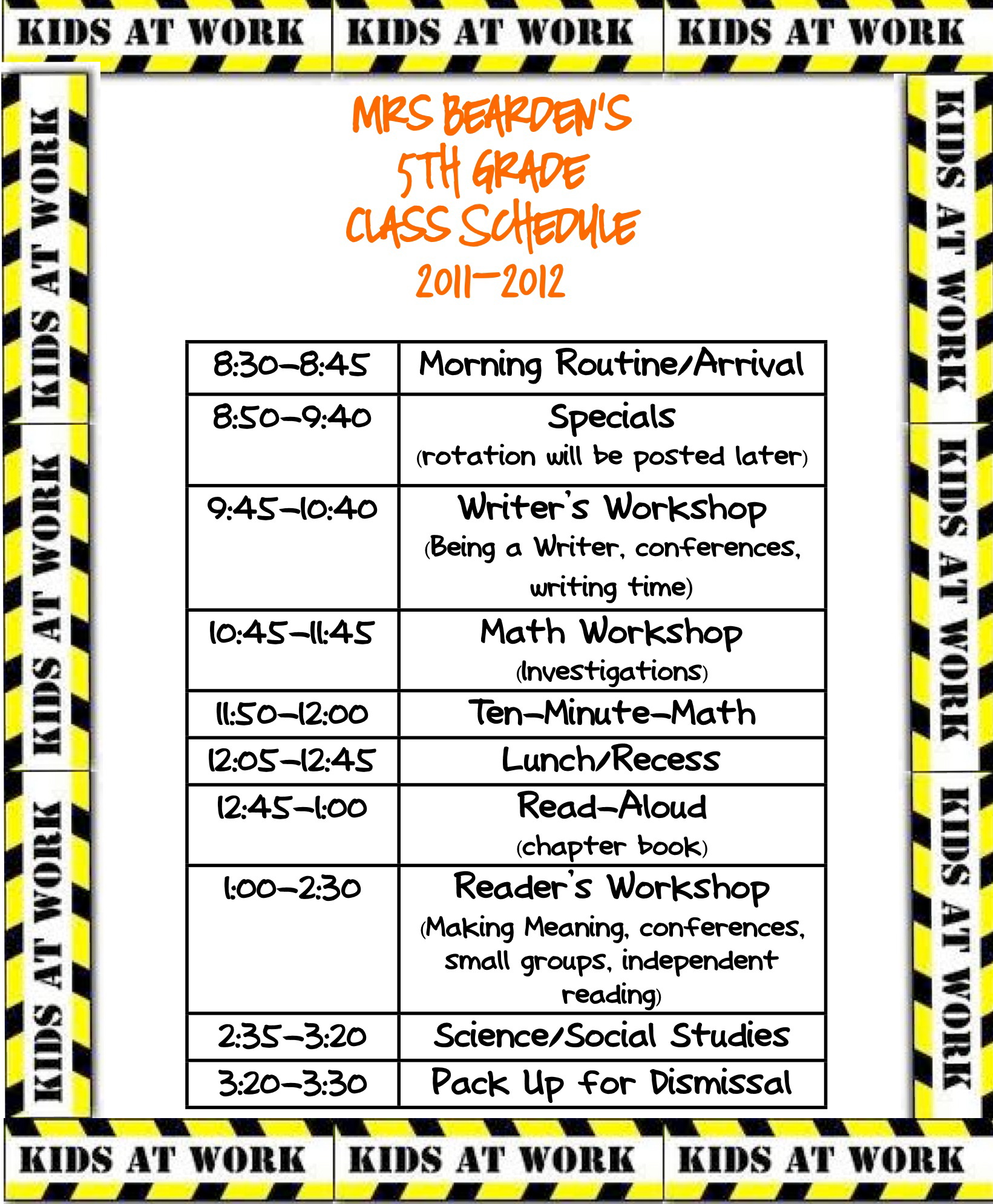
Reading: Reader’s Workshop has officially begun in Rm. 201!  We have made reading posters to share our likes/dislikes as readers, taken a reading survey, read The Lotus Seed, Something to Remember Me By and Everybody Cooks Rice together, had our first check-out from the Robinson library, gone on a scavenger hunt in our classroom library, took our first SRI assessment on the computer, read Hansel and Gretel and discussed how to trail our thinking as we read and then–you guessed it–we read!  I love how excited this class is to dig into books!  Next week we’ll start to focus on strategies that good readers use to make sense of text.

Writing:  We have already begun so much work as 5th grade writers!  From day one, your writer was busy thinking about ideas for stories, putting thoughts on paper.  We have gotten our Writer’s Notebooks, and spent sometime making them our own.  We talked about how our WNBs should be a snapshot of who we are; we should be able to tell whose notebook it is without even checking the name, but just by looking at what’s on the cover.  This week we started Being a Writer, which is the program that will support our writing work this year.  So far we’ve read The True Story of the Three Little Pigs by Jon Scieszka (which we learned is pronounced CHESS-ka), as well as The Frog Prince Continued, then talked about how to retell familiar fairy tales in a new way.   As a community-building activity, we played a game called “2 Truths and a Lie”, then lifted a line from what we had written to expand our thinking.  We will dig in further to the Writing Life next week as we continue our journey as writers together.  I cannot say enough how excited I am about sharing my writing life with your kiddos!  I loved this quote from someone today as I was writing in my own notebook: “Wow.  You have a Writer’s Notebook?  I’ve never seen a teacher write in their  notebook during the school day before.”  I’m hoping that there’s already a connection forming there–we are growing as writers together this year!

Math: The mathematicians in Rm. 201 have already been very busy!  We started the year by playing a few math games (Dice Duel and Contig), as well as learning how to correctly roll dice in 5th grade. (Really.  Ask your kiddo to tell you all about how I hate the sound of dice on the tables! 🙂 )  We took a math survey, and then dug right into our first unit in 5th Grade Investigations: Finding Factors and Prime Numbers.  So far we’ve learned (or reviewed) vocabulary related to multiplication–factor, product, multiple, prime number, square number, composite number, array, dimensions–and started working on finding factors of a variety of numbers.  We worked number puzzles, and started an activity called Quick Images for ten-minute-math.  This subject has soo much to tell–be sure to have a conversation with your kiddo about all that’s been going on.  Feel free to use this to help them get started talking about what’s been going on.

Community:  An crucial part of the beginning of our year is beginning to grow our classroom community.  We do this by working together to create things, learn procedures and routines that will be used in our room and throughout Robinson, and learn more about each other so we can celebrate our differences and build on our similarities.  We’ll continue to revisit this idea all throughout the year, to keep our connections strong.

Read- Aloud: Read aloud (chapter book) is a integral part of our classroom.  While it is fun, it is also an important time when we think and talk about books.  The choices I make for books during Read Aloud are often Mark Twain award nominees, or have topics related to the curriculum in our class.  The first book this year is called The Boys Start the War, and is a big hit already!  Have your reader tell you about how we use the strategy of “say something” to share with our partners, and have them introduce you to BOT graphs.

I am sure that there’s probably something I’ve missed.  I’m amazed at how quickly time flies when we’re so busy and having so much fun!

Stay tuned for more updates on the fun and learning in Rm. 201.  Maybe next time there’ll be pictures. 🙂

What I did on my summer vacation–Part 4: Write

Like I said last time, I am a reader and a writer.

That being said, I spent many hours writing this summer.  I won’t leave a lengthy explanation of it here, because you’ll hear a ton more about it once we get into Writer’s Workshop this year.  But I feel like it is important to mention.  I posted a writing challenge earlier this month, and am excited to hear if you decided to take it. I believe that writing is something that everyone can do, and that you can get really good at if you just put in the work necessary to make that happen.

But what, you might ask, do I write?  You’re not an author, Mrs. Bearden, you’re a teacher.

I write mainly for myself right now.  I love the quote “If I don’t write to empty my mind, I’d go mad.”  So I write about anything.  And everything.  I write about what I’m thinking, what has happened to me, what I want to do, what I have done.  I write about my kids, my family, my friends, my hubby, myself.  I write stories, poems and lists.  I ask questions and try to find answers.  I ask questions that don’t have answers.  Sometimes I write things in my notebook that I know I will come back to later, maybe to work on again and create into a longer piece.  Many times I write things that I know I will never come back to, but that are important at the time.

But the most important thing?  I write.  I love it and I hope that you will see that as we work together this year.  And if you don’t love it like me, I hope that you’ll at least give it a chance.  If you already do, then I hope you’re inspired to continue your writing journey and that you are challenged in a new and refreshing way.

Now it’s your turn: What have you written this summer?  Do you have a Writer’s Notebook already?  Did you write a letter to someone?  Did you make a list of something?  Tell us about your writing from this summer by commenting on this post.  Can’t wait to hear what you’ve been up to!


Writing Challenge

I read lots of other people’s blogs.  Most are either teachers or crafters.  Today I read one that I really loved, and thought I’d share here.  It’s a writing challenge that I’m taking on.  Ok, well really it’s something I already do, but love a challenge, so I’m in.  Read about it here and see if you’re in, too.  BELIEVE ME, we’ll talk alot more about it once we get started with Writer’s Workshop, but I thought I’d give you a chance for a head start.  Don’t know what to write about today?  How about the favorite thing you did this summer, or what you wish you’d done this summer that you didn’t get a chance to do.  The biggest thing is that you write, not what you write about. 🙂