A Little Twist

Remember when I shared my new door idea yesterday?  Well…today my friend and new teammate, Rachael, suggested something that would put a little twist on the whole thing: put in on the INSIDE of the door instead of the outside.

Ok, I know at first mention it doesn’t sound like that big of a deal.  Not really that different from what I did originally.  But really for me it was a huge thing–turned my whole thinking on end, mainly because I had thought long and hard about why I wanted it to go outside: my goal was that I wanted every kiddo (or anyone really) who came into my room to be reminded about who they are, what they are capable of and how much I want them to succeed, every time they came into the room.

But then Rachael pointed out that if my door is open (like it usually is), then all of that will be on the BACK–hidden from view.  And then she reminded me that when we all come into the room (from specials, lunch, etc.) the only way they would be able to see it is if they each came in individually–again, the door would be open and the words would be on the BACK of the door.

Ha!  SO simple, but so obviously not how I was thinking about it.  Don’t you love it when other people get their eyes on things and give you a completely new way of seeing them?  Brilliant idea, Rachael!  And yes, I think I will be moving it tomorrow! (Lucky for me that I didn’t finish attaching it all permanently yesterday! 🙂 )

When did someone help you see something a completely different way?  What did you do in response?

My Brain Hurts!

Today was one of those days that made my brain hurt.  Don’t worry, though, it was that good kind of hurt.  The kind of hurt that comes from chewing on really big topics with really smart people as you try to solve really meaty problems.  But it’s on days like these that I am reminded that I am a ssssllllooowww processor, that I need time to continue to chew and contemplate before I can give you my full opinion or take on the issue, before I can commit to what my part will be in addressing the issue.  And when you’re in a room full of quick-thinking, fast-moving people, that can make you feel like you’re being left WAY behind!  Oh well, somehow I feel better since I know this about myself, and I am also glad to know that that kind of thinking is valued by the group of people I was working with, too.  So now is when I can sit down to think.  To make plans.  To decide on what I’m willing to commit to for this upcoming year.  To figure out how I can be a contributing member of the AMAZING community of learners that I teach with.  Wish me luck, friends! I’ll get there eventually! 🙂

What’s All This “Box Factory” Business?–Part 1

You may have heard me or my students mention the Box Factory lately, and wondered what in the world we were talking about.  Let me tell you about this fabulous math work we’ve been doing lately.
In 5th grade, we have a unit on 3D geometry, focused around finding volume of different kinds of rectangular prisms and figuring out a formula for how to do this (l x w x h or b x h).  This year we incorporated a unit by Cathy Fosnot, which created a context for this learning.  Enter the “Box Factory.”

The basic premise of the investigation is that kids work in a box factory and have to figure out certain things related to volume and surface area (although these things are not specifically named until later in the unit).  There were three parts, and kids worked small groups to investigate the answers to these questions:
1.  If the box factory wanted to create boxes that held 24 items, how many different boxes could they create?  What would the dimensions be of those boxes? Which box would be the cheapest one to produce? There were 16 possible answers to this question, and the students used cubes, graph paper, equations, drawings, or whatever necessary to figure it out.  They had to then create a poster to show their strategies and explain their thinking to show to the other groups.

2. How much cardboard would you need to cover each of these boxes? This one extended the conversation into surface area, and invited students to now look at the outside of the box, instead of just the inside.  Most groups figured out that if they used the formula (2 x L) + (2 x W) + (2 x H) to determine how much cardboard they’d need.  The cheapest boxes to make would be ones that are closest to the shape of a cube, as opposed to a long, skinny box.

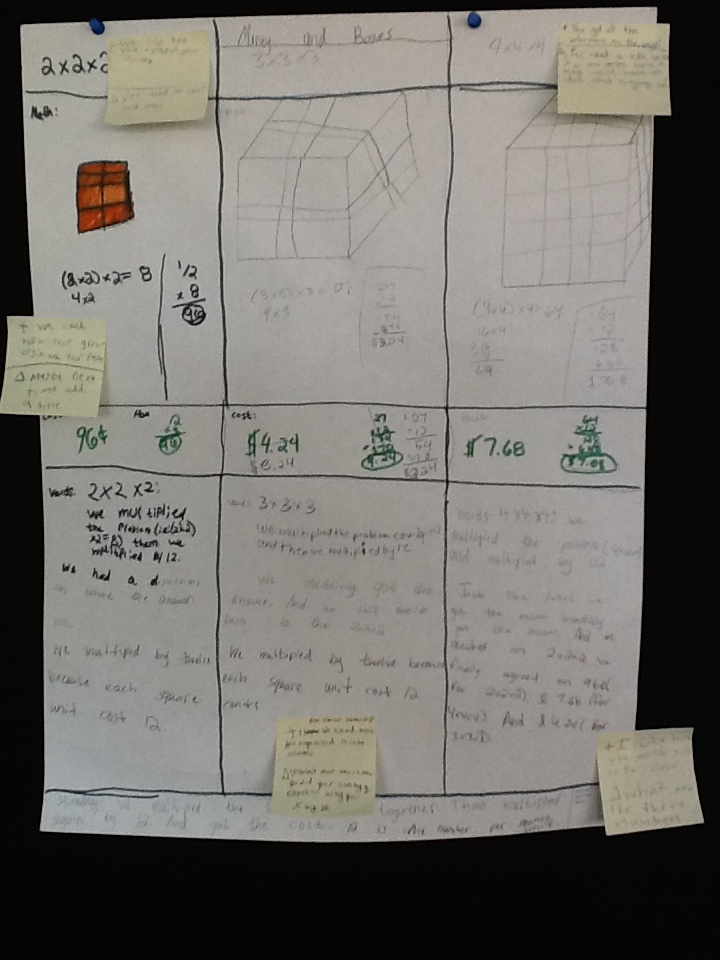
3.  If the factory created three sizes of cube-shaped boxes–2 x 2 x 2, 3 x 3 x 3, and 4 x 4 x4, how many units could each hold?  If it costs 12 cents per unit, how much would each box cost?  This one looked at the inside again, and added another layer of multiplication (with money) to figure out the final answers.


All throughout this investigation (which goes for about 10 days), the focus is on kids discovering strategies for volume, rather than just giving it to them.  Through the posters they create and the Math Congress conversations we share, they are also working on sharing and representing their thinking.  They are learning how to make their representations clear and concise so that other people can understand exactly what they did.

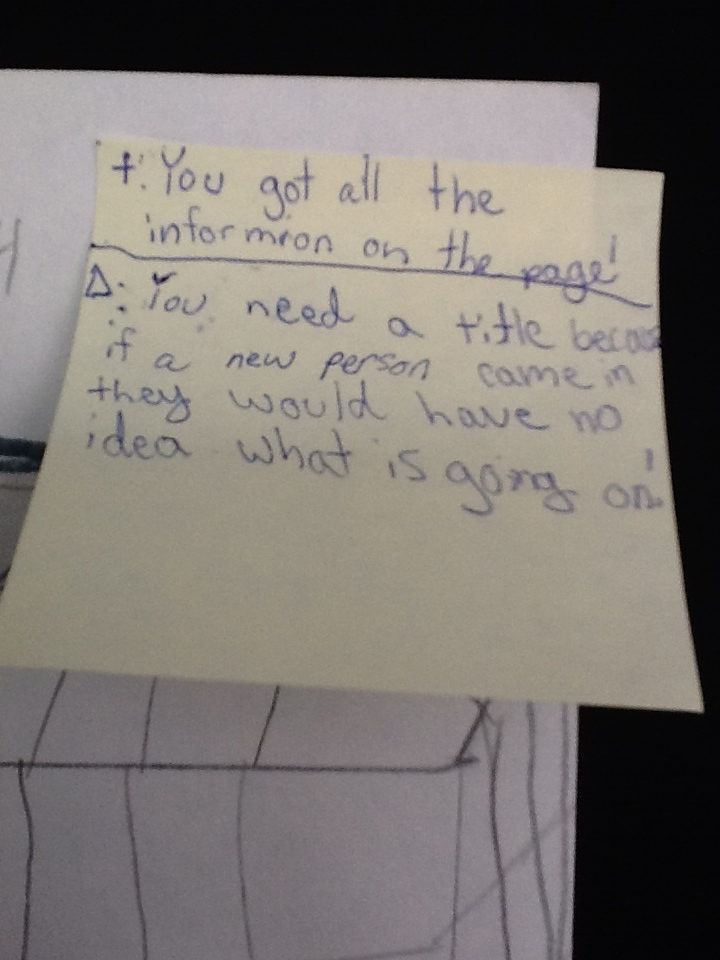
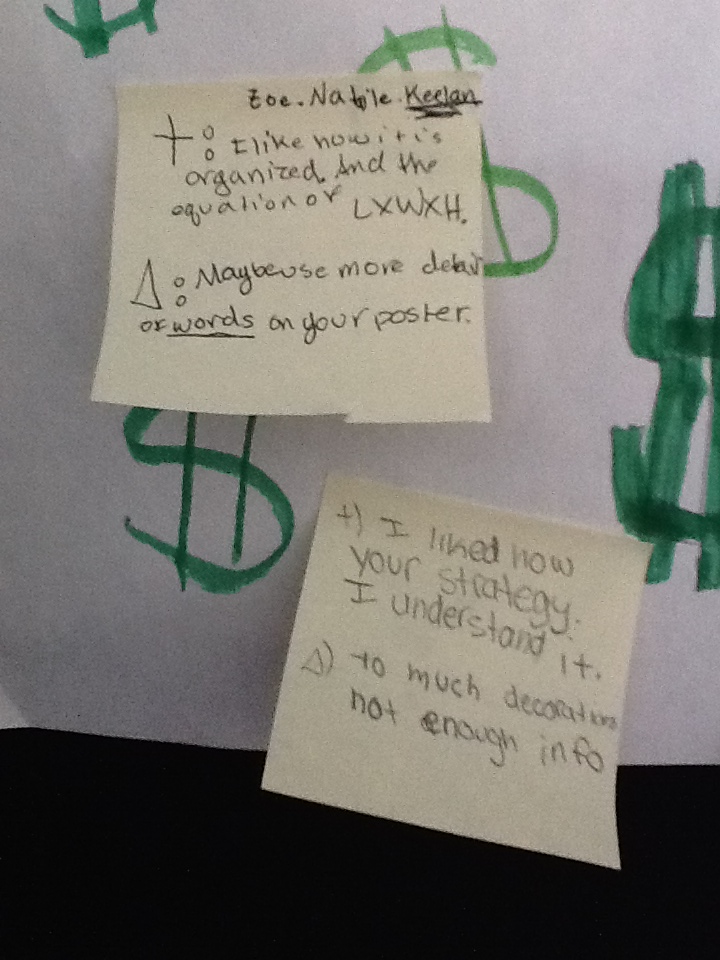
This poster-sharing part is not new to me in Math Workshop.  But Fosnot’s unit added a layer I’ve never thought of before in math–revision.  Much like when mathematicians publish proofs (and like we’d just spent time on in Writer’s Workshop!), students were able to get feedback from others on what worked, what was confusing, what they should add or take away.  They they had the opportunity to revise and edit their posters before they shared.  With each new poster they created, they added new ways of showing their thinking clearly.   They did this by discussing with their group, and then leaving suggestions on post-its.  We used the “Plus-delta” model to share something we liked and something we’d change:


So by the third time around, we were pretty great at showing thinking on our posters.  Even though you didn’t see all the steps, you can still appreciate the clarity and organization of these:


Have you ever done a Cathy Fosnot unit before?  How have you used revision and feedback in math to clarify thinking? What strategies do you use for teaching volume? We’d love to hear about it!

Mental Models and The Mississipians at Cahokia

Our first Social Studies unit of the year (well, the first “official” one after we set up our classroom community) was a doozey (is that how you spell that??).  Let me back up.  The theme for 5th grade SS is Three Worlds Meet, and so we study the Native Americans, Ancient West Africa and Medieval Europe, then look at how all of those cultures merged and became the Colonies.  The first unit, while being about Native Americans–specifically the Mississippians at Cahokia and the Iroquois–was also about bigger things related to mental models.

What are mental models, you ask?  Check out this example that we use to help explain them to kiddos (taken from the text we use during this unit):
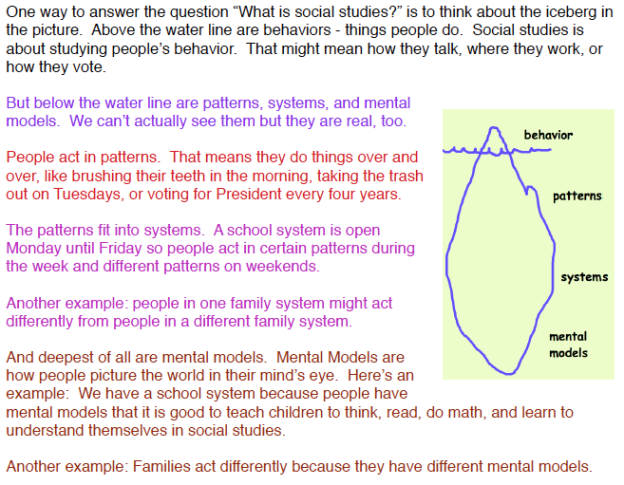
We begin by looking at the mental models that many kids have about Native Americans.  Many of these are things like that they live in tepees, they wear buffalo skin or feather headdresses, they are savage hunters and that they danced and chanted.  None of these mental models are wrong, so to speak, but as we go through the unit, we hope that by learning new things about specific groups of Native Americans, their mental models will be challenged.  And maybe changed because of their new knowledge.

We specifically study the Mississippians at Cahokia, or just Cahokians, because they are from an area very close to where we live in Missouri.  Cahokia, Illinois is just a hop, skip and a jump across the Mississippi River from the area that these kiddos know so well. For that reason, they are more easily able to make connections and inferences about how the Cahokians may have lived–and they realize that in many ways these people are more similar to them than they are different.

I mentioned before that there is a text we use, which is broken down into the five disciplines of Social Studies (history, economics, geography, culture and civics) and these disciplines provide the framework for all of the conversations and activities that we do during this unit.  First we learn what each of those are generally, then are able to zoom in on them more specifically to Cahokia (and later to the Iroquois, but I’ll tell about that in a later post).

Before we jump into our text, however, we have a lesson about figuring out the difference between important and interesting when you’re reading, so you know which parts to pay most attention to as a reader and learner.  We discovered that it all looks important, until we look more closely at the purpose of why we’re reading.  For example, if we are reading to find the answer to a certain question, then the only important things are the ones related to answering that question–all the rest is just interesting for now.  If we are reading just to find out about economics, then only the ideas related to economics (not history, culture or any of the other groups) are important for now.  As we also discovered, what’s important changes based on your goal.

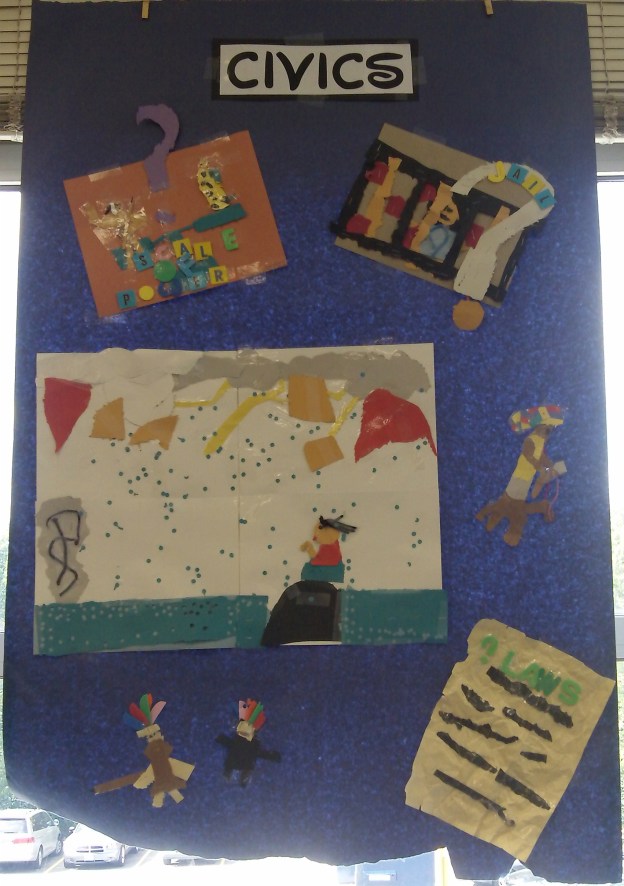
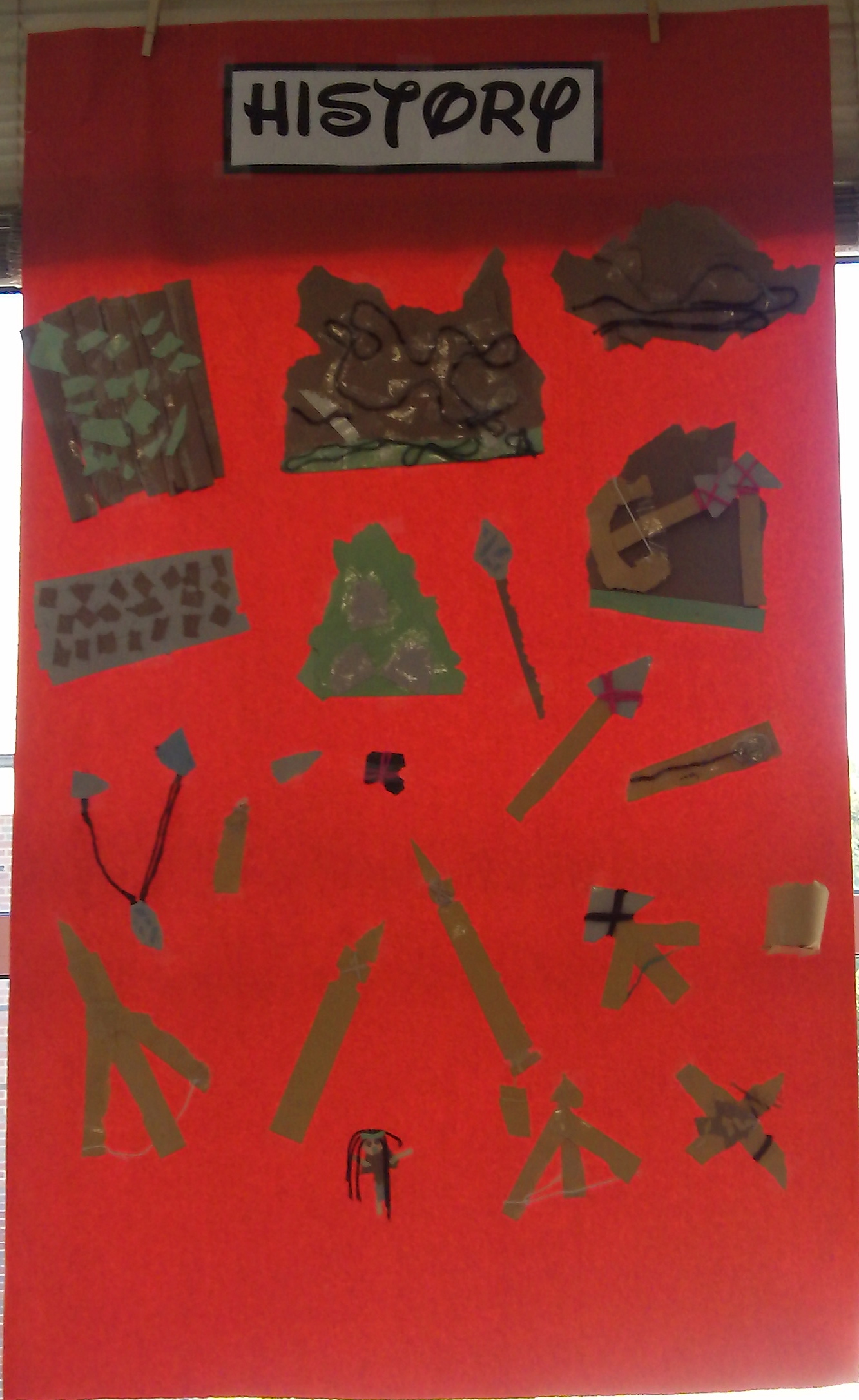
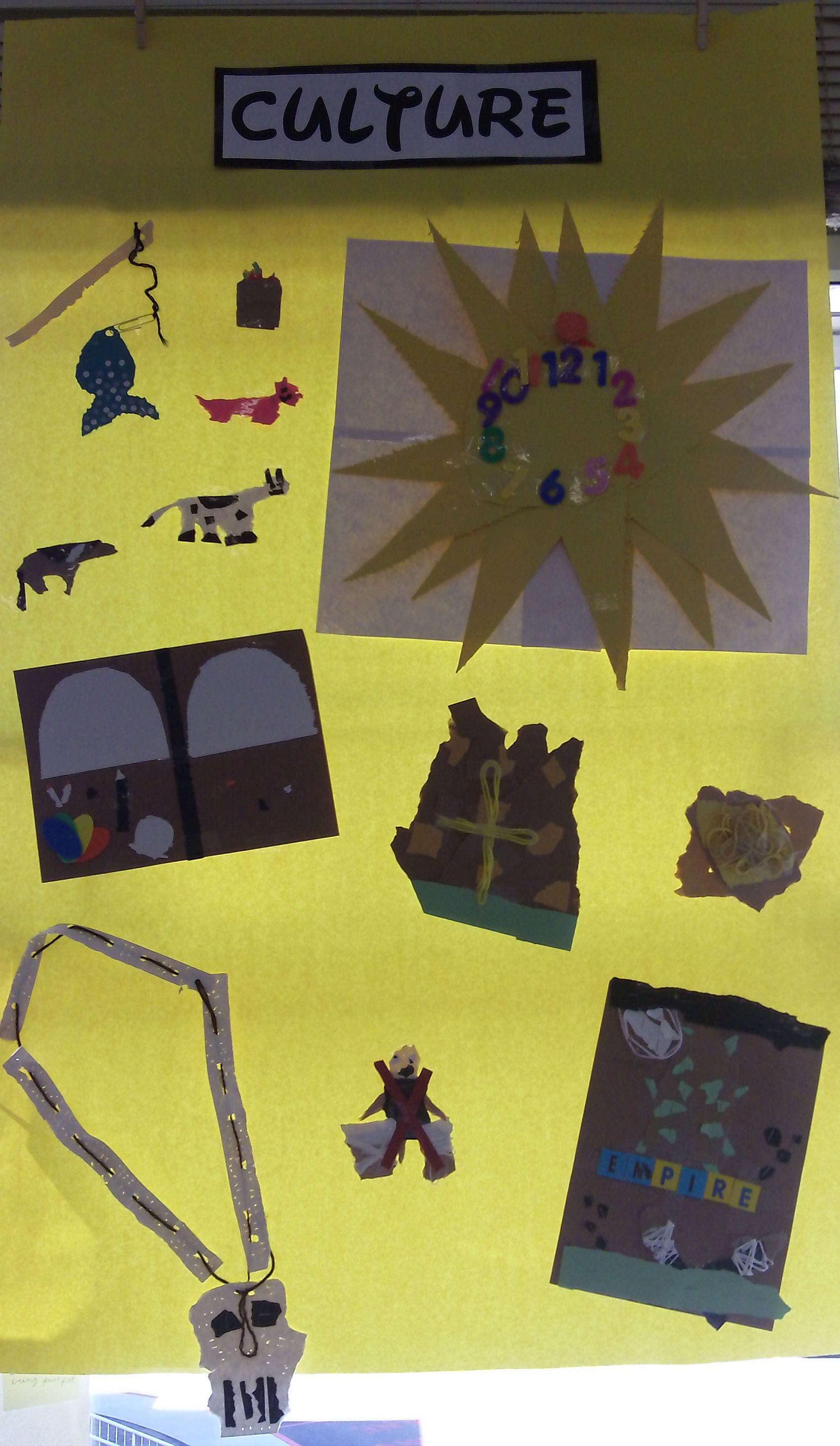
Ok, now that we know how to pick out the parts we need to remember, we got busy into the real work of this unit.  In short, for every discipline, we read a section of the text and underlined what was important, then made a class list of those key ideas.  After that, we created big window-sized posters with representations we made to show each of the big ideas.

Nice, right?  An art project to help us remember what we read about.  Fun, too.  Yes, but it’s not that simple.  There are very specific rules about how you are to go about creating your representation:

1. You may use paper and anything that holds paper together (i.e. paper clips, tape, glue, glue sticks, etc.).

2. You may not use scissors.

3. You may not use any writing utensils.

What was once just a simple show-me-what-you-remember-from-what-you-just-read type activity is now a challenge to think outside the box, to be creative, to solve problems.  So I was all the more impressed with what they came up with, the quality of their images, and the creative ways that they figured out to get their job done–like using the edge of a ruler or a paper clip to score paper so you can tear it neatly in the shape you want it, rather than cutting.  Or using the punched-out pieces from a hole punch together to create a picture.  Amazing, really.

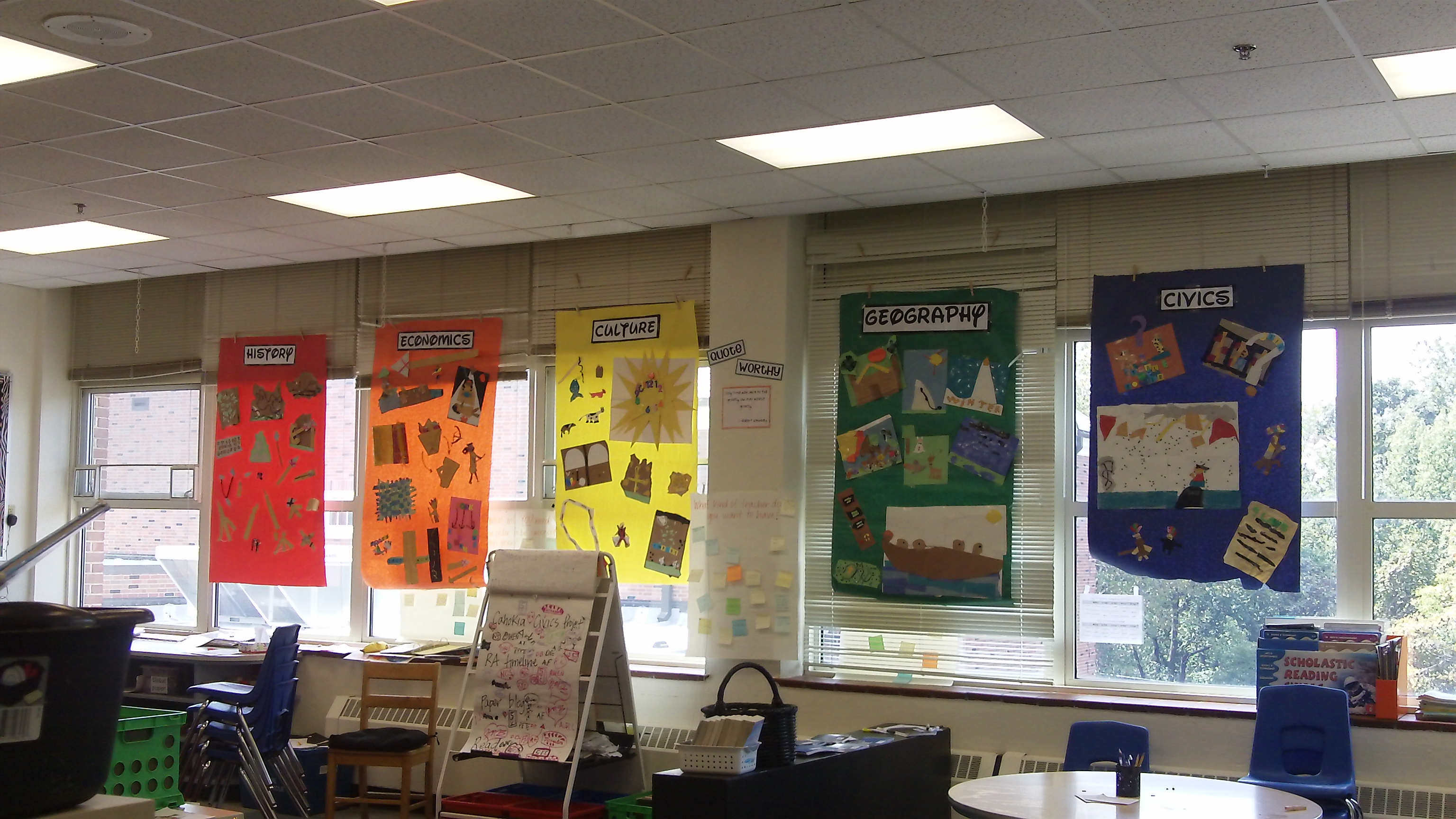
Here’s what our posters look like once we were finished–which really took us about 6-7 school days to accomplish:
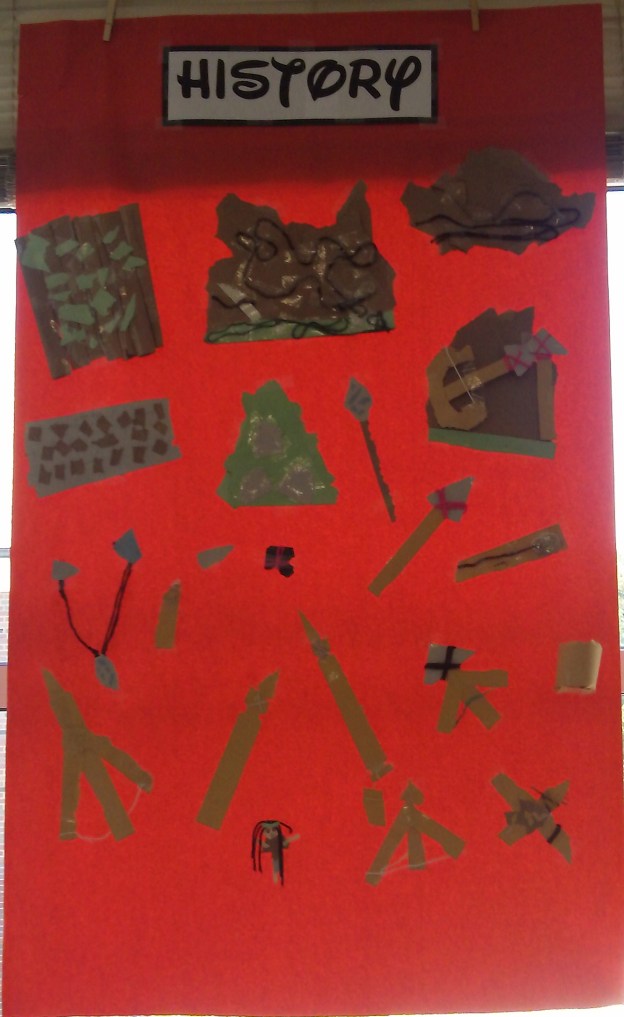


Besides the fact that these hold a lot of information and show what we’ve learned about what’s important about the Cahokians, I love how they look hanging on the windows:

As we were working on these projects, it was so great to see the group/partner work that was taking place, the problems that were being solved as they created their pieces, and the smiles on their faces as they worked.  I was so glad at how many kiddos voiced to me how much they loved doing this because it was “so different from anything I’ve ever done before.”  They told me how the rule of not using scissors and pencils “made their brains think in a new way and challenged me in a new way.”  Gotta love it when kiddos say those things out loud!  It’s exactly what I had hoped was happening.

On a side note, these posters hung in our room throughout the whole Cahokia unit, and we came back to them time after time, as we made connections between different aspects of Cahokia, our own lives, and then as we moved into learning about the Iroquois.  I’m actually going to be sad later this week when they have to come down to make room for other things. 😦

 

Welcome to Rm. 202!

Welcome to Rm. 202!

I am so excited you’re here!

Please proceed with caution, and read carefully….

The following letter contains 2049 words that will begin to shape your fifth grade year. Be sure you have time to read them all carefully. You may like to have your parents sit and read with you so you can all be excited about fifth grade together.You should also have dancing shoes on (true story) and a video camera handy (extra credit).

Ready? Of course you are! Because you are about to become…

Fifth Grade and Fearless!

I am excited for the year ahead – but first, I need your help in knowing what next year is going to look like.


Yes, your help!

What next year holds, is, in large part up to you. I have my plans, my ideas, my goals….what about you?

I know some of you may have sneaked a peek at the letter I sent your parents, or may already know me, so this next part may be a bit of a review.  Too bad.  Keep reading anyway. 🙂  I have been teaching for 12 years and every one of them has been at Robinson!  I even did my student-teaching there long ago, so Robinson is definitely my home-away-from-home.  In my real home–which is in St. Peters–I have a fabulous family that I love dearly.  My husband, Grant, is a teacher, too, in Wentzville.  He is starting in 3rd grade this year, but has taught 4th and 5th grade like me, too.  Fun, right?  We have a 5YO, Riley, who will be at Robinson, too.  I am sure you’ll get to know him really well as we got through the year together.  We also have a little girl named Allison–we call her Allie–who is 19-mo-old.  We LOVE (yep, love) Disney World, and travel there often.  We also just like to hang out together at home (or anywhere, really) and spend time with each other.  So that’s me.  What about you? Can’t wait to learn more about YOUR family!

Like I said, I have been teaching for 12 years, and every year, I begin the school year as a different person. I decide on that first day and then every day thereafter, who I am as a teacher. What is important to me. What I want to accomplish. What I want my students to see when they come to school. I choose that. I don’t let other people tell me who I will be and I don’t just be who I think other people want me to be. I read, I think, I write and then I decide.

Who Will You Be? (This is a big question – take your time to think about this!) Will you be the kid who has brilliant ideas? The kid who loves math? The kid who looks to help other people? The kid who……? Fresh start. Clean slate. We all get one (that includes you!) and we all get to begin fifth grade as the person we want to be.

What is important to you? (This is another big question and one I am really curious about so I will ask it twice.) What is important to you?

There are lots of things that are important to me: my husband and my kids, sharing ideas, reading, writing, being able to have a conversation, making things, discovering things, sharing what I know, sleeping in, staying up late and knowing when to say sorry.

As a teacher, there are a few more things that are important to me:

* YOU!:   You’re the reason I’m there, after all right?  It is important for me to get to know you, and know you well.  Not just as a learner, but as a kid, too.  I want to know what you like, what you don’t like, what makes you tick.  Who you are.  That’s ok, right? 🙂

* Respect: If you’ve been around Robinson for longer than 5 minutes you know that respect is a HUGE part of our culture.  It’s pretty much what we’re all about.  I expect respect to be a huge thing in our classroom.  I will respect you, and I expect you to respect me, as well as everyone else in our community.  This counts when we agree and even when we don’t.  I have a saying that I learned from my good friend Mrs. Ford years ago, that is really important with this whole respect thing.  It’s this: You are not the sun.  In other words, the world does not revolve around you, and there are lots of other people in our classroom that have needs, wants, likes, dislikes, etc., that we need to take into account.  I love you, but I love everyone else, too!

* Mistakes:  I expect you to make them.  Yep, I said it.  I want things to be hard for you.  I want you to struggle.  If you need more than one try or lots more practice with a concept, you’ll get it.  If you need to show me what you know in a different way, then we’ll figure it out.  If  you need me to repeat something or explain it for you in another way, I’ll do.  If you need a big, fat challenge–watch out, you’ll get one! No, I’m not crazy, I just want you to try things that may be tricky at first.  I want you to learn to work through it when it’s hard and figure out what to do.   I want you to feel the joy and success when you learn something new and it’s because you persevered!  Not everything will be easy here. And that’s ok. We’re in it together and I’ll help you all along the way. 🙂

* Collaboration: I love to share ideas and get ideas and try new things and even when those things fail, I know I am just one step closer to finding what does work. I love to work with other teachers to figure things out and find new solutions to old problems.  But just as much as working with adults, I love to collaborate with students.  I love to hear what you’re thinking, how you’re feeling about things, what you think would be the best way to learn something.  Even when you don’t agree with me, or have a plan that is completely different than mine, I want you to share it!  It’s our classroom, and often your ideas are WAY better than mine.  I know I’ll share lots of examples with you about how that’s happened to me over the years.

Aside from collaborating with me, though, you’ll be collaborating with each other!  You will have lots of opportunities to share with your classmates, to give your ideas, ask questions, prove your reasoning and challenge each other.  I expect that we will work together to help EVERYONE in our class be the best they can be.  Together we’ll achieve much more than we would if we tried to do it on our own. 🙂

* Questions: I found a quote I love by a guy named Tony who loves learning. “No one cares what you know. What the world cares about is what you do with what you know.” Think about that. Chew it over. We can all google and find stuff out – but then what? After we know stuff, what we do with it = inquiry. And that is what the world cares about. Me too. You?

* Time is precious: So are you. I don’t like wasting time and I especially don’t like wasting your time. That means I try to come to school ready, fired up, and prepared to make a ruckus (I like to think that a ‘ruckus’ is the sound your brain makes when it is challenged to be creative, thoughtful, inquisitive and world-changing – it is a beautiful sound).  I hope–and expect–that you will come into our classroom every morning ready to learn, ready to work hard, ready to put your very best foot forward.  We only have so many days together, and we need to make the most of every single one of them.  We’ve got so much to do! 🙂

* Technology : I  love technology because it allows me to connect to new ideas. I like to think about what I want to do and look for tools to help me do it. I want to hear your ideas on technology and what works for you. We will be using technology in many new and exciting ways this year, so get ready!  You’ll be blogging, using iPads and laptops, working on the ActivBoard, making videos of your learning and trying out many new things that we may not even know about yet.  Whatever we do, though, the goal is always learning.  We will use technology in meaningful ways to better create new knowledge.  Excited?  I know I am!

* Community: our class, our families, our school, our neighborhood, our city, our state, our country, our world. There are so many amazing people doing amazing things. I bet you can think of ten amazing people who do amazing things right now. We need to hear those people’s stories. Your mom and dad should be on that list. They are awesome. (Assignment one; email me List of Awesomeness about people in your family* -*family = people you love and are connected to even if they don’t happen to live in your house or share your last name).

* Taking risks: I like to take risks.   I hope you do too. It is scary sometimes and it fails sometimes but sometimes, more often, it is just A-MAZ-ING! Usually when you do something scary you do things you never thought you could.  You surprise yourself.  And then you want to do more! Someone smart once said “Fear and Excitement are shades of the same color”. Cool, huh?

HANG IN THERE….THE END IS NEAR!

OK…if you made it this far and are still with me, congratulations, you are a rockstar. Stop reading right now and do some kind of victory dance.  No really, go ahead.  Dance.  I’ll wait.  Better yet, have someone video tape your dance and send it to me!  I’ll even post it on our blog!

So….what now? How can you best prepare for the extreme awesomeness of fifth grade?

  1. Have a great summer! Be extraordinary.
  2. Read something.  Write something.  Wonder something.  This’ll get your learning muscles warmed up. 🙂
  3. If you have any questions you can always email me. Anytime. No question to big or too small.
  4. Think about what I said about being who you want to be. Most importantly, remember that everyone else in our class is thinking about that too. Be gracious to those who are brave enough to set lofty goals and make the effort to become an even better version of themselves.
  5. Look around your house (or your computer, maybe) for a picture of your family.  I’d love to be able to decorate our room with us–pictures of all the people who help make us who we are and who encourage us to do our best.  If you want to email it to me, that’s great (I’ll add my contact info to the end of this post), or you can print it and bring it to school on the first day.  And if you don’t have one, don’t worry!  We’ll take your picture!

Despite having now used about two thousand words, there are no words to describe how excited I am about working with you next year!

Here’s To Being Fifth Grade and Fearless!

♥ Mrs. Bearden

PS. If you didn’t get up and dance before and are now wishing you did, there is still time to do it. Anytime. Send me that video with your best moves (extra credit).

When you have had a chance to relax, digest this letter (maybe talk about it with your family or friends) and get your fifth grade brain tuned up, I would love for you to write to me to introduce yourself, ask questions, maybe respond to something you read in this letter that made you think.

I look forward to hearing from you before the end of the summer!

Mrs. Bearden: Email–jennifer.bearden@kirkwoodschools.org; Phone–314-213-6100 x4214 (after August 15); Twitter: @jbeardensclass

**Thanks to @terSonya and Mrs. Hong for help with writing this post! Like I said, I love to share ideas!**

Love This Quote

I just had this quote on the side of my WordPress screen and thought it was great:

Writing, to me, is simply thinking through my fingers. — Isaac Asimov

Love what it means about how writing is not just mechanics and conventions.  Yes, those things are important, but more importantly it is thinking.  It is figuring out what you want to say and how you want to say it.  It’s deciding on who your audience is and how to best get your message out to them so that they “get it.”  The mechanics and conventions are then the part you fix, as a courtesy to your reader, so that they can clearly understand what you’re saying.

What do you think?

Are You Hungry?

If you’re anything like me, then you love to eat.  And you really like to eat out.  My family loves to find new restaurants around town and try them out; “chain” restaurant is kind of a bad word in my house.  So, if you’ve ever eaten out, then you know the idea behind a menu–you are offered a variety of choices of yummy things to eat.  Most times you will choose a main course, side dishes and dessert.  Maybe if you’re really hungry, or if something looks really interesting, you might add an appetizer to your meal.

Ok, so what?  This is a blog about school, about education.  Why all the restaurant talk?  Well, if you’ve spent any time in our classroom lately, or if you’ve seen a 5th grade homework sheet this year at school, then you’re familiar with the idea of a menu.  But why, you ask, would you use a menu in school?

Let me tell you. 🙂

The big idea that makes a restaurant menu work, that makes it desirable, is the idea of choice.  When you sit down to eat, no one tells you “Eat this.  Chew it 25 times.  Swallow it.”  You’re not forced to eat things you don’t want to (well, unless maybe you’re a kid!), and there are many ways to achieve your goal of filling your empty stomach.

That’s what we’re trying to do with menus in school.  We have a goal–based on subject and unit–and then students are given a choice of ways to show their knowledge and learning related to that subject.  The idea is not new, really; I’ve been doing a variation of it for years.  Long ago we called them “invitations” or had a list of “must-dos and can-dos”, but the idea behind it is the same: children are going to have more ownership over their work and probably ‘dig in’ and little deeper when they have choice in what they do and what the final product looks like.

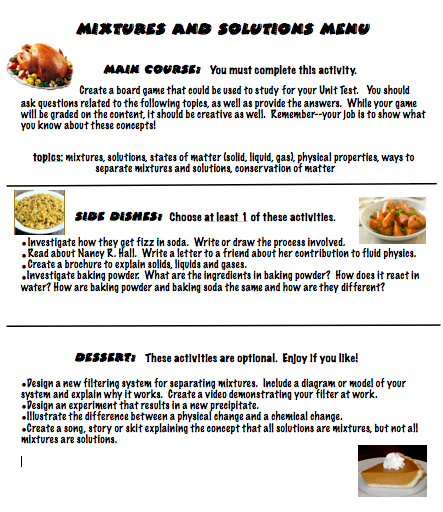
Here are some examples of menus we’ve used this year so far:


I must add, though, that besides giving students a say in what their work looks like, menus are an important tool in differentiation.  The categories are tiered, so that every learner can be engaged wherever they are in their understanding of the concept; the main course is something that everyone can do (still at their own level with their own creativity), side dishes are a little deeper, and then desserts are activities and projects that allow and enable students to stretch themselves and think in a deeper way.  Everyone in my classroom has their needs met regardless of what they are, and everyone has activities that are appropriate for them.

So, are you hungry for learning? Menus are for you. 🙂


Learning Is Messy


Today was our last day of school before Thanksgiving break.  And so traditionally, that means that we do things that are a little bit nontraditional in our schedule.  For math, that meant that I put the kiddos to work.

Here’s what I mean…

For many years, my husband and I have taught together.  Well not really together, like in the same school or anything, but we’ve always taught the same grade or the one just behind.  So since that’s the case, we’ve been known to do some of the same things in our classrooms.  One such thing is the Thanksgiving Dinner project in math that comes during these last two days of school.

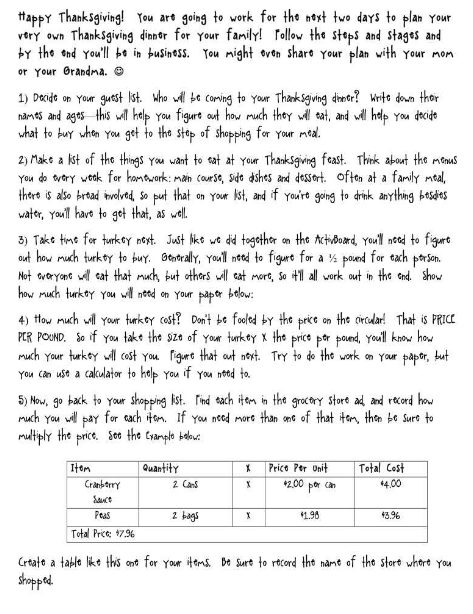
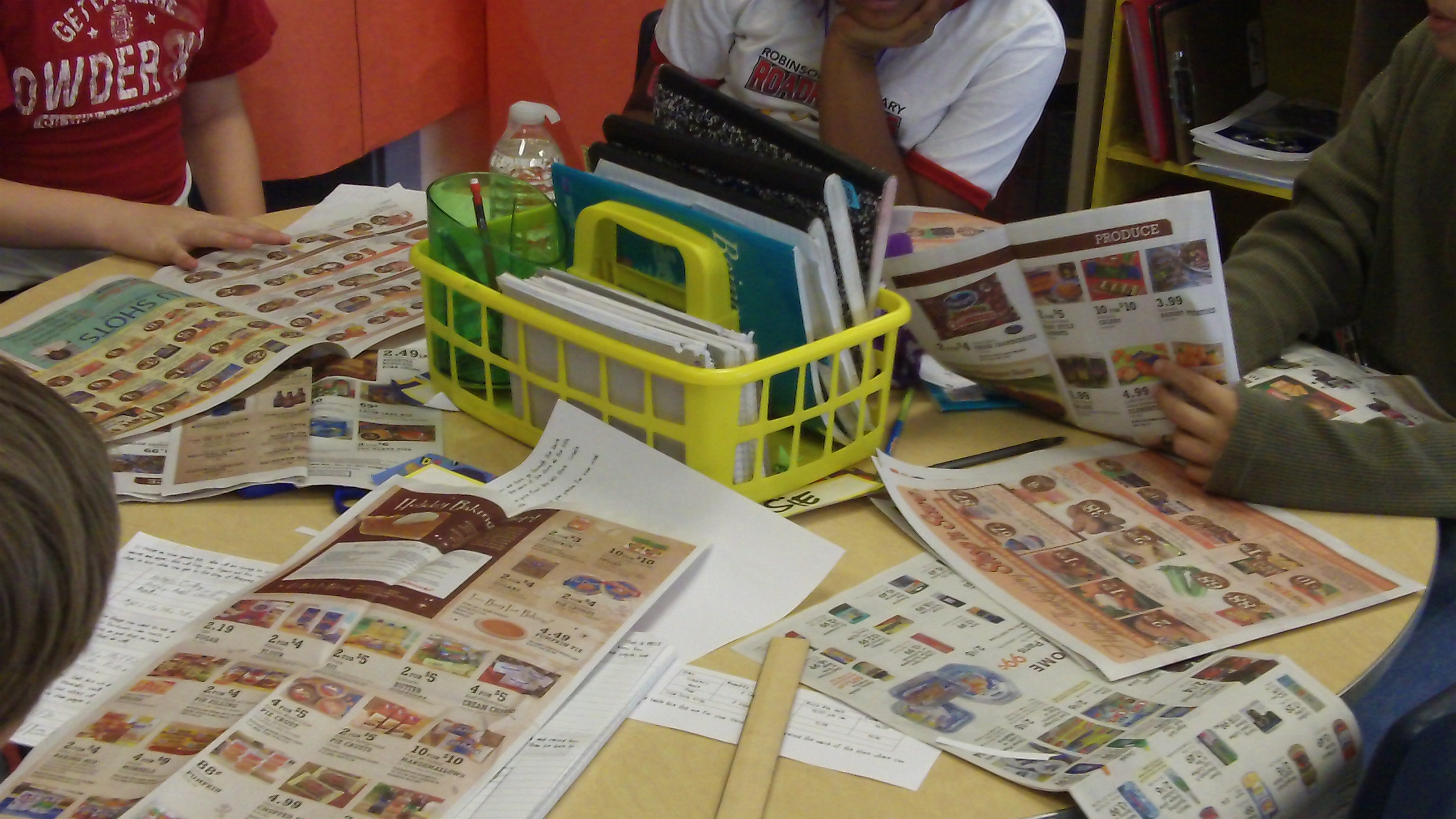
The idea is pretty simple–plan and shop for the Thanksgiving meal for your family.  The directions for my class this year looked like this:

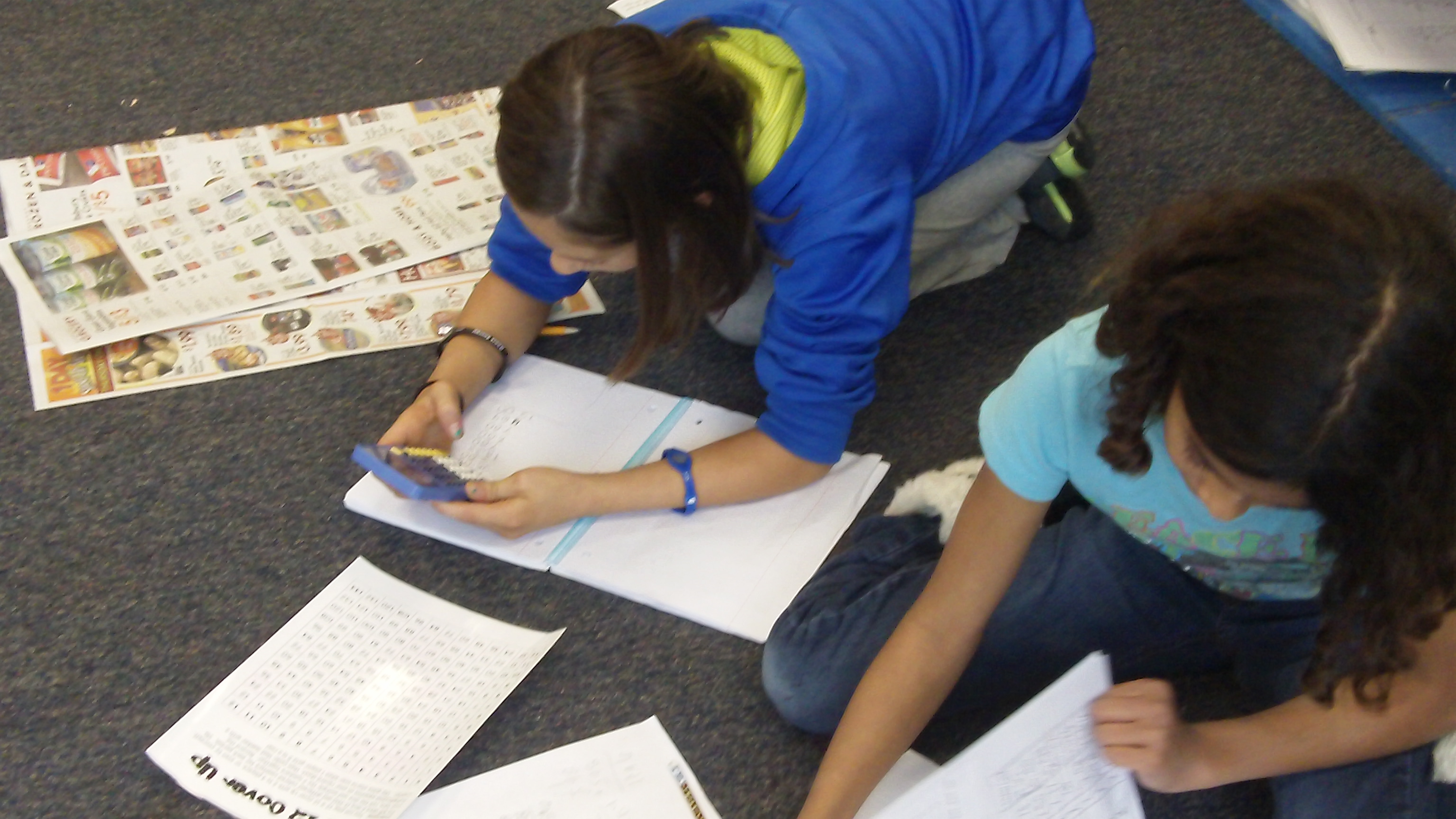
What’s cool is what happens after you give all the directions and answer all the questions and set them all loose to figure it out for themselves.  Check it out.  Like I said, learning can get a little messy.  But it’s a really good kind of messy. 🙂

Z was so focused on his meal, searching diligently through each circular to find just the right foods!


Love how my friend M is so into the paper in this one!  Can you see her behind there?


The other cool thing, besides a messy classroom and lots of kids saying things like “this is really fun!” or my friend D asking me to copy his plan so he could share it with his mom (love that!), was the togetherness that this project brought as they worked with each other.  Truly a family feel in Rm. 201 today!


Happy Thanksgiving, friends!


1/8 is 12 1/2%

At our school we use Investigations for math.  One thing I love about the program is that it usually digs into the why of each math concept instead of just the how.   It encourages students to create their own strategies for solving problems, emphasizing that there is not just one way to come to a solution. In the case of our fraction/decimal unit that we’re in now, we are doing more than just learning the rote definition of a fraction and coloring in fractional parts of pictures or just adding or subtracting them using the method I directly taught them–like I know I did in 5th grade.  Instead, we are investigating and creating and figuring out and–most importantly in my opinion–using what we already know to discover something we don’t.

Here’s an example of what I’m talking about:

We are at the beginning of a unit called What’s the Portion?, which includes experiences with fractions, decimals and percents. Yesterday and Thursday we were working on figuring out the percent that is equivalent to a fraction.  We started by making drawings on a 10X10 grid (which helped us “see” what was going on) since we know that percent means “out of a 100.”

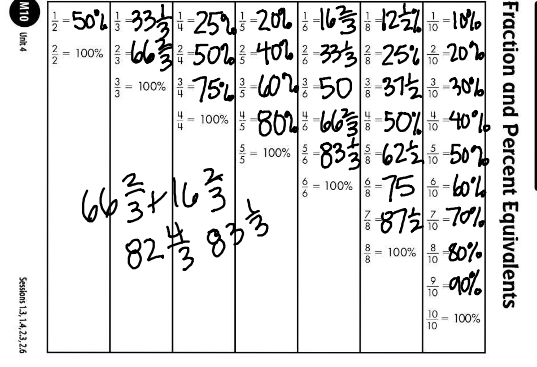
We used this visual, and what we knew about fractions and percents already to figure out that 1/8 is equivalent to 12 1/2%, because 1/4 is 25% and an eighth is half of a fourth. Our music teacher, Mrs. Kesler, will be tickled to know that I even had one kiddo make the connection between this and what he knows about music notes to help him figure it out.

So after the initial idea of fraction and percent equivalents was presented, they were to dig in a little deeper.  I gave them a chart to fill in, that had lots of other fractions to work with.  I told them to fill in all that they could with the directions to NOT do thirds and sixths, that we’d do them the next day.  But what they did instead, was make it their goal TO DO the thirds and sixths.  In this case I didn’t really care that they did the opposite of what I said, because it meant that they were going to try something that might be a challenge, might stretch them a little, might give them questions to ask when we worked on it together.

And for the most part, they all totally rocked it.  They made it look really easy.  Like they’d been figuring out fraction and percent equivalents for years. (Ok, 5th grade readers—which character from one of our favorite read-alouds did that sound like?  Comment on this post with your answer if you know!!)

Here’s what our chart looked like when we were done:

The thing that I think is really remarkable about the thinking behind this is that they are already getting comfortable with going back and forth between fractions and percentages, and can tell you how that relates to a group of things, like how getting 10 out of 20 of your spelling words right is 50% or that 3/4 of a class of 24 is 18.  There is understanding being created that goes far beyond just memorizing definitions.  I like that.  And they like it, too.