Our First Class Meeting!

If you don’t know about how we do Class Meetings around here, be sure to check out the previous posts Lessons in Democracy and Class Pet Petitions for a little background first….go ahead.  I’ll wait for you. 🙂

We had our first real class meeting this past Friday and it went really well!  I say “real” because the week before (our first Friday) I walked them through the process of 5th grade class meetings, to either remind or inform them of how we’d be doing them this year.

Here’s our chart after dots were added: Screen Shot 2013-09-03 at 7.28.13 PM
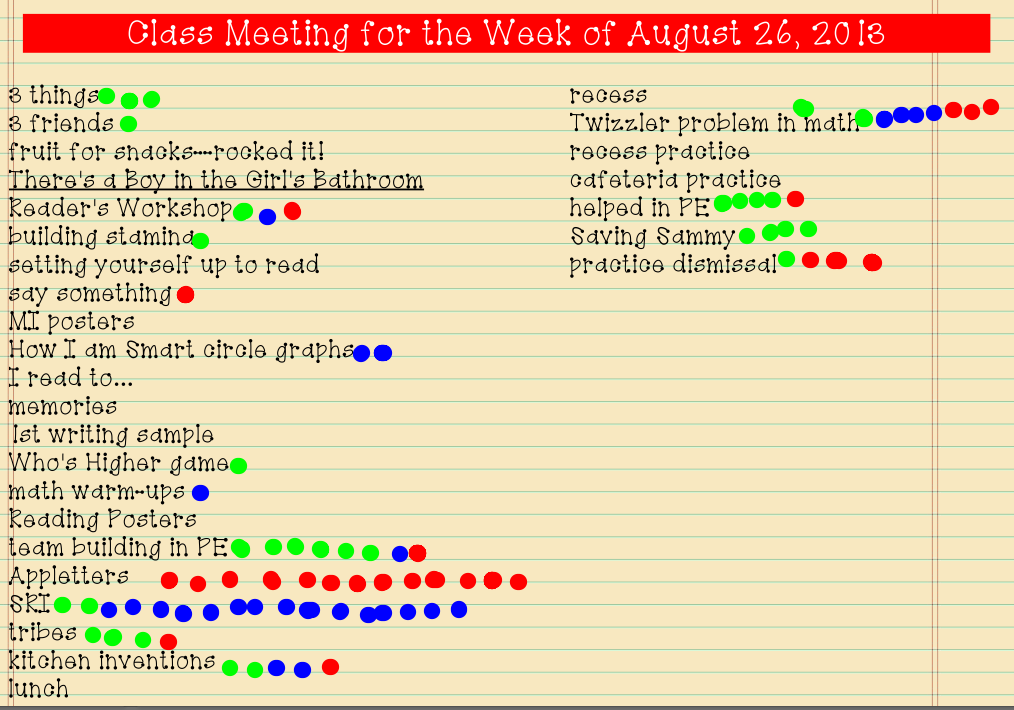
We had a busy week, huh?  The lists at the beginning of the year always seem to be a lot longer because we do many more short activities as we’re getting to know the classroom and each other, as opposed to longer projects as we move further into the year.  And for some reference, SRI is the Scholastic Reading Inventory and helps assess readers.  Students get their Lexile level from this assessment, which helps them as they choose books (which I guess is why so many kiddos gave this a blue dot–signifying that they learned alot from that activity).

I found it really interesting (and surprising, honestly) that so many kiddos chose Appletters as the topic to discuss and problem solve around.  And with that many red dots I was dying to find out their thinking about how we could fix it for next time.

After they shared their concerns, these were the things they mentioned that we could work on:

  • kiddos using really loud voices during the game
  • some just sitting (not participating or waiting for others to come to them)
  • not allowing others to join their words
  • leaving others out on purpose, or replacing their letters with other letters
  • only trying to make words with friends, instead of trying lots of options
  • people stepping on each other, running into each other or shoving as we move around the room

Then we were on to problem solving (we actually had a lunch break in between to do some thinking), and came up with some ideas on how we could improve our game the next time we played it:

  • aim at using a Level 1 or 2 voice (which at our school means whispers or soft voices), so even if we get a little louder we’ll still be at a reasonable volume
  • give kiddos time to think independently before we move together to build words
  • make a rule that you could add letters or rearrange them to make new words, but NOT remove letters once they are there
  • play in another part of our room, or try to use more space instead of clumping together
  • have a place for “odd” letters (like Z, X, Q, etc.) to go if you can’t build a word, then those letters try to build something.
  • I also suggested that I would add some other guidelines for what kinds of words they could build.

These were pretty good, and we were excited for the next time we played!

Little did they know that their next opportunity would come that afternoon!  The “rules” this time was that their words had to be at least 4 letters long, and could not be names (remember GIBY from last time?). We all agreed that the next time we were much improved.  Check out our words the second time around!
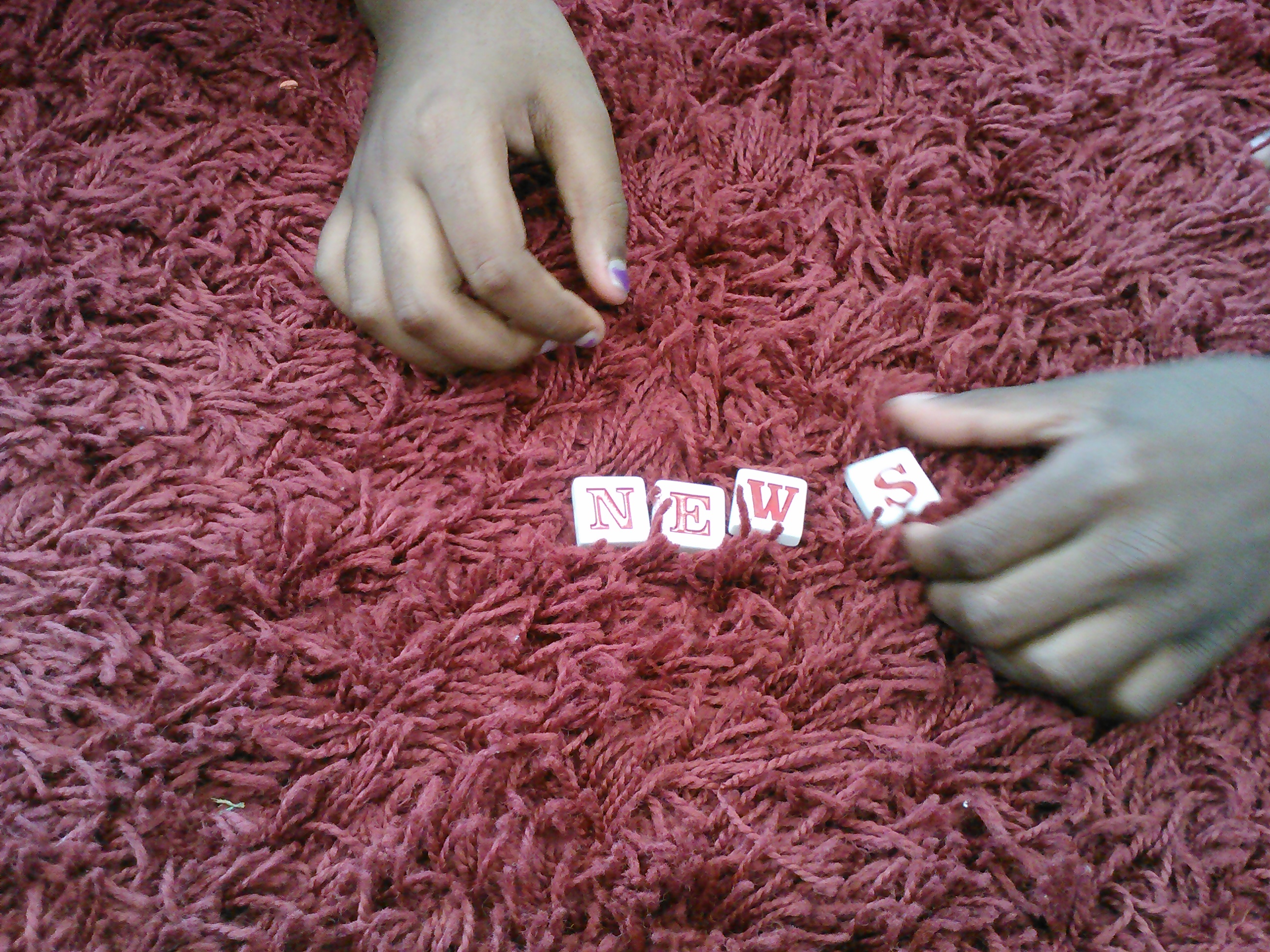
IMG699

Someone said this word was inspired by a book cover they were looking at just before we played our game–funny that they were actually able to find the letters to build it!
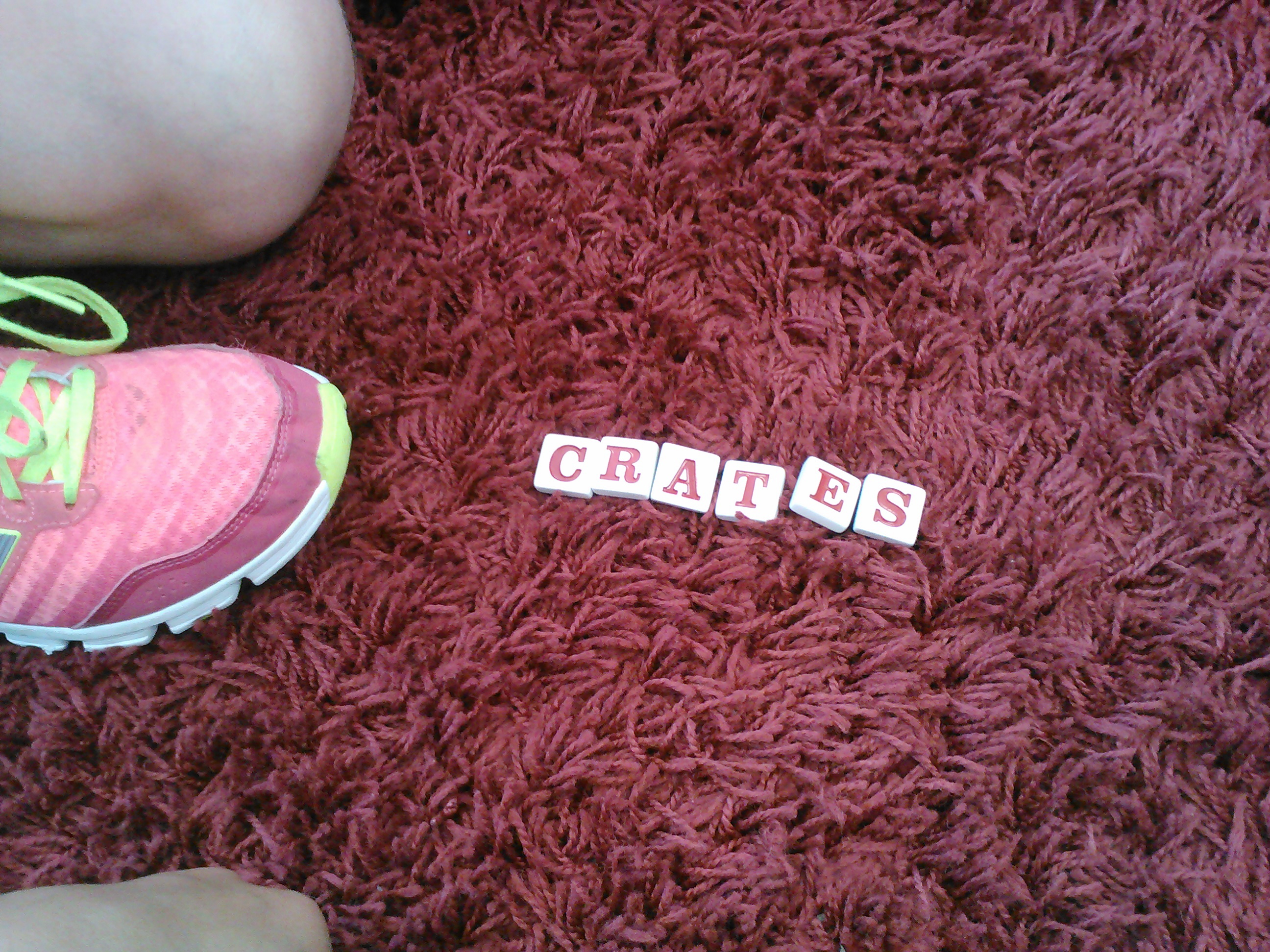
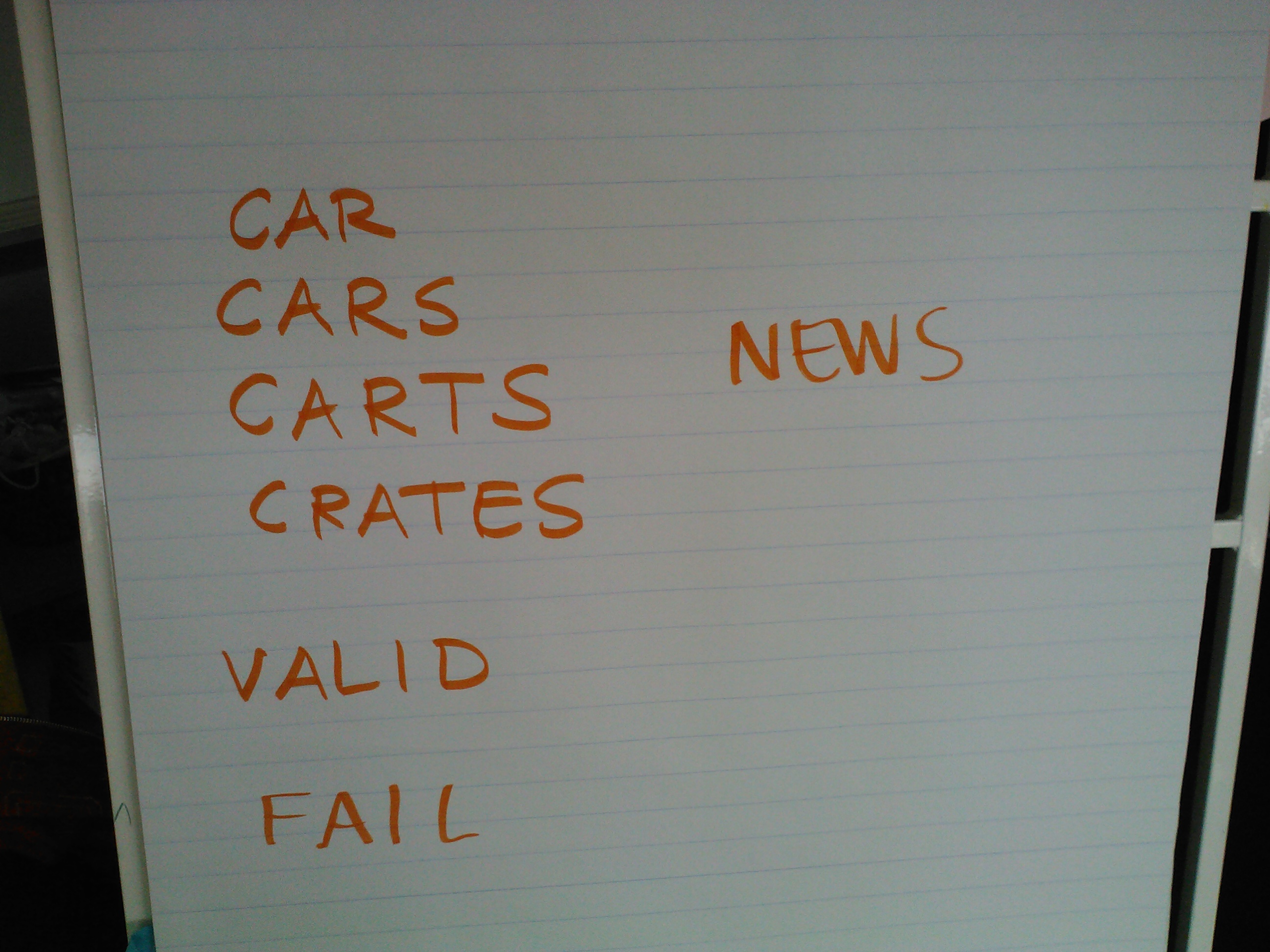
IMG700

Check out the way CAR turned into CRATES--a longer word with more friends involved!  Success!
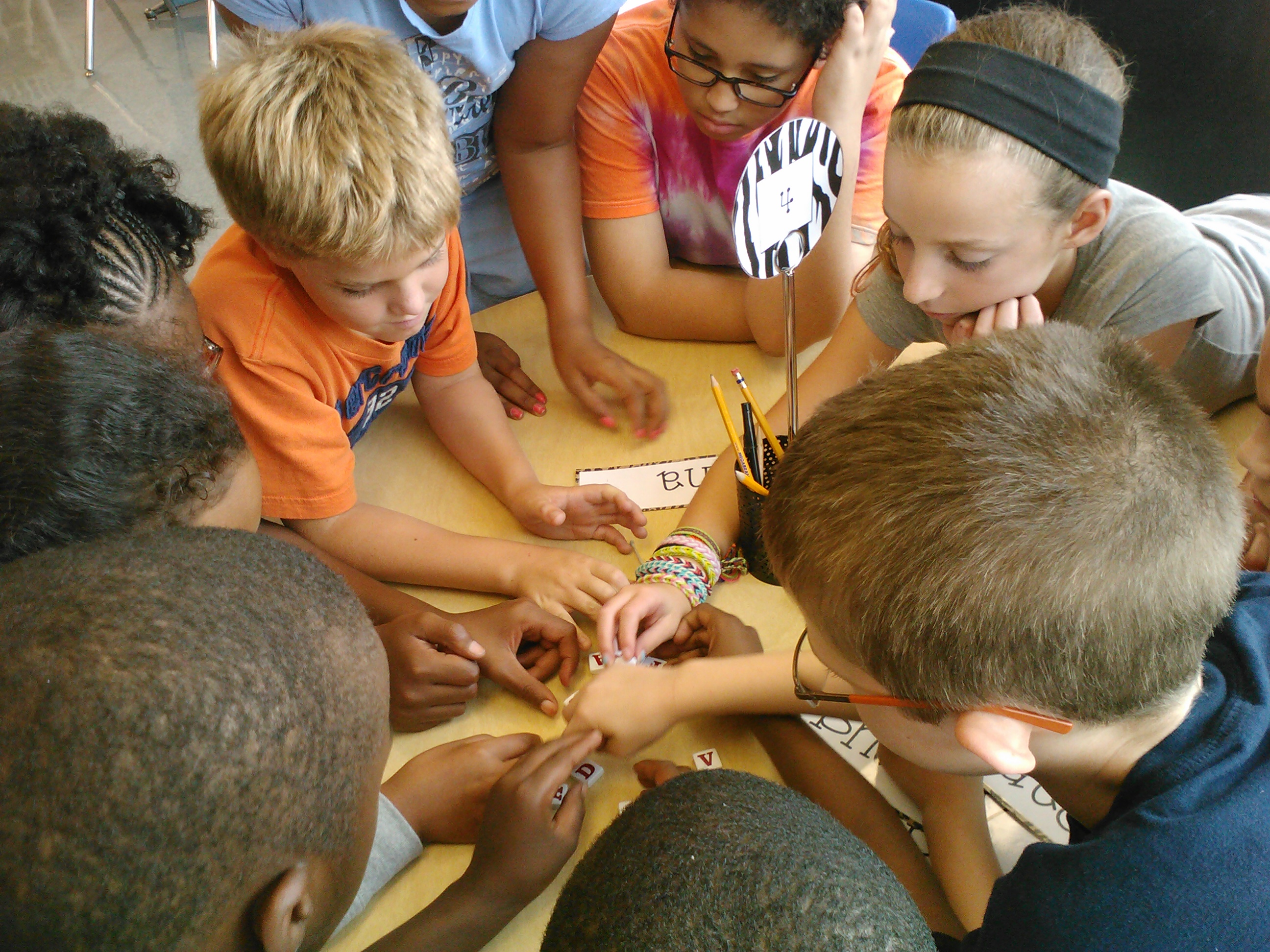
Check out the way CAR turned into CRATES–a longer word with more friends involved! Success!


All of the "odd" letters met at Table 4 to see what they could come up with...

All of the “odd” letters met at Table 4 to see what they could come up with…
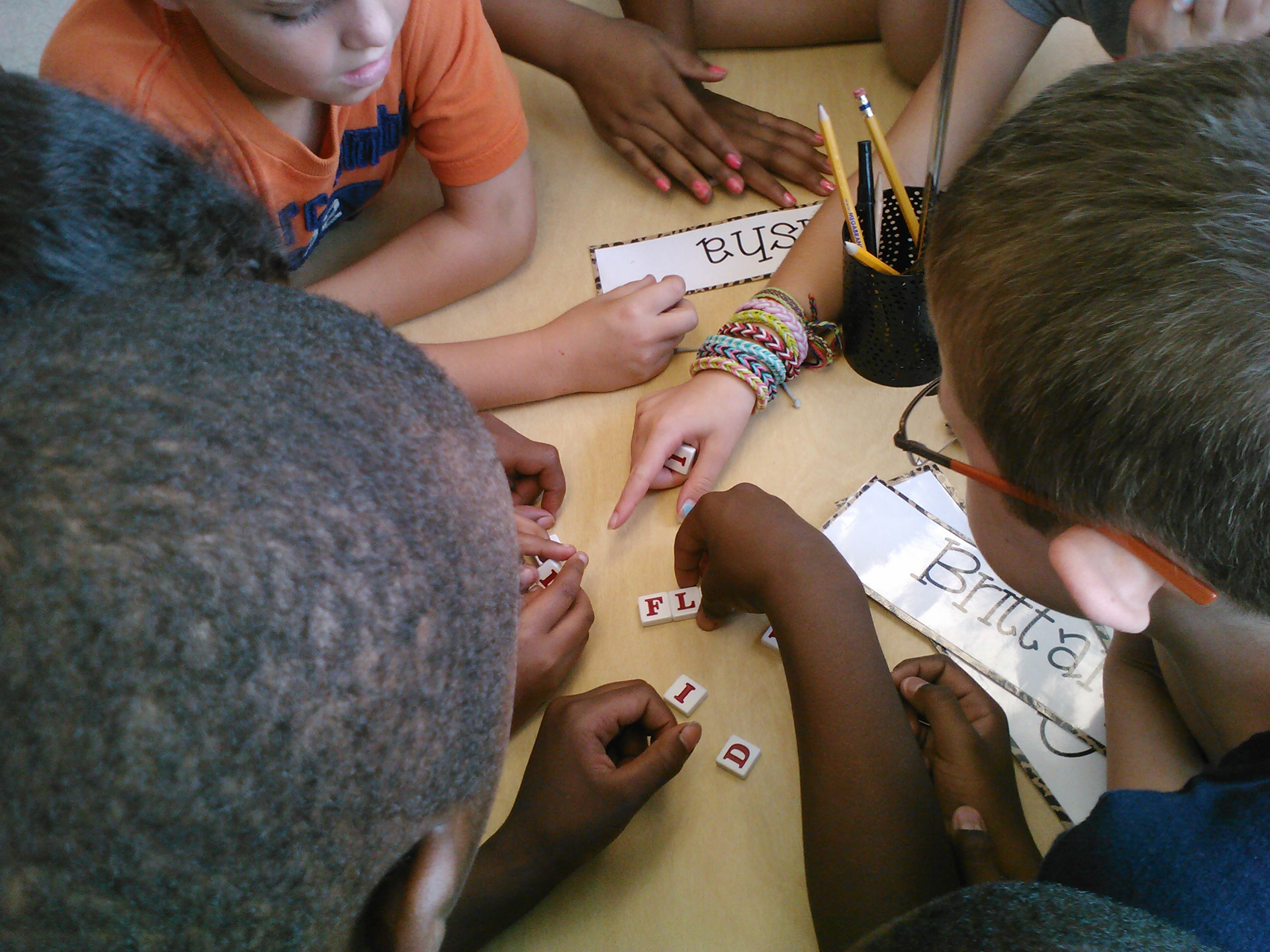
 

...and many hands made for light work.

…and many hands made for light work.


IMG704

Definitely not an Appletters “fail” here–that’s a good word!
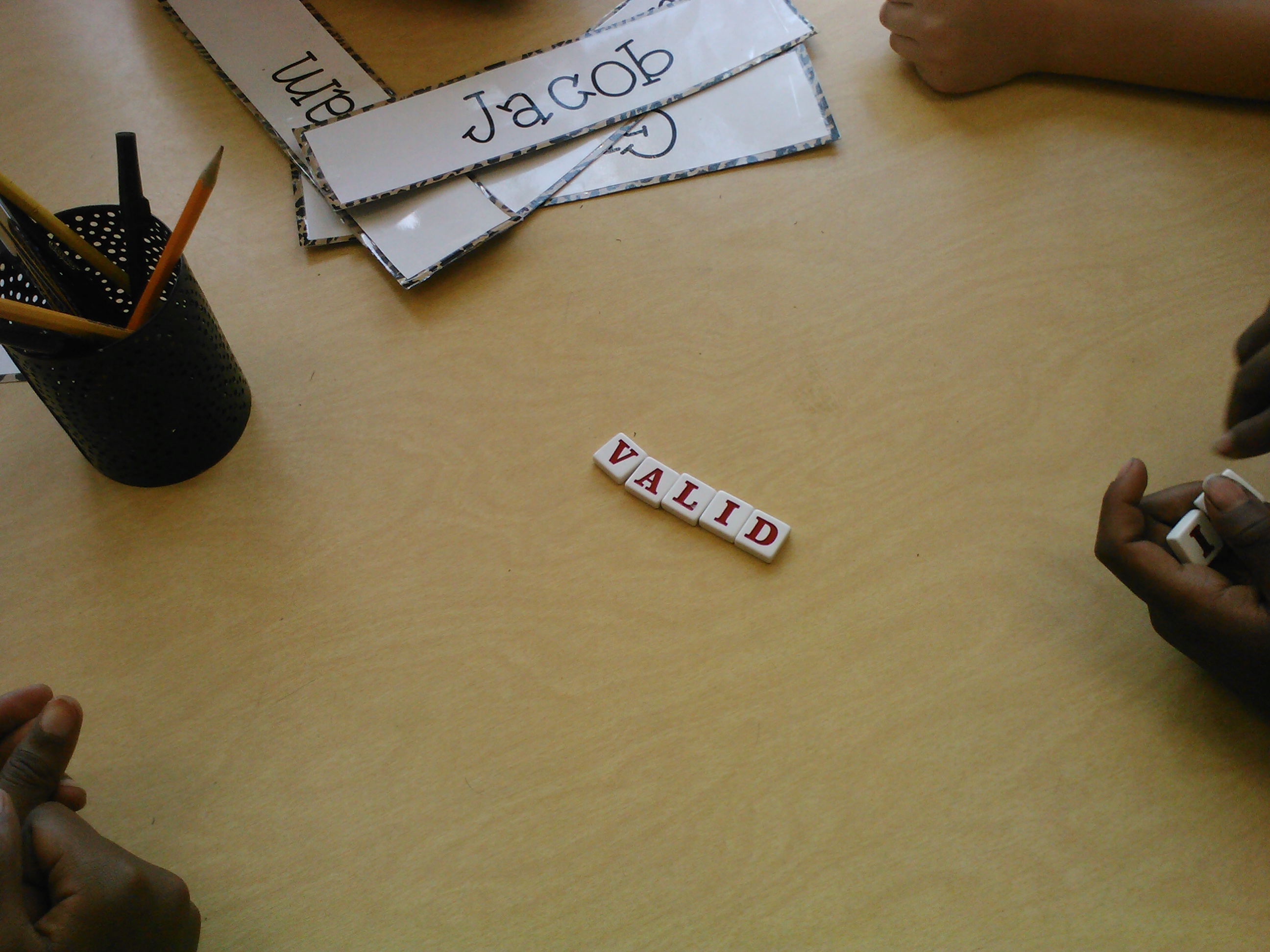
IMG703

Check this one out! Another one where someone (Owen!) was just looking at the letters and this came to him! Genius!

What a FABULOUS example about how a group of people with great ideas can change things for the better!  What a great start to the year, and an exciting precedent for class meetings to come. WAY TO GO, RM. 202!! YOU ROCK!

An Authentic Australian Audience

First of all, to my friends in 5SK, I’m SO sorry you’ve been waiting so long for this post!  We ended up needing another day to get our presentations “just so” before we shared them.

And so for those of you who are not from 5Sk (a Year 5 class in Queensland, Australia), let me fill you in on what’s going on.

I have been talking to Ms. Scharf for a little while, and received an email from her the other day with a request.  She also posted it on her blog:

The challenge from Mrs. Scharf for her 5SK friends.

The challenge from Ms. Scharf for her 5SK friends.

I was beyond excited about this question because 1) I knew my friends could answer it and help their Aussie friends, and 2) this was a REAL, AUTHENTIC audience with a REAL problem that we needed to solve–talk about motivating!

So after talking through what we needed to do first (which was research the Australian money system so we knew what connections to make and so we’d have some background knowledge), as well as all the things we needed to include in our responses.

And so, after two days of working, here’s what we came up with for our friends:

And last, but not least, one group made a poster to explain their answer:

Fiona, Anna K., Sammy and

Fiona, Anna K., Sammy and Rebekah chose to explain their thinking in a poster.

So what do you think?  5SK friends–did we help you?  Please write and tell us what you think.  We’d also love to hear how your Pocket Money Challenge went today! 🙂

I Speak Greek When I Teach Math–PART 3

Hopefully you’ve caught the first two parts of this story already.  If not, they are here and here.  🙂

After we had our cooking lesson, we got back into our groups to do a re-try of our posters.  Another thing that my friend Pam mentioned to me when we were talking about what could have gone wrong was that maybe the paper they were using was too big.  What?!  Something that simple?  It’s funny, because I hadn’t really considered that before she said it, but as soon as she did, it made perfect sense.  They only had a certain amount of information to share with other mathematicians, and many groups ended up with lots of white space they didn’t know what to do with.  Maybe it wasn’t a factor in our troubles, but it was worth taking a look at.  So as we started again, we used smaller posters. 🙂

We tried something else with this investigation, too–we invited another class (who didn’t know anything about our problem) to do our gallery walk with us.  This, we thought (ok, well I thought) would give us an even better idea of how we could revise our first drafts, since it was a “cold read” for them–they could only use the information we gave them to make sense of our mathematical ideas, rather than the context of the problem or background knowledge of the process.  So we invited Mrs. Hong’s class to work with us.  This was a PERFECT situation, because they had just finished a big problem, too, and needed someone to help them revise, too.  Match made in heaven, right?

This slideshow requires JavaScript.

I mentioned in my last post that I’ve been thinking about incorporating more with cooking into math next year, and this whole trade-classrooms-and-do-a-gallery-walk thing is another idea my team is considering doing more of.  We want to be more purposeful in how we create real-life, meaningful scenarios for our kiddos to solve, then use the knowledge and ideas of each other to help make the work even better.  Seeing another version of a problem you’ve also solved is very different than looking at a poster that is completely new. The mathematician has a much bigger job to do for these new viewers; every word, number and symbol they write is a clue to help them figure out the puzzle.

So what have you done with posters, gallery walks or real-life problem solving in your class?  What advice do you have for us as we work to continue these ideas with our mathematicians for next year?  We’d love to hear your thoughts. 🙂


I Speak Greek When I Teach Math–PART 2

Wow–I’ve been doing a horrible job with updates lately!  I’ve left this one hanging for over a week, and I’m sure you were waiting on the edge of your seat to hear the rest of the story, right?  Well, thanks for being patient. 🙂   The “rest of the story” will actually end up being told in two more parts.

Remember how we were working with a problem about ranch dip and I was baffled by what was going so wrong?

Screen Shot 2013-04-17 at 8.55.41 PM

Ranch dip problem, part 1

Part 2

Part 2

Well, what I don’t think I told you last time was that I had a conversation with a colleague of mine, who happens to be a fabulous math teacher, too, and we agreed there could have been many reasons why this was trickier than I had intended.  I decided to tackle these issues one at a time.  The first one we thought of was related to the context.

I think I may have taken for granted the fact that my kids would know about teaspoons, tablespoons and just the whole act of mixing it all together.  There were actually several kiddos who could not relate to what I was talking about with making the dip, so I decided to fix that problem.  I hoped that using the recipe would help them better understand what I was asking them to figure out.  So we got cooking!

IMG_0748

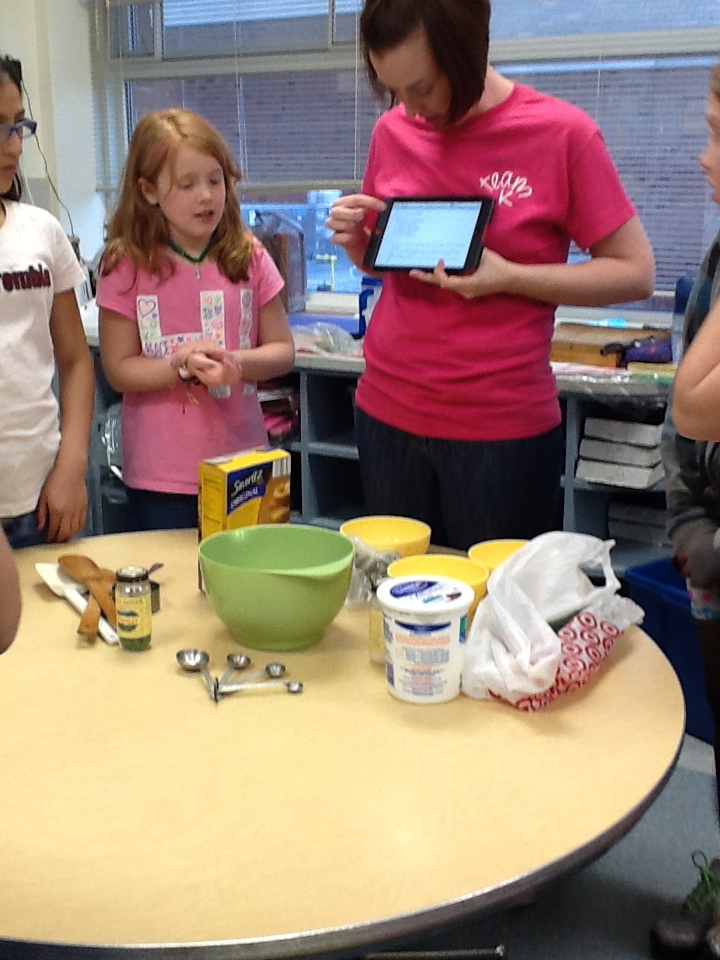
First, we reviewed the recipe and talked ingredients so we made sure we knew what to do. See how handy our iPads are for jobs like this? 🙂

IMG_0751

Sorry, this ones a little blurry, but we’re smelling the spices the recipe called for: onion powder, garlic powder, parsley and dill. Many hadn’t ever seen these before!

IMG_0754

Oh, and there’s basil in it, too! Smells yummy already!

IMG_0756

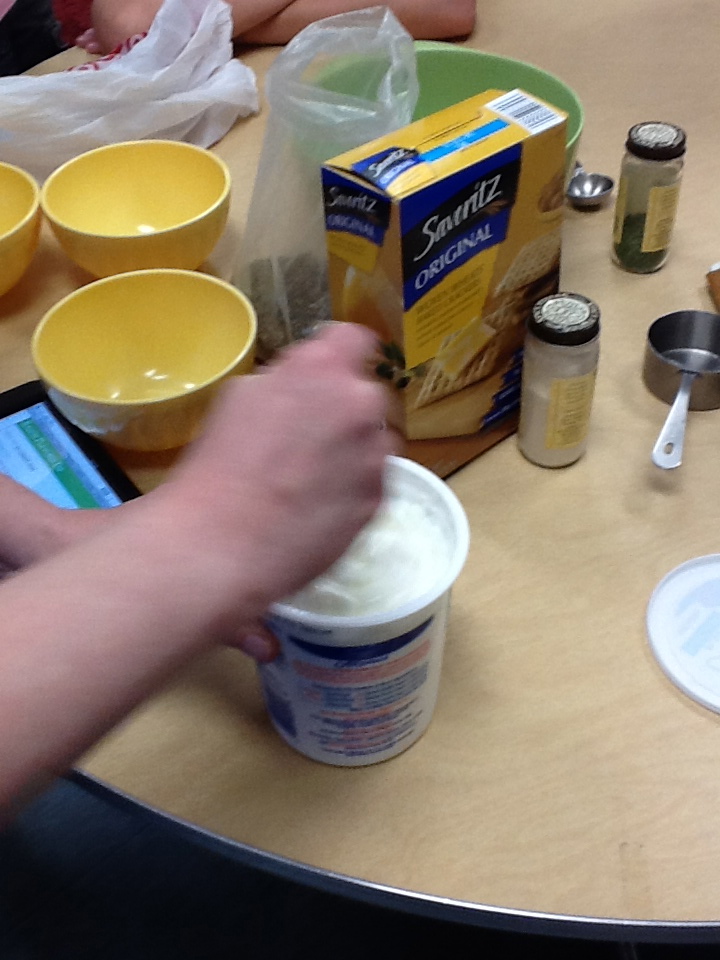
The recipe calls for sour cream, but I decided to use plain yogurt instead. Man, I must have been stirring fast!

IMG_0757

We discovered another part that was important (and in many cases missing) knowledge–knowing the difference between the sizes of teaspoons and tablespoons. Knowing that there are 3 teaspoons in a tablespoon was necessary for use in the final answer, but this was hard for some kids to image without seeing it.

IMG_0760

Spice mix ready to be stirred!

IMG_0764

We needed a 1/2 cup of yogurt for every tablespoon of spices.

IMG_0768

Looking good!

IMG_0774

I forgot a knife. 😦 Cutting a cucumber with the back of a fork is harder than it looks! Eventually I made it happen, though. 🙂

IMG_0776

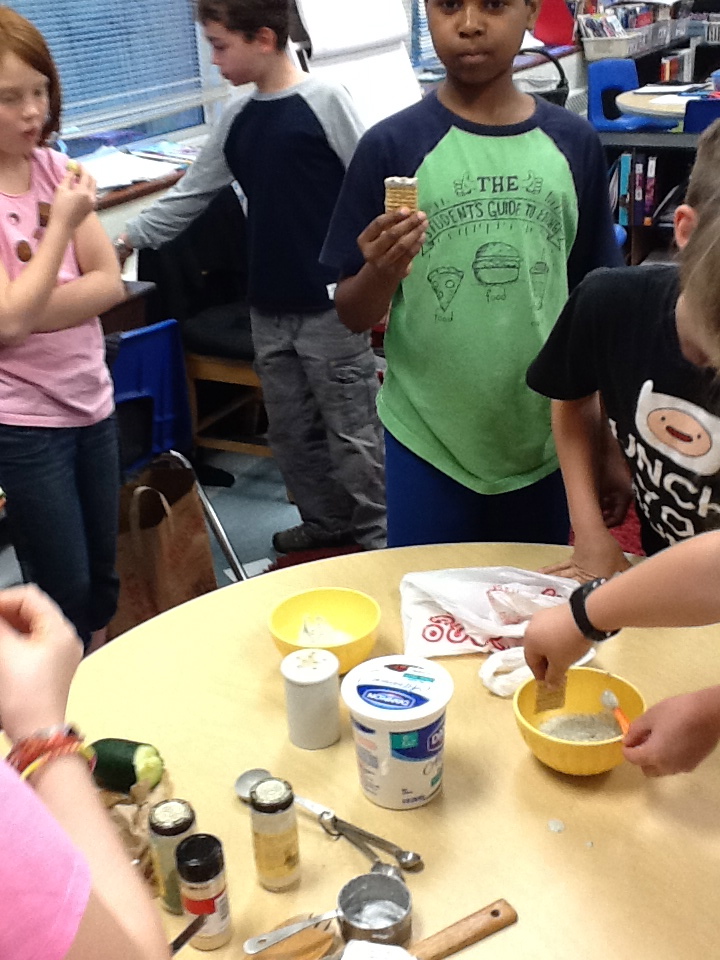
Yum! Ranch dip with cucumbers and Triscuits for our morning Math snack!

So while my cooking class didn’t solve every problem we were having (which I’ll tell you about in Part 3), I do think it gave many of them the ability to make connections they were unable to make before.  And there is so much math (and science) in cooking and baking, I don’t know why we don’t do more of it.  TOTALLY wish my classroom had a kitchen!  It has also made me and my team think about how we want to purposefully involve more of these types of activities into our classes for next year.  We’re thinking it would be a great addition and preparation for next year’s Feast Week, too.

How do you use cooking in your classroom?  What connections do you make for your kiddos to math and science?  Or maybe even reading and writing? We’d love to hear your thoughts and suggestions as we make plans for next year. 🙂

I Speak Greek When I Teach Math

Or maybe it’s Spanish or Chinese or Pig-Latin, but today I felt like I was definitely not speaking English to my kiddos during math.  Meaning no one understood what I was trying to explain, and many kids ended up more confused than when we first started.  WHAT?  It’s not like I’m new at this, nor to the topic.  We were even working on a problem that I made up!  Needless to say, we all wanted to throw in the towel, or rip up our papers and start over.  Or something else that you shouldn’t do when you’re frustrated.  And no, in case you’re wondering–we didn’t.  But we did put the problem away until tomorrow when we’re fresh and can tackle it again.  And I am already armed with a different plan for how to address it, but am hoping you can help me, too!  (And by the way, after how fabulous the first round of problems-with-posters went the other day, this was all the more mind boggling!)

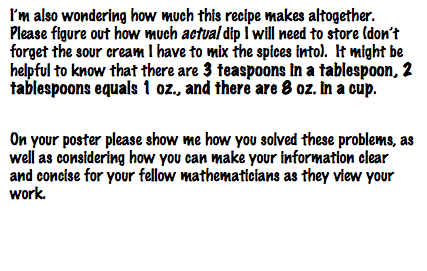
Ok, so I’m hoping that you can help me figure out what might be making my friends so confused.  Here is the problem that we were working on yesterday and today:

Screen Shot 2013-04-17 at 8.55.41 PM

This problem is 1) based on a real-life problem, 2) uses math skills we already have (or at least that are not new!), and 3) really just focuses on making sure they use clear and concise notation to record their solution and thoughts.

Part 2

Part 2

PLEASE give me feedback on parts you see that may  have tripped them up.  After working on it for two days, I see a couple of things, but I really expected this to be a rather simple fraction problem; the difficulties they were having were not ones I had anticipated.  My hope was they could focus on the poster part, as a prep for how they’d answer questions as we start testing next week.  Instead, now they’re all convinced that math is hard and confusing.  Pretty much a teacher fail, huh? 😦

Thoughts?  Oh, and I guess it’s a given that I want you to be nice.  Truthful, but nice, please. 🙂  And maybe you could even tell me what you think the answer is.  That might help me see if the problem reads the way I intended it to.  THANK YOU, FRIENDS!

Mystery Skype Take 2

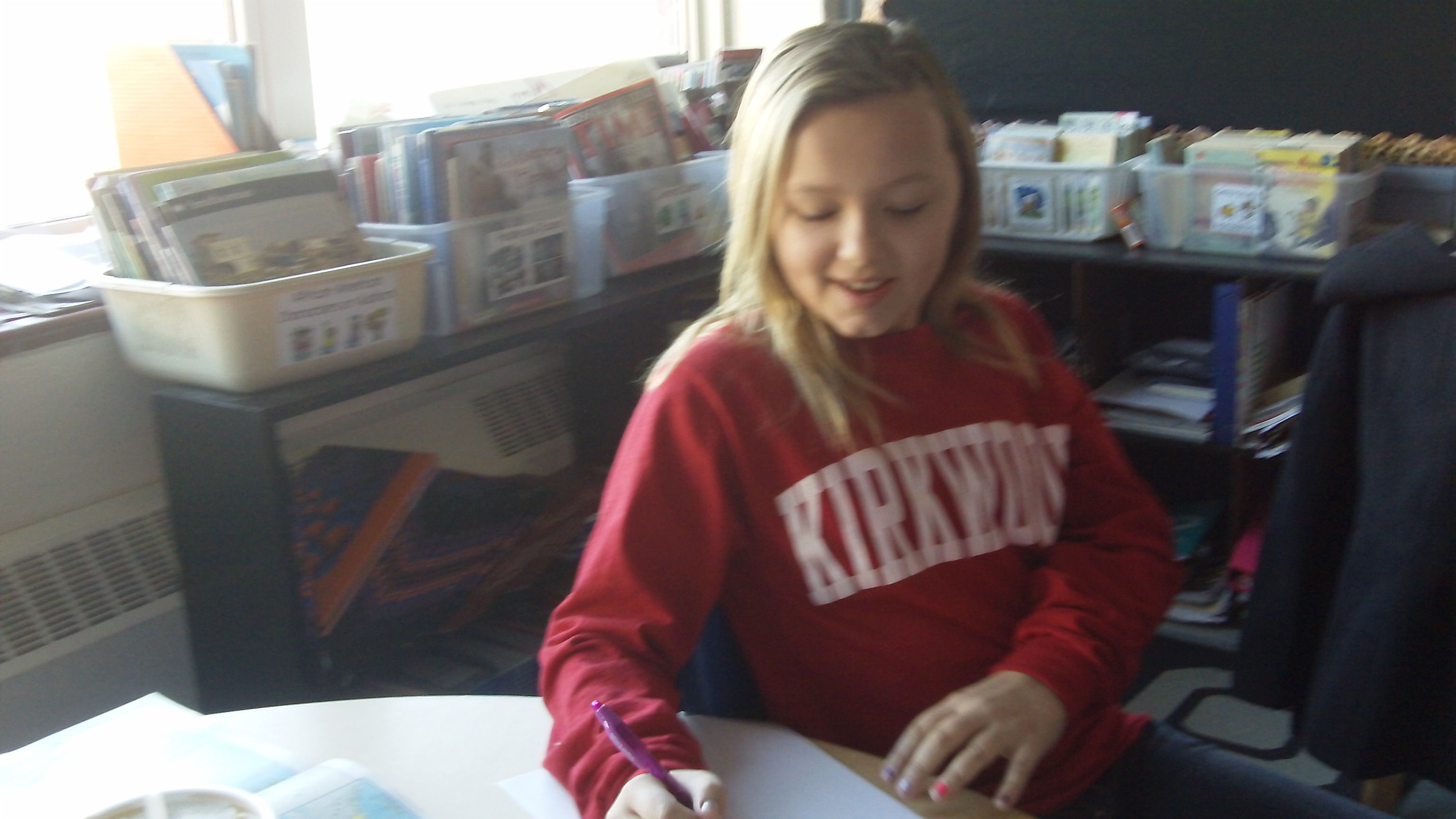
Last week we participated in our first Mystery Skype.  It was great fun, and we were looking forward to our next opportunity, which came this week!  On Friday, we were able to connect with Ms. Copland’s 4th graders–a connection we made from some friends I have on Twitter.

We had some basic knowledge this time around, since we’d done it before, but we were determined to improve on some things.  For one, we knew that we’d need to have more maps out, and to already have our computer ready–if we needed a map or some other resource that wasn’t in our atlas.  And since I didn’t have pictures from our first try, I knew I wanted to have a photographer ready for this call.   It was great to have some teachers comment on our blog in the meantime, too, offering great suggestions for how they do Mystery Skype.  Thanks to Mrs. Kneller, Mrs. Venosdale (who was our Mystery Skype call last week!), Mrs. Bowman, and Ms. Ripp (who didn’t comment on our post, but who is definitely one of my go-to teachers on topics like this!) for sharing your Mystery Skype know-how with us!

This time the set up of our call was a little trickier (at least for me!) because there was a time difference to take into account.  I cannot tell you how many times I checked and then double-checked if the times we were throwing out were for Central (where we are) or Eastern time.  Finally we settled on a 9:40 EST phone call.  This meant that I would have less of my class present for the beginning of the call (since we don’t really start school until 8:45 CST), but it worked out ok, I think.  We were able to get started with 7 or so students and then the rest joined us as they trickled in.

So we were prepared with our first question to be related to time zone, because last time it gave us great info to start narrowing down where our Mystery Skype friends were located.  But then, I had a smart cookie who saw this on the message board on my Skype page where I’d been talking to Ms. Copland prior to our call:

Screen Shot 2013-02-02 at 9.59.39 PM

We didn’t need our time zone question anymore, because my friends had already figured out that our new friends were calling from somewhere east of us.

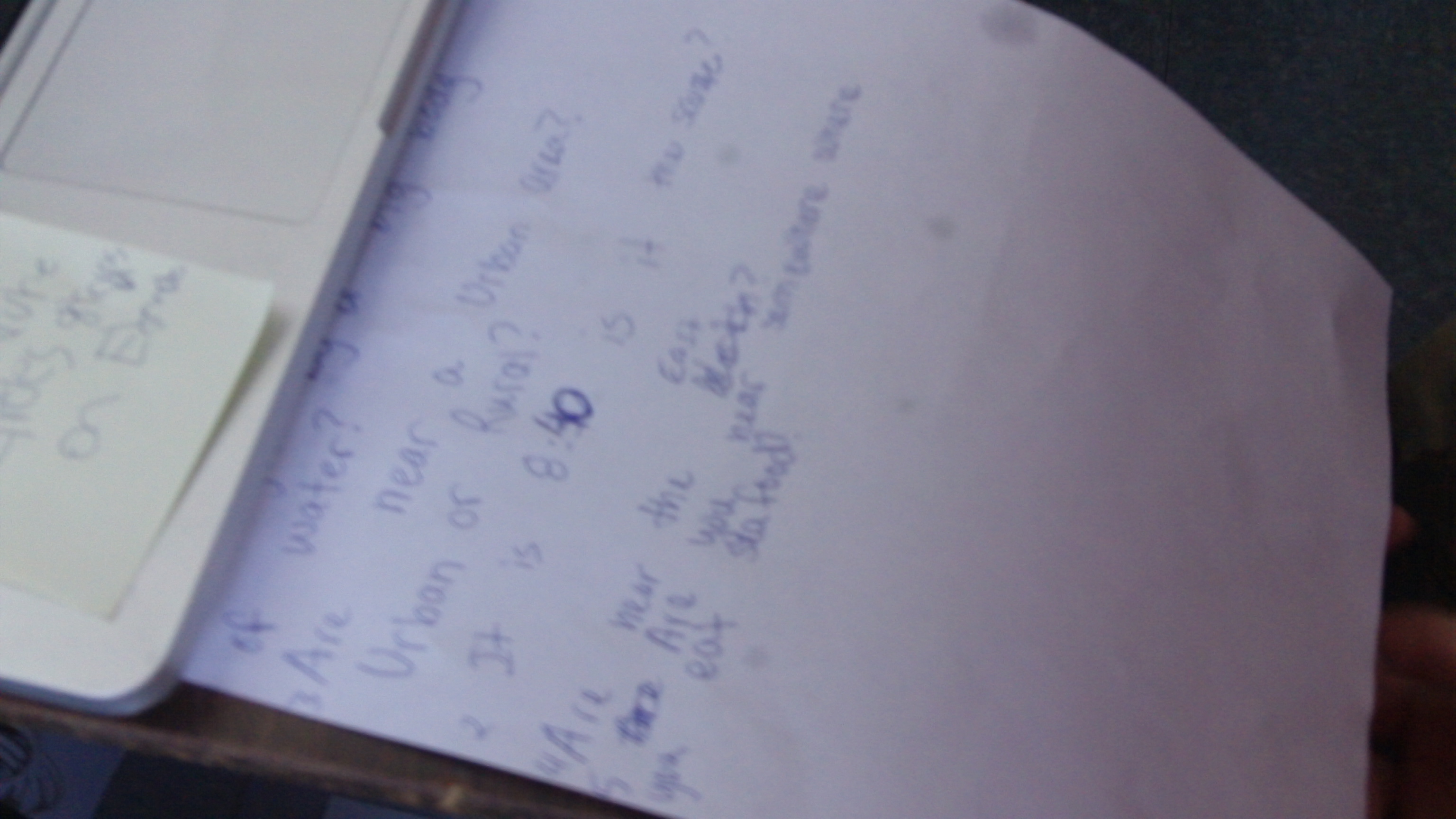
This time we had “stricter” rules that you had to get 10 clues before you could guess the other classes’ location, so we kept careful track of their answers to our questions.

109_0001109_0006

I was pretty impressed by the questions that the kiddos thought of this time, but even more surprised by the initial prediction that Seamus made on the state they were in.  Once he knew they were in the eastern US, he said, “I bet they’re in Massachusetts.”  It was kind of a fluke, related to the fact that his dad is from Boston, but was indeed the place we were supposed to be guessing!   So with Massachusetts knowledge in his head, he began to gear our questions toward MA facts that would help us decide if that was indeed the mystery state.

109_0003109_0008


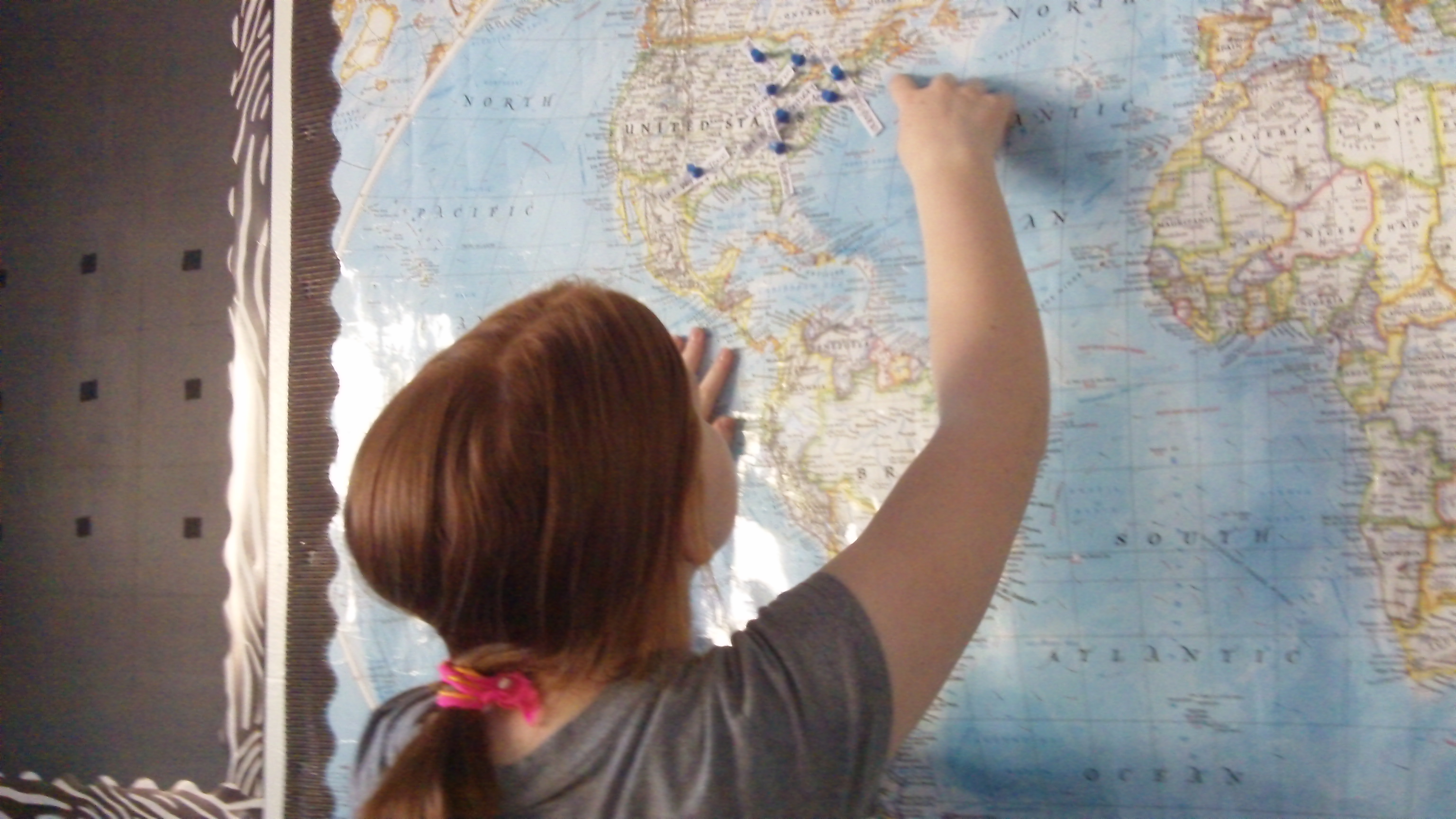
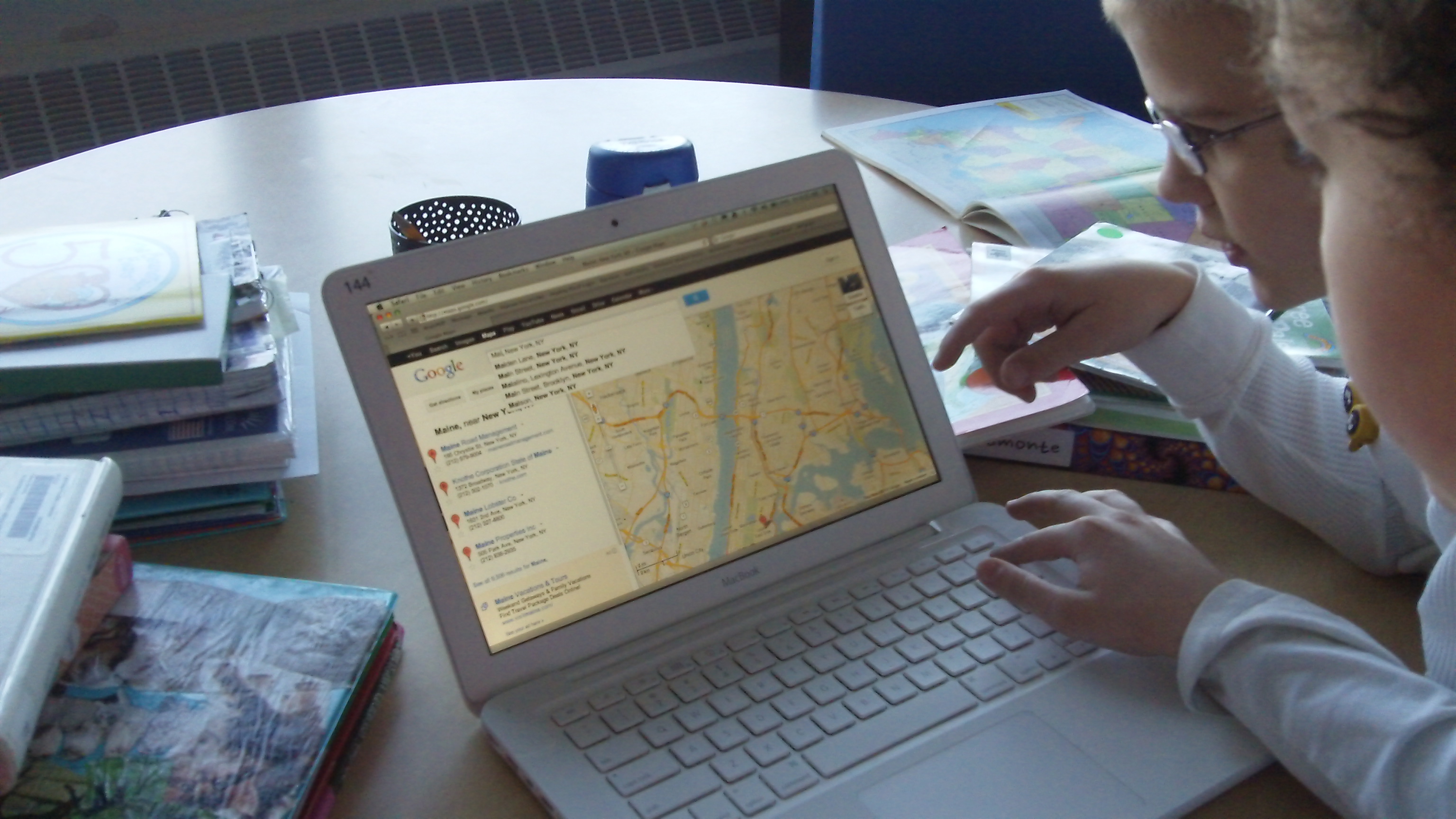
As the rest of the class starting arriving, more and more kiddos got involved in the work, using the big map on our wall, the computer and the atlas.

109_0010109_0012109_0005

I was so impressed by how well this one went!  Last time we were a little fuzzy on our own MO geography, and so we knew we needed to brush up on that before this call.  This time we knew the answers to the questions they asked, used many resources at our disposal to figure out which questions to ask, and also paid attention to the details we saw in their room to help narrow down our guess on their location–like the fact that someone close to the camera was wearing a Boston Red Sox shirt!  We asked them about that, but they quickly pointed out all the other teams represented in the room–including our very own St. Louis Cardinals!

What a great time we had!  We’re definitely Mystery Skype missionaries now, and are helping connect other teachers in our school to this great activity!  Another 5th grade class is going to visit during our Mystery Skype next week (yep, already have another one on the calendar!) so that they can learn how it works.  So cool!

Yay for Mystery Skype!

109_0004

One more resource I found was this list of other ways to use Mystery Skype, posted by Krissy Venosdale (@ktvee) on her blog, venspired.com.  Excited to try some of these others in the future!