Remember when first told you about math warm ups? These were the warm ups we did this week, focused on decimals for our current math unit. How would you answer them?


Remember when first told you about math warm ups? These were the warm ups we did this week, focused on decimals for our current math unit. How would you answer them?
Remember this? Since then we’ve done several other math warmups about geometry and decimals. But we’ve also been doing some other things–things that started out with math and quickly spread to other areas of our life together in Rm. 201.
Let me explain…
The other day I asked my kiddos a question, and after I did, I realized–by listening to the crickets and seeing their confused faces–that they didn’t get it. So I rephrased it, and also took them on a little tour to help explain what I meant.
One of the things I’m working on is making our room look and feel like it’s as much a place for mathematicians as it is for readers, writers, and scientists. So I took them to a place that I knew would help them get a feel for what that looks like–our neighbor next door, Mrs. LeSeure’s 5th grade class.
We sneaked in very quietly and looked around. The directions were to pay attention to what they saw that told them that math happened in that room, things that maybe they didn’t see in our own classroom. We then came back and brainstormed what we noticed.
Here’s what our list looked like:

Ok, I know–you’re distracted by the messy handwriting. I promise, it’s not usually that bad. I was writing fast. 🙂
What was really great about what they put on the list was that they noticed things that I know that Pam specifically did for her math environment, but they also caught on to the things about how the room felt, the subliminal messages that were being sent in that space.
As you can see on our chart, Mrs. LeSeure’s class has things that help her students in math, like anchor charts from things they’ve just learned about, like area/perimeter and the difference between similar and congruent, both from our recent 2D geometry unit. But my students also talked about how her classroom felt. They said that it felt relaxed. It was clean and neat and colorful. This was where I had to be brave. I had to remember that just because they said her room was like that didn’t mean that ours wasn’t, or that I am a bad teacher, or that her class is better than ours. It just meant that Rm. 202 had some things that ours doesn’t have, different things. Things that we want to add to our own room.
Most of what they were saying actually went way beyond the original math-related question I asked. They went deep. And they made me nervous. But like I said, I had to be brave. Their statements dug deep to the reasons why some things happen in our room, the reasons why we sometimes struggle with paying attention and why it seems like we don’t know what to do next, or why we waste our learning time. They were really great comments, actually, and come down to the fact that our room just really isn’t working for us anymore. That was the part I had to be brave about–I am, after all, the one who designed that room, and created the environment in the first place.
Remember when I showed you what it looked like the first time I came in during the summer? And then how it started to change as I put it together? Well, even since then, many things have changed since we first started together in August. But on Wednesday we were talking again about how more change needed to be made. I loved how Evan put it when he said, “I don’t mean to be mean, but you arranged the room without us, and we’re the ones who spend the most time here.” And you know what? He’s totally right! It’s really funny how that whole thing works, really, with the teacher planning and arranging and setting up the room for a group of kiddos she doesn’t even know yet, without their input. I know it’s just what has to be done, but it would make sense that the people spend all that time and energy there every day should have some say in how it looks. And feels.
So that’s when it happened. I gave them a chance to suggest changes they thought should be made. I asked them to tell me, and to even draw a map if they wanted to, what they thought about what we could take out and what we needed to move. Everyone got busy, some by themselves and some in pairs or small groups, making lists and floor plans to help us all see the vision of what we could do.
It was so very cool to “see” the classroom through so many new sets of eyes. I obviously look at and pay attention to different things than my students do as I go through the learning day. It was also really cool how similar their maps were when we sat down to look at them. For example, there at least 3 different groups who suggested that our classroom library move to another part of our room (a place where I originally was going to put it, actually, but then changed my mind about) and how everyone agreed that the cubbies as a divider between the carpet and Table 3 just didn’t work. Most of them had the same idea for how “my” area could change, by turning my desk 90 degrees and putting my computer in a different place. And I appreciated how they used their new geometry vocabulary to explain it to me!
So I began that very afternoon to make some of the changes that they suggested. And you know what? IT LOOKS AMAZING! These kiddos are so darn smart about what they need and what works for them as learners. They teach me every day, in a respectful and appropriate way, that I don’t know everything! The room has taken on a new and different feel, and most people who have come in have commented on how they like what’s happening. We’re not quite done yet, but believe me, I’ll definitely show it to you when we’re finished. I’m really pretty excited about it. And they are, too. I love how many kiddos said to me how much they appreciated that they have a say in this. I’m glad I gave them a say, too. Because they are saying some pretty great things.
How do you make decisions about your room/environment? When have you had to be brave? What ideas do you have for us as we work on the environment of numeracy (and literacy and so on…) in our classroom?
I just started a book study, led by Mrs. Bell and Mrs. LeSeure, on the book Guided Math by Laney Sammons. I have only read the first few chapters so far, but am really loving it already. The book is based on the idea of using the strategies that kiddos already know as readers (visualizing, connecting, questioning, rereading, summarizing, etc) in relation to math; the same things that we do to understand what we read can help us understand math (or any other subject, for that matter!).
So, like I said, we’re just at the beginning, but have learned the overview of the big ideas in Guided Math. Then we were supposed to choose one that we were going to commit to change or add to our math class as we work through the book together. My goal was to add to the environment of numeracy in my classroom: to find new and innovative ways to add math to parts of our day outside of “math time.” The goal is to get kids thinking like mathematicians in all parts of their life at school.
One way to do this, even from the minute they walk into the room in the morning is with warm-ups. These are quick, math-focused questions that kids answer on a chart for everyone to learn from together. This was our warm-up from this morning:

It wasn’t a ground-breaking question, nor is it the most deeply I’ll ever ask my kids to think, but it got us focused on math right from the beginning. I loved it when someone said they had no idea what to write and with just one question from a friend, were able to add “I used math when I had to figure out how long I had until I had to leave to go to my dad’s house” to the chart. That’s what it’s all about really, supporting each other in our learning.
So what math did you use this weekend? How do you involve your kids in mathematical thinking outside of “math time?” What suggestions do you have for math questions we can use for a warm-up? We’ve love to hear your thinking and add to ours!
Today was one of those days when I decided to totally change my plan for math and it worked out tremendously better than the original plans. Let me tell you about it. 🙂
My kids are used to what I call “geometry challenges”, where they have to prove that a statement is true, by using what they know as mathematicians. The first one we did was to prove that the shortest distance between two points is a straight line. They worked alone or with a partner to show how that was true, or to find a way to prove that it wasn’t. Then next one was to prove that a straight angle equals 180 degrees. With that one, they used Power Polygons with angles that they know to show whether that statement was true or untrue. Needless to say, they’ve totally rocked each of those situations, and really shown what they know about geometry.
So today I was headed in a totally different direction, but decided to do today’s lesson as a challenge again. Here is what they were asked to do:
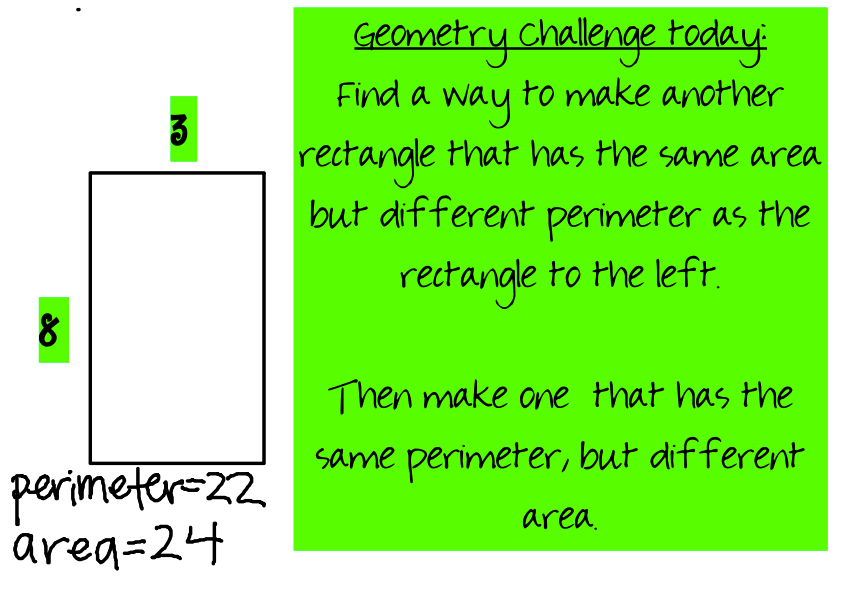
Like in the past, they had amazing things to show for the work on this challenge. Before I show you what they did, I’m curious to know what your answer would be. Could you answer this challenge?
Ok, so the other day I posted about our first lesson in our new geometry unit. I was a little frustrated by not being able to post videos, because I caught a great conversation about rotational symmetry that one group had.
After some smart thinking by my brother-in-law, I am attempting it again, using our newly created YouTube channel. Let’s see if it works:
But anyhow, I hope you caught what was happening in that conversation. The boys were working to put their geometry terms into groups and label them, and got to talking about rotational symmetry related to triangles. Evan was trying to explain to Harry about how all triangles have rotational symmetry and was showing him with the picture on the post-it. Harry–and then Dom, who you only hear but not see–help him with the idea that regular triangles, but not all triangles have rotational symmetry.
I love how you ask kids to do one thing, and then they take the conversation to other (and many times deeper) levels. Great job, kiddos!
(And sorry to those of you who were annoyed by the quality of that video. I’m still new to this part of blogging and uploading! I’ll get better, I promise. 🙂 )
Today was the first day back after Winter Break. In math we went back to a unit we had briefly started before we left–2D geometry and measurement. You just never know how kids will be the first day back into the routine of school after being gone for so long, but my kiddos totally rocked it!
We started a unit from the book Differentiation in Practice by Carol Ann Tomlinson and Caroline Cunningham Eidson, which I have used before with other classes. I love the way it’s tiered so that everyone can engage at the level they need, and the lessons are written in such a clear way that I can just jump right in!
We started with the first lesson today, which began with a rating scale to get them thinking about how well they know geometry. We made a class chart that looked like this:

Obviously we already feel like we know a lot about geometry! That will mean we can go to great places and expand our learning to topics we might not otherwise have been ready for! What fun we will have!
After we completed our rating scale, we went ahead with a List-Group-Label activity related to geometry terms. In small groups at their tables, they first listed words they thought of that were related to geometry. Remember when we made Wordles in math last month? Well they used those to help get their thinking started.
 Lauren references her Wordle to help with geometry terms for her list today.
 Taylor and Abigail work together on their list.
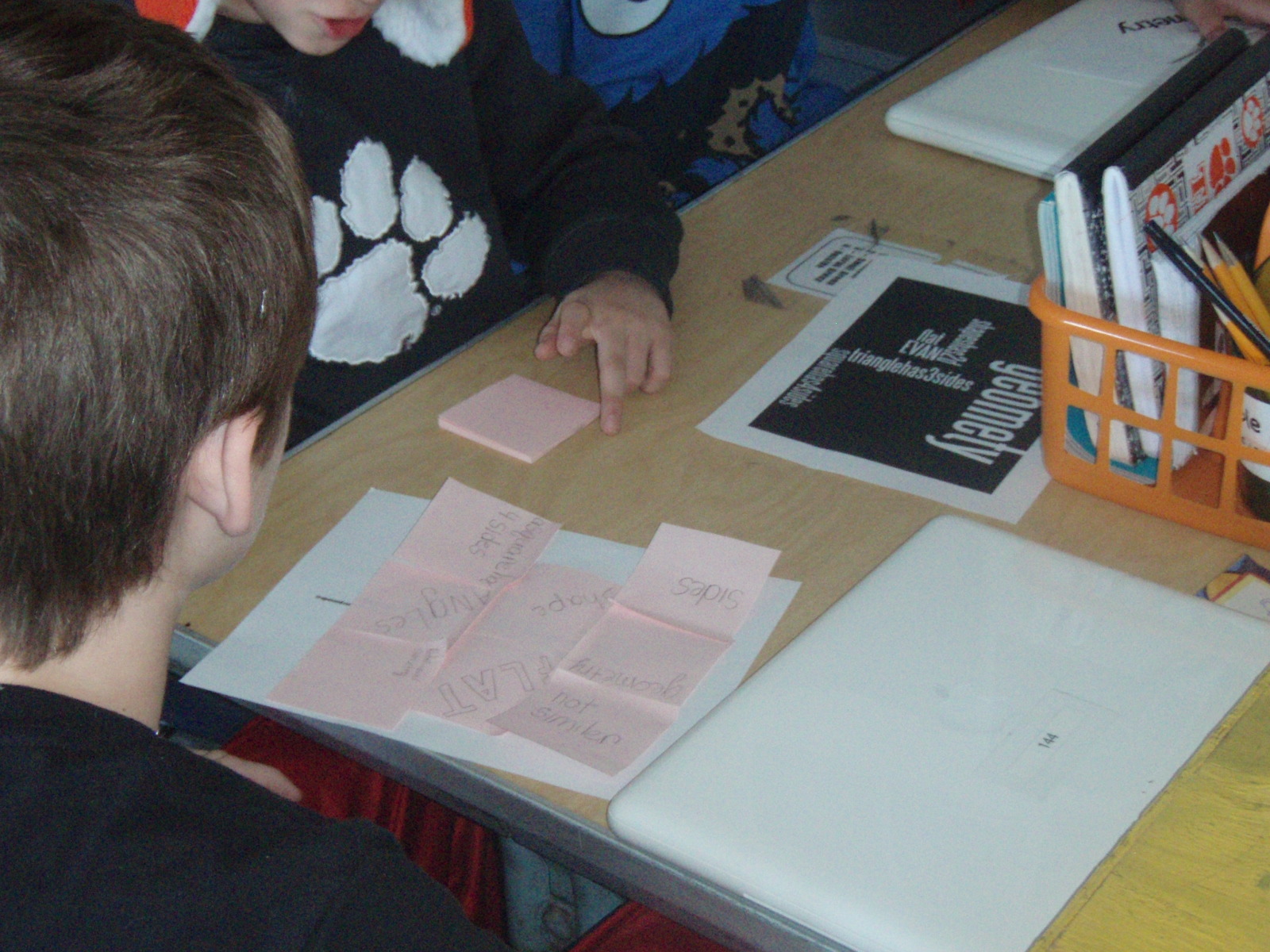 Harry and Evan have a variety of polygons on their list of geometry terms.
After their groups listed terms, then their job was to group these terms into categories. They did this on paper first, and then we started a class web that we’ll finish up tomorrow:

While what we were doing today was not hard, and was based on prior knowledge, they really dug in and did some great work. If only you could see the videos I took of a conversation on rotational symmetry from Harry and Evan’s group! I will have to find a way to be able to upload it–such an amazing example of students building on each others’ learning and working with misconceptions together. I just got stand by and watch.
More to come as we dig deeper into this unit. Cannot wait to share what happens next! 🙂
We’ve been busy this week. We’re always busy, but I think for some reason we’ve crammed more than usual into the last fives days. And it seems that a lot of what we did was new. And very cool. And involved technology.
We tried making Wordles again on Monday. It was the start of a new unit on 2D geometry in math, so I needed to get a feel for what they remember from 4th grade. Rather than do a pencil/paper pre-assessment, I had them create a Wordle to show me their background knowledge for this unit. We brainstormed some words we might use and explain in our Wordles, and then got to work.
I should stop saying I’m amazed with their final products–by this point they’ve shown me countless times that they can do amazing work. But that’s what I was: amazed. And I learned much about what they already knew.
Enjoy!
If you’re anything like me, then you love to eat. And you really like to eat out. My family loves to find new restaurants around town and try them out; “chain” restaurant is kind of a bad word in my house. So, if you’ve ever eaten out, then you know the idea behind a menu–you are offered a variety of choices of yummy things to eat. Most times you will choose a main course, side dishes and dessert. Maybe if you’re really hungry, or if something looks really interesting, you might add an appetizer to your meal.
Ok, so what? This is a blog about school, about education. Why all the restaurant talk? Well, if you’ve spent any time in our classroom lately, or if you’ve seen a 5th grade homework sheet this year at school, then you’re familiar with the idea of a menu. But why, you ask, would you use a menu in school?
Let me tell you. 🙂
The big idea that makes a restaurant menu work, that makes it desirable, is the idea of choice. When you sit down to eat, no one tells you “Eat this. Chew it 25 times. Swallow it.” You’re not forced to eat things you don’t want to (well, unless maybe you’re a kid!), and there are many ways to achieve your goal of filling your empty stomach.
That’s what we’re trying to do with menus in school. We have a goal–based on subject and unit–and then students are given a choice of ways to show their knowledge and learning related to that subject. The idea is not new, really; I’ve been doing a variation of it for years. Long ago we called them “invitations” or had a list of “must-dos and can-dos”, but the idea behind it is the same: children are going to have more ownership over their work and probably ‘dig in’ and little deeper when they have choice in what they do and what the final product looks like.
Here are some examples of menus we’ve used this year so far:
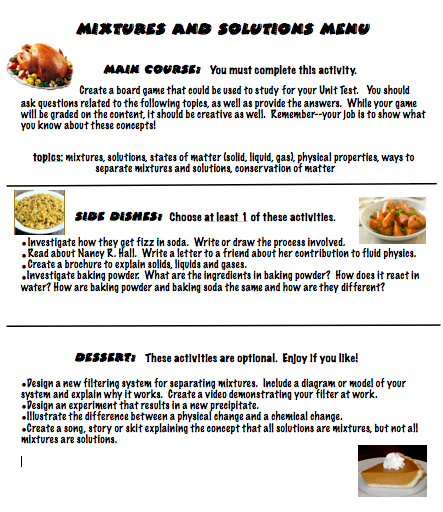

I must add, though, that besides giving students a say in what their work looks like, menus are an important tool in differentiation. The categories are tiered, so that every learner can be engaged wherever they are in their understanding of the concept; the main course is something that everyone can do (still at their own level with their own creativity), side dishes are a little deeper, and then desserts are activities and projects that allow and enable students to stretch themselves and think in a deeper way. Everyone in my classroom has their needs met regardless of what they are, and everyone has activities that are appropriate for them.
So, are you hungry for learning? Menus are for you. 🙂
Today was our last day of school before Thanksgiving break. And so traditionally, that means that we do things that are a little bit nontraditional in our schedule. For math, that meant that I put the kiddos to work.
Here’s what I mean…
For many years, my husband and I have taught together. Well not really together, like in the same school or anything, but we’ve always taught the same grade or the one just behind. So since that’s the case, we’ve been known to do some of the same things in our classrooms. One such thing is the Thanksgiving Dinner project in math that comes during these last two days of school.
The idea is pretty simple–plan and shop for the Thanksgiving meal for your family. The directions for my class this year looked like this:
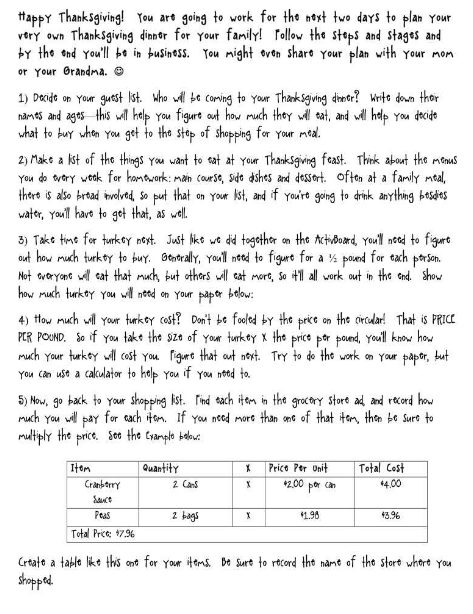 What’s cool is what happens after you give all the directions and answer all the questions and set them all loose to figure it out for themselves. Check it out. Like I said, learning can get a little messy. But it’s a really good kind of messy. 🙂


 Z was so focused on his meal, searching diligently through each circular to find just the right foods!

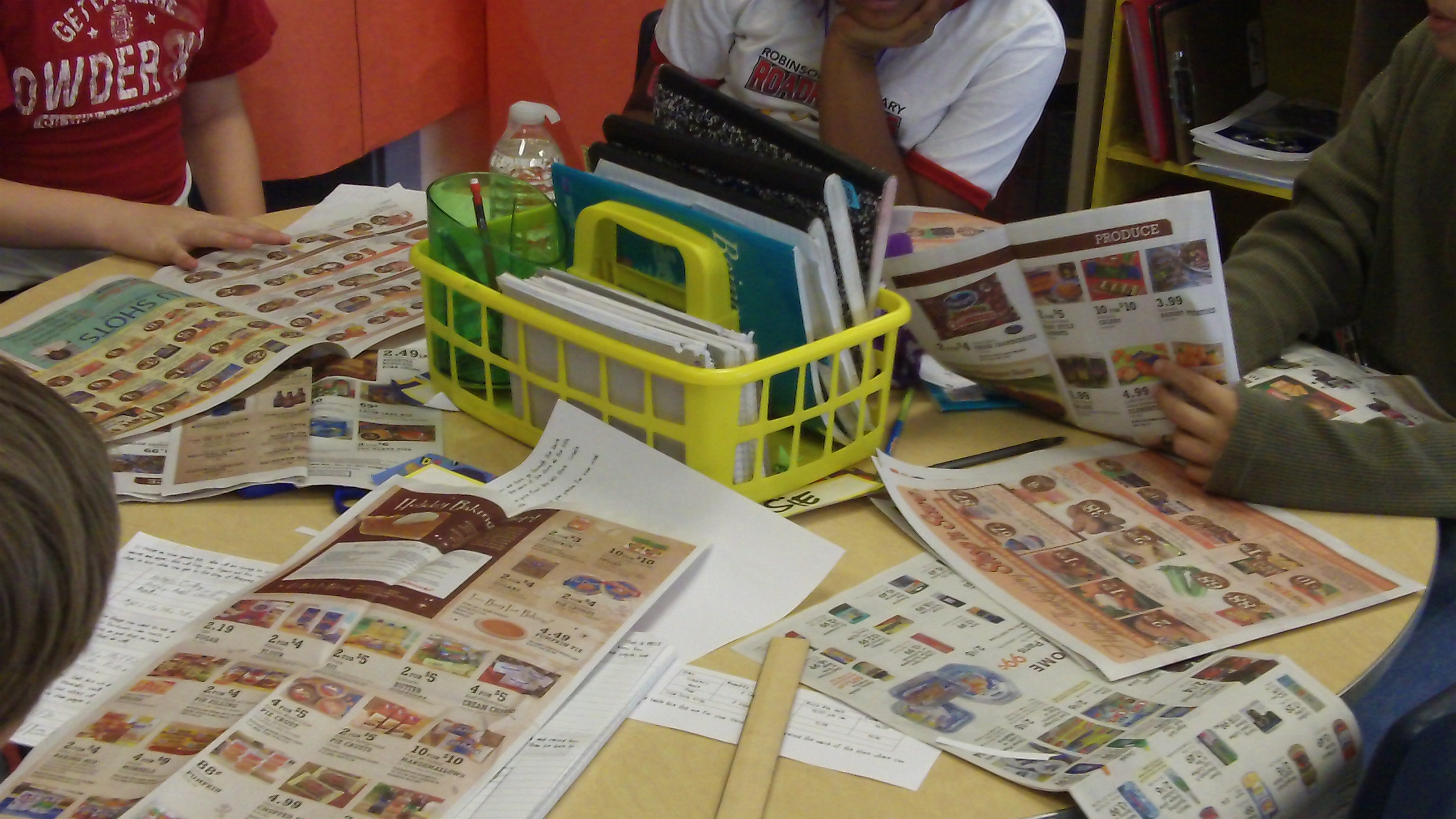
 Love how my friend M is so into the paper in this one! Can you see her behind there?
The other cool thing, besides a messy classroom and lots of kids saying things like “this is really fun!” or my friend D asking me to copy his plan so he could share it with his mom (love that!), was the togetherness that this project brought as they worked with each other. Truly a family feel in Rm. 201 today!

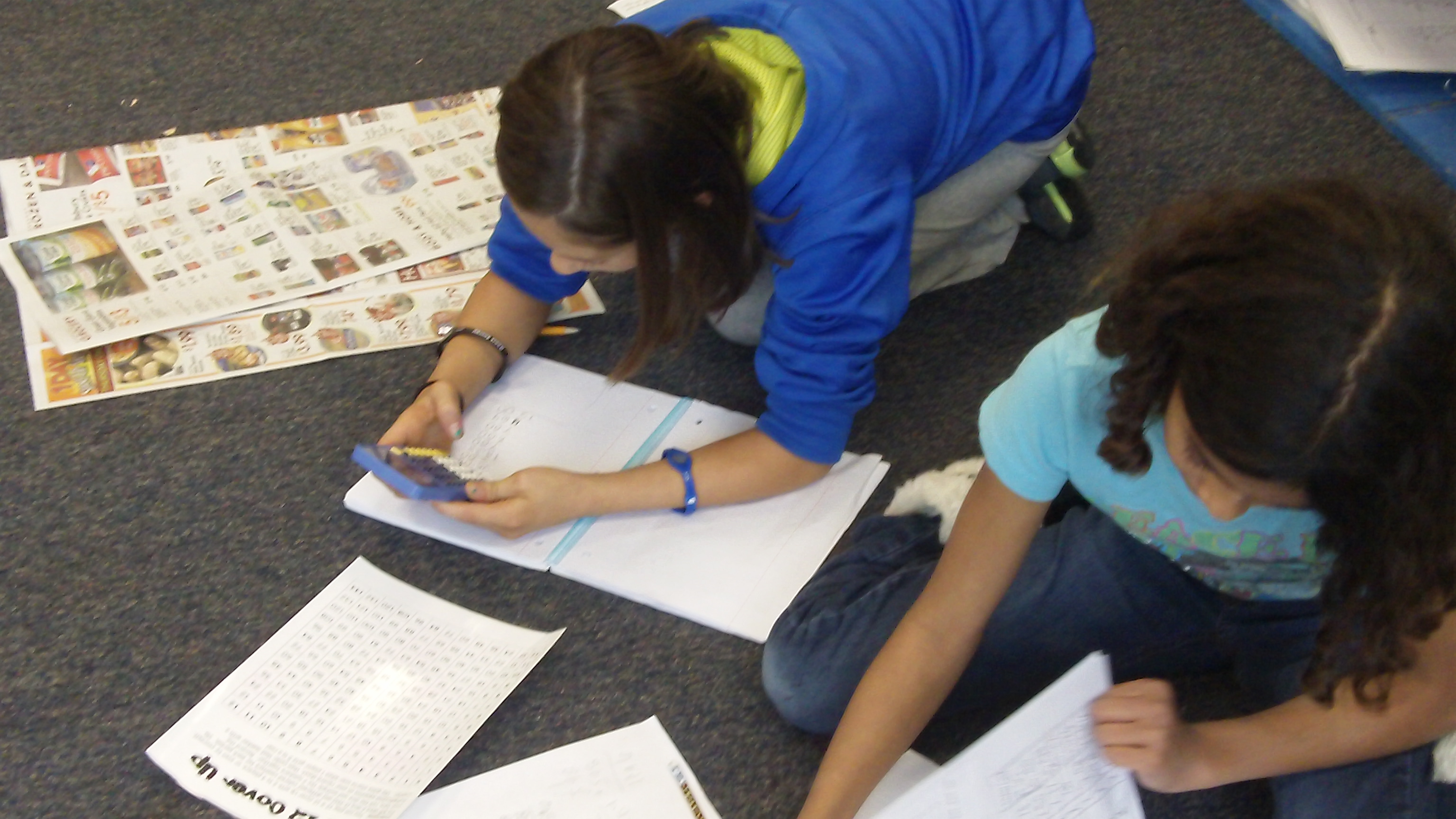
Happy Thanksgiving, friends!
At our school we use Investigations for math. One thing I love about the program is that it usually digs into the why of each math concept instead of just the how. It encourages students to create their own strategies for solving problems, emphasizing that there is not just one way to come to a solution. In the case of our fraction/decimal unit that we’re in now, we are doing more than just learning the rote definition of a fraction and coloring in fractional parts of pictures or just adding or subtracting them using the method I directly taught them–like I know I did in 5th grade. Instead, we are investigating and creating and figuring out and–most importantly in my opinion–using what we already know to discover something we don’t.
Here’s an example of what I’m talking about:
We are at the beginning of a unit called What’s the Portion?, which includes experiences with fractions, decimals and percents. Yesterday and Thursday we were working on figuring out the percent that is equivalent to a fraction. We started by making drawings on a 10X10 grid (which helped us “see” what was going on) since we know that percent means “out of a 100.”

We used this visual, and what we knew about fractions and percents already to figure out that 1/8 is equivalent to 12 1/2%, because 1/4 is 25% and an eighth is half of a fourth. Our music teacher, Mrs. Kesler, will be tickled to know that I even had one kiddo make the connection between this and what he knows about music notes to help him figure it out.
So after the initial idea of fraction and percent equivalents was presented, they were to dig in a little deeper. I gave them a chart to fill in, that had lots of other fractions to work with. I told them to fill in all that they could with the directions to NOT do thirds and sixths, that we’d do them the next day. But what they did instead, was make it their goal TO DO the thirds and sixths. In this case I didn’t really care that they did the opposite of what I said, because it meant that they were going to try something that might be a challenge, might stretch them a little, might give them questions to ask when we worked on it together.
And for the most part, they all totally rocked it. They made it look really easy. Like they’d been figuring out fraction and percent equivalents for years. (Ok, 5th grade readers—which character from one of our favorite read-alouds did that sound like? Comment on this post with your answer if you know!!)
Here’s what our chart looked like when we were done:
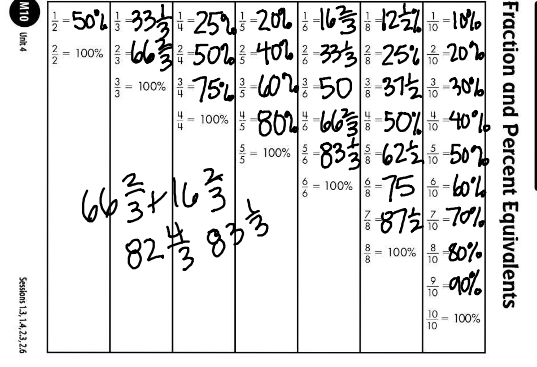 The thing that I think is really remarkable about the thinking behind this is that they are already getting comfortable with going back and forth between fractions and percentages, and can tell you how that relates to a group of things, like how getting 10 out of 20 of your spelling words right is 50% or that 3/4 of a class of 24 is 18. There is understanding being created that goes far beyond just memorizing definitions. I like that. And they like it, too.
 20somethingkids and 1kookyteacher
