EdcampSTL-take 3!

I went to my first EdcampSTL two years ago.  At that point I was a newbie on Twitter, and although I was excited about learning something new, I let my discomfort of going there by myself get in the way of having a great day.  I didn’t talk to anyone, didn’t make any connections, and can’t even remember walking away with anything.

Then there was last year.  EdcampSTL #2 was about 3000% better than the first go-round.  I know that some of it was because I went with friends–my best friend, my hubby, actually :)–and since I had been on Twitter a year longer, I had some familiar faces I’d “met” online to connect with, as well.  Plus, I guess like with most things, the second time you do something it’s always easier.  I met a great new friend, as well, and have been able to learn and share much with her since then, too.  Much better experience.

This year was the 3rd EdcampSTL, and it had the largest enrollment yet.  We were actually hoping for a record, but I think the weather kept some away from the fun. 😦 For those of us who were there, though, it was a great day!  I have to give a shoutout to by little bro, Chuck Baker, who is a fabulous teacher/father/tech guru/blogger, who came today for his first time!  He even got in on the fun and presented a session.  Gotta love the initiative there–I haven’t had the courage yet. 🙂  And then, yep, my more-than-fabulous hubby (who is also an amazing teacher, father and blogger in his own right!)  Grant was in on the fun again, too; I love that we can do this whole teaching thing (as well as our Masters’ program) together.   Adds a different level of help, support and even collaboration when he “gets” what I do.  LOVE YOU, honey!!

While I attended several great sessions this time around, I think I am most excited about the one where I learned more about Makerspaces.  I’ve been looking into Genius Hour for a little while now, and am also interested in problem/project based learning, and this was exciting to hear; two middle school science teachers shared real-life examples from their classrooms.  While it won’t look exactly the same in my situation, I’m interested in getting it all figured out.  I’m thinking about doing a really basic, Valentine’s version of a makerspace this week for Valentine’s boxes.  Not exactly how it’s supposed to work, but I think it could be a good way to introduce it.  Guess we’ll see!

I know to some it seems weird to go to school on a Saturday, to make a choice to get up early to learn on your day off.  Believe me, I wouldn’t do it for everything, but for EdcampSTL, it’s totally worth it!  Join me next year, will ya? 🙂


Mathematics in the City (in Kirkwood)

Mathematics in the City is an organization I learned about this summer when the fabulous Kara Imm came to Robinson to teach us about how to better teach addition/subtraction and multiplication/division of fractions using new units from Cathy Fosnot (another amazing math mind!).

Fast-forward to now: yesterday we (several 5th and 6th grade teachers and math specialists) were lucky to have Kara back again to continue to learn from her (and each other!) as we taught one of those units in our own classrooms!  We spent the morning planning our lesson, digging into the mathematics, talking about how we’d introduce the scenario, anticipating what kiddos would do and say, and brainstorming questions we’d ask our mathematicians to help “lift their thinking.”  Then our group (oh, did I mention there were like 15 teachers??) watched as Mrs. Hong taught the lesson in her room with her friends.  We got to “kid-watch” and take notes on what thinking they used, how they explained their work and also practice what we’d planned during our earlier session.

At lunch we debriefed on how the morning had gone, planning for how we’d change things based on the information we gathered.  Then it was time to plan for what would happen in my classroom later that day.

We decided that Kara would lead a number string with my students, focusing on fractions, but using the context of money.  Her string looked like this:

photo-27

See the red parts?  Those are the problems she gave students to solve (remember when we did number strings together at our Curriculum Night?  Same idea, only with a different concept).  The black is documenting kiddos’ thinking, and the blue is how she was modelling their thinking.  The story she told here (that gave kiddos an entry point and helped them make connections to what they know) was about how she’d found some money as she walked along this morning.  What a great way to talk about fractions huh?  TOTALLY made it less scary, and who doesn’t know at least SOMETHING about money?  The thinking they were able to share was fabulous, and the kiddos who felt confident to share their thinking was great, too; some kids who don’t normally share during number strings were more than willing to do so with this one!


I know that pictures of this totally don’t do the fabulous thinking justice, but here are some shots I captured during our work yesterday.  Check them out!

This slideshow requires JavaScript.

What a fabulous (man, I say that alot, but it’s true!) opportunity to learn with such great minds!  Can’t wait to see how this helps our math thinking progress as we begin a new investigation and more number strings!

If you’re a parent, be sure to share what your kiddos said about this experience.  If you’re a teacher, have you used number strings in your room?  Do you know Kara or Mathematics in the City?  Do you use Cathy Fosnot units with your learners?  What do you think of them??  I’D LOVE TO HEAR ABOUT IT!!


Narrative Writing Lessons

Happy Tuesday, friends!  It’s our first it’s-so-dark-and-rainy-we-had-to-turn-on-the-lights days of the fall.  Kind of gloomy, but also one of my favorite things about this time of year!  Weird, huh?

So..today we’re going to do some thinking together about writing RIGHT HERE ON THE BLOG!  I’m going to give you your job and then you will leave a comment on this post to share your thoughts with me and with the other writers in our room.  Ready?  Ok, here we go!

Below are two of the anchor charts we’ve been using during our study of narrative writing.  Reread them to yourself.

                       CAM00089              CAM00090

Now I want you to think about something from these charts that you know you have tried during this unit, either in your Writer’s  Notebook or your story.  Tell me about how you have used it in your comment below.   You could start your sentence with something like: “During our study of narratives, I learned…and I tried it in my writing by…”  Your words might sound different than that, but use the starter if you need it!  I can’t wait to hear about your smart thinking!  The pieces you are writing are pretty great, Rm. 202, and I’m excited to see where we continue to go as writers this year!

5th Grade On Stage

On May 21, 2013, 5th Grade did something they’d been working up to all year–they performed a musical that they had planned, written, choreographed, staged, costumed, and acted in!  It began as a seed of an idea early in the school year, and blossomed into something bigger better than we could have even imagined.  They really did a stellar job.  But not on their own: our amazingly fabulous music teacher, Mrs. Kesler, was there every step of the way helping them make their dream a reality.

The general premise was of a 5th grade class who was learning to write autobiographies in Writer’s Workshop and the scenes were the memories they came up with to write in their pieces.  A couple of them were “real-life”, like reminiscing about Missouri Day and Box Town, but the other two vignettes twisted truth a little further: one was about a visit one day in kindergarten from a leprechaun and his minions that involved an arm wrestle over some chocolate “gold”, and the other was a crazy escapade to Cahokia Mounds that involved lots of dancing.  It was a great example of what can happen when you let kids run with their ideas, focus on their passions and do what is often “off limits.”  Trusting them with the plan and the execution could have been hard for some, but I love that Mrs. Kesler knew that that was the right thing to do in order to really make it “theirs.”  And theirs it was.

(Wish I had more pictures of it–we really did work for almost 9 months on it.  But I only have pictures from the performance.  Boo. 😦 )

IMG_0876

Backstage on performance night with Jernandra, Sophia and Anna C. They were portraying kindergarteners in the scene with the leprechaun. I was Mrs. Bearden (quite a stretch, huh?)

IMG_0877

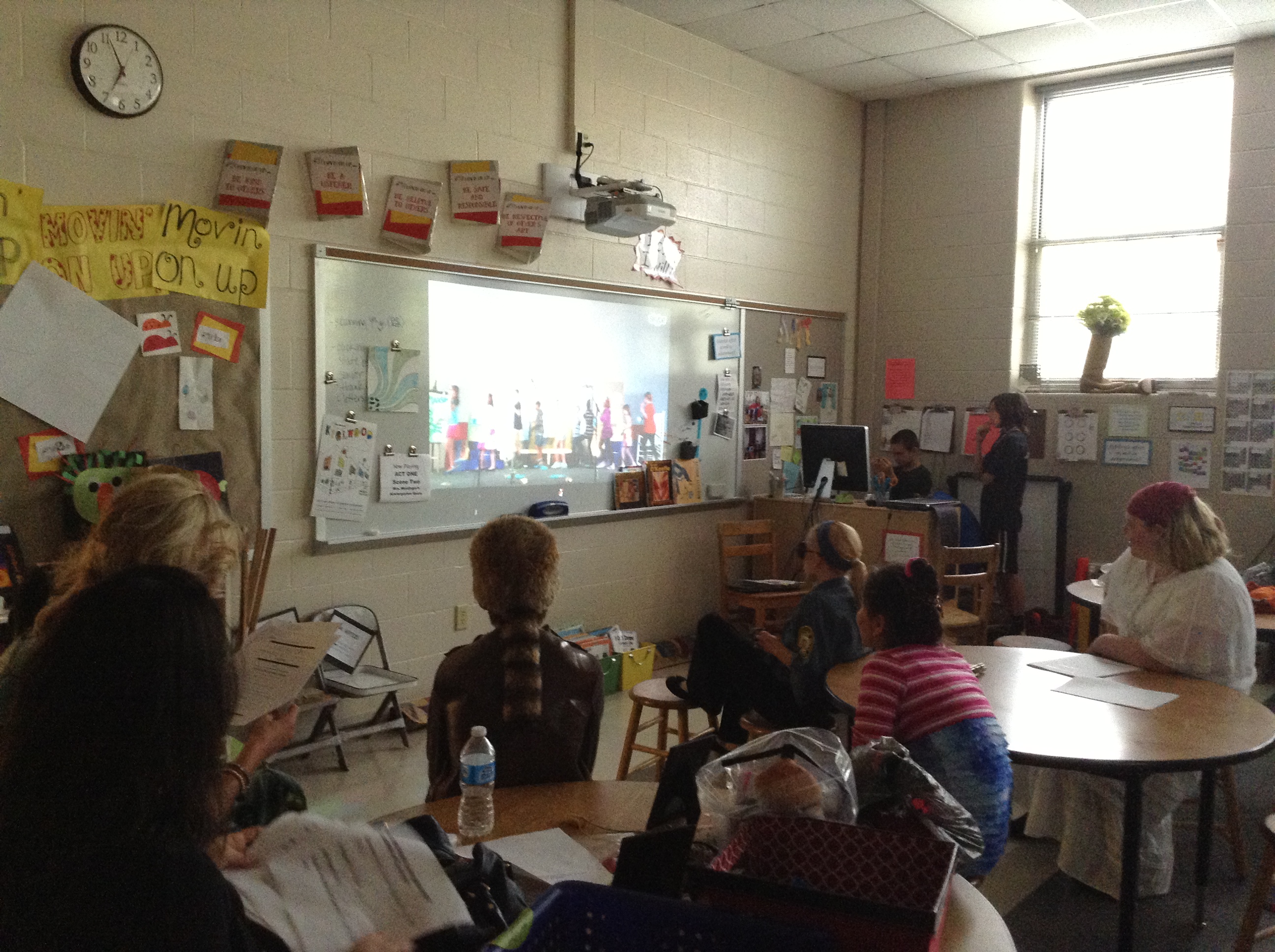
The art room worked as the “green room” for kids to wait in when they weren’t on stage. We had a Skype connection worked up between the gym and this room so we could see what was going on on stage. Teachers and students were in charge of following the script to help actors know when they needed to go over for their next scene. This was really a genius idea that worked out SUPER well!

IMG_0878

Aiden and Don were stage managers and did an amazing job of making sure it all went down as it should. They were in charge of lights, music and all other stage cues to keep us on track. Definitely the two best guys for the job!

IMG_0881

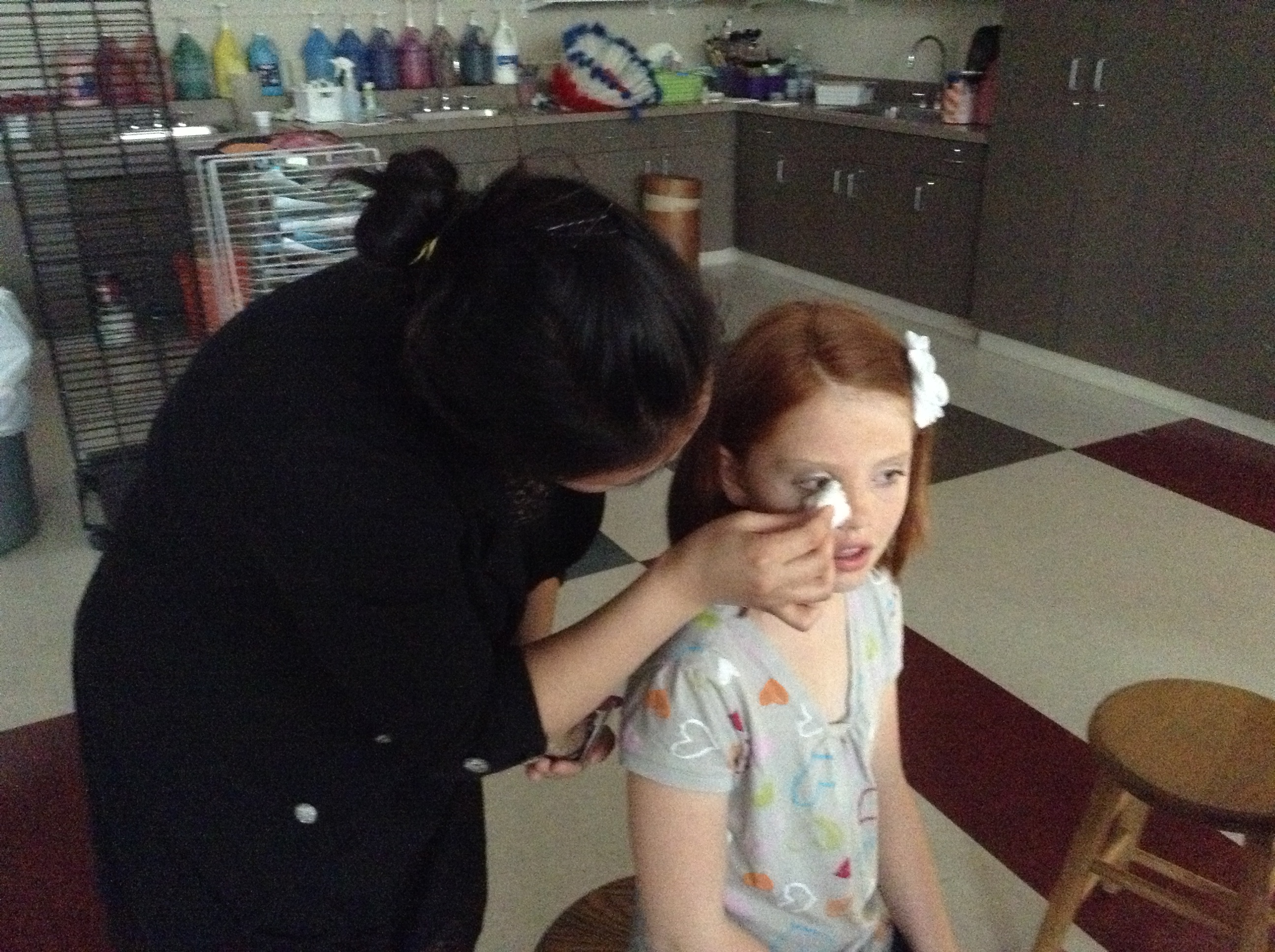
We call these next two pictures “The Many Hats of Mrs. Hong” because aside from being a fabulous teacher, she showed her skills in make-up…

IMG_0882

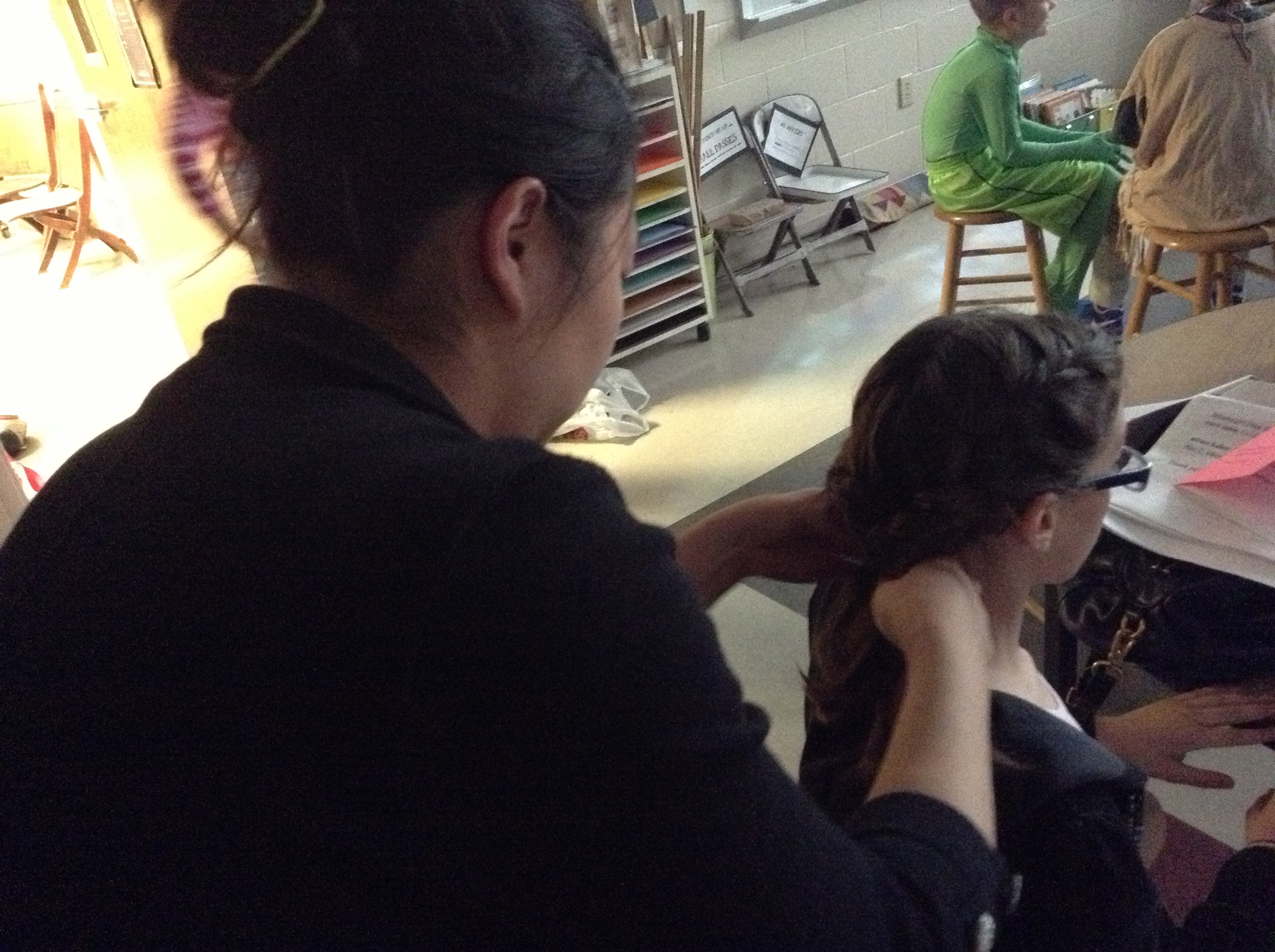
…and hair, as well. Is there anything she can’t do? I don’t think so. 🙂

group pic

Group pic after the performance

  Have you ever taken on a huge project like this one?  How did it go?  What did you learn?

I Speak Greek When I Teach Math

Or maybe it’s Spanish or Chinese or Pig-Latin, but today I felt like I was definitely not speaking English to my kiddos during math.  Meaning no one understood what I was trying to explain, and many kids ended up more confused than when we first started.  WHAT?  It’s not like I’m new at this, nor to the topic.  We were even working on a problem that I made up!  Needless to say, we all wanted to throw in the towel, or rip up our papers and start over.  Or something else that you shouldn’t do when you’re frustrated.  And no, in case you’re wondering–we didn’t.  But we did put the problem away until tomorrow when we’re fresh and can tackle it again.  And I am already armed with a different plan for how to address it, but am hoping you can help me, too!  (And by the way, after how fabulous the first round of problems-with-posters went the other day, this was all the more mind boggling!)

Ok, so I’m hoping that you can help me figure out what might be making my friends so confused.  Here is the problem that we were working on yesterday and today:

Screen Shot 2013-04-17 at 8.55.41 PM

This problem is 1) based on a real-life problem, 2) uses math skills we already have (or at least that are not new!), and 3) really just focuses on making sure they use clear and concise notation to record their solution and thoughts.

Part 2

Part 2

PLEASE give me feedback on parts you see that may  have tripped them up.  After working on it for two days, I see a couple of things, but I really expected this to be a rather simple fraction problem; the difficulties they were having were not ones I had anticipated.  My hope was they could focus on the poster part, as a prep for how they’d answer questions as we start testing next week.  Instead, now they’re all convinced that math is hard and confusing.  Pretty much a teacher fail, huh? 😦

Thoughts?  Oh, and I guess it’s a given that I want you to be nice.  Truthful, but nice, please. 🙂  And maybe you could even tell me what you think the answer is.  That might help me see if the problem reads the way I intended it to.  THANK YOU, FRIENDS!

Dichotomous Keys, WebQuests and the Zoo–Part 1

We have been busy scientists lately in Rm. 202.  Let me tell you about it! (And also let me apologize for not writing about Science very often.  This may be one of the first posts I’ve ever included about our lives as scientists…boo. 😦 )

During 3rd quarter we were busy learning about many things.  The latest science unit we ventured through was one on Living Systems, specifically animal classification.

One thing we focused on was dichotomous keys.  What?  You’ve never heard of them?  Well before I started teaching about them in 4th grade several years ago, I hadn’t either!  Well at least I didn’t know that’s what they were called.  Let me show you what I mean:

Dichotomous key to determine Silly Scientist names of common items

Dichotomous key to determine Silly Scientist names of common items

The goal is for students to be able to use keys like this to identify animals, but we started somewhere else.  With shoes.  We worked first to CREATE a dichotomous key, so we’d know how it works, and then we practiced using it.

We began by putting everyone’s shoes in a big pile on the floor.  Then, we had to decide two groups that we could classify all those shoes into (see, the dichotomy part–two groups).  Here’s how we started:

Screen Shot 2013-03-24 at 4.32.20 PM

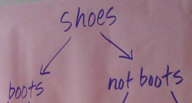
Shoes were put into one of two groups: boots or not boots.

Then, with two groups, we tackled the “boots” pile first.  Again, we asked ourselves what two groups we could make.  This was pretty easy, and so we decided on:

Screen Shot 2013-03-24 at 5.10.32 PM

Only two choices with this one! There were two boots, one was brown and the other was not. We could quickly label those as Natalie and ZB202’s shoes.

Next we had a big ‘ole pile of everyone else’ shoes to classify.  We started like this:

Screen Shot 2013-03-24 at 4.36.59 PM

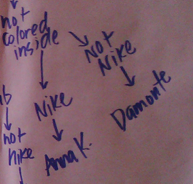
We looked at shoelaces on all those “not boots.” They all happened to be tennis shoes, by the way.

Screen Shot 2013-03-24 at 4.40.24 PM

Two more: this time looking at the inside of the shoes

Screen Shot 2013-03-24 at 4.43.15 PM

The last step here was pretty easy: only two shoes left, one was a Nike and the other was not. So we could then label one of them as Anna’s and the other as Damonte’s.

Screen Shot 2013-03-24 at 5.04.23 PM

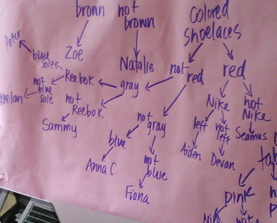
The other side (colored insides) was a little bigger, so needed more groups: tab/no tab, then Nike/not Nike, and pink/not pink and blue/not blue.

After that pile was classified and labeled, we could tackle the other side of the “not boots” bunch, which was colored shoelaces.

Screen Shot 2013-03-24 at 5.14.38 PM

You can see that we had many more small categories in this group, but went through the same process: what two groups could we break the larger one into?

And so once we were finished, our key looked like a beautiful tree, and ended with everyone’s names.  We could now use that key to determine whose shoe was whose.

IMG275

Devan uses our dichotomous key to identify Sophia’s shoe.

Here is Natalie in action, proving how she knows who shoe she has in her hand:

After we had practiced with this dichotomous key that we built, kiddos had a go at the one from the top up there, where they had to identify the silly scientific names of these common items:

1. a die

2. a small paperclip

3. a large paperclip

4. a piece of chalk

5. a popsicle stick

6. a colored marble

7. a white marble

8. a sharpened pencil

9. an unsharpened pencil

10. an eraser

Could you do it?  Use this dichotomous key and tell us what you think the names of each of these items are.  Good luck!

Screen Shot 2013-03-24 at 4.20.51 PM

Life Lessons I Learned on my Treadmill

I am a thinker.  If you know me, you probably know that I ask a LOT of questions, and that I am always chewing on something.  It’s great to know that if you’re ever in a meeting with me, too, because I will often not have any answers for you on what I think about the topic right then–but if you get back with me the next day, I’ll have a big, long list of things I want to talk to you about!

I’ve shared some of that thinking here before, related to me as a reader and a writer.  I’ve even wrote about things you should know about me as a runner.

And so that brings me to this post here today: Life Lessons I Learned on My Treadmill.  Surprisingly, even when I’m running and sweating on my treadmill at night, my brain is working.  I’m thinking.  And usually I’m thinking about what I’m going to write about next, or what I will write at my next Facebook status (weird, I know. 🙂 ).

Hope you’ll enjoy what I was thinking about during my run tonight:

1. Just do it.  Even if you don’t want to.  There are times in each of our lives when we don’t want to do something, but know it’s good for us, or maybe that we have to do it because someone’s told us to, or is expecting us to.  Tonight was one of those nights when I just wanted to sit on my couch and veg out–to check my email and Facebook, hang out on Twitter and blog.  But what I needed to do was run.  It was a running day (every other day is), and it shouldn’t matter if I’m tired.  And so I had to ignore those voices screaming in my head for me to be lazy and just. Do. It.  And you know what?  Once I got started, I was SO glad I had made that decision.  And just like with running, sometimes you just have to stop thinking about how much you DON’T want to do it (a project, homework, the laundry, whatever) and DO it.  Usually that takes less time than the whining part anyway.

2. Take someone with you.  In this case my “someone” is not a real “someone,” but is instead a music playlist.  Many times when I run, I watch TV–shows that no one else in my house cares about, that I can watch while I’m alone and exercising.  Tonight, though, I took my friends from Pandora with me instead, and it made the time pass much more quickly.  Instead of paying attention to the clock or the time I had left in my workout, I was singing along (yes, at the top of my lungs!) and not even noticing the time.  Many things are like that–having a friend (real or on the radio) there to chat with, laugh with, learn with makes the whole thing much more enjoyable.  You might even learn something new without knowing it.

3. You just feel better when you’re moving. This one might be a personal opinion rather than something I’ve learned, but I can definitely say I feel loads better when I’m moving than when I’m not.  There were some weeks months when I wasn’t doing anything in terms of exercise.  I had started running a year or so ago, and was loving it and what it had done to me and for me physically.  And then school started again.  And I started my Masters program.  And I had a little one start kindergarten.  You get the idea.  Suddenly I looked up and it was JANUARY and I hadn’t run a single step since August.  And I didn’t feel very well.  I was sluggish, run down and just felt plain icky.  And yes, I had gotten a little larger than where I was at the end of the summer.  And so just after the first of the year I started over and relaced my running shoes.  And am feeling so amazing again.  Now it’s hard NOT to run because of the fabulous way it makes me feel when I do it. (I’m not really sure how this one relates to learning specifically, except for I guess that your brain works better when you’re active than when you’re a couch potato.  It’s a muscle, right?)

4. You will make time for what’s important to you. This one is true about whatever it is in your life that you want to do, but for me it’s running and writing.  People often ask me how I find time to keep up with this blog, do what I need to do as a wife, mother and teacher, running, etc. and the short answer is that I make it.  Ok, really I tell them that I don’t sleep.  But that’s not at all true because I love me a good nap!  We all have the same number of hours in the day; it’s about how you use them.  Instead of watching TV or playing a game, I choose to write on my blog or read a book I want to share with my 5th graders.  Instead of watching TV (or WHILE I’m watching TV) I run.  And so I guess another part of the answer is that I am a master at multi-tasking.  I don’t do much sitting.  I do many things all at the same time, because I want to make sure I have time to do them all.  Doing the things that are important to you first is another strategy I choose to employ, too, and then I make sure there’s time for them.  If you want to, you will.

5. Think before.  I was going to make that title say “Think before you speak,” but then I thought about it (ha!), and really I’d say it’s a great thing to do before you do LOTS of things: think before you speak, think before you write, think before you act, think before you eat, think before (and while!) you read, etc…thinking is just a good thing in general, and there are many people who just don’t do it!  They move and do and go, without really knowing where they’re going or why, what they’ll do when they get there, or the process they’re going to use while they’re there.  I mentioned already that I am always thinking.  The whole time I was running, I was drafting what this blog post would sound like!  See? Multi-tasking.

6. Smile. Smiling just makes everything better, and can even fool you into liking something you didn’t think you would.  Plus it makes your face look nicer. 🙂

7. Don’t listen to Adele Radio.  That Pandora station doesn’t play enough Adele.  Pick the Sara Bareilles station instead.  Much better stuff.

Your turn: what life lessons have you learned lately?  Where or when did you learn them?  Share your ideas with me and my students!  We’d love to learn from you!


Read Around

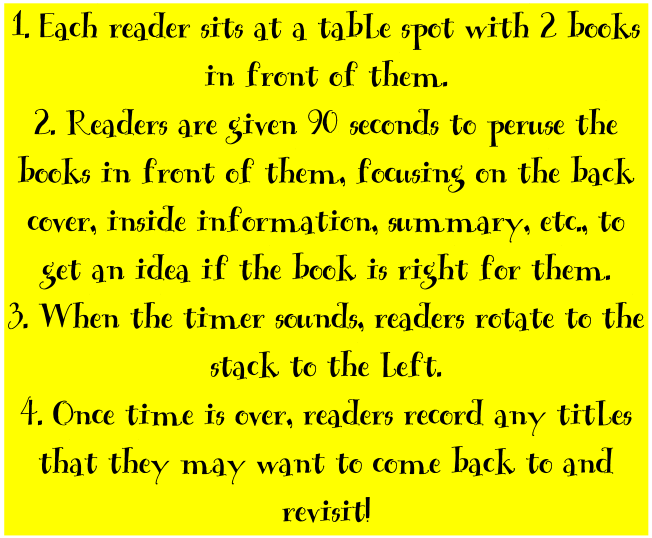
A few months ago, our librarian shared a phenomenal strategy with us for exposing readers to new (and sometimes old!) books–a Read Around.   The directions were pretty basic:

Screen Shot 2013-03-11 at 9.39.43 PM

Mrs. Meihaus’ purpose was to (re)introduce older readers to books they may have missed (or overlooked because they have old covers) and encourage them to try some new things.  In the 40 minutes we spent in the activity, we were able to peruse (which was a word she taught us the meaning of and how to do) over 40 new (or old!) titles that we were previously not on our 5th grade radars!  What a gift!  It was great to hear how many kiddos found some fabulous new try-its–even the ones who only read certain titles or series.  Impressive, really.

Well…I liked the strategy so much, that I knew I had to do it in my own classroom library.  Just like in Mrs. Meihaus’ library downstairs, I have books that are FABULOUS stories, but may be a few years old, or have a worn cover.  Classics, really, that need a second chance.

So we tried it for ourselves.

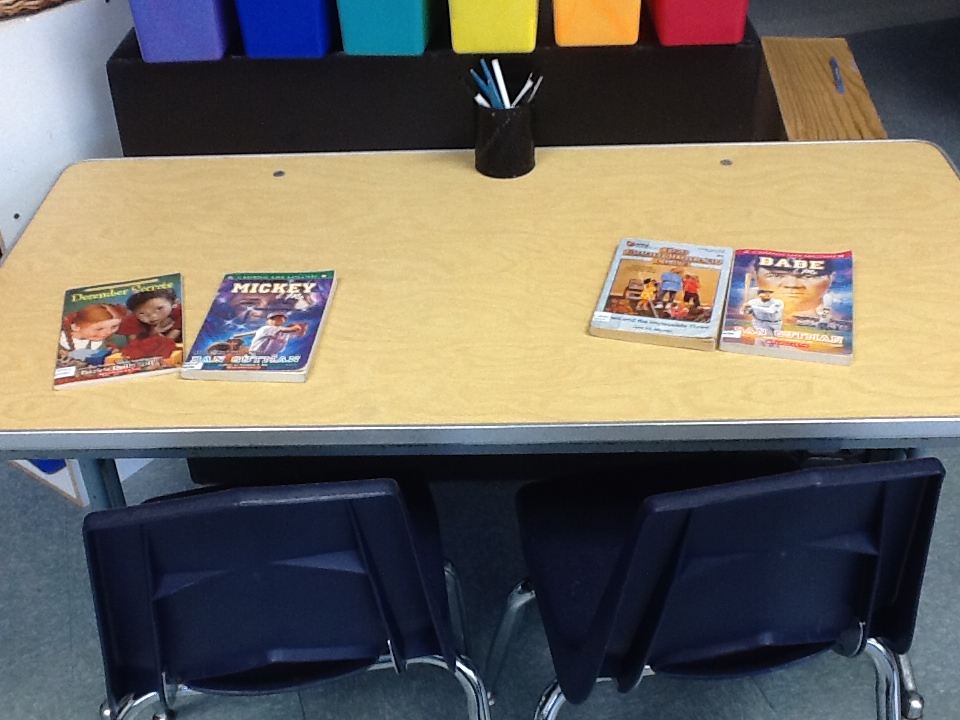
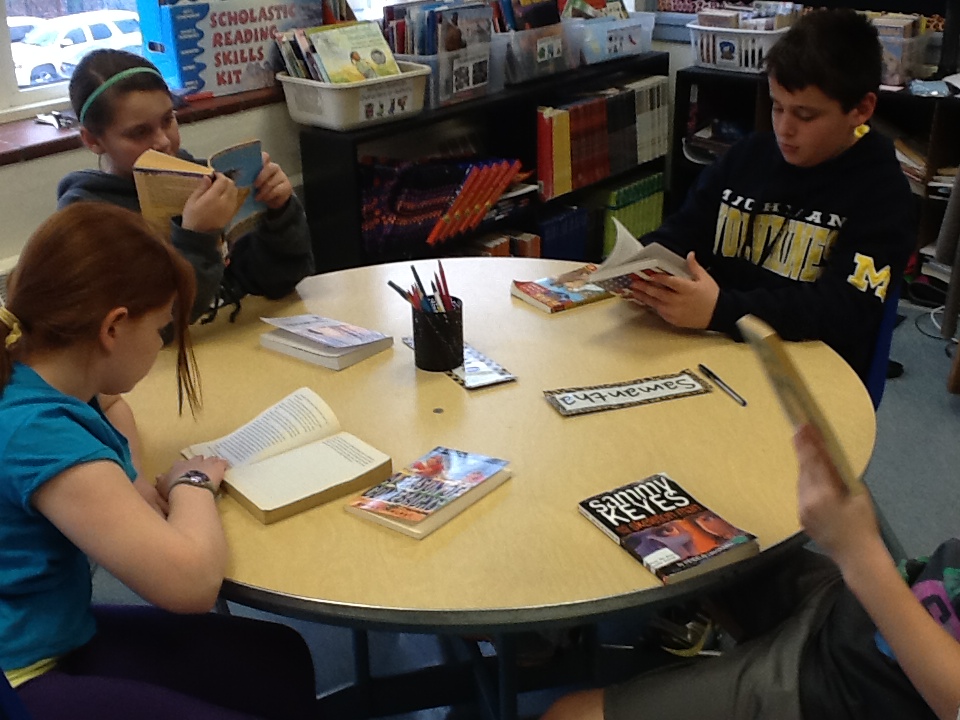
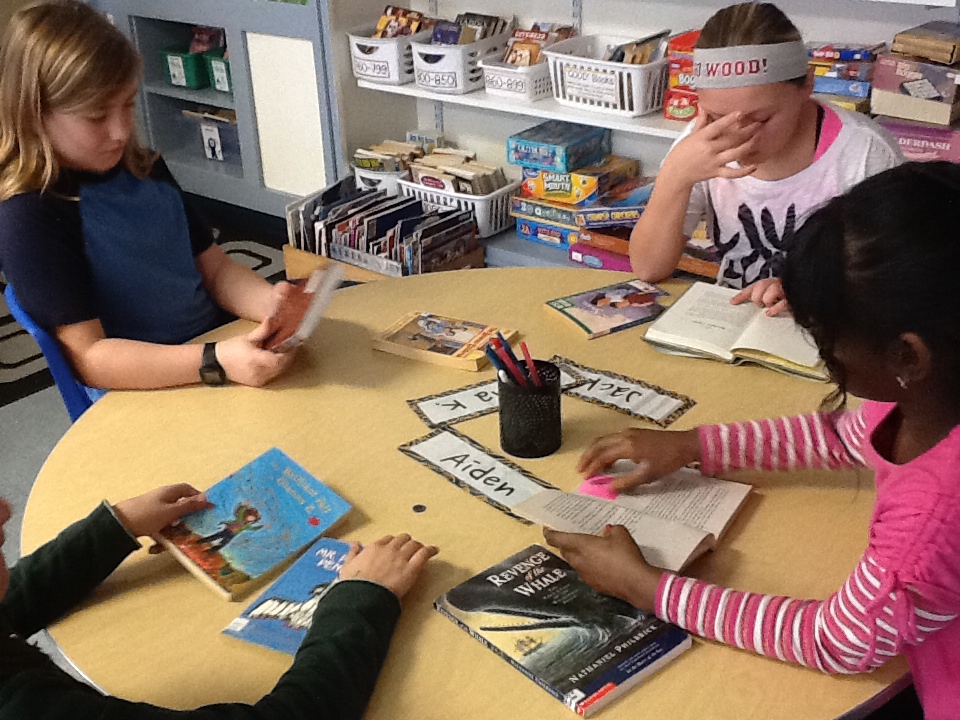
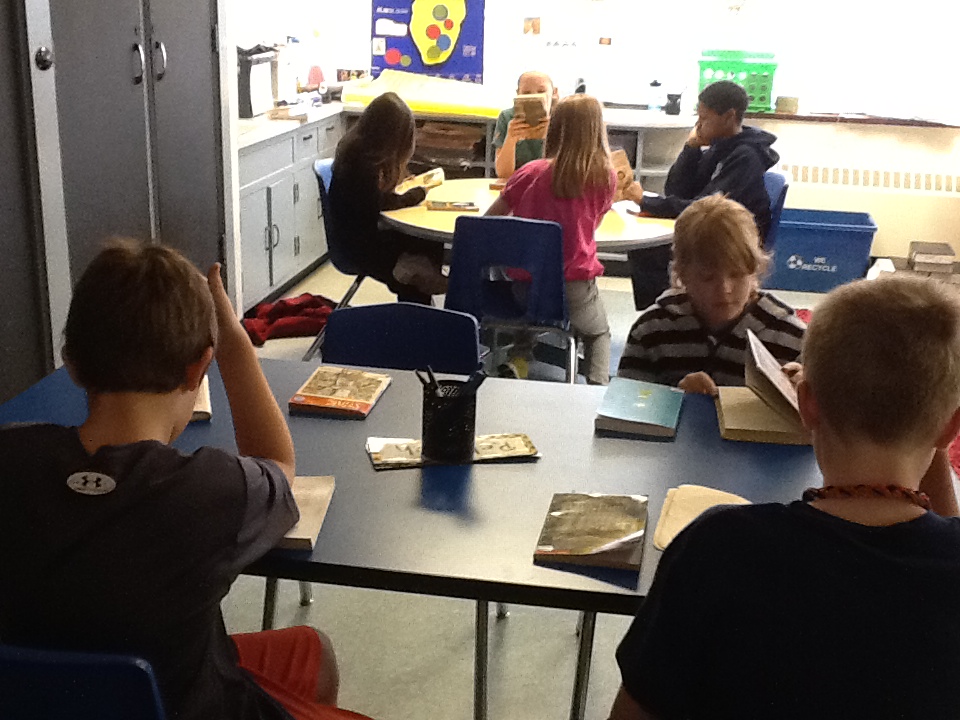
Tables started out like this, with two books at each seat.

Tables started out like this, with two books at each seat.

IMG_0678

Learning how to peruse is a useful new skill!

IMG_0677

One part of perusing that many kiddos tried was reading the first few pages.

IMG_0676

I pulled out many unread (old and new) books for readers to try.

IMG_0675

I love how serious and diligent my readers are during things like this–they really dig in deep and learn well. 🙂

Have you ever done a Read Around?  How did it go?  Did you find a new book you didn’t think you’d read?  Tell us about it!

Mystery Skype–Ecuador Style!

This week we were busy with a whole LOAD of fabulous things, but maybe our favorite was when we did a Mystery Skype with Ms. Turken on Thursday!  She is a beloved teacher who used to work at our school, but who has taken a year away to teach English in Ecuador.  That’s pretty amazing, right?

Well, when we had an opportunity to chat with her, we were beyond excited!  The best part, though, in my mind, was that most kiddos in my class didn’t know that she was where she was, so we decided to do a Mystery Skype with her.

IMG259

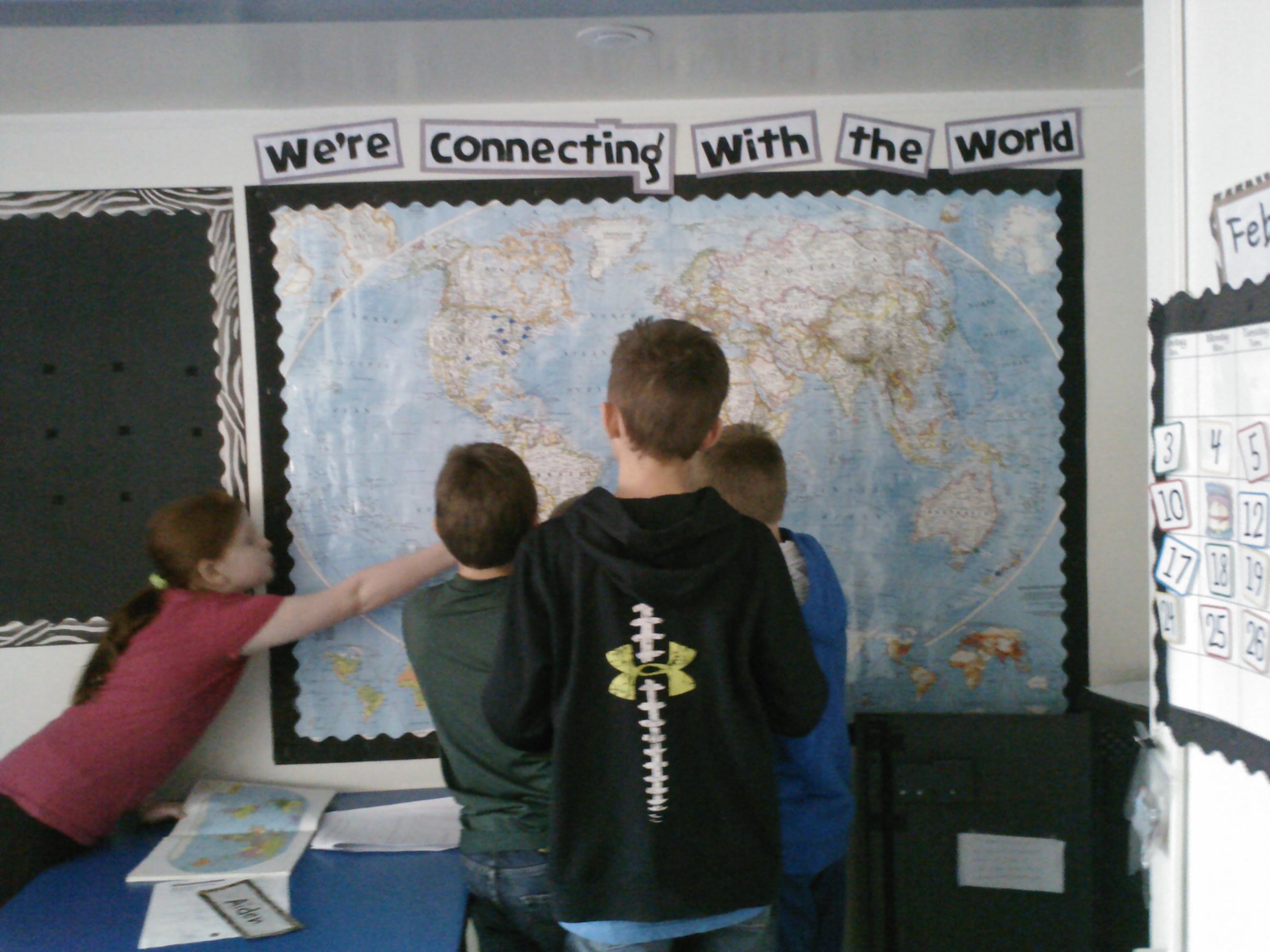
It started in much the same way as the ones we’ve done previously this year–with us asking questions, using the computer and our big world map to figure out clues related to the answers, and then narrowing in on the location of our Mystery Skyper.

Sammy uses Google to help us figure out Ms. Turken's location.

Sammy uses Google to help us figure out Ms. Turken’s location.  I think at this point we’re even trying to zoom in as far as her town–Riobamba.

This map has been a very busy place in our classroom lately!

This map has been a very busy place in our classroom lately!

This was a special Mystery Skype, though, for a couple of reasons.  First of all, Mr. Kieschnick’s class came to sit in with us, so that they could learn how to do Mystery Skype, too.  That meant that we had 40 heads to help us figure out the clues instead of just our 20!  We kept talking, too, once we knew Ms. Turken’s location, since, of course, the real reason we called was to visit with our old friend.  She told us all about her life in Ecuador, including the food, her classroom where she teaches English, and she even gave us a little tour of the house where she’s living.  We learned many things about her (which I think I will leave for my students to tell you in the comments!), and had a great conversation.

So many kids in the room for this one!  That's Mr. Kieschnick in the corner of this picture.

So many kids in the room for this one! That’s Mr. Kieschnick in the corner of this picture.

And then, something very cool–and unexpected–happened.  Since Ms. Turken teaches English, but has to know how to both speak and understand Spanish to do that, someone asked that she speak to us in Spanish so we could hear what they sounds like.  Well, that’s a little bit weird unless you have a reason to be saying something, or someone to speak to in Spanish.  Remember how I told you that Mr. K’s class was there?  Well, a friend of his, Andres, piped up and offered to have a quick conversation with Ms. Turken in Spanish while we all watched and listened.  Perfect!

Ms. Turken began by asking him about school (escuela).  They went back and forth, and I know enough Spanish that I could figure out they were talking about math (mathematicas) and books (libras).  So while I couldn’t join in on the conversation, I could at least follow along.  Sophia, whose dad is from Peru, was also helpful in translating much of it to those sitting by her.  It was so cool to see the looks on everyone’s faces while Ms. Turken and Andres rattled away in another language–I know I heard “How do they do that?” several times and definitely saw big smiles and wide eyes on the faces of many.

Thank you, Ms. Turken, for a great morning, getting to know more about you and the adventures you are having in Ecuador!  We’re excited to learn more (she sent us questions to research) and to speak to you again soon!

Adios!


EDUC 573: Week 5–I Went to School on a Saturday

Yep, you heard me right.  I got up at 5:45 (which is WAY earlier than a school day), drove my kids 30 minutes to my mom’s house, then drove about 40 minutes in the other direction to go to school on a Saturday.  And it was all by choice.

EdCampStl was the reason.  What’s EdCamp?  Well, it’s honestly just a bunch of teachers who all gather at a school together on a Saturday to learn together, and what that learning is is not decided until we all arrive.  Sessions are planned on the fly, based on what people know and what they want to know.  You’re encouraged to sit in on as many sessions as you can, moving from one to another if it doesn’t end up meeting your needs.  For more about what your brain looks like on EdCamp, check out Krissy Venosdales’ blog where she wrote about it this weekend.

I attended my first EdCamp last year, and this was even more fabulous!  Last time I went alone, which was a little bit daunting, because I am not the most outgoing person.  I had a fine time, but didn’t really talk to anybody or make any new connections.  I did learn more about using social media in the classroom, but didn’t really take away anything I could implement right away.

This time, I was really excited to be able to finally meet some of my online “friends” in person, putting a real face to the avatar I’ve been looking at for the last year!  This was better than I even anticipated, and will make the connection we share online even stronger.  I attended some pretty great sessions, too, where I  learned about a new iPad app, how to use Google forms in the classroom, more about collaborative groups and had a discussion about the impact of ELA Common Core on what we do in our day-to-day teaching lives.

For me, it was the conversations that made this year different.  We’ve been talking alot about PLNs lately, and I definitely have some pretty fabulous people in mine.  Being able to sit in the same room as them and share ideas was a little bit surreal.  Kinda like nerd heaven, really.  And the best part was that since we’re connected on Twitter (which is where I learned about the whole EdCamp experience in the first place), we could keep  the conversation going even after the day was over.  Our learning continues beyond the conference, which is not always something that happens.

I feel really lucky to be a part of a PLN of some really smart, risk-taking, innovative educators from whom I learn something new every time I log on (which is pretty much every day!).  I can truly say that without them, I would not be the teacher I am today. 🙂

Are you a member of a PLN?  Why do you like it?  What do you learn from your PLN?  Have you been to EdCamp?  Tell me about it!