We have been studying Earth and how it changes. We’ve talked about slow changes like weathering and erosion; fast changes like earthquakes, volcanoes and floods; landforms like plateaus, mountains, plains, barrier islands (which I have to admit I didn’t really know about!); and about bodies of water. Because we needed to breathe a little bit of life into our work after having been discussing and watching videos for a few days, and because I know my kiddos are builders and creators at heart, I tried to figure out a design challenge of sorts that we could try. There were many options I could have employed (and still might), but I thought that bodies of water would be a nice place to start.
So kiddos chose groups (in 4s) and then I explained their job: Create a representation of the body of water they get (I passed out cards to each group) so that everyone else can guess what it is. They had options for research before they got started if they needed clarification on the characteristics of their body of water, and they could use whatever supplies in our room that they wanted. There was a 30 minute time limit.
So do you think you can guess what each one is? Try it out. Here is body of water #1, a picture and a video (oh, and the video might have a spoiler, so guess before you watch it!):
Ok, here’s #2:
Try it with group #3:
Group #4 made this:
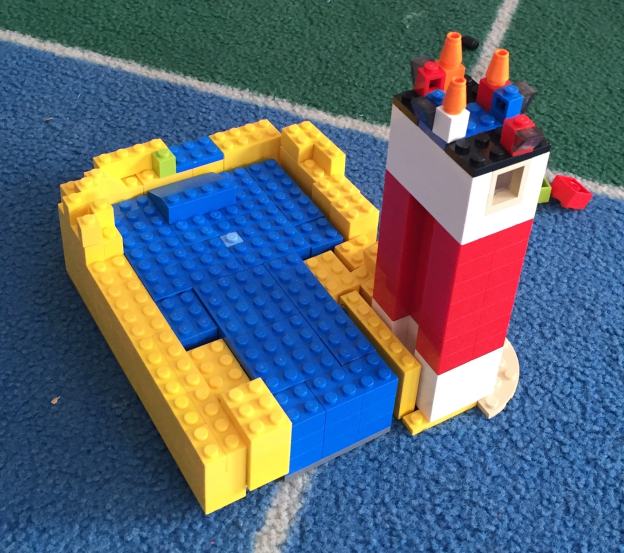
Check out #5, made with Legos:
Ok, and now that you’re done, check your answers. Promise that you’ve tried it?
#1–ocean #2–creek #3–lake #4–river #5–bay
The best part? We had fun, we learned alot and the only thing I’ve heard since we finished is “When are we going to do this again??” 🙂
This week we had a pretty great team of Special Olympians compete and then we had an even more great tradition of welcoming them all back from the competition by having everyone meet on the front steps with signs and cheers. Check it out:
I know, pictures just don’t do it justice. Ok, here’s a video, too. 🙂
It’s a small gesture in many ways, but I think speaks to the great big hearts of all of the students and teachers in our school community. We are definitely ONE. Way to go, Robinson kiddos! 🙂
We started a new unit this week on geometry, but aren’t all quite solid with adding and subtracting within 1000 yet, so we came back to that as well.
Monday
Somehow I got home today (it’s Friday, when I usually post these while I am eating pizza and watching our family movie) without a picture of Monday’s MWU. Oh well, I’ll just tell you. The chart simply asked the question “What is a polygon?” Well, I thought it asked it simply, but I was surprised that many kiddos answered it very differently than I expected. What I thought I was asking them to tell me was the definition of a polygon. What most of them game me was a picture of a hexagon. Those that didn’t draw a hexagon pretty much described one in a few words. I was puzzled by their responses, but as has happened more than once with these problems, it was a great lesson in asking better questions. Had I asked “What is the definition of a polygon?” or even “Use words to tell what you know about polygons,” it would have made more sense to them. I guess I did get information that they knew that a hexagon was a polygon, and that they didn’t understand the word itself, too, so it wasn’t a total wash. LOL
Tuesday
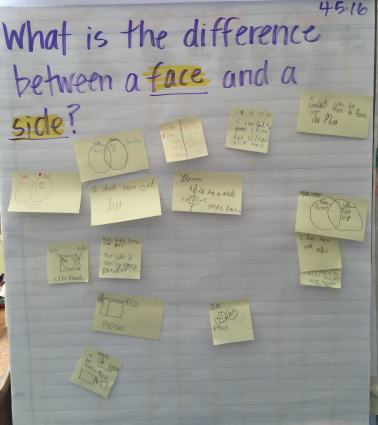
This one was another attempt at a vocabulary question, and was based on responses to the pretest from our geometry unit. We had a great conversation about the difference between these two things, and how one is for 2D shapes and the other is for 3D. We got out the rectangular prism and a Power Polygon that was a square and looked at the differences. Oh, and notice how they connected the word “difference” with comparison, and so many of them drew a Venn Diagram. Nice work, Rm. 202 kiddos!
Thursday
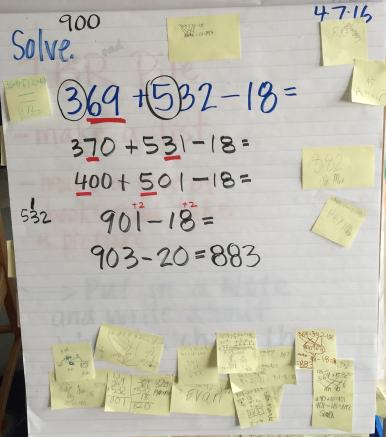
This was a great day, because Ja’Mia and Ava volunteered to create our Math Warm-Up (like has happened with lots of things in our room lately!), so I told them to have a go. They had to solve their problem, too, so that they would know if we got it right. Unfortunately I changed the numbers just a teeny bit when I wrote it, but I do know I got the -18 part correct from their original problem. Check it out:
Want to explain a couple of things on the chart, based on our conversation. The 900 at the top is because we talked about how estimating the answer before we solve the problem is a way of helping us know if we’re right. We knew that the 300 and 500 would be at least 800, but then since both of the numbers were so big, it would be closer to 900 than 800. We decided that the 69 in 369 was screaming at us (do you hear it??) that we should compensate and make the problem easier so we moved 1 from the 532 and made 370+531. Then we moved 30 over to the 370 to make 400 and added together the resulting numbers. Once we got to 901 – 18, we remembered what we had learned about constant difference and knew that if we added the same thing to both numbers we could get the same answer with an easier problem–thus we did 903-20, which is super easier than subtracting 18. I was impressed with their hard work and glad to see that so many of them could apply the strategies we’ve been practicing.
Friday
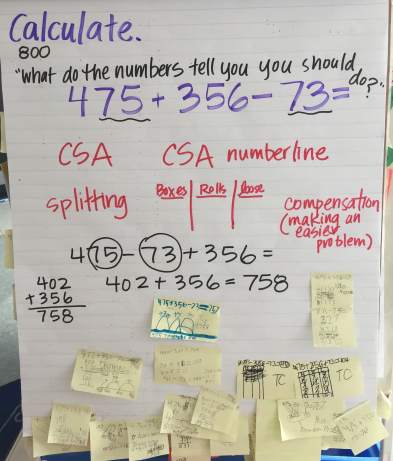
Today is a busy morning usually, because we do a Week-in-Review sheet that takes the place of the math warm-up. Often we don’t even get to it, but I decided to try it as our right-back-from-recess activity and it worked pretty well. We tried another one like yesterday’s but I changed the numbers a bit.
This one has many annotations, too. Let me explain:
We had to have a quick explanation of the directions, as many of them thought I meant that they should use their calculator. I just meant I wanted them to figure it out. 🙂 The 800 is our estimate, which we figured out by thinking about 500 + 400, but then realizing that 73 is about 100 so we subtracted that next. The red words were a request for a reminder of the strategies we have learned (as well as a reminder that I still owe them an anchor chart!): Circle, Split, Add; Circle, Split, Add with a number line; splitting; a chart that we’d used during our investigation into the T-Shirt Factory (that is really a visual form of regrouping 10s/1s); and compensation (making an easier problem). As we were deciding upon a strategy to try together, I reminded them that good mathematicians choose one based on what the numbers tell them, not based on their favorite or the one they know the best. Kiddos decided that the numbers were telling them to subtract first, because they noticed that the 75 in 475 could help us subtract the 73. Once we rearranged the numbers, we realized our problem was a SUPER easy addition problem.
On a side note, at our class meeting today, the topic of math came up and many kiddos marked it as their “trouble spot” with a red dot.
Again I was puzzled by this (probably because I define trouble spots as places where our class has something to figure out together or areas/activity where our choices could use some reworking and they instead mark them as things that were hard for them to figure out), so I had them explain. Many said that the warm-ups were hard this week because they had to both add and subtract in the same problem. We came to the conclusion that it was probably “hard” because we still needed practice. We also discussed that labeling something as “hard” can sometimes lead us to believe we can’t do it. If our self-talk is always negative instead of saying “I just don’t get it YET”, that ends up being our reality because we’ve quit trying. We agreed that I could give them just one operation in a problem and that they would work on positive self-talk as they tackled these tricky problems next week. Win/win. 🙂
You might remember that last year we prepared for a Mystery Skype by Skyping with Ms. Turken’s class INSIDE of our school. We were ready and had a plan, but then our Skype that we had scheduled fell through. Somehow we didn’t get another on the books until this year. So a week or so ago we did a Mystery NUMBER Skype with Ms. Bartin’s class at Keysor–the next step above someone in our school is in our school district. hee hee
Then, when I tweeted about how much fun we’d had, I asked for any takers on another Mystery Skype. We quickly got a bite from Mrs. LaRose’s 2nd graders! We quickly put a day and time on the schedule and I got busy getting my class ready for the big time.
Since a few years ago when I did this with 5th graders, I have made some new “friends” on Twitter and knew that they would be the right ones to go to for help. Paul Solarz, 5th grade teacher extraordinaire and author of Learn Like a Pirate has some GREAT Mystery Skype resources, and I used many of them to get us prepared for our conversation.
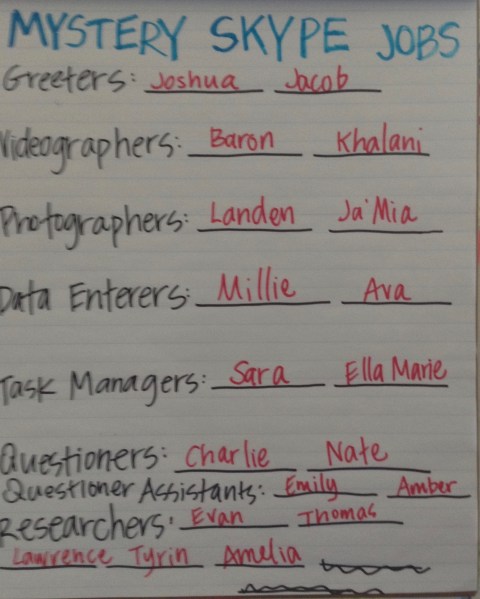
It started with determining our jobs. While Mr. Solarz has 5th graders and does most of his Mystery Skype work online, we were still able to use many of their listed jobs, modified a little to fit our needs.
While I think that Mr. Solarz assigns jobs, we had a meeting before we got started and I explained each job, then we decided who should do each one. If more than the allotted number wanted a specific job, kiddos had to find a way to decide who should do it (many of them played rock-paper-scissors to get to a decision). In the end, we agreed that the right people were in the right jobs, based on their strengths and personalities.
I was excited (as were they) and even though I had done this many times before, I really didn’t know what to expect because I hadn’t done it with this format in any other session previously. Because we were ready a little early (ok, I did that on purpose), we were able to practice. We were able to run through the whole deal twice, with me pretending to be the other class and them trying out their assigned jobs (thanks, Mr. Solarz for that idea–it was SUPER helpful!). First I was in Illinois (Chicago, actually) and then I was in Florida (ok, fine–Orlando). If you know me at all, you could probably guess those would have been my choices. Ok, fine, they probably had a little head start on that, too. Anyway…
While we were working, I was surprised with how busy everyone was, how well they worked together and how quiet but bustling the room was! We were even able to host a few teachers who wanted to see what this whole Mystery Skype thing was about without any real trouble. Thanks for Ja’Mia and Landen for submitting the pictures for this post, and for Khalani for taking the video.
Check out our archives from our first-ever REAL Mystery Skype!
After we were finished, we sat down to debrief and it was great how excited they all still were–I had them turn and talk so everyone could get all their thoughts out, then they shared some with me. Here is a little of what kiddos said, some positive and some things we might change:
I liked holding up the “Good job” sign, it made me feel great to see everyone focusing, learning and doing the right thing! -Sara
I thought it was fun and I really wanted to do a good job to help out our class! -Thomas
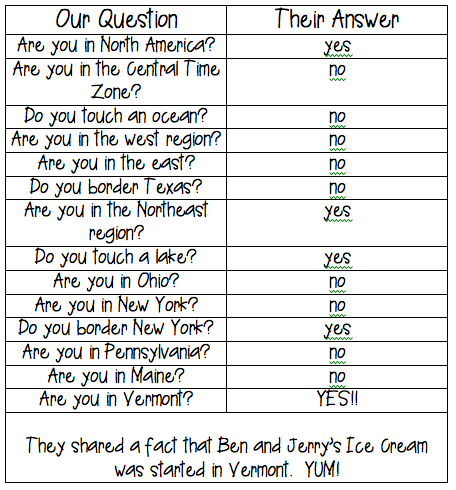
I liked that I helped find Vermont! -Amber
I didn’t like walking around the whole time. -Landen
I liked my job because I got to remind people. -Ella Marie
I thought it was tricky trying to find a question. -Emily
I liked it when Nate and Charlie asked about the time zone. -Lawrence
I like that my behavior was good. I got a “good job” card and I really wanted to do my very best for our class! -Jacob
I liked being a greeter. I was good at that job because I am friendly. -Joshua
I liked learning things that I didn’t know about our state. -Ava
I liked learning about maps. -Evan
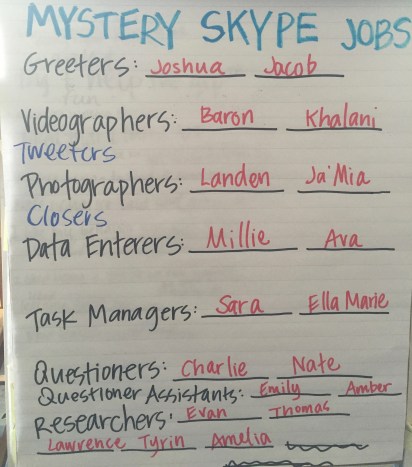
We also debriefed on jobs. The consensus was that there were too many researchers, and that we needed to add a couple of new ones: Tweeters and Closers. Mrs. Sisul, our principal, texted me during our session and asked that I make sure to Tweet since she couldn’t make it and I could not believe that I hadn’t even thought about it! We will definitely find some friends to do that next time, as well as choose two friendly kiddos to close the call and say thanks and good bye. 🙂
One more thing…it’s very long and it’s kind of shaky–it’s our first time, after all–but I think it gives a great example of all the hustle, bustle and hard work that was happening during our Mystery Skype. We’d love to hear what you think, especially if you notice anything or have any questions.
This year we finally did a Mystery Skype with someone that wasn’t inside our school. Remember that from last year? It really was pretty cool anyway.
I have a friend, Jen Bartin, who teaches 2nd grade at another school in our district, who was looking to do her first Mystery Skype as well, and we decided a good first try would be with a mystery number rather than location. Nope, that wouldn’t be very hard to figure out.
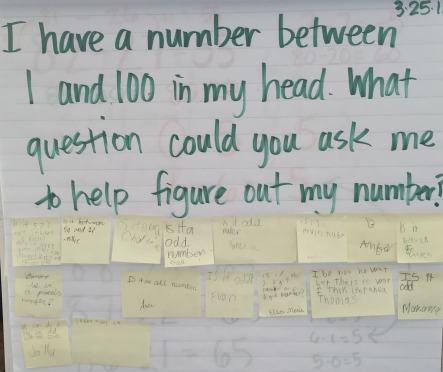
Unlike a typical Mystery Skype, we needed a hundreds chart instead of a map. We got ourselves into pairs and brainstormed what kinds of questions we could ask to narrow down the number. We had done this kind of thing before as our Math Warm-Up, as well as a game we play during Math Workshop. The part that we hadn’t done was talk to another class over our computer while also answering questions about our own mystery number. But we were excited and prepared.
While we chatted, kids took turns at the computer asking and answering a question. Ja’Mia and Ella Marie were in charge of writing down the questions each class asked, and Landen and Amelia had the important task of marking the 100s chart to narrow down the choices as we got information from our answers.
It didn’t take us long, but it took them even less time to figure out our number was 62. We did a great job of asking broad enough questions that we crossed of lots of numbers, but specific enough ones that we finally got it right. This was fun and we were ready to do another one!!
I have been on Twitter for almost 5 years now (started in July 2011), and I can honestly say that it has been a great decision since day one. Probably there are lots of people who haven’t evaluated their Twitter decision, but I wonder if the reason I did is because I use it solely for my professional life (where I am often evaluating the effectiveness of decisions I make). Nope, no celebrities or sports figures on my “following” list; I follow other educators (of all levels, not just the one I teach), authors, librarians, principals, consultants, instructional coaches and other related to education. I do also have a few family members (although they don’t really tweet), and also news organizations because even thought they are not teachers, they inform my teaching and keep me informed as a person. I decided that meant they fit the criteria.
I went back to look at if I had already written this post (sometimes I have the same thoughts over and over LOL), and realized I haven’t really ever done that. I did write about the fact that I use Twitter in a reflection I wrote for grad school a few years ago, and I wrote a post called Why I Blog, inspired by educator and author David Warlick (@dwarlick). I realized I mentioned Twitter in that post, but only the fact that I’m on it–not why.
So I guess in some ways this post is five years in the making–hopefully that doesn’t mean it will be five-years long! Here we go!
Personalized Professional Learning–in my pjs!: Because I have been particular with who I follow, I am pretty certain that every time I log on to Twitter I will read a tweet that includes something I didn’t know. Whether it’s someone who’s tweeting from a conference they’re attending, someone tweeting an article they’re reading (or have written!), a blogger publicizing their latest post, someone tweet a meanginful quote, a chat in which I’m participating about a specific topic or just a statement about the day, I feel smarter for having spent that time there reading. Sometimes I am able to read the whole thing right then, but often I will retweet or save the tweet for later so I can find it when I have more time. Either way, I am able to cater the learning I am doing to my needs, on my time, and like I mentioned before, to where I am (and what I’m wearing!).
Publicizing:While it’s certainly not the only thing, having someone to read the blog you’re writing is kind of an essential thing to keeping a blog going and having a conversation. I use Twitter as a place to publicize my blogs, as well as the ones that my students write. I use hashtags to add to the readership, and cater them to the topic of the post I wrote. For my students’ writing there is always #comments4kids, and some typical hashtags I add are #2ndchat (2nd grade teachers), #1stchat (because I taught 1st grade last year and many things I write about could apply to that grade as well), #moedchat (MO educators), #ksdpd (my school district), #803learns (my school’s new hashtag), #tlap (Teaching Like a Pirate), #LearnLap (Learn Like a Pirate), #elemmathchat (elementary math educators) and #miched (Michigan educators–just met many of them in a chat last week!). Often I add in ones specific to ELA (#rwworkshop, #tcrwp, #kidlitchat), science (#elemscichat) or social studies #elemsschat). I could really go on forever with hashtags because they are kind of endless, but adding them can maximize the number of people who see my posts as they far outreach the number of followers I have.
Quick Sharing: Sometimes I do have time to write a blog (at least not at that moment), so I use my Twitter feed (@jenbearden) or our class Twitter feed (@jbeardensclass) to share what we’re doing through out the day.
Collaboration: One of the BEST things about Twitter (maybe I should have put these in order!) is that it has allowed me the opportunity to connect and collaborate with classes and teachers from all over the world–something I would not have been able to do otherwise. I forged a relationship with a fabulous educator in Australia early on (Hi, Tam!) and even 5 years and a couple of grade-level changes later, we’re still working together because of our connection on Twitter. I have found many connections on Twitter that allow me to bounce ideas off of others (even if I don’t really know them I know that they’ll respond). One of the best layers of collaboration that I’ve found lately is the ability to reach out to authors. It really is mind-blowing to 2nd graders (ok, sometimes to me, too!) that the REAL author of the book they just read would take time to talk to them and answer their questions. We’ve been able to connect with many fabulous writers this year and I LOVE LOVE LOVE that my kiddos are now the ones who suggest that we tweet at them our thoughts. Some of our favorites are Ralph Fletcher (he might be our bestie by now; we LOVE his books and he has become a mentor to my students as he has been to me for years and years; Betty Birney (she came to our school so we reached out to her before she came and told her how excited we were); Mary Casanova (also visited our school and we shared our favorite parts of her books); Kate Klise (we had a super author visit with her and have since asked her some writing questions), Marla Frazee and Maribeth Boelts (used their books for a craft study last year and still tweet to them when we find new books by them this year), and Charles R. Smith, Jr. who wrote an important text we used in Social Studies recently. Lastly, my kiddos have been able to connect with other classes from around the world simply via tweets on our class feed or even better with Mystery Skype–which are set up through teachers on Twitter.
Validation: Sometimes you just need to hear someone else say you’re doing a good job, you know? While I by no means do what I do for a pat on the back, or to toot my horn, but it does feel really nice when someone else agrees that what you’re doing is a good idea. Having someone retweet your idea or respond to you and tell you they agree with your thought feels good. Often it doesn’t even take anything on the other end, but just for me to see that someone is doing something similar based on their tweets or retweets. This often happens during chats (which could fit into the collaboration section, too), as you can talk to other educators about a common topic, learning and growing together, as you share ideas.
I’m not even sure that this covers all the bases (I’m sure that as soon as I hit PUBLISH I’ll think of something else I’ll want to go back and add), and in some ways it’s hard to even put it into words how much I feel like Twitter is an important resource for me. I’m hoping that this list at least gives some small idea of it’s great possibilities for helping both me and my students explore and connect with the world!
Why do you use Twitter? What would you add to my list? Leave a comment and tell us what you think!! 🙂
We were continuing with our study of subtraction this week, and so all our MWUs are related. Happy calculating!
Monday
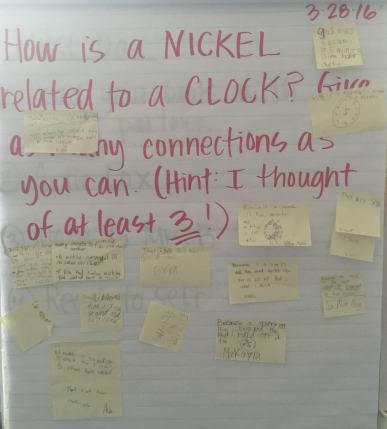
This one is just to keep our brains fresh about money and time, since we’ve “officially” moved on, but that we obviously should not forget. 😊
Tuesday
This problem pushed my kiddos to think about the reciprocal relationship of addition and subtraction. I had to remind many of them how this could be solved with subtraction, but we had a great conversation once I convinced them it was possible. The strategies are ones we had been working on in Math Workshop lately.
Wednesday
Just because, you know, I don’t want them to forget how to add…:)
Thursday
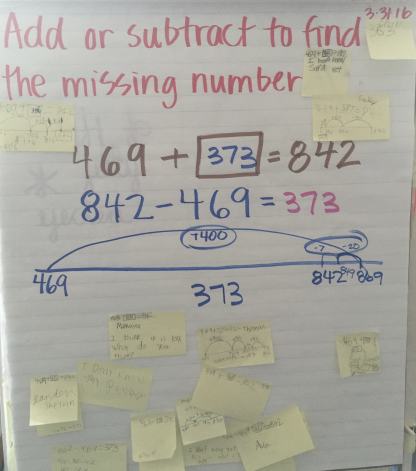
Tried this format again because I wanted to see what they remembered. The great question after we modeled our thinking with the number line was “Where is our answer?” This one took a few minutes for those that still didn’t see the connection between the parts and whole, between how we could either add or subtract. It was also surprising (still) to some that the answer to the second equation is the same. Ja’Mia had to convince us of you she knew. And yes, she was able to do that by telling us about how addition and subtraction are “opposites.”
Last week I shared our story of the tightening up that has happened lately in Rm. 202. It was based on this picture of our day last Wednesday:
We decided (ok, well Evan and Emily really had the idea) to keep track of our behavior every day, and to use our Behavior Over Time charts to help better guide our choices.
We started by drawing a blank chart, and then over the last week have gotten in the routine of stopping briefly after each portion of our day to reflect on how it went. Kiddos think about where they think the dot should go (based on their behavior + or – or so/so) and then I move my finger up the chart and kids raise their hands to show when they think I should stop. Once we draw the dot, we talk about what evidence they have that supports that choice. Instead of just saying “It’s good,” they have to provide real reasons why that makes sense. As a class we come to a consensus about what is the right dot placement.
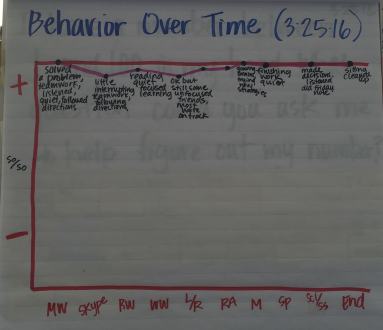
Our first day’s try. We decided after this day that we needed to define the top of the chart so we could show what the highest choice was for our dot. We were excited that the line on this graph went up throughout the day.
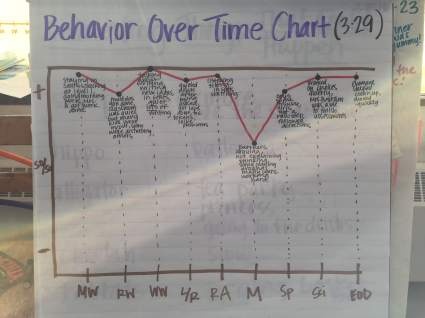
Sorry about the lighting on this one! We added the top line, as well as the “so/so” on the side today to help us better define our choices. We also focused on giving really specific reasons for our dots, as well as positive ones. Instead of saying we weren’t doing this or we weren’t doing that, we tried to make sure we listed what we WERE doing that helped our behavior be at that particular level on the graph. This one made us happy because it was straighter than yesterday’s and almost the whole day was at the top of the graph!
We left for the weekend feeling really great about the changes we’d made in our classroom, and agreed during our class meeting that we were on a much better track than we had been even just a few days before. We had been thinking about how our choices impacted the whole class (not just ourselves!), and how if we certainly can try to influence our friends, we are ultimately only in charge of our own decisions. When I asked kiddos to tell me what they thought the last two days had been so much better, many said it was our Xs system and their wanting to make sure they got the reward, but I think Sara really nailed it when she said that our BOT graphs help us see how we’re doing. We are definitely a bunch of visual learners (me included!), and having things around that remind us of what to do or help us better understand what’s going on is extremely helpful.
On Monday, our graph looked like this:
We noted that something odd much have happened during math, and the data we were keeping was helpful in our seeing how our behavior really trends during the day.
As we started Tuesday, we talked briefly about a goal that we could make for ourselves after looked at the behavior data we had collected the day before. Many mentioned that we had to do a better job of listening, working hard and cooperating during math so our dot could move up.
Here is our Tuesday BOT graph:
Notice anything?
Let me show you again, side-by-side:
We founded it the oddest thing that they were almost identical! This was puzzling to us, but obviously gave us good data that we had something specific to work on for Wednesday: math time.
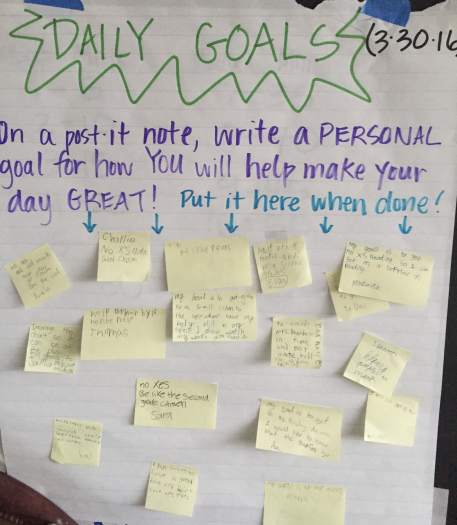
As we started our day today, I had them think about goals again, but had them write them down. This way we could be more clear on what we had decided to work on, and by announcing our intentions, it made it more likely that we would make them happen.
Another thing that we added to our routine today was that each kiddo got their own BOT graph to mark. Amber and Millie had started doing this independently the other day, and it seemed like a super idea to share with the whole group. We us a LMS called eBackpack that allows me to easily push out documents to kiddos, lets them mark them up and then send them back to me. Easy as pie I took a picture of our blank chart at the beginning of the day and each student was responsible to mark THEIR behavior throughout the day today. This also added a level of authenticity to our class dots, as kiddos used their personal marks to inform their decision for our collective one.
They were pleased to try this for themselves, and were very motivated to give good evidence for their dot choices, as well as keep their graph up at the top. I heard lots of kids say things like “Wow, this is a great day!” or “Look at my graph, it’s practically straight!” or “I need to make my dot move up next time.” It was great to listen to how they were really thinking through the cause and effect of the whole thing, their motivation to do well and how we had good evidence for that description of the day as a “good one.” We could point to specific things we had done (or not done!) that helped make our day successful.
Here’s today’s graph:
We were SO pleased with where our math dot ended up today!
Here are a few of kiddo graphs from the day:
We were also able to have a great conversation about our afternoon today; it was Wednesday last week when this whole mess started anyway. Reflecting on our behavior using hard data was so helpful!
I’m not sure how long we will keep this up. As with most things we do it’ll be around as long as we need it, and usually it’s the kiddos who help me decide when that is. We’ll try the personal graphs again tomorrow and Friday and maybe even find a way to incorporate them with weekly reflection sheets. I hope to be able to send them home at some point, too, to help spur conversations around dinner tables about data collection at school!
If you have a second, please leave us a comment and tell us what you think, or better yet, what questions you have. We LOVE to know that people are reading about our learning!
We are back from Spring Break!! We quickly got back into the swing of things with our morning routine, and I was trying to focus on spiraling back around to topics we haven’t touched for a while. We also had a Mystery Number Skype scheduled for Friday, so the problem that day was specifically designed to help that thinking.
I’m not sure how this is possible, but it seems that my class just had our first class meeting on Friday. I know that’s really not the case, but I guess all the meetings we have had have been either impromptu or have followed a different protocol than is typical to Rm. 202 because when I opened up our class meeting flipchart the other day the last one was from May 2015! WHAT?
Well, regardless, we sat down to have a meaningful class meeting, following a protocol that everyone new because even if we didn’t do it this year “officially,” everyone had followed the same procedure in 1st grade. (In case you don’t remember how we do class meetings in our school and district, check out this post, as well as this one where I wrote about it previously, then keep reading. 🙂 ).
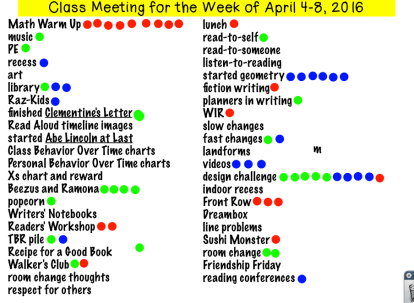
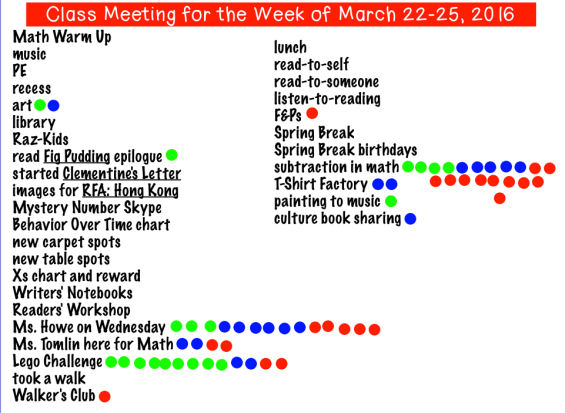
We went around our circle and our chart dots looked like this when we were finished:
A comment for the sake of transparency: our original chart got lost so I recreated the dots as I remember then. There may be a few in the wrong place, but this is generally the result after our choices. Sorry, friends!
While often the red dots indicate times where our class was having trouble behaviorally, as we talked through the dots for this class meeting, we figured out that the red dots next to “subtraction in math” were related to the fact that the math we were doing was tricky (more on that later!). The red dots next to the others were things we had already worked through earlier in the week. All-in-all, this chart shows a pretty great week for Rm. 202!
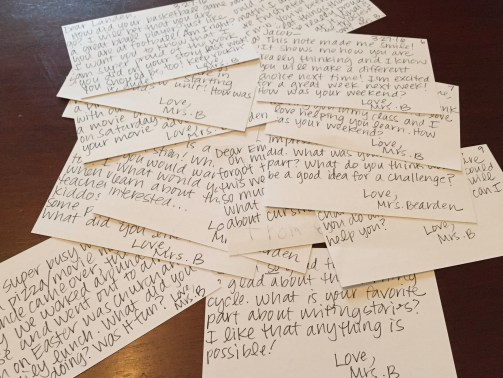
As is part of the typical class meeting protocol, the last part of the meeting is having kiddos write me a “Friday note” where they share whatever is on their mind: something from the meeting that they didn’t get to say, something from the week that they think when well (or was hard for them personally), an idea they have for something in our classroom, a question, what they’re doing over the weekend, etc.
Then I spend time over the weekend answering their notes. I was SUPER impressed that many of our notes were related to how kiddos knew that they needed to work on not getting Xs next week. A couple of friends asked for help with certain subjects, and many kiddos told me about weekend plans. And yes, as happens at least everyone once in a while, someone’s note just told me I was the best teacher EVER. Loved that one, of course. LOL
As with any class, the Friday note is perhaps one of my favorite pieces of communication with my students. I learn something every week, and I find that kiddos share things in this venue that they may not feel safe to say to me or have time to talk to me about during the course of a regular, busy day. These notes are so personal and give EVERY kid a chance to have a voice in our community. Friday notes #FTW!



















 20somethingkids and 1kookyteacher