Are you connected?

Today I was at school all by myself.  Ok, not all by myself, but without any students there.  It was a work day for teachers before students return tomorrow.  And it’s definitely a nice way to ease back into the school routine slowly.

I had a couple of goals today, one of them being this new bulletin board:

It’s right at the front of the room, behind the rocking chair I sit in for read aloud and much of our carpet time.  I hope it becomes a place where we can have daily conversations about the world, specifically about the people and places we’re connecting with via our blogs.  The plan is to mark the places where visitors (and those who leave comments) to our site are from.  I anticipate some really rich conversations around culture and geography will spark from this map–thanks to you, our readers.  Can’t wait to see how full the board becomes as the year goes on.

Will you help us?  We’d love to set the goal of getting as many different pins as possible on our map! Be sure to leave us a comment after you read and tell us a little about your town and yourself.  My kids would love it if you did the same on their blogs, as well, which can be found at www.kidblog.org/MrsBeardensClass2.

Can’t wait to see who we will meet this year!

Missing Wordles Pictures

As I was so excited about Wordles the other day, I started the post before I realized that they were saved on my computer at school, and I sit with my laptop at home and blog.  Boo! 😦

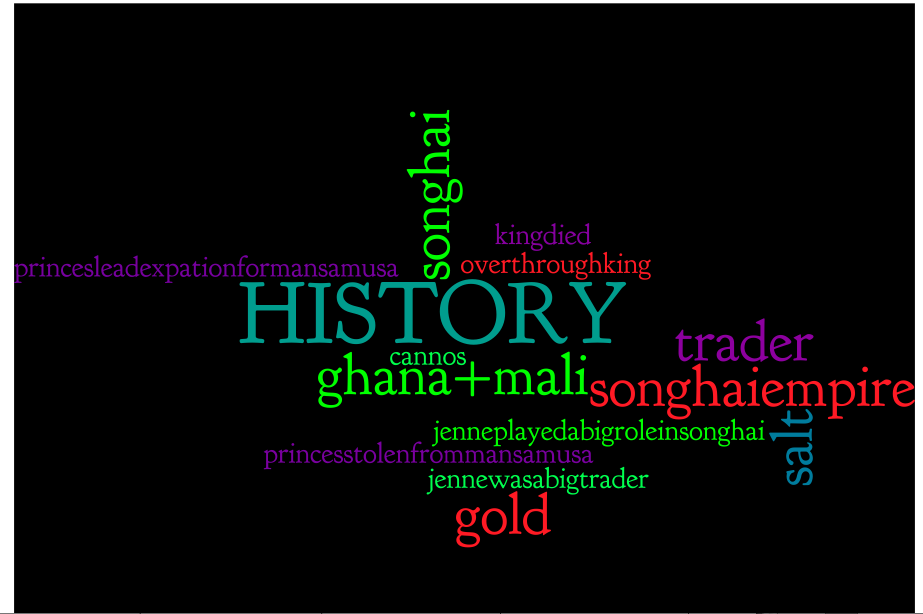
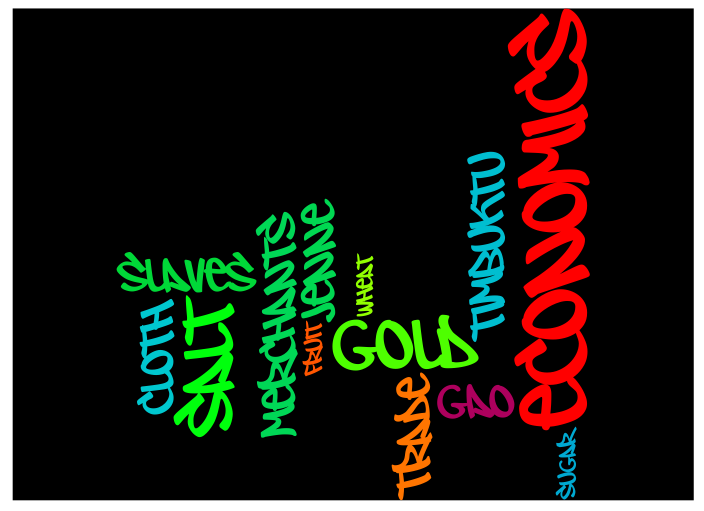
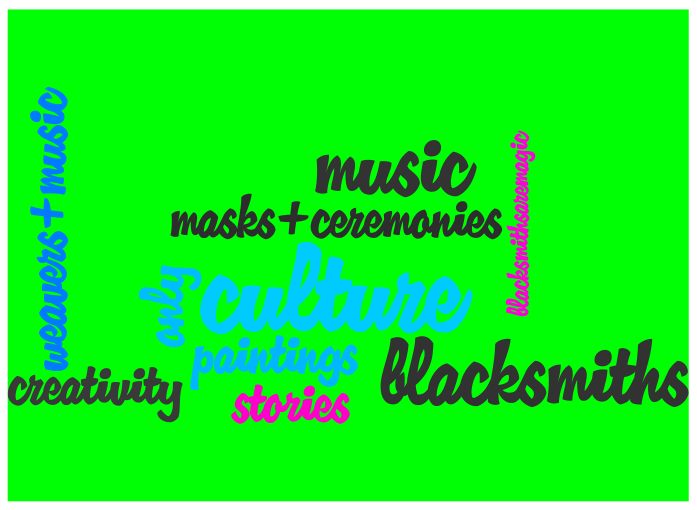
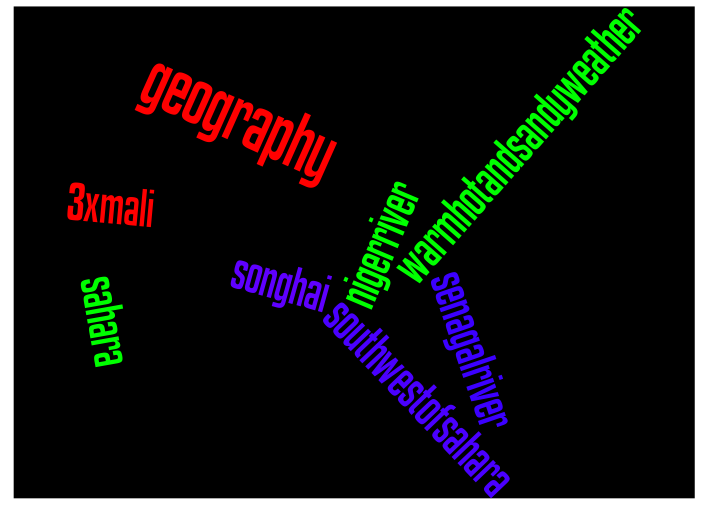
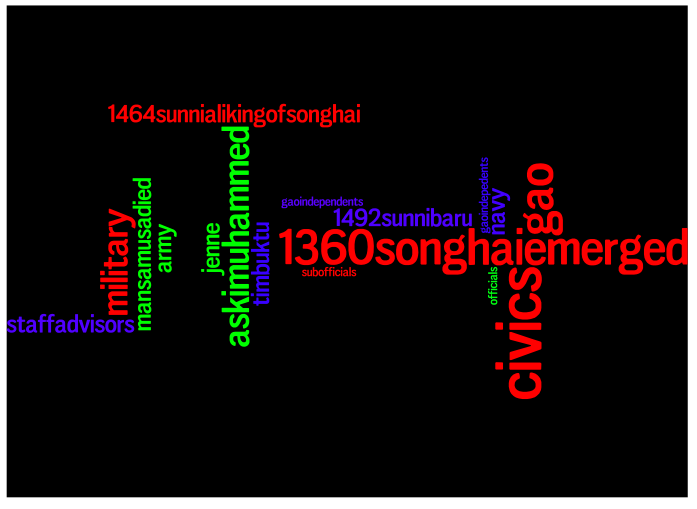
So here they are–finally.  Remember, they’re about the Ancient West African kingdom of Songhai.  And they’re pretty great.  Hopefully you can tell what they’re about by the way kiddos prioritized the size of the words.

Enjoy!

More Than Community Service

Many schools participate in service-learning projects.  Ours is one of those.  But I’m not sure that until recently that I really knew what service-learning was.  I think that in years past, I’ve said that I did a service-learning project, but really it was nothing more than a brief activity we did related to a holiday food drive or because there was a hospital next door to our school and we thought it was a good idea.  Not until last month did I learn what I should have been doing in order to really call something service-learning.  And now we’re actually doing it.

Even though the name really does imply its definition, I think it’s easier to start by saying what service-learning is not:

  • It’s not just a one-time episode when you help someone.
  • It’s not an add-on to your curriculum.
  • It’s not logging in community service hours just because you have to.
  • It’s not just something big kids or grown-ups do.  (taken from information on http://www.servicelearning.org)

Service-learning is a strategy that involves meaningful, authentic service to address a problem or issue in your community, where your students learn and then reflect on what they’ve learned.  It benefits both the volunteers and the recipients of your service.

Ok, but how to you do it?  How do you make sure that you effectively combine the service part and the learning part so that your students benefit as well as the ones you are serving? Service-learning includes several important components to help make this happen:

  1. Preparation: As you prepare to do a service-learning project, your class (or school or Girl Scout Troop, etc) should identify a community need that you could address.  Brainstorm possibilities and then choose one.  After your need is chosen, then you will need to work to investigate or learn more about the need.  This can be done through internet research, reading books about the subject, talking with people or groups that might be involved in the work already, or a variety of other methods.  In the service-learning project we just did at our school, we focused on Veteran’s Day.  We had an assembly on Veteran’s Day where we learned more about what veterans are, listened to a current serviceman speak about his experiences in Iraq, met people in our community who were veterans, and sang patriotic songs.  We also read picture books and watched videos to help us get more information on the meaning of Veteran’s Day and why it should be important to every citizen in our country–even elementary students.
  2. Action: Not surprisingly, this is the step in which students actually do the service part of the project.  Again, this should be related to the identified community need, and based on the foundation built while you learned more about the topic during the preparation phase.  For our action step, we wrote letters to veterans.  Most kids in our school wrote to veterans in homes or hospitals.  We were lucky enough to have the name of an airman currently serving in the Middle East.  He was a friend of a classmate, and so we wrote to him and told him how much we appreciated what he does for our country to keep us safe.
  3. Reflection: Part of what makes service-learning more than just community service is the reflection stage.  Once you have completed your action step, it is important to step back and look at what has happened, what you have or can learn from it, and pay attention to the effects your project has had on you and those you were serving.  The reflection step of our Robinson service-learning project actually started with every student in our school receiving a letter of their own in the mail. Every member of our staff wrote letters to students–in their own handwriting, in a hand-addressed envelope–and then there were mailed home.  Later in the the same week, our class (and the rest of our school) sat down to reflect on how it had felt to receive a letter in the mail with their name on it.  The hope was that students could then apply how that might have felt for the veterans to whom we had written. My students did a great job of identifying how special and “noticed” they felt to have gotten mail addressed to them; usually the mail was for the grown-ups in their house or was bills or junk mail.  We had a great discussion about how our airman friend Mark might have felt alot of the same things when he received a big packet of letters from our class.  Our hope was that it helped him to realize that he was doing a good thing and that we had noticed.  We wanted him to feel proud for what he was doing to serve our country.  Many connections were made during our conversation.
  4. Demonstration/Celebration/Evaluation:After you’ve done the amazing work of your service-learning project, take time to celebrate it!  You could do this in a variety of ways, like by writing about what your students learned, in a journal or in a PowerPoint presentation.  You could create banners or posters around the school highlighting the project, coordinate news coverage about your project or post the project on the school website.  Here you also evaluate how the project went, and begin steps for doing your next service-learning project based on what happened this time around.  The celebration phase of our Robinson service-learning project is ongoing, really.  We have shared it on our website, and we are planning a schoolwide assembly in the spring at our school to highlight all of the projects that we will have been involved in throughout the year.  Our class may create Wordles about it (related to my post from yesterday), or blog about it (once we start this next week!).  No matter what we decided to do, it’s vital that we stopped to notice the work we had done and the difference we made!

So what will you do to participate in service-learning? Everyone can make a difference.

Wordles!

I mentioned last week how we had a great day in Social Studies on Monday.  Then on Tuesday, we discussed how to make the change stick during our class meeting.    So on Wednesday, it was really cool when we had another amazing SS time.  Not cool because I didn’t expect it, but cool because I did expect it to go well and then it did! (If you’re a teacher you know what I mean–a well-laid plan doesn’t always work out the way it’s supposed to!)

I had taken some advice from my friends as I planned Wednesday’s lesson: choosing their partners/groups, working together with them first, and doing the reading part of the job in Reader’s Workshop.  We proceeded much like we had the previous two days, but with the focus being Songhai (or Songhay) rather than Mali (remember: we’re studying kingdoms of Ancient West Africa).  But I added one thing: a new piece of technology that my kids didn’t know.  We made Wordles!

If you haven’t heard of a Wordle before, you’re not alone.  I hadn’t heard of one until I read about it from someone I follow on Twitter over the summer.  (Yes, I’m on Twitter.  More about that later.)  In a few words, it’s a word cloud that you create about whatever topic or concept you want.  I’ve seen them used for spelling words or other subjects, as well as to describe yourself.  The size of the words is determined by how many times you enter that word in the box, and then the bigger size implies bigger importance.

This is a wordle I made about me:

So fast forward to our Social Studies application of Wordle.  Each group met with me again during group time in Reader’s Workshop to read, discuss and pull out important information that they could use on their Wordle.  They had a plan, and then worked with their group to create a word cloud showing the important facts related to Songhai and their specific discipline (history, civics, economics, culture, geography).  Just like on Monday, they were busy, they were quiet, they were engaged.  (I know it sounds like my class is never any of those things.  That’s totally not true!  They really are an amazing bunch of kiddos!)

I have gotten such great feedback from my kids on this day!  They loved learning something new–both about Africa and about how to create a Wordle.  They’ve already asked when we can do it again, made suggestions for other places in our day we could try it, and want to try it at home on their own time.  Love, love, love what’s happening in this unit now. 🙂

(Ok, I realize I didn’t post pictures of the actual Wordles they made, but that’s because I just realized their on my computer at school and I didn’t want til Monday to post this!  I’ll add them later, I promise!)

Rephrasing the Question, Refocusing the Conversation

We had a class meeting today.  I know, it’s not Friday, but this was when we had time for it.  (If you’re new here or need a reminder of how we do class meetings, see this link.)

So we sat down, like normally, in a circle on our carpet.  I put up the class meetings flipchart and Archie got ready with the pen to mark our thoughts.  Today, instead of having the red dot count for things we thought we could do better on, though, I rephrased it to just be “things we want to talk about.”  I thought this might help some kiddos who might look at the list and not see an “issue.” Here’s what our dots looked like before we started our main conversation:

See all those red dots on Super SS on Monday?  Well that was related to the post about Monday’s Social Studies time and how well it went.  And unlike our usual class meeting conversations, they wanted to talk about it because it went so well!  YAY! As they went back and forth and shared, I kept hearing kiddos share how they thought it was a great day and why they thought so.  I heard them saying that they liked how they could work on the reading part in reading and then the SS part in Social Studies, how I had picked their groups for them (they admitted that often they don’t choose wisely and end up wasting their learning time), how they could work with me to make sure they knew what to do and then focus in to go and do it.  They knew that it was a good day and they wanted today’s SS time to be the same.  But then my friend Abigail asked a very important question: We know that we want it to be great again today, but it’s not as easy as just saying we’re going to do it.  How will we make it happen? I love it when a kid reads my mind and says exactly what I’m thinking!  So many times they just say that their solution is that they’re not going to do whatever we were discussing that the problem was.  And usually that doesn’t work.  Abigail knew that and was brave enough to call us on it.

They then took a little bit of time to discuss this, and made a plan for how they would go and get their work done in a focused manor again today.  And they did. 🙂

Monday, Monday…

Remember the other day when I told you that learning is messy?  Well yesterday was another day when that happened in our classroom.  But the reason I’m writing about it again is because besides being messy, it was again really successful.  Only this time, it was in Social Studies.

Mondays are very unusual days in our classroom.  At some points during reading you can look around and only see 5 or 6 kiddos, because of the schedule of pull-outs and other things.  And for whatever reason, Social Studies on these days always seems to be really hard for our class.

But this was not one of those days!  We’re studying Ancient West Africa, which is hard for many of us to wrap our heads around, since it was so long ago and so far away.  We’ve tried at least 3 or 4 different structures and plans to make this unit work for us, but it still seemed like we’d get to the end of the Social Studies time and feel like we weren’t any farther than the day before! Well, today we tried something else.

We’re working on creating class charts–think murals or collages–that highlight all of the things we need to remember for the kingdoms of Ghana, Mali and Songhai.  The thinking is focused around the 5 disciplines of Social Studies: history, economics, civics, culture and geography.  Here’s some that were made for the Cahokia unit:


Well, this time around the idea was the same, but I changed some of the specifics.  Instead of working in groups completely on their own to read, take notes and then create their representation, we met in small groups during Reader’s Workshop to do the reading and research part.  I went through the text with each group (each was responsible for a single discipline, all related to Mali), and we read and discussed what we thought was important.  A recorder took notes for the group, then before they left the table, we made a plan for what their group was going to make.  We decided right then who would do what, and then their group left to get to work.  Instead of squeezing this project into just one Social Studies time (I know–crazy, right?  I’ve had several good friends tell me how stupid I was to expect it all to get done in 45 minutes!), we used part of our reading block and added on our Social Studies time, too.  Altogether, they were able to work for about an hour or more one day, then finish this part today (Tuesday).

I’m not really sure exactly what part worked out the best, but I know for sure it worked.  Every group was busy and quiet and focused for the entire time.  And when we were finished and I said my usual, “May I have your attention please?”, they knew what I was going to say.  This Monday, unlike many others, we were all going home in a good mood, having learned a lot.  They knew it was a good time; it just felt different. Our buckets were full and so were our heads–with concepts about Ancient West Africa as well as how to work together towards a common goal.  And they came back today determined to figure out how to make it happen again.

“Blog Worthy” Part 3: Talk-a-Mile-a-Minute

My students love to talk.  I do, too, so I can’t blame them.  I remember myself as a 5th grader, even, and remember that the thing I got in trouble for most often was talking when it was somebody else’s turn.  So whenever I can, I try to give them opportunities to talk while we’re learning.  Partly so that they won’t fill in the space with talk about non-learning things, but also because learning is a social thing; talking is part of how you make meaning.

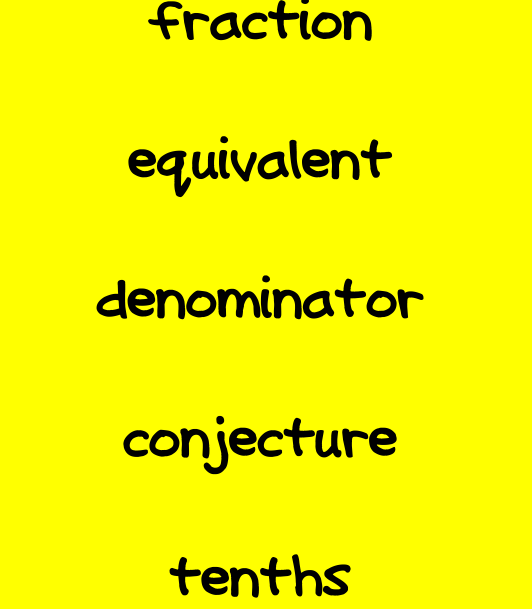
So frequently we play a game called Talk-a-Mile-a-Minute.  It’s a vocabulary game, and can be used in any subject, with any set of words.  I think I introduced it in math (because there is a TON of vocabulary there!), but we have also played it with science and social studies terms.  Today we played it with new terms from our Ancient West Africa unit in social studies.  It’s fun, they can talk and be active, and they learn something.

Here’s how it works:

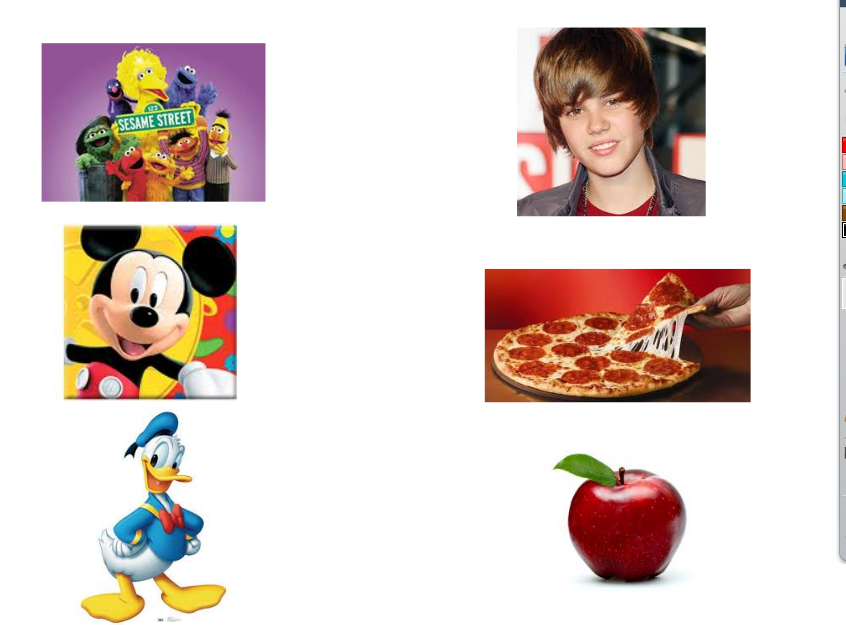
Kids choose a partner to work with.  Partners sit “eye-to-eye, knee-to-knee” in front of the ActivBoard.  The person with their back to the board is the guesser, and the person who can see the board is the describer.  I put up a screen with words they should know (or that they are working on), and the describer has one minute to get the guesser to say all of them.  The first time we played it, we did several practice rounds, and instead of words there were pictures, like this:

The goal is to be as descriptive as you can, without saying what the word starts with or rhymes with.

The first round was pretty easy, so then we tried it with words:

Here are some terms we used yesterday in math:

And here’s today’s version for Social Studies:

How well do you know these words?  Play with your child and see how it goes!