Can You Tell Me a Story?

The storytellers who visited us last week sure could!  We had the pleasure of being visited by some professional storytellers on Friday, and MAN did they do a great job!  We were amazed by the tales they spun, and everyone–adults and kids alike–were totally engaged!

The first storyteller has some hilarious stories about growing up–which were great, because we could all relate!  The first story was about learning to play the juice harp, and all about the WRONG ways of doing it!  He even played it for us, which was really cool!  We found out that he is responsible for many sounds we hear in cartoons, as well, including the sound of Bullseye galloping in Toy Story 2 (since this is one of my family’s favorite movies, I got an extra kick out of that detail!  Felt like I was in the presence of a legend!).  The other story he told us about were the strange gifts he got from his grandpa, which included a rock and a stick, tied in a fancy red bow.

IMG_2549

Our second storyteller came in full costume, which represented his Cherokee ancestry, told some amazing stories about animals, as well as Daniel Boone.  The most unbelievable one was about Daniel Boone’s final hunting trip, where he encountered and then killed a bear, and then “wore” the bear hide to keep warm.  He ended up heading up, crawling right into bed with his wife–still in his bear suit–and scaring her half to death!  He told us it was true, but I have yet to find proof….either way, it was GREAT story that kept us interested until the very end.

I haven’t heard many live storytellers, but in many ways they are like me–lovers of words!  I appreciate performers who can incorporate their words and their voices to weave magical tales for kids and help them want to do the same!

What story can you tell us?  Have you ever heard a great storyteller?  What about their performance was most interesting to you?  Do you know if that Daniel Boone story is true??  We’d love to hear from you! 🙂
40 Book Challenge Revisited

It’s been a while since the excitement of the 4o Book Challenge began.  And I HATE to say that that excitement may have weaned a little bit.  Remember back when I told my class about it, and everyone was really energized by it?  Ready to do it and not at all worried?  And remember how my friend Brittany asked if I would do it, too, and I begrudgingly gladly accepted?  Yes?  Well let me update you on how it’s going.

First of all, I feel like I should share with you what my kiddos are saying about it.  Of course, as with any important thing in our class, it becomes a topic on our blog.  I’m excited to say that the topic has come up multiple times in the “What I liked…” section of their notes for student-led conferences (yes, that is a topic I’m going to add here soon!), and that many have WAY over half of their challenge done already!

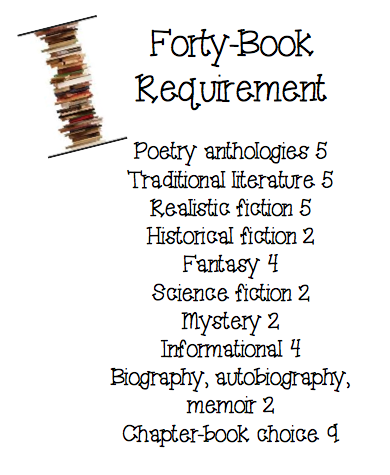
As a reminder, the challenge looked like this:

Screen Shot 2013-09-06 at 8.47.27 PM

Requirements for the 40 Book Challenge, which is inspired by Donalyn Miller’s The Book Whisperer.

Not surprisingly (at least to me), most kiddos started with what they know and what they love: fiction.  Many of them knocked out Realistic Fiction first, then did their chapter book choice, and then tried mystery before they got a little annoyed by my list.  Still, they trudged on, heading towards informational and poetry.  I was noticing, though, that there has been very little traditional literature or biography/autobiography/memoir showing up in the hands of my readers lately (more on that later).

What?  You want to know how I’m doing with the 40 Book Challenge?  Me?  Well….

I’m gonna be really honest with you that I have not been doing my part to keep up with the 40 Book Challenge like I’d hoped and like I’d expected.  I think I am probably at 5 or 6.  I know, right???  YUCK!  I have had very good intentions, and I truly believe in the importance of showing my reading life to my students, but like I mentioned earlier, I’m having a hard time finding  prioritizing time to make it happen.  There always seems to be something else to do, you know?!  But I WANT to make it happen (I really feel like I’m letting my friends down!), and since I don’t make resolutions, I guess it’s time to make a goal and a plan to achieve it.  And I’d love your help!

How do you make time to read inside your busy life?  What do you leave out so that you have that time (there are, after all, only 24 hours in a day!)?  What suggestions do you have for me to achieve my challenge goal by the end of the school year?  Come on, I KNOW a lot of you are readers, and I want to be one, too! 🙂

Knowing the Standards

It’s probably a pretty obvious statement, but knowing what’s expected of you helps you make sure you do that expected thing, right?  Sure, of course.  So why don’t I spend more time chewing on rubrics with my students?  Why do they sometimes feel like the expectation for the end of the unit is a surprise to them? Well, the simple answer is that we should spend more time looking at rubrics.  Together.  Often.  Before, during and after learning happens.  And it’s my goal (but not my resolution!) to make that happen more this semester.

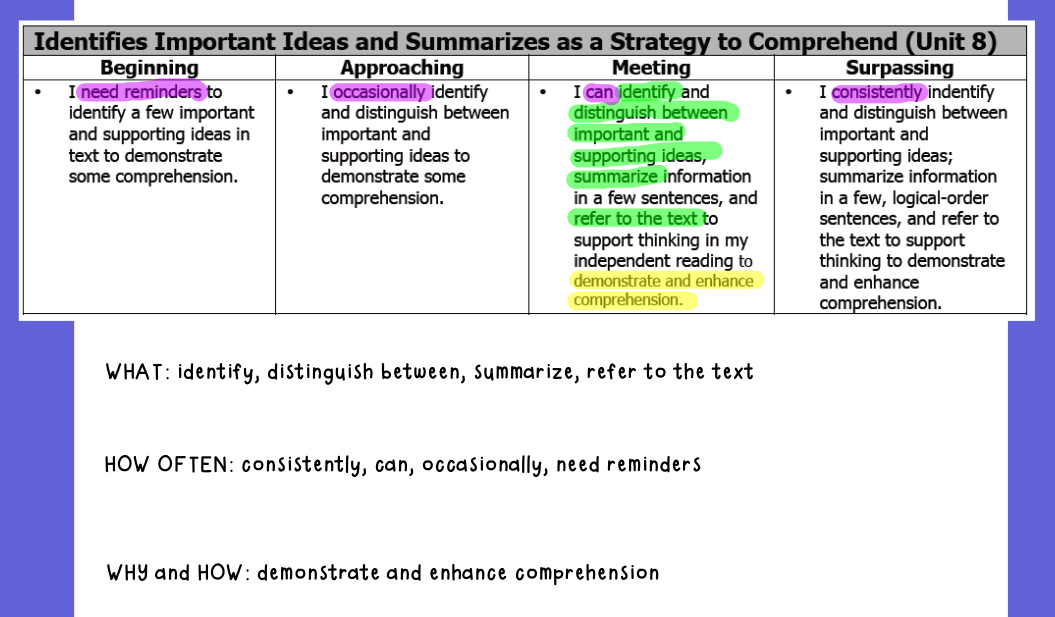
So fast forward to last week and the beginning of our focus on summarizing and main idea in Readers’ Workshop.  We started by checking out the rubric together.  I gave kiddos a copy of the rubric to chew on in pairs.  Along with the expectations, I also asked some questions, and had them look for certain things in the standards that would help them make sure they were doing what was expected.  Together we read, discussed and highlighted.  Our board (and their papers) looked like this when we were finished:

Screen Shot 2014-01-21 at 11.27.12 AM

I think it was important work that happened here.  I kept asking the what and why questions as we chatted.  I had them repeat the verbs.  We talked about the fact that these are understandings they need to demonstrate more than once.  And we focused on the reason behind why you need to know how to do this: to help you better comprehend your text, not because your teacher says you should.

Now we talk about this almost every day.  Before we begin anything reading, we review the words in this rubric.  We use the words.  We reflect on whether we’re identifying, distinguishing, supporting, referring and demonstrating.  And this image will hang in our room to help us remember what to do–and for a visual person like me, that’s an important step.  So many times things are out of sight, out of mind.  This way they will not be.

And so after this work in reading, we did the same thing in math with the beginning of our decimal unit.  And during that conversation I had another (saddening) aha moment.  As I handed each kiddo at my table the rubric book that is usually reserved for parents and teachers, I wondered why I didn’t give one to each STUDENT to have.  To read.  To digest. To reference and keep at the front of their minds (and binders!).  Why had it never occurred to me–in all of these years of teaching–that my STUDENTS are probably the ones that most need that book??  They are the ones, after all, that are responsible for making those things happen, right?  Man.  Humbling thought right there.

Moving forward I pledge to do more to make my students aware of their learning.  Don’t get me wrong–we talk about these things and I believe I am making them aware of our goals, but there is much I can do to make it more visible for them, so that they can take more of an initiative in their own learning.  Nothing here should be a mystery, and the outcome should not be a surprise.  And I’m vowing to take steps to unveil some of these things for my kiddos.  I only wish I would have done it a long time ago…

What do you do in your classroom to make your students aware of standards and expectations?  How do you involve them in the process?  What “aha”s have you had regarding these things? I’d love to hear from you!

Book by Book…

Yesterday we talked about the journeys that readers take.   Today we talked about how readers can make little goals along the way to help the goals in their journey seem more attainable.

We talked with our elbow-partners about goals that they’ve made, and when we shared out from our conversations, we realized that we had made goals that fit into 3 basic categories: goals for at school during RW (like reading 30 pages before the end), goals for at home at night (like reading 2 hrs before bedtime or “scheduling” it for after dinner or before bed), and goals that span the whole week (like finishing a certain number of books each week).  It was a great conversation that helped us all better envision how to have (and keep) a growth mindset.

Then I was ready to give them a goal of my own.  It is a year-long goal, and is definitely a pretty big one: to read at least 40 books, in a variety of different genres.

Screen Shot 2013-09-06 at 8.47.27 PM(Remember how I read The Book Whisperer this summer?  This challenge and genre requirements came from there. 🙂 )

I put this slide up on the ActivBoard and waited for the reactions.  To my surprise (is it ok to say that?), no one freaked out.  No one cried, and no one seemed discouraged!  I was really expecting at least one person to say that this was an impossible challenge, deciding already that they were doomed to fail.  But beautifully, what happened instead were a variety of responses somewhere along a continuum of “only 40? I thought it would be more like 150!” to “on 40?  I know I’ll read more than that this year!”.   I loved it, too, when one sweet friend looked at me, slowing nodding and smiling, seemingly saying “I can do that, Mrs. Bearden! I don’t know how yet, but I know you’re going to help me.” 🙂  And YES, my friend, I will help you!

But then my favorite part happened.  My friend Brittany (remember her from that big pile of books yesterday?), who had been talking to Grace, looked at me and said, “Mrs. Bearden, you’re going to do this, too, right?  You’re going to read 40 books with us?”  I was a little surprised, because I was surprised that she asked.  But I was SO GLAD that she did.  It would have been one thing for me to say that I was going to join them–which I was planning on doing anyway–but it’s a completely different thing when it’s their idea.  Now it’s OUR challenge instead of just mine.  And we’re going to accomplish it together, book by book. 🙂

Everybody Loves Reading!

Or at least they will when I’m done with ’em! HA!

One of the most important goals of the beginning of 5th grade–or any grade–is to help kids get to the place where they love school.  Really love it.  This is the case with the beginning days of my Reader’s Workshop as well.  Unfortunately, I have students that come to me and can honestly say that they don’t read because they want to.  They read because they have to, or they don’t read at all.  Boo. 😦

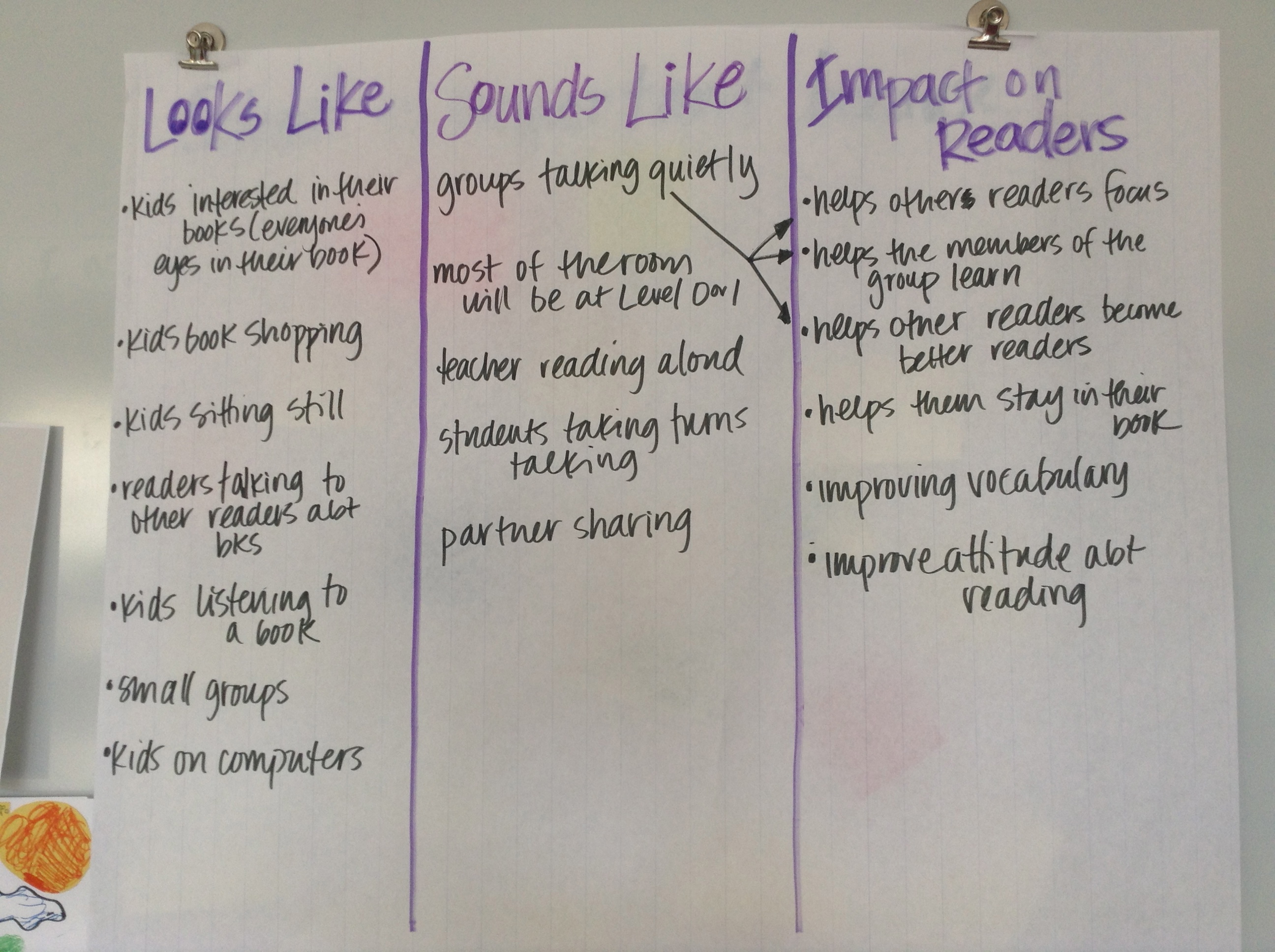
So in addition to conversations about how our Reader’s Workshop will function (like we had as we filled in this chart the other day):

Kids worked in pairs first and then we discussed together our thoughts about what Reader's Workshop looks and sound like, and how that helps us as readers.

Kids worked in pairs first and then we discussed together our thoughts about what Reader’s Workshop looks and sound like, and how that helps us as readers.

we also have lessons that give kids chances to see themselves as readers, and to see what is possible for them–no matter where they are starting.

Today we started with a conversation about mindset (growth vs. fixed) and tied it to this quote:

Screen Shot 2013-09-05 at 8.54.45 PM

We talked about how every reader is on a journey, and those journeys look different for every person.  We talked about how having a growth mindset–believing that we are capable of achieving great things if we keep trying, changing and making mistakes–helps us on our journey.    Then I described one reader’s journey from short, picture books with few words to reading Harry Potter using this pile of books:

IMG_1249

While the scenario was hypothetical (I know…sometimes stories I tell at school are made up.  Don’t sue me. 🙂 ), it is very much like what real readers do, and I wanted my readers to see that there are steps that they can plan to help them get from where they are to where they want to be (which in this case was the desire to read a Harry Potter book–a very real goal for many readers!).

After I told the story of how this reader traveled through their journey and after I piled these books high in Brittany’s arms (who so kindly volunteered to play the role of the reader in my story), I had everyone think about whether they saw themselves somewhere in this pile of books.  Maybe they were already on a similar journey to this one.  Or maybe they were starting in a different place.  Regardless of the answer, their next step was to consider their own personal reading journey and write about it.
I want readers in my room to understand and appreciate that we need to think past the book we’re reading and onto the next book and the next book and so on (I’m working through Reading Ladders to help me help them with this right now).  Everywhere has somewhere they can go!  Here’s to a remarkable reading year in Rm. 202!

I Need Your Help!

The rush to get ready for school is in full swing, and I need your help (you being the parents in my classroom or  friends of mine who want to donate something fabulous to my class or whatever other category you might fit into as a generous person) to finish up a couple of things:

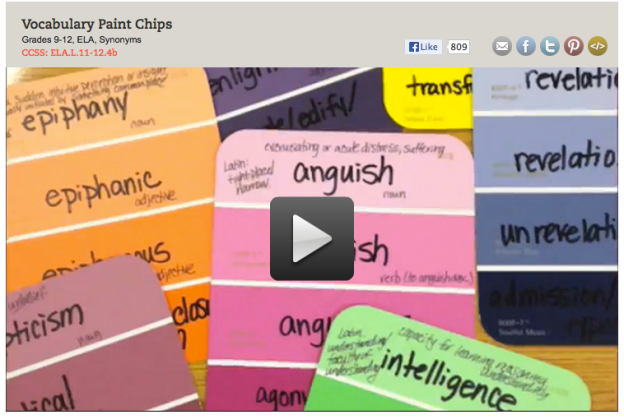
I am going to try a new idea with how to engage with vocabulary this year, similar to our Words We Know board from last year…

As we read books together, we investigate words we don't know, and connect them to what we do know to help make sense of them.

As we read books together, we investigate words we don’t know, and connect them to what we do know to help make sense of them.

…but is even more visually appealing and organized:

Screen Shot 2013-07-31 at 8.22.14 PM(I feel like I should apologize for the fact that this is not actually the video, but instead a link to Teaching Channel where you can find it.  Silly embed code just did not want to work….)

So as I was at Home Depot today, I grabbed 20 or so paint chips, but would LOVE IT if you could help me collect even more!  I figure they would notice less if 10 or 20 people grabbed a small stack then if I filled up my cart!  Any color will do. 🙂

Secondly, as we are working to more deeply engage readers with nonfiction text this year, I am beefing up that section of my classroom library.  I want to put in lots of different kinds of nonfiction text at many different levels.  The upper end is really in need of some attention, and following a great suggestion (from somewhere or someone really smart–I just can’t remember who), I’m adding in college textbooks and technical manuals, as well as travel books and whatever else might be of interest to a kid (and believe me, 10 and 11 year olds are interested in TONS of different topics!).

If you happen to have any books you need to clean out at home or if you’re shopping at Goodwill or a garage sale, and you see anything you think our class would benefit from, could you grab it for us?  I’d love to be able to do an even better job of surrounding my students with rich, complex, challenging text that they can dig into! (Ok, and that being said, ANY other books you’d want to donate would be TOTALLY welcomed as well….we’re easy here in Rm. 202 🙂 ).

You can feel free to leave me a comment here if you can help us, send me a message on Twitter or Facebook or even just drop it off at school in the office with my name on it!  THANK YOU in advance for whatever kind of help you can give! The readers in Rm. 202 GREATLY APPRECIATE you! 🙂

An Uncertain Future

I met with my team today–the fabulous Mrs. Hong and Ms. Turken–to talk about how to integrate reading, writing and sci/ss, as well as to update our curriculum calendar.  We only had 2 hours blocked out on the calendar, and so in some ways those were really big plans.  And we started 45 minutes late.  🙂

So, as we sat down and tried to tackle reworking the curriculum calendar (based on new Common Core standards, district resources and just things we wanted to change), we realized we had lots of work to do BEFORE we could address that problem.  You know how it goes, before you can do the job you actually sat down to do, you have to do this and before that you have to do this….we were in that boat.

We are wanting to reorganize our thinking and our schedule to allow for more integration, working Social Studies and Science topics into everything rather than having things so compartmentalized and isolated from each other.  But we had plans to UbDize (yep, just made up that word) our SS curriculum and organize our units around common EQs for each quarter.  But like I said before, it’s easier said than done.

And then there’s my crazy brain that isn’t just quite ready to think about these things.  For one thing, I have to have my space all done before I can planning for what we will do in that space.  Since it’s not even August, I do not have my classroom put together yet.  Granted, I do have all of my furniture where it will go and have big ideas for where things will go and what it will look like, but it’s not done yet.  And I have plans for how I want to redo parts of my classroom library.  And I haven’t met my class yet.

That last part is really the biggest piece of the puzzle that makes it hard for me to complete the calendar.  So in the mean time, I feel like I am facing an

Screen Shot 2013-07-31 at 1.09.33 PM

I know–you’re thinking, “Well, duh, Mrs. Bearden.  Isn’t the beginning of the year always uncertain?  You never really know what the school year will bring or what every detail of every day will look like.”  And no, I don’t have a crystal ball or any tarot cards, and so I guess in a way I always face an uncertain future at this point in the year.

But the reason why it so affects me is because I have such a hard time making decisions about things I’ll do and ways to go without actually knowing my students.  So much of where we go and how we get there depends on what my students need, and where they are when we start.  I have information and data about these things on paperwork (transition reports, testing scores, Lexile levels, etc.) from previous teachers, but until I really see what it looks like for actual kids in my actual space, I can’t really get a feel for it.  (My family has always said that I don’t have much of an imagination–maybe this is proof of that! 🙂 )

But obviously I can’t just not make plans.  I can’t not work with my team.  I can’t not try to figure it out now, because I owe it to these new students of mine to have at least an idea of where we will go, and how we might get there.  If not, then we’ll never get there.  And that’s definitely not an option.

Along the way I’ll tweak the plans–adjusting and reworking based on personalities, learning styles, academic and social needs, interests–and I’ll be totally ok with that.  And then, at the end of the year, I’ll look back at the plans we made around the table today in the summer and laugh, because of how different they are.  But I gotta start somewhere.

How does your “summer brain” work?  In what order do you do your work–space first or plans first? How does your team work before school starts to map our curriculum/unit plans?  I’d love your thoughts and/or advice! 🙂

It’s Monday! What Are You Reading? (2)

You know, guilt accountability is a crazy thing.  Now that I’ve made the commitment to actually write about my IMWAYR, I feel pressure to do more reading and want to have new, exciting things to share each week.  That being said, I have to admit: I haven’t read a thing since last Monday. Not. A. Thing.

Ok, now I did take a fabulous trip to the library with good intentions, and I did gather a really great pile of things that I could read….but somehow I was busier this week.  I know, I know–lame excuses.  😦

So I guess instead of It’s Monday! What Are You Reading?, this is my “It’s Monday! Here’s What I Really Want to Read” list:

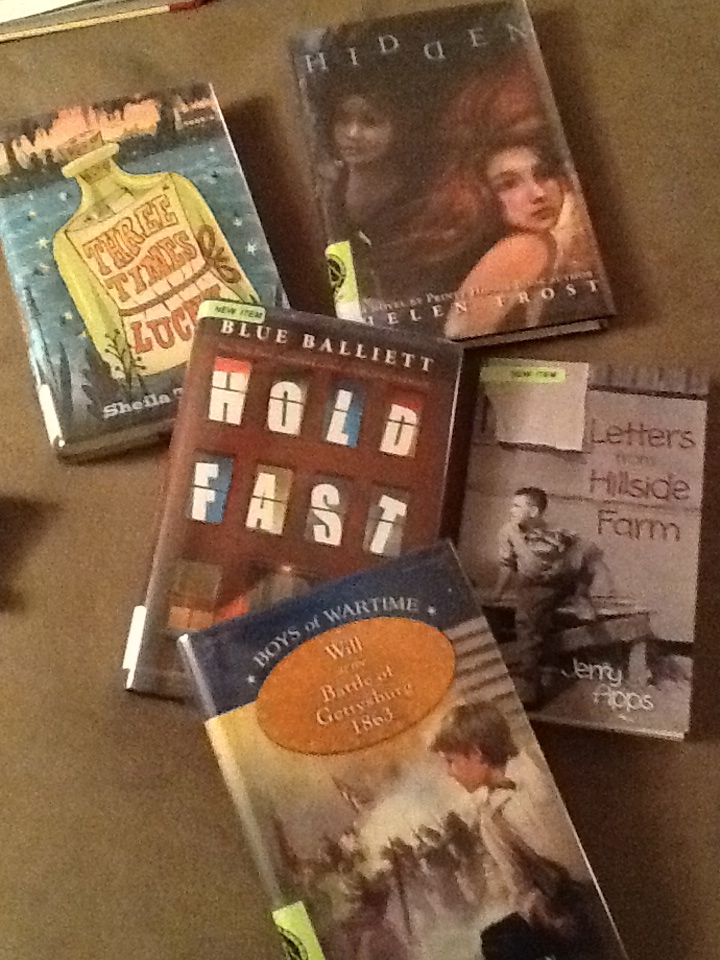
IMG_0831Ok, so both Hidden and Will at the Battle of Gettysburg 1863 are both Mark Twain Nominees that I still want to read so I can share with my new readers.  Hold Fast and Three Times Lucky are both titles I’ve read about from my friends on Twitter, and Letters From Hillside Farm looked like another great historical fiction title that could possibly be incorporated into Social Studies or used in small groups or read aloud.

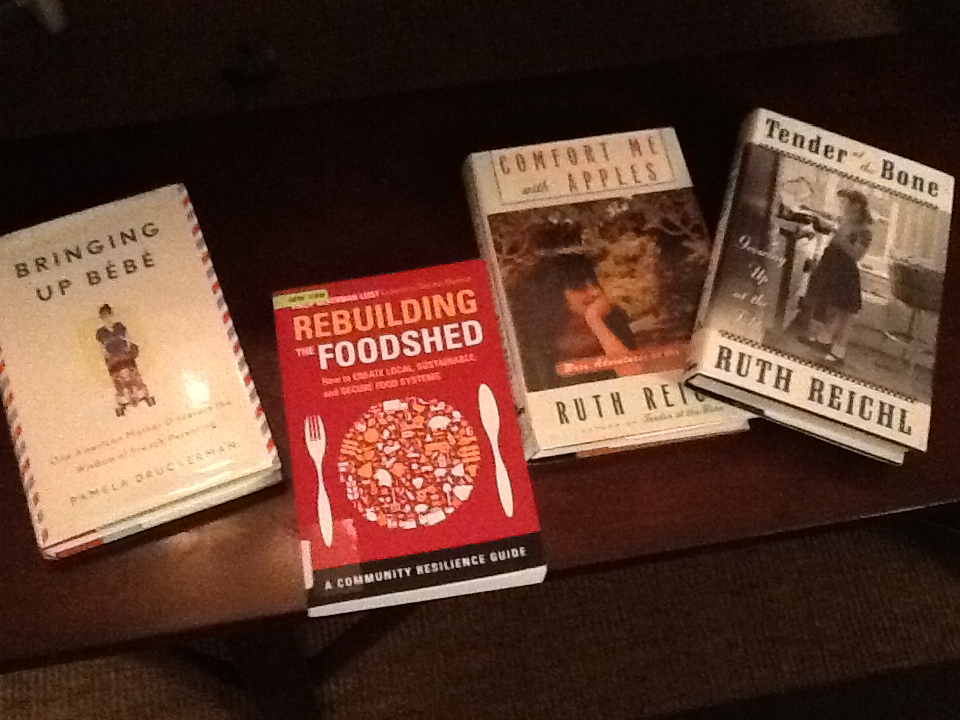
IMG_0832So what I’m really excited about from my library trip this week are the titles I picked up that are NOT middle grade novels that I might use at school.  After reading The Book Whisperer by Donalyn Miller recently, I was challenged to do more reading that was just for me, or just because.  Maybe even an adult fiction title or two.  It feels a little weird, because it’s a kind of reading that is new to me, but I know it’s important as I build my identity as a reader–which will spill over into my connections with and recommendations for readers in my room.   These are suggestions from other readers I respect: my friend, Lisa, who reads EVERYTHING and my high school English teacher, Carol Jessen (who I reconnected with on Facebook last week!).  Ms. Jessen suggested the two titles by Ruth Reichl because of the food themes (which I mentioned in my writing about the Mark Twain nominees I’ve read), and they seemed really great.  I hope to be able to share them with Grant (my husband) when I’m done, because he’s definitely both a foodie and a reader and would love that combination.  Bringing up Bebe was on Lisa’s GoodReads list, and is all about how French mothers raise their children.  This is intriguing to me, and I know Lisa loved it (because I’ve heard her talk about it before!), so I figure I will, too.  The last one is about another recent interest of mine–local, organic, healthy eating.

Now, all I need is time just to sit this week.  Maybe I can squeeze out a few last days of summer break to get it all done??

Have you read any of these books?  What did you think?  Have you read The Book Whisperer?  How has it changed you as a reader or a teacher?  I’d love to hear from you.  Please leave your comments!


It’s Monday! What Are You Reading?

So I’ve been checking out #IMWAYR for a while, and even talk about it with my students, but haven’t officially done anything with it on my own blog.  What??  Weird, right?  So I guess unofficially the post from earlier today about what I’ve been reading this summer counts (thanks for the reminder, Jenn Fountain!), right?  And somehow, in the excitement of writing my first blog post in FOREVER, I forgot another book I’ve read.  Well heard.

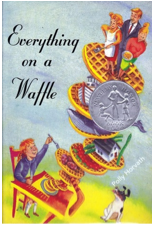
Screen Shot 2013-07-22 at 10.53.35 AM Everything on a Waffle by Polly Horvath

Again the theme of parentless children and food comes to play in this story of a girl named Primrose, whose parents have been lost at sea and who is trying to find her place in the world.  She goes to live with her Uncle Jack, and spends her time with Miss Bowser at The Girl on the Red Swing, a diner in town where everything is served on a waffle.  Like the other food-missing-parent-child-trying-to-find-themselves books I’ve read this summer, the spunk and “realness” of the character of Primrose made this story interesting and fast-paced.  If I had been reading it (rather than listening to it!), it would have been a page-turner for sure!

In the “what I’m going to read category,” I’ve just had no less than 4 new titles suggested to me in just the last hour or so.  I hope to catch Reading in the Wild by Donalyn Miller, as well as Reading Ladders and Igniting a Passion for Reading by Steven Layne (thanks for the suggestions, Heidi Ford), then Tender at the Bone and Comfort Me with Apples by Ruth Reichl (both suggested by a beloved teacher I just reconnected with on Facebook–Carol Jessen 🙂 ).  Then, if I have any time left before the craziness that is August starts, I KNOW I can find a great recommendation from my friend Lisa, who reads the most fabulous books and tells me all about them.  Maybe I should save her list for next week…:)