The World of Geometry

Today was the first day back after Winter Break.  In math we went back to a unit we had briefly started before we left–2D geometry and measurement.  You just never know how kids will be the first day back into the routine of school after being gone for so long, but my kiddos totally rocked it!

We started a unit from the book Differentiation in Practice by Carol Ann Tomlinson and Caroline Cunningham Eidson, which I have used before with other classes.  I love the way it’s tiered so that everyone can engage at the level they need, and the lessons are written in such a clear way that I can just jump right in!

We started with the first lesson today, which began with a rating scale to get them thinking about how well they know geometry.  We made a class chart that looked like this:

Obviously we already feel like we know a lot about geometry! That will mean we can go to great places and expand our learning to topics we might not otherwise have been ready for!  What fun we will have!

After we completed our rating scale, we went ahead with a List-Group-Label activity related to geometry terms.  In small groups at their tables, they first listed words they thought of that were related to geometry.  Remember when we made Wordles in math last month? Well they used those to help get their thinking started.

Lauren references her Wordle to help with geometry terms for her list today.

Taylor and Abigail work together on their list.
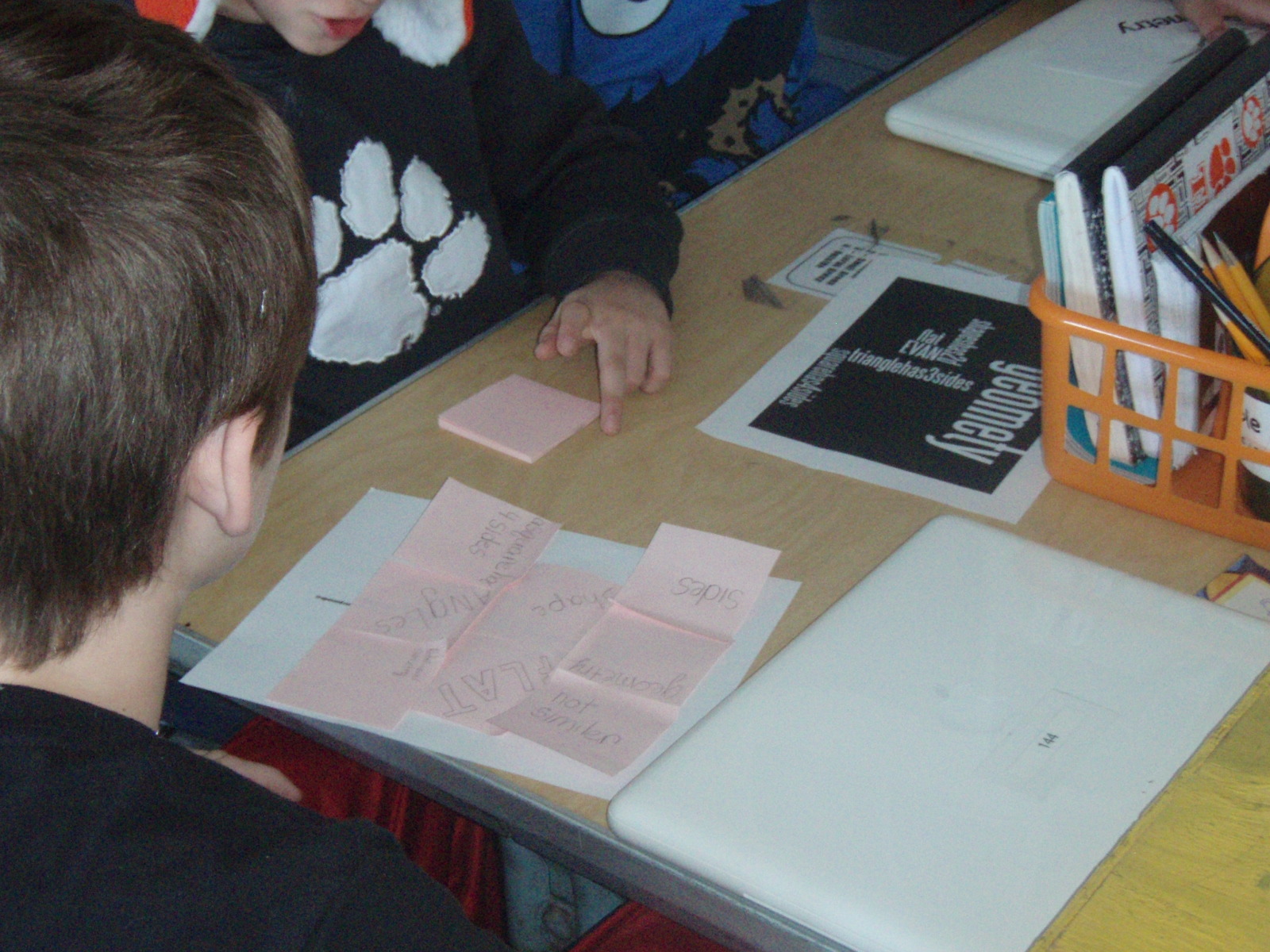
Harry and Evan have a variety of polygons on their list of geometry terms.
After their groups listed terms, then their job was to group these terms into categories.   They did this on paper first, and then we started a class web that we’ll finish up tomorrow:

While what we were doing today was not hard, and was based on prior knowledge, they really dug in and did some great work.  If only you could see the videos I took of a conversation on rotational symmetry from Harry and Evan’s group!  I will have to find a way to be able to upload it–such an amazing example of students building on each others’ learning and working with misconceptions together.  I just got stand by and watch.

More to come as we dig deeper into this unit.  Cannot wait to share what happens next! 🙂

Wordles in Math

We’ve been busy this week.  We’re always busy, but I think for some reason we’ve crammed more than usual into the last fives days.  And it seems that a lot of what we did was new.  And very cool.  And involved technology.

We tried making Wordles again on Monday.  It was the start of a new unit on 2D geometry in math, so I needed to get a feel for what they remember from 4th grade.  Rather than do a pencil/paper pre-assessment, I had them create a Wordle to show me their background knowledge for this unit.  We brainstormed some words we might use and explain in our Wordles, and then got to work.

I should stop saying I’m amazed with their final products–by this point they’ve shown me countless times that they can do amazing work.  But that’s what I was: amazed.  And I learned much about what they already knew.

Enjoy!

This slideshow requires JavaScript.

Are You Hungry?

If you’re anything like me, then you love to eat.  And you really like to eat out.  My family loves to find new restaurants around town and try them out; “chain” restaurant is kind of a bad word in my house.  So, if you’ve ever eaten out, then you know the idea behind a menu–you are offered a variety of choices of yummy things to eat.  Most times you will choose a main course, side dishes and dessert.  Maybe if you’re really hungry, or if something looks really interesting, you might add an appetizer to your meal.

Ok, so what?  This is a blog about school, about education.  Why all the restaurant talk?  Well, if you’ve spent any time in our classroom lately, or if you’ve seen a 5th grade homework sheet this year at school, then you’re familiar with the idea of a menu.  But why, you ask, would you use a menu in school?

Let me tell you. 🙂

The big idea that makes a restaurant menu work, that makes it desirable, is the idea of choice.  When you sit down to eat, no one tells you “Eat this.  Chew it 25 times.  Swallow it.”  You’re not forced to eat things you don’t want to (well, unless maybe you’re a kid!), and there are many ways to achieve your goal of filling your empty stomach.

That’s what we’re trying to do with menus in school.  We have a goal–based on subject and unit–and then students are given a choice of ways to show their knowledge and learning related to that subject.  The idea is not new, really; I’ve been doing a variation of it for years.  Long ago we called them “invitations” or had a list of “must-dos and can-dos”, but the idea behind it is the same: children are going to have more ownership over their work and probably ‘dig in’ and little deeper when they have choice in what they do and what the final product looks like.

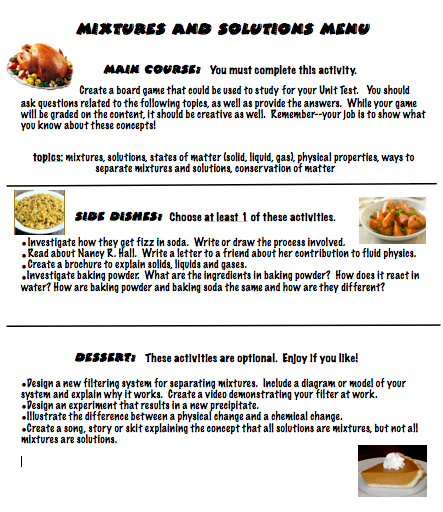
Here are some examples of menus we’ve used this year so far:


I must add, though, that besides giving students a say in what their work looks like, menus are an important tool in differentiation.  The categories are tiered, so that every learner can be engaged wherever they are in their understanding of the concept; the main course is something that everyone can do (still at their own level with their own creativity), side dishes are a little deeper, and then desserts are activities and projects that allow and enable students to stretch themselves and think in a deeper way.  Everyone in my classroom has their needs met regardless of what they are, and everyone has activities that are appropriate for them.

So, are you hungry for learning? Menus are for you. 🙂


Learning Is Messy


Today was our last day of school before Thanksgiving break.  And so traditionally, that means that we do things that are a little bit nontraditional in our schedule.  For math, that meant that I put the kiddos to work.

Here’s what I mean…

For many years, my husband and I have taught together.  Well not really together, like in the same school or anything, but we’ve always taught the same grade or the one just behind.  So since that’s the case, we’ve been known to do some of the same things in our classrooms.  One such thing is the Thanksgiving Dinner project in math that comes during these last two days of school.

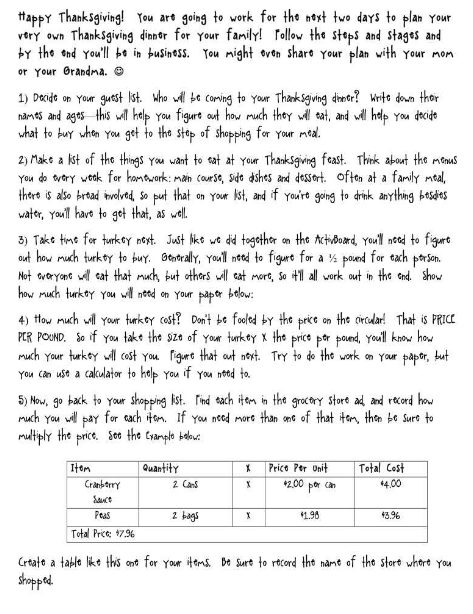
The idea is pretty simple–plan and shop for the Thanksgiving meal for your family.  The directions for my class this year looked like this:

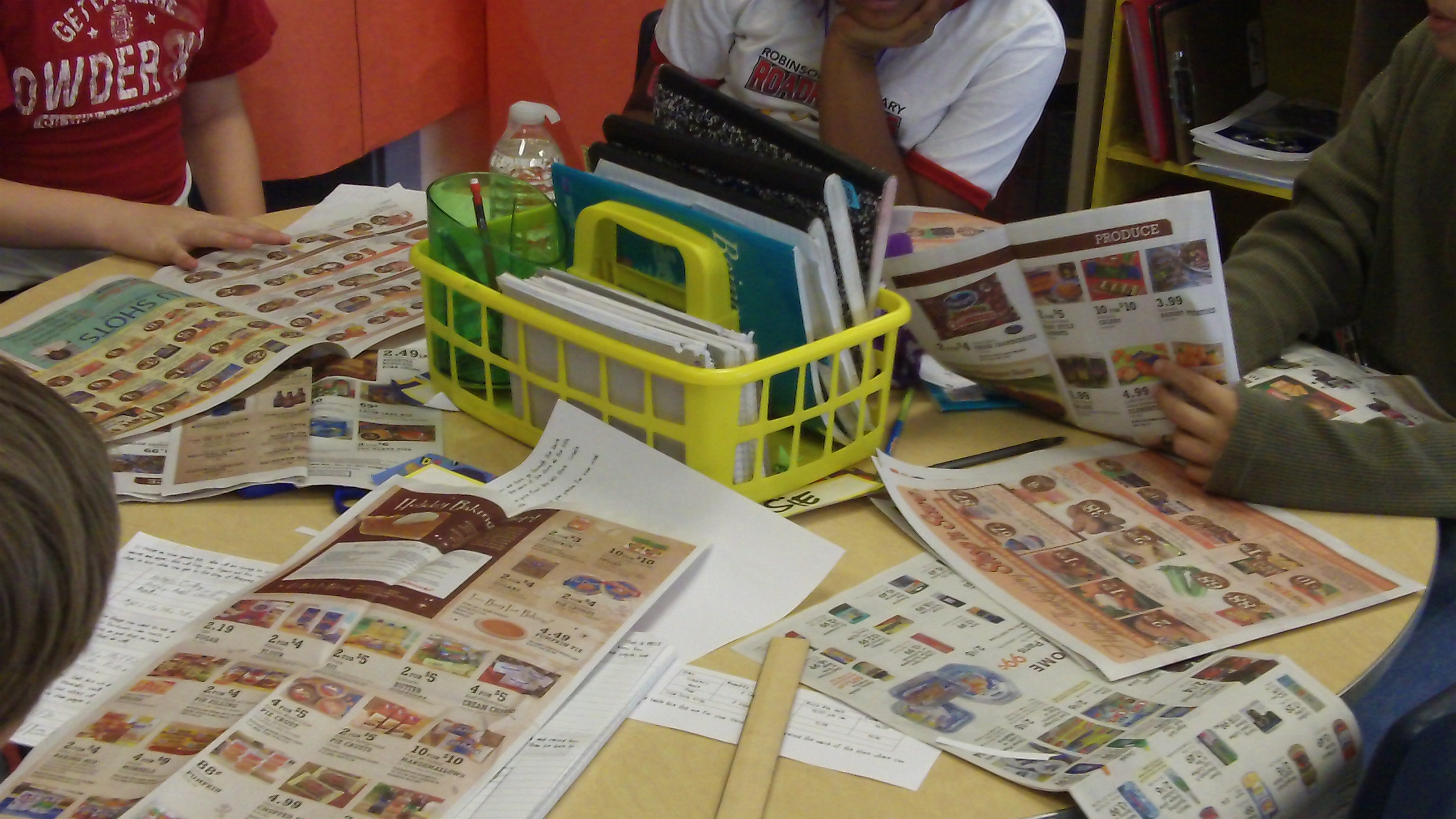
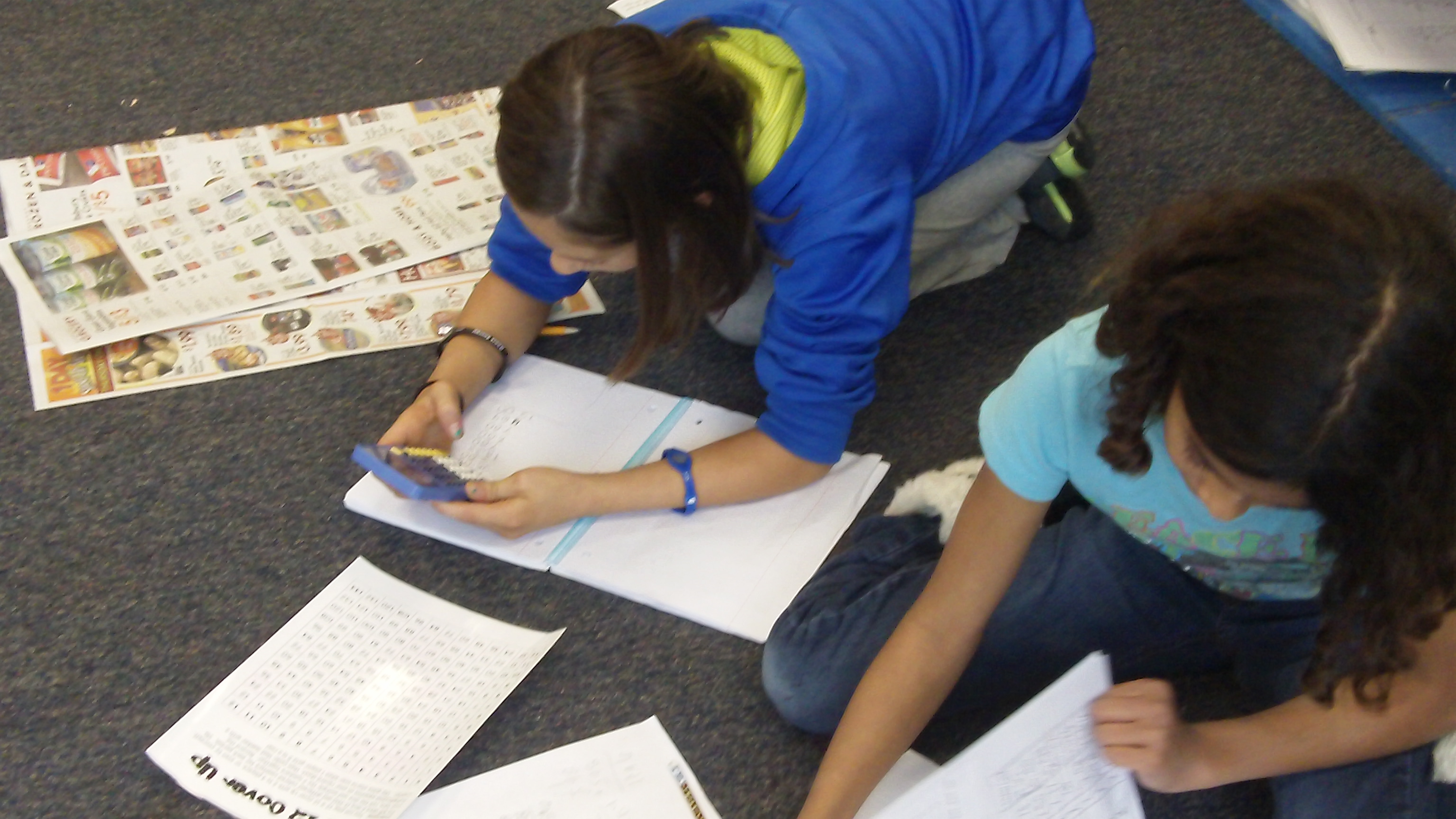
What’s cool is what happens after you give all the directions and answer all the questions and set them all loose to figure it out for themselves.  Check it out.  Like I said, learning can get a little messy.  But it’s a really good kind of messy. 🙂

Z was so focused on his meal, searching diligently through each circular to find just the right foods!


Love how my friend M is so into the paper in this one!  Can you see her behind there?


The other cool thing, besides a messy classroom and lots of kids saying things like “this is really fun!” or my friend D asking me to copy his plan so he could share it with his mom (love that!), was the togetherness that this project brought as they worked with each other.  Truly a family feel in Rm. 201 today!


Happy Thanksgiving, friends!


1/8 is 12 1/2%

At our school we use Investigations for math.  One thing I love about the program is that it usually digs into the why of each math concept instead of just the how.   It encourages students to create their own strategies for solving problems, emphasizing that there is not just one way to come to a solution. In the case of our fraction/decimal unit that we’re in now, we are doing more than just learning the rote definition of a fraction and coloring in fractional parts of pictures or just adding or subtracting them using the method I directly taught them–like I know I did in 5th grade.  Instead, we are investigating and creating and figuring out and–most importantly in my opinion–using what we already know to discover something we don’t.

Here’s an example of what I’m talking about:

We are at the beginning of a unit called What’s the Portion?, which includes experiences with fractions, decimals and percents. Yesterday and Thursday we were working on figuring out the percent that is equivalent to a fraction.  We started by making drawings on a 10X10 grid (which helped us “see” what was going on) since we know that percent means “out of a 100.”

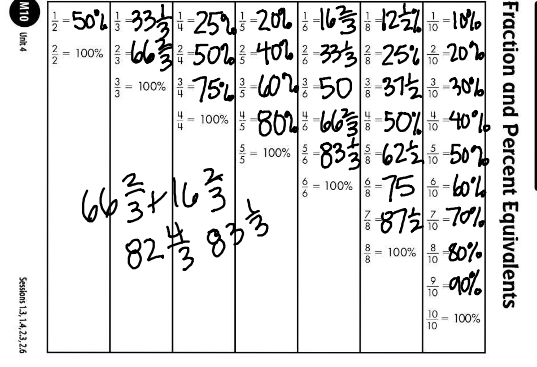
We used this visual, and what we knew about fractions and percents already to figure out that 1/8 is equivalent to 12 1/2%, because 1/4 is 25% and an eighth is half of a fourth. Our music teacher, Mrs. Kesler, will be tickled to know that I even had one kiddo make the connection between this and what he knows about music notes to help him figure it out.

So after the initial idea of fraction and percent equivalents was presented, they were to dig in a little deeper.  I gave them a chart to fill in, that had lots of other fractions to work with.  I told them to fill in all that they could with the directions to NOT do thirds and sixths, that we’d do them the next day.  But what they did instead, was make it their goal TO DO the thirds and sixths.  In this case I didn’t really care that they did the opposite of what I said, because it meant that they were going to try something that might be a challenge, might stretch them a little, might give them questions to ask when we worked on it together.

And for the most part, they all totally rocked it.  They made it look really easy.  Like they’d been figuring out fraction and percent equivalents for years. (Ok, 5th grade readers—which character from one of our favorite read-alouds did that sound like?  Comment on this post with your answer if you know!!)

Here’s what our chart looked like when we were done:

The thing that I think is really remarkable about the thinking behind this is that they are already getting comfortable with going back and forth between fractions and percentages, and can tell you how that relates to a group of things, like how getting 10 out of 20 of your spelling words right is 50% or that 3/4 of a class of 24 is 18.  There is understanding being created that goes far beyond just memorizing definitions.  I like that.  And they like it, too.

“Blog Worthy” Part 3: Talk-a-Mile-a-Minute

My students love to talk.  I do, too, so I can’t blame them.  I remember myself as a 5th grader, even, and remember that the thing I got in trouble for most often was talking when it was somebody else’s turn.  So whenever I can, I try to give them opportunities to talk while we’re learning.  Partly so that they won’t fill in the space with talk about non-learning things, but also because learning is a social thing; talking is part of how you make meaning.

So frequently we play a game called Talk-a-Mile-a-Minute.  It’s a vocabulary game, and can be used in any subject, with any set of words.  I think I introduced it in math (because there is a TON of vocabulary there!), but we have also played it with science and social studies terms.  Today we played it with new terms from our Ancient West Africa unit in social studies.  It’s fun, they can talk and be active, and they learn something.

Here’s how it works:

Kids choose a partner to work with.  Partners sit “eye-to-eye, knee-to-knee” in front of the ActivBoard.  The person with their back to the board is the guesser, and the person who can see the board is the describer.  I put up a screen with words they should know (or that they are working on), and the describer has one minute to get the guesser to say all of them.  The first time we played it, we did several practice rounds, and instead of words there were pictures, like this:

The goal is to be as descriptive as you can, without saying what the word starts with or rhymes with.

The first round was pretty easy, so then we tried it with words:

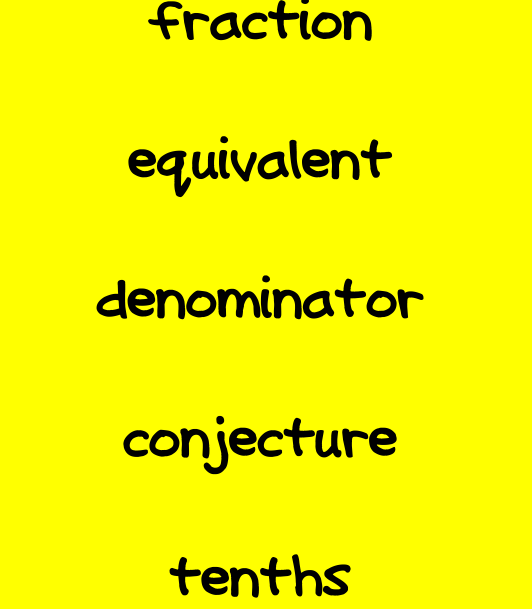
Here are some terms we used yesterday in math:

And here’s today’s version for Social Studies:

How well do you know these words?  Play with your child and see how it goes!

Highlights: The 1st two weeks of 5th grade

I have had good intentions.  Intentions that included adding new blog posts every day of school.  And obviously those intentions did not end up resulting in new blog posts yet.  But here’s a new one.  And I’ll make it worth your while.  I promise. 🙂

So since it’s called “highlights”, I’m going to give you the big ideas of what we’ve been doing so far, and hopefully your 5th grader can fill in the details.  Hopefully.  There are at school every day, afterall.

Ok, so let’s get started:

Reading: Reader’s Workshop has officially begun in Rm. 201!  We have made reading posters to share our likes/dislikes as readers, taken a reading survey, read The Lotus Seed, Something to Remember Me By and Everybody Cooks Rice together, had our first check-out from the Robinson library, gone on a scavenger hunt in our classroom library, took our first SRI assessment on the computer, read Hansel and Gretel and discussed how to trail our thinking as we read and then–you guessed it–we read!  I love how excited this class is to dig into books!  Next week we’ll start to focus on strategies that good readers use to make sense of text.

Writing:  We have already begun so much work as 5th grade writers!  From day one, your writer was busy thinking about ideas for stories, putting thoughts on paper.  We have gotten our Writer’s Notebooks, and spent sometime making them our own.  We talked about how our WNBs should be a snapshot of who we are; we should be able to tell whose notebook it is without even checking the name, but just by looking at what’s on the cover.  This week we started Being a Writer, which is the program that will support our writing work this year.  So far we’ve read The True Story of the Three Little Pigs by Jon Scieszka (which we learned is pronounced CHESS-ka), as well as The Frog Prince Continued, then talked about how to retell familiar fairy tales in a new way.   As a community-building activity, we played a game called “2 Truths and a Lie”, then lifted a line from what we had written to expand our thinking.  We will dig in further to the Writing Life next week as we continue our journey as writers together.  I cannot say enough how excited I am about sharing my writing life with your kiddos!  I loved this quote from someone today as I was writing in my own notebook: “Wow.  You have a Writer’s Notebook?  I’ve never seen a teacher write in their  notebook during the school day before.”  I’m hoping that there’s already a connection forming there–we are growing as writers together this year!

Math: The mathematicians in Rm. 201 have already been very busy!  We started the year by playing a few math games (Dice Duel and Contig), as well as learning how to correctly roll dice in 5th grade. (Really.  Ask your kiddo to tell you all about how I hate the sound of dice on the tables! 🙂 )  We took a math survey, and then dug right into our first unit in 5th Grade Investigations: Finding Factors and Prime Numbers.  So far we’ve learned (or reviewed) vocabulary related to multiplication–factor, product, multiple, prime number, square number, composite number, array, dimensions–and started working on finding factors of a variety of numbers.  We worked number puzzles, and started an activity called Quick Images for ten-minute-math.  This subject has soo much to tell–be sure to have a conversation with your kiddo about all that’s been going on.  Feel free to use this to help them get started talking about what’s been going on.

Community:  An crucial part of the beginning of our year is beginning to grow our classroom community.  We do this by working together to create things, learn procedures and routines that will be used in our room and throughout Robinson, and learn more about each other so we can celebrate our differences and build on our similarities.  We’ll continue to revisit this idea all throughout the year, to keep our connections strong.

Read- Aloud: Read aloud (chapter book) is a integral part of our classroom.  While it is fun, it is also an important time when we think and talk about books.  The choices I make for books during Read Aloud are often Mark Twain award nominees, or have topics related to the curriculum in our class.  The first book this year is called The Boys Start the War, and is a big hit already!  Have your reader tell you about how we use the strategy of “say something” to share with our partners, and have them introduce you to BOT graphs.

I am sure that there’s probably something I’ve missed.  I’m amazed at how quickly time flies when we’re so busy and having so much fun!

Stay tuned for more updates on the fun and learning in Rm. 201.  Maybe next time there’ll be pictures. 🙂