I Speak Greek When I Teach Math–PART 2

Wow–I’ve been doing a horrible job with updates lately!  I’ve left this one hanging for over a week, and I’m sure you were waiting on the edge of your seat to hear the rest of the story, right?  Well, thanks for being patient. 🙂   The “rest of the story” will actually end up being told in two more parts.

Remember how we were working with a problem about ranch dip and I was baffled by what was going so wrong?

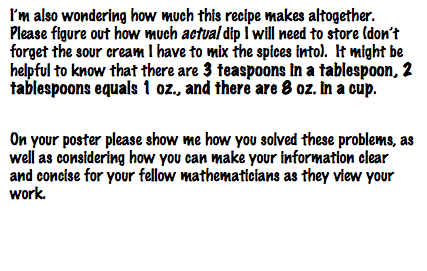
Screen Shot 2013-04-17 at 8.55.41 PM

Ranch dip problem, part 1

Part 2

Part 2

Well, what I don’t think I told you last time was that I had a conversation with a colleague of mine, who happens to be a fabulous math teacher, too, and we agreed there could have been many reasons why this was trickier than I had intended.  I decided to tackle these issues one at a time.  The first one we thought of was related to the context.

I think I may have taken for granted the fact that my kids would know about teaspoons, tablespoons and just the whole act of mixing it all together.  There were actually several kiddos who could not relate to what I was talking about with making the dip, so I decided to fix that problem.  I hoped that using the recipe would help them better understand what I was asking them to figure out.  So we got cooking!
IMG_0748

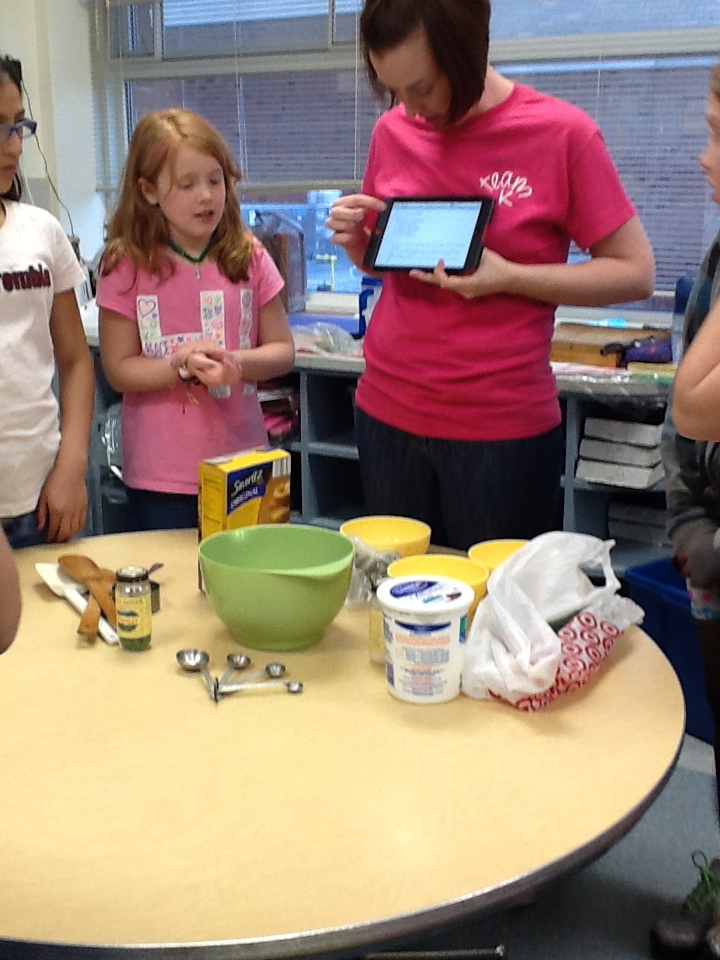
First, we reviewed the recipe and talked ingredients so we made sure we knew what to do. See how handy our iPads are for jobs like this? 🙂

IMG_0751

Sorry, this ones a little blurry, but we’re smelling the spices the recipe called for: onion powder, garlic powder, parsley and dill. Many hadn’t ever seen these before!

IMG_0754

Oh, and there’s basil in it, too! Smells yummy already!
IMG_0756

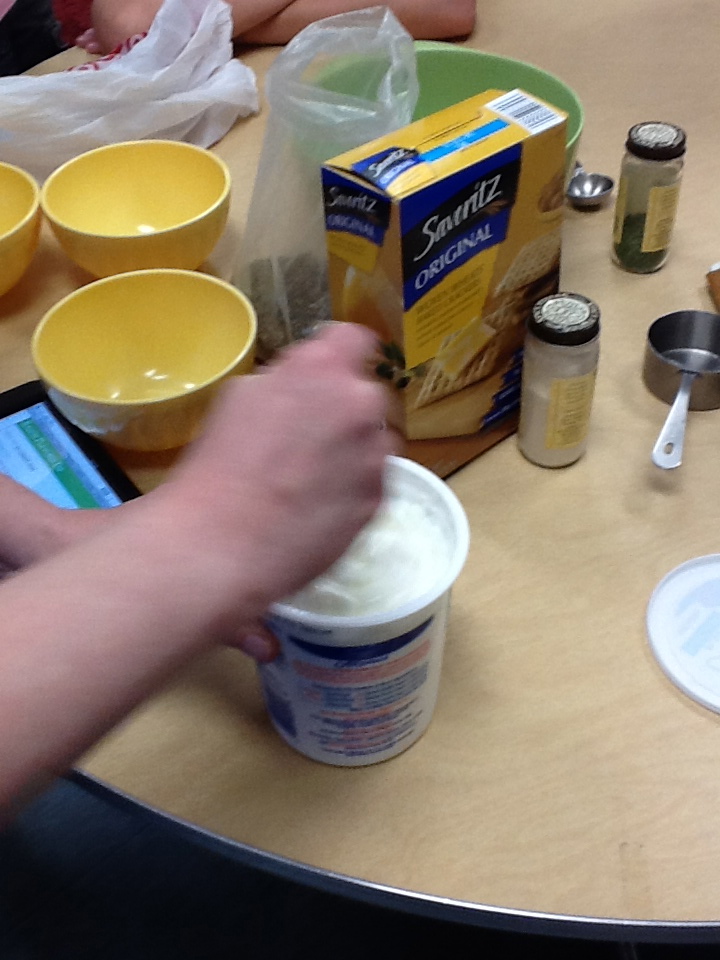
The recipe calls for sour cream, but I decided to use plain yogurt instead. Man, I must have been stirring fast!

IMG_0757

We discovered another part that was important (and in many cases missing) knowledge–knowing the difference between the sizes of teaspoons and tablespoons. Knowing that there are 3 teaspoons in a tablespoon was necessary for use in the final answer, but this was hard for some kids to image without seeing it.

IMG_0760

Spice mix ready to be stirred!

IMG_0764

We needed a 1/2 cup of yogurt for every tablespoon of spices.

IMG_0768

Looking good!

IMG_0774

I forgot a knife. 😦 Cutting a cucumber with the back of a fork is harder than it looks! Eventually I made it happen, though. 🙂
IMG_0776

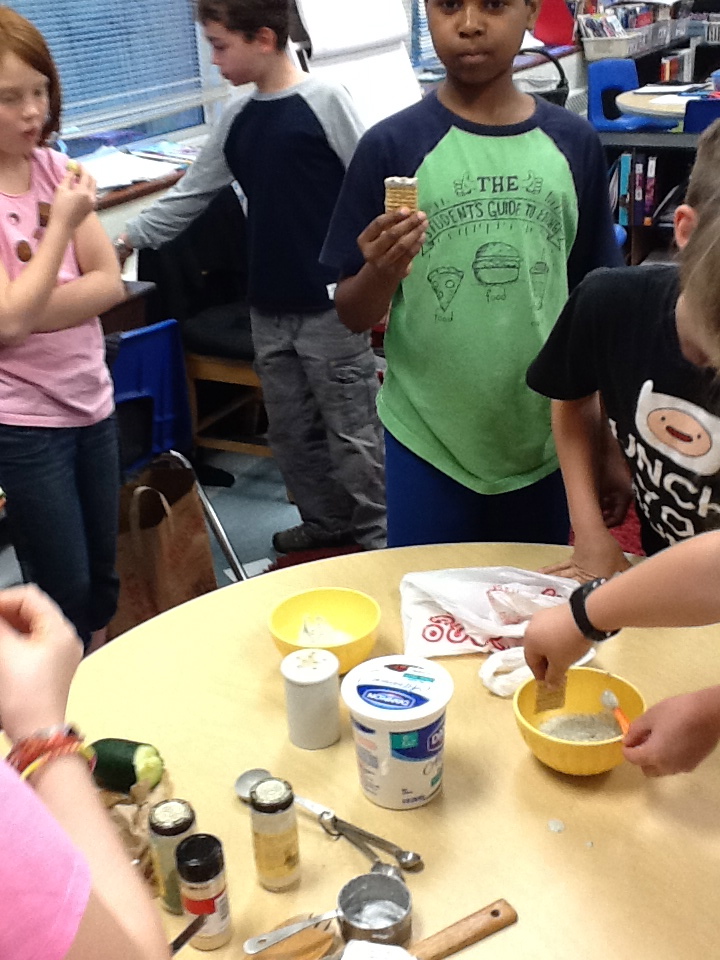
Yum! Ranch dip with cucumbers and Triscuits for our morning Math snack!

So while my cooking class didn’t solve every problem we were having (which I’ll tell you about in Part 3), I do think it gave many of them the ability to make connections they were unable to make before.  And there is so much math (and science) in cooking and baking, I don’t know why we don’t do more of it.  TOTALLY wish my classroom had a kitchen!  It has also made me and my team think about how we want to purposefully involve more of these types of activities into our classes for next year.  We’re thinking it would be a great addition and preparation for next year’s Feast Week, too.

How do you use cooking in your classroom?  What connections do you make for your kiddos to math and science?  Or maybe even reading and writing? We’d love to hear your thoughts and suggestions as we make plans for next year. 🙂

Math Warm-Ups April 15-19, 2013

Yeah, I know I’m posting this a week late.  Sorry! But better late than never, right? 🙂  (I also feel like I must explain that there are no warm-ups to post from this week–state testing left us with a different schedule than what’s normal.)

Monday

5th graders always need to practice division!

5th graders always need to practice division, and decimal division takes even more practice!


Wednesday

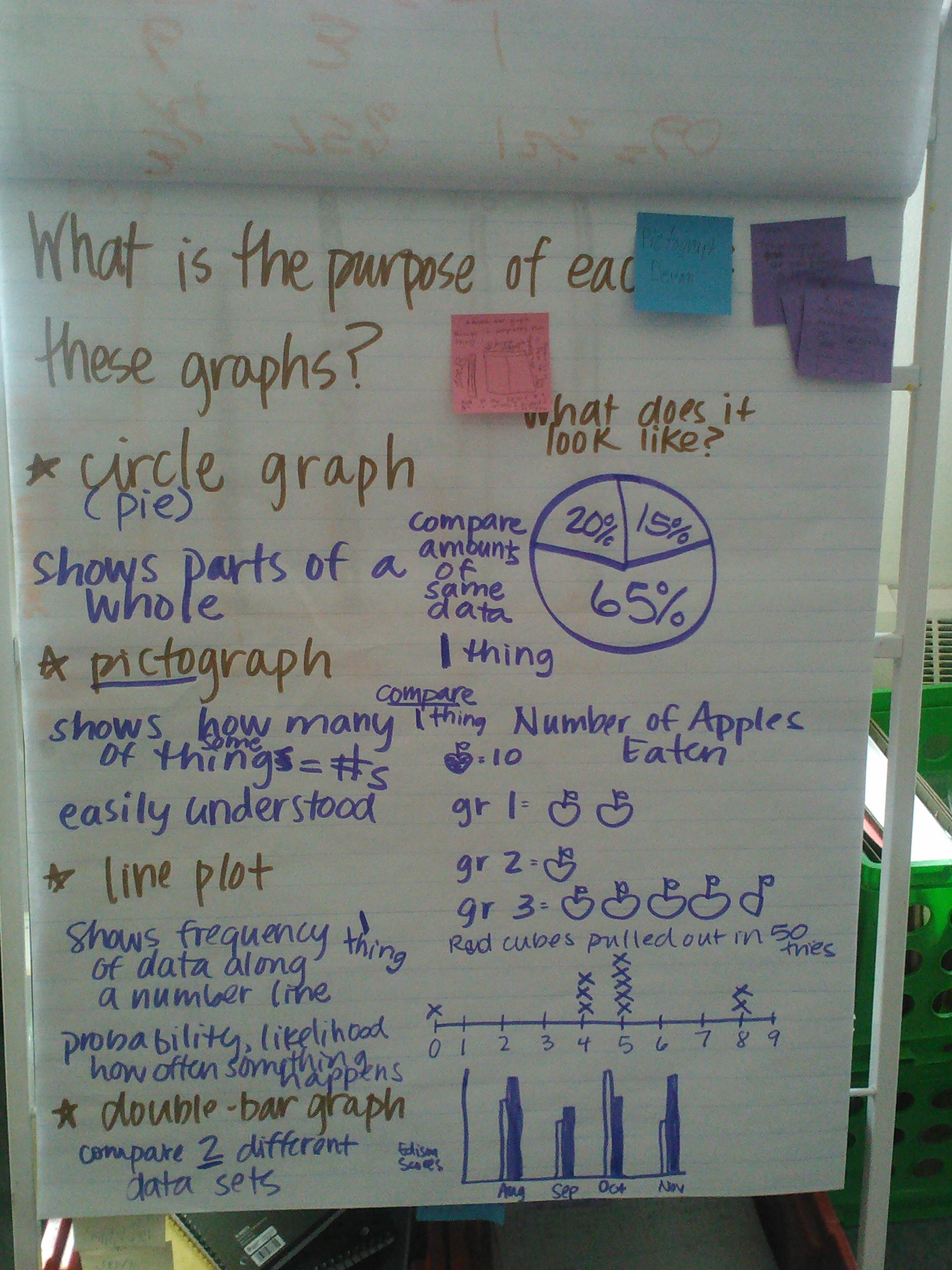
Often the problems we work on for morning warm-ups are from our monthly Edison assessments.  This was one that many of us got wrong, so it showed we needed to review graphs and their purposes.  It's a busy chart, I know, but that usually means we had a GREAT conversation around the problem!

Often the problems we work on for morning warm-ups are from our monthly Edison assessments. This was one that many of us got wrong, so it showed we needed to review graphs and their purposes. It’s a busy chart, I know, but that usually means we had a GREAT conversation around the problem!


Thursday

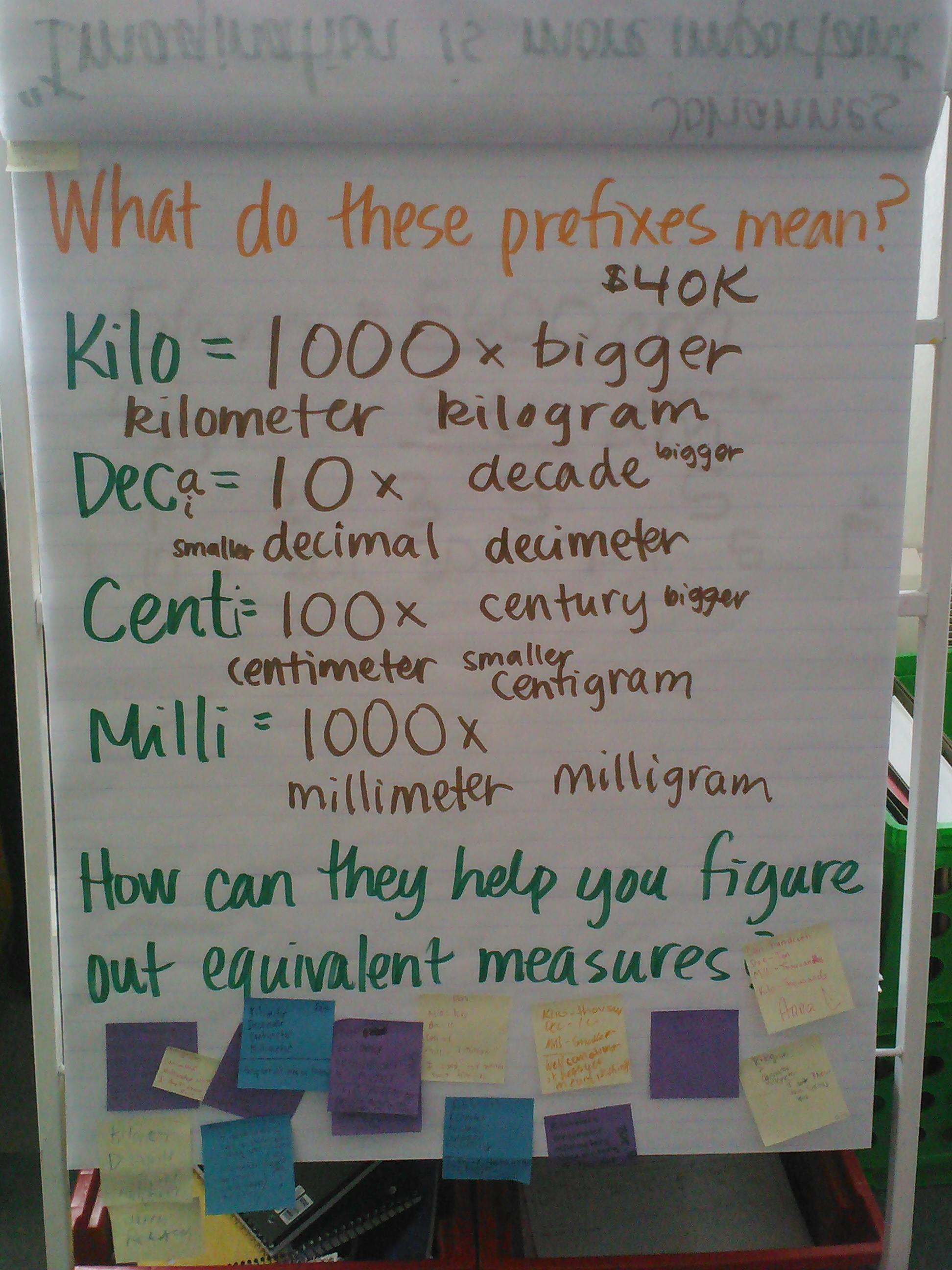
Another thing we needed to talk about was measurement and the prefixes you use in the metric system.  After this, we did some work with find equivalent measures.  Have you ever heard of how King Henry Usually Drinks Chocolate Milk?  This was very helpful to us in our equivalents work.

Another thing we needed to talk about was measurement and the prefixes you use in the metric system. After this, we did some work with find equivalent measures. Have you ever heard of how King Henry Doesn’t Usually Drink Chocolate Milk? This was very helpful to us in our equivalents work.

How did you use math warm-ups this week?  Leave us an example!  Maybe we could try a problem together with you next week!

I Speak Greek When I Teach Math

Or maybe it’s Spanish or Chinese or Pig-Latin, but today I felt like I was definitely not speaking English to my kiddos during math.  Meaning no one understood what I was trying to explain, and many kids ended up more confused than when we first started.  WHAT?  It’s not like I’m new at this, nor to the topic.  We were even working on a problem that I made up!  Needless to say, we all wanted to throw in the towel, or rip up our papers and start over.  Or something else that you shouldn’t do when you’re frustrated.  And no, in case you’re wondering–we didn’t.  But we did put the problem away until tomorrow when we’re fresh and can tackle it again.  And I am already armed with a different plan for how to address it, but am hoping you can help me, too!  (And by the way, after how fabulous the first round of problems-with-posters went the other day, this was all the more mind boggling!)

Ok, so I’m hoping that you can help me figure out what might be making my friends so confused.  Here is the problem that we were working on yesterday and today:

Screen Shot 2013-04-17 at 8.55.41 PM

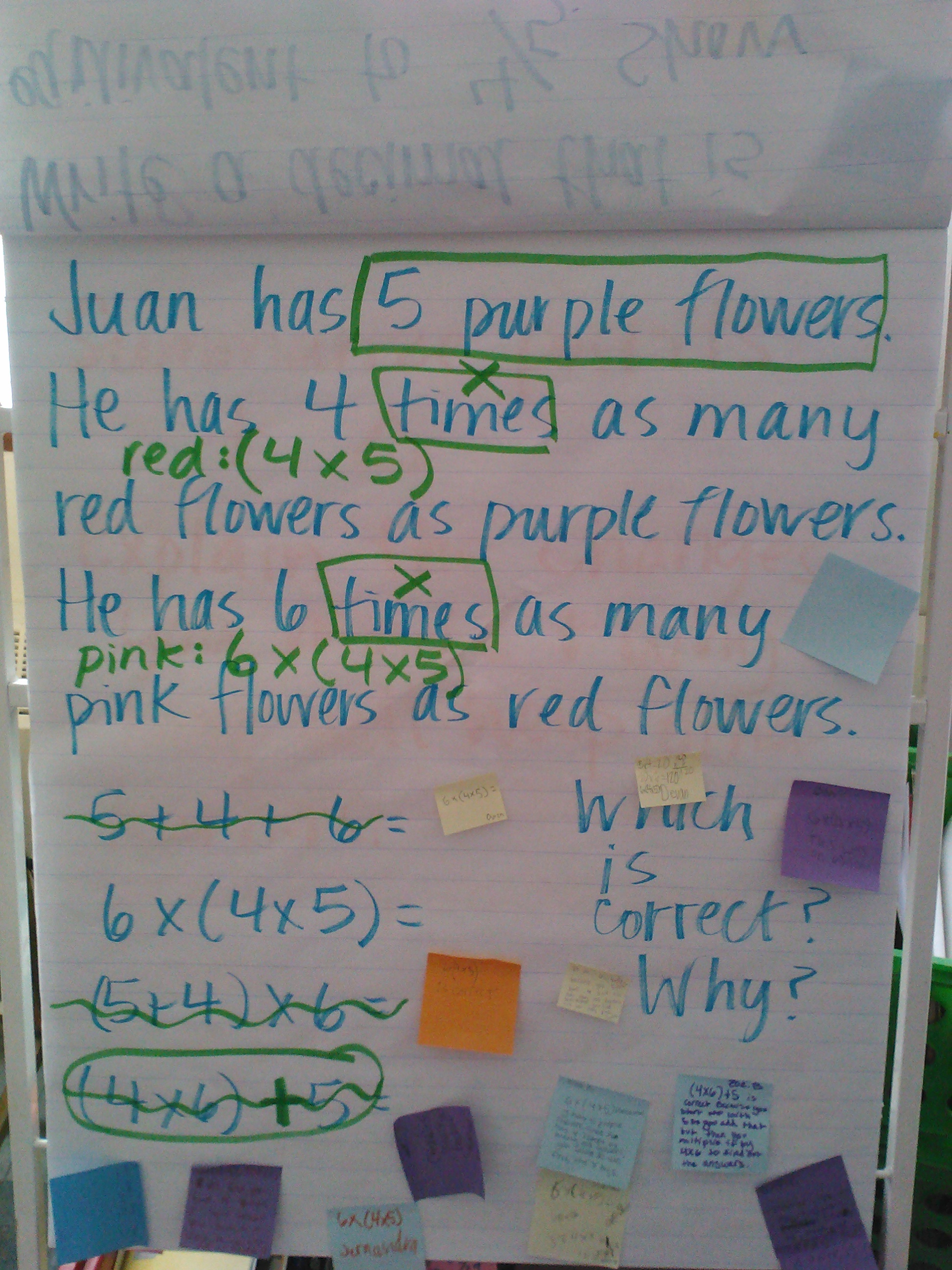
This problem is 1) based on a real-life problem, 2) uses math skills we already have (or at least that are not new!), and 3) really just focuses on making sure they use clear and concise notation to record their solution and thoughts.

Part 2

Part 2

PLEASE give me feedback on parts you see that may  have tripped them up.  After working on it for two days, I see a couple of things, but I really expected this to be a rather simple fraction problem; the difficulties they were having were not ones I had anticipated.  My hope was they could focus on the poster part, as a prep for how they’d answer questions as we start testing next week.  Instead, now they’re all convinced that math is hard and confusing.  Pretty much a teacher fail, huh? 😦

Thoughts?  Oh, and I guess it’s a given that I want you to be nice.  Truthful, but nice, please. 🙂  And maybe you could even tell me what you think the answer is.  That might help me see if the problem reads the way I intended it to.  THANK YOU, FRIENDS!

Math Warm-Ups April 8-12, 2013

Wow–how has it been a whole month since I last posted math warm-ups?  Oh, yeah, because MARCH was crazy–including a SNOW DAY and SPRING BREAK right next to each other.  And not that April is any less busy, but at least this week could be considered somewhat normal.  Oh, not it wasn’t–I had a sub on Tuesday.  But hey, what’s normal anyway, right?  Regardless, here are some recent math warm-ups I haven’t shared yet.

First of all, a couple from last week:

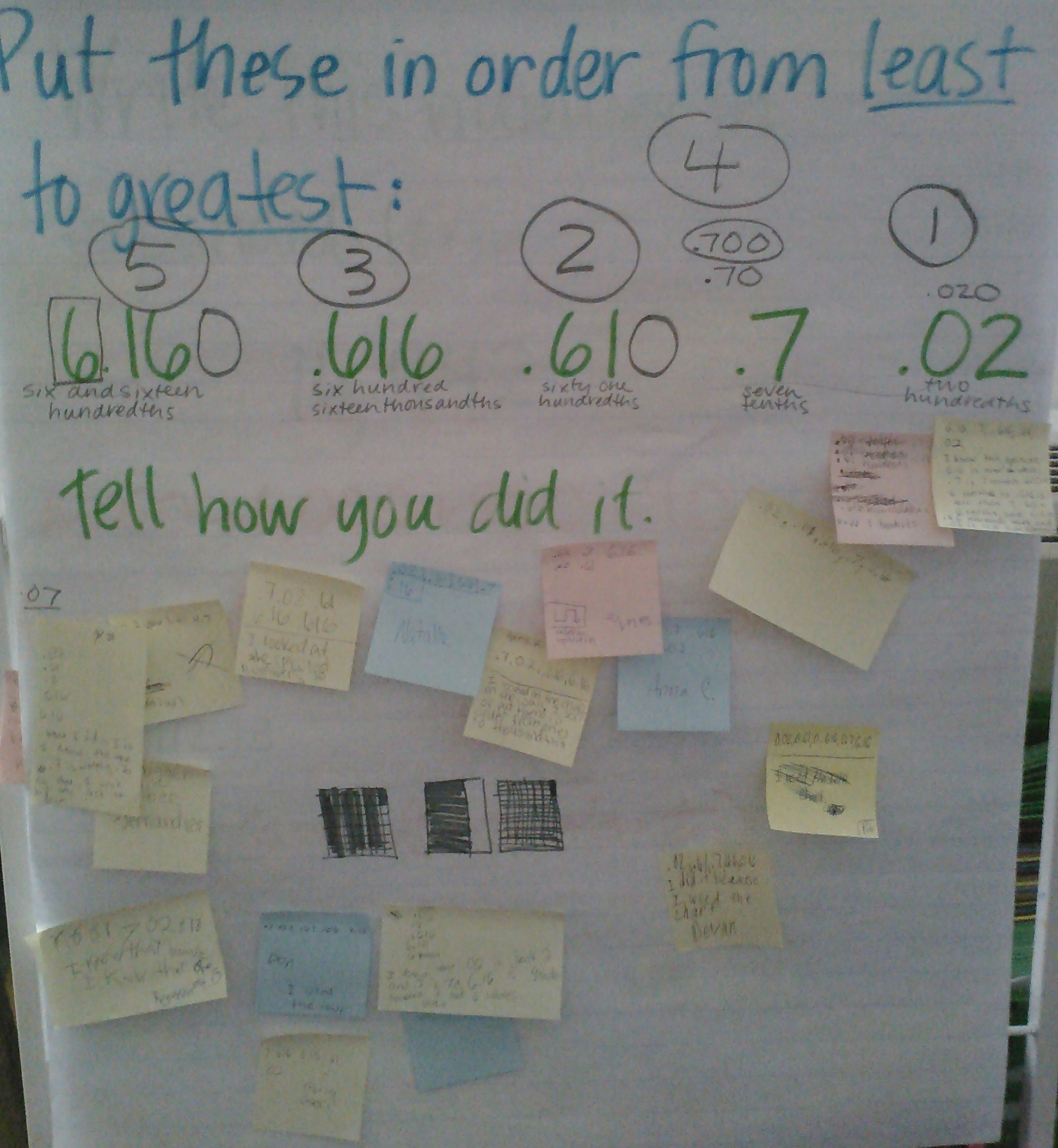
This one was to help discuss fraction place value, and also to help us talk about writing clear and concise answers to questions like these (in preparation for MAP testing in just over a week).

This one was to help discuss fraction place value, and also to help us talk about writing clear and concise answers to questions like these (in preparation for MAP testing in just over a week).

Can you tell I ran out of paper and didn't have a chance to get more for a couple of days?  Sorry. :)  This one is another place value one, hoping that students would see the relationship between money and fractions, and how they can just "move" the decimal (by multplying by 10), rather than having to use the algorithm to solve the problem.

Can you tell I ran out of paper and didn’t have a chance to get more for a couple of days? Sorry. 🙂 This one is another place value one, hoping that students would see the relationship between money and fractions, and how they can just “move” the decimal (by multiplying by 10), rather than having to use the algorithm to solve the problem.

This week’s warm-ups:

Wednesday

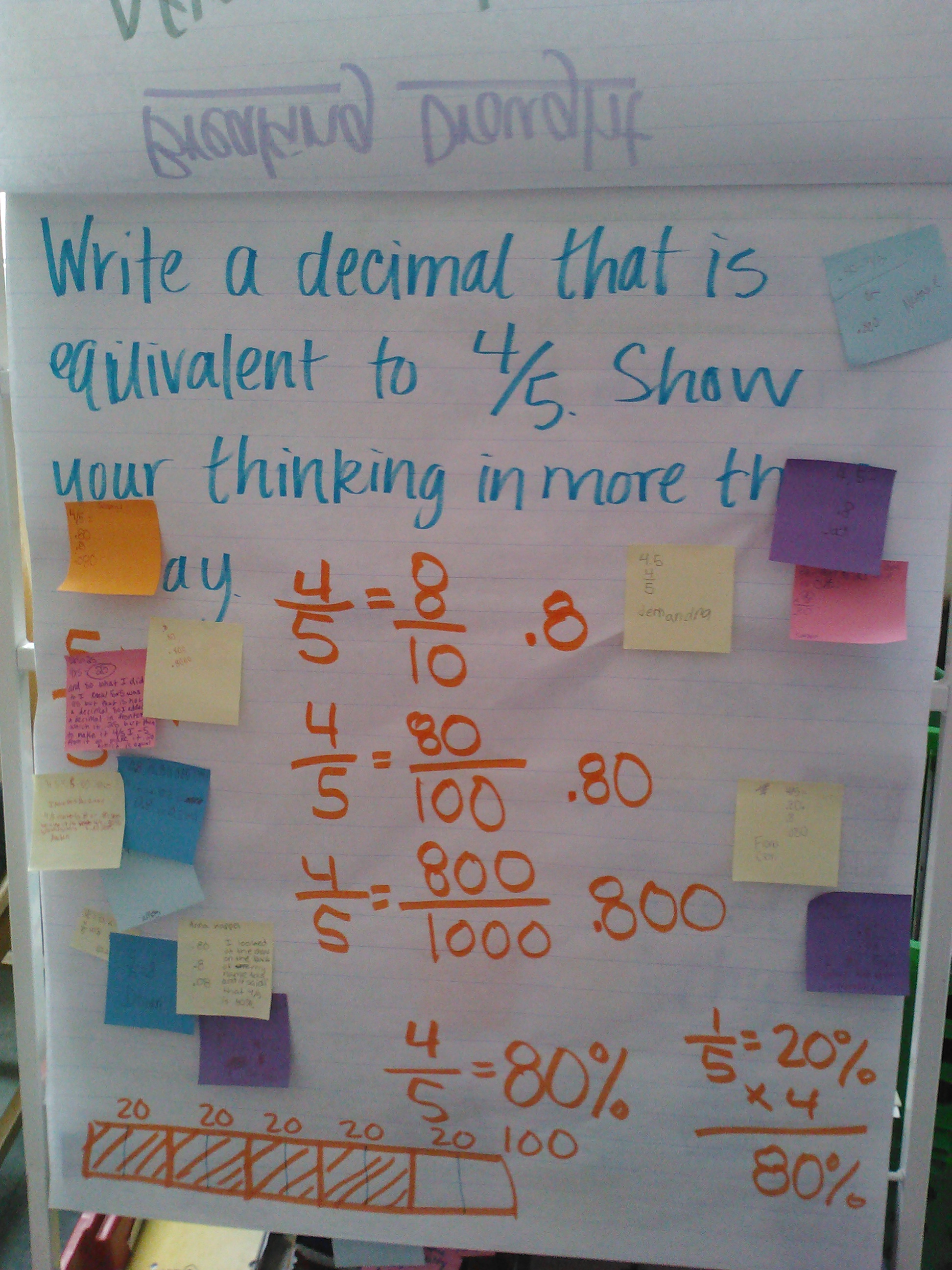
We needed to reminded (again) about equivalent fractions, as well as their tie to decimals.

We needed to reminded (again) about equivalent fractions, as well as their tie to decimals.

This one came right off of our Edison benchmark practice from this month.  We're using the problems on that assessment to help us analyze the "why" of the ones we get wrong.  This can help us not make those same mistakes again the next time we encounter them.

This one came right off of our Edison benchmark practice from this month. We’re using the problems on that assessment to help us analyze the “why” of the ones we get wrong. This can help us not make those same mistakes again the next time we encounter them.

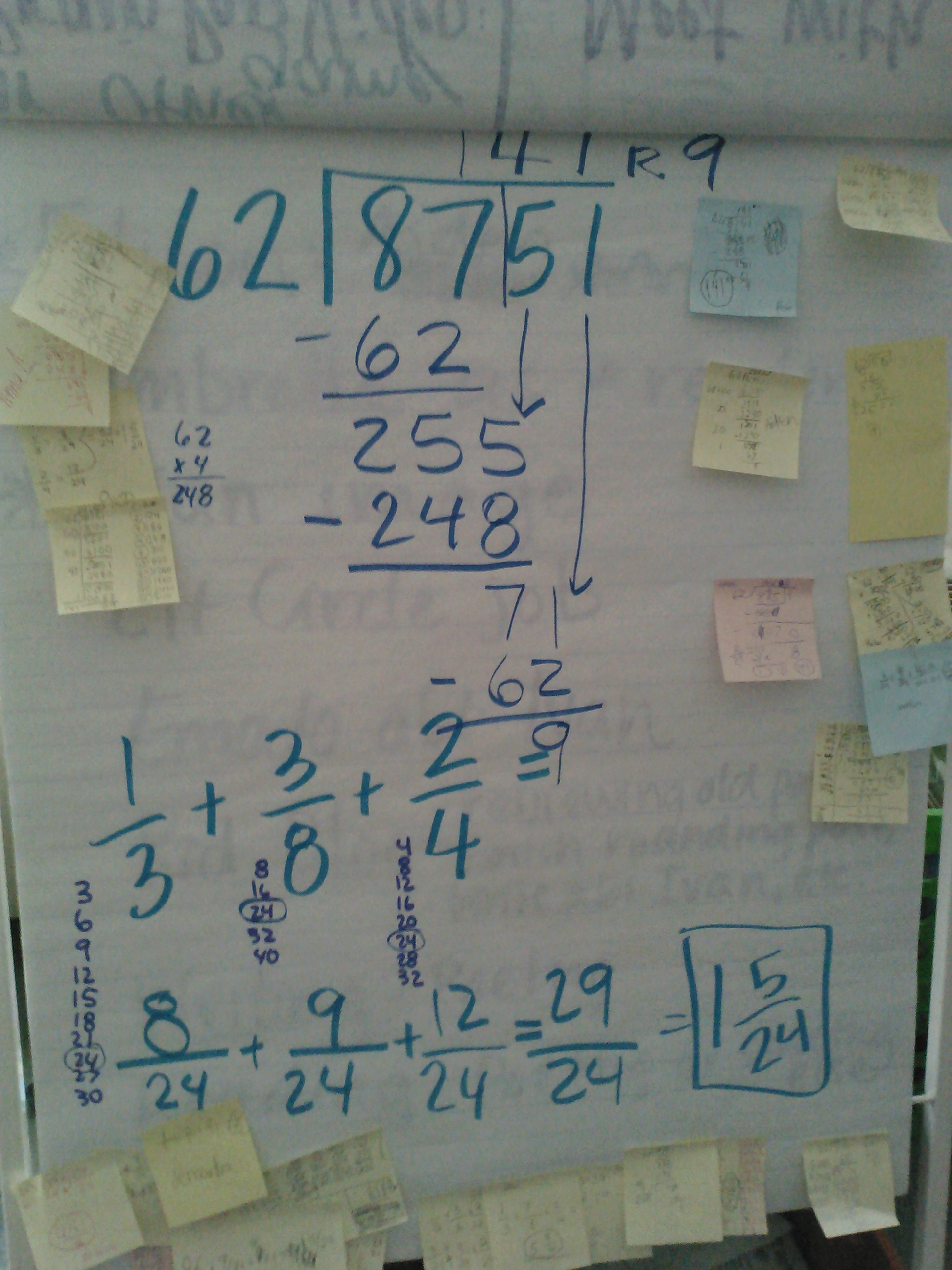
This is another Edison problem, but I changed the numbers.  Many students are still not remembering to make the denominators the same before they add.  This one also elicited great conversations around simplifying answers--both how and why here as well.

This is another Edison problem, but I changed the numbers. Many students are still not remembering to make the denominators the same before they add. This one also elicited great conversations around simplifying answers–both how and why here as well.


I’m hoping I’m back in the routine of posting warm-ups.  Sorry if you’ve missed them! 🙂


iPad Scout Reflections Week 2: Math Revisions and Video Thoughts

So I realize it’s really only been a couple of days since I posted my Week 1 Reflections, but since today was technically the end of Week 2 and we had such a fabulous tech day, I thought I’d tell the story today.

Since our horrible experience last Friday trying to get our Dropboxes all figured out, we’ve had some pretty successful days with our iPads.  Today was a particularly great day, with many great ideas flowing about how we could enhance our learning by using our iPads to record our thinking.

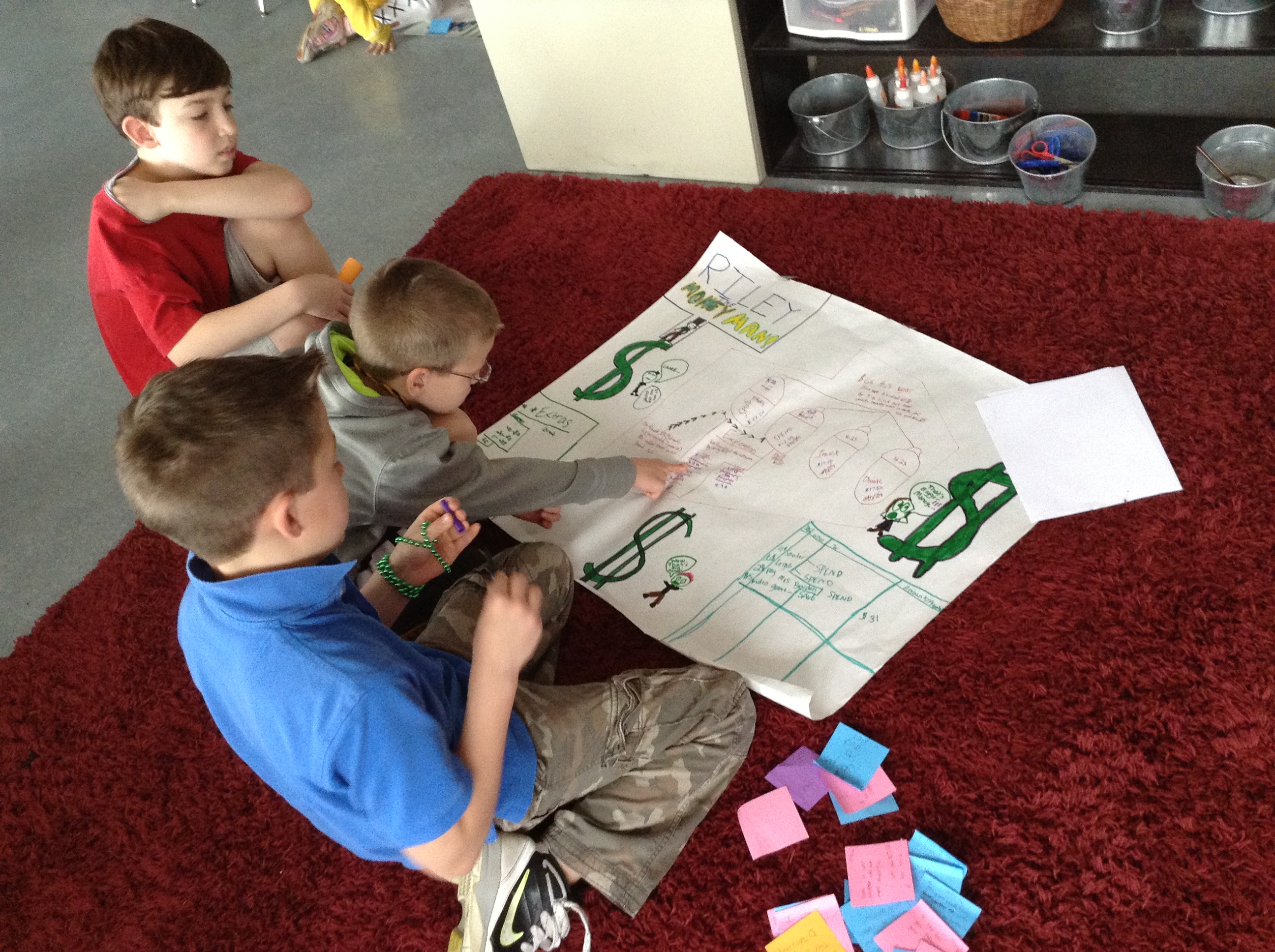
On Monday, we started an investigation in math that was focused around my son, Riley’s, allowance.

Riley's Allowance Problem

Riley’s Allowance Problem

Now, the math involved in this problem was not difficult; the focus here was on using clear and concise notation to record thinking, as well as revising your work before “publishing” it for others to see.  We focused on making sure we followed all of the directions and did the whole problem (which is a great skill to review since we’re doing state testing starting in about a week and a half. 🙂 )

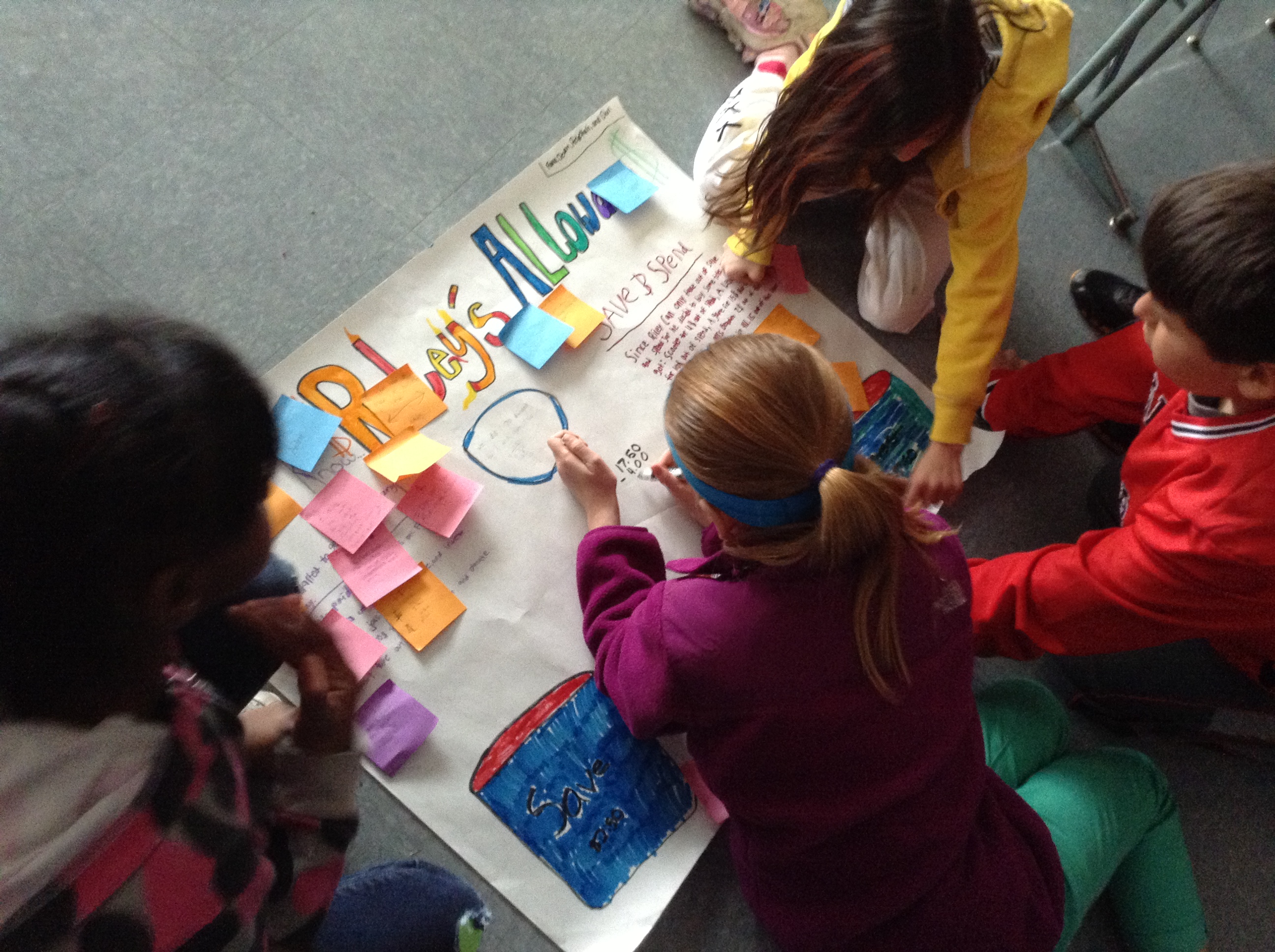
Kiddos spent two days working on the problem and then creating their posters.  After everyone had a poster, we did a gallery walk where groups were responsible for leaving feedback for others related to how well they accomplished each of those goals.  They left plusses and deltas for the group to consider as they revised their poster later.

IMG_0793

Revising based on what classmates said about their poster.

IMG_0795

One of their “deltas” was that they had too much white space and not enough numbers. They added in equations to show how they got their answers.

IMG_0797

Creative use of paper scraps as “white out” to cover parts they needed to change.

IMG_0798

Don’t you just love the combination of “old school” and “new school” here? IPads right alongside big ‘ole paper and markers. 🙂  They’re using one as a calculator and the other has a screenshot of the original directions where they did their draft work before the poster.

IMG_0800

Adding headings to each section (which classmates thought included too much writing) helped their thinking make more sense.

Then, I gave them one more direction: make a video to summarize your post-its, share your revisions and explain why they would help learners better understand your poster.  Pretty cool, huh?  Here’s what they did next:

I’m trying to decide when to mention that it took SIX STEPS to get those videos from where they were recording to being able to embed them on this blog post!!  WHAT?  I’m sure some of it was me not knowing some details about Dropbox (where I was hoping to be able to upload the videos so I could have access to them on my computer after school), but honestly, some of our biggest problems come from the filter that our Minis have embedded on them.  Obviously an internet filter is a necessary thing to have, but so often it also keeps us from efficiently doing what we need to do as learners.  So…the videos went from kiddo iPads where they were recorded——–>they were sent to me through iMessage (which ended up being the only way we could figure out to export them, and by the way, we had to set up before we could use today)——-> then I learned how to upload them to the Dropbox app on my Mini so I could access them———>then I had to download them to my computer, since the Dropbox they were in is not the same as my personal Dropbox linked to my computer—–> then they were uploaded to YouTube——-> and THEN they could be added to my blog.  Are you tired yet?

That definitely wore me out a little.  Surprised I had any energy left to even write all these words!  Is that crazy to anyone but me?  PLEASE, PLEASE, PLEASE tell me if you know an easier way to get video from kid iPads to a usable form for me.  I want to use them more often for things like this, but I’d love to be able to do it without so much work. 🙂

(And so here I was going to add a really SUPER idea that my friend ZB had today about how to show our thinking about poetry, but surprisingly the examples I wanted to share are still on the iPads where we recorded them today.  Just didn’t have enough hours in the day to figure that one out.  Hopefully tomorrow. 🙂 )

Math Warm-Ups March 4-8, 2013

I’m starting to feel like there’s not really such a thing as a “normal” week; every Friday I say something about how this past week hasn’t been.  So–this week was another “unnormal” week.  Here are our warm-ups:

Monday

Screen Shot 2013-03-08 at 8.10.09 PM

I was out Monday with a sick little girl, and somehow forgot to get a picture of that warm-up. This one is practice with both place value and decimals.


Tuesday

After reading the note from my Monday sub, I knew we needed to review what to do with the decimal point in this multiplication problem.  Then, as in a stroke of genius, we made a connection to our fraction unit where we used fraction bars to help us visualize what the numbers were doing.

After reading the note from my Monday sub, I knew we needed to review what to do with the decimal point in this multiplication problem. Then, as in a stroke of genius, we made a connection to our fraction unit where we used fraction bars to help us visualize what the numbers were doing.


Wednesday

After we stumbled upon fraction bars again Tuesday, I gave them a problem where I had them use that strategy again (on purpose!).  For many it was the visual they needed to help it click.  But, for some others it just made them more confused! :(  We had a great discussion about figuring out which strategy or model works for you and making sure you use that one well.

After we stumbled upon fraction bars again Tuesday, I gave them a problem where I had them use that strategy again (on purpose!). For many it was the visual they needed to help it click. But, for some others it just made them more confused! 😦 We had a great discussion about figuring out which strategy or model works for you and making sure you use that one well.

Close-up of the marking on the fraction bar: we took 1/4 out of each one of the 1/10, which made 6/24.  Eventually we were able to simplify our answer all the way back to something that we could turn back into a decimal (1.5/10 or .150).

Close-up of the marking on the fraction bar: we took 1/4 out of each one of the 1/10, which made 6/24. Eventually we were able to simplify our answer all the way back to something that we could turn back into a decimal (1.5/10 or .150).


Thursday and Friday

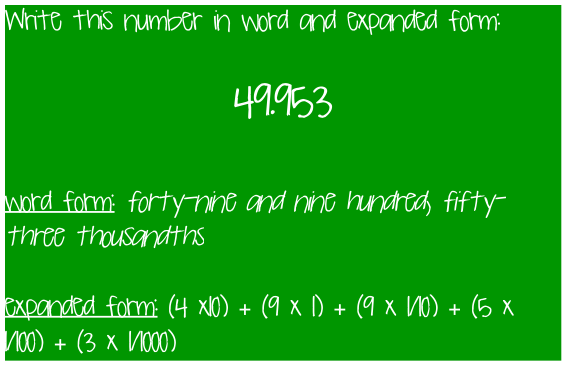
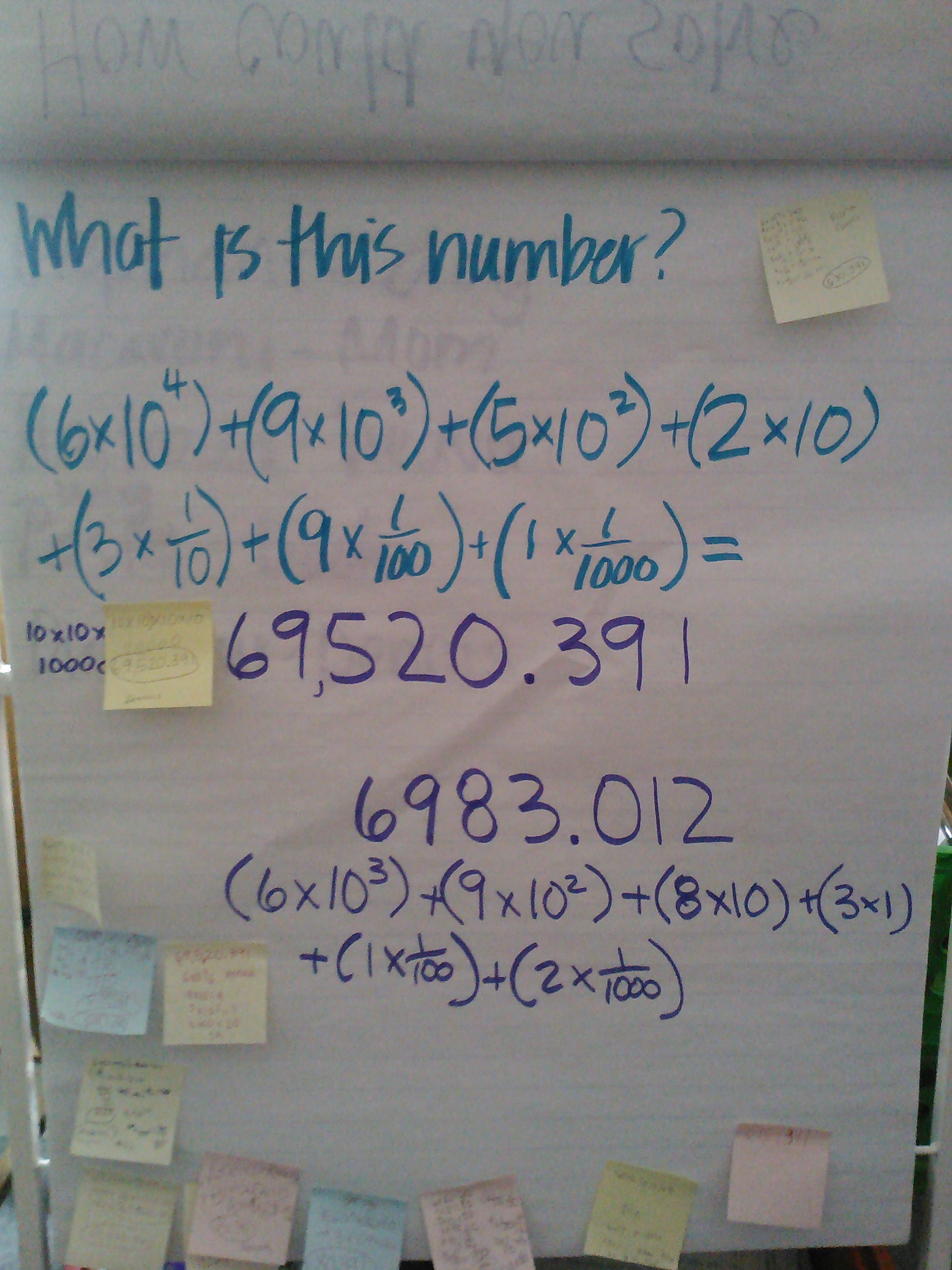
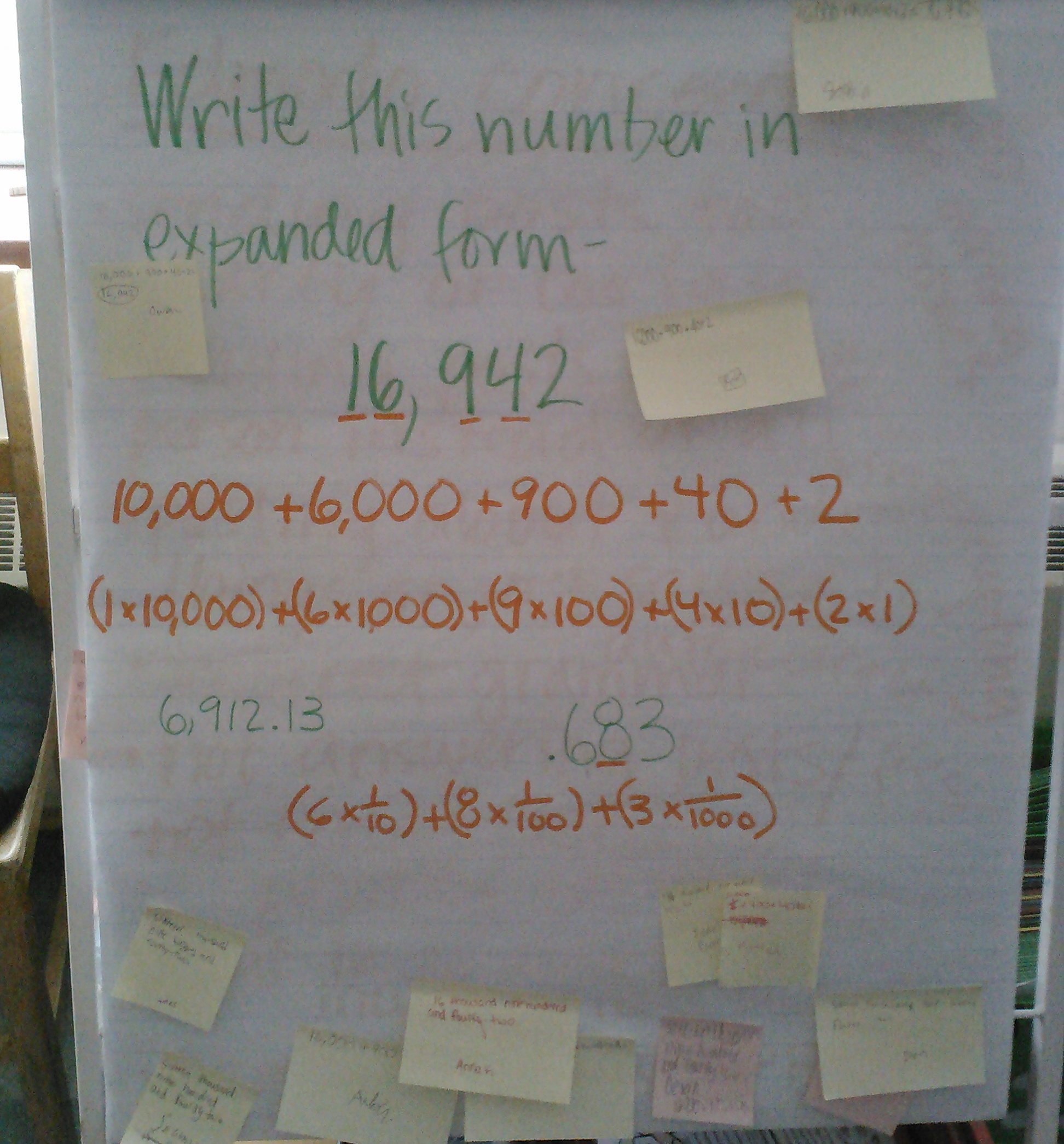
Remember that "unnormal" part of this week?  On Thursday we were only at school for about 20 minutes before we left to head to the middle school for the dress rehearsal of their Spring production of Guys and Dolls Jr. (which was FABULOUS, by the way!), so we didn't have math this day.  We had the discussion over this warm-up today.  Because many people got thrown off by both 1) the exponents in this problem and 2) the "backwards" nature of how I did expanded form, we did another example problem first (the number at the bottom).  This problem is a great example of how the warm-up is often a response of something that happens in our math rotations: as we were reading the rubric for reading and writing decimals, we realized that we needed more practice with expanded form and so that group requested we do more with it in our morning work.  Great idea, friends!

Remember that “unnormal” part of this week? On Thursday we were only at school for about 20 minutes before we left to head to the middle school for the dress rehearsal of their Spring production of Guys and Dolls Jr. (which was FABULOUS, by the way!), so we didn’t have math this day. We had the discussion over this warm-up today. Because many people got thrown off by both 1) the exponents in this problem and 2) the “backwards” nature of how I did expanded form, we did another example problem first (the number at the bottom). This problem is a great example of how the warm-up is often a response of something that happens in our math rotations–as we were studying the rubric for the standard of Reading and Writing Decimals, we realized that we needed more practice with expanded form.  So that group requested we do more with it in our morning work. Great idea, friends!

What are you thinking about our math warm-ups lately?  Do you have a suggestion for a decimal problem we could do?  Feel free to share it and we’ll try it, then leave you the answer!  We’re always ready to try something new!


Math Warm-Ups February 25-March 1, 2013

Last week was a little crazy, so we only had three warm-ups that stretched all throughout the week.

Monday

IMG267We came back to division (again) this week, as it’s a skill that many kiddos still have trouble with, even at this point in the year.  We have another unit of it in a couple more weeks, but we need the practice nonetheless.  The difference, too, this time is that we’re working on using a different strategy.  In the past–like when we were first learning how to divide–we thought about the number as a whole, and worked to find groups inside of it, rather than using the traditional algorithm.  Our focus was on understanding what division means, and we incorporated what we knew about multiplication as much as we could, as well.  This time, we’re trying to use the traditional method–still connecting to multiplication–but just organizing our thinking and our numbers in a different way.  We have been talking about reasonableness of answers, too, and use estimation to help us determine if our answers make sense.


The Rest of the Week

IMG269The rest of the mornings during the week were busy, we we actually took a couple of days to work through these problems.  You’ll notice a second division problem and then a good ‘ole adding fractions problem because we’re still fuzzy on this concept.  But truly, this is what is perfect about Math Warm-Ups–being able to easily revisit concepts that we need more time with.


Feast Week Part 7: THE FEAST!!

Ok, so I’m not at all sure how it got to almost the end of February and I didn’t tell you about the final part of Feast Week!  I know…I’m sorry!  But you’ve been reading blog all along, right?  We’ve been busy!

But here’s perhaps the most important part of the whole thing we called Feast Week–the feast!  (And just in case you haven’t read the first parts of Feast Week, you can find the first one here, and then the others are linked from there.  It’s worth your time if you haven’t read them!)

The day had finally arrived, and we were excited.  But no, we were not excited about the fact that Winter Break was just a day away, or because we’d be off for 14 days–we were excited because all of our hard work with fractions and recipes and cooking and baking and planning was about to pay off!

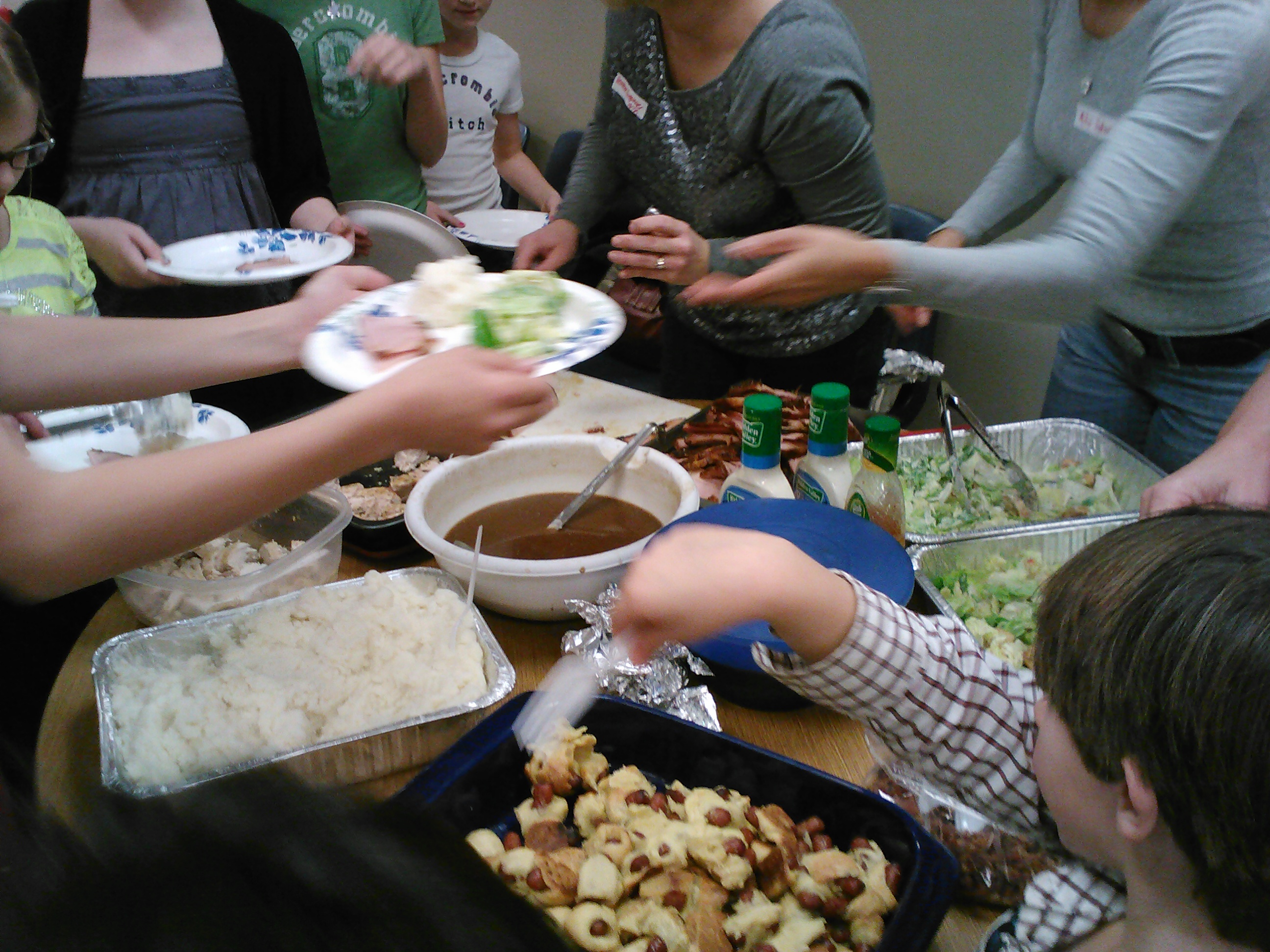
And it went even better than we’d hoped.  Thanks to some fabulous parents who were willing to let us throw out this crazy idea of our Winter Party to them (and then just told them to run with it!), we ended up with a lovely, delicious meal that helped us all see the fruits (and hams and green beans and ice cream pies) of our labors.  It was definitely a  FABULOUS FIFTH GRADE FRACTION FEAST!!

Anticipating our fabulous feast as we wait outside the cafeteria!

Anticipating our fabulous feast as we wait outside the cafeteria!

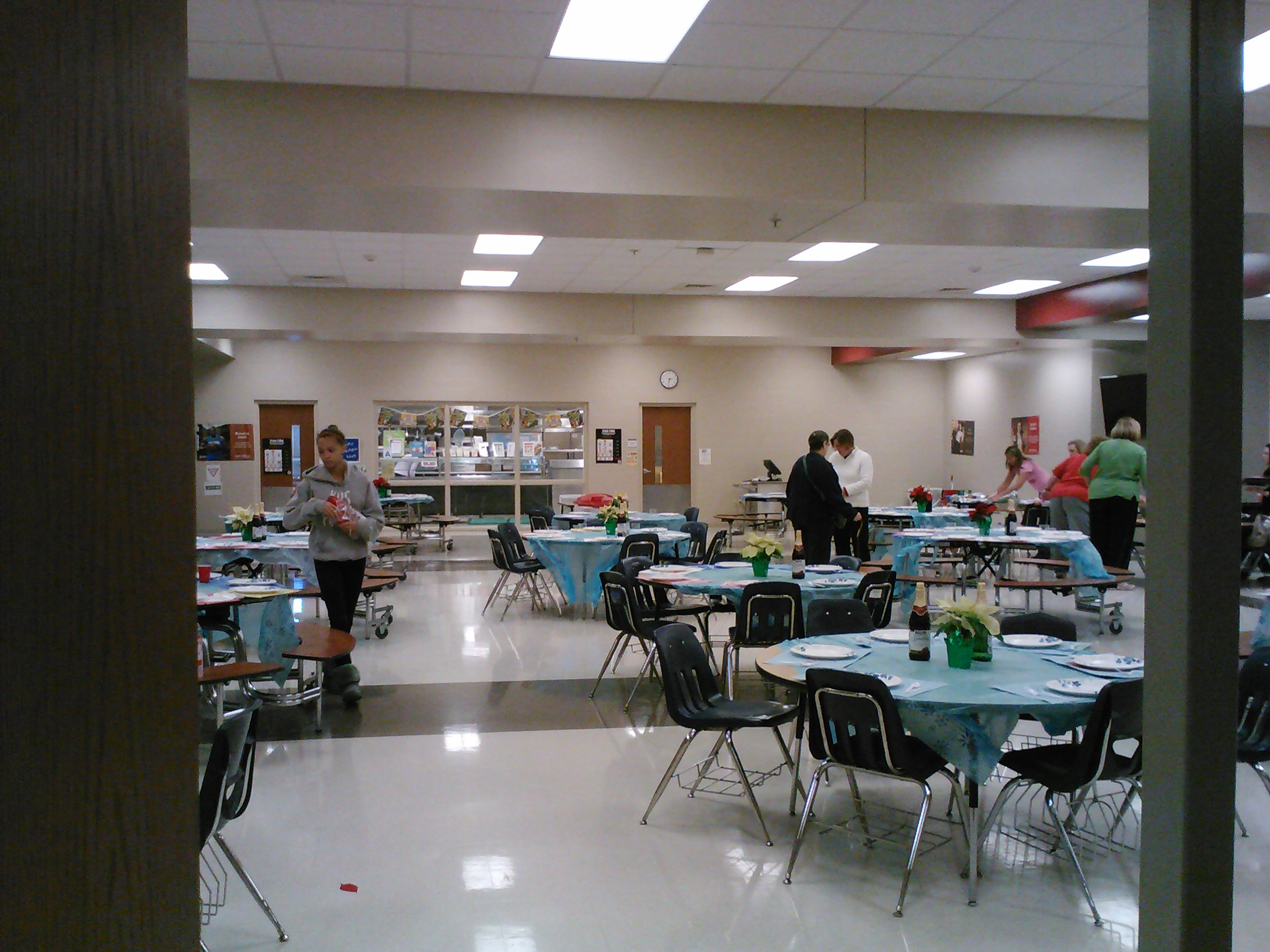
Looks good, doesn't it? Tablecloths and centerpieces and everything!  So elegant!

Looks good, doesn’t it? Tablecloths and centerpieces and everything! So elegant!

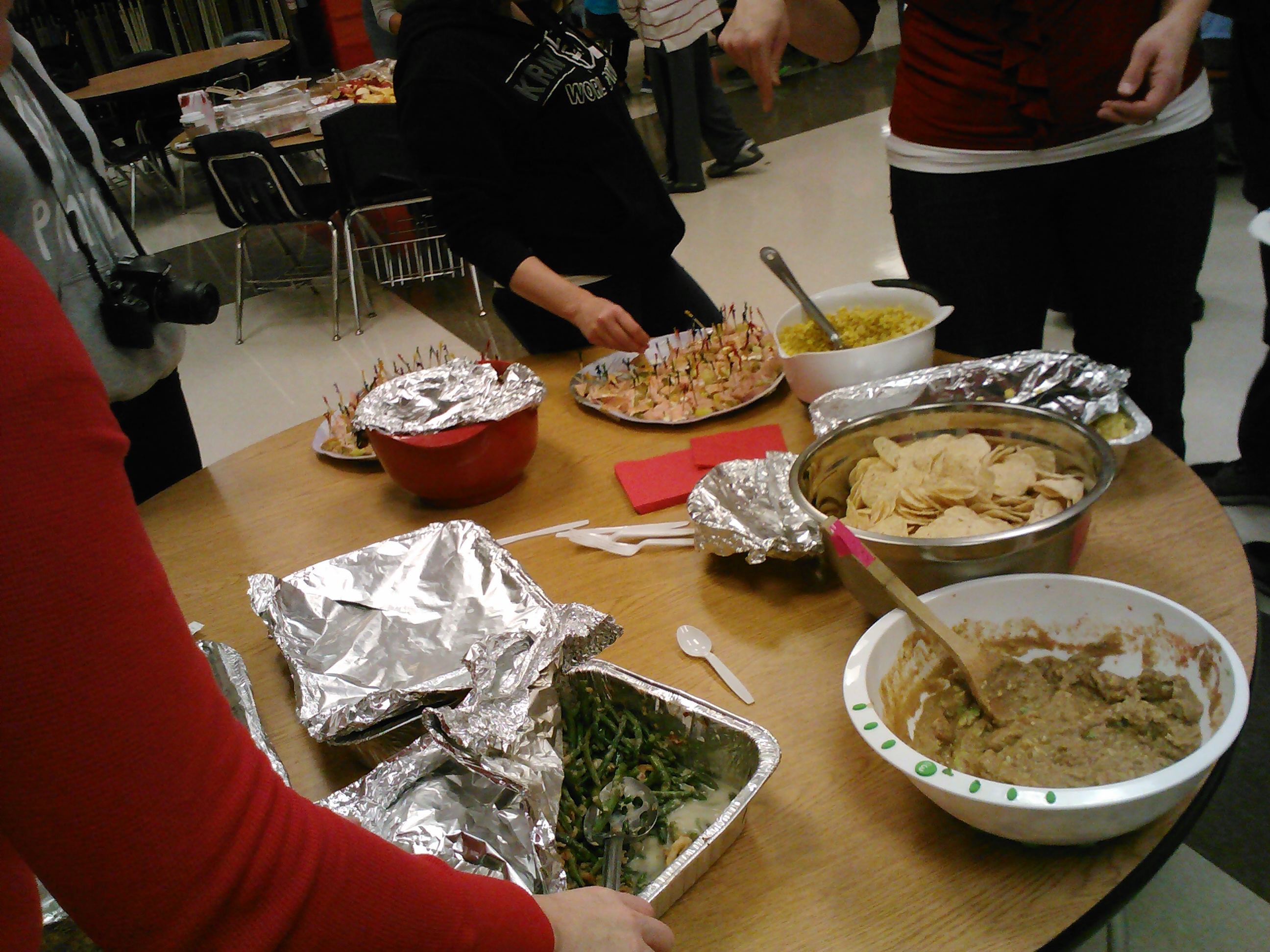
Here's our handiwork!  Looks yummy!

Here’s our handiwork! Looks yummy!

IMG678

That bowl is guacamole–I promise, it was pretty good!

Moving through the line

Moving through the line–sausage snack wraps were a hit!

A toast to food, fun and friends!  (and fractions!)

A toast to food, fun and friends! (and fractions!)

IMG669 IMG670 IMG672 IMG674

WE LOVE FEAST WEEK!

WE LOVE FEAST WEEK!


Math Warm-Ups February 11-14, 2013

Another 4-day week for us, but only a 3-day warm-up week because of some very messy cubbies that needed to be attended to on Tuesday morning.  Happy calculating!

Monday

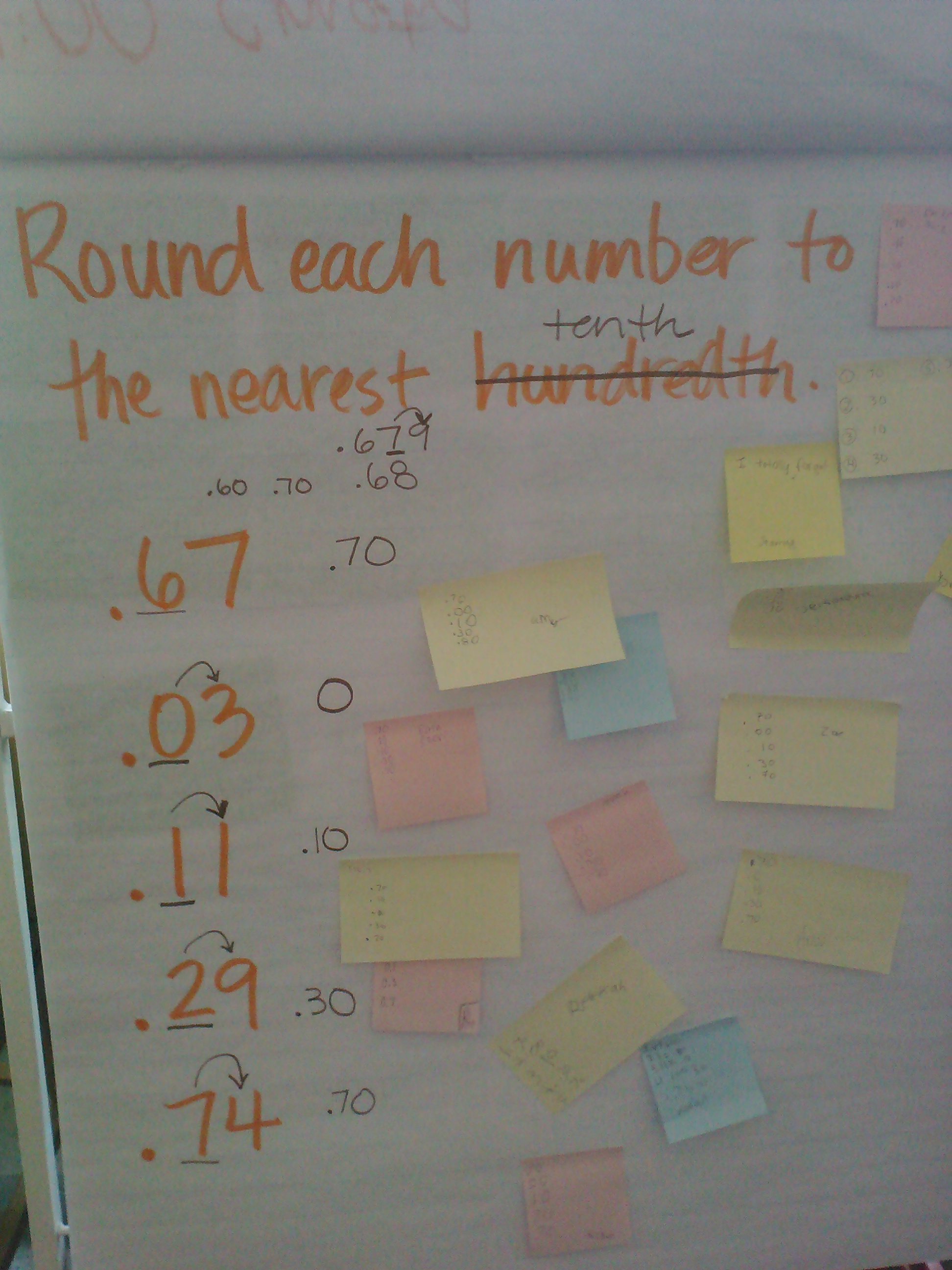
IMG157Can you catch the mistake I made in this warm-up question?  I didn’t catch it until we started discussing how to do it and figured out that you can’t round a decimal to the hundredths place if it’s already a hundredth!  So we changed it to tenths.  Oops.  HATE it when that happens, but LOVE that it continues to teach my kiddos I’m not perfect.  Teachers don’t know everything and they do make mistakes.  And we know how to solve problems like that when they happen.  So I guess in some ways this was a double-whammy warm-up: two lessons in one!  Only wish I’d planned it that way….:)

Tuesday

Oh, yeah, we were cubby cleaning.  There was too much mess to take a picture, so nothing to share here.

Wednesday

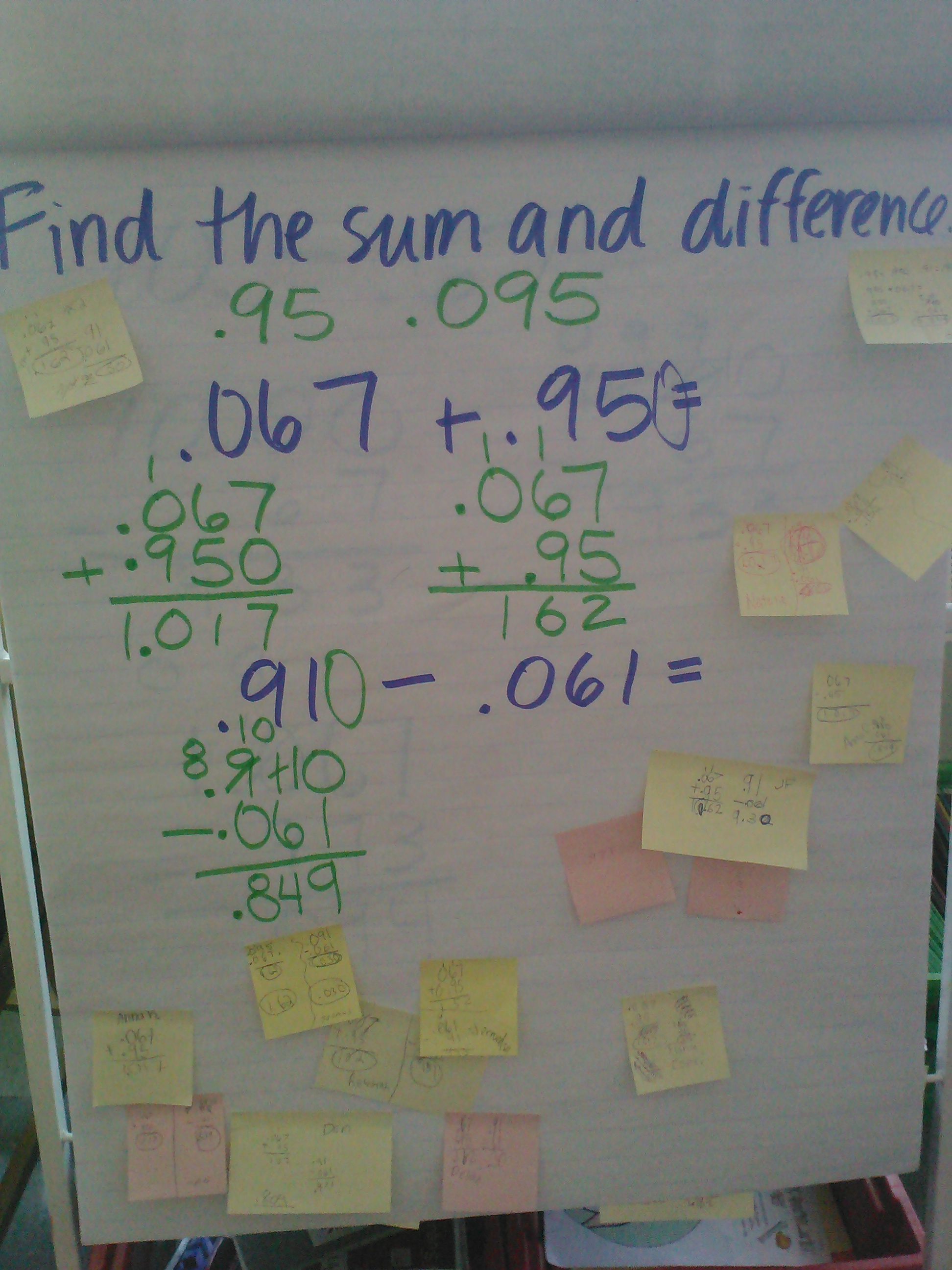
IMG158We had been working on place value and rounding with decimals for about a week and were ready to move on to adding and subtracting, which I was figuring would be pretty straightforward, and so relatively easy.  The way this one was worded, though, caught a couple of kiddos because they wouldn’t remember what “sum” and “difference” meant–definitions we reviewed as we went over the problems.

That second problem sparked another one, too, which was a goodie:

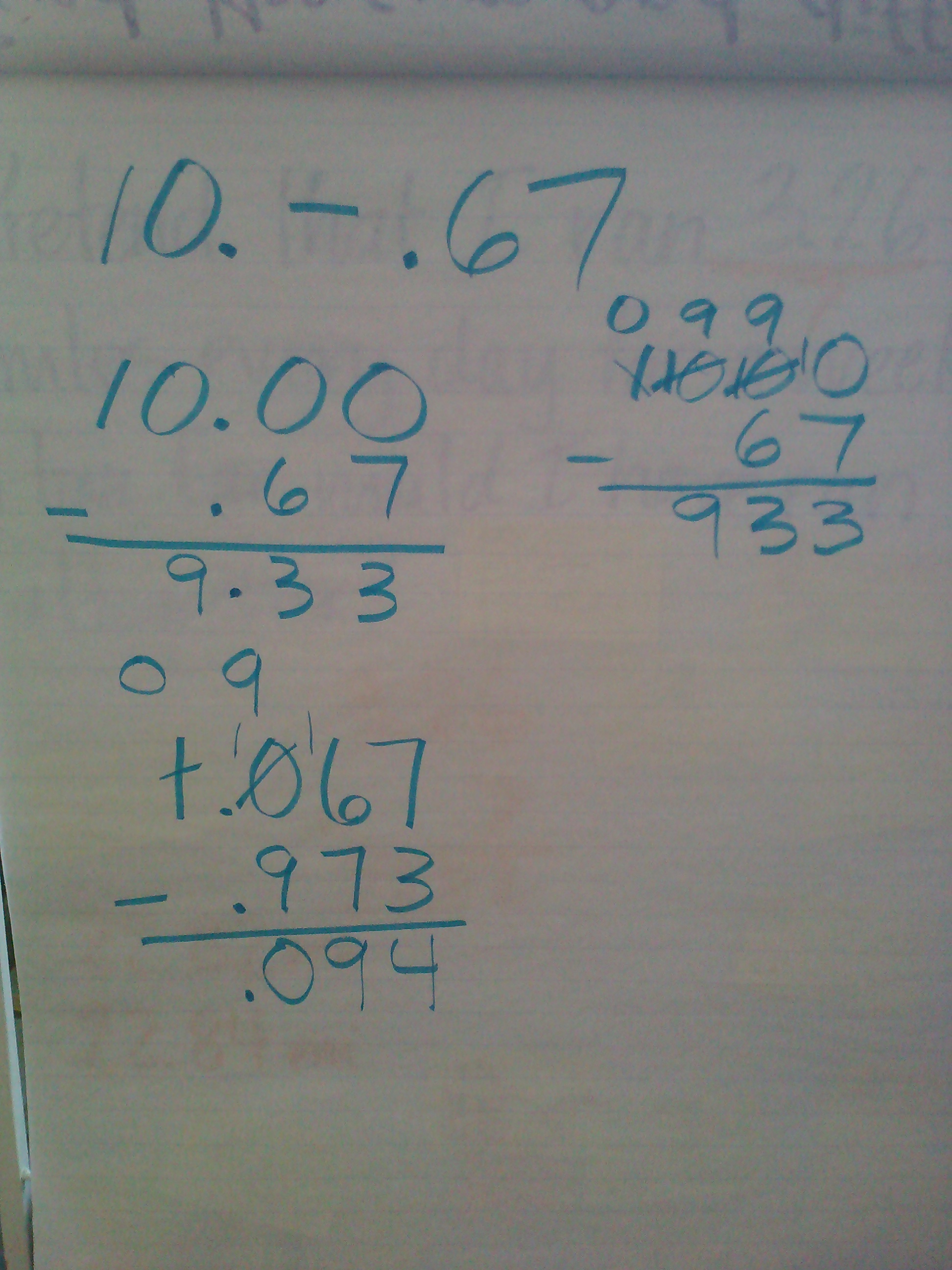
IMG159What do you do when you have a whole number and you subtract a decimal?  There isn’t a decimal to line up.  Or is there??

Thursday

IMG160There’s a joke in this warm-up (that’s probably only funny to me and my class).  See, we were noticing on Wednesday that many of the word problems we have in our math book involve running (Sally ran .89 of a mile on Monday, 2.3 miles on Tuesday and .5 miles on Wednesday, etc.).  In our groups we’d been talking about how guilty those references made me feel since I’ve been REALLY lazy about my running the last few months.  So Thursday I made the problem all about my running.  But since I can’t lie about what’s really happening, I made sure to say that we should pretend that I ran all those miles last week.

But aside from making us all laugh at my funny joke, there was another reason I wrote the problem the way I did.  We are going to be moving into multiplication of decimals next week and I wanted to see what they could do with that.  The problem could easily be answered without multiplying, too, for those that weren’t ready yet–and some just used repeated addition to get the answer–but some did try multiplication as a strategy.  Many of those figured out just what to do with the decimal point, and did so in a logical way–which I loved!  Rather than spouting off the rule about having the same number of decimal places in the answer as in the problem, they used what they know about the problem.  They got to the number 2282, and when thinking about what the final answer should be, thought “Well it can’t be 2.282 because that’s not even as far as she ran in one day.  It can’t be 228.2 because number is WAY too big.  22.82 makes sense because 3 miles times 7 days is 21 miles and the answer has to be a little bigger than that.”  THAT is the kind of thinking I look for and was so excited to see as I threw them this new concept.  It makes me excited to hear and see more as we dig in deeper this upcoming week!

Math Warm-Ups February 4-8, 2013

We had a pretty much normal week with warm-ups, so I have five to share!  This week we started working on decimals, and our warm-ups were related.

Monday

IMG133


Tuesday

IMG134There are two notes to make about this warm-up: 1) that should say “expanded form” rather than “extended form”, and 2) I realized after I’d written it that they weren’t ready to talk about that yet.  Sometimes I’ll do a warm-up about a brand new concept, especially if we’re going to talk about it that day in rotations, but that just didn’t make sense for this one.  I was out with a sick baby, and we weren’t going to talk about it for another couple of days, so we skipped that part until later.


Wednesday

IMG135


Thursday

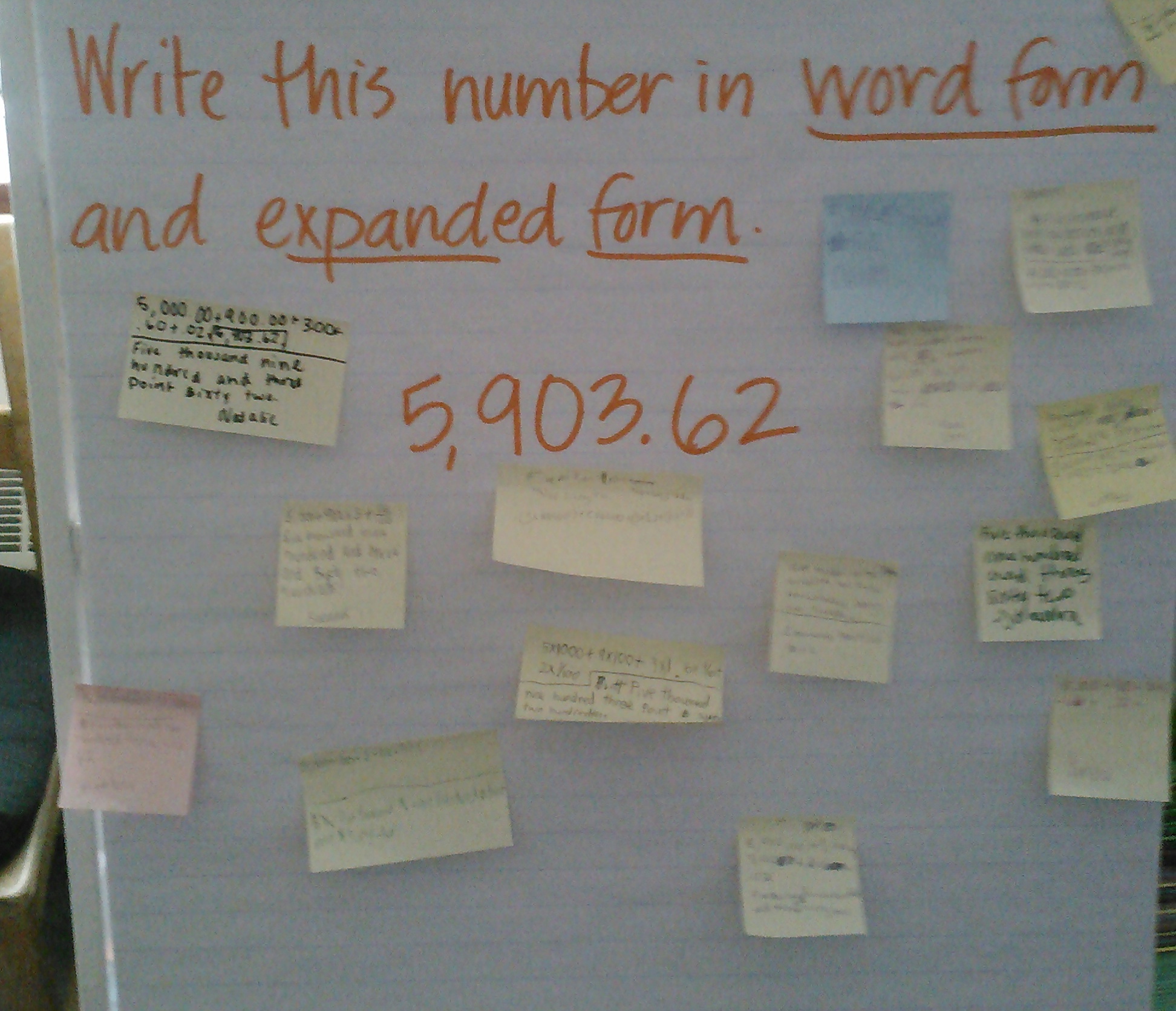
IMG136So this was the day when we came back to expanded form.  I was glad that we waited, because I could tell from their responses that they didn’t have a clear idea about what it meant.  Many wrote the number in words–which is word form instead of expanded form.  Once I showed them what it was, many remembered, and so after the whole number we tried it with a decimal (the part at the bottom).  The whole idea of expanded from with decimals is new (both to my students and to me!) and was added in because of changes we’re making to align closer with Common Core standards.  Once you start talking about how it works, though, it’s really the same idea as with a whole number.  Most picked up on it pretty quickly.


Friday

IMG138