A couple of days ago I posted about the amazing work my writers did during our Punctuation Study. Here are the pics of our class charts that I promised you. Like I told you, it’s AMAZING!

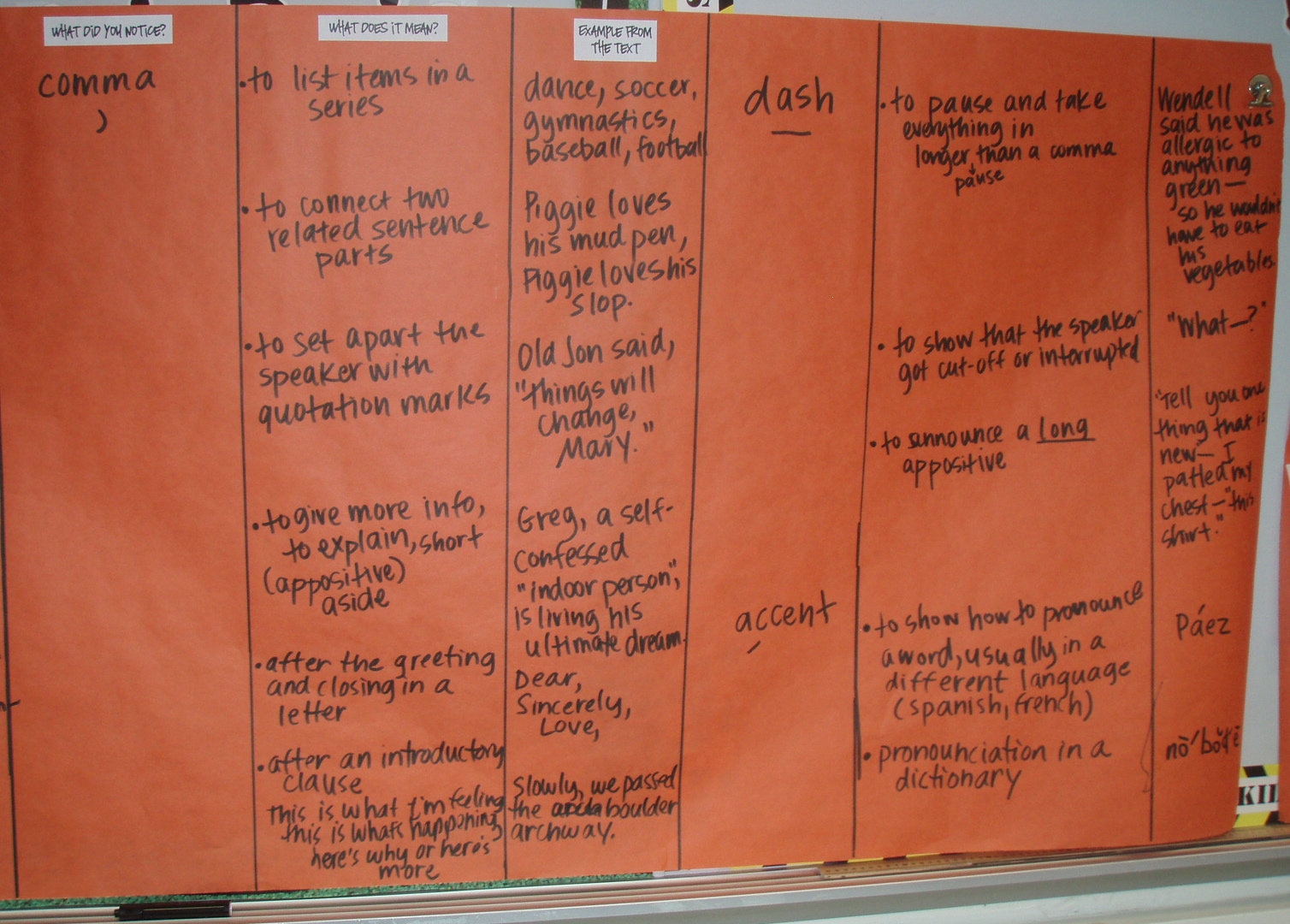


A couple of days ago I posted about the amazing work my writers did during our Punctuation Study. Here are the pics of our class charts that I promised you. Like I told you, it’s AMAZING!
We started something new in our classroom today. Well, we do that almost every day, so really it was just like every other day. But today my students requested that I blog about this one.
Starting today, we’re tracking “Table Points.” Every week, each table group can earn points for their table for doing the right thing; for following the universals of our school (we call them the Robinson Road Rules). They never know when I will award them, or how many I will give. They can be earned as a whole group or I can decide to give them just to one person (but they count for the whole table) for doing something extra amazing. At the end of the week, the table with the most points earns lunch with me on the following Monday.
I got the idea for table points from my hubby, who also teaches elementary school. He started using table points in his classroom a few years ago, and after seeing it work really well and hearing how excited his kids were about it, I was interested in trying it in my own classroom.
I think kids intrinsically really want to do the right thing. Sometimes things get in the way of that and they do kooky things like talk in line and stare out the window during reading time or doodle on their paper instead of answering the math problems. But deep down in there most kids want to follow the rules and act in a respectful way. Sometimes they need some motivation and encouragement to do so–or just recognition when they do it without being asked.
That’s where table points come in. Today I gave 10,000 points for being the first table to be cleaned up and quiet for lunch. I gave 10,000 more points to every table for waiting quietly in the line for us to go to lunch (this is hard for us to do most days). Table 1 and Table 4 earned 5,000 points for spending all of their writing time really focused on adding new, thoughtful entries to their notebooks. Tomorrow I might give points for doing morning work quietly or picking up other people’s messes up off the floor without being asked. It might be 10,000 points or 5,000 points or just 1 point. The amount of points is not important, and neither is when they earn them. I think it’s that they earn them, and that they never know how I’m going to do it.
During our Closing Circle today (an activity that happened to be another thing that they thought was blog-worthy), I loved how S complimented her tablemates for helping her earn so many points today. She thanked them for staying focused and working together. Together. They had decided at the beginning of the day that they were going to do whatever they could to make sure they were on task, engaged and doing the right thing. And since they had all made it their goal, they achieved it. Each person had a small part in the success of the whole group.
I am excited to see who “wins” lunch with me on Monday. It could be anybody, but no matter who it is who, we’re all winners because we’re focused on being better, more focused, respectful learners. And we’re doing it together.
I don’t remember how I made decisions when I was a fifth grader. Maybe it was by picking a number between 1 and 10, or by doing eeny-meeny-miney-mo. It seems like fifth graders these days in our school seem to be pretty good at using rock-paper-scissors. I’ve seen it in action when deciding who goes first in math games and when choosing what to play at recess, and today I saw it used to make another big decision related to seating.
In our classroom we have mainly tables. And often, they choose where they sit at those tables for the week. So last Friday before we left for the weekend, I had them put their nametag at the spot where they thought they could be the best learner. I mentioned before that we have mostly tables, which is true, but we also have desks. 2 of them. And they are in high-demand. So one of the desks–the one right in front of my desk and next to the ActivBoard–is a popular spot for kids who might need a “private office” or who just likes to be alone while they work, since it’s pretty much on the other side of the room from everyone else. Well, that desk had 4 people’s nametags on it this morning. Which meant 4 people wanted to sit there. In 1 desk. With 1 chair. Obviously that wasn’t going to work.
So rather than just pick someone to have that seat–which definitely would have been easier–I told them that they needed to find a fair and respectful way to decide who was going to have that spot this week. And what happened next was really great. No one yelled. No one cried (you just never know with 5th grade girls!). No one pouted. But everyone played Rock-Paper-Scissors. Yep, they rock-paper-scissor’d to decide whose it was going to be! They even decided to split in half and go two-on-two, then have one “battle” at the end (best two-out-of-three) for a final decision. And so fair and square, they decided that R was going to sit there. And T and K and A were all happy with the choice. I think they even talked about giving another one of them the chance to sit there next week.
“Oh, come on,” you’re thinking. “Big deal, it’s rock-paper-scissors. And a story about a desk. Big deal.” But I argue that it is a big deal. I think it’s a big deal that my students have strategies. That they know what to do when faced with tough decisions. Yes, in this case it’s just about figuring out where they will do their work, but they knew what to do. They didn’t just sit there and stare at each other. They didn’t scream, yell or fight. They didn’t let one person decide for them and be a bully. They worked together and made a plan. They tried something and it worked. And since it works for the little things like this in life, they’ll continue to use that strategy for bigger situations. And no, they probably won’t be using rock-paper-scissors for all of their major life decisions as they grow up, but they will know how to get started. They will remember those rock-paper-scissor lessons from childhood and hopefully use them for college-marriage-career choices in the future. That’s a big deal. 🙂
The end of October brings with it an exciting feeling for me. November and December are two of the best months in school, in my opinion. We have multiple units that are my favorites to teach, I share some of the best read alouds of the year (again, my person opinion), and the excitement of the fall/winter holidays is everywhere. Because of all of this, I get a needed 2nd-quarter energy boost. So join me as we dive into fractions/decimals, fiction stories, The Secret of Zoom, Fig Pudding, Ancient West Africa and inferring in poetry! Along the way we’ll ride on a magic carpet with Alladin (thanks to the Nipher musical next week); take a few days off for Thanksgiving; talk about the science fair and make plans for the projects to start in January; drink some cocoa together on cold days and then eventually celebrate the season at our Winter Party at the end of the quarter. I don’t know about you, but I am ready! Happy Fall!
So in case you don’t follow me on Twitter, or I didn’t post this on your Facebook wall, or email it to you (because I definitely did all of those things!), then be sure to check out the latest place our blog showed up:
http://paper.li/stevejmoore/missouried
I’m kind of excited about it….:)
We had a class meeting today. I love class meetings. They are such a great way to solve problems, give everyone a voice, work together as a team, learn something new.
Last year, because of a new protocol introduced in our district, I started doing class meetings in a different way than I had done for so many years before. At first I wasn’t sure about how it would work–mainly because it was new and new is sometimes scary–but jumped in with both feet and gave it a try.
We schedule class meetings once a week and there is a set way we do it each time:
1. I start with a list of the things we’ve done during the week. Usually this includes the activities we’ve done, books we’ve read, concepts we’ve worked on, and then also includes any special things we do. Last week that was a special musical performance and meeting with our Learning Buddies. We review this together and kiddos can add anything that I may have forgotten.
2. We sit in a circle and then mark the list according to three criteria:
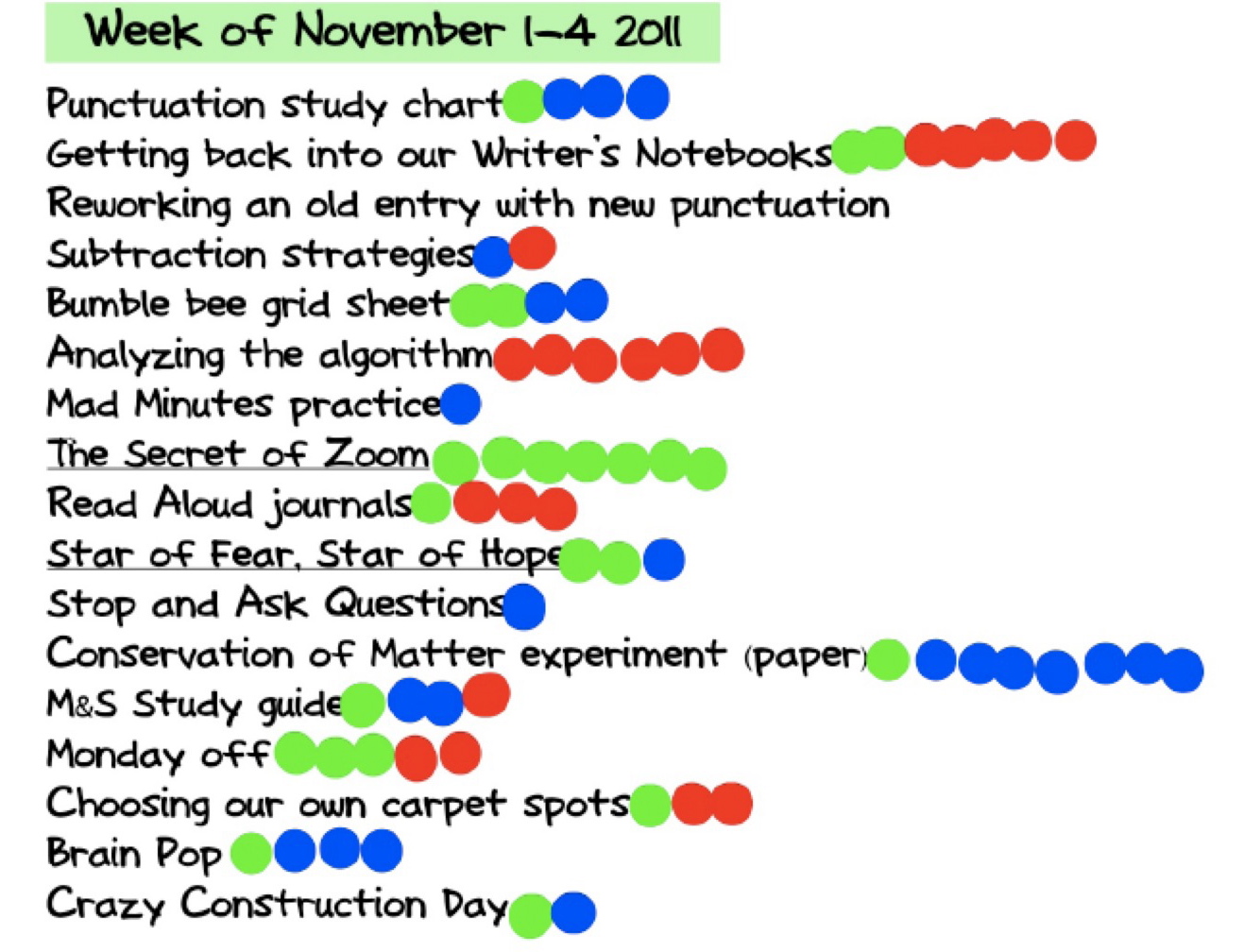
Someone is the timer for this section, and allows us 2 minutes for each round. A student puts the dots on the ActivBoard flipchart with the pen. This is what our flipchart looked like from today’s meeting:
3. After these steps, then we work! By looking at what we’ve marked, we decide what we should discuss; usually it is the item with the most red dots. The timer allows us 15 minutes to discuss the problem and work on a solution together.
4. After we’ve reached consensus (more on this later), we decide what we’re going to try and then start doing that.
For the past few weeks, our discussions have been around the volume of our voices, choosing smart carpet spots, or other behavior-related issues. Today, though, something really cool happened.
See how there are red dots by “getting back into our Writer’s Notebooks” and “analyzing the algorithm?” Those were both topic-related items, based on how well we did something in writing and math, rather than how well we followed (or not followed) the rules of school.
Well, we decided to talk about Writer’s Notebooks, and what came up as a result was nothing short of amazing. For the next 15 minutes, my students discussed (without raising their hands, which we’ve been working on!) how they feel like they haven’t been doing the best job of coming up with good ideas to put in their writer’s notebooks, and how they need to really get back into the routine of writing. They made suggestions of how they could do this, calmly and respectfully, and worked hard together to decide on a plan of action. I was most impressed by the leaders that naturally rose to the top, how the others listened to them as they led, and how many kiddos invited others who hadn’t said anything yet into the conversation. Somebody even got up–without being prompted–and started keeping a list of who had shared (and how often they spoke), so she would know who we still hadn’t heard from. There were a couple of times that they started to get off track or started talking over each other, but both times someone was there to calmly remind us of our job or of the time we had left. The best part was that this time that person wasn’t me–I’ve been working on talking less during class meetings. 🙂
Today was a great picture of what kids can do when they are allowed to identify real problems and then work to solve them. I didn’t have anything to do with the decision made today–outside of setting up the framework for discussing it–and they came up with a completely doable solution, that everyone was happy with.
And so now a word on consensus….in our meetings we don’t vote on an idea; we work to try to reach a consensus. That is, work on the problem until we get a feel that most of the group is happy with the plan. Unlike voting, it doesn’t become an “us against them” kind of thing, and the most popular or loudest voices don’t get to make the decision. By allowing more than just choice A and choice B (like in a vote), often times choice C will arise; a choice that is often a combination of the first two, or is even better than what we originally mentioned. And the best part is that usually that final solution suggestion comes from the quietest voice on the carpet, the one who has been sitting and listening and then finally has the courage to speak their mind.
I am so proud of my learners. I am so glad that my friend Mike Holdinghaus taught me how to do class meetings this way. I am so glad that we take time out to learn important things like how to have a civil discussion, how to make a decision and how to work together. This is good stuff, people, good stuff. And it’s all stuff that they’ll need and use long after they leave me for middle school. Hopefully for the rest of their lives. 🙂
I feel like I apologize alot. Especially about how long it’s been since I’ve posted on here. But hey, here I am doing it again. Sorry–that’s just the way it is. I do have a full-time job, after all. 🙂
So I’m thinking I’m just going to give a quick overview of what’s been going on for the last month, and then I can hopefully come back more often and fill in the gaps. Hopefully.
Reading: For most of the month of October, we were working on text features in nonfiction and asking questions that help us better comprehend what we’re reading. I loved the text features project we did, where the kids were given a plain text (about the Iroquois, which we were studying in Social Studies) and asked to add text features to it that would help their reader better understand what was being presented. It was a great way to see how much they really understood about how pictures, diagrams, captions, headings, subtitles, etc., impact the reader. These turned out great, and most kiddos really got into it! We also practiced a strategy called Stop and Ask Questions, which is a mainstay in Making Meaning. As we read (picture books during Reader’s Workshop, chapter book during Read Aloud and independently in their own reading), we stopped at several points in the story to record what we were wondering. The goal was to focus our thoughts in on specific details in the story, then pay attention for when the question was answered. Like I say often: The other part of a good question is a good answer. Last week, then, we moved on to a new unit on story elements. We’ve been looking at how analyzing characters, setting, plot, problem/solution, etc., can help us better understand that story. Today we read the first half of Star of Fear, Star of Hope and will continue with this text tomorrow. Stay tuned for more in reading soon!
One of the most important learning times in our classroom is read-aloud (chapter book). I use this time to introduce kids to authors and books they may not know, as well as working on strategies that good readers use and practicing how to talk about books.
We recently finished The Boys Start the War, by Phyllis Reynolds Naylor. I’m sure you heard how funny and interesting it was, and how there are at least 12 or 13 other books with these characters that we could read next. Well, once we were finished, I introduced a structure that we will use after every chapter book we read: the read-aloud timeline.
Here are some pictures of what it looks like in our room:
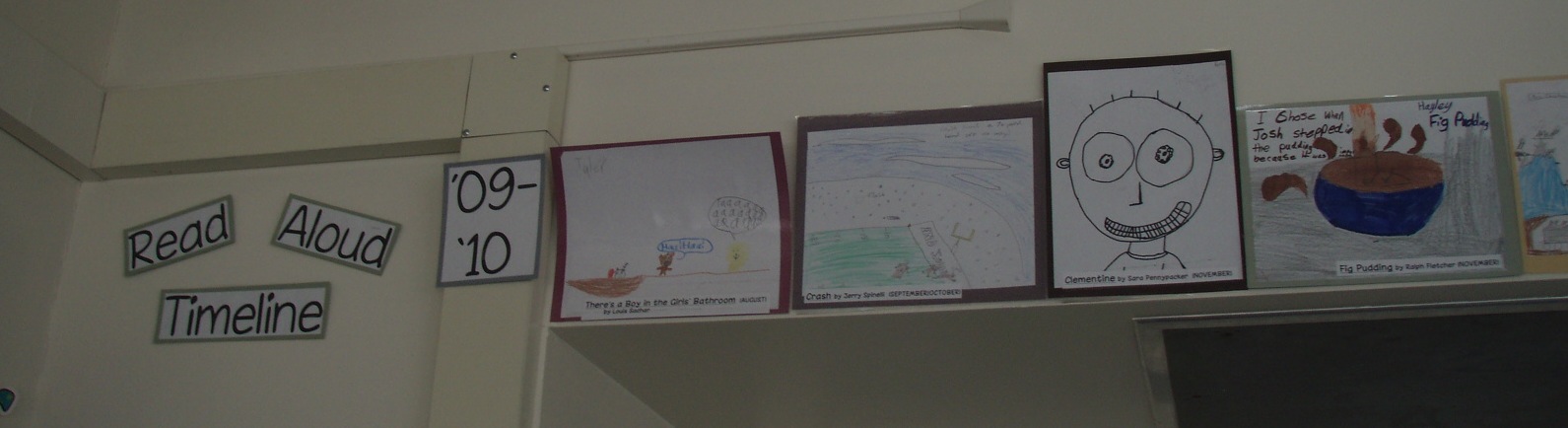


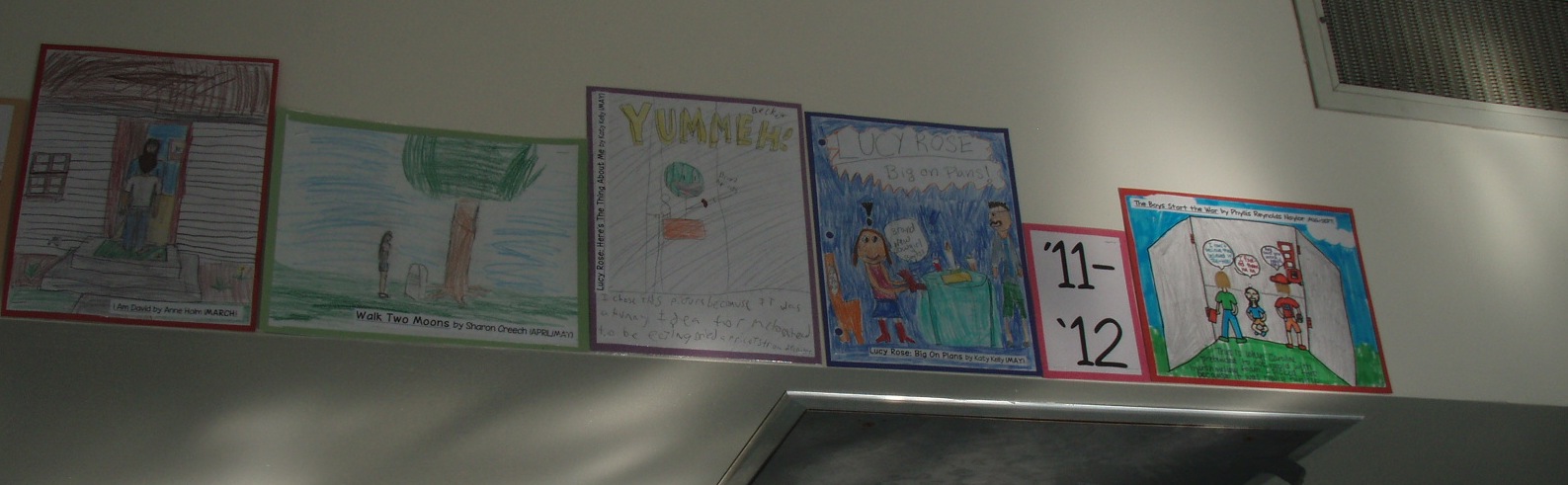
I know the pictures don’t really do it justice, so make sure you stop by to see the real thing! It’s been really great to incorporate a good reader strategy (creating images) with remembering what we’ve read. At the end of the year, each kiddo will get a book of all of their images together, for their own timeline of our reading year. So glad I’ve started this in our classroom! Ask your kiddo to tell you what they love about it. And stay tuned for an update–we just finished Crash yesterday, so it’ll go up this week. 🙂
It’s Homework Day again. So this is not what I meant when I said I’d “make it worth your while”, but it’s important nonetheless.
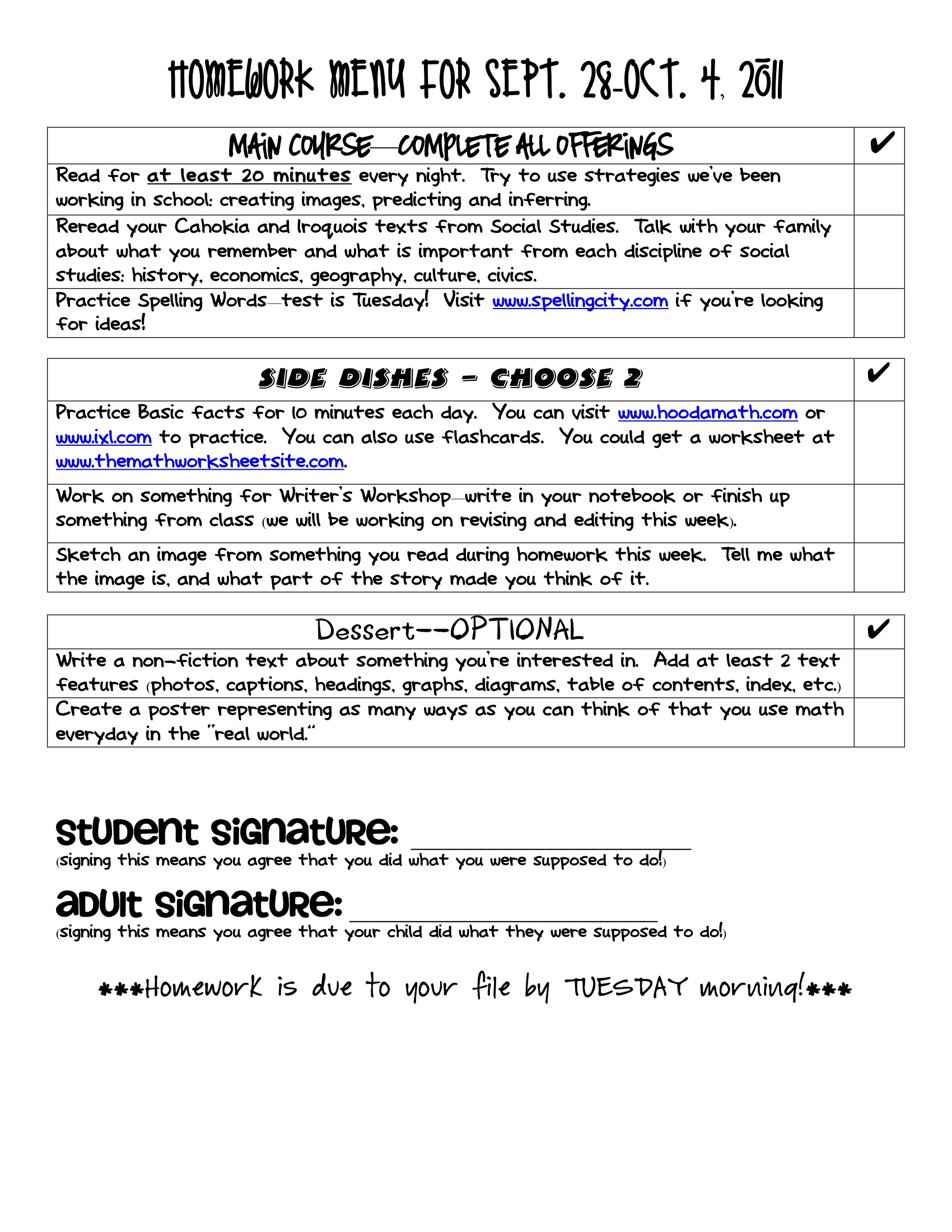
Today was the first day of homework in 5th grade! We had a really great conversation about how it would work and your kiddos were really excited. No, really–they were! The new format is around a menu, and there are many choices that they will be able to make as they practice what we’re doing in class. Here’s the Homework Menu for this week: Homework Menu 8-31 to 9-1 Exciting times ahead!
 20somethingkids and 1kookyteacher