Class Meetings: A Lesson in Democracy

We had a class meeting today.  I love class meetings.  They are such a great way to solve problems, give everyone a voice, work together as a team, learn something new.

Last year, because of a new protocol introduced in our district, I started doing class meetings in a different way than I had done for so many years before.  At first I wasn’t sure about how it would work–mainly because it was new and new is sometimes scary–but jumped in with both feet and gave it a try.

We schedule class meetings once a week and there is a set way we do it each time:

1.  I start with a list of the things we’ve done during the week.  Usually this includes the activities we’ve done, books we’ve read, concepts we’ve worked on, and then also includes any special things we do.  Last week that was a special musical performance and meeting with our Learning Buddies.  We review this together and kiddos can add anything that I may have forgotten.

2.  We sit in a circle and then mark the list according to three criteria:

  •      With green dots, we mark the activities we like the most.  Each kiddo gets one choice.
  •      With blue dots, we mark the activities where we think we learned the most.  Again, everyone gets one choice.
  •      Lastly, with red dots, we mark the activities that we think we could improve upon, work on, or do better at the next time.

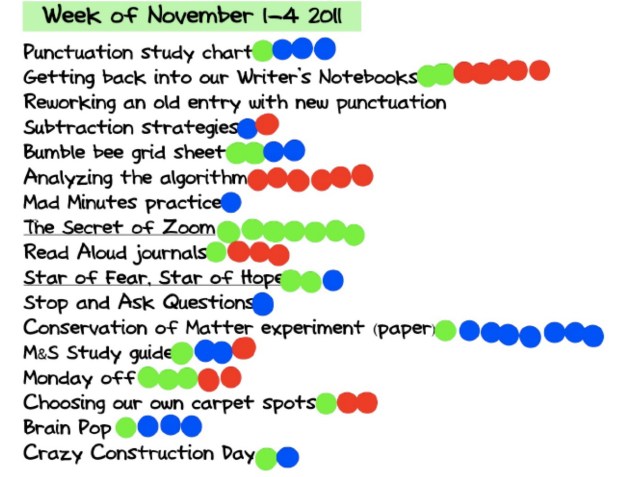
Someone is the timer for this section, and allows us 2 minutes for each round.   A student puts the dots on the ActivBoard flipchart with the pen.  This is what our flipchart looked like from today’s meeting:
3.  After these steps, then we work!  By looking at what we’ve marked, we decide what we should discuss; usually it is the item with the most red dots. The timer allows us 15 minutes to discuss the problem and work on a solution together.

4.  After we’ve reached consensus (more on this later), we decide what we’re going to try and then start doing that.

For the past few weeks, our discussions have been around the volume of our voices, choosing smart carpet spots, or other behavior-related issues.  Today, though, something really cool happened.

See how there are red dots by “getting back into our Writer’s Notebooks” and “analyzing the algorithm?”  Those were both topic-related items, based on how well we did something in writing and math, rather than how well we followed (or not followed) the rules of school.

Well, we decided to talk about Writer’s Notebooks, and what came up as a result was nothing short of amazing.  For the next 15 minutes, my students discussed (without raising their hands, which we’ve been working on!) how they feel like they haven’t been doing the best job of coming up with good ideas to put in their writer’s notebooks, and how they need to really get back into the routine of writing.  They made suggestions of how they could do this, calmly and respectfully, and worked hard together to decide on a plan of action.  I was most impressed by the leaders that naturally rose to the top, how the others listened to them as they led, and how many kiddos invited others who hadn’t said anything yet into the conversation.  Somebody even got up–without being prompted–and started keeping a list of who had shared (and how often they spoke), so she would know who we still hadn’t heard from.  There were a couple of times that they started to get off track or started talking over each other, but both times someone was there to calmly remind us of our job or of the time we had left.  The best part was that this time that person wasn’t me–I’ve been working on talking less during class meetings. 🙂

Today was a great picture of what kids can do when they are allowed to identify real problems and then work to solve them.  I didn’t have anything to do with the decision made today–outside of setting up the framework for discussing it–and they came up with a completely doable solution, that everyone was happy with.

And so now a word on consensus….in our meetings we don’t vote on an idea; we work to try to reach a consensus.  That is, work on the problem until we get a feel that most of the group is happy with the plan.  Unlike voting, it doesn’t become an “us against them” kind of thing, and the most popular or loudest voices don’t get to make the decision.  By allowing more than just choice A and choice B (like in a vote), often times choice C will arise; a choice that is often a combination of the first two, or is even better than what we originally mentioned.  And the best part is that usually that final solution suggestion comes from the quietest voice on the carpet, the one who has been sitting and listening and then finally has the courage to speak their mind.

I am so proud of my learners.  I am so glad that my friend Mike Holdinghaus taught me how to do class meetings this way.  I am so glad that we take time out to learn important things like how to have a civil discussion, how to make a decision and how to work together.   This is good stuff, people, good stuff.  And it’s all stuff that they’ll need and use long after they leave me for middle school. Hopefully for the rest of their lives. 🙂

 

Punctuation is not a 4-letter-word!

I am sooo into writing.  I pretty much eat, sleep and breathe it at times.  Oh, and I get to teach it, too, which is a nice bonus!  We recently finished our first writing cycle on the writing process, and so as the 2nd quarter began, I was ready to start something new with my kiddos.

What was it, you ask?  A punctuation study, of course!

What?  Punctuation?  Isn’t that something you dread?  Isn’t that just something you have to go back and fix at the end when you’re editing?  Isn’t punctuation a bad word?

Absolutely not.  And unfortunately, this is something I have to teach my students.  Because unfortunately, many well-intentioned people have taught them–as I thought for a long, long time–punctuation (along with grammar and spelling and capitalization) are just things you have to learn about because your teacher tells you you have to put them in your writing.  It’s what you’re “supposed” to do.

I want my students to think about punctuation as another tool in their toolbox as a writer.  Just like they use word choice, voice,  and organization to set the mood and enhance their message, they can use punctuation to further their message, as well.

That’s where the punctuation study comes in.

For the last two weeks, we have been immersed in the world of commas and colons, parentheses and dashes.  We’re learning that writers use punctuation for a reason.  They think about it while they’re writing, not after they’ve finished writing.  By digging into the text of writers we love (Jerry Spinelli, Cythina Rylant, Eve Bunting, Patricia Polacco, Kevin Henkes, Tomie dePaola, to name a few), writers have worked to figure out the “why” behind many of the punctuation marks they use every day.  Rather than me just telling them what it’s for and when to use it, they’ve begun to discover on their own why a writer would use it in a certain situation.  We’ve had several really “meaty” conversations about the ins and outs of punctuation lately.  My favorites have been about what the “dot-dot-dot” is called (it’s called an ‘ellipsis’, by the way); whether or not the long line (–) and the short line (-) are the same thing and if you use them the same way (one is a dash and the other is a hyphen, if you’re wondering); and how you can use commas, parentheses and dashes in similar ways based on the formality of your writing.  I had a moment the other day when I literally had butterflies in my stomach as they were talking to each other as real writers.  They built on the knowledge of some to create a shared knowledge of how punctuation can shape your words into a more powerful piece of writing.  How it matters what you use and don’t use.  That you can actually choose.  That you’re supposed to think about it….

I wish I had thought to take a picture of the amazing class chart we’ve created to capture all of this smart thinking.  I will have to come back and add it soon, as it will BLOW YOUR MIND!  The best part is that it is going to be a living, breathing part of our room, as we visit and revisit it throughout the rest of the year.  We’ll use it for clarification, for reminders and for inspiration to try something new.  We’ll come back many times to add to it, too, as we learn new punctuation marks that maybe we missed this time around.  Each student will have a smaller version of it in their Writer’s Notebook, as well, to refer to as a resource in their own writing.

Today we went back to old entries in our writing to rethink the punctuation.  The kiddos were helpful to me as they worked on an old entry from my notebook, adding commas and dashes and colons to make the story stronger.  Then everyone chose their own old entry to rework.  That amazing thinking starts tomorrow!

(Oh, and just for full disclosure, the ideas for this study can from two much smarter people than me:  Janet Angelillo in her book A Fresh Approach to Teaching Punctuation and Dan Feigelson’s Practical Punctuation. I’m just the one figuring out how to implement it with my students.)


Getting back into it…reading

I feel like I apologize alot.  Especially about how long it’s been since I’ve posted on here.  But hey, here I am doing it again.  Sorry–that’s just the way it is.  I do have a full-time job, after all.  🙂

So I’m thinking I’m just going to give a quick overview of what’s been going on for the last month, and then I can hopefully come back more often and fill in the gaps.  Hopefully.

Reading:  For most of the month of October, we were working on text features in nonfiction and asking questions that help us better comprehend what we’re reading.  I loved the text features project we did, where the kids were given a plain text (about the Iroquois, which we were studying in Social Studies) and asked to add text features to it that would help their reader better understand what was being presented.  It was a great way to see how much they really understood about how pictures, diagrams, captions, headings, subtitles, etc., impact the reader.  These turned out great, and most kiddos really got into it!  We also practiced a strategy called Stop and Ask Questions, which is a mainstay in Making Meaning.  As we read (picture books during Reader’s Workshop, chapter book during Read Aloud and independently in their own reading), we stopped at several points in the story to record what we were wondering.  The goal was to focus our thoughts in on specific details in the story, then pay attention for when the question was answered.  Like I say often: The other part of a good question is a good answer.   Last week, then, we moved on to a new unit on story elements.  We’ve been looking at how analyzing characters, setting, plot, problem/solution, etc., can help us better understand that story.  Today we read the first half of Star of Fear, Star of Hope and will continue with this text tomorrow.  Stay tuned for more in reading soon!