Self-Portraits

One thing I believe is that we’re all beautiful.  I want to help my students believe the same thing, and celebrate diversity.  One way we began to do this is to read books about the ways we are all beautiful and then create art to showcase that–art that will hang in our room all year to help us remember. 🙂

Last week we read the book The Skin You Live In, by  Michael Taylor.  It is written in the form of a poem, so it sounds good, but the point of the story is that our skin is something to celebrate and appreciate.  The pictures are really great, and everyone loved reading it!

Screen Shot 2014-09-06 at 4.15.31 PM(photo courtesy of goodreads.com)

After we read it, we talked about the beautiful skin that we live in in our class, and started a project to create portraits of ourselves.  I have done this many times with classes, and sometimes there’s paint involved, sometimes markers, sometimes colored pencils.  This time is was colored pencils, along with yarn, fabric, string and glue. 🙂

I was so impressed at how diligently everyone worked to make it both creative and authentic to themselves.

IMG_3130

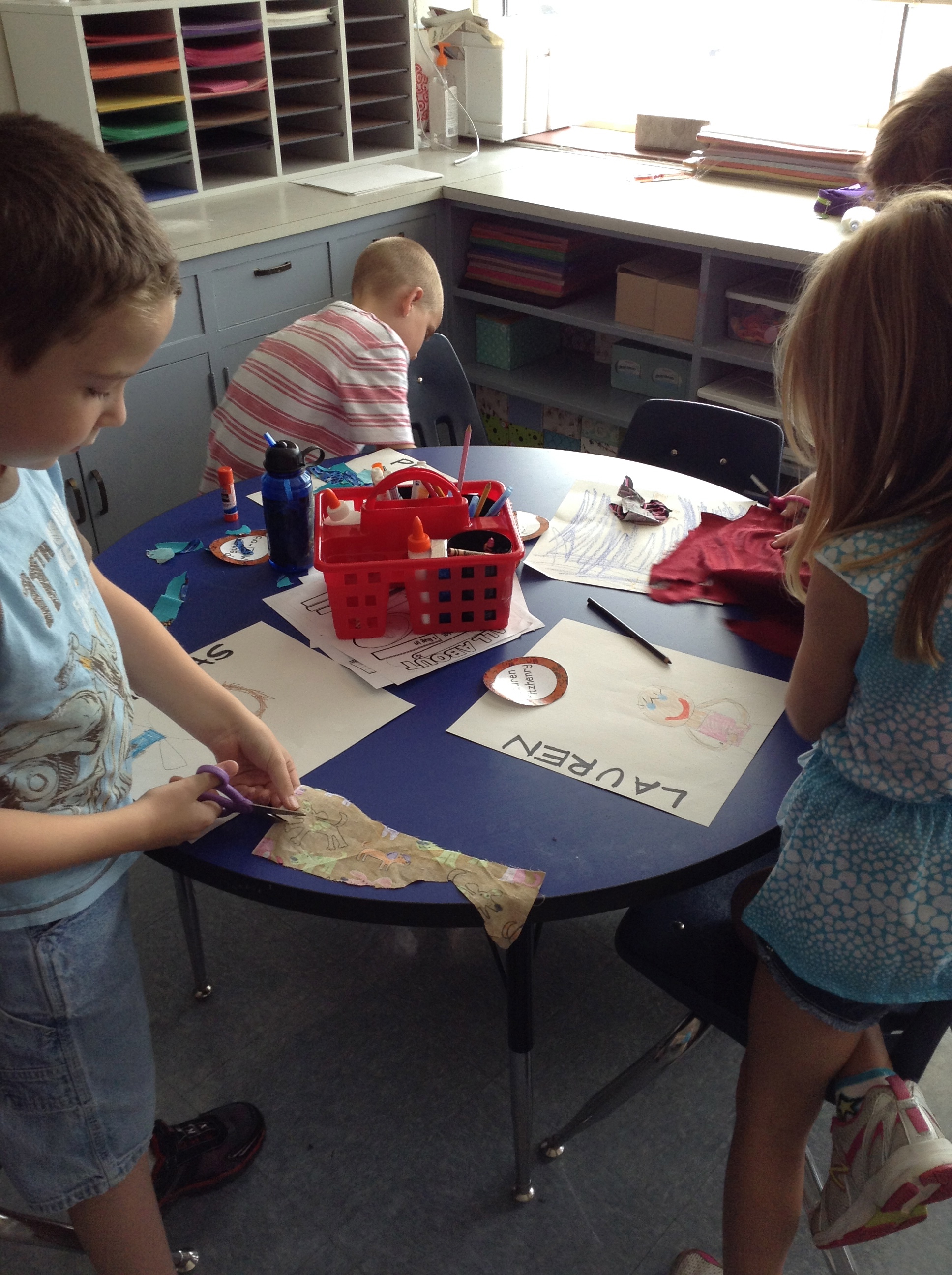
Look! We got to practice our cutting skills with this project.

IMG_3133

I love that we have so many adult helpers at our school to support us! Mrs. Gaglio is helping Makayla create her portrait. 🙂

IMG_3131

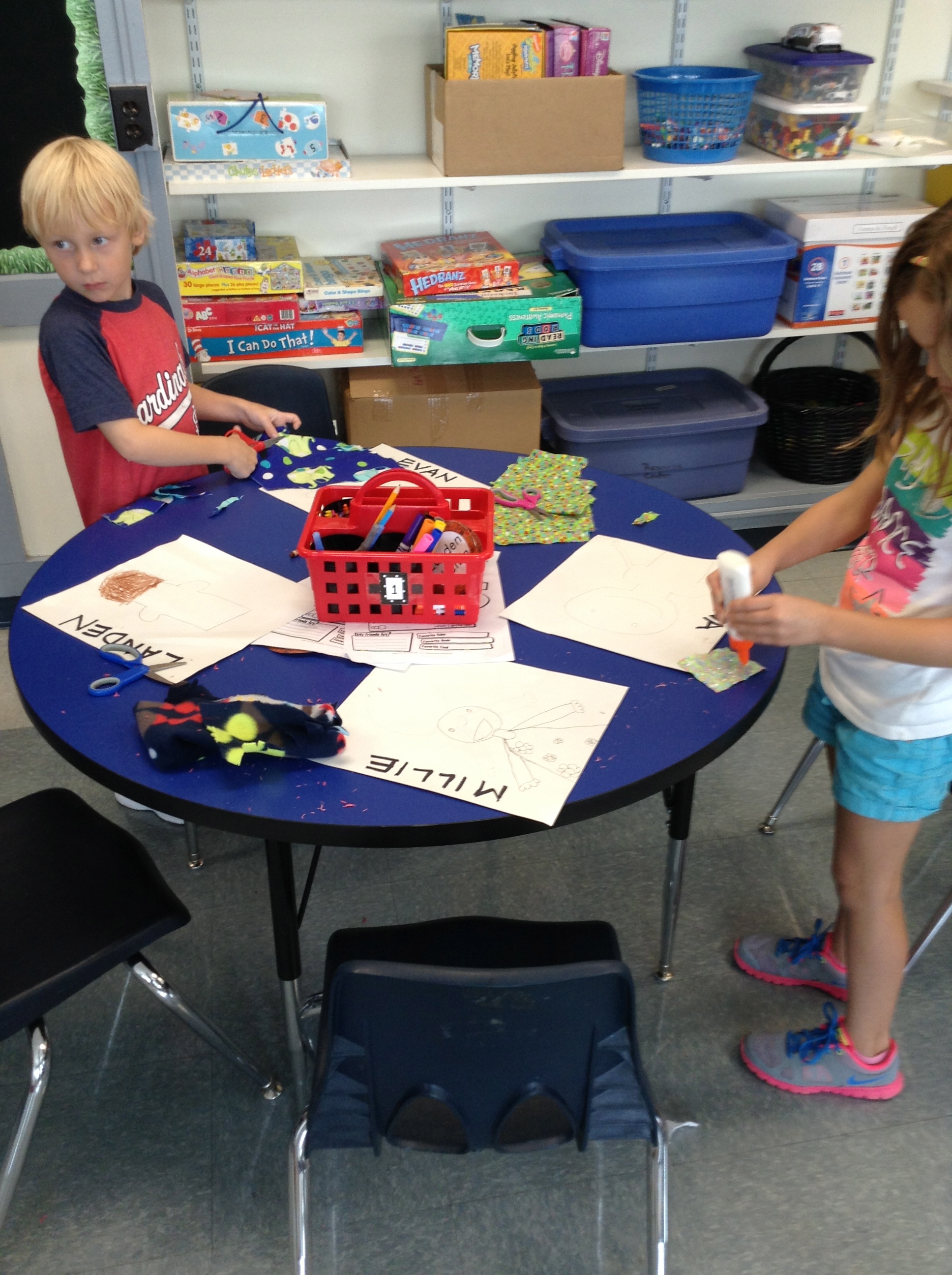
We also got to practice our gluing skills.

I had to highlight Ava and the way she masterfully demonstrated her understanding of using "just a dot, not alot."

I had to highlight Ava and the way she masterfully demonstrated her understanding of using “just a dot, not alot.”

Here Diego is helping Briannia figure out how to make the cloth look like her clothes.  I love how projects like this have opportunities to work both alone and with each other.

Here Diego is helping Briannia figure out how to make the cloth look like her clothes. He figured out how to solve the problem, and is showing her how to sketch the shape of her shirt before she cuts the fabric. I love how projects like this have opportunities to work both alone and with our classmates, sharing our knowledge and teaching each other.    This picture exemplifies the phrase I love–everyone is a student and everyone is a teacher.

I just had to take a picture of this part of our rug as we worked.  Learning is messy, friends! (Don't worry--they know how to respect our environment and they picked it all up!).

I just had to take a picture of this part of our rug as we worked. Learning is messy, friends! (Don’t worry–they know how to respect our environment and they picked it all up!).

We had just the right spot to hang them so they can smile down on us all year! :)

We had just the right spot to hang them so they can smile down on us all year! 🙂 There are a few friends who aren’t finished yet, and theirs will fill that hole by the clock when they’re done.


EDUC 573: Week 4–Creativity and Critical Thinking?

This past week we read the article Why Creativity Now: A Conversation with Sir Ken Robinson (Azzam, 2009).  Several points from the article stuck out to me as I considered the answer to the question raised: Are creativity and critical thinking opposed to each other?  Can they exist together?

I guess I’ve always considered myself a creative person.  Until recently, though, I’m not sure I’d have been able to define what that meant.  I could tell you what it didn’t mean, though–my creativity did not involve being able to draw or dance.   In many ways I have always thought of my creative side coming out in relation to making things out of other things–scrapbooking, cards, sewing, etc.  I believe I have a knack for writing in a creative way, as well, but that was pretty much it.  Like I said, don’t ask me to create a song, do improv, draw (anything), or create a sculpture out of clay.  And so just like a misconception mentioned in the article, I equated my creativity with just artistic things.

So what does that have to do with my teaching life?  Or my students for that matter?  Well once I became a teacher, I like to think that that creative side merged with my “thinking” side as I began to work to create situations for my students where they could figure out how they best create new things.  Partly through learning I’ve done just this semester already, I have begun to do even more to allow my students choice in their learning.  Being able to decide upon the topic,  who they will work with and what type of product (if any) they will end up with is highly motivating to students–boys especially.   As we just completed our student-led conferences, I can’t tell you how many students (from both genders) mentioned that they really enjoy the projects we do because they get to make choices about their learning and because they don’https://20somethingkidsand1kookyteacher.wordpress.com/wp-admin/post.php?post=2319&action=edit&message=10t have to “just sit and listen.”  The way these projects are laid out also encourages the “forever and always” type of learning I’m hoping to give my students; I want these concepts to be useful forever, not just for now.

This part of the article was also especially important, in my opinion:

Also, we’re living in times of massive unpredictability. The kids who are starting school this September
will be retiring—if they ever do—around 2070. Nobody has a clue what the world’s going to look like in
five years, or even next year actually, and yet it’s the job of education to help kids make sense of the
world they’re going to live in.

I work a lot with Fortune 500 companies, and they’re always saying, “We need people who can be
innovative, who can think differently.” If you look at the mortality rate among companies, it’s massive.
America is now facing the biggest challenge it’s ever faced—to maintain it’s position in the world
economies. All these things demand high levels of innovation, creativity, and ingenuity. At the moment,
instead of promoting creativity, I think we’re systematically educating it out of our kids.

Now more than ever, it would be utterly futile for me to try to educate my students for the world I live in.  The world of now.  These kiddos are growing up in a time of massive change, where they will have to be able to be ready for jobs that don’t even exist right now.  The possibilities are endless, really.  And I think that one way that I can do my part to help prepare them for that unknown future is to encourage them to think today.  I want them to be able to make rational, logical decisions and then act upon them.  Even if right now those decisions are about who to work with and what to create, it’s a start.

But even still, this point is made regarding teaching creativity:

I make a distinction between teaching creatively and teaching for creativity. Teaching creatively means
that teachers use their own creative skills to make ideas and content more interesting. Some of the
great teachers we know are the most creative teachers because they find a way of connecting what
they’re teaching to student interests.

I hope that I respond to this well when I tell my kiddos I want them to know that they can create knowledge, that they are responsible for their learning.  I am not going to just give them all the answers– say “Here, do it this way.”  I love how often times the way I imagined doing it isn’t at all the best way; my students many times suggest much better ideas for how lessons will go than what I originally planned.  But I have to be willing to let that happen.  I have to be ok with not knowing all the answers or risking looking dumb in front of a class of 5th graders because I don’t know what to do next.  I have to be willing to take risks and let them take the reins.  My job is that of facilitator, not dictator.  It is our classroom, not mine.  We are all students and we are all teachers in Rm. 202.

And so yes, I do agree that creativity and critical thinking can coexist.  I have seen with my own eyes the way a kiddo will dig deep into a subject because I’ve given them just enough guidance and structure to get them going and then I let them go.  And where they ended up was beyond even where we envisioned at the beginning.  Not because I told them to, but because they made the choice, the plan and then made it happen.

Azzam, A. M. (2009). Why creativity now? A conversation with Sir Ken Robinson. Educational Leadership, 67(1), 22-26.

Mental Models and The Mississipians at Cahokia

Our first Social Studies unit of the year (well, the first “official” one after we set up our classroom community) was a doozey (is that how you spell that??).  Let me back up.  The theme for 5th grade SS is Three Worlds Meet, and so we study the Native Americans, Ancient West Africa and Medieval Europe, then look at how all of those cultures merged and became the Colonies.  The first unit, while being about Native Americans–specifically the Mississippians at Cahokia and the Iroquois–was also about bigger things related to mental models.

What are mental models, you ask?  Check out this example that we use to help explain them to kiddos (taken from the text we use during this unit):
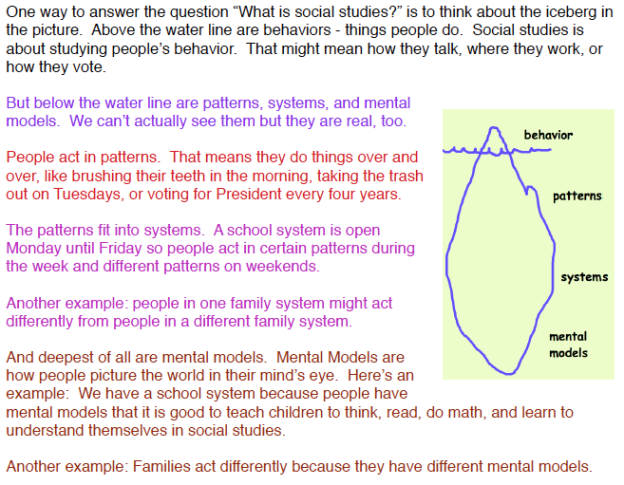
We begin by looking at the mental models that many kids have about Native Americans.  Many of these are things like that they live in tepees, they wear buffalo skin or feather headdresses, they are savage hunters and that they danced and chanted.  None of these mental models are wrong, so to speak, but as we go through the unit, we hope that by learning new things about specific groups of Native Americans, their mental models will be challenged.  And maybe changed because of their new knowledge.

We specifically study the Mississippians at Cahokia, or just Cahokians, because they are from an area very close to where we live in Missouri.  Cahokia, Illinois is just a hop, skip and a jump across the Mississippi River from the area that these kiddos know so well. For that reason, they are more easily able to make connections and inferences about how the Cahokians may have lived–and they realize that in many ways these people are more similar to them than they are different.

I mentioned before that there is a text we use, which is broken down into the five disciplines of Social Studies (history, economics, geography, culture and civics) and these disciplines provide the framework for all of the conversations and activities that we do during this unit.  First we learn what each of those are generally, then are able to zoom in on them more specifically to Cahokia (and later to the Iroquois, but I’ll tell about that in a later post).

Before we jump into our text, however, we have a lesson about figuring out the difference between important and interesting when you’re reading, so you know which parts to pay most attention to as a reader and learner.  We discovered that it all looks important, until we look more closely at the purpose of why we’re reading.  For example, if we are reading to find the answer to a certain question, then the only important things are the ones related to answering that question–all the rest is just interesting for now.  If we are reading just to find out about economics, then only the ideas related to economics (not history, culture or any of the other groups) are important for now.  As we also discovered, what’s important changes based on your goal.

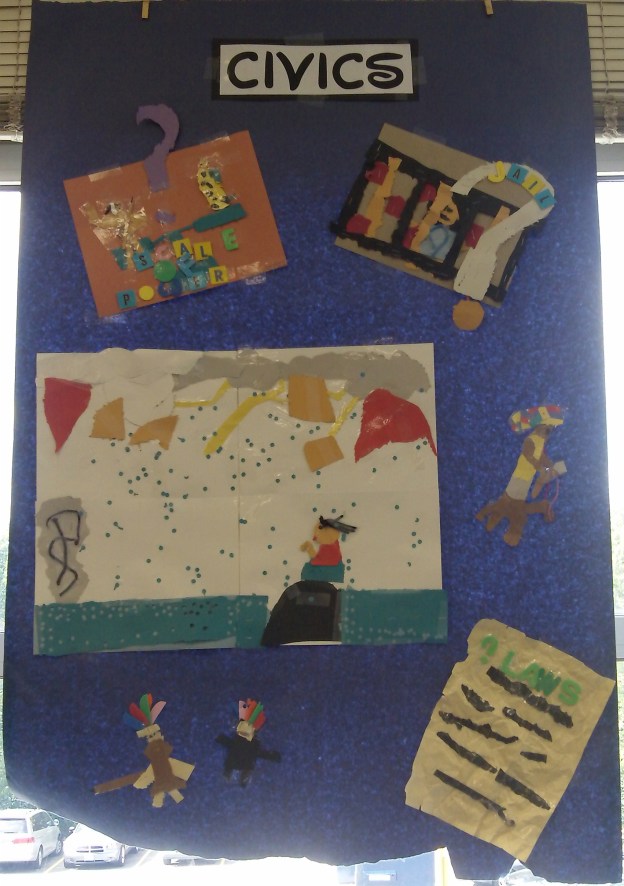
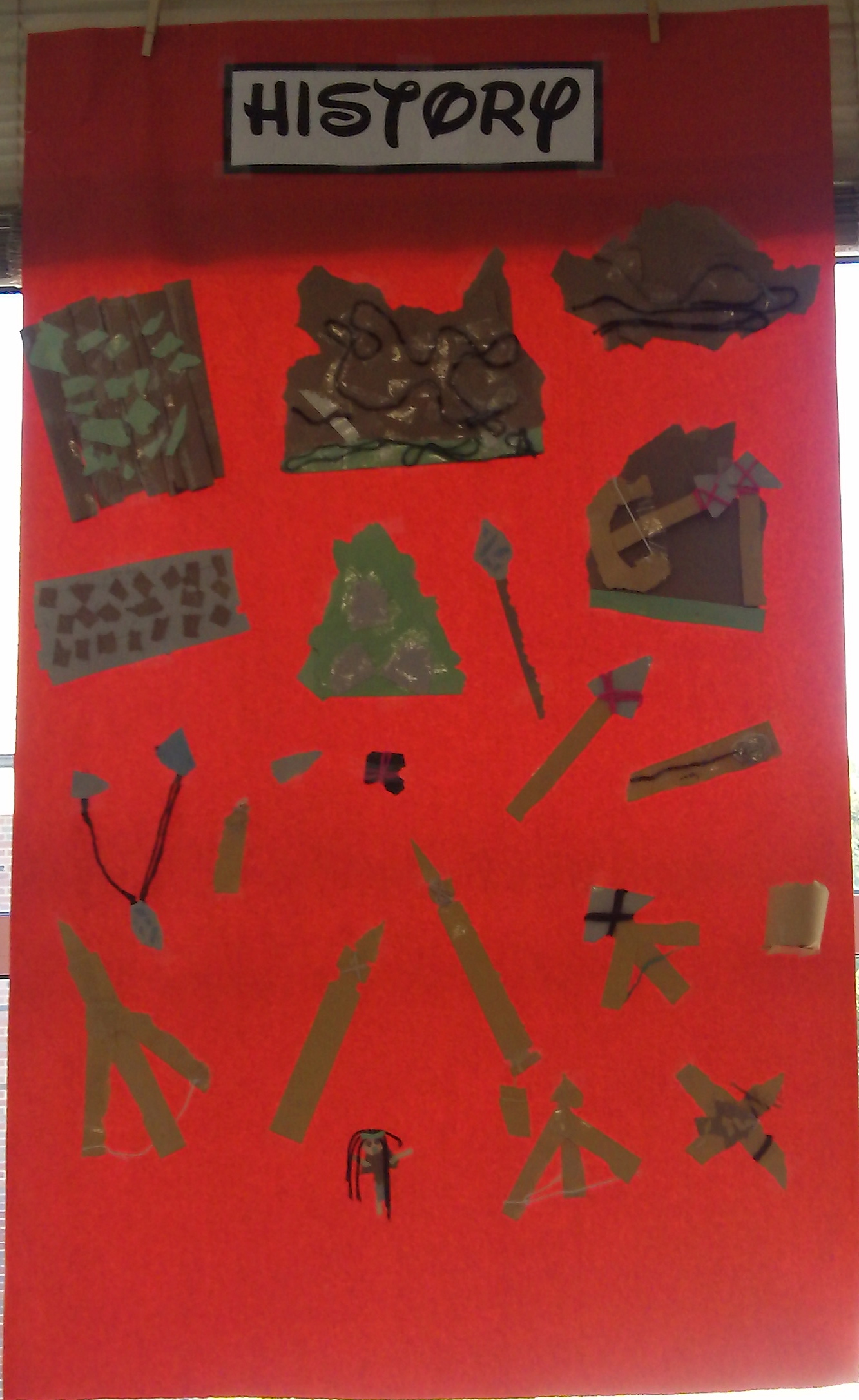
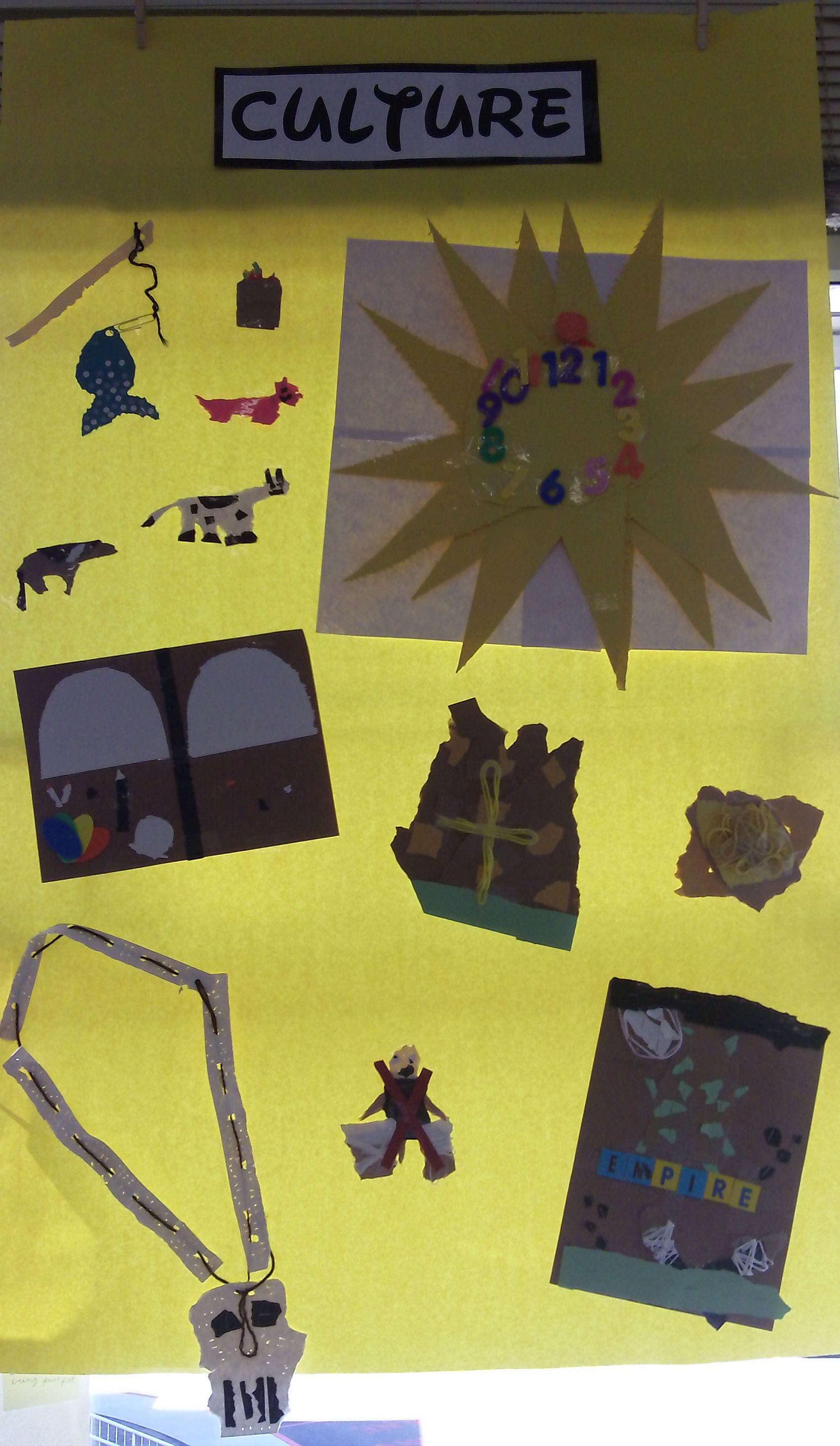
Ok, now that we know how to pick out the parts we need to remember, we got busy into the real work of this unit.  In short, for every discipline, we read a section of the text and underlined what was important, then made a class list of those key ideas.  After that, we created big window-sized posters with representations we made to show each of the big ideas.

Nice, right?  An art project to help us remember what we read about.  Fun, too.  Yes, but it’s not that simple.  There are very specific rules about how you are to go about creating your representation:

1. You may use paper and anything that holds paper together (i.e. paper clips, tape, glue, glue sticks, etc.).

2. You may not use scissors.

3. You may not use any writing utensils.

What was once just a simple show-me-what-you-remember-from-what-you-just-read type activity is now a challenge to think outside the box, to be creative, to solve problems.  So I was all the more impressed with what they came up with, the quality of their images, and the creative ways that they figured out to get their job done–like using the edge of a ruler or a paper clip to score paper so you can tear it neatly in the shape you want it, rather than cutting.  Or using the punched-out pieces from a hole punch together to create a picture.  Amazing, really.

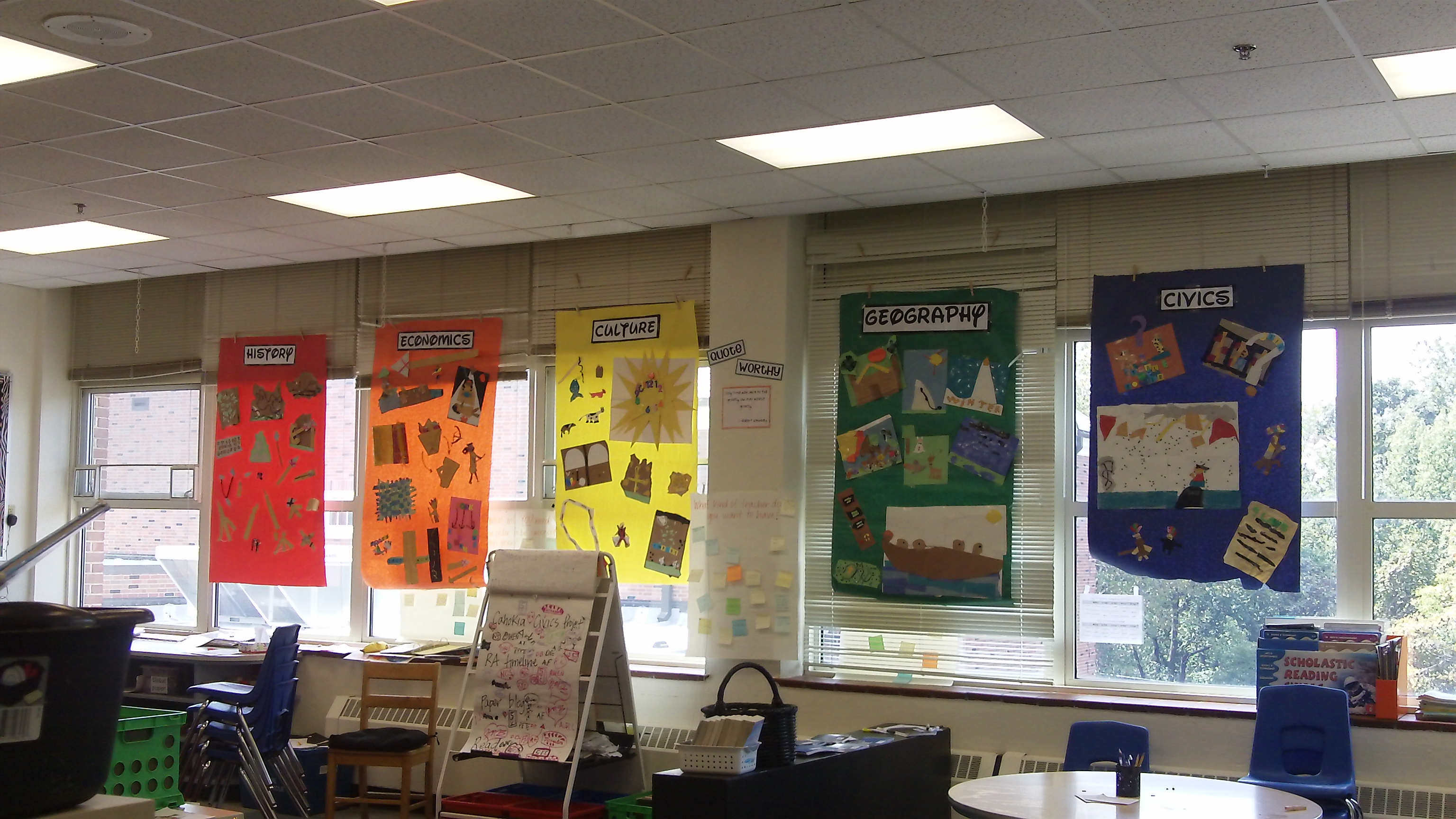
Here’s what our posters look like once we were finished–which really took us about 6-7 school days to accomplish:
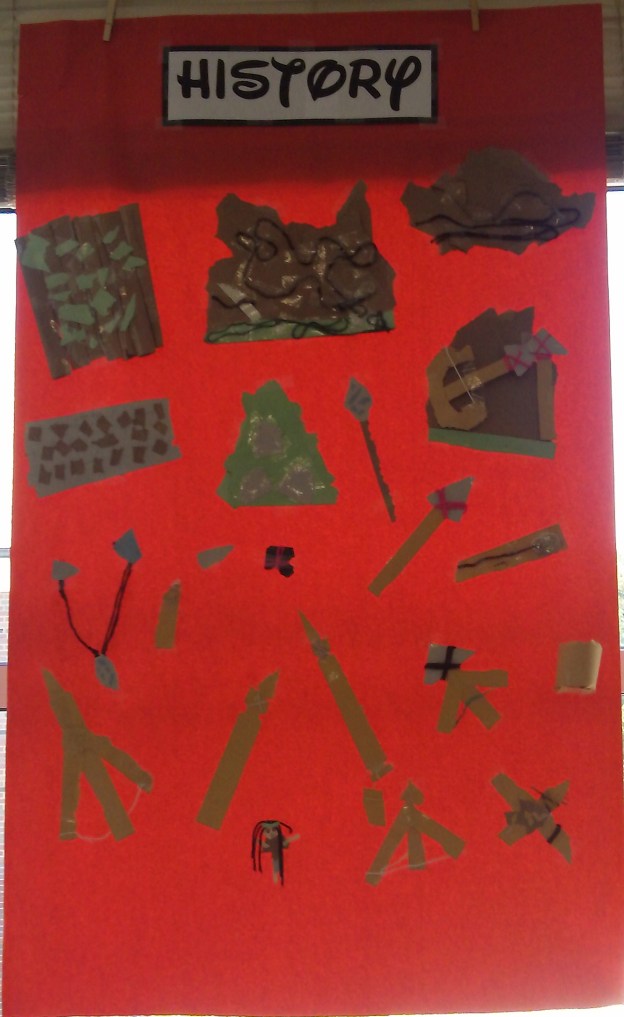


Besides the fact that these hold a lot of information and show what we’ve learned about what’s important about the Cahokians, I love how they look hanging on the windows:

As we were working on these projects, it was so great to see the group/partner work that was taking place, the problems that were being solved as they created their pieces, and the smiles on their faces as they worked.  I was so glad at how many kiddos voiced to me how much they loved doing this because it was “so different from anything I’ve ever done before.”  They told me how the rule of not using scissors and pencils “made their brains think in a new way and challenged me in a new way.”  Gotta love it when kiddos say those things out loud!  It’s exactly what I had hoped was happening.

On a side note, these posters hung in our room throughout the whole Cahokia unit, and we came back to them time after time, as we made connections between different aspects of Cahokia, our own lives, and then as we moved into learning about the Iroquois.  I’m actually going to be sad later this week when they have to come down to make room for other things. 😦


Do You Remember It All?

Of course, not, silly, but I can help you pull some of it out of the depths of your memory!  Wait–let me back up a little bit.  Remember when I mentioned the other day about how we are going to be starting MAP testing in a couple of weeks? Well, one thing that we have been doing to help us prepare for the Science section of that test is to review concepts that they have learned about previously.  Because, of course, they probably wouldn’t remember all of it without a few reminders.  And pretty much anything they’ve ever learned about (yep, since 1st grade!) is fair game on this test.  So we had some work to do.

This week we went back to an activity we’d done with past units in Social Studies in our classroom.  Since I knew that it worked to help us remember big ideas and I knew they had fun doing it, I figured it was perfect to pull out again.  Plus, unfortunately, the last few units we’d been doing in Social Studies had been more of the sit-and-read-from-this-book-and-tell-me-what-you-learned type units, so they were ready for a change.

We have access to Safari Montage through our school district, which is an amazing resource for videos to supplement your curriculum.  There is a great series by Schlessinger Science Library that presents concepts in a fun and informative way with short, interesting videos.  This week we watched several videos and then created window murals to help us remember the big ideas.  We worked with a partner or in a group of 3, and created representations for each big idea on the mural.

Here’s what we’ve been working on this week–

This one was after a video called All About Plant Life:

Can you see the big ideas of leaves, roots, what plants need, how plants are different from animals, photosynthesis, and how they give us oxygen?

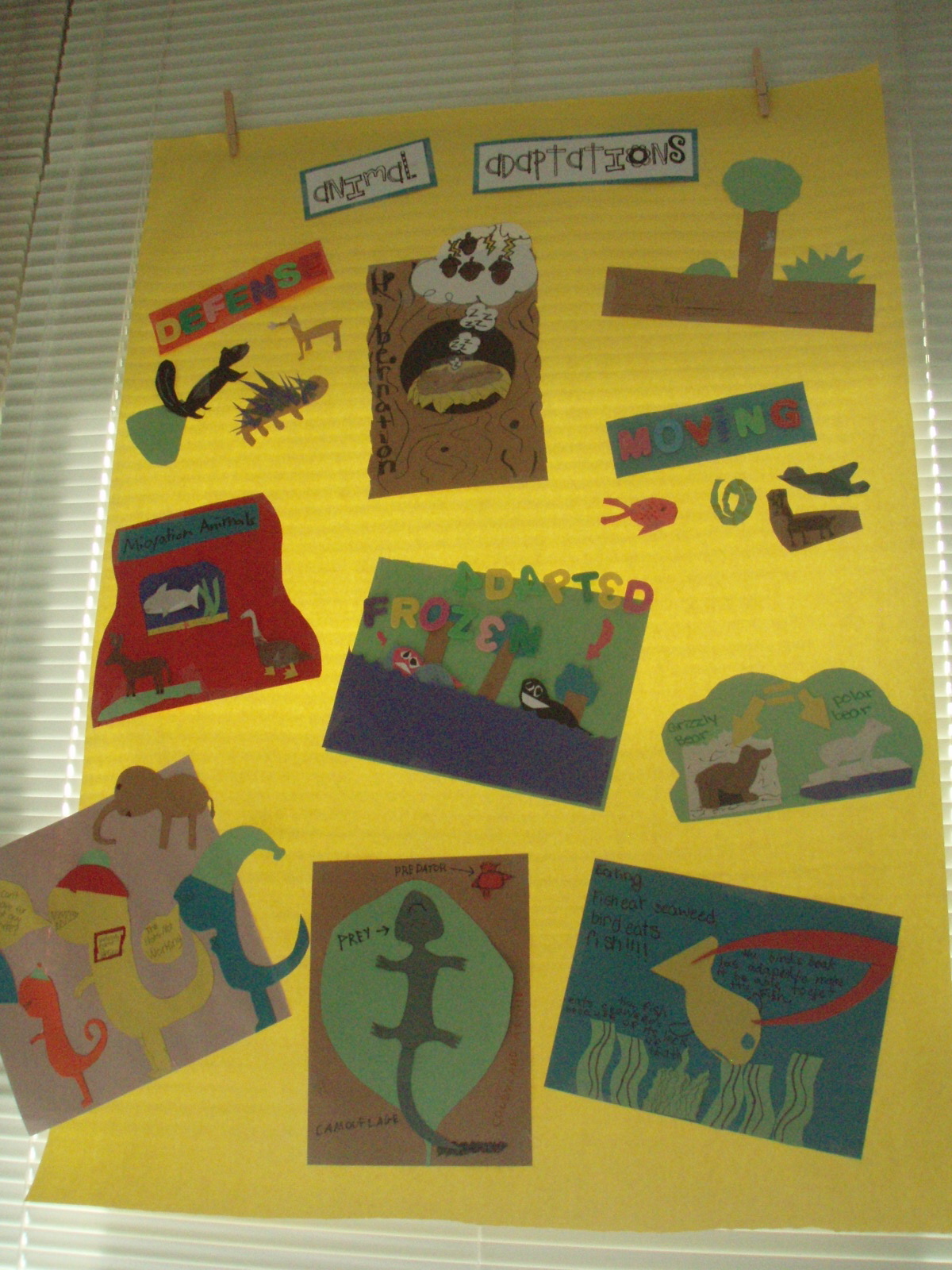
Next we watched a video called All About Animal Adaptations:

I wish the picture had turned out better, but this one had big ideas about how animals have to adapt to their environments to help them survive.

On Thursday, the topic was animals again, but this time Life Cycles:

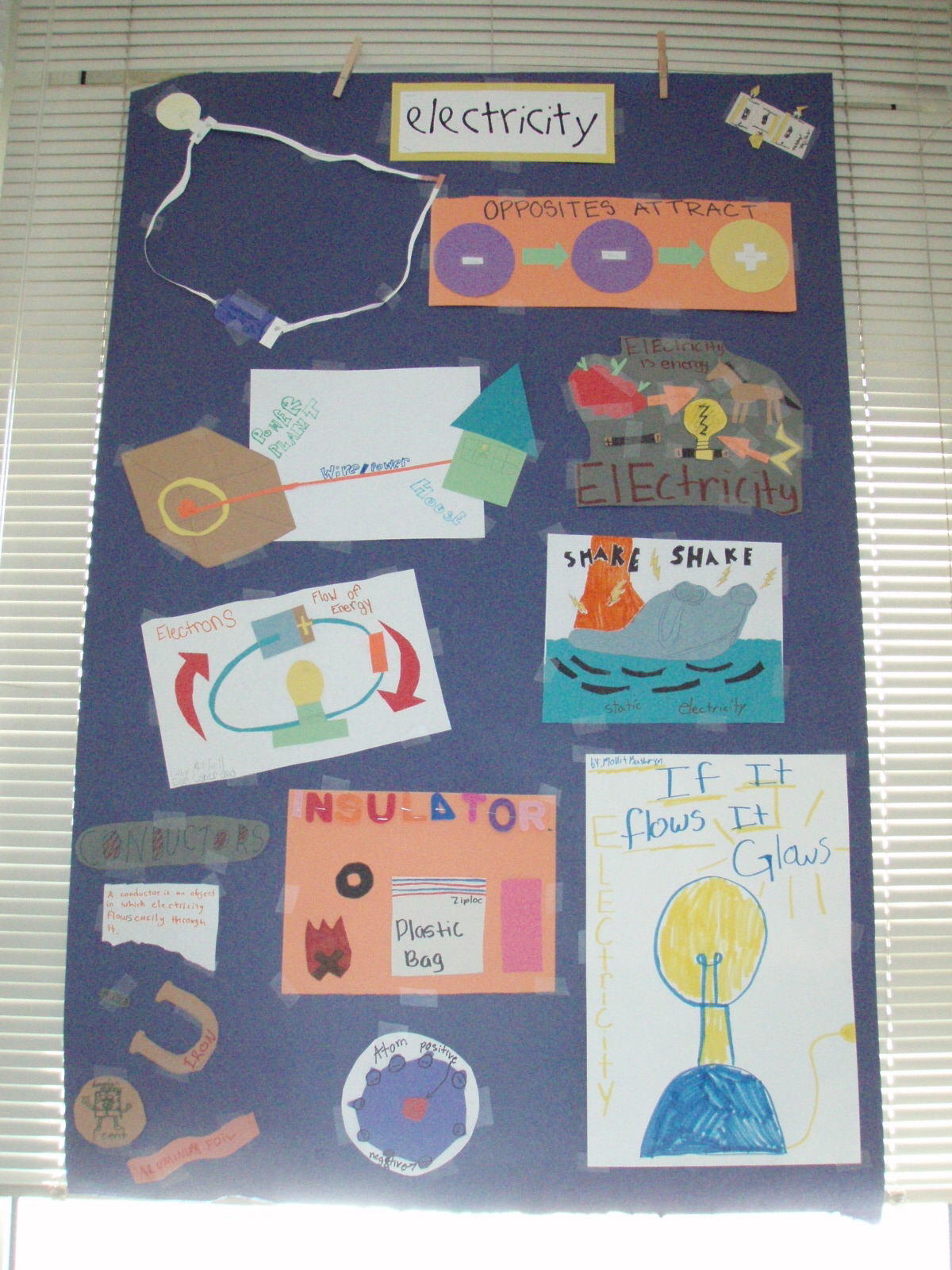
And then Friday we moved on to Electricity:

It is always great to see what my students do when they are given a challenge, and how much fun they have doing it.  I loved how so many kiddos mentioned this activity when they shared in our closing circle on Friday.  The Friday question is almost always “What did you like or what did you learn?” and a majority of kiddos mentioned that they liked going back to this again.  And any time we can learn in a fun way, I’m all game.  We have more window space and more science to review, so there are surely more of these in our future next week!  I am sure my class will be just fine with that. 🙂